

Metro was an English symphonic/art-pop combo that was active through two iterations between 1976 and 1980. In its initial trio formation with veteran singer/songwriter Duncan Browne, the band released a classic self-titled album in late 1976. After his departure, two further albums appeared circa 1979/80 from a revised five-piece lineup.
Musically, Metro wed the quasi-symphonic fullness of assorted Alan Parsons/Rupert Hine productions — APP, Al Stewart, Anthony Phillips, Café Jacques — to the romantic elegance and cosmopolitan chic of Roxy Music.
Members: Peter Godwin (vocals, tenor saxophone, Moog), Duncan Browne (bass, guitar, keyboards, vocals, vibraphone, percussion, 1976-79), Sean Lyons (guitar, piano), Colin Wight (guitar, 1978-80), Tony Adams (bass, vocals, 1978-80), John Laforge (drums, 1978-80)
Background
Metro formed in early 1976 when singer, songwriter, and multi-instrumentalist Duncan Browne teamed with singer, keyboardist, and songwriter Peter Godwin.
Browne (b. 1947) was a nine-year musical veteran, having first recorded in the folk-psych trio Lorel. In 1968, he released the album Give Me Take You on Immediate Records. After his 1970 one-off single (“Resurrection Joe”) on Bell Records, he resurfaced in 1973 with a self-titled album on RAK. During 1974/75, he played on albums by Colin Blunstone, Stacy Dorning, and Mike Heron’s Reputation.
Godwin and Browne enlisted 21-year-old guitarist Sean Lyons as their creative third wheel and signed as Metro to Transatlantic Records, an established folk-specialty label with recent expansions into hard rock (Stray), art pop (Sonny Worthing), and symphonic-rock (Gryphon).
1976: Metro (the album)
 Metro released their self-titled album in late 1976 on Transatlantic (UK, Europe, Canada, New Zealand). Each side intersperses slow, swelling numbers (“Criminal World,” “Overture/Flame,” “One-Way Night”) with blazing uptempo tracks (“Precious,” “Mono Messiah,” “Jade”). Godwin and Browne co-wrote half the songs as a duo and collaborated with Lyons on some of the more complex pieces.
Musically, Metro is one of the earliest albums to carry the torch of 1973–75 Roxy Music.
A1. “Criminal World” (5:22) fades in with a muted wah-wah intro; coy, whispered verses; and rising, Leslied second half — climaxing with a pensive, chromatic arch (B♭..C#..C..B..) — recalls Stranded-era cuts like “Amazona.”
A2. “Precious” (2:59) struts with instant vocals on a descending four-note piano/bass figure. Browne lures his subject, a crestfallen diva, to the raptures of fate with lines like “you will not be naked when you shed your entourage.” The chorus is instrumental, spearheaded by a lyrical guitar figure that modulates with rising intensity amid a terse, persistent piano figure. This very pattern multi-tracks with shifting key centers to a grand fadeout.
A3. “Overture to Flame / Flame” (8:20) fades in with echoey, chugging chords; doubled with funkier chordal licks that — combined with bubbling bass and a sliding hi-hat — create a stormy sea effect. “Flame” itself is a slow, quiet ballad comprised of whispering vocals, soft piano, misty tambourine, and Spanish guitar filigree. As the song advances, multi-tracked voices lend a 10cc-like fullness. Things speed up in the final seconds with soaring vocals over a swishing fadeout.
A4. “Mono Messiah” (3:57) cuts in with staccato guitar/organ interplay, anchored by a sliding hi-hat. A silvery, Manzanera-like lead tone reverberates amid the full, swaying verses and exploding chorus, built with layers of keyboards and echo over sustained chords and cymbals.
B1. “Black Lace Shoulder” (4:25) consists of brisk, strummed, multi-layered acoustic guitars and air vocals over subdued, sundry percussion. Browne offers a spiking vocal hook on pre-chorus lines like “don’t talk, only touch, you said.” From the second verse onward, slithery violin enhances each romantic couplet. The instrument takes over, Darryl Way style, during the final minute.
“Paris” and “Jade” are two additional uptempo numbers on side two, bisected by the slow, quiet ballad “One-Way Night.”
Metro was co-produced by the group and Peter Sames, who also produced the long-vaulted second album by Fantasy (Beyond the Beyond). The engineer, Dave Grinsted, had an illustrious string of post-psych credits on Decca/Deram, including 1969–72 albums by Ashkan, Caravan, Galliard, ‘Igginbottom, Khan, Trapeze, Whistler, and Zakarrias. Near the time of Metro, he engineered albums by Gonzalez, Cado Belle, and Clifford T. Ward.
Musical guests on Metro include bassist John Giblin (Brand X, Wilding/Bonus), violinist Graham Preskett (Lewis Furey, Shabby Tiger), and drummer/percussionist Simon Phillips, who also played on 1975/76 albums by Chopyn, Gordon Giltrap, Mr. Big (Photographic Smile), Brian Protheroe (I/You), and Murray Head (Say It Ain’t So).
Lyons plays acoustic guitar, plus 6- and 12-string electric guitar, as does Brown, who also plays Spanish guitar, 12-string acoustic, and numerous effects (talk box, guitar choirs), plus vibraphone, tambourine, and assorted keyboard. Godwin handles vocal effects and Moog synthesizer.
Godwin and Browne sport chic European formal attire on the front and back cover, photographed by one Sanders (Randy Pie), who also took the b&w inner-sleeve photos, including a seated shot of Lyons.
Transatlantic issued a 7″ of “Criminal World” (b/w “Precious”). The a-side — banned by the BBC for sexual content — was used in a 1977 Italian documentary on the London punk movement. In 1983, David Bowie covered the song on Let’s Dance, his biggest selling album.
Metro appeared in the US on Sire in 1977.
Public Zone
In early 1977, while doing interviews on the back of Metro, Godwin and Browne expressed interest in the burgeoning punk scene and Bowie’s latest album, Low.
 Eager to try something in this newfangled raw/stripped vein, Metro masqueraded as Public Zone for the single “Naive,” a riff-based rock song with brisk down strokes and brash rhythmic elements; tempered by Browne’s tender vocal delivery.
The b-side, “Innocence,” is a straight guitar-pop song with a simple 1-6-4-5 progression and a harmonized bridge and chorus. Ex-Curved Air drummer Stewart Copeland plays on both songs. He passed on an invitation to join the group because he was already busy trying to launch his own new band, The Police.
“Naive” appeared on Transatlantic-subsidiary Logo in a red and black sleeve with a xerox photo of the now short-haired group. The single was produced by Hugh Murphy (Gerry Rafferty, Jack the Lad, Kursaal Flyers, Kilburn & the High Roads).
New Lineup
In 1978, Browne left Metro and resumed his solo career with the Logo/Sire release The Wild Places, recorded with keyboardist Tony Hymas and the rhythm section on Metro, Giblin and Phillips. Musically, it continues the sound of Metro with forays into punk (“Samurai”) and jazz-rock/fusion (“Camino Real (Pts. I, II, III)”). The final track on the album, “Planet Earth,” is credited to Godwin.
“The Wild Places” charted in the Netherlands, where Browne performed the song on TopPop. He followed the album with the similar 1979 release Streets of Fire. Hymas and Phillips then formed the pop trio PhD with singer Jim Diamond.
Godwin and Lyons regrouped as Metro with guitarist Colin Wight, bassist Tony Adams, and drummer John Laforge. Colin (as Dave Wight) played earlier in London, a punk band with Riff Reagan and (future Edge/Culture Club) drummer Jon Moss. The new five-piece Metro signed to EMI.
New Love
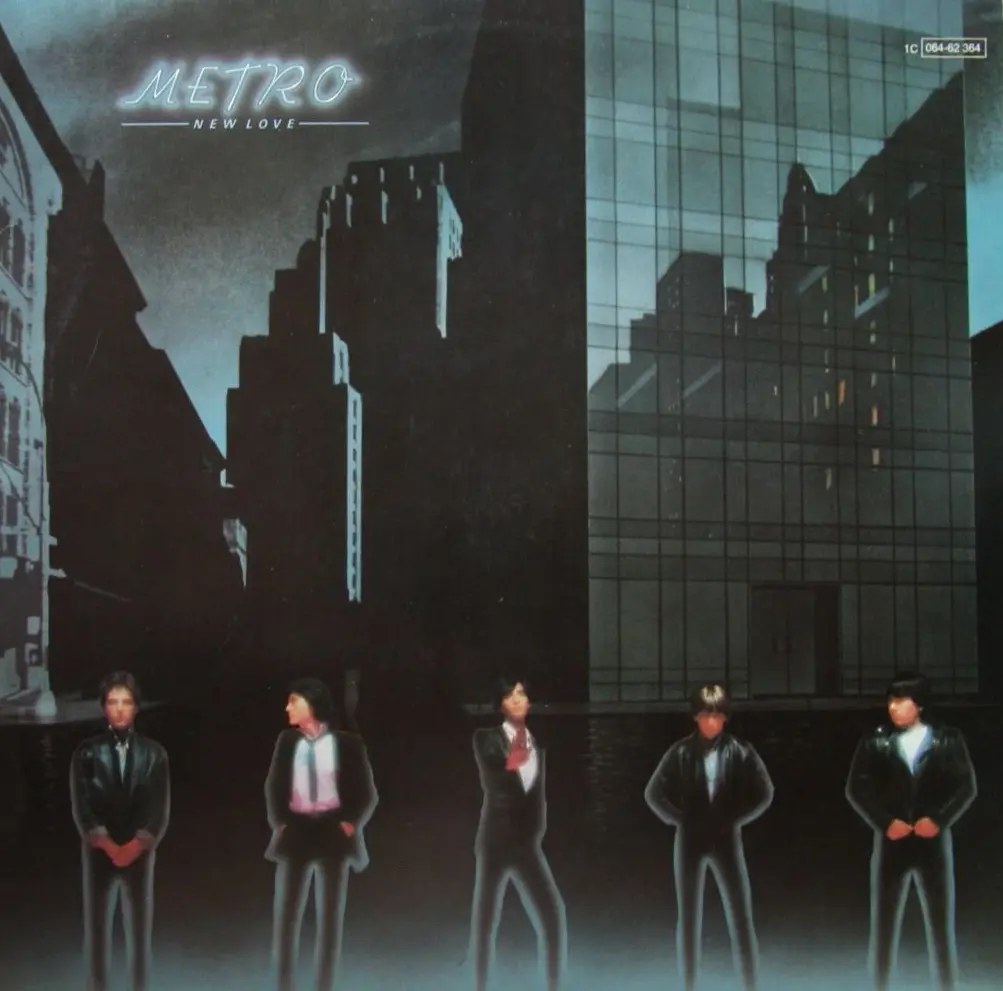 Metro released their second album, New Love, in June 1979 on EMI. It features ten originals, including “Woman Zone,” “Madness Is a Virtue,” and the singles “Girls in Love” and “The Mystery.”
Peter Godwin wrote “Now I Wanna Dance” and the bulk of Side B apart from “Woman Zone,” a co-write with Sean Lyons, who co-wrote the balance of Side A. Colin Wight contributed to “Madness Is a Virtue” and “Underworld.”
A1. “Cut-Up” (3:58)
A2. “Now I Wanna Dance” (3:34)
A3. “I Don’t Wanna Dance” (3:29)
A4. “New Love” (4:05)
A5. “Madness Is a Virtue” (3:32)
B1. “Girls In Love” (3:15)
B2. “Underworld” (4:04)
B3. “Christine” (2:59)
B4. “The Mystery” (4:15)
B5. “Woman Zone” (6:08)
Metro recorded the lead single, “Girls in Love,” with producer Ritchie Gold, a soundman for Sonny Worthing and the Pasadena Roof Orchestra. Wire producer Mike Thorne produced the rest of New Love in sequence with titles by The Shirts, Téléphone, and Plaza, a disco-inspired Soft Machine spinoff.
New Love was engineered by Thorne-associate Paul Hardiman, a soundman on earlier albums by Brian Eno, Curved Air, Druid, Fleetwood Mac, Groundhogs, and Zzebra.
New Love appeared in a cityscape cover by the design firm Cream, which also created 1978/79 cover visuals for Barbara Thompson (Paraphernalia), Bruford (Feels Good to Me), Bryan Ferry, Cliff Richard (Green Light), Gary Moore, Robert Fripp, The Saints, and Yellow Dog.
“Girls in Love” appeared on May 18 as an advance single (b/w “I Don’t Wanna Dance”). On September 14, “The Mystery” became the second single (b/w “Cut-Up”).
Future Imperfect
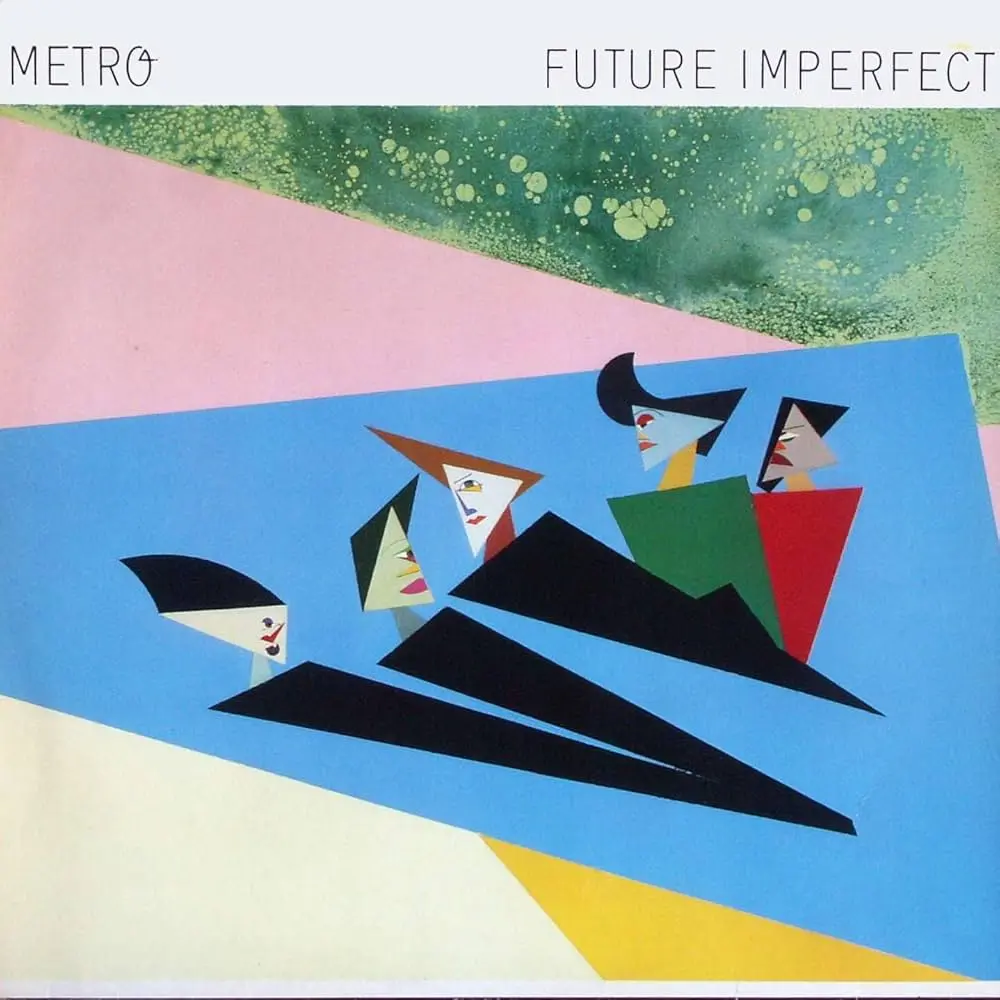 Metro released their third album, Future Imperfect, in November 1980 on Metronome (Germany) and Original Records (Australia). It features nine originals written primarily by Peter Godwin, including “The Promise,” “Going Up In Flames,” and “Middle of the Night.”
Westbrook Brass saxophonist Chris Hunter plays “Making You Up” and “Gemini,” the latter with piano by Sean Lyons, who co-wrote the first two tracks, “Exterminating Angels,” and “America In My Head.” Peter Godwin lone-wrote the remainder apart from the two final tracks, both co-writes with Colin Wight.
A1. “Going Up In Flames” (3:10)
A2. “Alone” (3:30)
A3. “The Promise” (2:45)
A4. “Exterminating Angels” (3:25)
A5. “The Face” (3:50)
B1. “America In My Head” (5:35)
B2. “Gemini” (4:53)
B3. “Middle of the Night” (4:02)
B4. “Making You Up” (4:35)
Metro recorded Future Imperfect in Stockport, Greater Manchester, at 10cc’s Strawberry Studios North, where Barclay James Harvest soundman Martin Lawrence produced and engineered the album in sequence with titles by Harvey Andrews, Sad Cafe, pop parodists the HeeBeeGeeBees, and Belgian rockers The Bet.
Artist William Douglas painted the Future Imperfect cover, which depicts Metro as pointy cubist figurines against geometric pastel plates. Graphic illustrator Michael Rowe designed the cover back-to-back with The Disappearing Boy, the second solo album by onetime Kush frontman Duffo.
“Gemini” first appeared in April 1980 as a standalone single (b/w “The Face”). In April 1981, “America In My Head” became the second single (b/w “Alone”). The 12″ contains an extended dance version of “America In My Head” (6:10) mixed by Landscape mastermind Richard James Burgess.
Post-Metro
Peter Godwin went solo with the 1981 single “Torch Songs for the Heroine,” produced by Ultravox frontman and Visage backbone Midge Ure. Godwin retained Colin Wight for the 1982 mini-album Dance Emotions, which spawned the Eighties synthpop classic “Images of Heaven,” produced by Sailor/Data mastermind Georg Kajanus, who oversaw Godwin’s 1983 full-length album Correspondence and its runaway hit “Baby’s in the Mountains.”
Sean Lyons played on Curved Air frontwoman Sonja Kristina’s 1985 comeback single “O Fortuna” and formed Raise the Dragon, which cut a synthpop EP and morphed into Intimate Strangers, a sophisti-pop duo behind multiple singles and the 1986 I.R.S. release Charm.
Discography:
- Metro (1976)
- New Love (1979)
- Future Imperfect (1980)
Sources:
Artist/Album Pages:
Dane Donohue is an American vocalist and songwriter who released a self-titled album on Columbia i...
Hank Crawford (Dec. 12, 1934 — Jan. 29, 2009) was an American post-bop/jazz-funk alto saxophonist...
Third World are a Jamaican roots-reggae band, established abroad with the 1976–78 Island albums Th...
Blind Faith was an English rock band that released a self-titled album on Atco in 1969. The band a...
Ramsey Lewis (May 27, 1935 - September 12, 2022) was an American pianist, composer, and bandleader...
Swans Way as an English sophisti-pop trio that released the 1982 standalone single "Theme From the...
Roger Daltrey (born March 1, 1944) is an English vocalist from Hammersmith, known internationally ...
Pentacle was a French symphonic-rock band that released the album La Clef des Songes on Arcane in ...
Zior was an English post-psychedelic hard rock band that released a 1971 self-titled album on Nepe...
BB Gabor — aka Gabor Hegedus (1948 — Jan. 17, 1990) — was a Hungarian-born/Canada-based singer, gu...
Asia Minor was a French-Turkish symphonic-rock band that released the 1979 album Crossing the Line...
Voyager was an English art-rock band from Newbury, Berkshire, that released two albums on Polygram...