

Barbara Thompson (July 27, 1944 — July 2, 2022) was an English saxophonist who emerged as a guest musician on 1969/70 albums by the Keef Hartley Band and husband Jon Hiseman’s Colosseum, followed by stints with pianist Neil Ardley, trombonist Michael Gibbs, and singer Inez Foxx.
In 1975, Thompson co-founded the multinational ten-piece United Jazz+Rock Ensemble, which made ten albums between 1977 and 1999 on Mood Records. In 1978, she led the Latin-rock nonet Jubiaba and formed Paraphernalia, her longstanding jazz-rock vehicle.
Background
Barbara Gracey Thompson was born on July 27, 1944, in Oxford, England. Her father, David Richard Thompson, served as Registrar of the Court of Criminal Appeal; pianist William Thompson was her paternal grandfather, and her maternal grandmother played cello.
Albert Bosworth, the family’s maternal great-uncle, ran the Bosworth music publishing firm. Thompson learned recorder at primary school, then studied clarinet and piano at Queen’s College, Harley Street. She passed Grade 8 clarinet with distinction and served five years (1957–62) in the London Schools’ Symphony Orchestra.
In 1963, she worked as a secretary and took up alto saxophone. She joined the Ivy Benson All Girl Band for a 1964 Isle of Man season, then entered the Royal College of Music on a performer’s-course grant. At RCM, Thompson studied clarinet with Syd Fell, flute with John Francis, and piano with Peter Element; she studied saxophone privately with Charles Chapman outside the college. Student-band work placed her under Gordon Rose, Bill Geldard, Alan Cohen, and Graham Collier.
Thompson worked with the all-female pop group The She Trinity on UK and overseas dates, including three support appearances with The Who. Neil Ardley brought her into the New Jazz Orchestra, where she worked beside Dave Gelly, Ian Carr, Mike Gibbs, Trevor Watts, Paul Rutherwood, Michael Garrick, Jack Bruce, and drummer Jon Hiseman.
In 1967, Thompson married Hiseman, who soon formed Colosseum with GBO/Bluesbreakers colleague Dick Heckstall-Smith. She also built early credits with Graham Bond, Georgie Fame, John Mayall, and Mike Taylor. During 1967–68, Thompson played in the onstage band for the Wiemar-period musical Cabaret at the Palace Theatre in London.
In 1970, she formed a quintet with tenor saxist Don Rendell. They opened for Oscar Peterson at Ronnie Scott’s jazz club and cut the 1974 Spotlite album Just Music. In 1975, Thompson, Hiseman, and Carr joined the United Jazz + Rock Ensemble, assembled by German heavyweights Wolfgang Dauner, Volker Kriegel, and Albert Mangelsdorff.
Jubiaba
 Barbara Thompson’s Jubiaba released their self-titled album in 1978 on MCA.
Jubiaba presents a nine-piece Latin-rock jazz ensemble led by Thompson on flute and saxophone. The lineup features bassist Roy Babbington, drummer Trevor Tomkins, percussionist Glyn Thomas, trombonist Derek Wadsworth, trumpeters Ian Hamer and Henry Lowther, and keyboardists Peter Lemer and Bill Le Sage.
A1. “The Funky Flunky” (6:20) – Thompson
A2. “Seega” (4:15) – Thomas
A3. “Helena” (5:32) – Wadsworth
B1. “Cuban Thing” (5:00) – Thomas
B2. “Black Pearl” (5:10) – Wadsworth
B3. “Touch of Blue” (4:32) – Thompson
B4. “Slum Goddess” (6:04) – Lemer
MCA issued Jubiaba during the first year of Thompson’s contract with the label, which also covered early Paraphernalia work at Morgan Studios in London.
During the same period, Thompson performed with the United Jazz + Rock Ensemble on their 1977/78 albums Live im Schützenhaus and Teamwork. She played wind parts alongside Brand X and Colosseum II personnel on the 1978 Andrew Lloyd Webber album Variations.
Paraphernalia
 Barbara Thompson’s Paraphernalia released their self-titled debut album in 1978 on MCA.
The album moves from the Jubiaba large-ensemble model to a quartet with keyboardist Colin Dudman, bassist Roy Babbington, and drummer Harold Fisher. Thompson wrote all eight titles, and the track sequence places compact pieces beside longer side-end forms.
“La Tranquillité D’Ame” glides through flute-led lyrical lines within a four-piece electric setting. “La Tranquillité D’ame” glides through flute-led, contoured phrases over a light ensemble bed. “Temple Song” surges through irregular meter, a repeated saxophone theme, racing rhythm, and a freer middle section with keyboard splinters.
A1. “Goodtyme Mr. Sam” (3:50)
A2. “Study to Be Quiet” (4:45)
A3. “La Tranquillité d’âme” (6:04)
A4. “Spanish Memories” (5:03)
B1. “Sicilian Sting” (6:12)
B2. “Next Spring” (4:56)
B3. “Temple Song” (7:39)
B4. “Stairways” (4:17)
MCA issued Paraphernalia as Thompson’s first album under the band name. The 1978 BBC Paraphernalia session preserved the same Dudman–Babbington–Fisher lineup on “Study to Be Quiet,” “Goodtyme Mr. Sam,” “Next Spring,” and “Machismo.”
Wilde Tales
 Barbara Thompson’s Paraphernalia released their second studio album, Wilde Tales, in 1979 on MCA.
The album introduces bassist Dill Katz and drummer Jon Hiseman beside returning keyboardist Colin Dudman. Side one contains the five-part suite “The Selfish Giant,” drawn from the Oscar Wilde story; side two contains four shorter Thompson and Dudman pieces.
A. “The Selfish Giant” (19:43)
— a. “Playtime”
— b. “The Giant”
— c. “The North Wind”
— d. “The Linnet”
— e. “The Child”
— f. “Spring Song”
— g. “Garden of Paradise”
B1. “Late Again” (6:50) – Dudman
B2. “Pipe Dream” (2:49)
B3. “Frankfurt Fayre” (3:46)
B4. “Canción Sin Nombre” (8:54)
Sessions occurred in autumn 1979 at Morgan Studios in London. During the same year, Thompson appeared on Neil Ardley’s Harmony of the Spheres, while BBC Paraphernalia broadcasts documented the Babbington–Dudman–Gary Husband lineup in March and the Katz–Dudman–Hiseman lineup in August.
Live in Concert
 Barbara Thompson’s Paraphernalia released the live double album Live in Concert in 1980 on MCA.
The album documents the Dudman–Katz–Hiseman quartet at Queen’s Theatre in London during July 1980. Thompson plays tenor, alto, and soprano saxophones, flute, and tambourine across eight long-form stage pieces.
A1. “Summer Madness” (6:48)
A2. “Frilly Bolero” (10:33)
B1. “From Nowhere” (9:07)
B2. “Scrummage” (8:28)
B3. “Little Annie-Ooh” (6:29)
C1. “Blues for Adolphe Sax” (8:55)
C2. “Sunset” (5:54)
D1. “Aliyah” (18:17)
The Queen’s Theatre recording preserves the 1980 touring quartet with bassist Dill Katz, drummer Jon Hiseman, keyboardist Colin Dudman, and Thompson on saxophones and flute.
During 1980–81, Thompson also appeared on the United Jazz + Rock Ensemble albums The Break Even Point and Live in Berlin, added saxophone to Manfred Mann’s Earth Band on Chance, and played flute and saxophone on Andrew Lloyd Webber and Marti Webb’s Tell Me on a Sunday.
Ghosts
 In 1982, MCA issued a collaborative album between Barbara Thompson and former Zombies/Argent keyboardist Rod Argent.
The album weaves Rod’s organ/synth arrangements with Barbara’s reed lines, backed by Hiseman and bassist John Mole, guitarist Keith Airey, and percussionist Robin Jones.
A1. “Poltergeist” (5:25) – Thompson
A2. “With You” (4:11) – Argent
A3. “Secret Soul” (5:00) – Thompson
A4. “All Alone” (7:05) – Argent
B1. “Ghosts” (5:45) – Thompson
B2. “Little Girl” (4:06) – Argent
B3. “Falling Stars” (4:42) – Thompson
B4. “Moving On” (3:07) – Argent
B5. “Sweet Spirit” (4:20) – Thompson
The album credits engineer Martyn Webster with assistant Charles Harrowell and executive producer Monty Babson. Cream designed the sleeve. During 1981, Thompson also appeared in the original London cast recording of Andrew Lloyd Webber’s Cats.
Mother Earth
 Barbara Thompson’s Paraphernalia released their third studio album, Mother Earth, in 1982 on Intuition.
Dudman, Katz, and Hiseman return from the 1979–80 Paraphernalia lineup, joined on select material by violinist Anthony Oldridge. The album contains five Thompson pieces and one Dudman composition, “Humaira.”
“The Adventures of Water” traces air-and-water imagery through atmospheric keyboard shading and interlaced woodwind–violin lines.
A1. “City Lights” (7:21)
A2. “Country Dance” (6:20)
A3. “The Adventures of Water” (9:26)
B1. “Fear of Spiders” (4:38)
B2. “Humaira” (8:12) – Dudman
B3. “Castles in the Air” (6:50)
After the MCA period, Hiseman built TM Studios beside the family home, where he produced and engineered Thompson’s Paraphernalia albums. BBC broadcasts from 1981–82 carried “Country Dance,” “The Adventures of Water,” “Castles in the Air,” “Humaira,” “Fear of Spiders,” and “Night Watch” in the group’s live repertoire.
Pure Fantasy / Nightwatch
 Barbara Thompson’s Paraphernalia released Pure Fantasy in 1983 on Intuition; later issues carried the title Nightwatch.
The album contains ten Thompson originals performed with Hiseman and a revised Paraphernalia lineup with keyboardist Bill Worrall, bassist Dave Ball, and violinist Rod Dorothy.
“Fields of Flowers” glides through a salsa-tinged flute line with light echo around the lead. “The Coconut Hurling Game” growls under rasping synths and aggressive sax. “Dusk” settles into a sonorous opening, then twines fretless bass with violin under a gentler lead. “Nightwatch” brightens the pace before Hiseman’s freer passage.
“Kafferinya” darts through bowed leads and recorder fills. “Chapter and Verse” weaves fluid four-string in a chamber setting. “To Ceres” foregrounds Ball’s fretless presence. “Listen to the Plants” surges through fast recorder figures and busy ensemble crossings. “Pure Fantasy” drifts on restrained keys passages. “Firefly” closes on a moderato ensemble blend.
 A1. “Fields of Flowers” (4:51)
A2. “The Coconut Hurling Game” (5:21)
A3. “Dusk” (2:45)
A4. “Nightwatch” (4:25)
A5. “Kafferinya” (3:31)
B1. “Chapter and Verse” (6:20)
B2. “To Ceres” (2:01)
B3. “Listen to the Plants” (4:34)
B4. “Pure Fantasy” (3:22)
B5. “Firefly” (4:31)
The 1983–84 BBC Paraphernalia sessions placed “The Coconut Hurling Game,” “Nightwatch,” “Listen to the Plants,” “Kafferinya,” “Fields of Flowers,” “Rollercoaster,” “Pure Fantasy,” and “Chapter and Verse” in the group’s broadcast set. Thompson also appeared with the United Jazz + Rock Ensemble on the 1984 live album Opus Sechs.
ShadowShow
 ShadowShow released their self-titled album in 1984 on TM.
The group placed Thompson beside keyboardist and singer Rod Argent, guitarist Clem Clempson, bassist John Mole, and drummer Jon Hiseman. David Sancious added keyboards to “Manhattan Midnite.” The album contains Argent-led vocal material, Thompson instrumentals, and several joint Argent–Thompson or Thompson–Hiseman pieces.
A1. “Secure in You”
A2. “Down on Your Luck”
A3. “Sleepwalker”
A4. “Siren”
A5. “Manhattan Midnite”
B1. “It’s Over”
B2. “Echoes”
B3. “Moving in the Morning Sun”
B4. “Doing What Must Be Done”
B5. “Midday Riser”
B6. “Times Past”
ShadowShow recorded at TM Studios after the Mother Earth tours. The group issued “Secure in You” as a single and made one television appearance, then Thompson resumed Paraphernalia and outside work. During 1985, she appeared on Frauen Power and Andrew Lloyd Webber’s Requiem.
Heavenly Bodies
 Barbara Thompson released the solo album Heavenly Bodies in August 1986 on Intuition.
The album features an extensive cast with Hiseman and guitarist Paul Dunne, trombonist Bill Geldard, and bassists Dave Ball and Andy Pask, the prior Landscape player. She also employs three keyboardists (David Cullen, Peter Lemer, Steve Melling), trumpeters (Guy Barker, Stuart Brooks, John Thirkell), and five string players.
A1. “Le Grand Voyage” (5:28)
A2. “Extrême Jonction” (3:55)
A3. “Requiem Pour Deux Pilotes” (5:18)
A4. “Entre Les Trous de la Mémoire” (5:12)
A5. “Les Barricades Mystérieuses” (4:37)
B1. “Heavenly Bodies” (2:32)
B2. “Love on the Edge of Life” (4:09)
B3. “Elysian Fields” (3:07)
B4. “Flights of Fancy” (6:35)
B5. “Tibetan Sunrise” (4:51)
B6. “Horizons New” (3:59)
Heavenly Bodies draws part of its program from Dominique Appia paintings and uses real strings and brass within a broader orchestral design. Thompson continued with the United Jazz + Rock Ensemble on Highlights and Round Seven across 1986–87, while the official discography also places the 1987 Thompson anthology Special Edition in the same Intuition period.
A Cry From the Heart
Barbara Thompson’s Paraphernalia released the live album A Cry From the Heart in 1988 on Intuition.
Cry documents a London concert with Thompson on saxophones, drummer Jon Hiseman, keyboardist Peter Lemer, guitarist Paul Dunne, and bassist Phil Mulford.
1. “Joyride”
2. “L’Extrême Jonction”
3. “A Cry From the Heart”
4. “Entre Les Trous de la Mémoire”
5. “Out to Lunch”
6. “Close to the Edge”
7. “Voices Behind Locked Doors”
8. “Eastern Western Promise Part I & II”
The album carries a 76:41 duration on Intuition. During 1988, Thompson gave the first performance of her Saxophone Concerto at the Freiburg Festival, with a later broadcast by the Hannover Radio Symphony Orchestra.
During 1989, she played on Julian Lloyd Webber’s brotherly tribute Lloyd Webber Plays Lloyd Webber and the Sarah Brightman album The Songs That Got Away, then formed the nineteen-piece Moving Parts big band for ensuing festival work.
Breathless
 Barbara Thompson’s Paraphernalia released Breathless in 1990 on Intuition.
Breathless presents eight originals by a revised Paraphernalia lineup with Hiseman and keyboardist Peter Lemer, guitarist Malcolm Macfarlane, and bassist Phil Mulford. Guest players Hossam Ramzy, Noel Langley, Ashley Slater, and Frank Holder add percussion, trumpet, trombone, and congas.
1. “Breathless” (9:25)
2. “Sax Rap” (6:48)
3. “Jaunty” (4:14)
4. “You Must Be Jokin’” (6:03)
5. “Squiffy” (6:57)
6. “Bad Blues”
7. “Cheeky”
8. “Gracey”
Intuition issued Breathless with a 61:45 duration. The album appeared amid Thompson’s Celestial Harmonies activity, which placed Kanak Songs; Feast and Lullabies and Songs From the Center of the Earth in the same calendar year.
Songs From the Center of the Earth
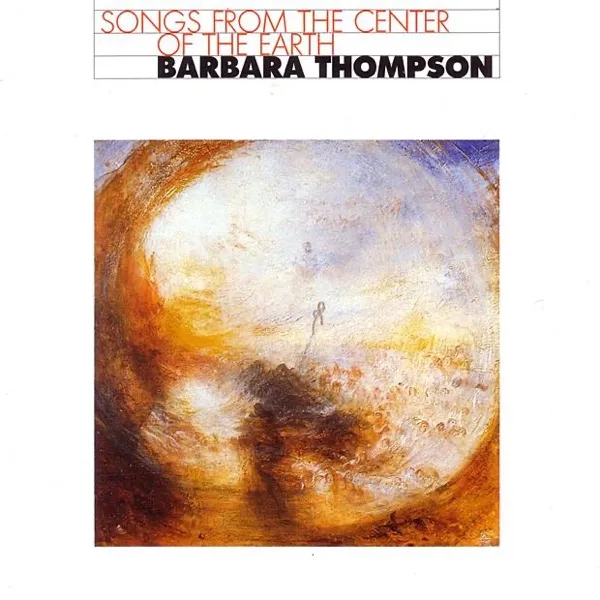 Barbara Thompson released Songs From the Center of the Earth in 1990 on Celestial Harmonies.
The album presents unaccompanied soprano, alto, and tenor saxophone interpretations of traditional material, recorded inside the twelfth-century Abbaye du Thoronet in Var, Provence. Thompson recorded the album over two summer nights in August 1990, using the abbey’s long natural decay as the record’s central acoustic condition.
“The Fanaid Grove” arches through an Irish lost-love air with unaccompanied saxophone and long Abbaye resonance. “Nobilis, Humilis” and “Chanterai por Mon Coraige” adapt medieval church sources through spare solo lines. “Al Ya Zane” curls a Syrian love melody through pitch bends and glissandos. “Canción de Cuna” glides through a Spanish cradle-song source with restrained phrasing. “Down by the Sally Gardens” traces an Irish air through slow-breathing solo passages.
1. “The Fanaid Grove” (3:39)
2. “Nobilis, Humilis” (4:44)
3. “Chanterai Por Mon Coraige” [I Would Be Singing for Consolation] (4:12)
4. “Al Ya Zane” [Oh Thou Zane] (5:07)
5. “Canción de Cuna” [Cradle Song] (3:30)
6. “Toriad y Dydd” [Day-Break] (4:32)
7. “Suspira Coração Triste” [My Heart Is Heavy With Sadness] (2:37)
8. “Whereto Should I Express” (3:03)
9. “Estilo” (3:50)
10. “O My Love, How Long” (3:14)
11. “Winder Wie Ist No Dein Kraft” [Winter, Now Your End Is Near] (4:26)
12. “I Can’t Stay in Egypt Lan’” (2:57)
13. “De Ribber Ben Come Dung” (4:08)
14. “Down by the Sally Gardens” (3:21)
Sessions occurred on August 13 and August 14, 1990, at Abbaye du Thoronet in Var, Provence, with producer Jon Hiseman. Fernando Lippa designed the package, J.M.W. Turner handled art direction, and Nick White supplied photography. “The Fanaid Grove” later became the basis for the main title theme of A Touch of Frost.
Discography:
- Jubiaba (1978)
- Paraphernalia (1978)
- Wilde Tales (1979)
- Ghosts (1982 • Rod Argent & Barbara Thompson)
- Mother Earth (1982)
- Nightwatch / Shadowshow (1983)
- Pure Fantasy (1984)
- Heavenly Bodies (1986)
- Songs from the Center of the Earth (1990)
Sources:
- Discogs: Barbara Thompson
- RYM: Barbara Thompson
- 45cat: Barbara Thompson
- MusicBrainz: Barbara Thompson
Artist/Album Pages:
Primevil was an American hard-rock/psych band from Indiana that self-pressed the 1972 single "Too...
Department S was an English new wave band that released three singles on Stiff Records circa 1980/...
Godley & Creme were an English musical duo and video-production team comprised of multi-instrume...
The Gadgets were an English electro/experimental trio that issued two albums on small-press Final ...
Skyy was an American soul-funk band from Brooklyn that released seven albums on Salsoul Records be...
Mott the Hoople was an English hard-rock band that released four albums between 1969 and 1971 on I...
Weapons of Peace were an American soul/funk quintet active during the mid 1970s. The band released a...
Colin Scot (1941–1999) was an English–Canadian singer–songwriter who released a self-titled album in...
Pages were an American adult-oriented rock band from Los Angeles that released the 1978–79 albums ...
Sam Rivers (Sept. 25, 1923 — Dec. 26, 2011) was an American avant-jazz multi-reedist and pianist ...
Babylon was an American symphonic-rock band from Florida that released an eponymous album on self-...
Ripple was an American funk band that made a 1973 self-titled album on GRC, followed by the 1977 S...