

Dislocation Dance was an English post-punk/jazz-funk band from Manchester that cut two EPs and the 1981 album Music Music Music on New Hormones. Trumpeter Andy Diagram held dual membership in the Diagram Brothers. Singer Kathryn Way features on their stopgap singles “You’ll Never Never Know” and “Violet” and 1983 Rough Trade album Midnight Shift, a sophisti-pop set with assorted sting and brass guests. Singer Sonja Clegg joined for their 1985 EP What’s Going On.
Members: Ian Runacres (guitar, vocals, keyboards), Paul Emmerson (bass, backing vocals), Richard Harrison (drums, backing vocals), Andy Diagram (trumpet, backing vocals), Kathryn Way (vocals, saxophone), Sonjah Clegg (vocals), Herbie Ryan (trumpet), Phil Lukes (bass), Chris Gravestock (drums), Andrew Weaver (keyboards), Jon Board (trumpet)
Background
Dislocation Dance formed in November 1978 when Manchester bassist/lyricist Paul Emmerson found guitarist/singer Ian Runacres through a musicians wanted ad at the Virgin Records outlet on Newton St.
Emmerson and his brother, Simon ‘Booth’ (1956–2023), played in Stepping Talk, a post-punk trio with drummer John McGill. In 1979, they released Alice In Sunderland, a four-song maxi-single on Eustone Records, which issued two singles by Simon’s subsequent band, Methodishca Tune. In 1982, Booth formed Weekend, a jazz-pop Young Marble Giants spinoff that morphed into Working Week.
For his new band, Paul Emmerson envisioned a mix of funk, soul, jazz, psychedelia, and Krautrock. Of his contemporaries, he admired the free-form eclecticism of The Pop Group and the jovial nature of The Mekons. Dislocation Dance filled its initial lineup with Richard ‘Dick’ Harrison and singer Kathryn Way, an on/off presence.
Early Activity
In March 1979, Dislocation Dance played their first show at the Factory Club, opened by Manchester music mogul Tony Wilson. At a subsequent Factory show, Buzzcocks frontman Pete Shelley joined them onstage as a guest vocalist. They also played events by the Manchester Musicians’ Collective, a new music operation launched by Passage mastermind Dick Witts. Dislocation Dance contributed one track (“You Can’t Beat History”) to Unzipping the Abstract, a 1980 compilation of MMC acts.
Dislocation Dance turned down Wilson’s Factory label for New Hormones, a Manchester indie first launched by Buzzcocks manager Richard Boon for that band’s seminal 1977 EP Spiral Scratch. After three years of dormancy, Boon relaunched the label for Manchester’s new post-punk breed (Ludus, Eric Random, The Tiller Boys). Kathryn Way took a two-year pause for studies.
Dislocation Dance (EP)
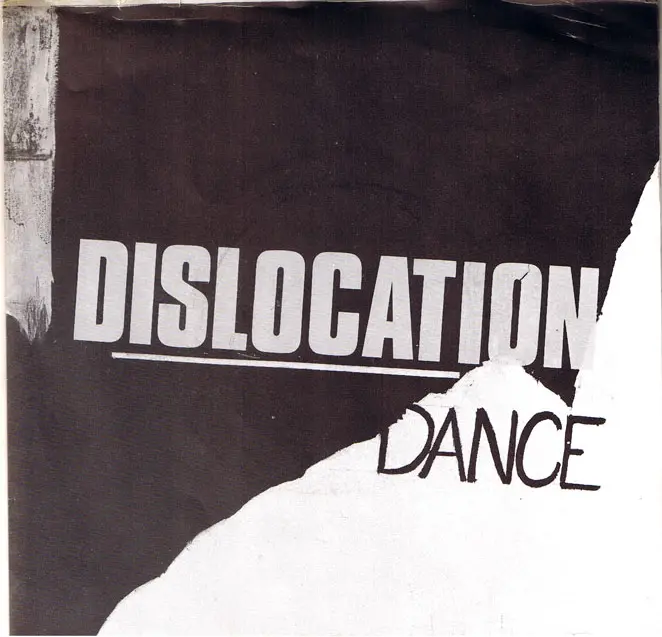 In October 1980, Dislocation Dance made their vinyl debut with a self-titled EP on New Hormones.
A1. “It’s So Difficult” (2:56)
A2. “Familiar View” (3:20)
B1. “Birthday Outlook”
B2. “Perfectly In Control” (6:48)
Initial copies appeared in a monochrome fold-out poster sleeve. The inner-leaf lists Emmerson, Harrison, and Runacres by their respective forenames: Paul, Dick, and Ian; augmented by a certain ‘B’ on keyboards and vocals. Dislocation Dance bore the catalog number ORG 7, the fifth New Hormones release since the label’s reactivation.
By New Years, Dislocation Dance welcomed trumpeter Andy Diagram, who doubled as the bassist of label-mates the Diagram Brothers. Diagram and Harrison masqueraded in the Mud Hutters, a Mancunian post-punk band. The Hutter’s label, Defensive Records, issued the 1980 comp Four Ways Out, which features two untitled Dislocation Dance tracks.
On March 13, 1981, Dislocation Dance played York University. Three short numbers from their set (“So Much Fault,” “Perfectly In Control,” “Hiya”) appear on Northern Lights 2, a 1981 cassette comp distributed by New Hormones with cuts by Dick Witts and Eric Random.
Slip That Disc (EP)
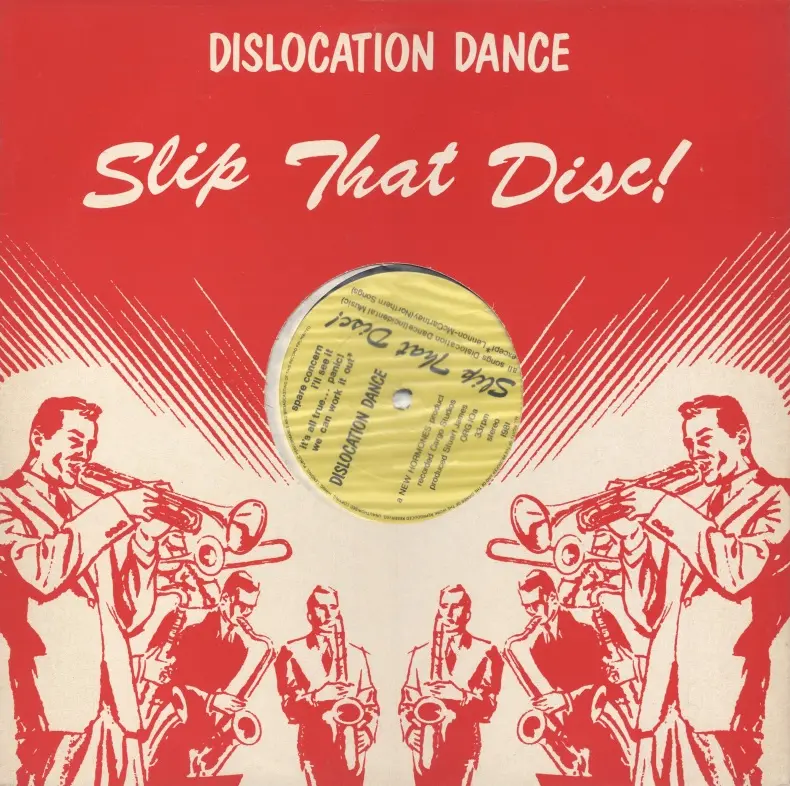 On June 12, 1981, Dislocation Dance released their second EP, Slip That Disc, an eight-song set on New Hormones. It features seven group-written originals and the Beatles cover “We Can Work It Out.”
A1. “Spare Concern” (2:54)
A2. “I’ll See It” (2:07)
A3. “It’s All True… Panic!” (2:50)
A4. “We Can Work It Out” (4:05)
B1. “So Much Fault” (1:40)
B2. “This Problem” (3:23)
B3. “Clarinetsource” (2:01)
B4. “Under One and Over” (3:48)
Sessions occurred at Cargo Studios, a 16-track Rochdale facility used for recent singles by A Certain Ratio and Orchestral Manoeuvres In the Dark. Musician/soundman Stuart James (the keyboardist in Eric Random’s Bedlamites) produced Slip That Disc amid 1981 recordings by Biting Tongues and the Diagram Brothers. Half the tracks (A1, A3, A4, B2) appear on Teenage Topics, a New Hormones cassette comp with the Diagrams, Ludus, and Random.
On August 5, Dislocation Dance cut their first session for BBC Radio One DJ John Peel, whose 8/11 broadcast aired four songs; one future album track (“Friendship”) and three exclusives: “Remind Me of Those Little Things,” “Shoot Out at Dead Man’s Creek,” and “It Don’t Mean a Thing.”
Music Music Music
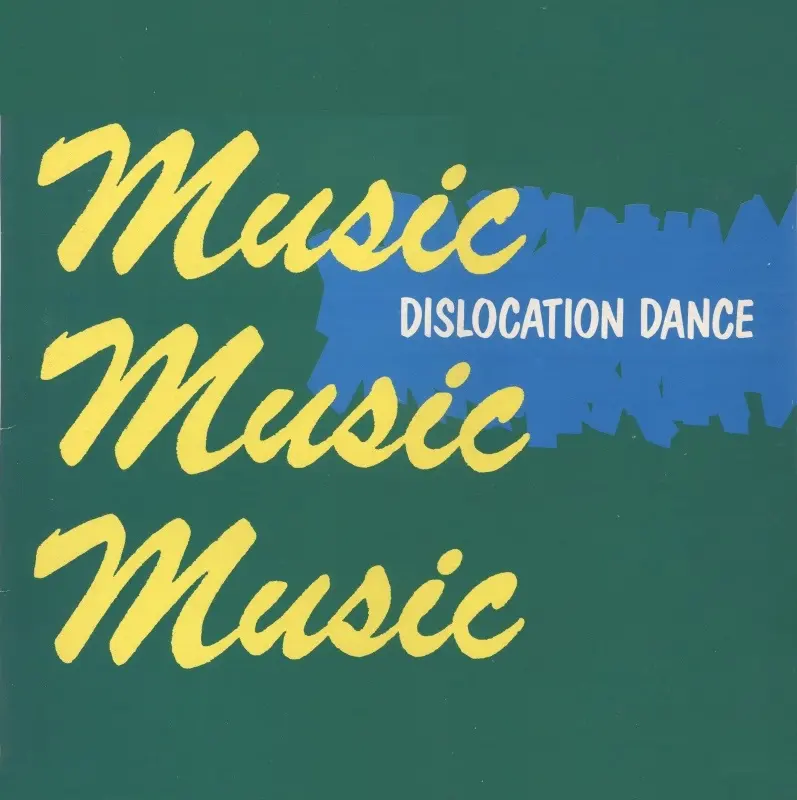 Dislocation Dance released their first full-length album, Music Music Music, in October 1981 on New Hormones.
The album contains fourteen group-written originals, including “Vendetta (Theme),” “Wonder What I’ll Do Tomorrow,” “Stand Me Up,” “Narrow Laughs,” and the vividly titled numbers “Can’t Race Time… and the Mad Killer (Coda)” and “With a Smile On Your Face and a Frown In Your Heart.”
Musically, the group blends sprightly jazz-pop with fifties beatnik vibes; rendered with clean guitars, clipped trumpet, and soft vocals.
A1. “Stand Me Up” (2:22)
A2. “Don’t Knock Me Down” (2:20)
A3. “YOPS Course” (2:14)
A4. “Meeting Mum and Dad” (2:35)
A5. “Friendship” (2:20)
A6. “Take a Chance (On Romance)…” (2:40)
A7. “…Have a Dance” (1:54)
B1. “Roof Is Leaking” (1:26)
B2. “With a Smile On Your Face and a Frown In Your Heart” (2:02)
B3. “Vendetta (Theme)” (4:00)
B4. “Narrow Laughs” (2:11)
B5. “Footloose” (2:49)
B6. “Can’t Race Time… and the Mad Killer (Coda)” (3:54)
B7. “Wonder What I’ll Do Tomorrow” (2:48)
Sessions occurred in Manchester at studios in Oldham (Pennine Sound) and Cheadle Hulme (Revolution). Stuart James produced the album ahead of Earthbound Ghost Need, the debut Bedlamites longplayer. Music Music Music was engineered by Stuart Pickering (Crispy Ambulance, Durutti Column) and Pennine co-owner Paul Adshead (Any Trouble, Joy Division).
The back-sleeve features blue monochrome studio pics by rock photojournalist Tony Barratt (NME, Melody Maker), whose photos appear on mid-Eighties sleeves for Art of Noise and Frankie Goes to Hollywood.
“Stand Me Up” appeared on Touchdown, a 1982 UK Fontana comp with cuts by Animal Magic (“Life”), Design For Living (“Red Ribbon Day”), The Higsons (“Touchdown”), Maximum Joy (“Do It Today”), Pinski Zoo (“Put Your Ghost Shirt On”), and Vital Excursions (“Flowers For Ingrid”).
1982/83 Singles
In June 1982, Dislocation Dance released their first single: “Rosemary” backed with “Shake,” both band-written exclusives on New Hormones (UK, ORG 19) and the German Ariola label, which issued 7″ and 12″ versions, the latter with the Music Music Music track “Can’t Race Time….”
A. “Rosemary” (2:46)
B. “Shake” (3:51)
Stewart Pickering produced this and the subsequent two singles amid 1982/83 titles by Blue Orchids, Quando Quango, Swam Children (So Hot), Twelfth Night, and The Wake. Dislocation Dance mimed “Rosemary” on the Dutch music program TopPop, on which reinstated fifth member Kathryn Way “plays” the sax intro and dances about the soundstage in a strapless polkadot petticoat.
On June 12, Dislocation Dance (with Kathryn) cut their second Peel session for the DJ’s 7/14 broadcast, which aired one upcoming a-side (“You’ll Never Never Know”), three future album tracks (“Baby Blue,” “Tyrannies of Fun,” “Working the Midnight Shift”), and an exclusive titled “The Next Year I Returned to St Michel (But Marie Had Gone and With Her My Childhood).” The last of those appears on Hours, a 1982 Dutch comp on the Minny Pops‘ Plurex label with cuts by A Blaze Colour, Nasmak, and Xmal Deutschland.
 In October 1982, Dislocation Dance released their second non-album single and final New Hormones title: “You’ll Never Never Know” backed with “You Can Tell,” both group-written by the core band (Diagram, Emmerson, Harrison, Runacres) with Kathryn Way, whose renewed membership is represented by her likeness on the sleeve sketch.
A. “You’ll Never Never Know” (2:28)
B. “You Can Tell” (2:22)
“You Can Tell” was produced by Dale Griffin, an erstwhile drummer (Mott the Hoople, British Lions) with a growing list of sound credits (Bauhaus, Danse Society, Lotus Eaters, Scritti Politti).
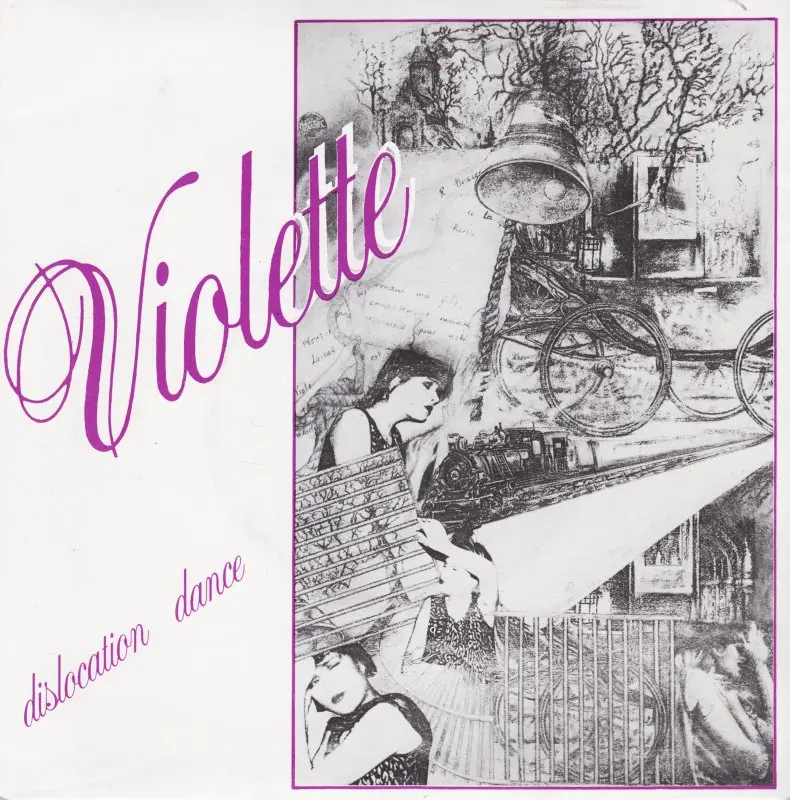 In May 1983, Dislocation Dance released their third consecutive non-album single: “Violette,” backed with “San Michelle,” self-released locally on ‘The Music Label.’ In Germany, “Violette” appeared on Rough Trade Deutschland with a different b-side, the Music Music Music track “Don’t Knock Me Down.”
A. “Violette” (3:02)
B. “San Michelle” features violist Kate Musker, a future sidewoman of Michael Nyman and Sam Brown.
“Violette” appeared in a monochrome sleeve with intricate pencil sketches (front and back) and purple lettering. Despite the single’s DIY status, the labels bear the same format as prior singles on the now-defunct New Hormones label.
Midnight Shift
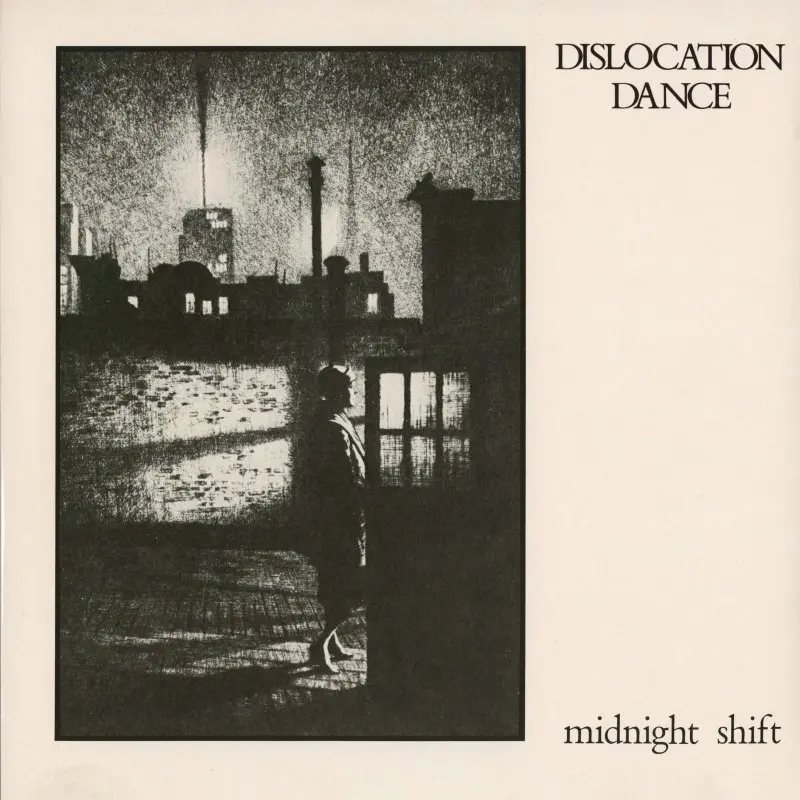 Dislocation Dance released their second album, Midnight Shift, in late 1983 on Rough Trade.
Midnight Shift contains eleven group-written originals, including the pre-released b-side “San Michelle” and the subsequent a-side “Show Me.” Side B includes the Donna Summer cover “Midnight Shift,” their second non-original.
The album features Ricky Harrison on assorted percussion (maracas, claves, gwiro, fruit tins) and Paul Emmerson on electric, fretless, and synthesized bass. Andy Diagram plays trumpet and flugelhorn and shares synthesizer and piano roles with Ian Runacres, who plays electric and acoustic guitar.
“Show Me” features guest guitarist Steve Hopkins (Invisible Girls, Mercurian) and saxophonists Keith Ojo (alto) and Herbie Bryan (tenor). “Tyrannies of Fun” and “Baby Blue” feature cellist Suzanna Graham, violinist William Robinson (Pale Fountains), and “San Michelle” violist Kate Musker. Bryan later joined Dislocation Dance.
A1. “Show Me” (4:25)
A2. “I’m Doing Fine” (2:40)
A3. “Here Comes Love” (3:44)
A4. “Remind Me” (2:25) features guest violinist David Monroe.
A5. “Tyrannies of Fun” (3:04)
A6. “Open Cages” (3:00)
B1. “Baby Blue” (3:10)
B2. “With a Reason” (3:55)
B3. “Mr. Zak” (3:44)
B4. “Bottle of Red Wine” (3:28)
B5. “Midnight Shift” (4:37) originated as “Working the Midnight Shift” on Once Upon a Time, a 1977 double-album by Donna Summer; written with her co-producers Giorgio Moroder and Pete Bellotte.
B6. “San Michelle” (3:24)
Sessions occurred sporadically between June 1982 and September 1983 at Revolution Studios, where Dislocation Dance co-produced the album with Stuart Pickering.
Midnight Shift sports design work credited to ‘Bonnie and Clyde’ with a front-cover etching by Martin Lewis and a back-cover group pic by Mancunian photojournalist Michael J. Pollard (Bee Vamp, The Fall). Lewis’s image depicts a 1920s-era woman at night by the Manchester Ship Canal.
 In Australia and France, Rough Trade lifted “Show Me” as a 7″ single with the Music Music Music track “Vendetta.” In the UK, an extended “Show Me” appeared on 12″ with a remixed version of “We Can Work It Out” and another “Show Me” remix (the Skid Mix) by dub producer Dennis Bovell (Matumbi, The Slits, The Pop Group).
On the sepia “Show Me” 7″ sleeve, Kathryn Way sits alone on a bench with an umbrella in the rain; details rendered rough by cross-hatching.
“What’s Going On”
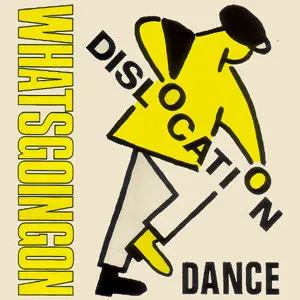 In 1985, Dislocation Dance returned with What’s Going On, a five-song EP with four originals and the Charles Mingus jazz standard “Fables.”
The originals are group-credited to Diagram, Emmerson, Harrison, Runacres, and two new members: saxophonist Herbie Bryan (a prior sessionist on “Show Me”) and singer Sonja Clegg, whose flamboyant, sexual delivery altered the band’s presentation.
A1. “He’s The Man” (3:40)
A2. “My Only Friend” (4:50)
B1. “When” (4:40)
B2. “Fables” (3:50) originated as “Fables of Faubus” on Mingus Ah Um, the 1957 Columbia release by legendary upright bassist Charles Mingus (1922–1979).
B3. “What’s Going On” (2:50)
Sessions occurred in Manchester at Drone Studios, a 16-track Chorlton-cum-Hardy facility used in tandem by bIG fLAME. Dislocation Dance co-produced the EP with Andy’s former Diagram Brothers bandmate Lawrence Diagram, who co-engineered What’s Going On with Drone owner Paul Machiavelli, who also produced “Wake Me When It’s Over,” the b-side to “Blue Mood,” the 1985 debut single by Swing Out Sister.
What’s Going On features cover art by Andy Diagram, who now held dual-membership in the Pale Fountains, which (since Midnight Shift) released the 1984/85 Virgin albums Pacific Street and …From Across the Kitchen Table.
Discography:
- Music Music Music (1981)
- Midnight Shift (1983)
Shortplayers:
- Dislocation Dance EP (1980)
- Slip That Disc EP (1981)
- “Rosemary” (1982)
- “You’ll Never Know” (1982)
- “Violette” (1983)
- “Show Me” (1983)
- “What’s Going On” (1985)
Sources:
- Discogs: Dislocation Dance
- John Peel Wiki: Dislocation Dance
- LTM Recordings: Dislocation Dance
- 45worlds: Dislocation Dance
- 45cat: Dislocation Dance
- RYM: Dislocation Dance
- MusicBrainz: Dislocation Dance
Artist/Album Pages:
Spring was an English symphonic-rock band behind a 1971 self-titled album on RCA/Neon. Members: Pa...
Ensemble Pittoresque was a Dutch coldwave band that made the 1983 album For This Is Past on Clogso...
Gary Farr (Oct. 19, 1944 — July 29, 1994) was an English singer/songwriter who first emerged in t...
Mkwaju Ensemble was a Japanese post-minimalist project behind the 1981 Better Days albums Mkwaju a...
Mariya Takeuchi — 竹内まりや (born March 20, 1955) — is a Japanese singer and songwriter who made five ...
P.R. Computer was a Hungarian electronic trio behind a 1983 self-titled album on the Start label. ...
Randy Hansen (born Dec. 8, 1954) is an American hard-rock guitarist from Seattle who released a 19...
Kalima was an English jazz-pop ensemble that released one EP, three singles, and three albums betwee...
Jodo was an English hard-rock/blues band that released the album Guts on Decca in 1970. That same ...
Gate was a German space-rock band behind a 1977 Brain live release and the studio album Red Light ...
Kajanus & Pickett were the rustic-folk/rock duo of Norwegian-born singer/guitarist Georg Kajan...
Marillion are an English art-rock band that released a 24-minute EP on EMI in 1982, followed by fo...