

Kalima was an English jazz-pop ensemble that released one EP, three singles, and three albums between 1984 and 1990. The band comprised alumni from earlier Mancunian acts A Certain Ratio and Swamp Children.
Members: Martin Moscrop (drums), Tony Quigley (bass, saxophone), Andrew Connell (piano, synthesizer, vibraphone), Jez Kerr (bass guitar), Ann Quigley (vocals), Cliff Saffer (saxophone), John Kirkham (guitar)
Background
Kalima emerged in 1983 from the final lineup of Swamp Children, who issued one album and two EPs on Factory and Factory Benelux between 1981 and 1982. As the group’s sound shifted toward more structured jazz-pop, they adopted the name Kalima, taken from a track on Elvin Jones’ Remembrance.
The renamed ensemble featured vocalist Ann Quigley, guitarist John Kirkham, saxophonist Cliff Saffer, and drummer Martin Moscrop, now joined by percussionist Chris Manis, keyboardist Andrew Connell, and bassist/vibraphonist Jeremy Kerr. With the inclusion of Connell and Kerr, Kalima comprised every member of A Certain Ratio except Donald Johnson, enabling both bands to operate concurrently—ACR leaning into abrasive funk, while Kalima pursued a more polished, Latin-tinged jazz-pop direction.
The Smiling Hour (EP)
Kalima released their debut EP, The Smiling Hour, in February 1984 on Factory Records (FAC 87). The 12″ marked a stylistic departure from their Swamp Children material, signaling a move toward refined jazz-pop and Latin fusion. The band self-produced both tracks and issued the single under their own Swamp Children production credit.
Side A featured a smoky arrangement of “The Smiling Hour,” a Sarah Vaughan-associated piece by Ivan Lins, Aloysio de Oliveira, and Vítor Martins. Side B contained “Fly Away,” a band original in 7/8 time—a rhythmic signature Kalima would explore further in later recordings.
A. “The Smiling Hour” (4:20)
B. “Fly Away” (5:37)
Both tracks were produced by Kalima and pressed by MVS (Record Pressing) Ltd., with plating handled by Gedmal Galvanic Ltd. The Jazz Defektors contributed backing vocals to “The Smiling Hour.” The band published “Fly Away” under their in-house imprint, Swamp Publishing.
While mainstream radio overlooked the release, Kalima found their audience on the live circuit. Throughout 1984, they performed at key venues and festivals including The Wag, The Bass Clef, WOMAD, the Bracknell Jazz Festival, and a headlining date at Ronnie Scott’s. These appearances affirmed their growing stature among the UK’s “new jazz” circles, where their blend of West Coast cool, bossa nova textures, and post-punk sophistication met with warm reception.
Four Songs (EP)
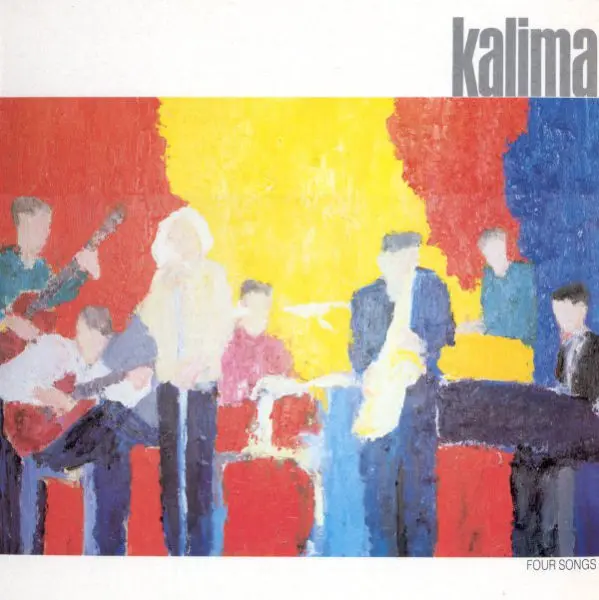 Kalima released their second EP, Four Songs, in July 1985 on Factory Records (FAC 127). The record deepened the band’s engagement with Latin jazz and modern swing, balancing rhythmic intricacy with atmospheric restraint. Self-produced and recorded as a unified session piece, the EP marked the full integration of the expanded lineup, now featuring members from A Certain Ratio and key guest brass players. Ann Quigley contributed lyrics and vocals across all four tracks, each composed collectively by the band.
“Trickery” opens the set with brisk swing phrasing and bright horn interplay. “Land of Dreams” unfolds as a slow-building Latin excursion, while “Sparkle” pairs scat-like vocal lines with sprightly syncopation. “So Sad” closes the set with hushed melancholy and impressionistic chord changes.
West Side
A1. “Trickery” (4:21)
A2. “Land of Dreams” (6:47)
East Side
B1. “Sparkle” (3:39)
B2. “So Sad” (4:13)
The EP was recorded in February 1985 at Yellow 2 Studios in Manchester with engineer Tim Oliver. Kalima produced the session and released the material under their Swamp Music imprint. Instrumentation includes bass and soprano saxophone by Tony Quigley, vibes and bass by Jeremy Kerr, drums by Martin Moscrop, guitar by John Kirkham, piano by Andrew Connell, tenor saxophone by Clifford Saffer, and percussion by Chris Hornerman.
Guests include Paul Latham on trombone and Andrew Diagram on trumpet and flugelhorn. Trevor Johnson designed the sleeve; Clifford Saffer supplied the inner painting; Graham Proudlove and Marshall Walker handled photography.
During A Certain Ratio’s U.S. tour in 1985, a reduced Kalima Quartet played scaled-back acoustic sets.
Night Time Shadows
 Kalima released their debut album, Night Time Shadows, in May 1986 on Factory Records (FACT 155).
The album marked a stylistic consolidation for the group, emphasizing sleek production, rhythmic sophistication, and greater cohesion across a nine-track set. The band retained their jazz-dance core but added contemporary swing textures, cinematic brass voicings, and Latin percussion to their harmonic palette. Ann Quigley sang lyrics penned in collaboration with pianist Andrew Connell, whose writing and arrangements shaped the album’s tone. Kalima self-produced the record and recorded the majority of material as a full ensemble at the start of the year.
“Mystic Rhymes” and “Black Water” both feature intricate brass voicings and mood-driven textures shaped by Connell’s writing. “Green Dolphin Street” appears in a concise trio rendition, while “Start the Melody” and “Token Freaky” reflect the group’s deepening grasp of syncopated form and instrumental counterpoint. “In Time,” a brief drum-and-bass sketch, reveals a more abstract tendency carried over from earlier material.
A1. “Mystic Rhymes” (5:19)
A2. “After Hours” (4:09)
A3. “Green Dolphin Street” (3:09)
A4. “Black Water” (6:36)
A5. “In Time” (1:03)
B1. “Father Pants” (7:45)
B2. “Start the Melody” (4:25)
B3. “Token Freaky” (3:36)
B4. “Love Suspended in Time” (4:13)
The album was recorded in January 1986 at Yellow 2 Studios, Manchester, with engineers Chris Nagle and Paul Harrison, and assistant Julia Adamson. Kalima arranged and produced all material under their Swamp Music imprint. Instrumentation includes Tony Quigley (bass, soprano sax), Jeremy Kerr (bass, vibraphone), Andrew Connell (piano, brass arrangements, DX7), John Kirkham (guitar), Martin Moscrop (drums), Chris Manos (percussion), and Clifford Saffer (tenor sax, cover woodcut artwork). Trevor Johnson designed the sleeve.
By 1986, the group had grown into an eight-piece plus manager, making touring and scheduling increasingly difficult.
Whispered Words (EP)
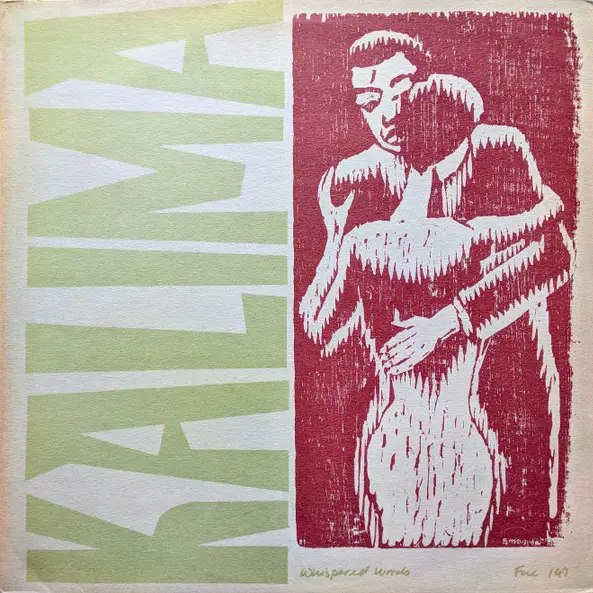 Kalima released their third EP, Whispered Words, in April 1986 on Factory Records (FAC 147).
The single extended the polished Latin jazz-pop style of their debut album with a refined lead track and two companion pieces recorded during the same January 1986 session. The group self-produced all three cuts, which balanced rhythmic detail and melodic restraint. “Whispered Words” and “Sugar and Spice” continued the band’s focus on mood, form, and ensemble texture, while the brief reprise of “In Time” echoed its earlier appearance on Night Time Shadows.
A. “Whispered Words” (4:37)
B1. “Sugar and Spice” (5:07)
B2. “In Time” (1:54)
All tracks were recorded at Yellow 2 Studios, Manchester, with engineers Chris Nagle and Paul Harrison, and assistant Julia Adamson. Kalima produced and wrote all material, published under Copyright Control. Clifford Saffer contributed woodcut cover artwork; Trevor Johnson designed the sleeve. Some export copies carried an Of Factory New York promo sticker.
The release marked the final appearance of Kalima’s original eight-piece lineup. Andrew Connell departed for Swing Out Sister, a sophisti-pop trio with ACR auxiliary Corinne Drewery and original Magazine drummer Martin Jackson. They scored a 1987 transatlantic hit with “Breakout” from their debut album It’s Better to Travel. Kalima also lost their original rhythm section, Jeremy Kerr and Martin Moscrop, along with percussionist Chris Manos.
Weird Feelings (EP)
Kalima released their fourth EP, Weird Feelings, on May 11, 1987, via Factory Records (FAC 187). The record continued the group’s polished fusion of Latin jazz and dance-pop, marked by bright horn arrangements, crisp ensemble interplay, and a more compact compositional form. Written by the band and co-produced with Paul Harrison, the EP captured a transitional phase in the group’s lineup following a brief European tour.
A. “Weird Feelings” (3:34)
B. “The Dance” (5:28)
Both tracks were recorded at Yellow 2 Studios, Stockport, in February 1987 with engineer Paul Harrison. The lineup included Ann Quigley (vocals, lyrics), John Kirkham (guitar), Chris Manis (percussion), David T. Higgins (drums), and Martin Hennin (bass), who appeared on this release only. Horn duties were handled by Anthony Quigley (soprano sax), Clifford Saffer (tenor sax), Matthew Taylor (alto sax), Bernard Moss (flute), and guest Khairie Ghadal (trumpet, flugelhorn).
Following the single’s release, both Martin Hennin and Clifford Saffer exited the band. Their departure paved the way for a newly stabilized lineup featuring Warren Sharples on bass, Higgins retained on drums, Andy Boothman on percussion, and horn augmentation from Taylor and Moss. Kalima also secured new management under Robin McMillan, setting the stage for their second album.
Kalima!
 Kalima released their second album, Kalima!, in May 1988 on Factory Records (FACT 206).
The album marked a new phase for the band, distancing them from A Certain Ratio’s orbit and expanding into richer Latin textures, layered percussion, and broader harmonic phrasing. Produced by Michael Johnson—known for his work with New Order—the album balanced danceable rhythms with bossa nova inflections and tight horn arrangements. Ann Quigley supplied lyrics and vocals across a nine-track program, with all material written and arranged by Kalima except for the French standard “Autumn Leaves.”
A1. “That Twinkle (In Your Eye)” (4:46)
A2. “Casabel” (3:18)
A3. “Sad and Blue” (4:22)
A4. “Over the Waves” (3:36)
A5. “Now You’re Mine” (3:28)
B1. “The Strangest Thing” (4:40)
B2. “Special Way” (3:55)
B3. “Autumn Leaves” (5:01) — music by Kosma, French lyrics by Prévert, English lyrics by Mercer
B4. “Julan” (5:02)
The album was recorded at Square One Studios, Bury, during November–December 1987. Michael Johnson produced, with Tim Oliver as engineer. Instrumentation features Ann Quigley on vocals, John Kirkham on guitar, Warren Sharples on bass, David Higgins on drums, Chris Manis on percussion, Bernard Moss on flute, and horn parts by Anthony Quigley (soprano sax, keyboards on “Julan”) and Matthew Taylor (alto and tenor saxophones). Artwork and design were handled by Johnson/Panas, with photography by James Martin.
Kalima! drew increased attention on the UK’s emerging acid jazz circuit and found a receptive audience in Japan and the Far East. The band became regulars at Gilles Peterson’s Sunday sessions at Dingwalls in London, where they once shared the stage with Pee Wee Ellis and Haji Akbar of the James Brown horn section.
Their visibility grew as they played alongside acts such as Roy Ayers and Arturo Sandoval, and met international figures like Flora Purim and Airto Moreira. In 1989, Kalima issued Flyaway, a best-of compilation that documented their expanding stylistic range and growing international presence.
Feeling Fine
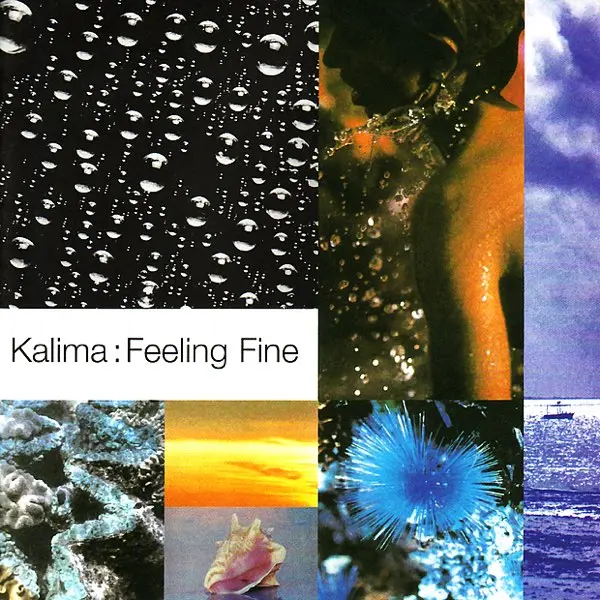 Kalima released their third album, Feeling Fine, in August 1990 on Factory Records (FACT 249).
Recorded at the end of 1989 with producer Tim Oliver, the album reaffirmed the group’s commitment to Latin-infused jazz-pop, presented with sleeker production.
Kalima group-wrote all nine tracks, which feature lyrics by Ann Quigley contributing lyrics. Their reconfigured lineup includes new drummer Iain Alexander Kelly and percussionist Andy Boothman, alongside returning core members from the Kalima! sessions.
A1. “Shine” (5:58)
A2. “A Thousand Signs” (5:23)
A3. “Take It Easy” (4:05)
A4. “Interstella” (5:03)
B1. “All the Way Through” (6:03)
B2. “Big Fat City” (5:17)
B3. “The Groovy One” (4:48)
B4. “Azure” (1:51)
B5. “Unreal” (4:20)
The album was recorded in December 1989 and January 1990 at Strawberry Studios, Stockport, with engineer John Pennington. The lineup included Ann Quigley (vocals, lyrics), Anthony Quigley (soprano saxophone, keyboards, vibraphone), Matthew Taylor (alto and tenor saxophones), Bernard Moss (flute, piano), John Kirkham (guitar), Warren Sharples (bass), Andy Boothman (percussion), and Iain Alexander Kelly (drums). Tim Oliver produced the session; the sleeve was designed by Johnson/Panas and plated by Max, with pressing handled by Audio Services Ltd.
Feeling Fine received positive press from Blues & Soul and gained radio support from Jazz FM, with several tracks becoming staples in acid jazz DJ sets. Lead track “Shine” was issued separately as a 12″ single (FAC 269) in July 1990, featuring two extended remixes: the Vibrazonic Dub Mix by Gilles Peterson and Patrick Forge, and the Concrèt Mix by Tim Oliver. The club play from these versions helped push Kalima further into the UK’s acid jazz consciousness.
The band’s sound reached its most refined point on Feeling Fine, combining Brazilian grooves, downtown funk, and modern jazz voicings within a unified framework. These sessions marked the final phase of Kalima’s Factory era and were later reissued with bonus tracks in an expanded edition in 2005.
Postlude
Despite modest success with Feeling Fine and its remix spin-offs, Kalima remained on the margins of broader commercial visibility. Bassist Warren Sharples departed shortly after the album’s release and was replaced for live appearances by Peter Condor. Around the same time, Factory Records relocated from their modest Palatine Road office to an expensive new city-centre location—an ambitious move that reflected the label’s investment in the Madchester boom but signaled a shift in priorities. As with the 1986 departures of Martin Moscrop, Jez Kerr, and Andy Connell, the departure of Warren—and the increasingly corporate direction of Factory—marked the end of another era for Kalima’s core trio: Ann Quigley, John Kirkham, and Tony Quigley.
Feeling Fine performed respectably as a niche release but failed to break through to a wider market. In the sleevenotes to the Palatine retrospective, Tony Wilson later acknowledged that Kalima “never got the credit,” attributing their lack of recognition to Factory’s own missteps. Following a performance at The Boardwalk with Ashley & Jackson, Ann and John stepped back from music, while Tony resumed activity with A Certain Ratio. Factory collapsed in late 1992, bringing Kalima’s long association with the label to a close.
A decade later, Kalima quietly returned with a fourth album, In Spirit, issued independently on their Kin label in 2002 and supported by a handful of trio-format shows. Though the group has remained inactive since, their recorded legacy—spanning Factory, Factory Benelux, and Kin—continues to reach new listeners through CD reissues and anthologies such as Palatine and other Factory retrospectives.
Discography:
- Four Songs (1985 EP)
- Night Time Shadows (1986)
- Kalima! (1988)
- Feeling Fine (1990)
Non-album shortplayers:
- “The Smiling Hour” / “Fly Away” (1984)
- “Whispered Words” / “Sugar and Spice” / “In Time” (1986)
- “Weird Feelings” / “The Dance” (1987)
Sources:
Artist/Album Pages:
Vinegar Joe was an English soul-rock band that released three albums on Island Records: Vinegar Jo...
Manfredo Fest (May 13, 1936 — Oct. 8, 1999) was a Brazilian samba-jazz/pop keyboardist and bandlea...
The Armoury Show was a British new wave rock band that released the 1985 Parlophone album Waiting fo...
Kazumi Watanabe — 渡辺香津美 (born Oct. 14, 1953) — is a Japanese jazz-rock guitarist who cut his first...
Syd Barrett (1946–2006) was an English singer, songwriter, and guitarist who co-founded Pink Floyd. ...
Hiroshi Sato — 佐藤博 (June 3, 1947 — Oct. 24, 2012) — was a Japanese art-pop keyboardist and songwri...
Sally Oldfield (born Aug. 3, 1947) is an English-Irish singer and composer, born in Dublin and rai...
City Boy was an English art-rock sextet from Birmingham that released seven albums on Vertigo betwee...
The Decorators were an English post-punk band that released the 1980 single "Twilight View" on the...
The Box was an English post-punk/funk band behind a self-titled EP and the 1983/84 Go! Discs album...
Genesis was an English rock band that released fifteen studio albums between 1969 and 1997. They for...
Ozzy Osbourne (December 3, 1948 – July 22, 2025) was an English hard-rock/metal singer who gained ...