

Amon Düül II was a German Krautrock band that released six studio albums and a live set on Liberty/UA between 1969 and 1973, followed by six further albums on NOVA/Telefunken between 1974 and 1981.
They emerged from an art commune with the 1969 album Phallus Dei, a pioneering German underground release. Their 1970/71 double-albums Yeti and Tanz der Lemminge established their mix of improvisation and post-psychedelic song suites, written primarily by organist Falk-Ulrich Rogner and guitarists Chris Karrer and John Weinzierl. They generally functioned as a six-piece (sometimes seven) with singer Renate Knaup.
After their 1972 albums Carival In Babylon and Wolf City, bassist Lothar Meid and producer Olaf Kübler formed Utopia, a project asurped by Amon Düül II, which continued with come-and-go members for the 1973–75 albums Vive la Trance, Hi-Jack, and Made In Germany.
Amon Düül II reconfigured as a quintet for the 1976/77 Pyragony X and Almost Alive, both marked by the art-pop sensibilities of keyboardist Stefan Zauner.
Members: Chris Karrer (violin, guitar, banjo, soprano saxophone, Mellotron, maracas, vocals), John Weinzierl (guitar, bass, piano, vocals), Peter Leopold (drums, percussion, tambourine, piano, vocals, synthesizer, 1968-2006), Renate Knaup (vocals, tambourine, 1968-75, 1981-present), Falk-Ulrich Rogner (organ, clavinet, harmonium, synthesizer, electronics, 1968-75, 1981-present), Christian Thierfeld [aka Shrat] (bongos, vocals, violin, 1968-70), Dave Anderson (bass, 1968-70), Christian Burchard (vibraphone, 1968-69), Edgar Hofmann (1968), Holger Trülzsch (darabuka, 1968-69), Dieter Serfas (drums, cymbals, 1968-69), Lothar Meid (bass, synthesizer, vocals, choir, 1971-75, 1997-2015), Karl-Heinz Hausmann (electronics, 1971-72), Jimmy Jackson (organ, electronics, piano, 1971-72), Rolf Zacher (vocals, 1971-72), Danny Fichelscher (drums, congas, vocals, guitar, 1972, 1981, 2006-present), Rainer Schnelle (keyboards, 1972), Keith Forsey (drums, 1973), Robby Heibl (bass, cello, guitar, vocals, violin, 1973), Peter Kramper (piano, 1973), Nando Tischer (vocals, guitar, 1975), Klaus Ebert (vocals, bass, guitar, 1976-78), Stefan Zauner (vocals, keyboards, synthesizer, bass, percussion, 1976-81), Jörg Evers (strings, bass, guitar, synthesizer, 1977, 1981)
Background
Amon Düül II spawned from Munich’s Amon Düül art commune, founded by local students in 1967 and named after the Egyptian sun god Amon. The band itself emerged in 1968 when the commune was given an opportunity to make a record.
The mainline members of the Amon Düül commune recorded a lengthy low-fi jam session that later appeared spread across four albums: Psychedelic Underground and Collapsing/Singvögel Rückwärts & Co. (both 1969, Metronome), Paradieswärts Düül (1970, Orh), and Disaster (2LP 1972, BASF). Before the session took place, the commune’s more musical faction broke away and formed Amon Düül II.
The initial Amon Düül II lineup featured multi-instrumentalist Chris Karrer, drummer Dieter Serfas, keyboardist Falk Rogner, guitarist John Weinzierl, and singer Renate Knaup. They entered the studio as a septet with percussionist Christian Thiele and second drummer Peter Leopold.
Phallus Dei
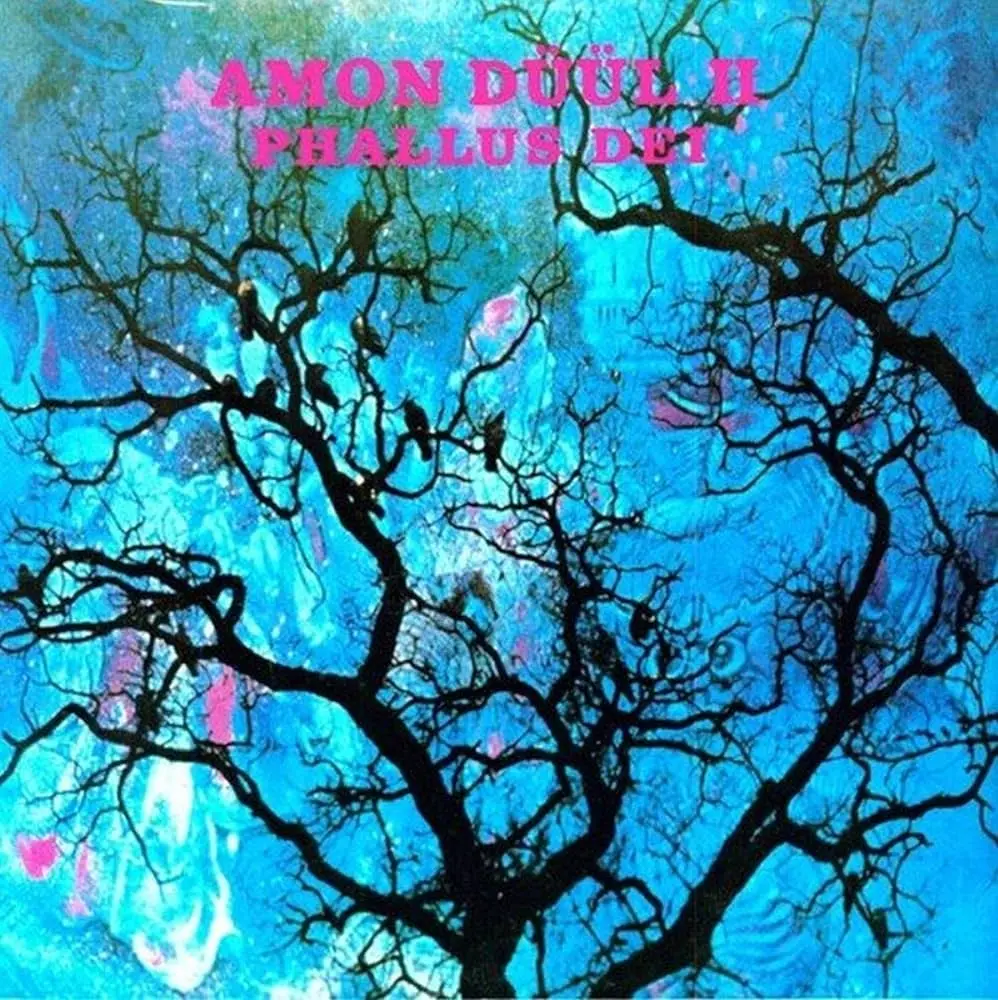 Amon Düül II released their debut album, Phallus Dei, on June 1, 1969, on Liberty.
The album contains four group-written songs and the twenty-minute title track, which consumes Side B.
Chris Karrer plays soprano saxophone, violin, and splits guitar tracks with bassist John Weinzierl. Percussionist Shrat (aks Christian Thiele) plays additional violin.
“Luzifers Ghilom” features English guest bassist Dave Anderson. Additional guests include Embryo founder Christian Borchard (vibraphone) and Popol Vuh co-founder Holger Trülzsch (Turkish drums).
A1. “Kanaan” (4:03)
A2. “Dem Guten, Schönen, Wahren” (6:14)
A3. “Luzifers Ghilom” (8:35)
A4. “Henriette Krötenschwanz” (2:03)
B. “Phallus Dei” (20:49)
Phallus Dei marked the producorial debut of veteran German saxophonist Olaf Kübler, who supervised the 1969 MPS release Malma Maliny by the Jan Hammer Trio. Sessions occurred in Munich at Trixi Tonstudios with staffer Willi Schmidt, a recent soundman for the Israeli duo Esther & Abi.
German copies show a dead tree under torrential blue sky. UK copies sport psychedelic orange/teal artwork.
Dieter Serfas played an auxiliary role on the first Missus Beastly album and had subsequent stints with Embryo. Amon Düül II continued with Dave Anderson as a full member.
Yeti
 Amon Düül II released their second album, Yeti, in April 1970 on Liberty.
Yeti was their first of three studio double-albums (67:49 duration). Record One contains six group-credited songs and the four-part suite “Soap Shop Rock.” Guitarist John Weinzierl again splits six and twelve-string tracks with violinist Chris Karrer.
Record Two contains improvisations, including the eighteen-minute title-track and “Yeti Talks to Yogi.” Flutist Thomas Keyserling (Tangerine Dream) guests on “Sandoz in the Rain” along with two Amon Düül I members: guitarist–singer Rainer Bauer and bassist Ulrich Leopold.
A1. “Soap Shop Rock” (13:45)
— a. “Burning Sister” (3:41)
— b. “Halluzination Guillotine” (3:05)
— c. “Gulp a Sonata” (0:45)
— d. “Flesh-Coloured Anti-Aircraft Alarm” (5:53)
A2. “She Came Through the Chimney” (3:57)
B1. “Archangels Thunderbird” (3:33)
B2. “Cerberus” (4:21)
B3. “The Return of Rübezahl” (1:41)
B4. “Eye-Shaking King” (5:40)
B5. “Pale Gallery” (2:12)
C. “Yeti” (18:09)
D1. “Yeti Talks to Yogi” (6:18)
D2. “Sandoz in the Rain” (8:59)
Amon Düül II recorded Yeti with Olaf Kübler. Liberty manager Siegfried Loch took a co-writing credit on “Archangels Thunderbird.”
Yeti appeared in a gatefold with a blue-back photo of the Grim Reaper, portrayed by the band’s late roadie, Wolfgang Krischke. The inner-gate shows a downing equine (right) and each member superimposed on the facade of a haunted hilltop mansion (left).
Liberty lifted “Archangel’s Thunderbird” as a single backed with an excerpt of “Soap Shop Rock.” After Yeti, Christian ‘Shrat’ Thiele jumped ship to Sameti while Dave Anderson returned to England and joined Hawkwind.
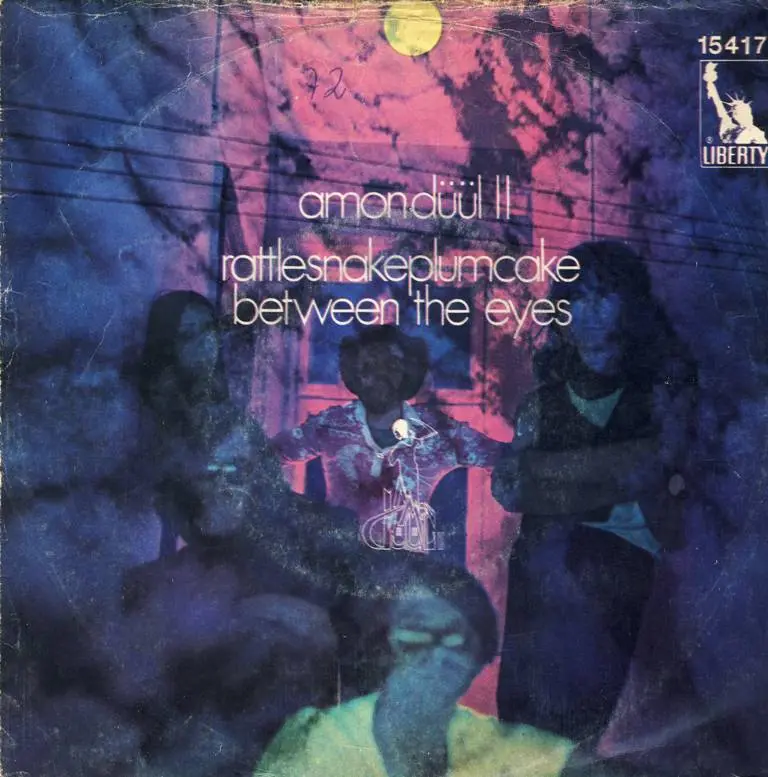 In November 1970, Amon Düül II released a standalone single: “Rattlesnakeplumcake,” a co-write by John Weinzierl and Falk Rogner backed with “Between the Eyes,” third-written by Chris Karrer.
A. “Rattlesnakeplumcake” (3:16)
B. “Between the Eyes” (2:24)
“Archangel’s Thunderbird” appears on Electric Monster Rock Show, a 1970 German Liberty two-record comp with cuts by Can (“Soul Desert”), Passport precursor Doldinger’s Motherhood (“Degeneration”), and Swiss Krautrockers Krokodil (“Tell Me What You Want”), plus bands from England (Aynsley Dunbar Retaliation, Brinsley Schwarz, Groundhogs) and the US (Fantasy, Sugarloaf).
Tanz der Lemminge
 Amon Düül II released their third album, Tanz der Lemminge, in March 1971 on Liberty.
Tanz der Lemminge contains four side-long suites. This was their second consecutive double-album (68:28 duration).
Amon Düül II recorded the album as a quintent with new bassist Lothar Mead, a Passport co-founder who joins organist Falk Rogner, drummer Peter Leopold, guitarist John Weinzierl, and guitarist/violinist Chris Karrer. Co-founder Renate Knaup sat out these sessions apart from a vocal on “Riding on a Cloud.”
The first record features guests appearances by Between sitarist Al Gromer and American pianist/organist Jimmy Jackson, a concurrent Passport and Haboob member. Weinzierl and Leopald play piano on the second record.
Side A contains a four-part Karrer-composed suite with one Rogner co-write (“Pull Down Your Mask”).
Side A: “Syntelman’s March of the Roaring Seventies” (15:51)
A1. “In the Glass Garden” (1:39)
A2. “Pull Down Your Mask” (4:39)
A3. “Prayer to the Silence” (1:04)
A4. “Telephonecomplex” (8:26)
Side B contains a nine-part Weinzierl suite. Lothar sings lead on “Riding on a Cloud” and the co-written “Transylvanian Brain-Surgery.” Actor Rolf Zacher vocalizes “H.G. Wells’ Take Off.”
Side B: “Restless Skylight-Transistor-Child” (19:33)
B1. “Landing in a Ditch” (1:12)
B2. “Dehypnotized Toothpaste” (0:52)
B3. “A Short Stop at the Transylvanian Brain-Surgery” (5:00)
B4. “Race from Here to Your Ears”
— a. “Little Tornadoes” (2:08)
— b. “Overheated Tiara” (1:46)
— c. “The Flyweighted Five” (1:26)
B7. “Riding on a Cloud” (2:33)
B8. “Paralyzed Paradise” (3:07)
B9. “H.G. Wells’ Take Off” (1:26)
The second record consists of a 33-minute suite spread across two sides with one ongoing section (C) and a three-part sequence (D), all group-credited to the band’s four veteran members: Karrer, Weinzierl, Meid, and Rogner.
Side C: “Chamsin Soundtrack”
C. “The Marilyn Monroe-Memorial-Church” (18:05)
Side D: “Chamsin Soundtrack” (14.59)
D1. “Chewing Gum Telegram” (2:41)
D2. “Stumbling Over Melted Moonlight” (4:33)
D3. “Toxicological Whispering” (7:45)
Amon Düül II recorded Tanz der Lemminge with producer Olaf Kübler and Haboob/Krokodil engineer Peter Kramper, who also worked on Emergency‘s debut. His assistant, Karl-Heinz Hausmann, did electronics programming on sides A and B.
Tanz der Lemminge appeared in a gatefold that depicts a red cosmic orb with apparitions of Renaissance men and Pieta (front) and a dendriod Grim Reaper on a sofa (back). The innergates depict a captain’s view from a spaceship cockpit.
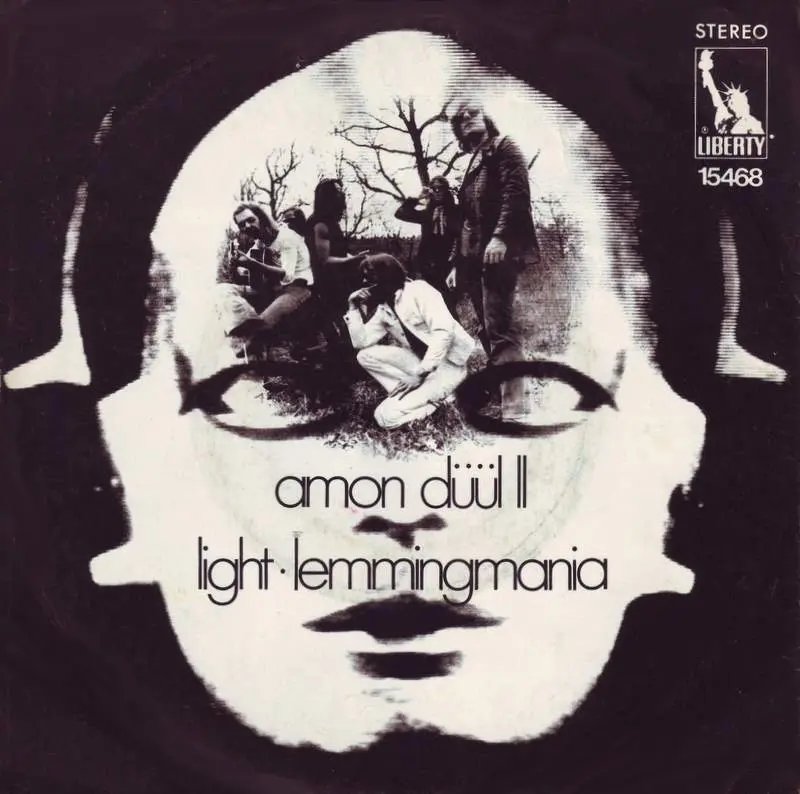 In May 1971, Amon Düül II released their second standalone single: “Light,” a Lothar Meid number backed with John Weinzierl’s “Lemmingmania.”
A. “Light” (3:48)
B. “Lemmingmania” (3:00)
1972
Carnival in Babylon
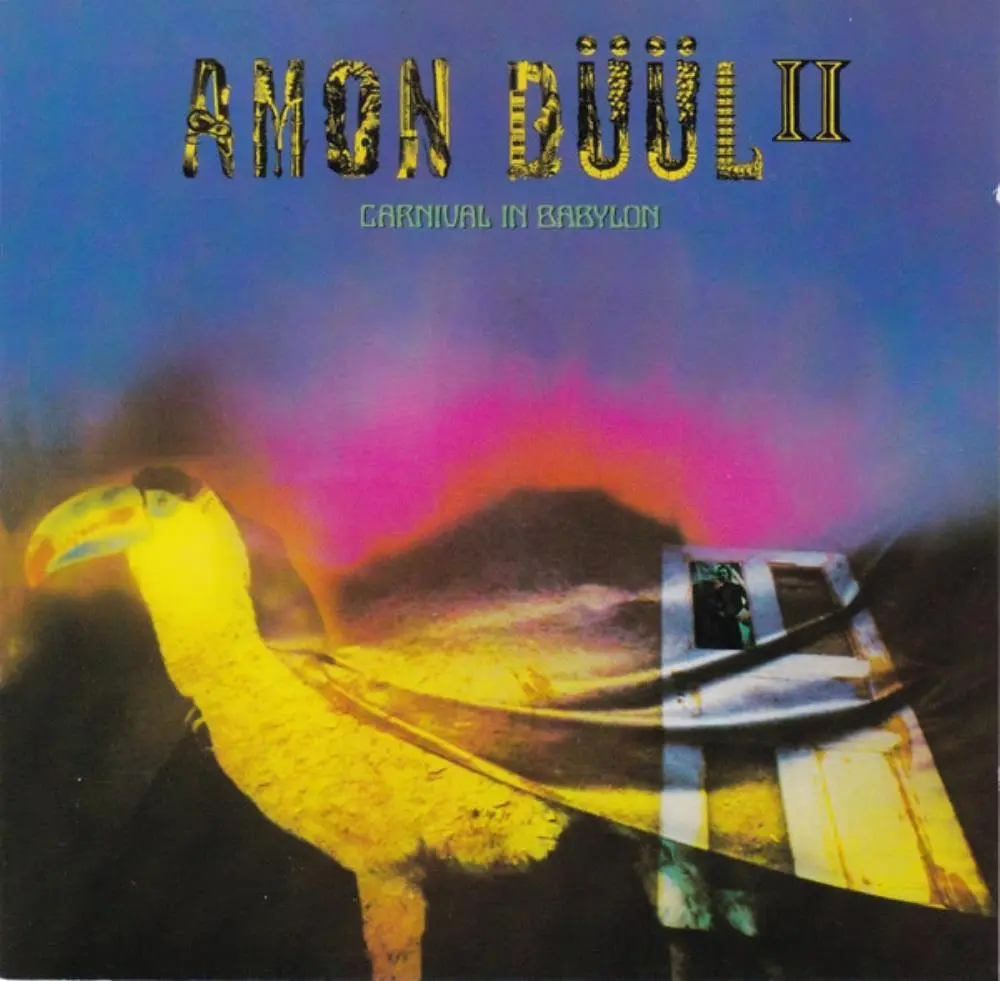 Amon Düül II released their fourth album, Carnival in Babylon, in early 1972 on United Artists.
The album contains two songs (“C.I.D. in Uruk,” “Kronwinkl 12”) by John Weinzierl, who co-wrote “All the Years ‘Round” with returning singer Renate Knaup and lyricist Falk Ulrich Rogner, who also worded Chris Karrer’s two contributions, “Shimmering Sand” and “Tables Are Turned.” Side B concludes with the lengthy, group-written “Hawknose Harlequin.”
Carnival in Babylon presents a septet Amon Düül II with Niagara drummer Danny Fichelscher and Lemminge electronics technician Karl-Heinz Hausmann, who takes the keyboardist slot from Rogner, listed here as a guest organist. Guitarists Karrer and Weinzierl retain the Lemminge rhythm section and regain co-founder Knaup. Carnival features vocal backing by one Joy Alaska.
1. “C.I.D. in Uruk” (5:30)
2. “All the Years ‘Round” (7:18)
3. “Shimmering Sand” (6:36)
4. “Kronwinkl 12” (3:50)
5. “Tables Are Turned” (3:33)
6. “Hawknose Harlequin” (9:49)
Sessions occurred in Munich at Bavaria Musikstudios with Olaf Kübler, who supplemented Karrer on soprano saxophone. Peter Kramper engineered Carnival in Babylon and its followup in sequence with Sameti and the third Popol Vuh album, Hosianna Mantra.
Carnival in Babylon appeared in a gatefold that depicts a valley with a dodo apparition and a standalone door (front) and a man at a portal on barren ground with transmitted visitation overhead (back). The inner-gate presents a color-adjusted group photo of the members crouched amid red shrubbery.
UA lifted “All the Years Round” as a single backed with “Tables Are Turned.”
Wolf City
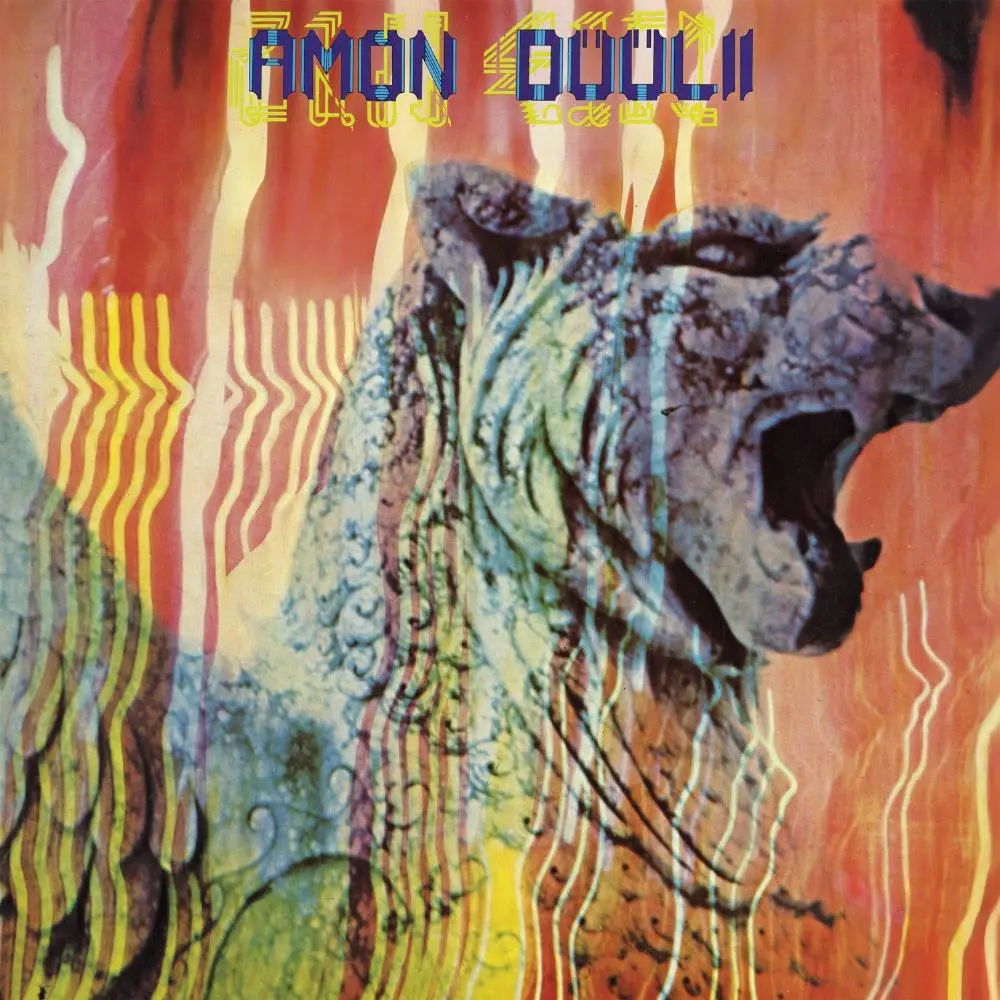 Amon Düül II released their fifth album, Wolf City, in late 1972 on United Artists.
Chris Karrer and returning keyboardist Falk-Ulrich Rogner co-wrote the opener, “Surrounded by the Stars.” John Weinzierl submitted “Green-Bubble-Raincoated-Man” and “Jail-House-Frog.”
Side B contains two group-credited songs: the title track and “Wie der Wind am Ende einer Strasse” (“Like the wind at the end of a street”). Bassist Lothar Meid co-wrote “Deutsch Nepal” with producer Olaf Kübler. Rogner co-wrote “Sleepwalker’s Timeless Bridge” with drummer D. Secundus Fichelscher.
Rogner plays the clavioline, an early (Fifties era) analog synthesizer also used on the 1972 Strawbs album Grave New World. Meid plays further synth along with former member Peter Leopold, one of eight Wolf City auxiliary performers along with Kübler (soprano sax) and Lemminge guests Jimmy Jackson (choir organ) and actor/singer Rolf Zacher (“Frog,” “Nepal”).
“Green-Bubble-Raincoated-Man” features Sadja tablist Pandit Shankar Lal, Nowy tambourist Liz van Neienhoff, Lemminge sitarist Al Gromer, and violinist Paul Heyda.
A1. “Surrounded by the Stars” (7:44)
A2. “Green-Bubble-Raincoated-Man” (5:03)
A3. “Jail-House-Frog” (4:56)
B1. “Wolf City” (3:20)
B2. “Wie der Wind am Ende einer Strasse” (5:47)
B3. “Deutsch Nepal” (2:57)
B4. “Sleepwalker’s Timeless Bridge” (4:53)
Sessions occurred in July 1972 at Bavaria Studios, where Amon Düül II and Kübler co-produced Wolf City. The album appeared in a gatefold that depicts a winged wolf with streaked overlays. The inner-gate shows Magritte-like subjects and floating objects against a turquoise sky.
1973
Utopia
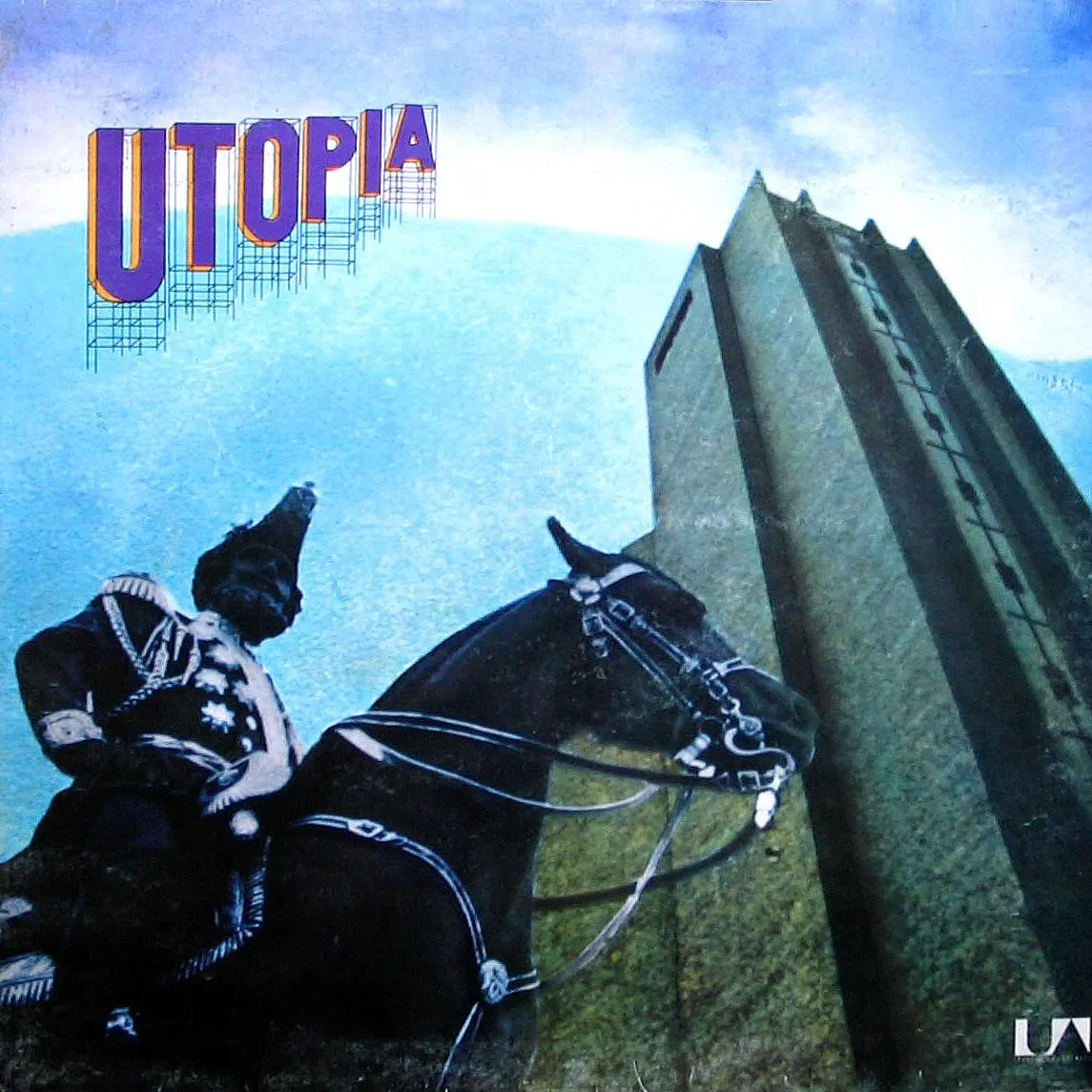 In 1973, Amon bassist Lothar Meid and producer Olaf Kübler formed Utopia, a side-project with Düül drummer Danny Fichelscher and auxiliary keyboardist Jimmy Jackson.
Utopia contains eight Meid/Kübler originals, recorded with backing by acoustic guitarist Andy Marx (four tracks) and Amon Düül II guitarist John Weinzierl (“The Wolfman Jack Show,” “Deutsch Népal”). Kübler plays Moog, saxophone, and (on “Las Vegas”) nose flute.
The album features single-track cameos by Amon singer Renate Knaup (“What You Gonna Do”), organist Falk-U Rogner (“Utopia No. 1”), and saxist/violinist Chris Karrer (“Jazz Kiste”). Additional guests include Et Cetera guitarist Siegfried Schwab (“Nasi Goreng”) and Niagara/Haboob drummer George Greene (“Utopia No. 1”).
A1. “What You Gonna Do” (6:38)
A2. “The Wolfman Jack Show” (5:05)
A3. “Alice” (3:07)
A4. “Las Vegas” (4:24)
B1. “Deutsch Népal” (3:11)
B2. “Utopia No. 1” (3:58)
B3. “Nasi Goreng” (5:35)
B4. “Jazz Kiste” (3:57) K
Kübler produced Utopia with four engineers, including Brainstorm/Sunbirds soundman Jürgen Koppers and Düül associate Peter Kramper, who played Moog on “Nasi Goreng.”
Meid recorded Utopia in sequence with All Bumm by 14 Karat Gold, his project with serial drummer Keith Forsey (Niagara, Nowy), who played on “What You Gonna Do” and briefly joined Amon Düül II.
Falk-U co-created the Utopia gatefold art with his brother, graphic illustrator Jürgen Rogner. It shows an upshot view of a horseback knight beside a modern skyscraper (front) and a bluescale fisheye photo of the sessions (back). The inner-gate shows a private jet take flight on a country estate.
Live in London
 In 1973, Amon Düül II released Live in London, recorded on December 16, 1972, at the Greyhound in Croydon.
Live in London features the Wolf City lineup: Renate Knaup, Chris Karrer, John Weinzierl, Falk-U Rogner, Lothar Meid, D Secundus Fichelscher, and earlier (now auxiliary) percussionist Peter Leopold.
Side A contains renditions of three Yeti numbers and a short improvisation. Side B features rearranged, condensed material from the first two sides of Tanz der Lemminge.
A1. “Archangels Thunderbird” (2:55)
A2. “Eye Shaking King” (6:09)
A3. “Soap Shop Rock” (7:33)
A4. “Improvisation” (3:40)
B1. “Syntelman’s March of the Roaring Seventies” (7:58)
— a. “Pull Down Your Mask”
— b. “Prayer to the Silence”
— c. “Telephonecomplex “
B2. “Restless Skylight-Transistor Child” (8:36)
— a. “Landing in a Ditch”
— b. “Dehypnotized Toothpaste”
— c. “A Short Stop at the Transylvanian Brain Surgery”
B3. “Race From Here to Your Ears” (4:56)
— a. “Little Tornados”
— c. “Riding On a Cloud”
— b. “Paralized Paradise”
Amon Düül II recorded their performance with the Pye Mobile Recording Unit, engineered by Vic Maile, a soundman on 1972–74 live albums by Man and Nektar.
Live in London sports sci-fi art by Plastic Dog illustrator Rodney Matthews, whose artwork graces early Seventies sleeves for Thin Lizzy, Dave Carleson, and multiple acts on the Village Thing folk label (Dave Evans, Hunt & Turner, Ian A. Anderson).
Vive la Trance
 Amon Düül II released their sixth studio album, Vive la Trance, in September 1973 on United Artists.
The album presents a reconfigured sextet with temp Robby Heibl, who juggles guitar/bass roles with John Weinzierl and guitar/violincello tasks with Chris Karrer, who plays saxophone on four cuts and mellotron on “Mañana.” Falk U. Rogner’s arsenal features organ harmonium, and the EMS VCS 3 (1,4-8) analogue synthesizer.
Vive la Trance contains eleven group-composed tracks, including one German-titled instrumental. Weinzierl worded “A Morning Excuse” and three Side B tracks. Karrer penned “Apocalyptic Bore” and the last two songs.
Select tracks feature lyrics by Heibl (“Fly United”), Rogner (“Jalousie”), and reinstated drummer Peter Leopold, who dedicated “Mozambique” to Monika Ertl (1937–1973), the recently martyred German-Bolivian communist guerilla reputed for the assassination of Che Guevara’s corpse defiler, Col. Toto Quintanilla. The song features choir and sundry percussion by furloughed member Lothar Meid and his 14 Karat bandmate, Keith Forsey.
A1. “A Morning Excuse” (3:19)
A2. “Fly United” (3:33)
A3. “Jalousie” (3:27)
A4. “Im Krater Blühn Wieder Die Bäume” (3:08) translates as “In the crater the trees bloom again.”
A5. “Mozambique (Dedicated to Monika Ertl)” (7:22)
B1. “Apocalyptic Bore” (5:50)
B2. “Dr. Jeckyll” (3:00)
B3. “Trap” (3:35)
B4. “Pig Man” (2:38)
B5. “Mañana” (3:20)
B6. “Ladies Mimikry” (3:18)
Amon Düül II recorded Vive la Trance at Bavaria Studios with Olaf Kübler and engineer Peter Kramper, who played grand piano on “Fly United” and “Jalousie.”
Vive la Trance appeared in a single sleeve with backside photos of Amon Düül II in carnival costumes and a frontal screen capture of Maya Deren (1917–1961), a Ukraine-American filmmaker known for her 1940s experimental shorts.
UA lifted “Pigman” as a single backed with “Mozambique.” Before the next album, Meid rejoined and Heibl left for Sameti.
Hi-Jack
 Amon Düül II released their seventh studio album, Hi-Jack, in 1974 on Nova (Germany), WEA (UK), and Atco (US).
Hi-Jack contains eight originals performed by the Lemminge lineup with reinstated bassist Lothar Meid. He wrote the Side A bookends and co-wrote “Da Guadeloop” with Peter Leopold, who co-wrote “Liquid Whisper” with Renate Knaup and Falk Rogner, the team behind “Traveller” with “Mirror” writer John Weinzierl. Chris Karrer wrote the Side B bookends and arranged their version of the Ornette Coleman chestnut “Lonely Woman.”
A1. “I Can’t Wait (Parts 1 & 2)” (6:16)
A2. “Mirror” (4:15)
A3. “Traveller” (4:23)
A4. “You’re Not Alone” (6:53)
B1. “Explode Like a Star” (4:00)
B2. “Da Guadeloop” (7:04)
B3. “Lonely Woman” (4:44) originated on The Shape of Jazz to Come, the 1959 Atlantic release by American jazz saxophonist Ornette Coleman.
B4. “Liquid Whisper” (3:30)
B5. “Archy the Robot” (3:30)
Amon Düül II recorded Hi-Jack with producer/accordionist Wild Willy, one of ten auxiliary players along with Icelandic keyboardist Thor Baldursson, American saxophonist Bobby Jones, and prior Düül producer Olaf Kubler.
Hi-Jack appeared in a gatefold with lunar mission illustrations by Patrick Von Spreckelsen, whose art graces 1972/73 covers for Creative Rock and Gash and subsequent titles by Das Waldemar Wunderbar Syndikat and Lucifer’s Friend.
Nova lifted “Mirror” as a single backed with “Liquid Whisper.” Before the next album, Meid made a permanent exit and formed Jackboot, a hard-rock quartet with Das Panik guitarist Karl Allaut. Amon Düül II rehired recent bassist Robby Heibl.
Made in Germany
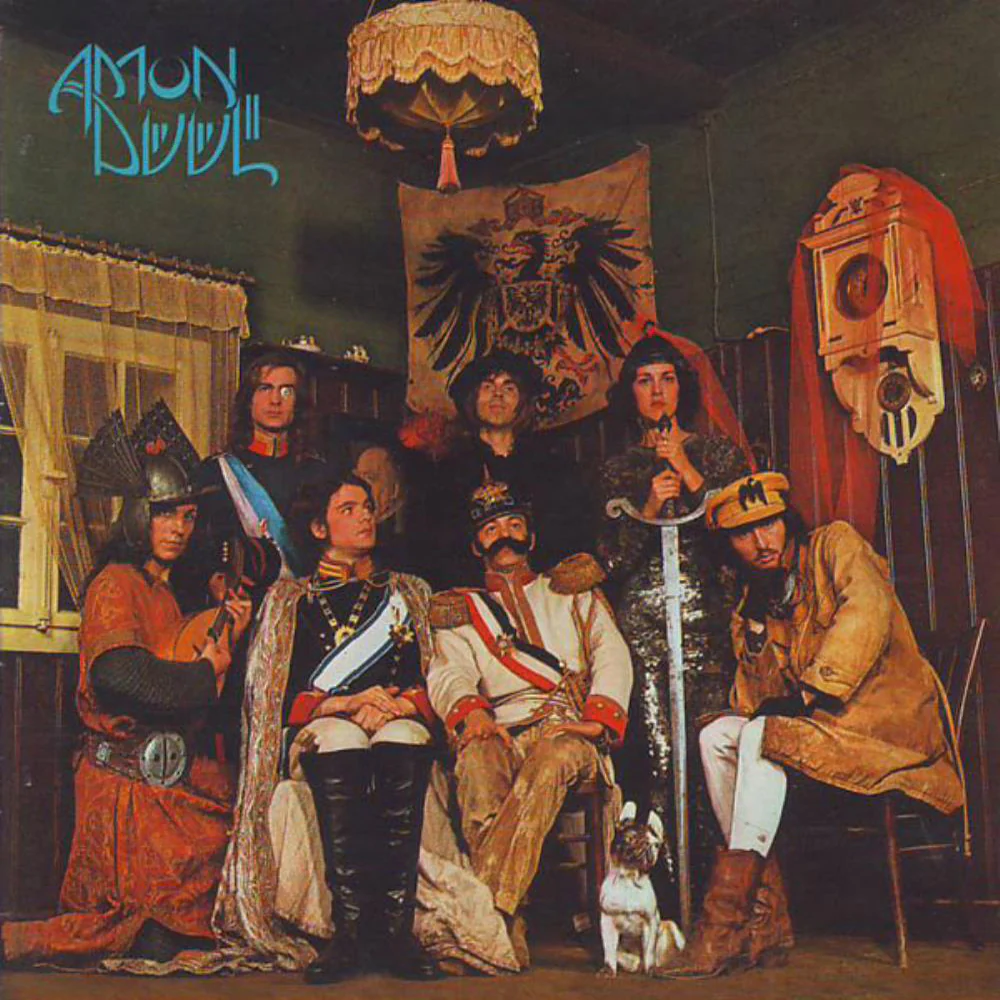 Amon Düül II released their eighth album, Made in Germany, in September 1975 as a double-album on Nova and a distilled single-LP on Atco.
Made in Germany is a concept album about the nation’s history. The two-record version (69:39) contains twenty songs performed by the Vive la Trance lineup with a seventh member, singer/guitarist Nando Tischer, an alumnus of the “Haare” Ensemble (the original German-production Hair cast).
Record One opens with an overture composed by 14 Karat Gold guitarist Jörg Evers. Drummer Peter Leopold wrote “Wir Wollen” and co-wrote songs with Tischer (“Wilhelm Wilhelm”) and guitarist John Weinzierl (“SM II Peng”). The latter pair co-wrote “Ludwig.”
Organist Falk-U Rogner wrote “Elevators Meet Whispering,” “The King’s Chocolate-Waltz,” and co-wrote two songs (“Metropolis,” “Blue Grotto”) with Weinzierl and singer Renate Knaup. Record One concludes with “Mr. Kraut’s Jinx” by guitarist Chris Karrer, who multi-tasks on banjo and violin (also played by rehired bassist Robby Heibl).
A1. “Overture” (5:11)
A2. “Wir Wollen” (1:33)
A3. “Wilhelm Wilhelm” (3:10)
A4. “SM II Peng” (2:17)
A5. “Elevators Meet Whispering” (1:26)
A6. “Metropolis” (3:37)
B1. “Ludwig” (2:33)
B2. “The King’s Chocolate-Waltz” (2:29)
B3. “Blue Grotto” (3:33)
B4. “Mr. Kraut’s Jinx” (8:44)
Record Two contains four Nando Tischer compositions, including the Heibl co-write “Emigrant Song” and the Weinzierl/Leopold-contributed “5.5.55.”
Rogner composed “Gala Gnome” and co-wrote “Wide-Angle” with Knaup and prior member Danny Fichelscher. Falk-U also co-wrote two miniatures (“Three-Eyed Overdrive,” “Excessive Spray”) with producer Jürgen S. Korduletsch. The penultimate piece, “La Krautoma,” is a group-credited number with interpolated themes by Spanish Basque composer Sebastián Iradier (1809–1865).
C1. “Wide-Angle” (4:06)
C2. “Three-Eyed Overdrive” (1:17)
C3. “Emigrant Song” (3:21)
C4. “Loosey Girls” (5:13)
C5. “Top of the Mud” (3:45)
D1. “Dreams” (4:08)
D2. “Gala Gnome” (3:52)
D3. “5.5.55” (1:39)
D4. “La Krautoma” (6:08)
D5. “Excessive Spray” (1:41)
Sessions occurred in Munich at Studio 70, where Amon Düül II co-produced the album with Korduletsch, who oversaw Made in Germany and its two followups in tandem with titles by his then-wife, singer Claudja Barry. Hi-Jack auxiliaries Lee Harper (trumpet) and Thor Baldursson (keyboards) reappeared along with timpanist Karlheinz Becker and Munich Philharmonic violinist Fritz Sonnleitner.
Studio 70 staffer David Siddle engineered Made in Germany in succession with 1975 jazz-funk titles by Catch Up, Guru Guru, and Klaus Weiss.
Made in Germany appeared in a gatefold with photos of Amon Düül II posed in period costumes (front) and positioned side-by-side in trench coats (back). The inner-gates feature mirrored images of a golden eagle monument (Germany’s national bird). The lyrical insert includes liner notes by German music journalist Ingeborg Schober, later noted for her biographies on The Doors and Janis Joplin.
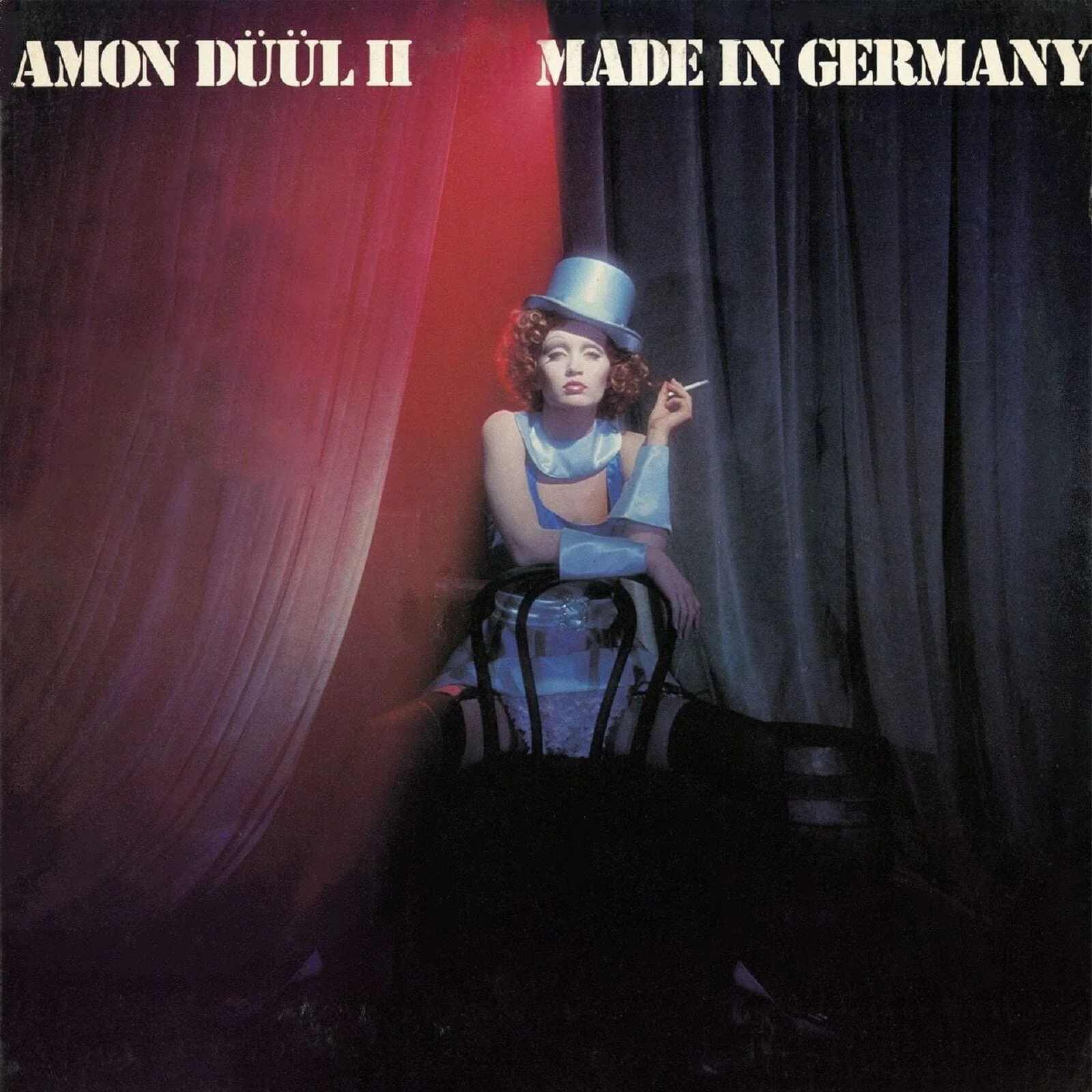 Outside Germany, the album appeared as a single record on Atco/Atlantic with a revised cover that shows a Marlene Dietrich lookalike, who chair-straddles in emulation of the siren’s iconic pose in the 1929 Wiemar Berlin cabaret drama The Blue Angel.
A1 “Dreams”
A2a “Ludwig”
A2b “The King’s Chocolate Waltz”
A2c “Blue Grotto”
A3 “5.5.55”
A4 “Emigrant Song”
A5 “La Krautoma”
B1 “Metropolis”
B2 “Loosey Girls”
B3 “Gala Gnome”
B4 “Top of the Mud”
B5 “Mr. Kraut’s Jinx”
Tischer limited his involvement to Made in Germany, which also signaled the exits of Heibl and co-founders Falk-U Rogner and Renate Knaup.
Pyragony X
 Amon Düül II released their ninth album, Pyragony X, in October 1976 on Nova.
The album presents an all-male quintet lineup of guitarist John Weinzierl, drummer Peter Leopold, multi-instrumentalist Chris Karrer, and two new members: 18 Karat Gold bassist Klaus Ebert and former Joy Unlimited keyboardist/guitarist Stefan Zauner.
Pyragony X opens with the group-written “Flower of the Orient” and contains songs by Karrer (“The Only Thing”) and Weinzierl (“Merlin,” “Crystal Hexagram”). Ebert wrote two songs (“Capuccino,” “Sally the Seducer”) and collaborated with Zauner on “Lost In Space” and “Telly Vision.”
A1. “Flower of the Orient” (6:00)
A2. “Merlin” (4:24)
A3. “Crystal Hexagram” (5:38)
A4. “Lost In Space” (4:12)
B1. “Sally the Seducer” (3:03)
B2. “Telly Vision” (4:07)
B3. “The Only Thing” (7:30)
B4. “Capuccino” (3:08)
Jürgen Korduletsch produced Pyragony X in sequence with Sweet Dynamite, Claudja Barry’s debut album with the sampled rare-groove classic “Love for the Sake of Love.” Zauner recorded his parts in tandmen with Narziss, his self-performed debut solo album.
Pyragony X features backside doodles by Zauner and a rocket/coin illustration by Europa cover artist Olof Feindt. Photographer Hartmut G. Laube took the backside member pics, which include shots of Leopold and Weinzierl in straight up-folded jeans, a look soon popularized by Berlin resident David Bowie.
Almost Alive
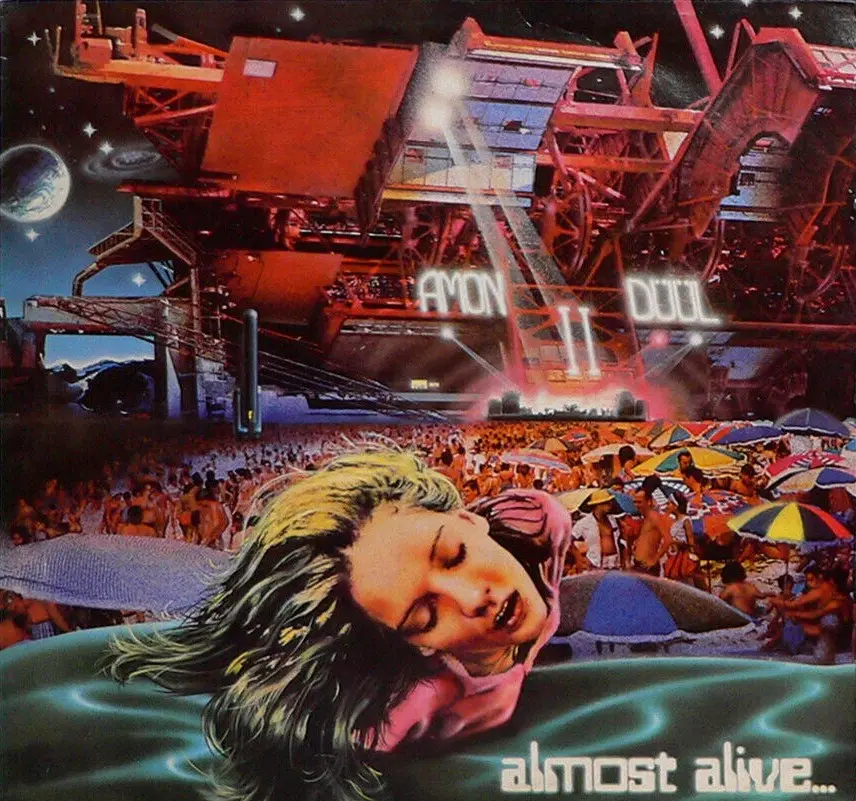 Amon Düül II released their tenth studio album, Almost Alive, in 1977 on Nova.
Almost Alive contains six group-credited songs, performed by the five-piece Pyragony X lineup. John Weinzierl splits guitar tracks with bassist Klaus Ebert and saxophonist Chris Karrer.
Ebert sings the first two songs, joined by his 14 Karat collegue Keith Forsey (percussion on “One Blue Morning”) and producer Jürgen S. Korduletsch’s wife, Claudja Barry (backing vocals on “Goodbye My Love”). Karrer sings “Ain’t Today Tomorrow’s Yesterday,” which features string arrangements by Made In Germany presence (and third 14 Karat alumnus) Jörg Evers. Keyboardist Stefan Zauner sings “Feeling Uneasy.”
A1. “One Blue Morning” (7:30)
A2. “Goodbye My Love” (8:13)
A3. “Ain’t Today Tomorrow’s Yesterday” (7:40)
B1. “Hallelujah” (4:13)
B2. “Feeling Uneasy” (6:02)
B3. “Live In Jericho” (13:19)
Sessions occurred in Munich at Arco Studios with engineer Peter Lüdemann, a onetime Brainstorm/Sunbirds soundman whose late-Seventies clients included singers Amanda Lear, Melba Moore, and the Salsoul one-off Gaz, a space-disco project with participation by Forsey, Korduletsch, and prior Düül associate Thor Baldursson.
Almost Alive sessions also took place at nearby Union Studios with Passport engineer Mal Luker, a soundman on the 1976 Jackboot album, Angel. The tapes arrived in London for a mixdown at Strawberry Studios, the newly opened South England branch of 10cc‘s namesake Manchester facility. Former Brinsley Schwarz rhythm guitarist Ian Gomm partook in the mixdown process.
Zauner illustrated the Almost Alive cover, which depicts an outdoor Amon Düül II festival show with a space-age stage construction and a tranced-out foreground attendee. The backside features windblown pics of each member by fashion photographer Tjien Tjioe, who snapped Karrer and Zauner in red ascots.
Only Human
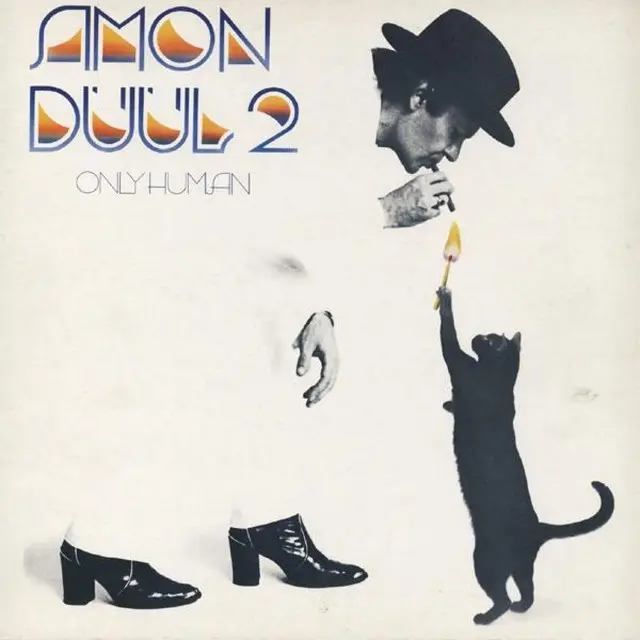 Amon Düül II released their eleventh album, Only Human, in 1978 on Strand.
A1. “Another Morning” (4:00)
A2. “Don’t Turn Too Stone” (3:50)
A3. “Kirk Morgan” (3:18)
A4. “Spaniards & Spacemen” (6:15)
B1. “Kismet” (7:50)
B2. “Pharao” (4:45)
B3. “Ruby Lane” (4:05)
– Chris Karrer / guitar, violin, sax, mouth harp, vocals (B1)
– Stefan Zauner / keyboards, synth, bass, percussion, vocals (A1,A3,B2)
– Klaus Ebert / bass, guitar, vocals (A2,B3)
– Peter Leopold / drums, percussion
Vortex
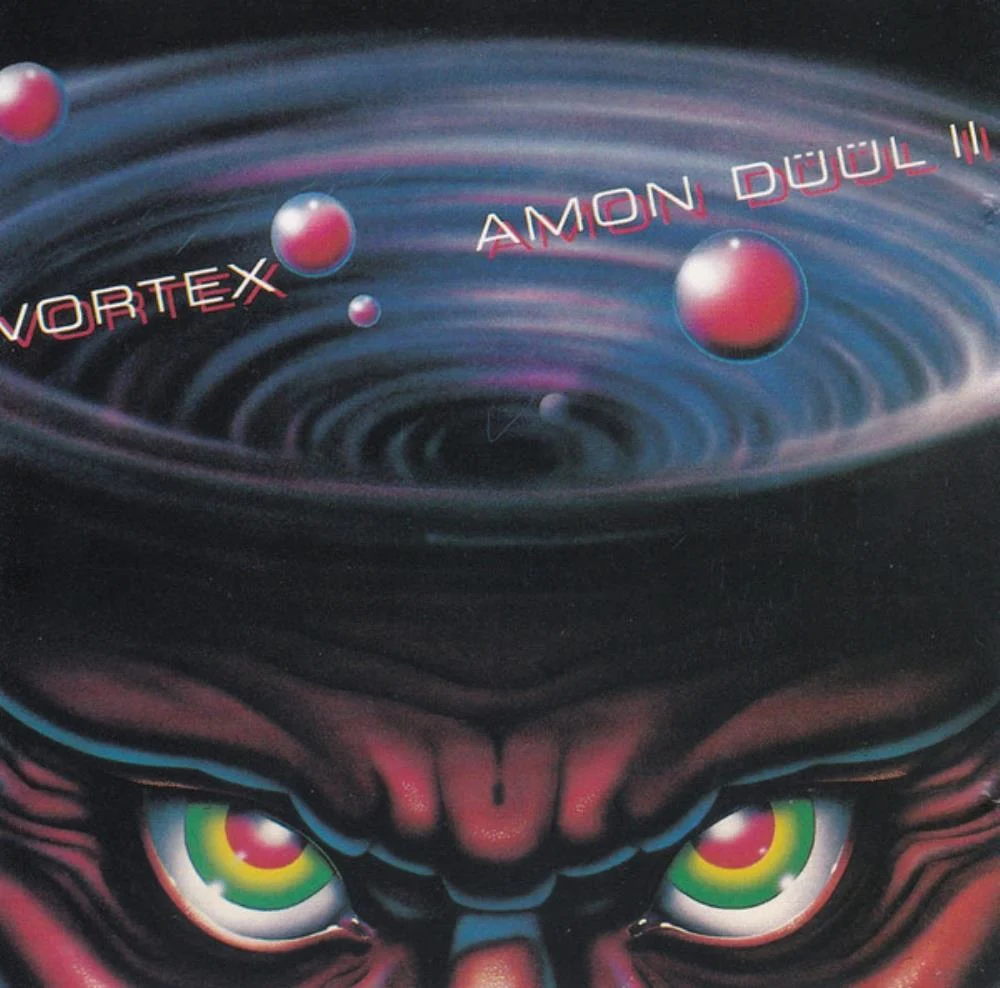 Amon Düül II released their twelfth album, Vortex, in 1981 on Telefunken.
A1. “Vortex” (5:50)
A2. “Holy West” (5:09)
A3. “Die 7 fetten Jahr'” (4:33)
A4. “Wings of the Wind” (4:50)
B1. “Mona” (5:01)
B2. “We Are Machine” (5:16)
B3. “Das Gestern ist das Heute von Morgen” (4:30)
B4. “Vibes in the Air” (6:27)
– Renate Knaup / vocals, tambourine
– Chris Karrer / acoustic & electric guitars, violin, sax
– Falk Rogner / synthesizer
– Jörg Evers / bass, acoustic & electric guitars, synthesizer, producer
– Daniel Fichelscher / drums, percussion, acoustic guitar
Discography:
- Phallus Dei (1969)
- Yeti (1970)
- Tanz der Lemminge (1971)
- Carnival in Babylon (1972)
- Wolf City (1972)
- Live in London (1973)
- Vive la trance (1973)
- Hi-Jack (1974)
- Made in Germany (1975)
- Pyragony X (1976)
- Almost Alive (1977)
- Only Human (1978)
- Vortex (1981)
Sources:
Artist/Album Pages:
Parzival was a German folk-rock band behind the 1971–73 Telefunken albums Legend and BaRock. Mem...
Stained Glass was an American psych-rock band from San Jose that released four singles in 1966/67...
Cleveland Eaton (August 31, 1939 – July 5, 2020) was an American jazz-funk bassist and arranger wh...
Mauro Pelosi (born Aug. 26, 1949) is an Italian singer-songwriter who emerged with the 1972/73 Pol...
Darryl Way’s Wolf was an English jazz-rock band responsible for the 1973–74 Deram albums Canis Lup...
Om was a Spanish jazz-psych/folk band that backed singer/songwriter Pau Riba on his 1970 Concèntr...
Leon's Creation was an American soul-funk band from San Francisco that released the 1970 album Thi...
The Montclairs were an American soul group from East St. Louis, Ill., that released the 1972 album...
Gracious was an English symphonic/art-rock band that released a self-titled album on Vertigo in 1970...
Bram Stoker was an English post-psych band that released the album Heavy Rock Spectacular on Windm...
Trouble was a Danish jazz-rock band behind the 1970 album After the War on Sonet/Telefunken. Me...
Antique was an American Latin-rock band from Miami behind the 1968 album Va Cayendo una Lagrima o...