

Janis Joplin (Jan. 19, 1943 — Oct. 4, 1970) was an American singer who fronted Bay Area blues-rockers Big Brother & the Holding Company, best known for their 1968 album Cheap Thrills and the evergreen “Piece of My Heart.” She went solo with the 1969 Columbia release I Got Dem Ol’ Kozmic Blues Again Mama! and died at age 27 after completing the followup, Pearl, which spawned the posthumous 1971 chart-topper “Me and Bobby McGee.”
Known for her husky voice and commanding stage presence, Joplin sparked a wave of white female blues-rock singers, including Maggie Bell (Stone the Crows), Lynn Carey (C.K. Strong, Mama Lion), Lydia Pense (Cold Blood), Gayle McCormick (Smith), Rosemary Butler (Birtha), Suzanne Rey (A Euphonious Wail), Linda Rothwell (Goliath), Jane Kevern (Room), Carol Grimes (Delivery), Elkie Brooks (Dada, Vinegar Joe), Jenne Haan (Babe Ruth), Jill Saward (Fusion Orchestra), Marge Raymond (Flame), and numerous others.
Background
Janis Lyn Joplin was born on January 19, 1943, in Port Arthur, Texas, to Texaco engineer Seth Ward Joplin and business-school registrar Dorothy East Joplin. She grew up with younger siblings Laura and Michael in Port Arthur. Joplin developed an early interest in drawing and painting, then gravitated in adolescence toward blues and folk records by Bessie Smith, Big Mama Thornton, Lead Belly, and Odetta.
Joplin graduated from Thomas Jefferson High School in 1960 and entered Lamar State College of Technology in Beaumont, where she studied art. She briefly attended Port Arthur College for secretarial courses before moving to Venice, California, in the summer of 1961. Joplin returned to Texas and enrolled at the University of Texas at Austin in 1962 to study art.
Early Music Activity
The Waller Creek Boys teamed Joplin on autoharp with guitarist–singer Lanny Wiggins and singer–harmonica player Powell St. John. The trio appeared at campus folksings and Threadgill’s tavern on North Lamar Boulevard. Joplin recorded her original “What Good Can Drinkin’ Do” at the home of a fellow university student in December 1962.
Joplin left the university in January 1963 and hitchhiked to San Francisco with Texas acquaintance Chet Helms. She sang in North Beach coffeehouses and established herself on the Bay Area folk circuit. Guitarist Jorma Kaukonen accompanied her at several appearances and recorded a June 1964 rehearsal with Joplin at his home.
Friends arranged her return to Port Arthur in May 1965 after her health deteriorated amid heavy amphetamine use. Joplin enrolled at Lamar University as an anthropology major and resumed appearances in Austin as a solo singer with acoustic guitar. She recorded seven acoustic performances in 1965, including her composition “Turtle Blues.”
Big Brother and the Holding Company
Chet Helms contacted Joplin in the spring of 1966 while managing San Francisco group Big Brother and the Holding Company, then sent Travis Rivers to bring her from Austin to San Francisco. Big Brother comprised bassist–singer Peter Albin, drummer Dave Getz, and guitarists Sam Andrew and James Gurley.
Joplin made her first public appearance with the group on June 10 at the Avalon Ballroom. The band signed with Mainstream Records after a September 1966 engagement left the group stranded in Chicago.
Big Brother & the Holding Company
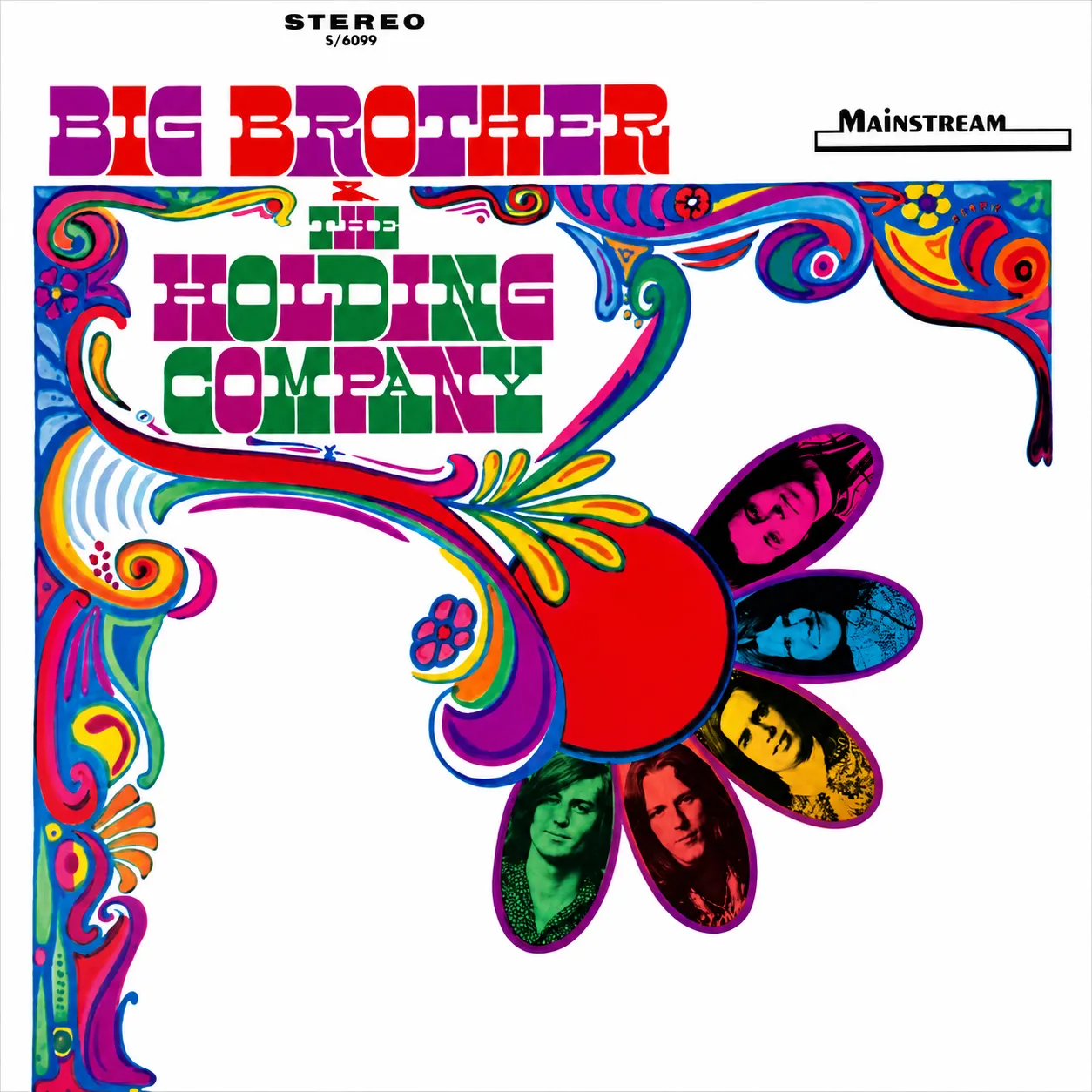 Big Brother and the Holding Company released their self-titled debut album in August 1967 on Mainstream.
The album contains seven group originals across its ten-track program. Remaining material comprises traditional “Down on Me,” Moondog (“All Is Loneliness”), and “Bye, Bye Baby.” Joplin arranged “Down on Me” and contributes “Intruder” and “Women Is Losers.”
“Bye Bye Baby” glides through doubled Joplin lines over gentle accompaniment. “Intruder” churns through a murky mix saturated with fuzz. “Call on Me” slows into a duet before Joplin closes with rasped cries. “Blindman” settles around haunting group replies and restrained lead phrases. “Down on Me” rolls through Joplin’s compact reworking with taut, repeated phrases. “All Is Loneliness” drones through recurring lines with a dark, sustained hum.
A1. “Bye, Bye Baby” (2:37) – St. John
A2. “Easy Rider” (2:23) – Gurley
A3. “Intruder” (2:27) – Joplin
A4. “Light Is Faster Than Sound” (2:30) – Albin
A5. “Call on Me” (2:32) – Andrew
B1. “Women Is Losers” (2:03) – Joplin
B2. “Blindman” (2:23) – Albin, Andrew, Getz, Gurley, Joplin
B3. “Down on Me” (2:04) – traditional; arranged Joplin
B4. “Caterpillar” (2:18) – Albin
B5. “All Is Loneliness” (2:30) – Moondog
Mainstream sessions began in October 1966 in Los Angeles with “Blind Man” and “All Is Loneliness,” then resumed December 12–14 for the album balance. Mainstream founder Bob Shad produced the recordings after extensive jazz, R&B, and blues work with Sarah Vaughan, Dinah Washington, and Lightnin’ Hopkins. His late-Sixties rock activity soon extended to the Amboy Dukes (self-titled).
Mainstream credited Jack Lonshein with front-cover design and Dennis Nolan with back-cover design. Lonshein also handled 1967 sleeves for the Amboys and the Jelly Bean Bandits (Jelly Bean Bandits). Nolan worked inside the San Francisco poster circuit, with 1967 Family Dog bills for Big Brother at the Avalon and the Grateful Dead in Denver.
Mainstream paired “All Is Loneliness” with “Blindman” in October 1966 and “Call on Me” with “Down on Me” in March 1967. “Bye, Bye Baby” (b/w “Intruder”) followed in August, while “Women Is Losers” (b/w “Light Is Faster Than Sound”) appeared in December. “Down on Me” later reached No. 43 on the Billboard Hot 100.
Big Brother & the Holding Company reached No. 60 on Billboard Top LPs and No. 28 on the R&B album chart.
Fame
Joplin reached a national audience with the group at the Monterey International Pop Festival in June 1967, where their second appearance supplied D.A. Pennebaker with a filmed performance of “Ball and Chain.” Columbia president Clive Davis pursued the group after Monterey, while Albert Grossman took over management later that year. Columbia subsequently bought the group out of the Mainstream contract.
Cheap Thrills
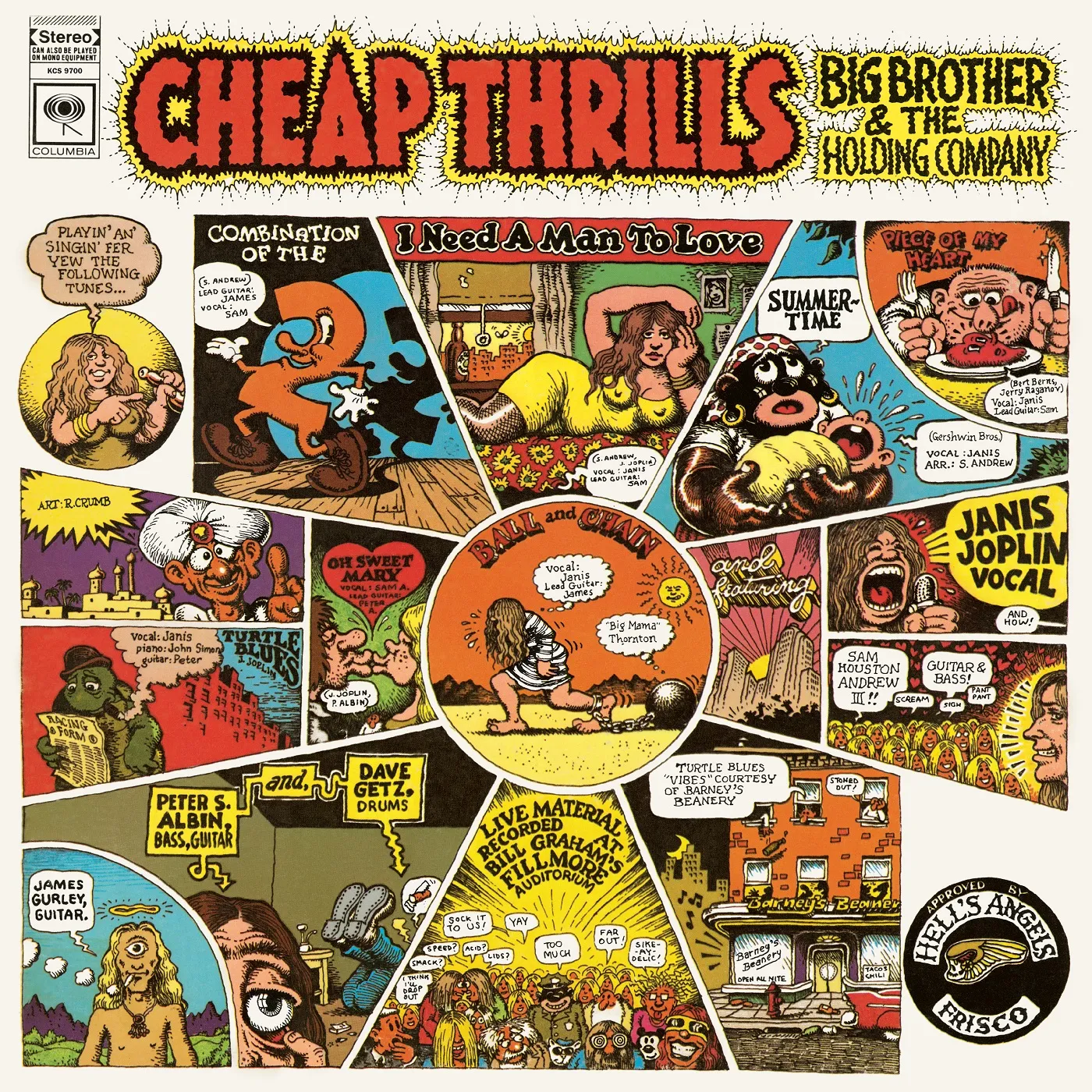 Big Brother and the Holding Company released their second album, Cheap Thrills, on August 12, 1968, on Columbia.
Cheap Thrills contains four group originals and three outside songs. Cover material draws from Porgy and Bess (“Summertime”), Erma Franklin (“Piece of My Heart”), and Big Mama Thornton (“Ball and Chain”). Joplin contributes “Turtle Blues,” while “Oh, Sweet Mary” carries a full-group credit.
“Combination of the Two” careens through feedback as Sam Andrew takes lead before Joplin harmony cuts across later phrases. “I Need a Man to Love” grinds through wild feedback under repeated pleas and roughened sustained lines. “Summertime” aches through drawn-out lines toward a searing guitar solo. “Piece of My Heart” charges through a sparse arrangement, with accompaniment receding beneath rasped peaks.
“Turtle Blues” saunters over barrelhouse piano and nimble fill figures. “Oh, Sweet Mary” swirls through a driving beat and dense instrumental passages. “Ball and Chain” lumbers from a false-start entrance into a languid, hypnotic live stretch.
A1. “Combination of the Two” (5:45) – Andrew
A2. “I Need a Man to Love” (4:56) – Andrew, Joplin
A3. “Summertime” (3:59) – George Gershwin, Ira Gershwin, Heyward
A4. “Piece of My Heart” (4:12) – Berns, Ragovoy
B1. “Turtle Blues” (4:21) – Joplin
B2. “Oh, Sweet Mary” (4:16) – Albin, Andrew, Getz, Gurley, Joplin
B3. “Ball and Chain” (9:30) – Thornton
Sessions spanned March through May 1968 at Columbia Recording Studios in Hollywood and New York, with John Simon producing. His adjacent work included Leonard Cohen (Songs of Leonard Cohen), Blood, Sweat & Tears (Child Is Father to the Man), and the Band (Music from Big Pink). Columbia engineers Fred Catero, Jerry Hochman, and Roy Segal share the engineering credit with Joplin and James Gurley; “Ball and Chain” preserves an April Winterland performance.
R. Crumb drew the song-by-song comic grid for the back sleeve before Joplin selected the artwork for the front cover. Crumb launched Zap Comix in the same year, linking the package to the San Francisco underground-comics circuit. The gatefold credits group photography to Elliot Landy and the portrait of Joplin to Thomas Weir.
Columbia issued “Piece of My Heart” (b/w “Turtle Blues”) in August 1968. The single reached No. 12 on the Billboard Hot 100.
Cheap Thrills reached No. 1 on Billboard Top LPs and No. 7 on the R&B album chart.
Kozmic Blues Band
Increased attention on Joplin coincided with disputes over Holding Company’s group direction. She announced her departure in September and completed her remaining Big Brother commitments near the end of the year.
Joplin and Sam Andrew left Big Brother in December 1968 as Albert Grossman enlisted guitarist Mike Bloomfield and singer–songwriter Nick Gravenites to help assemble a new group. The resulting Kozmic Blues Band placed Joplin and Andrew with bassist Brad Campbell, keyboardist Richard Kermode, drummer Maury Baker, and a brass section built around Cornelius “Snooky” Flowers, Terry Clements, and Luis Gasca.
I Got Dem Ol’ Kozmic Blues Again Mama!
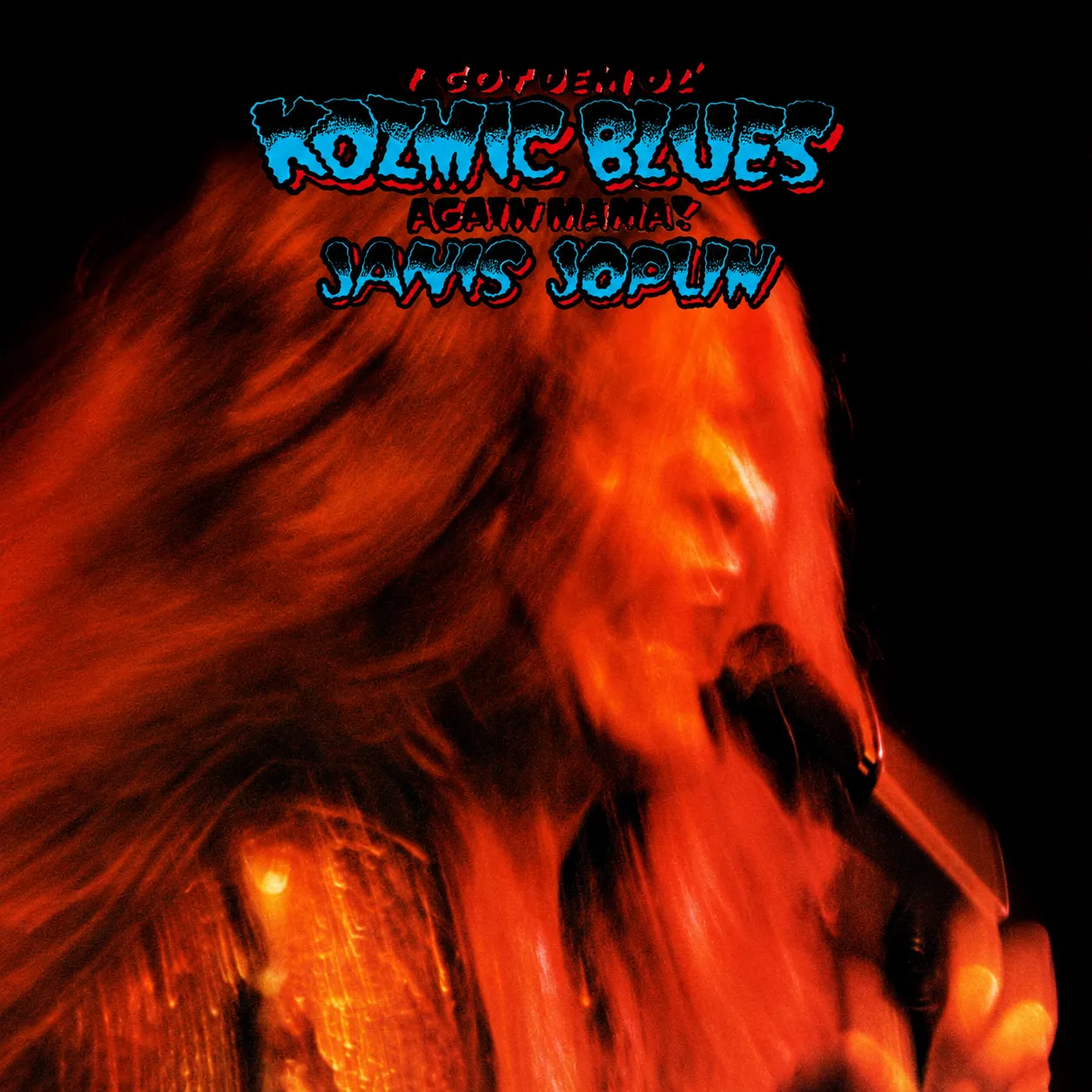 Janis Joplin released her debut solo album, I Got Dem Ol’ Kozmic Blues Again Mama!, in September 1969 on Columbia.
Kozmic Blues contains four covers among eight tracks, drawn from Lorraine Ellison (“Try [Just a Little Bit Harder]”), the Chantels (“Maybe”), the Bee Gees (“To Love Somebody”), and Nina Simone (“Little Girl Blue”). Andrew returns on guitar beside bassist Brad Campbell and organist Richard Kermode; guitarist Mike Bloomfield appears on four titles. Additional players include trumpeter Luis Gasca with saxophonists Terry Clements and Cornelius “Snooky” Flowers.
“Try (Just a Little Bit Harder)” stomps through backing replies and brassy breaks as Joplin leaps from shouts to falsetto squalls. “Maybe” slows into spacious accompaniment, with Joplin sustaining plaintive lines before a saxophone coda. “One Good Man” broods from organ entrance into a slide-guitar passage beneath roughened lead lines. “As Good as You’ve Been to This World” simmers through an extended instrumental lead-in before Joplin breaks in with hard-edged shouts.
“To Love Somebody” swells through dramatic pleading from softened phrases into harsher peaks. “Kozmic Blues” smolders at slow tempo between restrained phrases and rougher peaks. “Little Girl Blue” lingers through sparse, slow accompaniment with unusually understated phrasing. “Work Me, Lord” pleads through sparse backing before broader, soaring peaks.
A1. “Try (Just a Little Bit Harder)” (3:57) – Ragovoy, Taylor
A2. “Maybe” (3:41) – Barrett
A3. “One Good Man” (4:12) – Joplin
A4. “As Good as You’ve Been to This World” (5:27) – Gravenites
B1. “To Love Somebody” (5:14) – Barry Gibb, Robin Gibb
B2. “Kozmic Blues” (4:24) – Joplin, Mekler
B3. “Little Girl Blue” (3:51) – Hart, Rodgers
B4. “Work Me, Lord” (6:45) – Gravenites
Sessions took place in June 1969 at Columbia Records Studios in New York, with Gabriel Mekler producing for Lizard Productions. Mekler came from 1968/69 Dunhill work on Steppenwolf (Steppenwolf, At Your Birthday Party, Monster) and Three Dog Night (Three Dog Night, Suitable for Framing). Sy Mitchell, Jerry Hochman, and Alex Kazanegras engineered the album; concurrent work by Hochman included Taj Mahal (Giant Step/De Ole Folks at Home).
Bruce Steinberg supplied the cover portrait, while R. Crumb returned for cover lettering. Steinberg also handled center/back photography for the 1969 self-titled album by It’s a Beautiful Day. The back sleeve collects photographs by Michael Friedman, Richard DiLello, and Fred Lombardi.
Columbia issued “Kozmic Blues” (b/w “Little Girl Blue”) in October 1969, and the single reached No. 41 on the Billboard Hot 100. “Try (Just a Little Bit Harder)” (b/w “One Good Man”) followed in January 1970, then “Maybe” (b/w “Work Me, Lord”) in March.
I Got Dem Ol’ Kozmic Blues Again Mama! reached No. 5 on Billboard Top LPs.
Final Months and Death
Joplin entered 1970 with a new backing group after the dissolution of the Kozmic Blues Band. Full Tilt Boogie placed guitarist John Till, bassist Brad Campbell, drummer Clark Pierson, pianist Richard Bell, and organist Ken Pearson behind Joplin for a spring and summer schedule. She introduced the group at Louisville’s Freedom Hall on June 12 and returned to The Dick Cavett Show later that month.
Joplin appeared on Cavett on June 25 with Raquel Welch, Douglas Fairbanks Jr., and television journalist Chet Huntley. She performed “Move Over,” then joined the guests for the extended panel conversation. Joplin told Welch that rapid scene changes made Myra Breckinridge difficult to follow; Welch answered with a joke built around the film’s theme of change. Joplin also discussed her approaching tenth high-school reunion in Port Arthur.
Joplin joined the Festival Express train tour across Canada from June 28 through July 4 alongside the Grateful Dead and other touring groups. She returned to Cavett on August 3 for her final television appearance, where Full Tilt Boogie accompanied “Half Moon” and “My Baby.” Joplin played her final public concert at Harvard Stadium on August 12 before an estimated crowd of 40,000. Three days later, she returned to Port Arthur for the Thomas Jefferson High School class reunion that she had discussed with Cavett.
Joplin remained in Los Angeles in the autumn as work proceeded at Sunset Sound Recorders. She returned to the studio on October 3 to hear an instrumental track prepared for a session scheduled for the following day, then went back to Room 105 at the Landmark Motor Hotel in Hollywood. Road manager John Cooke found Joplin dead on the floor of the room on October 4 after she failed to appear at Sunset Sound. Los Angeles County coroner Thomas Noguchi attributed the death to acute heroin-morphine intoxication from an injected overdose. Joplin was 27 years old.
Rock audiences lost Jimi Hendrix on September 18, then Joplin sixteen days later in Hollywood. Editors placed news of Joplin across American front pages by October 5, including the Houston Chronicle, while British and French newspapers published immediate coverage of the singer. Musicians at Winterland in San Francisco learned the news backstage while the Grateful Dead performed, and Rolling Stone editors devoted extensive space to Joplin in the October 29 issue.
Joplin was cremated in Los Angeles, and her family scattered her ashes over the Pacific near Stinson Beach. Her will allocated $2,500 for a memorial party at the Lion’s Share in San Anselmo, where invitations carried the message “Drinks are on Pearl.”
Joplin spent her final weeks recording at Sunset Sound with producer Paul A. Rothchild and Full Tilt Boogie. She completed “Mercedes Benz” on October 1 and left most of a new album sufficiently advanced for Rothchild and the musicians to finish after her death. Those sessions became Pearl.
Pearl
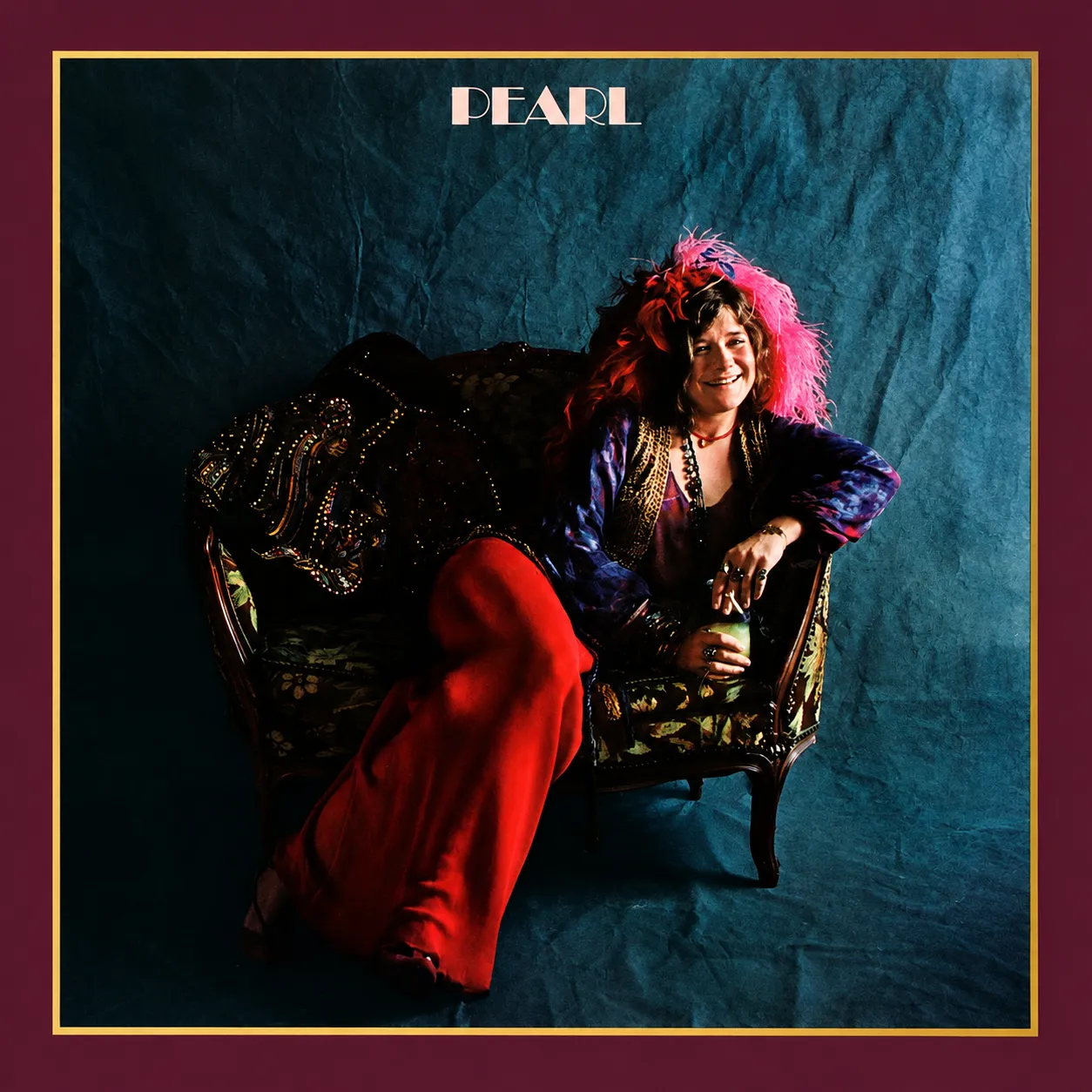 On January 11, 1971, Columbia released Pearl, the posthumous second solo album by Janis Joplin.
Pearl features Campbell with guitarist John Till, drummer Clark Pierson, pianist Richard Bell, and organist Ken Pearson in the Full Tilt Boogie lineup. Joplin covers songs associated with Garnet Mimms and the Enchanters (“Cry Baby,” “My Baby”), Roger Miller (“Me and Bobby McGee”), and Howard Tate (“Get It While You Can”). Bobby Womack wrote “Trust Me” and plays acoustic guitar on the track. “Buried Alive in the Blues” appears as an instrumental; Joplin died before she recorded her part.
“Move Over” drives from an abrupt opening beat into a biting ensemble pattern, with organ thickening Joplin lead lines. “Cry Baby” smolders through softened phrases before Joplin erupts into piercing peaks and a spoken middle passage. “A Woman Left Lonely” rises from churchy chords as Joplin climbs from subdued lines into higher cries. “Half Moon” bounces through an upbeat feel with brisk, compact ensemble figures. “Buried Alive in the Blues” roils through dense instrumental lines as band parts interlock across a hard-driving passage.
“My Baby” surges through group replies before a country-tinged guitar solo. “Me and Bobby McGee” gathers from conversational phrasing into a broad late rise and instrumental break. “Mercedes Benz” chants unaccompanied lines in a dry, conversational take. “Trust Me” sways between near-sweet restraint and rasped outbursts. “Get It While You Can” climbs from piano entrance into a closing crescendo.
A1. “Move Over” (3:40) – Joplin
A2. “Cry Baby” (3:55) – Ragovoy, Berns
A3. “A Woman Left Lonely” (3:26) – Penn, Oldham
A4. “Half Moon” (3:50) – John Hall, Johanna Hall
A5. “Buried Alive in the Blues” (2:23) – Gravenites
B1. “My Baby” (3:43) – Ragovoy, Shuman
B2. “Me and Bobby McGee” (4:28) – Kristofferson, Foster
B3. “Mercedes Benz” (1:45) – Joplin, McClure, Neuwirth
B4. “Trust Me” (3:14) – Womack
B5. “Get It While You Can” (3:22) – Ragovoy, Shuman
Sessions spanned September through early October 1970 at Sunset Sound in Hollywood, with producer Paul A. Rothchild and engineer Phil Macy. Rothchild came directly from 1969/70 work with The Doors (The Soft Parade, Morrison Hotel). Adjacent Columbia work by Macy includes Johnny Mathis (Raindrops Keep Fallin’ on My Head, Love Story).
Pearl carries photography and design by Barry Feinstein and Tom Wilkes for Camouflage Productions. A Feinstein session on October 3, 1970 produced the front-cover portrait of Joplin reclining on a Victorian loveseat. The Camouflage pair also handled 1970/71 packaging for George Harrison (All Things Must Pass) and Barbra Streisand (Stoney End).
Columbia issued “Me and Bobby McGee” (b/w “Half Moon”) in January 1971, and the single reached No. 1 on the Billboard Hot 100. “Cry Baby” (b/w “Mercedes Benz”) followed in April and reached No. 42, while “Get It While You Can” (b/w “Move Over”) appeared in August and reached No. 78.
Pearl reached No. 1 on the Billboard album chart and remained there for nine weeks.
Joplin in Concert
On April 24, 1972, Columbia released Janis Joplin’s posthumous double-live album Joplin in Concert.
The first disc draws from Big Brother & the Holding Company performances from 1968 and the April 1970 Fillmore West reunion, while disc two documents Full Tilt Boogie Band at Festival Express stops in Toronto and Calgary. Big Brother sides retain Albin, Getz, Gurley, and Andrew, with Nick Gravenites alongside Joplin on “Ego Rock.” Full Tilt sides retain Bell, Campbell, Pearson, Pierson, and Till.
A1. “Down on Me” (3:05) – Traditional, arr. Joplin
A2. “Bye, Bye Baby” (4:29) – St. John
A3. “All Is Loneliness” (5:44) – Hardin
A4. “Piece of My Heart” (4:19) – Ragovoy–Berns
B1. “Road Block” (2:53) – Joplin–Albin
B2. “Flower in the Sun” (3:07) – Andrew
B3. “Summertime” (4:31) – Heyward–Gershwin
B4. “Ego Rock” (8:32) – Gravenites–Joplin
C1. “Half Moon” (4:36) – J. Hall–J. Hall
C2. “Kozmic Blues” (6:05) – Joplin–Mekler
C3. “Move Over” (5:09) – Joplin
D1. “Try (Just a Little Bit Harder)” (8:13) – Ragovoy–Taylor
D2. “Get It While You Can” (7:04) – Ragovoy–Shuman
D3. “Ball and Chain” (9:15) – Thornton
Elliot Mazer collected and assembled tapes made between March 1968 and July 1970 at Grande Ballroom in Detroit, Winterland, Carousel Ballroom and Fillmore West in San Francisco, plus Festival Express stops in Toronto and Calgary. Columbia assigned re-recording and editing to engineers Don Puluse, Larry Keyes, and Tim Geelan.
Bob Cato and Squadra Galileo designed the gatefold around photography by David Gahr. The front places a black-and-white close-up of Joplin in round glasses beneath red outlined lettering, while the inner spread uses a full-length Gahr portrait. Clive Davis wrote liner notes.
Joplin in Concert reached No. 4 on the Billboard 200 and No. 30 on the UK Albums Chart.
Farewell Song
In February 1982, Columbia released Farewell Song, a posthumous collection of nine previously unreleased Janis Joplin recordings.
The collection spans live tapes and studio outtakes from 1967–70. Six selections feature Big Brother & the Holding Company, while “Tell Mama” uses Full Tilt Boogie Band and “Raise Your Hand” captures Kozmic Blues Band. “One Night Stand” pairs Joplin with Paul Butterfield Blues Band in a March 1970 studio session produced by Todd Rundgren.
A1. “Tell Mama” (5:43) – Daniel–Terrell–Carter
A2. “Magic of Love” (2:52) – Spoelstra
A3. “Misery’N” (4:12) – Albin–Andrew–Getz–Gurley–Joplin
A4. “One Night Stand” (3:04) – Flast–Gordon
A5. “Harry” (0:56) – Albin–Andrew–Getz–Gurley–Joplin
B1. “Raise Your Hand” (3:40) – Floyd–Cropper–Isbell
B2. “Farewell Song” (4:35) – Andrew
B3. “Medley: Amazing Grace / Hi Heel Sneakers” (2:33) – Traditional, arr. Albin–Andrew–Getz–Gurley–Joplin / Higginbottom
B4. “Catch Me Daddy” (4:50) – Albin–Andrew–Getz–Gurley–Joplin
Source recordings span January 1967 at Matrix in San Francisco through June 1970 at Festival Express in Toronto, with studio material from Columbia facilities in New York and Los Angeles. Elliot Mazer produced the 1982 assembly and mixed the material with Larry Keyes at CBS Recording Studios in Los Angeles and New York and His Master’s Wheels in San Francisco. Ray Janos mastered the album.
Mazer also rebuilt selected backing tracks with contemporary overdubs. His revisions included replacement of Peter Albin’s original bass part on “Farewell Song” with a new bass track, part of a broader attempt to reshape older tapes for the 1982 release.
Bob Cato designed the sleeve around a Bruce Steinberg close-up photograph of Joplin singing into a handheld microphone against a blue background. Michael Manoogian added white script lettering across the upper edge, while Country Joe McDonald wrote liner notes.
CBS issued “One Night Stand” as a 1982 German single (b/w “Catch Me Daddy”).
Farewell Song reached No. 104 on the Billboard 200
Discography:
- Big Brother & the Holding Company (1967)
- Cheap Thrills (1968)
- I Got Dem Ol’ Kozmic Blues Again Mama! (1969)
- Pearl (1971)
- Joplin in Concert (1972)
- Farewell Song (archival, 1982)
Sources:
Artist/Album Pages:
Gothic Horizon was an English folk-rock duo that released the 1971–72 albums The Jason Lodge Poetr...
Herbie Mann (April 16, 1930 — July 1, 2003) was an American jazz flutist, multi-reedist, bandleade...
Marconi Notaro (July 10, 1949 — Oct. 24, 2000) was a Brazilian folk-psych singer/songwriter behind...
Thelma Houston is an American soul singer who emerged with a pair of 1966/67 Capitol singles, foll...
Hawk was a South African hard-rock/psych band behind the 1971/72 Parlophone albums African Day and...
Bo Hansson (April 10, 1943 – April 23, 2010) was a Swedish keyboardist and composer best known for h...
Yusef Lateef (October 9, 1920 — December 23, 2013) was an American reedist and composer with a six...
Marie Queenie Lyons is an American soul singer who released the 1970 album Soul Fever on DeLuxe R...
Fusioon was a Spanish jazz-rock band that made the 1973/74 albums Fusioon and Fusioon 2, followed ...
Paul Jones is an English singer and songwriter, best known as the original vocalist of Manfred Mann....
Nkengas were a Nigerian highlife ensemble that released two albums in 1973 on Orbitone. The band s...
Carmel was an English jazz-pop/soul combo from Manchester led by the namesake vocalist Carmel McCo...