

Stained Glass was an American psych-rock band from San Jose that released four singles in 1966/67 on RCA Victor, followed by the 1968/69 Capitol albums Crazy Horse Roads and Aurora. Bassist/singer Jim McPherson resurfaced in Copperhead.
Members: Jim McPherson (bass, vocals), Dennis Carrasco (drums, vocals), Roger Hedge (guitar, vocals, 1966-67) Bob Rominger (guitar, vocals, 1966-68), Tom Bryant (guitar, 1968-69)
Background
Stained Glass formed in 1965 in San Jose, California, originating as The Trolls*, a club-oriented group led by college students Roger Hedge (guitar, vocals) and Jim McPherson (bass, vocals). Initially motivated by the local demand for live music, they brought in drummer Dennis Carrasco, then a high schooler with prior studio experience in the East Bay instrumental combo The Persuaders. Before joining, Carrasco had recorded unreleased material with that group and later cut a single as part of the Music City Frogs. With Carrasco onboard, The Trolls shifted toward youth venues and strengthened their vocal arrangements, assigning lead vocal duties across the lineup.
The Trolls’ sole release came in 1965 with “Walking Shoes” backed with “How Do You Expect Me to Trust You,” issued first as a self-pressed disc and then relabeled for release on the group’s own Peatlore imprint. Both sides, written by McPherson, were informed by Dylan-esque lyricism and a raw, local-studio sound. The band also recorded five additional tracks at Coast Recorders in San Francisco that remained unreleased until decades later. A brief Columbia Records demo session in early 1966 yielded three songs—each written by a different member—but led nowhere after a short-lived misunderstanding over the group’s signing status.
Following the Columbia setback, the group adopted the name Stained Glass Window at the suggestion of their production company, Jackson Square Productions. By the time of their RCA signing later that year, the name was shortened to Stained Glass. Hedge departed in 1966 and was replaced by lead guitarist Bob Rominger. Hedge, the group’s originator and an early business-minded presence, later passed away in 2021.
*No relation to the pre-LP iteration of Chicago psychsters The Troll.
RCA Singles
Stained Glass debuted on RCA in June 1966 with a cover of “If I Needed Someone,” recorded quickly with Carrasco on lead vocal and minimal overdubs. The B-side, “How Do You Expect Me,” was a revised version of their prior Trolls single, shortened and restructured at producer Danny Davis’s request. Their second RCA single, issued that September, paired “My Buddy Sin” — marked by Billy Mure’s harp and a brisk solo from Rominger — with “Vanity Fair,” a tighter ensemble track built on rhythmic control and close-harmony vocals.
In early 1967, RCA assigned the band “We Got a Long Way to Go,” a Barry Mann–Cynthia Weil tune tracked in one day with Carrasco again on lead and Rominger contributing a clipped, urgent solo. The B-side, “Corduroy Joy,” co-written by McPherson and Rominger, featured conversational exchanges over a tight rhythmic figure, capturing the group’s growing confidence and self-directed studio approach. Their final RCA single, released that October, matched the amplified textures and dynamic build of “A Scene In-Between” with the sharp syncopation of “Mediocre Me,” both indicative of a shift toward heavier tones and more spatial use of instrumentation.
Despite regular sessions, RCA limited the band to two singles per year and withheld approval for a full-length release. By late 1967, with no LP in sight and minimal promotional backing, the band’s management arranged a move to Capitol, where they regrouped with a revised lineup and broader creative scope.
In April 1968, Stained Glass released their Capitol debut single: “Lady in Lace” (b/w “Soap and Turkey”), a theatrical, Vaudeville-tinged number with ornate arrangement and whimsical flair. The label green-lit a full album.
Crazy Horse Roads
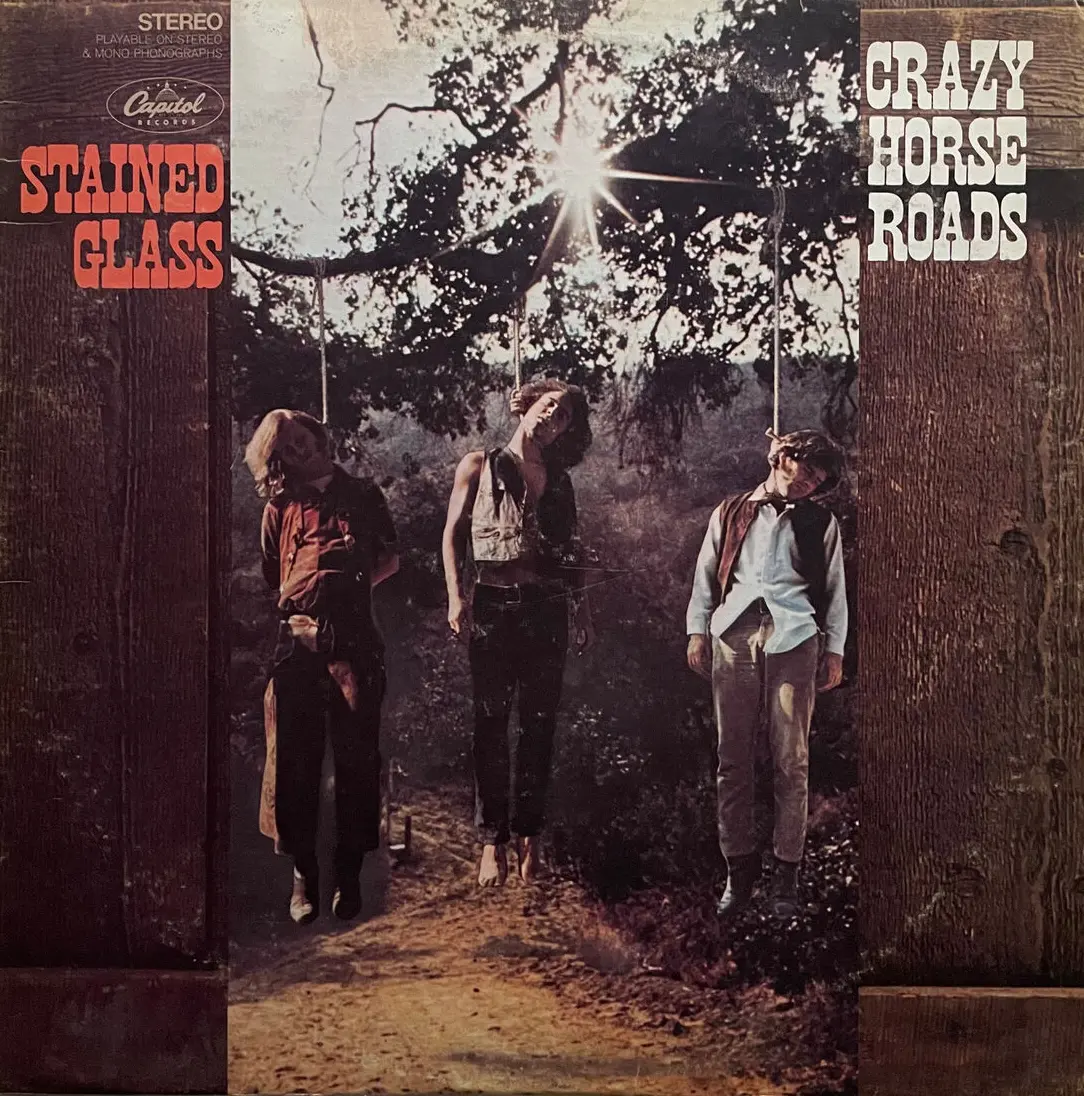 Stained Glass released their debut album, Crazy Horse Roads, in December 1968 on Capitol.
The album marked a pivot from compact singles into longform composition, with bassist Jim McPherson assuming primary authorship. Produced by Max Hoch and John Gross, the LP reflects the group’s movement away from their RCA-era harmonics toward a more electric and layered approach. Arranged in part by Lex de Azevedo, the sessions introduced chamber elements and studio ornamentation atop core trio arrangements. Capitol issued the track “Fahrenheit” as a promotional single.
McPherson wrote or co-wrote all eleven songs, with drummer Dennis Carrasco and guitarist Bob Rominger contributing to two. Lex de Azevedo played piano on “Fahrenheit,” while all other strings and woodwinds were arranged for outside players. Carrasco and Rominger provided harmony vocals, while lead duties stayed with McPherson throughout.
The album moves between clipped chamber pop, taut fuzz leads, and midtempo folk-rock, paced by McPherson’s pliant vocal phrasing and Rominger’s focused guitar work. “Sing Your Song” opens with sharpened harmonies, blended with saturated fuzz. “Soap and Turkey,” previously issued as a B-side, builds its contour from fingerpicked guitar and quick vocal stacking. “Fahrenheit” wields scorched fuzz leads while “Light Down Below” delivers a searing tone. “Nightcap” leans into lighter psych figures with flute and layered refrain, while “Twiddle My Thumbs” slows the pace under orchestral strings and falsetto. Closer “Doomsday” collapses into a protracted coda of noise and decay.
A1. “I Sing You Sing” (3:05) – Vocal trio arrangement against layered fuzz and bright rhythm guitar
A2. “Finger Painting” (2:11) – McPherson’s faux-English vocal phrasing with close-picked jangle guitar
A3. “Soap and Turkey” (2:39) – Fingerpicked figure under bright harmony layers and clipped vocal phrases
A4. “Twiddle My Thumbs” (2:40) – Falsetto lead over ornate strings; restrained, slow-paced
A5. “Fahrenheit” (3:43) – Saturated fuzz line under brisk tempo; alternating vocal lines
B1. “Nightcap” (2:55) – Flute and toy-pop accents with shifting phrasing
B2. “Horse On Me” (2:18) – Quickened pulse, fuzz textures; sharp harmony phrasing
B3. “Two Make One” (3:10) – Mid-tempo ballad with brassy horn interjections
B4. “Light Down Below” (3:22) – Densely compressed fuzz solo over steady rhythm
B5. “Piggy Back Ride and the Camel” (2:10) – Fragmented pace, intercut voices, and spoken elements
B6. “Doomsday” (4:23) – Builds to a sustained sonic collapse across final minute
The album was recorded and pressed by Capitol Records, Los Angeles, and published under Beechwood Music Corp. Arrangements were handled by de Azevedo alongside the band, with Rod Dyer providing photography. Production was overseen by John Gross and Max Hoch. Instrumental embellishments—piano, strings, flute—were performed by session players, with piano on “Fahrenheit” tracked by de Azevedo.
The cover concept—three members shown hanged from a tree—was proposed by Carrasco and approved without resistance from Capitol. The title references a roadside sign along Highway 101 near Salinas. Though four members are credited, only McPherson, Carrasco, and Rominger appear on the jacket; Tom Bryant joined after Rominger’s departure and did not perform on the album.
Capitol issued “Fahrenheit” backed with “Twiddle My Thumbs” as a promo-only 7″ (P-2372) in early 1969. No stock pressing followed, and the single received little promotional support.
Though overlooked on release, Crazy Horse Roads has gradually earned collector interest for its tonal range and Rominger’s controlled guitar execution. Reissue liner notes have since been corrected to reflect McPherson’s sole authorship on most tracks.
Aurora
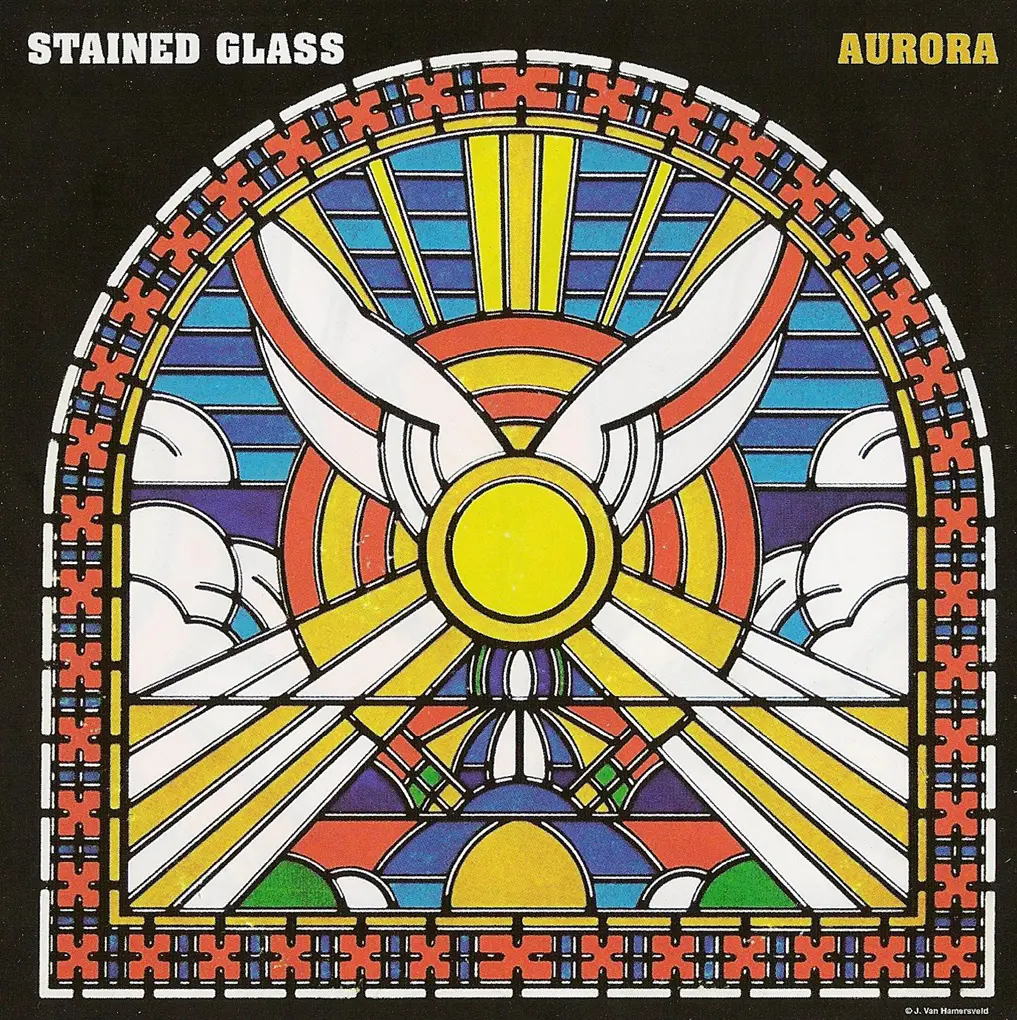 Stained Glass released their second album, Aurora, in May 1969 on Capitol.
Recent recruit Tom Bryant took over lead guitar duties while Jim McPherson remained primary writer and vocalist. The group’s prior vocal blend and chamber textures gave way to a stripped, trio-based approach grounded in live performance. With most tracks developed on stage, the arrangements lean on repetition and extended instrumental forms. The sole outside contribution is a cover of Lincoln Chase’s “Jim Dandy.”
Side one moves between clipped rhythm figures and mid-tempo blues forms. “Gettin’ On’s Gettin’ Rough” opens the album with brisk vocal turns and close harmonies. The band’s version of “Jim Dandy” follows a direct structure, with Bryant’s solo as the main departure. “A Common Thief” slows the pace with staggered phrasing and compressed backing. “The Kibitzer,” built on a Diddley-derived riff, centers on Carrasco’s percussion and became a live staple, later re-recorded by McPherson with Copperhead.
Side two draws further from Cream-era structures. “Inca Treasure” departs from the rest with layered echo effects and distant percussion arranged by session player Milt Holland. Bryant’s playing emphasizes reverb and contour, with space left for the rhythmic elements to expand. “Daddy’s Claim,” “Sweetest Thing,” and “Mad Lynn Ball” adopt a more distorted tone, anchored by McPherson’s falsetto phrasing and Bryant’s tight solos. “The Necromancer” closes the set with clipped pace and rising distortion, its bass line pushing against a constricted vocal line.
A1. “Gettin’ On’s Gettin’ Rough” (2:58)
A2. “Jim Dandy” (3:14)
A3. “A Common Thief” (5:20)
A4. “The Kibitzer” (5:00)
B1. “Inca Treasure” (3:37)
B2. “Daddy’s Claim” (3:44)
B3. “Sweetest Thing” (3:26)
B4. “Mad Lynn Ball” (3:42)
B5. “The Necromancer” (3:42)
The album was recorded live with minimal post-production under the direction of producer Voyle Gilmore. Capitol issued “Gettin’ On’s Gettin’ Rough” backed with “The Necromancer” as a single.
The album marked the end of Stained Glass’s tenure with Capitol. With no tour support and limited backing, they parted ways with the label.
After Stained Glass
The band continued briefly as Christian Rapid, an alternate name with no religious affiliation. The lineup expanded with guitarist/organist Lance Libby and percussionist Louie Schaivo. Jim McPherson introduced new material, including “Lovin’ Nobody,” later performed during a Fillmore West set opened as a trio for B.B. King and Ballin’ Jack after Libby and Schaivo quit. Bill Graham arranged a follow-up demo session that produced “Lovin’ Nobody” and “Wind Song,” both aired by San Jose DJ Mark Sherry.
The band dissolved in 1971. McPherson collaborated with Dennis Carrasco and Tom Bryant on studio work through the mid-1970s, including sessions for his solo album A Promise Kept, released posthumously in 2009. He joined Copperhead and co-wrote Jefferson Starship’s “Jane” before his death in 1985 at age 40. Bryant played with Gabor Szabo and remained active in music. Carrasco stayed in San Jose and issued the album Propellor in 2021 with contributions from his sons and Bruce Turgon of Foreigner. Roger Hedge left music and pursued competitive badminton. Bob Rominger became a fighter pilot and later transitioned to aviation.
Discography:
- Crazy Horse Roads (1969)
- Aurora (1969)
Sources:
Artist/Album Pages:
Kebnekaise was a Swedish ethno-folk/jam band that released five albums on Silence between 1971 and...
Ripple was an American funk band that made a 1973 self-titled album on GRC, followed by the 1977 S...
Kiki Dee is an English pop-rock singer who cut nine singles (1963–67) on Fontana, which issued her...
Bill Withers (1938–2020) was an American soul singer/songwriter, best known for the 1971/72 AM eve...
Sigmund Snopek III (born Oct. 21, 1951) is an American multi-instrumentalist, composer, and produc...
The Keef Hartley Band was an English brass-rock ensemble that released five albums and a live disc...
Ramases was the performance moniker of English folk-psych musician Kimberley Barrington Frost, who...
Universal Jones was an American soul-funk band that released the 1972 album Vol. 1 on MGM, produc...
George Duke (January 12, 1946 – August 5, 2013) was an American jazz-funk keyboardist, composer, arr...
Zoot was an Australian rock band from Adelaide that released seven singles between 1968 and 1971 on ...
Hamilton Streetcar was an American psych-rock band from Los Angeles that released two 1967/68 sing...
Dust was an American northeast power trio that released two albums, Dust and Hard Attack, on Kama...