

Lenny White is an American jazz-rock drummer who emerged behind Miles Davis (Bitches Brew) and Freddie Hubbard (Red Clay). After guesting on Santana‘s Caravanserai, he cut two albums with Latin-rockers Azteca.
White joined bassist Stanley Clarke in keyboardist Chick Corea‘s Return to Forever for the 1973 release Hymn of the Seventh Galaxy. With guitarist Al Di Meola, he drummed in the classic RTF quartet, which made the 1974–76 albums Where Have I Known You Before, No Mystery, and Romantic Warrior.
As a solo artist, White debuted with the 1975 Nemperor release Venusian Summer, followed by Big City and the 1978 Elektra titles Streamline and The Adventures of Astral Pirates. Along with fellow jazz-rock drummers Billy Cobham (Mahavishnu Orchestra), Alphonse Mouzon (Weather Report, Eleventh House), and Tony Williams, White earned plaudits for his speed, precision, intricacy, and timing.
In 1979, White formed Twennynine, a jazz-funk-soul group that cut three albums and scored R&B hits with “Best of Friends,” “Fancy Dancer,” and “Didn’t Know About Love (Till I Found You).”
Background
He was born Lenny White III on December 19, 1949, in Queens, New York City. From a young age, his father took him to jazz shows. A self-taught drummer by his teens, White soon landed spots in groups on the local jazz scene.
Early Credits
In the late Sixties, White gigged regularly at Slugs (242 East 3rd St.) and The Gold Lounge, where he backed saxophonist and Blue Note recording artist Jackie McLean. He came to the attention of Miles Davis, who hired White for an August 21, 1969, session that produced two long tracks (“Pharaoh’s Dance” and “Spanish Key”) on Miles’ landmark double-album Bitches Brew, released in March 1970 at the outset of the jazz-rock era.
In 1970, White appeared on albums by Freddie Hubbard (Red Clay), Joe Henderson (At the Lighthouse,), and Terumasa Hino (Just Flash In the Cosmic Pan, billed as Everything Is Everything). After notching credits on 1971 titles by Gato Barbieri (Fenix) and Woody Shaw (Blackstone Legacy), White played castanets on Caravanserai, the 1972 Latin/jazz-rock album by Santana.
Azteca
In 1972, White joined Santana alumni Neal Schon (guitar) and Coke Escovedo (percussion) in Azteca, a Latin-rock big band formed by Coke and his elder brother, percussionist Pete Escovedo. They cut the 1972/73 Columbia albums Azteca and Pyramid of the Moon. Concurrently, White played on 1972/73 titles by Buddy Terry (Pure Dynamite), Luis Gasca (For Those Who Chant), Eddie Henderson (Realization), Curtis Fuller (Crankin’), and Weldon Irvine (Time Capsule).
Return to Forever
In late December 1972, White backed Fuller-associate Stanley Clarke on sessions for the bassist’s debut album, Children of Forever. In 1973, White followed Clarke into the second iteration of Return to Forever, which bandleader Chick Corea reconfigured as a jazz-rock quartet after two Latin-jazz albums with Joe Farrell, Flora Purim, and Airto Moreira. White completed the new lineup with (ex-California Earthquake) guitarist Bill Connors after Corea’s first choice, session drummer Steve Gadd, refused to tour.
With Connors, RTF cut the October 1973 Polydor release Hymn of the Seventh Galaxy. Soon after, Connors stepped aside and Corea hired Al Di Meola, a 19-year-old guitar prodigy from the Berklee College of Music.
The RTF lineup of Corea, Clarke, Di Meola, and White made the 1974–76 Polydor albums Where Have I Known You Before, No Mystery, and Romantic Warrior. Each contains a respective White compositions: “The Shadow of Lo,” “Sofistifunk,” and “Sorceress.” As RTF united jazz and rock audiences on the US auditorium circuit, each member branched into solo work.
Venusian Summer
 Lenny White released his debut solo album, Venusian Summer, in November 1975 on Nemperor.
The album combines funk-rooted fusion with orchestral passages and extended instrumental workouts. White plays drums and adds keyboards on a set that involves fellow Return to Forever members, Latin-rock colleagues, and leading jazz-rock players from both coasts.
White composed four of the seven tracks and co-wrote two numbers with bassist Doug Rauch and guitarist Doug Rodrigues. Keyboardist Patrick Gleeson wrote and orchestrated the brief electronic prelude “Prelude to Rainbow Delta.”
The opening numbers “Chicken-Fried Steak” and “Away Go Troubles (Down the Drain)” center on rhythm interplay by White, Rauch, and Rodrigues with added organ by Jimmy Smith and Weldon Irvine. “The Venusian Summer Suite” unfolds in two parts: “Sirenes,” an electronic soundscape with Gleeson, Peter Robinson, and Tom Harrell on multiple synthesizers; and “Venusian Summer,” where flute (Hubert Laws), piano (Onaje Allan Gumbs), and synthesizers converge over fast-paced rhythmic patterns. “Mating Drive” accelerates into guitar-driven fusion with Larry Young on organ and Raymond Gomez on lead guitar. White closes with the eleven-minute “Prince of the Sea,” which pits guitarists Al Di Meola and Larry Coryell in extended trade-offs over layered keyboards and Doug Rauch’s bass.
A1. “Chicken-Fried Steak” (4:33) Doug Rauch’s bass locks with Lenny White’s drums while Jimmy Smith’s organ cuts sharp accents, framing Rodrigues’ guitar lines in a tightly wound rhythm exchange.
A2. “Away Go Troubles (Down the Drain)” (3:31) Layered keyboard textures interlace with Rodrigues’ biting guitar, as Rauch drives a brisk, interlocked pulse beneath shifting organ and synthesizer colors.
A3. “The Venusian Summer Suite, Part 1: Sirenes” (4:28) Swells of analog synthesizers stretch into hovering tones, creating a cosmic landscape where sequenced figures pulse against Robinson’s and Gleeson’s layered atmospherics.
A4. “The Venusian Summer Suite, Part 2: Venusian Summer” (6:38) The suite opens into a lively crosscurrent of piano, clavinet, and synths, propelled by Rauch’s elastic bass. Hubert Laws’ flute enters as a soaring countervoice, weaving through White’s restless pace.
B1. “Prelude to Rainbow Delta” (1:10) Patrick Gleeson’s electronic washes and White’s percussion build a brief, otherworldly tableau that dissolves directly into the following track.
B2. “Mating Drive” (7:40) Organ swells and electric piano figures press against a relentless bass line, while Raymond Gomez’s guitar erupts in blistering runs, matched by White’s driving accents and Gumbs’ expansive textures.
B3. “Prince of the Sea” (11:37) A quiet opening of piano, flugelhorn, and cymbal shimmer expands into a duel of guitars, with Larry Coryell and Al Di Meola trading fierce lines over White and Rauch’s surging foundation before subsiding into oceanic resonance.
Sessions occurred in June and August 1975 at Electric Lady Studios in New York with producer Lenny White and engineer Dennis MacKay. Orchestra sequences were recorded at Different Fur Studios in San Francisco with engineers Dane Butcher and John Viera. Mixing took place at Trident Studios in London. John Dent mastered the album.
Venusian Summer features cover art by illustrator Larry Kresek with design by Abie Sussman and liner photography by Dennis Chalkin.
Big City
 Lenny White released his second solo album, Big City, in February 1977 on Nemperor.
The album mixes large-scale funk arrangements, jazz-fusion interplay, and orchestral passages. White leads ensembles that range from Tower of Power’s horn section to Brian Auger’s Oblivion Express, alongside fusion players from Return to Forever, Mahavishnu Orchestra, and Headhunters lineups.
White wrote and arranged most of the material. Guitarist Alex Ligertwood and Jack Mills co-wrote the title track with him. Keyboardist Don Blackman composed “Nocturne” and bassist Alex Blake wrote “Dreams Come and Go Away.” Vocalist Linda Tillery sings lyrics by Weldon Irvine on “Sweet Dreamer.”
The funk-oriented numbers include the horn-driven “Big City,” the Hancock–Gomez vehicle “Rapid Transit,” and White’s percussive interlude “Ritmo Loco.” “Sweet Dreamer” contrasts with a slower pace and lead vocal. Short interludes frame the first side with Marcus Miller’s bass cameo on “Egypt” and string orchestration on “Nocturne.” Side two alternates fusion jams and orchestral textures, starting with “Dreams Come and Go Away” (featuring Neal Schon and Ray Gomez on guitars) and extending into the three-part “Enchanted Pool Suite” with Jan Hammer, Jerry Goodman, Miroslav Vitous, and Michael Gibbs’ orchestrations. White closes with the live-recorded “And We Meet Again,” where Brian Auger trades organ passages with Gomez and Schon.
A1. “Big City” (5:22)
A2. “Sweet Dreamer” (4:42)
A3.a. “Egypt” (1:00)
A3.b. “Nocturne” (1:24)
A4. “Rapid Transit” (3:59)
A5. “Ritmo Loco” (1:08)
B1. “Dreams Come and Go Away” (3:34)
B2.a. “Enchanted Pool Suite: Prelude” (1:31)
B2.b. “Enchanted Pool Suite: Part I” (2:18)
B2.c. “Enchanted Pool Suite: Part II” (5:39)
B3. “And We Meet Again” (6:41)
Sessions occurred between June and September 1976 at Different Fur Studios in San Francisco, Atlantic Studios and Electric Lady Studios in New York, and CBS Studios in San Francisco. White produced the album with synthesizer work and brass programming by Pat Gleeson. Engineers included Jimmy Douglass (Atlantic), Bernie Kirsh (Electric Lady), Don Cody and George Engfer (CBS), and Neil Schwartz and Skip Shimmin (Different Fur). Mixing took place at Different Fur (A1) and Cherokee Studios in Los Angeles.
Big City features cover art by David Wilcox with art direction by Abie Sussman and Bob Defrin. Hiro Ito supplied the liner photography.
The Adventures of Astral Pirates
 Lenny White released his third solo album, The Adventures of Astral Pirates, in February 1978 on Elektra.
The album takes shape as a sci-fi concept piece, structured in eleven linked movements that blend jazz-fusion, funk-rock, and orchestral passages. White leads a steady unit with keyboardist Don Blackman, bassist Alex Blake, and guitarist Nick Moroch, with synthesizer programming by Patrick Gleeson and additional production from Al Kooper.
White wrote and arranged the material with Blackman, Blake, and Moroch. Blackman contributed string arrangements and lead vocals on “Universal Love.”
The record bookends with two versions of “Theme for Astral Pirates,” framing instrumental sections that range from the funk-rock drive of “Pursuit” and “Stew, Cabbage and Galactic Beans” to the heavier pace of “Heavy Metal Monster” and “Assault.” “Mandarin Warlords” stands out for its layered vocal textures and contoured guitar lines, while “The Great Pyramid” shifts between world-flavored guitar phrasings and electric organ passages. The brief “Remembering” uses solo piano in a classical mode, and the closing “Climax” expands the central theme into an extended finale.
A1. “Prelude: Theme for Astral Pirates” (1:20) A brief overture of guitar and piano sketches the central motif, setting a cinematic entry point for the narrative arc.
A2. “Pursuit” (2:58) Bass and drums drive a rapid chase sequence, with guitar and organ trading sharp phrases as strings punctuate the motion.
A3. “Mandarin Warlords” (5:06) Chant-like vocal lines hover over angular rhythms, expanding into shifting layers of guitar, keys, and percussion that summon a martial intensity.
A4. “The Great Pyramid” (2:30) unk-leaning bass lines and hand percussion meet bright organ and guitar inflections, evoking ritual atmosphere before building to denser textures.
A5. “Universal Love” (3:30) Soul-infused vocals ride atop steady rhythm, while keyboards and strings add broad, ascending contours.
A6. “Remembering” (0:34) A short solo piano meditation, serving as an interlude of reflective stillness.
A7. “Revelation (Astral Pirates)” (3:25) Guitar figures emerge through a spacious backdrop, giving way to piano-led passages that unfold in lyrical arcs.
B1. “Stew, Cabbage and Galactic Beans” (3:51) A playful exchange of guitar and organ moves from rock-inflected riffs into tight funk pacing, shifting in and out of syncopated bursts.
B2. “Heavy Metal Monster” (4:39) Drums and bass establish a heavy pulse as guitar and organ alternate between jagged riffs and sustained surges.
B3. “Assault” (3:36) White’s percussion commands the spotlight, opening with an unaccompanied solo before the ensemble joins in a tightly coiled attack.
B4. “Climax: Theme for Astral Pirates” (7:42) The closing suite reintroduces the central theme with expanded scope, where piano, guitar, and synths interlace over a rising rhythmic foundation, culminating in a final convergence of voices.
Sessions occurred in August and September 1977 at Different Fur Studios in San Francisco, where White and Al Kooper co-produced with engineering by Bob Edwards. Mixing took place at Different Fur and the Record Plant in Sausalito. Bernie Grundman mastered the album at A&M Studios.
The Adventures of Astral Pirates features a gatefold illustration by Michael Kaluta with art direction by Tony Lane and design by Johnny Lee. The space-fantasy imagery depicts the Astral Pirates’ starship, tying into a storyline conceived by White and Don Mizell.
Streamline
 Lenny White released his fourth solo album, Streamline, in late 1978 on Elektra.
The album mixes jazz-fusion, funk, and R&B with streamlined production by White and Earth, Wind & Fire keyboardist Larry Dunn. It features White’s working unit of keyboardist Donald Blackman, bassist Marcus Miller, and guitarists Jamie Glaser and Nick Moroch, with vocals by Blackman, Dianne Reeves, and guest Chaka Khan.
White wrote three songs outright and co-wrote three more, while Blackman contributed two. Marcus Miller wrote “Night Games” and co-wrote “I’ll See You Soon” with White. Guitarist Nick Moroch wrote “12 Bars from Mars,” and keyboardist Denzil Miller wrote and played solo piano on “Lockie’s Inspiration.” The album also includes a cover of The Beatles’ “Lady Madonna,” sung by Khan.
Songs alternate between brief interludes and full-length pieces. “Struttin’” opens the set with clipped funk rhythms and guitar-led lines. Reeves appears on the layered vocal piece “Earthlings,” and White spotlights his own drumming on the 22-second “Spazmo Strikes Again.” Side two features the spacious ballad “I’ll See You Soon,” marked by Miller’s prominent bass, and the uptempo closer “Night Games.”
A1. “Struttin’” (4:45) Jamie Glaser’s guitar leads with clipped rhythmic phrases while Marcus Miller’s bass locks into a propulsive pulse. Larry Dunn threads in Mini Moog textures that expand the rhythm section’s forward drive.
A2. “Lady Madonna” (3:58) Chaka Khan delivers Lennon–McCartney’s anthem with a layered vocal presence. Nick Moroch’s guitar cuts against Denzil Miller’s tight rhythmic arrangement, reframing the familiar song within a fusion setting.
A3. “12 Bars From Mars” (3:11) Guitars from Glaser and Moroch exchange terse phrases before Donald Blackman’s organ surges in. The track pivots between jagged riffs and sudden ensemble punches, building tension through angular shifts.
A4. “Earthlings” (4:49) Moroch’s guitar lines interlace with Blackman’s Moog contours, alternating between clipped funk rhythm and fluid harmonic expansions. Vocals and chorus add a textural lift above the charged instrumental bed.
A5. “Spazmo Strikes Again” (0:22) White takes center stage in a rapid burst of drumming. Moroch’s guitar darts in briefly, creating a kinetic interlude that resets the album’s pacing.
B1. “Time” (2:56) Blackman’s keyboards trace shimmering patterns over Miller’s elastic bassline. Wordless vocals float above, lending a spacious counterpoint to the tight rhythmic core.
B2. “Pooh Bear” (5:02) Moroch’s sharp guitar accents thread around Blackman’s Oberheim phrases, while layered vocals echo the rhythmic syncopation. Percussion and synthesizer effects stretch the track’s tension across shifting sections.
B3. “Lockie’s Inspiration” (0:45) Miller sketches a brief interlude on keyboards, offering a reflective bridge through lyrical, suspended lines.
B4. “I’ll See You Soon” (6:30) Miller’s bass sets a cycling motif that threads through Blackman’s piano and Moog passages. Moroch’s guitar solos expand the harmonic field, while Dunn’s synthesizer adds contour to the track’s extended arc.
B5. “Night Games” (3:57) Blackman’s Rhodes anchors the harmonic base as Glaser and Moroch drive the track with interlocking guitars. The pace surges into unison runs before breaking into a late shuffle rhythm.
B6. “Cosmic Indigo” (0:50) White and Miller push a brisk rhythmic foundation while Blackman’s piano punctuates with bright chords. The concise piece functions as a closing statement, both energetic and final.
Sessions occurred in July and August 1978 at Wally Heider Recording Studios in Los Angeles with White and Larry Dunn as producers and Chris Brunt, Richard Kaplan, and Steve Hirsch as engineers. Mixing took place at Indigo Ranch (Malibu) and Hollywood Sound. Capitol Mastering handled the lacquer cut.
The cover shows photography by Moshe Brakha.
The Griffith Park Collection
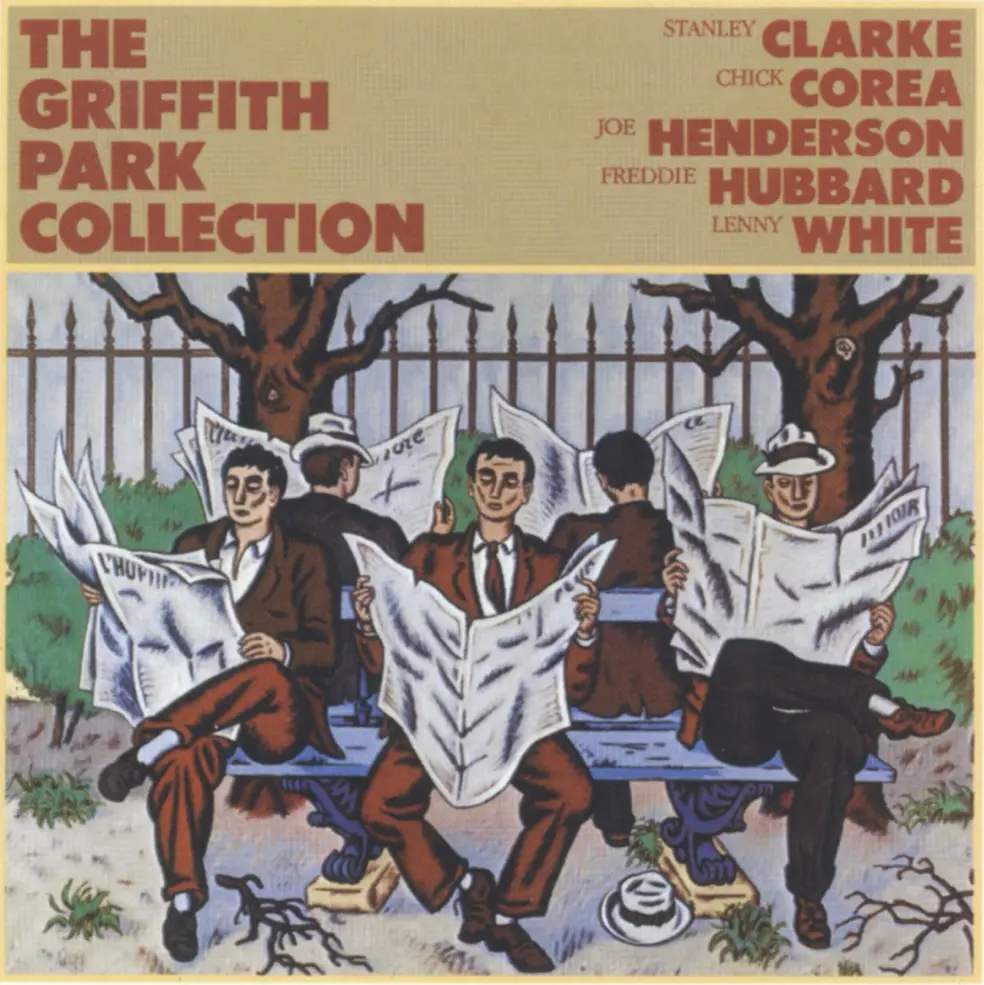 In July 1982, Elektra Musician issued The Griffith Park Collection, a super-quintet recording co-billed (in order) to Stanley Clarke, Chick Corea, Joe Henderson, Freddie Hubbard, and Lenny White.
The album brought together five leading jazz musicians in an acoustic setting that emphasized interaction and spontaneity. The program balances uptempo originals with lyrical balladry and modernist forms, highlighting each composer’s imprint within the group framework.
White contributed two compositions, including the nine-minute closer. Clarke, Corea, and Hubbard each supplied one piece, while Steve Swallow’s “Remember” stands as the album’s sole outside contribution.
The music ranges from driving ensemble passages to chamber-like ballads. Corea’s “October Ballade” places emphasis on piano and horn lyricism, while Hubbard’s “Happy Times” unfolds with bright rhythmic movement. White’s “Guernica” closes the album with an extended canvas that allows for expansive improvisation.
A1. “L’s Bop” (5:14)
A2. “Why Wait” (8:09)
A3. “October Ballade” (5:33)
B1. “Happy Times” (7:10)
B2. “Remember” (4:09)
B3. “Guernica” (9:35)
Sessions occurred at Mad Hatter Studios in Los Angeles with producer Lenny White and engineer Bernie Kirsh, assisted by Duncan Aldrich. Mastering took place at Sterling Sound, with lacquer cut at Sheffield Lab Matrix and pressing by Specialty Records Corporation.
The cover features artwork by Jean Hélion, a painting used for the front image under art direction by Ron Coro and design by John Barr.
Attitude
 Lenny White released his fifth solo album, Attitude, in 1983 on Elektra.
The album blends funk, soul, and fusion with extensive use of synthesizers, drum programming, and multiple guest vocalists. White produced the set himself, working with members of the Palmer family vocal unit, bassist Marcus Miller, keyboardists Bernard Wright and David Frank, and Material members Bill Laswell and Michael Beinhorn.
White wrote or co-wrote five tracks and co-arranged others with Arturo, Jon, and Melvin Palmer. Marcus Miller supplied bass on four numbers and co-wrote “Didn’t Know About Love (Till I Found You).” Laswell and Beinhorn wrote and produced “My Turn to Love You,” which features vocalist Bernard Fowler and an appearance by John Zorn. Keith Foley co-wrote “Tell Him (Fala Para Ele)” with White, who arranged the string parts on “Didn’t Know About Love” and “Fascination” with Leon Pendarvis.
A1. “Attitude” (5:49)
A2. “You Bring Out the Best in Me” (4:25)
A3. “Just Say the Word” (4:39)
A4. “The Ride” (4:36)
B1. “My Turn to Love You” (5:50)
B2. “Didn’t Know About Love (Till I Found You)” (4:39)
B3. “Fascination” (4:09)
B4. “Tell Him (Fala Para Ele)” (4:38)
Sessions occurred at Minot Sound (White Plains, NY), Kingdom Sound (Syosset, NY), and Mediasound (New York City) with White as producer for Berry Boo Enterprises. Alex Head engineered and mixed the album, assisted by Rich Hilton, Bruce Robbins, and Wayne Warnecke. Greg Calbi mastered the lacquer at Sterling Sound.
Attitude features cover photography by William Coupon, art direction by Ron Coro, and hand tinting by Karen Valentine.
Discography:
- Venusian Summer (1975)
- Big City (1977)
- Streamline (1978)
- The Adventures of Astral Pirates (1978)
- The Griffith Park Collection (1982 • Stanley Clarke, Chick Corea, Joe Henderson, Freddie Hubbard & Lenny White)
- Attitude (1983)
Sources:
- Discogs: Lenny White
- Zaragon: American Jazz-funk Albums
- 45worlds: Lenny White
- 45cat: Lenny White
- MusicBrainz: Lenny White
Artist/Album Pages:
John Paul Young (born June 21, 1950) is a Scottish-Australian soul-pop singer who scored a run of ...
Hatfield and the North were an English jazz-rock band that released the 1974/75 Virgin albums Hatf...
Tony Aiken & Future 2000 were an American soul-funk band that released the album Unity Sing It...
Trettioåriga Kriget was a Swedish symphonic/hard-rock band that released the 1974/75 CBS albums Tr...
Av'nir was a Québécois space-rock band that released two albums on Trans-World International in 19...
Ann Lewis — アン・ルイス (born June 5, 1956) — is a Japanese pop singer who released more than 25 albums...
Leo Sayer is an English pop singer who released ten studio albums between 1973 and 1983 on Chrysal...
Didier Lockwood (Feb. 11, 1956 — Feb. 18, 2018) was a French violinist with Seventies stints in Ma...
Waves were a New Zealander folk-rock combo that released a 1975 self-titled album on Direction Rec...
Bette Midler (born Dec. 1, 1945) is an American singer and actress from Honolulu who rose to promi...
Bette Bright is an English singer who emerged in the proto new wave band Deaf School, which releas...
Jon Faddis (born July 24, 1953) is an American jazz-funk trumpeter, conductor, and composer from ...