

Chick Corea (June 12, 1941 – Feb. 9, 2021) was an American jazz pianist, composer, and bandleader with a six-decade career that spanned the early 1960s to the late 2010s. He emerged as a backing player for Mongo Santamaria, Sonny Stitt, Blue Mitchell, Herbie Mann, Hubert Laws, and Cal Tjader.
As a solo artist, Corea debuted with the 1968 release Tones for Joan’s Bones on Atlantic-subsidiary Vortex, followed by a series of improvisational titles on ECM. Starting in 1972, he led Return to Forever through a sequence of samba-jazz and jazz-rock lineups, producing the popular titles Light As a Feather (1972), Hymn of the Seventh Galaxy (1973), and Romantic Warrior (1976). Concurrently, he explored Latin-jazz on his 1976 double-album My Spanish Heart.
During the 1980s and ’90s, Corea explored both sides of the jazz coin with his Elektric and Akoustic bands. In the late 2000s, he dueted with Japanese pianist prodigy Hiromi Uehara.
Background
He was born Armando Corea to an Italian-American family in Chelsea, Mass., on June 12, 1941. His father, Armando J. Corea, played trumpet in Boston-area Dixieland bands during the 1930s and ’40s. The young Armando took up piano at age four. His earliest influences included the bebop and post-bop bandleaders Dizzy Gillespie, Charlie Parker, Bud Powell, Horace Silver, and Lester Young.
At age eight, Corea tried his hands at drums, which lent a percussive element to his future keyboard style. Though initially self-taught on piano, he studied under concert pianist Salvatore Sullo, who sparked Corea’s interest in classical composition.
As a teenager, Corea played in the St. Rose Scarlet Lancers, a Chelsea drum and bugle corps. In high school, he formed his first jazz trio, which played Horace Silver numbers at local clubs. He then moved to New York City, where he briefly attended Juilliard School before launching his professional music career.
Early Credits
In 1962, Corea notched his first recorded pianist credit on the Riverside Records release Go, Mongo! by Mongo Santamaria and His Afro-Latin Group. The following year, he got featured status (along with percussionist Willie Bobo and trumpeter Thad Jones) on the album Stitt Goes Latin by saxophonist Sonny Stitt. Concurrently, Willie cut three Corea compositions for his 1963 Tico Records release Bobo! Do That Thing | Guajira.
Between 1964 and 1967, Corea played on three albums by Blue Mitchell (Down With It, The Thing to Do, Boss Horn). In 1965 alone, he played on three albums by flutist Herbie Mann (Latin Mann, Monday Night at the Village Gate, The Roar of the Greasepaint). He also played on two albums apiece by Hubert Laws (The Laws of Jazz, Flute By-Laws) and Cal Tjader (Soul Burst, Along Comes Cal). In 1967, he played on albums by Stan Getz (Sweet Rain), Pete La Roca (Turkish Women at the Bath), and Mark Weinstein (Cuban Roots).
Tones for Joan’s Bones
 Chick Corea released his debut album, Tones for Joan’s Bones, in April 1968 on Atlantic/Vortex.
The album marks his first statement as a leader after years in Latin-jazz and hard-bop units. Corea pivots from sideman roles into a writing style built on rapid harmonic motion, metric feints, and long-form thematic development. The quintet format gives him space to contrast open ensemble phrasing with tightly articulated runs.
Corea plays piano alongside trumpeter Woody Shaw, tenor saxophonist and flutist Joe Farrell, bassist Steve Swallow, and drummer Joe Chambers. Farrell’s broad phrasing frames Corea’s shifting left-hand voicings, while Shaw adds clipped brass figures that cut against the group’s fast rhythmic cycles. Swallow keeps a pliant center as Chambers pushes transitions with sharp tom accents and staggered cymbal patterns.
Corea composed three of the four tracks; Kurt Weill and Ira Gershwin wrote the cover piece “This Is New.” Farrell and Shaw expand Corea’s themes with extended lines that echo his metric pivots. Corea and Swallow shape the set’s inner movement, often tightening or stretching the pulse beneath Farrell’s phrasing.
“Litha” opens with quick upward figures that break into flowing exchanges between piano and tenor. “This Is New” shifts between compact rhythmic cells and broader horn unisons. “Tones for Joan’s Bones” builds on rising piano patterns that Chambers fractures with alternating snare placements. “Straight Up and Down” extends into a long-cycle form where Farrell pushes against the pulse while Corea threads sharp, stacked voicings through the upper range.
A1. “Litha” (13:33)
A2. “This Is New” (7:37) — originated in 1941 as a stage composition by Kurt Weill and Ira Gershwin for Lady in the Dark.
B1. “Tones for Joan’s Bones” (6:11)
B2. “Straight Up and Down” (12:33)
Sessions occurred on November 30 and December 1, 1966, at Atlantic Studios in New York City with producer Herbie Mann and engineer (uncredited).
The title track and “Straight Up and Down” later appeared on Blue Mitchell’s Boss Horn, recorded weeks before Corea’s session with most of the same musicians. All four tracks reappeared on the 1973 compilation Inner Space alongside two additional pieces from the same dates.
Now He Sings, Now He Sobs
 Chick Corea released his second album, Now He Sings, Now He Sobs, in December 1968 on Solid State Records.
The album shifts him from the quintet format of his debut into an open-form acoustic trio that blends structured themes with extended improvisation. Corea uses the trio’s wide harmonic space to test rapid meter changes, long-line phrasing, and bursts of unbound motion that anticipate his later ventures into freer forms.
Corea plays piano with bassist Miroslav Vitouš and drummer Roy Haynes. Vitouš keeps a mobile center with quick ascents and abrupt pivots that echo Corea’s shifting left-hand patterns. Haynes sharpens transitions with clipped ride figures and angled snare drops, giving the trio a constant sense of lift and interruption. Their interplay establishes a responsive three-way dynamic where no part remains static.
Corea composed all five tracks on the original LP. Each piece developed from sketches and ideas that the trio expanded in real time, some built on thematic seeds (“Steps – What Was,” “Matrix”) and others shaped as free improvisations (“The Law of Falling and Catching Up,” “Fragments”). Vitouš and Haynes match Corea’s turns with equal authority, giving the writing its character through active participation rather than fixed arrangement.
“Steps – What Was” opens with fast, rising lines that fold into long alternating sections, its pace tightening as Corea drives repeated accents into new spacing. “Matrix” runs on stacked chord figures that break into sharp, sprinting exchanges before Vitouš takes a solitary mid-piece ascent. The title track moves through broad intervallic sweeps and brief rhythmic hesitations that Haynes punctuates with quick, displaced taps. “Now He Beats the Drum, Now He Stops” expands in waves, shifting between dense motion and sudden halts, while “The Law of Falling and Catching Up” compresses the trio’s language into jagged, percussive fragments.
A1. “Steps – What Was” (13:53)
A2. “Matrix” (6:29)
B1. “Now He Sings, Now He Sobs” (7:05)
B2. “Now He Beats the Drum, Now He Stops” (10:40)
B3. “The Law of Falling and Catching Up” (2:28)
Sessions occurred on March 14, 19, and 27, 1968, at A&R Studios in New York City with producer Sonny Lester.
Blue Note reissued the album in 1988 with eight bonus tracks from the same sessions, including versions of “My One and Only Love” and Monk’s “Pannonica,” all previously issued on the 1975 double-LP Circling In.
Is
 Chick Corea released his third album, Is, on June 30, 1969, on Solid State Records.
The album captures Corea’s brief immersion in large-ensemble free improvisation, recorded between his appearances on Miles Davis’s In a Silent Way and Bitches Brew. The session expands his trio vocabulary into long, open forms where layered winds, dual drummers, and alternating keyboard timbres create a volatile, shifting frame.
Corea plays piano and electric piano with trumpeter Woody Shaw, tenor saxophonist Bennie Maupin, flautist Hubert Laws, bassist Dave Holland, and drummers Jack DeJohnette and Horace Arnold. Shaw and Maupin generate sharp surges that collide with Corea’s clustered voicings, while Laws threads lighter figures above the dense center. Holland anchors bursts of collective motion with quick directional changes. DeJohnette and Arnold overlap patterns, creating staggered pulses and sudden ruptures that tilt the ensemble’s balance.
Corea composed three of the four pieces; Holland contributed “Jamala.” The writing operates as a series of prompts—short motifs, rhythmic cells, or intervallic cues—that launch extended group movement. Themes appear briefly and dissolve into new configurations, driven by the horns’ abrupt entries and Corea’s switches between acoustic and electric texture.
“Is” stretches across side A, moving through rising horn swells, fractured drum patterns, and rapid shifts in piano density. Corea alternates percussive clusters with long descending lines while the twin drummers push the ensemble into rotating cycles. “Jamala” opens with a steadier center before breaking into jagged exchanges shaped by electric piano flashes. “This” unfolds in short, angled statements that Holland redirects with sharp pivots. “It” compresses the session’s language into a brief, percussive gesture.
A1. “Is” (28:54)
B1. “Jamala” (14:04) — composed by Dave Holland
B2. “This” (8:18)
B3. “It” (0:30)
Sessions occurred from May 11–13, 1969, at Bell Sound Studios in New York City with producer Sonny Lester.
Blue Note reissued the session in 2002 as The Complete “Is” Sessions, combining the album with Sundance and alternate takes from both projects.
Circle — Circulus
 Between April and August, 1970, Chick Corea performed with Circle, a free-jazz quartet that featured saxophonist Anthony Braxton, drummer Barry Altschul, and British bassist Dave Holland. In 1978, Blue Note issued Circulus, a studio double-album sourced from three 1970 Circle sessions.
Circulus documents Circle’s earliest developmental phase, captured before and after Braxton joined the Corea–Holland–Altschul trio. These sessions mark Corea’s furthest move into open-form improvisation, extending the exploratory direction of The Song of Singing into longer, unstructured pieces that emphasize collective motion over thematic framing.
Corea plays piano, celeste, vibes, and percussion. Braxton alternates among alto and soprano saxophones, flute, clarinet, and contrabass clarinet. Holland moves between bass, cello, and guitar with additional percussion, while Altschul drives textural shifts through drums and assorted untuned instruments. Their interplay focuses on reaction and contrast: abrupt horn entries against spreading piano clusters, bowed low strings against light celeste figures, and alternating percussive layers that shift the ensemble’s internal pulse.
All members contribute to the writing. Corea, Holland, and Altschul shape “Drone” as a trio improvisation from an earlier session, while the four subsequent pieces arise from full-group interaction. Each piece evolves from sparse sonic cues—short rhythmic taps, breathy reed tones, or single piano strikes—that trigger new sections without predetermined structure.
“Drone” opens with slow, staggered piano figures that expand into long overlapping layers; Holland redirects the motion with bowed lines while Altschul’s scattered accents pull the trio through rising and falling densities. “Quartet Piece No. 1” unfolds in short exchanges as Braxton probes with soft flute and clarinet colors around Corea’s angled runs. “Quartet Piece No. 2” deepens into a darker center shaped by contrabass clarinet murmurs and heavy low-register piano chords. “Quartet Piece No. 3” begins with a burst of sharp alto phrasing that the group surrounds with fast reactions before returning to quieter cross-currents. “Percussion Piece” condenses the group’s rhythmic ideas into a brisk exchange of closely spaced patterns.
A1. “Drone” (22:25) — composed by Corea, Holland, and Altschul
B1. “Quartet Piece No. 1” (16:13)
C1. “Quartet Piece No. 2” (17:33)
D1. “Quartet Piece No. 3” (12:25)
D2. “Percussion Piece” (5:52)
Sessions occurred at A&R Studios in New York City on April 8, 1970 (side A), August 19, 1970 (side D-2), and August 21, 1970 (sides B, C, and D-1) with producer Sonny Lester.
The Song of Singing
 Chick Corea released his fourth solo studio album, The Song of Singing, in February 1971 on Blue Note.
The album continues the free-form direction of Corea’s 1970 work with Circle, but narrows the focus to a trio setting that sharpens the music’s internal motion. With no horns present, Corea stretches the piano’s role across wide dynamic shifts and abrupt intervallic changes, giving the improvisations a denser, more percussive center than his earlier ensemble sessions.
Corea plays piano with bassist Dave Holland and drummer Barry Altschul. Holland drives the trio with fast pivots and extended arco shapes that underline Corea’s rhythmic feints. Altschul adds scattered accents, rolling tom figures, and brittle cymbal textures, shifting between light motion and sudden intensity. Their interplay forms a tight, reactive frame where ideas reshape quickly and no texture stays fixed.
Corea, Holland, and Altschul collectively developed most of the material, with Holland supplying “Toy Room” and Corea writing “Rhymes” and “Flesh.” Wayne Shorter’s “Nefertiti” appears as the lone outside composition, reshaped into a slower, more open structure. The trio treats the writing as flexible starting points—short motifs, rhythmic cues, or single-line cells that branch into broader exchanges.
“Toy Room” opens with angled bursts from Holland that pull the trio into quick exchanges. “Ballad I” stretches its sparse theme across quiet, staggered phrasing. “Rhymes” builds on insistent left-hand figures that open into wide, ascending lines. “Flesh” follows a darker, low-register arc shaped by sharp breaks from Altschul. “Ballad III” keeps a loose, suspended feel, while “Nefertiti” unfolds in long phrases that the trio fractures with displaced accents and sudden dynamic shifts.
A1. “Toy Room” (5:51) — composed by Dave Holland
A2. “Ballad I” (4:17)
A3. “Rhymes” (6:50) — composed by Chick Corea
B1. “Flesh” (6:06) — composed by Chick Corea
B2. “Ballad III” (5:34)
B3. “Nefertiti” (7:05) — composed by Wayne Shorter
Sessions occurred on April 7–8, 1970, at A&R Studios in New York City with producer Sonny Lester.
Blue Note reissued the album on CD with varying bonus tracks sourced from the same sessions and from contemporaneous material later compiled on Circling In and Circulus.
A.R.C. (w/ David Holland and Barry Altschul)
 In April 1971, ECM issued A.R.C., a collaborative album between Chick Corea, bassist Dave Holland, and drummer Barry Altschul.
The trio recorded the album shortly after The Song of Singing, shifting their free-form approach into a more deliberate framework shaped by Corea’s early ECM aesthetic. The music balances open improvisation with clearer structural cues, using recurring motifs, extended pedal points, and contrasting density levels to anchor the group’s rapid exchanges.
Corea plays acoustic piano with Holland on bass and Altschul on drums and percussion. Holland’s lines move between tight rhythmic figures and broad arco passages that redirect the trio’s shape. Altschul alternates between loose, scattered motion and crisp accents, giving the music abrupt changes in contour. Corea threads fast, angular runs across both rhythmic and static passages, often pushing the trio into sharp dynamic surges.
Corea wrote most of the material, with Holland contributing “Vadana” and the trio collectively shaping “Ballad for Tillie.” Wayne Shorter’s “Nefertiti” appears in an expansive version built around slow chord cycles and shifting rhythmic shading. The title piece reflects the album’s conceptual frame—short thematic fragments that trigger rapid transformations in pacing and texture.
“Nefertiti” opens the album with long, suspended phrases that the trio fractures into scattered pulses. “Ballad for Tillie” unfolds in loose, quiet shapes that break into brief, rising intensity. “A.R.C.” moves on clipped phrases that sharpen into fast, spiraling lines. “Vadana” centers on Holland’s repeating figures, which Korea and Altschul stretch through abrupt rhythmic displacement. “Thanatos” compresses ideas into terse gestures, while “Games” expands into alternating episodes of high-density motion and sparse, open cues.
A1. “Nefertiti” (9:40) — composed by Wayne Shorter
A2. “Ballad for Tillie” (5:25) — composed by Corea, Holland, and Altschul
A3. “A.R.C.” (5:39) — composed by Chick Corea
B1. “Vadana” (7:35) — composed by Dave Holland
B2. “Thanatos” (4:30) — composed by Chick Corea
B3. “Games” (7:40) — composed by Chick Corea
Sessions occurred from January 11–13, 1971, at Tonstudio Bauer in Ludwigsburg, West Germany, with producer Manfred Eicher and engineer Kurt Rapp.
The album marked the start of Holland’s long association with ECM and closed the trio’s run before each member pursued separate projects later that year.
Piano Improvisations, Vol. 1 | Vol. 2
On April 21 and 22, Chick Corea taped multiple piano improvisations at Ame Bendiksen Studio, Oslo, with Manfred Eicher, who released them on the 1971/72 ECM albums Piano Improvisations, Vol. 1 and Vol. 2.
Vol. 1 captures a transition from the open, free-form language of Circle toward a more melodic, introspective approach. Corea blends spontaneous development with short thematic cells, using wide dynamic spacing and alternating rhythmic pressure to shape each piece without fixed structures.
Corea performs alone on acoustic piano. His playing contrasts dense left-hand patterns with light, suspended figures in the upper range, often shifting between flowing arpeggios and clipped, percussive gestures. The set emphasizes direct phrasing and pared-down thematic writing, showing his move toward broader lyricism while keeping the improvisational freedom of his earlier work.
He composed all pieces except “Sometime Ago,” co-written with lyricist Neville Potter. Side I presents self-contained themes, while Side II forms the suite Where Are You Now?, built as eight short “pictures” that extend single motifs into varied rhythmic and harmonic directions.
“Noon Song” opens with slow, rising intervals that broaden into long phrasing arcs. “Song for Sally” uses compact figures that shift between quiet repetition and sudden runs. “Ballad for Anna” centers on light chord suspensions. “Song of the Wind” moves in winding patterns shaped by alternating intensity. “Sometime Ago” stretches across repeated harmonic cycles that build into extended right-hand flights. The Where Are You Now? suite alternates sparse fragments (“Picture 2,” “Picture 5”) with broader development (“Picture 4,” “Picture 6”), moving between quiet reflection and brief, sharp contrasts.
A1. “Noon Song” (4:00)
A2. “Song for Sally” (3:45)
A3. “Ballad for Anna” (2:25)
A4. “Song of the Wind” (3:10)
A5. “Sometime Ago” (8:20) — composed by Chick Corea & Neville Potter
B. Where Are You Now? – A Suite of Eight Pictures
B1. “Picture 1” (4:53)
B2. “Picture 2” (2:03)
B3. “Picture 3” (2:30)
B4. “Picture 4” (2:40)
B5. “Picture 5” (0:32)
B6. “Picture 6” (3:55)
B7. “Picture 7” (1:55)
B8. “Picture 8” (1:35)
ECM released Piano Improvisations Vol. 2 in March 1972, drawn from the same April 1971 solo sessions that produced Vol. 1.
The album deepens Corea’s shift toward brief, concentrated ideas, using short compositions and compact improvisational frames. His phrasing alternates between sharply angled gestures and open, reflective pacing, balancing exploratory movement with clearer thematic shapes than his preceding free-form work.
Corea uses repetition, quick interval jumps, and abrupt dynamic shifts to define the short-form pieces on side one, while side two unfolds as a longer sequence of linked improvisations. His playing ranges from clipped rhythmic motion to extended, suspended harmonies that momentarily slow the set’s pace.
He composed all pieces except Thelonious Monk’s “Trinkle, Tinkle” and Wayne Shorter’s “Masqualero.” Side one collects brief portraits—dedications, sketches, and two reinterpretations of modern standards—while side two forms a sequence of loosely connected sections that evolve from sparse material into more active lines.
“After Noon Song” opens with quiet, descending figures. “Song for Lee Lee” and “Song for Thad” use short, flowing shapes with quick cadential turns. “Trinkle, Tinkle” compresses Monk’s angular writing into a fast, crystalline reading. “Masqualero” broadens into layered chordal movement. The second side moves from isolated gestures (“Preparation 1,” “Preparation 2”) into extended tension and release (“Departure from Planet Earth”), resolving in the multi-part A New Place sequence.
A1. “After Noon Song” (2:49)
A2. “Song for Lee Lee” (2:41)
A3. “Song for Thad” (2:00)
A4. “Trinkle, Tinkle” (2:01) — composed by Thelonious Monk
A5. “Masqualero” (5:32) — composed by Wayne Shorter
B1. “Preparation 1” (2:37)
B2. “Preparation 2” (0:52)
B3. “Departure from Planet Earth” (7:36)
B4. “A New Place: Arrival” (0:36)
B5. “A New Place: Scenery” (5:49)
B6. “A New Place: Imps Walk” (1:36)
B7. “A New Place: Rest” (5:05)
Sessions occurred on April 21–22, 1971, at Ame Bendiksen Studio in Oslo with producer Manfred Eicher and engineer Jan-Erik Kongshaug.
The two Piano Improvisations volumes served as Corea’s bridge between his free-jazz period with Circle and the more lyrical writing he unveiled in Return to Forever later in 1972.
Sundance
 Chick Corea released his fifth solo studio album, Sundance, in February 1972 on Groove Merchant.
The album draws from the same May 1969 sessions that produced Is, presenting Corea’s large-ensemble free-jazz writing in a more compact four-piece program. These performances show him navigating the space between his late-1960s post-bop language and the freer, high-density collective motion that shaped his work with Circle.
Corea plays piano with trumpeter Woody Shaw, flautist Hubert Laws, tenor saxophonist Bennie Maupin, bassist Dave Holland, and drummers Jack DeJohnette and Horace Arnold. Shaw and Maupin alternate sharp, rising figures with long, open phrasing. Laws adds lighter accents that contrast the ensemble’s thicker textures. Holland provides quick directional changes beneath Corea’s clustered runs, while the dual drummers create overlapping rhythmic layers that shift the pace abruptly.
Corea composed all four tracks for the session. The pieces revolve around short motivic prompts that expand into extended sections of collective improvisation. Themes appear briefly—sometimes only as rhythmic cues or intervallic shapes—before dissolving into larger ensemble exchanges.
“The Brain” opens with angled horn lines and rapid piano bursts that set the session’s most active interplay. “Song of the Wind” moves at a slower pace, using broad melodic shapes that Laws and Maupin stretch against Corea’s rising chords. “Converge” builds from scattered figures into dense passages driven by pulsing drums. “Sundance” centers on a repeating rhythmic idea that breaks into spiraling exchanges between piano and horns.
A1. “The Brain” (10:09)
A2. “Song of the Wind” (8:05)
B1. “Converge” (7:59)
B2. “Sundance” (10:02)
Sessions occurred from May 11–13, 1969, in New York City with producer Sonny Lester.
Blue Note later compiled these recordings, along with alternate takes and material from Is, on The Complete “Is” Sessions (2002).
Return to Forever
 Chick Corea released his sixth proper studio album, Return to Forever, in September 1972 on ECM. Though conceived and billed as a Corea solo album, it’s generally accepted as the first release by the namesake band that emerged from the project.
The album marks Corea’s shift from free-form trio and solo work into a melodic, electric sound shaped around Fender Rhodes textures, extended song forms, and Latin-inflected rhythmic movement. The new ensemble blends open harmonic phrasing with layered percussion and airy vocal passages, establishing the lighter yet expansive style that defined the band’s early recordings.
Corea plays Fender Rhodes electric piano with flautist and soprano saxophonist Joe Farrell, bassist Stanley Clarke, percussionist and drummer Airto Moreira, and vocalist Flora Purim, who also adds light hand percussion. Farrell alternates between bright soprano lines and wide flute arcs. Clarke moves between agile electric bass patterns and resonant double bass on the long-form suite. Moreira adds shifting pulses and accent patterns, while Purim threads soft, sustained vocal lines that widen the ensemble’s harmonic center.
Corea composed all material, with Neville Potter contributing lyrics to “What Game Shall We Play Today” and the first half of the suite “Sometime Ago – La Fiesta.” The writing emphasizes long, cyclical structures shaped by repeated motifs, modal expansions, and contrasting rhythmic sections that open into extended instrumental episodes.
“Return to Forever” unfolds in slow-rising Rhodes figures that break into layered flute lines and buoyant electric bass motion. “Crystal Silence” centers on a spacious dialogue between Rhodes and soprano saxophone, using gradual dynamic swells and long-tone phrasing. “What Game Shall We Play Today” moves with a brighter, lightly accented pulse shaped by flute and Purim’s vocal lines. “Sometime Ago – La Fiesta” opens with floating Rhodes harmonies and voice, then shifts into faster unison lines and accelerating rhythmic passages that highlight Clarke’s doubled bass roles and Moreira’s driving patterns.
A1. “Return to Forever” (12:06)
A2. “Crystal Silence” (6:59)
A3. “What Game Shall We Play Today” (4:30) — lyrics by Neville Potter
B1. “Sometime Ago – La Fiesta” (23:13) — lyrics for “Sometime Ago” by Neville Potter
Sessions occurred on February 2–3, 1972, at A&R Studios in New York City with producer Manfred Eicher and engineer Tony May.
The album was released in Europe and Japan in 1972, with a U.S. release following in 1975, and effectively launched the band Return to Forever, whose second album Light as a Feather appeared the following year.
Crystal Silence (w/ Gary Burton)
 In April 1973, ECM issued Crystal Silence, a collaborative album by Chick Corea and vibraphonist Gary Burton.
Recorded in a single day at Arne Bendiksen Studio in Oslo, Crystal Silence presents a focused, minimal setting that highlights Corea and Burton’s conversational interplay. Without rhythm section or electronics, the album leans into spacious textures and subtle counterpoint. Burton’s four-mallet vibraphone technique adds rich voicings and harmonic expansion, while Corea alternates between fluid runs, suspended chords, and compact motifs.
Corea composed five of the album’s nine tracks, including “Senor Mouse,” which later appeared in an electric arrangement on Hymn of the Seventh Galaxy, and “Crystal Silence,” which became a signature piece for the duo. Steve Swallow contributed three selections—“Arise, Her Eyes,” “I’m Your Pal,” and “Falling Grace”—and Mike Gibbs supplied “Feelings and Things.” Corea closes with an acoustic version of “What Game Shall We Play Today,” originally recorded for Return to Forever.
A1. “Señor Mouse” (6:20)
A2. “Arise, Her Eyes” (5:08) — Steve Swallow
A3. “I’m Your Pal” (4:02) — Steve Swallow
A4. “Desert Air” (6:26)
B1. “Crystal Silence” (9:05)
B2. “Falling Grace” (2:42) — Steve Swallow
B3. “Feelings and Things” (4:46) — Mike Gibbs
B4. “Children’s Song” (2:11)
B5. “What Game Shall We Play Today” (3:46) — lyrics by Neville Potter (unvoiced)
The session took place on November 6, 1972, with Manfred Eicher producing and Jan Erik Kongshaug engineering.
Crystal Silence reached No. 24 on the Billboard Jazz Albums chart in 1974. Its quiet intensity and stripped-down format made it one of ECM’s early landmark recordings, setting a tone for the label’s clean, introspective aesthetic.
The Leprechaun
 Chick Corea released his seventh solo studio album, The Leprechaun, on February 2, 1976, on Polydor.
He recorded the material during an active period with Return to Forever but opted for a chamber-sized solo project with orchestral arrangements and thematic continuity. This marked the first in a trio of conceptually linked solo albums that continued with My Spanish Heart and The Mad Hatter.
Corea handled piano, organ, Rhodes, clavinet, and multiple synthesizers (ARP Odyssey, Micromoog, Moog Model 15), accompanied by bassist Eddie Gómez, drummer Steve Gadd, and guest soloists Joe Farrell (sax, flute) and Gayle Moran, who contributed vocals and one composition. He augmented the lineup with brass and string players, including violinists Ani and Ida Kavafian, violist Louise Shulman, and cellist Fred Sherry.
He wrote and arranged most of the album, pairing acoustic lyricism and progressive jazz fusion with whimsical textures and dramatic orchestrations. The suite-like closer, “Leprechaun’s Dream,” integrates impressionist strings, horn counterpoint, and soaring soprano lines into a 13-minute fusion symphony. “Nite Sprite” showcases Gadd’s precision against Corea’s layered keyboards. “Lenore” and “Reverie” foreground lyrical piano figures, while “Looking at the World” and “Soft and Gentle” introduce vocals over syncopated themes and shifting dynamics.
A1. “Imp’s Welcome” (2:56)
A2. “Lenore” (3:26)
A3. “Reverie” (2:01)
A4. “Looking at the World” (5:29) — lyrics by Neville Potter
A5. “Night Sprite” (4:33)
B1. “Soft and Gentle” (5:09) — composed by Gayle Moran
B2. “Pixieland Rag” (1:11)
B3. “Leprechaun’s Dream Part 1” (6:29)
B4. “Leprechaun’s Dream Part 2” (6:34)
Corea produced the album with Bernie Kirsh as engineer. Michael Frondelli assisted with engineering. Peter Corriston designed the sleeve with an illustration by David Palladini and photography by Leonid Lubianitsky.
The Leprechaun reached No. 1 on Billboard’s Jazz Albums chart, No. 42 on the Billboard 200, and No. 32 on the R&B Albums chart. It won two Grammy Awards in 1977: Best Jazz Performance by a Group and Best Instrumental Arrangement for “Leprechaun’s Dream Part 1.”
My Spanish Heart
 Chick Corea released his eighth studio album, the two-record My Spanish Heart, on December 15, 1976, on Polydor.
Spanning four sides, the album interweaves acoustic jazz, Latin motifs, and fusion textures in a suite-based format. Corea composed and arranged the entire work, producing it during a short hiatus between Return to Forever’s Romantic Warrior and Musicmagic sessions.
He plays grand piano, Yamaha organ, Fender Rhodes, and a range of synthesizers (ARP Odyssey, Minimoog, Polymoog, Moog Model 15), accompanied by bassist Stanley Clarke, violinist Jean-Luc Ponty, drummer Steve Gadd, percussionist Don Alias, and his wife Gayle Moran on vocals. Narada Michael Walden plays additional drums on select tracks. Corea also arranged separate string and brass sections, with four-piece strings and a five-member brass ensemble used selectively across the album.
Side one presents a four-part suite combining keyboard layering with Latin rhythms. “Love Castle” and “Night Streets” feature dense synth overlays and syncopated ostinati, while “The Gardens” and the title track offer contrasting acoustic sections with close-voiced piano chords and romantic pacing. Side two contains mid-tempo ensemble numbers and lyrical solo passages. “The Hilltop,” co-written with Clarke, integrates arco bass and hand percussion in an unfolding, rhythmically relaxed setting.
Side three contrasts the exuberant “Armando’s Rhumba”—a piano–violin duet with fast handclaps and Spanish figurations—with the electronic “El Bozo” suite, a three-part synthesizer cycle bracketed by a brief prelude. It features sequenced timbres and metric shifts that move between freeform episodes and rhythmic unisons. Side four hosts the “Spanish Fantasy” suite: four thematically linked sections ranging from solo piano to full brass and string accompaniment, evoking Spanish folk and Moorish scales with frequent tempo modulations and layered orchestration.
A1. “Love Castle” (4:45)
A2. “The Gardens” (3:12)
A3. “Day Danse” (4:27)
A4. “My Spanish Heart” (1:37)
A5. “Night Streets” (6:08)
B1. “The Hilltop” (6:16) – co-composed with Stanley Clarke
B2. “The Sky (Children’s Song No. 8 / Portrait of Children’s Song No. 8)” (4:57)
B3. “Wind Danse” (5:00)
C1. “Armando’s Rhumba” (5:19)
C2. “Prelude to El Bozo” (1:34)
C3. “El Bozo, Part 1” (2:52)
C4. “El Bozo, Part 2” (2:03)
C5. “El Bozo, Part 3” (5:03)
D1. “Spanish Fantasy, Part 1” (6:06)
D2. “Spanish Fantasy, Part 2” (5:14)
D3. “Spanish Fantasy, Part 3” (3:06)
D4. “Spanish Fantasy, Part 4” (5:16)
2000 CD bonus track:
17. “The Clouds” (4:33)
Sessions took place in October 1976 at Kendun Recorders in Burbank, California, with Corea as producer. Recording and mix engineers are uncredited on original pressings. The 2000 Verve remaster restores “The Sky” (previously omitted from 1980s–90s CD editions) and adds “The Clouds,” a piano-and-strings piece recorded during the original sessions.
My Spanish Heart reached No. 2 on Billboard’s Jazz Albums chart and No. 55 on the Billboard 200. DownBeat awarded it a five-star review. “Armando’s Rhumba” has since become a standard in the modern jazz repertoire.
The Mad Hatter
 Chick Corea released his ninth studio album, The Mad Hatter, on February 13, 1978, on Polydor.
A through-composed concept work inspired by Alice’s Adventures in Wonderland, the album presents a multi-movement suite performed by Corea’s chamber-fusion ensemble with elaborate orchestrations, shifting moods, and whimsical motifs. Sessions took place in November 1977 at Kendun Recorders in Burbank, California.
Corea plays acoustic piano across the album and supplements with electric piano (Fender Rhodes), multiple synthesizers (ARP Odyssey, Minimoog, Polymoog, Moog Model 15 modular, Oberheim Eight Voice), and auxiliary instruments including marimba, finger cymbals, and African shaker. He composed, arranged, and produced the entire set. Joe Farrell contributes saxophone and flute, joined by a dual rhythm section with bassist Eddie Gómez and drummers Steve Gadd and Harvey Mason. Corea’s wife Gayle Moran provides vocals and co-wrote lyrics for two tracks. Strings and brass enhance multiple scenes, creating orchestral passages that frame the narrative.
Side one unfolds with a four-part arc: “The Woods” sets a surrealist tone with layered keyboards and ambient percussion; “Tweedle Dee” and “The Trial” offer brief scene-setters with piano, strings, and Moran’s voice; “Humpty Dumpty” emerges as the first full-length piece—a jazz-fusion anthem with interlocking rhythm and brisk saxophone lines. The suite continues with the instrumental prelude and dramatic vocal centerpiece “Falling Alice,” where Farrell’s tenor and Corea’s synthesizers interact in a climactic arrangement of swirling counterpoint and impressionistic chord changes.
Side two opens with the atmospheric “Tweedle Dum” and gives way to the 13-minute “Dear Alice,” which intersperses lyrical piano with orchestral interludes and modal ensemble improvisation. The closing “The Mad Hatter Rhapsody” juxtaposes Corea’s acoustic piano with Herbie Hancock’s Fender Rhodes in a polyrhythmic duel, marked by layered horn figures, tempo modulations, and electronic overlays, returning to motifs from earlier scenes in operatic reprise.
A1. “The Woods” (4:26)
A2. “Tweedle Dee” (1:08)
A3. “The Trial” (1:40)
A4. “Humpty Dumpty” (6:30)
A5. “Prelude to Falling Alice” (1:19)
A6. “Falling Alice” (8:18) — lyrics by Gayle Moran
B1. “Tweedle Dum” (2:52)
B2. “Dear Alice” (13:07) — lyrics by Gayle Moran
B3. “The Mad Hatter Rhapsody” (10:44)
Corea produced the album with Kendun Recorders engineer crew; exact technical credits are absent from the original liner notes. The cover photo depicts Corea as the Mad Hatter, an absurdist character in Lewis Carroll’s 1865 novel.
The Mad Hatter peaked at No. 6 on Billboard’s Jazz Albums chart and No. 61 on the Billboard 200. Critics noted the album’s stylistic range and orchestral ambition. “Humpty Dumpty” and “Dear Alice” became enduring Corea pieces, while the album marked one of his most elaborate studio productions of the 1970s.
Friends
 Chick Corea released his tenth studio album, Friends, in July 1978 on Polydor.
The album reunites Corea with longtime collaborators Joe Farrell, Steve Gadd, and Eddie Gómez for a nimble, acoustic-based session. In contrast to the layered electronics of his recent solo projects, Friends emphasizes quartet interplay and lyrical restraint, folding elements of samba, chamber jazz, and modern swing into a cohesive eight-track cycle.
Corea plays Steinway grand and Fender Rhodes electric piano. Farrell alternates between soprano and tenor saxophones and flute, while Gómez supplies acoustic bass and Gadd delivers dynamic, fine-grained drumwork. The stripped-down format yields space for individual nuance across each member’s contributions.
Corea composed all eight pieces, including two brief “Children’s Song” entries and the extended centerpiece “Samba Song.” Though some titles gesture toward earlier Return to Forever stylings, the overall tone is intimate and focused.
“The One Step” builds on conversational motion with a Rhodes-led refrain that allows Farrell’s soprano lines to coast over Gadd’s crisp brush accents. “Waltse for Dave” swings gently on Gómez’s elastic phrasing and Farrell’s lilting flute theme, with Corea layering short flurries and suspended voicings. “Samba Song” stretches across shifting subdivisions and alternating lead roles, climaxing in staggered handoffs between piano, tenor sax, and bass solo sections. “Friends” unfolds over a delicate Rhodes pulse and overlapping melodic roles between flute, drums, and arco bass. “Cappucino” concludes with dense, clustered motifs and tempo modulation that push the quartet into more abstract territory without disrupting the album’s acoustic logic.
A1. “The One Step” (6:05)
A2. “Waltse for Dave” (7:32)
A3. “Children’s Song #5” (1:15)
A4. “Samba Song” (10:00)
B1. “Friends” (9:26)
B2. “Sicily” (6:15)
B3. “Children’s Song #15” (1:10)
B4. “Cappucino” (8:39)
Sessions occurred in 1978 at Kendun Recorders in Burbank, California, with Chick Corea producing.
Friends features cover art taken from the Smurfs franchise. The cartoon illustration contrasts the refined musical contents with a playful visual cue. After a liscening dispute, Polydor replaced the Smurfs with ceramic frog, bunny, and whale figurines.
The album reached No. 4 on the Billboard Jazz Albums chart and won the 1979 Grammy for Best Jazz Instrumental Performance, Group.
Secret Agent
 Chick Corea released his eleventh studio album, Secret Agent, in November 1978 on Polydor.
The album presents a stylistic pivot from Corea’s recent conceptual work toward a collection of varied, tightly constructed pieces. It retains his fusion aesthetic while incorporating funk, classical, and vocal pop elements across distinct, standalone tracks.
Backing players include saxophonist Joe Farrell, bassist Bunny Brunel (fretless), drummer Tom Brechtlein, percussionist Airto Moreira, and vocalists Gayle Moran and Al Jarreau. Corea layers acoustic piano with Fender Rhodes, clavinet, and a wide array of analog synthesizers. Brass and string sections enhance select cuts, particularly on the outer ends of each LP side.
Corea composed eight of the nine tracks. “Bagatelle No. 4,” by Béla Bartók, appears in an electronically reinterpreted version. Moran sings lead on three songs and shares arranging credit on “Drifting.” Al Jarreau contributes a one-off lead vocal on “Hot News Blues.”
“Golden Dawn” opens with surging analog textures and interlocked rhythmic cells that sustain a bright, two-chord cycle across layered voices. “Slinky” pivots to half-time Fender Rhodes phrases and fluted counterpoint over a steady funk cadence. “Drifting” unfolds with impressionistic vocal passages and a light Latin undercurrent. “Glebe St. Blues” alternates between horn-led unison lines and Farrell’s expressive tenor passages.
Side two lifts with “Fickle Funk,” driven by sharp brass accents and Brunel’s agile syncopation. “Bagatelle No. 4” distills Bartók’s harmonies into overlapping keyboard voicings and choir overlays. “Hot News Blues” contrasts tightly voiced brass with Jarreau’s airy vocal phrasing. “Central Park” concludes the album with a brisk, celebratory pulse, layered with hand percussion, ensemble shout lines, and bright flourishes from the full band.
A1. “Golden Dawn” (3:39)
A2. “Slinky” (5:42)
A3. “Mirage” (2:11)
A4. “Drifting” (4:09)
A5. “Glebe St. Blues” (6:58)
B1. “Fickle Funk” (5:05)
B2. “Bagatelle No. 4” (3:34) — originated as a 1940s piano miniature by Béla Bartók.
B3. “Hot News Blues” (6:18)
B4. “Central Park” (5:22)
Sessions occurred in 1978 at Producers Workshop in Los Angeles (tracks A1–B1, B3, B4) and Kendun Recorders in Burbank, California (track B2), with Chick Corea producing and engineering handled by multiple in-house personnel.
Secret Agent reached No. 7 on the Billboard Jazz Albums chart.
An Evening With Herbie Hancock & Chick Corea in Concert
In November 1978, Columbia Records issued An Evening With Herbie Hancock & Chick Corea in Concert, a live double-album sourced from joint performances by the two pianists earlier that year.
The album presents an all-acoustic collaboration between Hancock and Corea, recorded in February 1978 across four California and Michigan venues. It marks a notable departure from their concurrent electric fusion projects, offering a program of solo features, standards, and longform interplay framed in duet format.
Hancock and Corea each perform on grand piano, captured in stereo with Hancock panned left and Corea right. The setting emphasizes contrapuntal voicing, harmonic spacing, and shifting lead roles throughout expansive improvisational segments.
The program opens with a brisk rendition of “Someday My Prince Will Come” that flows into the syncopated rag motifs of Gershwin’s “Liza.” The jointly composed “Button Up” cycles through call-and-response figures and tempo feints across a 17-minute arc. Hancock introduces and performs “February Moment” as a lyrical, episodic solo feature. Side four combines two extended readings: a compressed-yet-complete traversal of “Maiden Voyage,” and Corea’s 22-minute “La Fiesta,” which closes the album with cascading sequences and left-right thematic alternation.
A1. “Someday My Prince Will Come” (12:36) — originated in 1937 by Disney composers Frank Churchill & Larry Morey.
A2. “Liza (All the Clouds’ll Roll Away)” (8:56) — first published in 1929 by George Gershwin, Gus Kahn & Ira Gershwin.
B1. “Button Up” (17:33) — co-written by Hancock and Corea.
C1. “Introduction of Herbie Hancock by Chick Corea” (0:41)
C2. “February Moment” (15:50) — composed by Hancock.
D1. “Maiden Voyage” (13:30) — composed by Hancock.
D2. “La Fiesta” (21:58) — composed by Corea.
Selections were recorded live in February 1978 at the Masonic Auditorium (San Francisco), Dorothy Chandler Pavilion (Los Angeles), Golden Hall (San Diego), and Hill Auditorium (Ann Arbor). David Rubinson and Herbie Hancock produced the album for Columbia Records.
Due to time constraints on side four, engineers compressed the dynamic range to preserve both “Maiden Voyage” and “La Fiesta” in full without editing. The 2CD version restores uncompressed fidelity.
An Evening with Herbie Hancock & Chick Corea reached No. 8 on the Billboard Jazz Albums chart and No. 100 on the Billboard 200.
Duet (w/ Gary Burton)
In May 1979, ECM issued Duet, the second collaborative album by Chick Corea and Gary Burton.
The album follows up their 1973 collaboration Crystal Silence with a more intimate, conversational exchange. Unlike their earlier studio effort or subsequent live duo recordings, Duet focuses on brief vignettes and lyrical abstractions framed by acoustic purity.
Corea plays grand piano throughout while Burton handles vibraphone. The absence of rhythm section or overdubs centers the interplay between tone, phrasing, and harmonic contour, captured in close-mic’d, atmospheric ECM sonics.
Corea composed six of the album’s nine tracks, including the multipart “Duet Suite” and four entries from his Children’s Songs series. Bassist Steve Swallow contributes two compositions, and the album concludes with a new reading of “La Fiesta,” first cut on Corea’s Return to Forever debut.
“Duet Suite” moves through rubato sections, rhythmically aligned passages, and clipped exchanges with seamless lead transfers. “Children’s Song No. 6” emerges as the most developed among the miniatures, expanding across arpeggiated piano and vibraphone flourishes. Swallow’s “Radio” blends scalar runs with asymmetrical pacing. “Song to Gayle” unfolds in a slow build, as Corea’s phrasing layers gently against Burton’s melodic counterpoint. The closing “La Fiesta” trades the original’s Latin thrust for elastic phrasing and harmonic crossplay, drawing the album to a spiraling, resolved finish.
A1. “Duet Suite” (15:41)
A2. “Children’s Song No. 15” (1:15)
A3. “Children’s Song No. 2” (0:56)
A4. “Children’s Song No. 5” (1:14)
A5. “Children’s Song No. 6” (2:13)
A6. “Radio” (Steve Swallow) (5:15)
B1. “Song to Gayle” (7:13)
B2. “Never” (Steve Swallow) (7:37)
B3. “La Fiesta” (10:17)
Sessions occurred October 23–25, 1978, at Delphian Foundation in Sheridan, Oregon, with Corea and Burton co-producing for ECM.
Duet topped the Billboard Jazz Albums chart in 1979, marking one of ECM’s most commercially successful acoustic duo recordings.
Tap Step
 Chick Corea released his twelfth studio album, Tap Step, on April 21, 1980, on Warner Bros.
The album expands Corea’s studio approach with a dense fusion of layered electronics, Latin percussion, and integrated vocal textures.. It departs from the acoustic restraint of Duet and the tonal focus of Friends in favor of layered studio constructions and polyphonic motion.
Corea plays grand piano and Fender Rhodes alongside an expanded synthesizer rig that includes Minimoog, Moog 55 modular, Oberheim OB-X, vocoder, and Hohner clavinet. He’s joined by longtime collaborators Joe Farrell (saxophone), Stanley Clarke (piccolo bass), Airto Moreira (drums, percussion), and Gayle Moran (vocals), with additional contributions from Flora Purim, Don Alias, Hubert Laws, Bunny Brunel, and Joe Henderson.
Corea composed and arranged all seven tracks, with lyrics by Tony Cohan on “Samba L.A.” and “The Embrace,” and vocoder narration by Corea on “Grandpa Blues.” Clarke and Brunel each contribute on electric piccolo bass, while three drummers alternate across the set’s dense rhythmic spectrum.
“Samba L.A.” opens with overlapping vocal lines and bright clavinet pulses against a shifting samba groove. “The Embrace” flows through modal horn voicings and descending keyboard phrases. The title track accelerates in a clustered rhythm cycle, with Corea trading leads across synths and Farrell’s tenor bursts. “Magic Carpet” rides on interlocked bass and Rhodes fragments, escalating into cross-channel solo flights. “The Slide” pivots between funk syncopation and brass stabs. “Grandpa Blues” places vocoded vocals over a jagged groove, while “Flamenco” closes the album with spiraling soprano sax, hand percussion, and fast-paced piano flourishes.
A1. “Samba L.A.” (5:52) — lyrics by Tony Cohan
A2. “The Embrace” (5:52) — lyrics by Tony Cohan
A3. “Tap Step” (8:19)
B1. “Magic Carpet” (6:51)
B2. “The Slide” (6:47)
B3. “Grandpa Blues” (4:03) — vocoder lyrics by Chick Corea
B4. “Flamenco” (3:34)
Sessions occurred from December 1979 to January 1980 at Ocean Way Recording (“Samba L.A.”) and Love Castle Studios, both in Los Angeles. Corea produced the album.
Tap Step reached No. 8 on Billboard’s Jazz LPs chart and peaked at No. 170 on the overall Top LPs & Tape listing.
In Concert, Zürich, October 28, 1979
In October 1980, ECM issued the third Chick Corea / Gary Burton joint-title: In Concert, Zürich, October 28, 1979, a two-record document from their show at Limmathaus in the Swiss capital.
The album captures the duo at the height of their synergy, presenting an unbroken acoustic dialogue in front of a live audience. It completes their 1970s ECM trilogy, following Crystal Silence and Duet, and blends composed material with extended improvisation across solo and duo passages.
Corea performs on grand piano and Burton on vibraphone. The program includes pieces by both artists, along with solo showcases that emphasize contrast in voicing, rhythm, and textural layering. The concert also includes reworkings of prior Corea compositions in more open, live formats.
“Señor Mouse” sets the tone with fast switches in lead phrasing and rhythmic feints. “Bud Powell” balances darting melodic figures with locked pulse statements. “Crystal Silence” unfolds gradually, with Burton sustaining chordal motifs under Corea’s lyricism. Burton’s solo medley “I’m Your Pal / Hullo, Bolinas” introduces rubato phrasing and free modulations, while Corea’s solo “Love Castle” builds on cascading left-hand patterns and clustered voicings. “Tweak” and “Falling Grace” move briskly through contrast sections and metric overlap. “Song to Gayle” flows through a slow, linear arc, while “Endless Trouble, Endless Pleasure” closes on a compact thematic statement.
Original 2LP release:
A1. “Señor Mouse” (9:51)
A2. “Bud Powell” (8:30)
B1. “Crystal Silence” (11:52)
B2. “Tweak” (5:58)
C1. “I’m Your Pal / Hullo, Bolinas” (6:58) — solo medley by Gary Burton
C2. “Love Castle” (14:35) — solo by Chick Corea
D1. “Falling Grace” (5:04)
D2. “Mirror, Mirror” (5:26)
D3. “Song to Gayle” (6:57)
D4. “Endless Trouble, Endless Pleasure” (4:48)
Recorded live on October 28, 1979, at Limmathaus in Zürich. Produced by Manfred Eicher for ECM.
A condensed CD reissue appeared with two tracks omitted. In 2009, ECM reissued the full-length version as part of the 4CD box Crystal Silence: The ECM Recordings 1972–79.
In Concert reached No. 23 on Billboard’s Jazz Albums chart and won the 1982 Grammy Award for Best Jazz Instrumental Album, Individual or Group.
Three Quartets
 Chick Corea released his thirteenth studio album, Three Quartets, in July 1981 on Warner Bros.
The album marked a return to acoustic post-bop following Corea’s diverse electric output of the previous decade. Framed as a modern analog to classical string quartets, it explores the form through jazz instrumentation and extended interplay, balancing compositional precision with group improvisation.
Corea plays grand piano throughout, joined by tenor saxophonist Michael Brecker, bassist Eddie Gómez, and drummer Steve Gadd. Each player functions as an equal voice within the ensemble, emphasizing line, texture, and timbral contrast over rhythm section hierarchy. On the CD-only closer “Confirmation,” Corea switches to drums.
Corea composed all four pieces on the original LP, with “Quartet No. 2” split into two parts—one dedicated to Duke Ellington, the other to John Coltrane. The 2000s-era CD reissue adds three session outtakes and a live Charlie Parker cover.
“Quartet No. 1” moves through a rock-inflected 3/4 vamp under a stacked fourths theme, marked by high-intensity exchanges and Brecker’s extended phrasing. “Quartet No. 3” opens with formal flourishes and evolves into alternating solos over tight rhythmic coordination. “Quartet No. 2 (Part I)” stretches from rubato piano to Ellington-inspired lyricism and subtle voicing. “Part II” begins with clustered harmonies and turns stormy with shifting tempos and modal extrapolation. Among the reissue tracks, “Folk Song” rests on scalar motion and modal ambiguity, while “Confirmation” renders Parker’s bebop lines in brisk duo format with Gómez on bass and Corea on kit.
A1. “Quartet No. 1” (10:16)
A2. “Quartet No. 3” (9:41)
B1. “Quartet No. 2 – Part I (Dedicated to Duke Ellington)” (7:09)
B2. “Quartet No. 2 – Part II (Dedicated to John Coltrane)” (12:01)
2000s CD reissue bonus tracks:
5. “Folk Song” (5:51)
6. “Hairy Canary” (3:43)
7. “Slippery When Wet” (6:02)
8. “Confirmation” (Charlie Parker) (6:17) — Corea on drums
Sessions occurred in January–February 1981 at Mad Hatter Studios in Los Angeles. Corea produced the album with engineering by Bernie Kirsh.
Three Quartets reached No. 17 on Billboard’s Jazz Albums chart and No. 179 on the Billboard 200. The full sessions were later reissued on Corea’s Stretch label.
Touchstone
 Chick Corea released his fourteenth studio album, Touchstone, on August 30, 1982, on Warner Bros.
The album presents six compositions with shifting configurations of jazz, flamenco, and electric fusion players across acoustic and electronic setups. Corea performs on Steinway grand piano, Fender Rhodes, Fairlight CMI, Oberheim OB-Xa, Minimoog, Yamaha GS-1, and Moog 55 Modular.
Paco de Lucía plays acoustic guitar on “Touchstone” and “The Yellow Nimbus,” supported by Carles Benavent (fretless bass) and Alex Acuña (cajón, snare, cymbals), with Gayle Moran on wordless vocals. Al Di Meola joins on “Compadres” alongside Stanley Clarke (electric bass) and Lenny White (drums). “Duende” features a chamber combo of Gregg Gottlieb (cello), Bob Magnusson (bass), Carol Shive (violin), and Lee Konitz (alto sax). Corea fronts a full electric sextet on “Dance of Chance,” with Steve Kujala (flute, tenor), Allen Vizzutti (trumpet), and a Latin–funk rhythm section of Benavent, Acuña, and Don Alias.
A1. “Touchstone: Procession, Ceremony, Departure” (10:58)
A2. “The Yellow Nimbus” (8:51)
A3. “Duende” (3:11)
B1. “Compadres” (9:41)
B2. “Estancia” (6:18)
B3. “Dance of Chance” (7:14)
Sessions occurred at Mad Hatter Studios with Corea producing and Bernie Kirsh engineering. Touchstone reached No. 9 on Billboard’s Jazz Albums chart.
Trio Music (w/ Miroslav Vitous and Roy Haynes)
In October 1982, ECM issued Trio Music, a collaborative album by Chick Corea, bassist Miroslav Vitous, and drummer Roy Haynes.
The album reunites the trio first heard on Corea’s 1968 release Now He Sings, Now He Sobs. The first disc presents collective and duo improvisations, including five trio vignettes and two piano–bass duets. Corea closes the set with his original “Slippery When Wet.” The second disc honors Thelonious Monk with seven reinterpretations, including “Rhythm-a-ning,” “Reflections,” and “Hackensack.”
A1. “Trio Improvisation 1” (3:26)
A2. “Trio Improvisation 2” (3:51)
A3. “Trio Improvisation 3” (3:08)
A4. “Duet Improvisation 1” (4:26)
B1. “Duet Improvisation 2” (5:26)
B2. “Trio Improvisation 4” (4:40)
B3. “Trio Improvisation 5” (7:43)
B4. “Slippery When Wet” (6:01)
C1. “Rhythm-a-ning” (5:06)
C2. “‘Round Midnight” (5:15)
C3. “Eronel” (4:38)
C4. “Think of One” (4:28)
D1. “Little Rootie Tootie” (4:50)
D2. “Reflections” (6:47)
D3. “Hackensack” (6:13)
Sessions took place in November 1981 with Manfred Eicher producing. Trio Music reached No. 17 on Billboard’s Jazz Albums chart.
Lyric Suite for Sextet
In September 1983, ECM issued Lyric Suite for Sextet, the third collaborative studio album by Chick Corea and Gary Burton after Crystal Silence (1972) and Duet (1978).
The pair are joined by a string quartet featuring violinists Ik-Hwan Bae and Carol Shrive, violist Karen Dreyfus, and cellist Fred Sherry.
Corea composed the entire suite, which unfolds in seven movements that bridge classical chamber textures and jazz-inflected dialogue. Despite the sextet billing, the work centers on the piano–vibraphone interplay, with the strings providing color, contour, and thematic framing.
A1. “Part 1 – Overture” (6:25)
A2. “Part 2 – Waltz” (7:11)
A3. “Part 3 – Sketch (For Thelonious Monk)” (2:13)
A4. “Part 4 – Roller Coaster” (1:25)
B1. “Part 5 – Brasilia” (7:57)
B2. “Part 6 – Dream” (10:33)
B3. “Part 7 – Finale” (3:54)
Sessions took place in September 1982 at Mad Hatter Studios in Los Angeles with production by Manfred Eicher. ECM issued the album as catalog number 1260.
Children’s Songs
In April 1984, Chick Corea released Children’s Songs, a collection of solo improvisations on ECM.
He recorded the album in July 1983 as a solo piano suite, with one trio piece featuring violinist Ida Kavafian and cellist Fred Sherry. Corea began the series in 1971 and gradually completed the remaining pieces over the following decade.
The album comprises twenty miniatures that embody Corea’s stated goal to express “simplicity as beauty, as represented in the Spirit of a child.” Built around pentatonic scales and varied rhythmic structures, the pieces evolve in complexity while maintaining a gentle, introspective tone. The collection bears similarities to Béla Bartók’s Mikrokosmos, particularly in its sequencing of short, structurally varied works that increase in technical difficulty.
Corea played all piano parts. Kavafian and Sherry perform on the final track, which expands the instrumentation into chamber trio format. Manfred Eicher produced the album for ECM.
Again and Again (The Joburg Sessions)
Chick Corea released his fifteenth solo studio album, Again and Again (The Joburg Sessions), in 1984 on Elektra Musician.
The set marks a transitional phase in Corea’s output, blending lyrical electric themes with Latin grooves and rhythmically layered fusion pieces.
Corea plays a wide array of electronic keyboards, including the Fender Rhodes, Minimoog, Hohner Duo, Yamaha GS-1, and Oberheim OB-Xa. He’s joined by flutist and saxophonist Steve Kujala, bassist Carles Benavent, drummer Tom Brechtlein, and percussionist Don Alias. The track “Twang” features Corea on cowbell and Chinese cymbal. The album peaked at No. 15 on Billboard’s Jazz Albums chart.
A1. “Quintet #3” (9:24)
A2. “Waltze” (7:56)
A3. “Again and Again” (4:19)
B1. “1-2-1234” (4:06)
B2. “Diddle Diddle” (8:15)
B3. “Twang” (11:01)
Corea recorded the material on March 23, 1982, at the South African Broadcasting Corporation (SABC) during a Johannesburg tour stop. He produced the album and wrote the liner notes. The cover features a painting by Milton Avery and photography by Norman Seeff.
The Chick Corea Elektric Band
 The Chick Corea Elektric Band released their self-titled debut album in 1986 on GRP Records.
The album introduced a new lineup and direction for Corea, integrating complex fusion writing with then-contemporary digital production techniques. It reflects his ongoing interest in synthesizer programming and MIDI integration, developed across sessions with a consistent five-piece lineup.
Corea handles an array of digital and analog keyboards, including Yamaha TX816 modules, Fairlight CMI, Synclavier, and keytar-synth controllers. He’s joined by bassist John Patitucci (acoustic, electric, and six-string), drummer Dave Weckl (acoustic and Simmons electronic kits), and alternating guitarists Scott Henderson and Carlos Rios. Rory Kaplan, Bo Tomlyn, and Rhett Lawrence assist with programming.
Corea composed all eleven tracks, collaborating on “Side Walk” with Patitucci and Weckl. The CD version adds three tracks not included on the vinyl: “City Gate,” “All Love,” and “Silver Temple.”
“City Gate” opens with atmospheric textures and digital percussion hits. “Rumble” accelerates on triggered drum pads and filtered synth bass, setting the album’s kinetic tone. “Cool Weasel Boogie” alternates through key shifts over a compound time groove, with interlaced solos from synth and guitar. “Got a Match?” stands out with its rapid unison lines and syncopated handoffs between keytar and bass. “King Cockroach” features thick ensemble scoring and flanged guitar overlays, while “India Town” closes the LP with open-voiced melodies and a more spacious rhythmic feel.
1. “City Gate” (0:54)
2. “Rumble” (4:04)
3. “Side Walk” (3:48) — co-written with Weckl and Patitucci
4. “Cool Weasel Boogie” (6:43)
5. “Got a Match?” (5:38)
6. “Elektric City” (4:07)
7. “No Zone” (5:29)
8. “King Cockroach” (6:56)
9. “India Town” (5:06)
10. “All Love” (5:45)
11. “Silver Temple” (8:32)
Sessions occurred in January 1986 at Mad Hatter Studios and Golden Era Studios in Los Angeles. Corea produced the album with engineering by Bernie Kirsh.
The Chick Corea Elektric Band reached No. 6 on the Billboard Top Jazz Albums chart. It launched a multi-album series that would define Corea’s fusion direction for the remainder of the decade.
Light Years (Chick Corea Elektric Band)
 The Chick Corea Elektric Band released their second album, Light Years, in 1987 on GRP Records.
The album refines the high-tech fusion format introduced on their debut with a tighter emphasis on ensemble structure and layered synth voicing. Corea expands his keyboard palette while allowing more foreground space for the band’s fixed lineup: Frank Gambale (guitar), Eric Marienthal (alto sax), John Patitucci (bass), and Dave Weckl (drums).
Corea plays acoustic piano, Rhodes, Minimoog, and a full range of digital gear including Synclavier, Yamaha TX816, Kurzweil, Oberheim Xpander, and MIDI-linked systems. Patitucci alternates between six-string, fretless, and upright bass. Weckl plays acoustic and programmed drums, and co-produces. Marienthal appears on five tracks; Gambale features on half the set. Bob Rice and Carlos Rios contribute programming and additional guitar, respectively.
Corea composed all twelve pieces, sharing writing credit with Weckl and Patitucci on the title track, and with Patitucci on two others. Tracks 10–12 appear only on the CD version.
“Light Years” opens with shifting pulses and modulated chord stabs, anchored by synchronized keyboard–bass phrasing. “Second Sight” and “Prism” move through clipped digital motifs and active syncopation. “Time Track” unfolds over sequenced layers and wide-interval bass phrasing. “Starlight” introduces sax-driven modal statements under a slow build. “The Dragon” emerges as the set’s heaviest cut, with distorted guitar over tight rhythmic interplay. Later tracks like “Smokescreen” and “Kaleidoscope” open into broader form, stacking themes and tempo shifts within elaborate voicing schemes.
1. “Light Years” (3:51) — co-written with Patitucci and Weckl
2. “Second Sight” (4:12)
3. “Flamingo” (4:08)
4. “Prism” (3:29)
5. “Time Track” (5:02)
6. “Starlight” (3:51) — co-written with Patitucci
7. “Your Eyes” (3:56)
8. “The Dragon” (5:31) — co-written with Patitucci
9. “View from the Outside” (6:33)
10. “Smokescreen” (4:24)
11. “Hymn of the Heart” (6:40)
12. “Kaleidoscope” (8:03)
Sessions occurred in 1987 at Mad Hatter Recording Studios in Los Angeles. Corea produced the album with associate production by Weckl and executive oversight by Dave Grusin and Larry Rosen.
Light Years reached No. 6 on Billboard’s Top Contemporary Jazz Albums chart and won the 1988 Grammy for Best R&B Instrumental Performance.
Eye of the Beholder (Chick Corea Elektric Band)
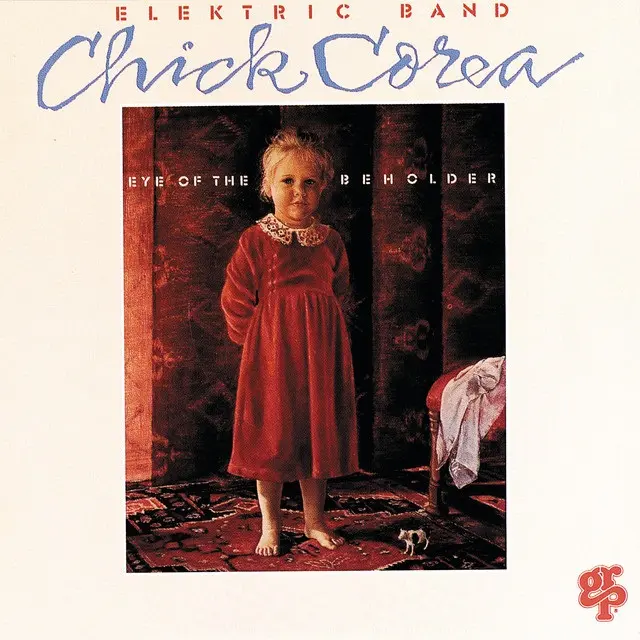 The Chick Corea Elektric Band released their third album, Eye of the Beholder, in 1988 on GRP Records.
The album marks a shift toward a more refined and acoustic-centered fusion sound, with Corea returning predominantly to grand piano amid a reserved electronic palette. The compositions adopt longer arcs and slower pacing, balancing modal lyricism with sharp dynamic turns.
Corea handles piano and synthesizers and arranged all eleven tracks. He’s joined by Frank Gambale (guitar), John Patitucci (bass), Eric Marienthal (saxophones), and Dave Weckl (drums), with a brief contribution from keyboardist John Novello. Patitucci’s role broadens, with intricate solos and deep electric textures anchoring the midtempo material.
Corea composed and arranged the entire album, including the two-part “Cascade” suite and climactic title track. The CD version includes all eleven tracks, while the vinyl edition omits the final two cuts.
“Home Universe” opens with a piano–saxophone dialogue that sets a reflective tone. “Eternal Child” unfolds slowly across sustained chords and melodic sax lines. “Passage” builds momentum through dynamic contrast and fast unison phrasing. “Beauty” stretches across nearly eight minutes, moving from sparse piano figures to full ensemble development. “Trance Dance” introduces one of the album’s sharper rhythmic edges, driven by Patitucci’s rapid phrasing. The title track balances structural complexity with bright melodic resolution. “Ezinda” stretches over extended modulations, while “Amnesia” concludes the set with rapid shifts in meter and harmonic color.
1. “Home Universe” (2:43)
2. “Eternal Child” (4:51)
3. “Forgotten Past” (2:58)
4. “Passage” (4:55)
5. “Beauty” (7:55)
6. “Cascade – Part I” (1:53)
7. “Cascade – Part II” (5:18)
8. “Trance Dance” (5:50)
9. “Eye of the Beholder” (6:38)
10. “Ezinda” (6:54)
11. “Amnesia” (3:26)
Sessions occurred in 1988 at Mad Hatter Studios in Los Angeles, with Corea producing and Bernie Kirsh engineering. Mike Reese handled mastering at The Mastering Lab.
Eye of the Beholder reached No. 7 on Billboard’s Top Contemporary Jazz Albums chart. It remains one of the Elektric Band’s most compositionally balanced and sonically dynamic recordings.
Akoustic Band (Chick Corea Akoustic Band)
 Chick Corea released his first Akoustic Band album on March 6, 1989, on GRP.
The album marked Corea’s return to acoustic trio jazz after a decade of electric and fusion-focused projects. Backed by John Patitucci and Dave Weckl—his rhythm section from the Elektric Band—Corea reinvents classic standards and original material with a virtuosic, high-energy acoustic approach. The album won the 1990 Grammy for Best Jazz Instrumental Performance, Group.
Corea performs on Yamaha concert grand piano. Patitucci plays upright bass throughout, and Weckl handles a traditional drum kit with crisp, dynamic interplay. The set emphasizes tonal precision and group agility, balancing lyricism with explosive rhythmic breaks.
Side one explores the jazz canon, including Coltrane’s “Bessie’s Blues,” Porter’s “So in Love,” and Ellington’s “Sophisticated Lady.” Corea’s trio approach amplifies harmonic depth and meter flexibility. Side two presents original material, including “Morning Sprite”—a signature Corea composition built on shifting cycles and rapid piano motifs—and a trio version of “Spain,” restructured with renewed melodic spacing and rhythmic nuance.
1. “Bessie’s Blues” (4:57) — originally composed by John Coltrane
2. “My One and Only Love” (4:47) — written by Guy Wood & Robert Mellin
3. “So in Love” (6:55) — written by Cole Porter
4. “Sophisticated Lady” (5:07) — composed by Duke Ellington, with lyrics by Irving Mills & Mitchell Parish
5. “Autumn Leaves” (5:07) — composed by Joseph Kosma, lyrics by Jacques Prévert & Johnny Mercer
6. “Someday My Prince Will Come” (6:14) — written by Frank Churchill & Larry Morey
7. “Morning Sprite” (6:33)
8. “T.B.C. (Terminal Baggage Claim)” (5:15)
9. “Circles” (6:33)
10. “Spain” (5:52)
Sessions occurred in 1989 at Clinton Recording Studios in New York and Mad Hatter Studios in Los Angeles. Corea produced the album with Bernie Kirsh engineering and mastering by The Mastering Lab in Hollywood.
Akoustic Band reached No. 1 on the Billboard Top Jazz Albums chart and marked the formal launch of Corea’s dual trio/fusion recording approach in the GRP era.
Inside Out (Chick Corea Elektric Band)
 The Chick Corea Elektric Band released their fourth album, Inside Out, in 1990 on GRP.
The album reasserts the group’s technical intensity after the more atmospheric Eye of the Beholder. With Corea returning to fast-paced compositional structures and suite-based formats, Inside Out presents a densely layered synthesis of fusion, post-bop, and programmatic motifs. The material favors complexity and speed, highlighting each player’s range within extended episodic forms.
Corea leads on acoustic piano and synthesizers and arranged all eleven tracks. He’s joined by Frank Gambale (guitar), Eric Marienthal (saxophones), John Patitucci (bass), and Dave Weckl (drums). Synthesizer programming was handled by Jay Oliver. The instrumentation follows the core Elektric Band format with renewed emphasis on unison lines, counterpoint, and shifting time signatures.
Corea composed the entire set, including two multipart suites: “Make a Wish” and the four-part “Tale of Daring.” The latter closes the album with a narrative arc in abstract musical form.
“Inside Out” opens with staccato lines and compound meter phrasing across rapid piano–sax–guitar interplay. “Make a Wish” unfolds over shifting harmonic cells and sustained melodic extensions. “Stretch It” alternates between skeletal motifs and sudden harmonic bursts. “Kicker” moves with syncopated forward momentum, weaving bass patterns into angular keyboard phrases. “Child’s Play” introduces brief contrast through a slower, motif-based construction. The “Tale of Daring” suite spans contrasting moods—suspenseful textures, cross-rhythmic overlays, and fast cadences—culminating in a structurally dense finale.
1. “Inside Out” (5:10)
2. “Make a Wish, Pt. 1” (1:39)
3. “Make a Wish, Pt. 2” (6:17)
4. “Stretch It, Pt. 1” (0:51)
5. “Stretch It, Pt. 2” (7:51)
6. “Kicker” (6:18)
7. “Child’s Play” (3:25)
8. “Tale of Daring (Chapter 1)” (2:02)
9. “Tale of Daring (Chapter 2)” (3:40)
10. “Tale of Daring (Chapter 3)” (5:48)
11. “Tale of Daring (Chapter 4)” (4:19)
Sessions occurred in 1990 at Mad Hatter Studios in Los Angeles with Corea producing and Jay Oliver assisting with programming. Executive producers included Dave Grusin and Larry Rosen.
Inside Out reached No. 6 on Billboard’s Top Contemporary Jazz Albums chart and became one of the band’s most ambitious studio efforts, establishing the format for their later suite-based works.
Discography:
- Tones for Joan’s Bones (1968)
- Now He Sings, Now He Sobs (1968)
- Is (1969)
- The Song of Singing (1971)
- A.R.C. (1971 • Chick Corea, David Holland & Barry Altschul)
- Piano Improvisations, Vol. 1 (1971)
- Sundance (1972)
- Piano Improvisations, Vol. 2 (1972)
- Return to Forever (1972)
- Crystal Silence (1973 • Gary Burton / Chick Corea)
- My Spanish Heart (1976)
- The Leprechaun (1976)
- Chick Corea, Herbie Hancock, Keith Jarrett, McCoy Tyner (1976 • Chick Corea / Herbie Hancock / Keith Jarrett / McCoy Tyner)
- Circulus (1978)
- Friends (1978)
- Secret Agent (1978)
- The Mad Hatter (1978)
- An Evening With Herbie Hancock & Chick Corea in Concert (1978 • Herbie Hancock & Chick Corea)
- Duet (1979 • Gary Burton & Chick Corea)
- Tap Step (1980)
- Three Quartets (1981)
- Touchstone (1982)
- Trio Music (1982 • Chick Corea, Miroslav Vitous & Roy Haynes)
- Children’s Songs (1984)
- The Chick Corea Elektric Band (1986 • The Chick Corea Elektric Band)
- Light Years (1987 • Chick Corea Elektric Band)
- Eye of the Beholder (1988 • Chick Corea Elektric Band)
- Akoustic Band (1989 • Chick Corea Akoustic Band)
- Inside Out (1990 • Chick Corea Elektric Band)
- Alive (1991 • Chick Corea Akoustic Band)
- Beneath the Mask (1991 • Chick Corea Elektric Band)
- Paint the World (1993 • Chick Corea Elektric Band II)
- Like Minds (1998 • Burton / Corea / Metheny / Haynes / Holland)
- To the Stars (2004 • Chick Corea Elektric Band)
- The Ultimate Adventure (2006)
- The Enchantment (2007 • Chick Corea & Béla Fleck)
- Further Explorations (2011 • Chick Corea, Eddie Gómez & Paul Motian)
- The Vigil (2013)
Sources:
Artist/Album Pages:
Jeff & Jane Hudson are an American husband/wife minimal wave duo from Boston that cut two 197...
Stealers Wheel was a Scottish folk-pop band that released three albums on A&M: Stealers Wheel ...
Iguana was an English brass-rock/funk band from Southampton that released a self-titled album on P...
Double Exposure was an American soul group from Philadelphia that released three albums between 1...
Minoru Muraoka — 村岡実 (May 21, 1923 — Jan. 2, 2014) — was a Japanese shakuhachi player who released...
Graduate was an English mod-ska band from Bath, Somerset, that released the 1980 album Acting My Age...
Apollo was a Finnish psych-rock band that released a self-titled album on Blue Master in 1970. Per...
Pharoah Sanders (1940–2022) was an American jazz saxophonist who cut eleven albums between 1967 an...
Armada were an English art-rock band that was active through several iterations between 1970 and 1...
Ruphus was a Norwegian symphonic/jazz-rock band that released six albums between 1973 and 1979 on ...
Delta 5 was an English post-punk band that released three 1979–80 Rough Trade singles and the 1981...
Sahara was a German symphonic-rock band that evolved from Subject ESQ. As Sahara, they made the 19...