

Larry Young (October 7, 1940 – March 30, 1978) was an American organist who released eleven albums between 1960 and 1976 and had backing stints with Grant Green, Miles Davis, John McLaughlin, and Tony Williams.
In the early 1960s, Young built his reputation through soul-jazz recordings and extensive sideman work. He released his first three albums on Prestige—Testifying (1960), Young Blues (1960), and Groove Street (1962)—which highlighted his mastery of the Hammond organ and his developing use of chordal extensions and blues-inflected phrasing.
By the mid-1960s, Young reached his peak as a leader with Blue Note Records. His albums Into Somethin’ (1964), Unity (1965), and Of Love and Peace (1966) displayed a more adventurous harmonic and modal language, combining hard-bop energy with emerging post-bop concepts. During this period, he also collaborated with tenor saxophonists like Joe Henderson and trumpeters like Woody Shaw, integrating complex rhythms and contrapuntal lines into his organ work. His Blue Note recordings remain notable for their sophisticated interplay between organ, horns, and rhythm section.
In the 1970s, Young explored jazz-funk and fusion through projects as both leader and sideman. He contributed to landmark recordings with the Tony Williams Lifetime, Miles Davis, John McLaughlin, and Carlos Santana, expanding his palette to include electric keyboards, synthesizers, and layered textures. Albums such as Lawrence of Newark (1973), Larry Young’s Fuel (1975), and Spaceball (1976) combined funk rhythms, dense percussion, and unconventional harmonies, reflecting his willingness to experiment and blur the lines between jazz, funk, and electronic instrumentation.
Background
Larry Young (also known as Khalid Yasin Abdul Aziz) was born on October 7, 1940, in Newark, New Jersey. He was the cousin of drummer Jimmie Smith (b. 1938). As a student at Newark Arts High School, Young teamed with classmates in assorted jazz and R&B combos.
Larry Young launched his professional career in the 1950s, performing with local R&B bands in Newark. He soon gravitated toward jazz, gaining experience as a sideman with musicians including Jimmy Forrest, Lou Donaldson, and Kenny Dorham. These engagements allowed him to develop his technique and improvisational approach, preparing him for a more prominent role in the jazz organ scene.
Early Albums
Young’s leadership emerged through a series of soul-jazz albums on Prestige Records. He recorded Testifying (1960), Young Blues (1960), and Groove Street (1962), showcasing his command of the Hammond organ and growing compositional skills.
Simultaneously, he maintained an active sideman career, contributing to Jimmy Forrest’s Forrest Fire (1960), Etta Jones’s Love Shout (1963), and Pony Poindexter and Booker Ervin’s Gumbo! (1963), demonstrating versatility across diverse ensembles and styles.
Into Somethin’
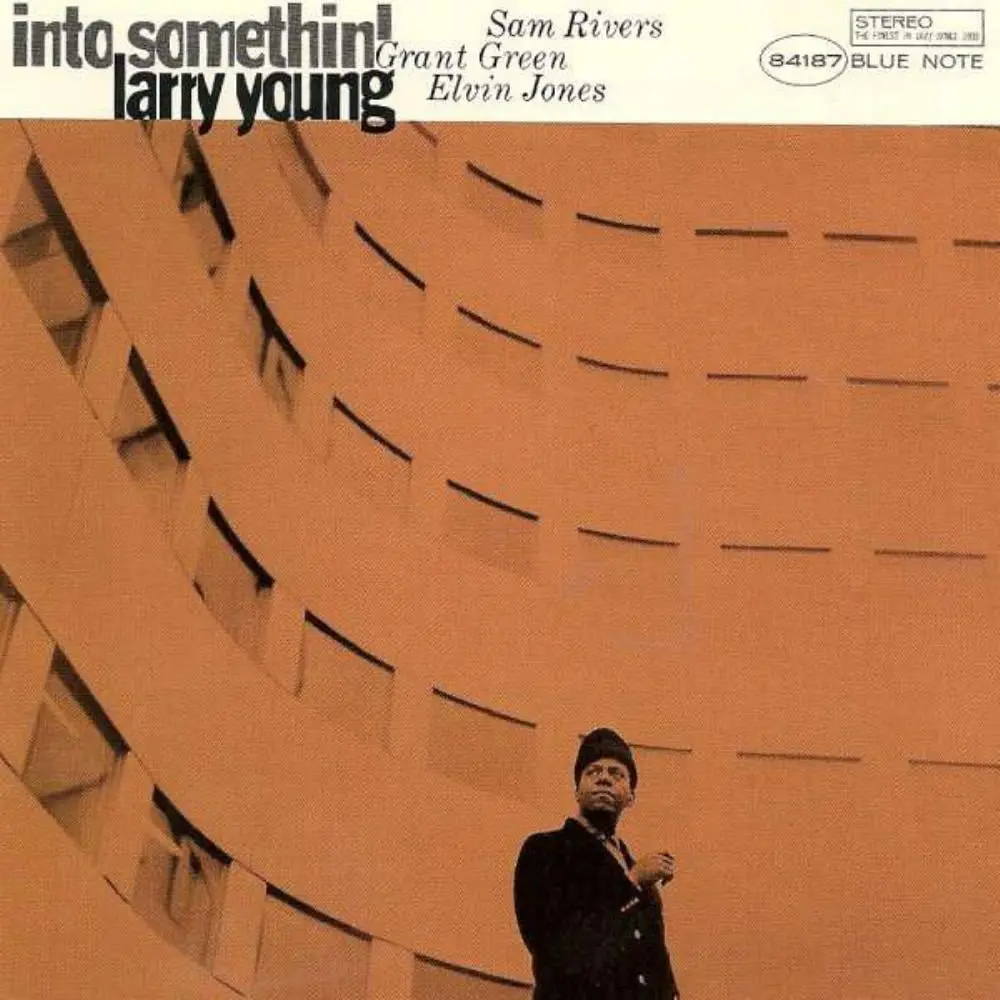 Larry Young released his fourth album, Into Somethin’, in March 1965 on Blue Note.
The album presents Young’s organ in a modern quartet setting, balancing dense harmonic textures with freer rhythmic interplay. With no bassist present, the organ anchors both foundation and motion while the other instruments stretch outward.
Young wrote everything apart from “Plaza De Toros,” a composition by guitarist Grant Green.
Into Somethin’ unfolds across contrasting designs: “Tyrone” and “Plaza De Toros” offer extended space for improvisation while “Paris Eyes” and “Ritha” turn inward with lyrical contours. “Backup” sits between, running on firm rhythmic insistence but leaving room for sharp turns in phrasing. The organ’s stacked voicings and quartal runs supply weight and color as Green, drummer Elvin Jones, and tenor saxophonist Sam Rivers push the music in divergent directions.
A1. “Tyrone” (9:40) rides on 6/8 with head-solo-head solos from Young, Green, and Rivers. Young explores quartal harmonies and stacked fourth chords, introducing his early use of minimalist, repeating lines. Green and Rivers add expressive variations, blending traditional blues phrasing with improvisation.
A2. “Plaza de Toros” (9:39) features Spanish-influenced tonalities with half-tone modulations. Solos proceed with Green first, Rivers second, and Young last in a head-solo-head structure. Rivers applies Spanish phrasing on tenor sax, while Young layers organ lines with subtle dissonances.
B1. “Paris Eyes” (6:42) glides with soft, steady momentum as Young’s organ provides harmonic and rhythmic foundation with concise solo lines.
B2. “Backup” (8:40) presents a swinging blues structure with crisp articulation. The arrangement follows traditional blues phrasing, with solos alternating between organ, guitar, and tenor sax. Ensemble sections maintain the tune’s steady 12-bar form.
B3. “Ritha” (6:45) is performed as a trio without Sam Rivers. Young’s organ, Green’s guitar, and Elvin Jones on drums alternate solos and coordinated figures, focusing on chordal movement and rhythmic interaction.
Sessions occurred at Van Gelder Studio in Englewood Cliffs, New Jersey, on November 12, 1964, with Alfred Lion producing and Rudy Van Gelder engineering.
After his Blue Note debut, Larry Young remained an active sideman in 1965 and 1966, frequently collaborating with guitarist Grant Green on albums including Talkin’ About! (1965), His Majesty King Funk (1965), and I Want to Hold Your Hand (1966), as well as Street of Dreams (1967), recorded in 1964. He also contributed to pianist Gildo Mahones’s projects, appearing on I’m Shooting High (1964) and The Great Gildo (1965).
Unity
 Larry Young released his fifth album, Unity, in August 1966 on Blue Note.
The record captures Young in a bold quartet setting that stretches the expressive range of the organ. The music is tense and forward-driving, anchored by Elvin Jones’s turbulent drumming and expanded through angular lines from trumpeter Woody Shaw and saxophonist Joe Henderson.
Shaw contributed three pieces, “Zoltan,” “The Moontrane,” and “Beyond All Limits.” Henderson supplied “If,” while the group also interpreted Thelonious Monk’s “Monk’s Dream” and the standard “Softly as in a Morning Sunrise” by Sigmund Romberg and Oscar Hammerstein II.
The opening “Zoltan” establishes a dramatic pulse with its brass fanfare-like theme over shifting organ harmonies, while “The Moontrane” rides on a propulsive rhythmic cycle that leaves space for sharp turns in improvisation. “If” takes a more spacious form, with Henderson shaping a serpentine theme against Young’s layered chords. The standards provide contrast: “Monk’s Dream” is jagged and dryly phrased, while “Softly as in a Morning Sunrise” is reworked with restless energy. Shaw’s closing “Beyond All Limits” pushes hardest into abstraction, with fragmented phrases unraveling against Jones’s surging pace.
A1. “Zoltan” (7:37) presents a Latinized march at high velocity. Horns play in unison over a modal AABA structure while Joe Henderson inserts free-jazz phrasing. Woody Shaw aligns trumpet lines with Henderson, and solos erupt in short bursts of improvisation.
A2. “Monk’s Dream” (5:45) drives with Young’s organ stating a polished theme with bold pedal use. Elvin Jones propels the rhythm with energetic patterns, trading phrases with the organ. Modal structures underpin the solos, which integrate tightly with the ensemble.
A3. “If” (6:42) unfolds a 12-bar theme by Henderson, who trades solos with Shaw and then Young with key modulations supporting transitions. Young injects blues-inflected lines over a swinging, steady pulse.
B1. “The Moontrane” (7:18) launches with a hard-bop unison theme within a modal framework. Shaw’s trumpet and Henderson’s saxophone take initial solos before Young’s organ, while Jones maintains legato cymbal textures. A drum solo concludes the improvisational section before returning to the main theme.
B2. “Softly as in a Morning Sunrise” (6:21) opens with a brief thematic statement before improvisation. Henderson and Shaw trade solos with contrasting intensity over Young’s organ and Jones’s dynamic drumming. Lines emphasize angularity and interactive phrasing.
B3. “Beyond All Limits” (6:02) launches the horns into a fast hard-bop unison theme, with the rhythm section adding Latin accents. Young’s organ solo surges with rhythmic energy before the ensemble returns to the main theme.
Sessions occurred at Van Gelder on November 10, 1965, with Alfred Lion producing and Rudy Van Gelder engineering.
Of Love and Peace
 Larry Young released his sixth album, Of Love and Peace, in September 1967 on Blue Note.
The record places Young in a freer context than his earlier work, balancing structured themes with long stretches of collective improvisation. His organ lines are set against jagged horn phrases and overlapping drum patterns, creating a sound that draws equally from hard bop, soul-jazz, and the avant-garde.
Young performs here with trumpeter Eddie Gale, saxophonists James Spaulding (alto, flute) and Herbert Morgan (tenor), and drummers Jerry Thomas and Wilson Moorman III. Young wrote the album’s title piece and “Falaq.” They also tackle pieces by Morton Gould (“Pavanne”) and Miles Davis (“Seven Steps to Heaven”).
“Pavanne” begins as a modal swing before unraveling into open improvisation, with horns and organ breaking into independent threads that rejoin in bursts of intensity. The title track and “Falaq” take a quieter approach, favoring space and sparse textures over harmonic density. “Seven Steps to Heaven” contrasts by racing forward at high pace, its fragmented phrasing and ensemble interplay echoing the freedom of Ornette Coleman’s groups.
A1. “Pavanne” (13:30)
A2. “Of Love and Peace” (6:30)
B1. “Seven Steps to Heaven” (10:00)
B2. “Falaq” (10:00)
Sessions occurred at Van Gelder on July 28, 1966, with Alfred Lion producing and Rudy Van Gelder engineering.
Contrasts
 Larry Young released his seventh album, Contrasts, in May 1968 on Blue Note.
The album presents extended ensemble passages alongside stark, pared-down pieces, with the organ central to both. Shifts in instrumentation highlight sharp stylistic turns from dense, percussive exchanges to sparse, meditative stretches.
The group features saxophonists Herbert Morgan and Tyrone Washington, flugelhornist Hank White, guitarist Eddie Wright, drummer Edward Gladden, and conga player Stacey Edwards. Young wrote four of the six tracks. They also tackle Tyrone Washington’s “Tender Feelings” and the cinematic ballad “Wild Is the Wind.”
“Majestic Soul” opens as a long, psychedelic workout driven by percussion and surging horns. “Evening” begins with a bossa undercurrent that loosens into freer interplay. “Major Affair” strips down to organ and drums for a terse exchange. “Wild Is the Wind” appears as a stark ballad with Althea Young’s voice stretched over slow, unsettled accompaniment. “Tender Feelings” and “Means Happiness” close the album with modal pieces, the latter built on a drone.
A1. “Majestic Soul” (11:55)
A2. “Evening” (7:10)
B1. “Major Affair” (3:45)
B2. “Wild Is the Wind” (4:45) signer Althea Young appears on this track; written by Dimitri Tiomkin and Ned Washington for the 1958 drama film starring Anthony Quinn.
B3. “Tender Feelings” (6:50)
B4. “Means Happiness” (4:40)
Sessions occurred at Van Gelder with producer Alfred Lion and engineer Rudy Van Gelder. David Bowie re-popularized “Wild Is the Wind” on his 1976 album Station to Station.
Heaven on Earth
 Larry Young released his eighth album, Heaven on Earth, in April 1969 on Blue Note.
The album shifts between rhythm-heavy pieces and stripped-down explorations, with Young’s organ guiding a set that spans funk-driven passages, impressionistic textures, and reworked standards.
Young composed four tracks, while the group also plays Tony Hatch’s “Call Me” and Richard Rodgers and Lorenz Hart’s “My Funny Valentine.”
For this set, Young enlisted guitarist George Benson, drummer Edward Gladden, and saxophonists Byard Lancaster (alto) and Herbert Morgan (tenor).
“The Infant” and the title track ride strong rhythmic foundations with organ at the forefront. “The Hereafter” expands into layered percussion and elongated harmonic shifts. “The Cradle” stays tighter in form, while “Call Me” is approached with a lighter touch. The closer, “My Funny Valentine,” slows to a sparse ballad framed by Althea Young’s vocal.
A1. “The Infant” (6:05)
A2. “The Cradle” (5:05)
A3. “The Hereafter” (8:42)
B1. “Heaven on Earth” (6:10)
B2. “Call Me” (7:25)
B3. “My Funny Valentine” (4:35)
Sessions occurred at Van Gelder with producer Francis Wolff and engineer Rudy Van Gelder.
Jazz-rock Sideman Credits
Between 1969 and 1972, Larry Young established himself as a central force in early jazz-rock fusion through a string of high-profile sideman appearances. He anchored the Tony Williams Lifetime with his organ work on Emergency (1969), Turn It Over (1970), and Ego (1971), providing angular chordal structures, modal explorations, and dynamic solos that propelled the group’s intense, rock-influenced energy.
Young also shaped the sound of Miles Davis’s late-1960s sessions, contributing to Bitches Brew (1969 recordings, released 1970) and Big Fun (1969–70 sessions, released 1974), where he layered dense keyboard textures and counterpoint rhythms beneath the ensemble’s improvisations. He collaborated with John McLaughlin on Devotion (1970) and joined Carlos Santana for Love Devotion Surrender (1972), adding harmonic sophistication and inventive organ lines to these fusion-driven projects.
Lawrence of Newark
 Larry Young released his ninth album, Lawrence of Newark, in June 1973 on Perception Records.
Young composed and self-produced this set, comprised of organ-led spiritual improvisations driven by heavy percussion and shifting textures. Newark marked his return as a leader after several years working in collective settings.
His ensemble here includes multiple drummers (Abdul Shahid, Howard T. King, James Flores, Art Gore) and percussionists (Jumma Santos, Armen Halburian, Stacey Edwards, Umar Abdul Muizz, Poppy La Boy). Bassists Don Pate and Juni Booth alternate around guitarist James “Blood” Ulmer and electric pianist Cedric Lawson. Young also enlisted cellist Diedre Johnson, electric trumpeter Charles Magee, and saxophonists Dennis Mourouse and “mystery guest.”
“Saudia” opens with layered organ lines and percussion swells. “Alive” is brief and transitional, moving into “Hello Your Quietness (Islands),” where organ drones and cello create a meditative core against scattered percussion. “Sunshine Fly Away” rides a thick, trance-like rhythm with organ and horns surging over it. The closer, “Khalid of Space (Part Two) Welcome,” stretches into 12 minutes of surging momentum with organ, guitar distortion, horns, and drums colliding into a ritualistic climax.
A1. “Saudia” (4:28) opens with a laid-back arrangement featuring a simple bass line and layered percussion from multiple drummers. Young’s Hammond organ delivers a stately, church-like tone, while James “Blood” Ulmer’s guitar adds sporadic, unusual textures that float over the rhythm.
A2. “Alive” (1:50) propels forward on an intense, driving rhythm from two or three drummers and additional percussionists. Young contrasts this with subdued, sustained organ lines, creating tension between the relentless percussive patterns and his keyboard work.
A3. “Hello Your Quietness (Islands)” (10:02) interweaves swirling percussion, pulsing bass, and nervy bowed cello lines with complex organ and woodwind textures. Solos unfold freely over the multi-layered backdrop, balancing high-energy improvisation with expansive rhythmic support.
B1. “Sunshine Fly Away” (8:37) establishes a solid rhythmic foundation from drums, percussion, and bass. Woodwinds and cello provide harmonic support as Young and tenor saxophone trade angular lines and abrasive, spacey organ phrases, culminating in a cello solo that closes the track.
B2. “Khalid of Space (Part Two) Welcome” (12:20) presents multi-themed percussion and pedal-tone excursions, maintaining a pocket funk pulse despite the complex layering. Solos from Young, a soprano saxophone guest, and Ulmer navigate the dense textures, with organ, overdriven guitar chords, and cello driving interlocking rhythmic and harmonic patterns.
Sessions occurred at Blue Rock Studio in New York with engineer and remixer Eddie Korvin.
Larry Young’s Fuel
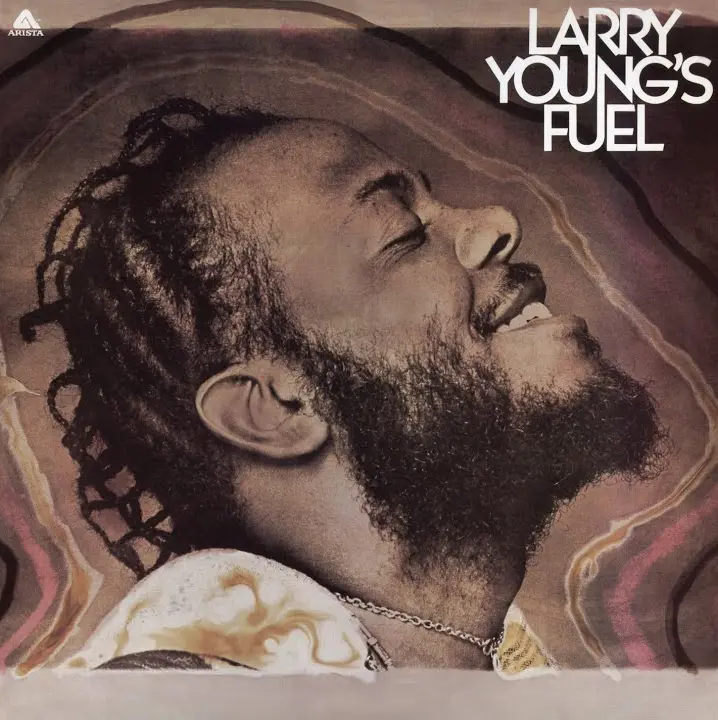 Larry Young released his tenth album, Larry Young’s Fuel, in June 1975 on Arista.
Young wrote two tracks on his own—“I Ching (Book of Changes)” and “H + J = B (Hustle + Jam = Bread).” He co-wrote “Fuel for the Fire” with Sandy Torano and Terry Philips, “Turn Off the Lights” with Fernando Saunders and Linda ‘Tequila’ Logan, “People Do Be Funny” with Philips, and “New York Electric Street Music” with Saunders and Torano. Torano alone composed “Floating.”
Young plays Mini Moog synthesizer, CDX-0652 Portable Moog Organ, Freeman String Symphonizer, Hammond B-3, Fender Rhodes, and acoustic piano. Fuel features Sandy Torano on guitar, Fernando Saunders on bass, and Rob Gottfried on congas, supported by additional drummers and an electric pianist. Linda “Tequila” Logan sings on three tracks, while Young handles vocals on one.
Fuel blends funk rhythms, rock dynamics, and synthesizer-driven textures. “Fuel for the Fire” opens the record with thick bass lines and wiry synthesizer layers. “I Ching (Book of Changes)” stretches over pulsing rhythms and spiraling organ figures. “Turn Off the Lights” leans on Logan’s sultry vocal lines over shifting keys. “Floating” pares back into a guitar-led instrumental. The closer, “New York Electric Street Music,” expands into a dense, urban-themed jam with synthesizer, bass, and percussion competing for space.
A1. “Fuel for the Fire” (6:07) establishes a funk foundation with layered percussion and bass while Linda “Tequila” Logan delivers wordless vocals. Young alternates between synthesizer and Fender Rhodes, adding angular, video game–like textures over the rhythm section.
A2. “I Ching (Book of Changes)” (6:25) blends Oriental and classical melodic motifs over an urban funk base. Young layers synthesizer lines with contoured, playful textures, producing a quirky, cartoon-like sonic character.
A3. “Turn Off the Lights” (7:03) features Logan’s sultry vocals atop a steady funk pulse. Young explores multiple keyboard timbres with angular runs and dense harmonic clusters, interacting with the rhythm section’s tight patterns.
B1. “Floating” (4:12) drives a cruising funk motif over repetitive chordal structures. Young’s lead synthesizer delivers precise, staccato lines, while the arrangement draws lightly on classical phrasing for ornamental passages.
B2. “H + J = B (Hustle + Jam = Bread)” (6:17) centers on organ riffs over dense percussion and bass patterns. Young layers synthetic textures, accentuating rhythmic variations while the band maintains a firm urban funk backbone.
B3. “People Do Be Funny” (3:42) foregrounds Logan’s vocals, with Young weaving keyboard motifs beneath. The arrangement focuses on repetition and rhythmic interaction between organ, synthesizer, and percussion.
B4. “New York Electric Street Music” (8:33) rests on a broad funk framework with energetic lead guitar lines. Young adds playful, angular synthesizer and vocal phrases, punctuating the rhythmic foundation and providing counterpoint to the instrumental textures.
Sessions occurred at Minot Sound Studio in White Plains, New York with producers Larry Young and Terry Philips, engineered by Brian MacDonald and Doug Clark, and mixed by MacDonald and Philips.
Spaceball
 Larry Young released his eleventh album, Spaceball, in May 1976 on Arista, which billed the title to Larry Young’s Fuel.
Spaceball blends funk, progressive rock, lounge exotica, and early disco, highlighting layered keyboards and analog synthesizer textures. Young wrote four of the seven tracks; keyboardist Julius Brockington composed “Startripper,” “Sticky Wicket,” and “Flytime.”
Young plays CDX-0652 Portable Moog Organ, Mini-Moog, Freeman String Symphonizer, Hammond B-3, Fender Rhodes, and acoustic piano. The core band, Fuel, includes Dave Eubanks on bass, Jim Allington on drums, Danny Toan on guitar, and Julius Brockington on keyboards. Guest guitarists Larry Coryell and Ray Gomez appear, with Al Lockett on horns and vocals, Paula West on vocals, and a percussion section including Abdoul Hakim, Barrett Young, Clifford Brown, and Farouk.
“Moonwalk” opens with tight funk lines over dueling keyboards and guitars. “Startripper” and “Sticky Wicket” explore prog-rock fusion with layered synths. “Flytime” combines instrumental exotica with jazzy keyboard runs. “Spaceball” and “Message From Mars” mix analog synth textures with funk rhythms, while “I’m Aware Of You” closes with a focused, keyboard-led arrangement.
A1. “Moonwalk” (5:00) runs lively patterns with layered keyboards from Young and Brockington. Gomez and Coryell duel on guitar while Young emphasizes low-end textures. Intermittent choral vocals punctuate the rhythmic framework.
A2. “Startripper” (4:44) rides Latin-inflected rhythms with angular keyboard exchanges between Young and Brockington. Gomez and Coryell interlock rhythm and lead guitar lines, and flute adds airy counterpoints to the ensemble.
A3. “Sticky Wicket” (9:26) builds on dense, layered rhythms from Allington and Eubanks. Coryell delivers an incendiary guitar solo while keyboards and percussion accentuate shifting textures and interwoven patterns.
B1. “Flytime” (4:50) unfolds with a measured, flowing pulse. Young and Brockington trade keyboard lines over steady bass and drums, while rhythmic shifts accentuate angular phrasing.
B2. “Spaceball” (5:07) opens with unusual vocalizations before settling into syncopated rhythms. West leads vocals as keyboards, guitars, and percussion interweave tight, contoured lines.
B3. “Message From Mars” (7:29) layers keyboards, guitars, bass, and drums over interlocking, angular patterns. Gomez and Coryell exchange rapid guitar lines while the ensemble maintains complex, shifting structures.
B4. “I’m Aware Of You” (5:09) emphasizes tightly coordinated horns, drums, keyboards, and guitars. Ensemble passages feature interlocking rhythmic figures and precise, contoured phrasing throughout the track.
Sessions occurred at Dick Charles Studio in New York with producer Terry Philips, assistant producer Brian MacDonald, engineered and mixed by Brian MacDonald and Les Paul Jr.
Mother Ship
In 1980, Blue Note issued Mother Ship, an unearthed Larry Young session from February 7, 1969, with Lee Morgan.
Discography:
- Testifying (1961 • The Larry Young Trio)
- Groove Street (1962)
- Young Blues (1962)
- Into Somethin’ (1965)
- Unity (1966)
- Of Love and Peace (1967)
- Contrasts (1968)
- Heaven on Earth (1969)
- Lawrence of Newark (1973)
- Larry Young’s Fuel (1975)
- Spaceball (1976 • Larry Young’s Fuel)
Sources:
- Discogs: Larry Young
- 45worlds: Larry Young
- JazzMusicArchives: Larry Young
- RYM: Larry Young
- MusicBrainz: Larry Young
Artist/Album Pages:
Michael Farneti is an American singer, songwriter, and multi-instrumentalist from Palm Beach Shore...
Food Brain was a Japanese jam-rock band that released the 1970 Polydor album Social Gathering. M...
Nasty Pop was an English pop-rock band that released a self-titled album on Island in 1975, followed...
Saturnalia was an English folk-psych band that released the album Magical Love on Matrix in 1973. ...
Bruford was an English jazz-rock supergroup that released four albums on Polydor/EG between 1978 a...
Spud was an Irish folk-rock band from Dublin that made the 1974/75 Philips albums A Silk Purse and...
Reale Accademia di Musica was an Italian symphonic-rock band that released a 1972 self-titled albu...
Contraluz was an Argentine progressive folk band behind the 1973 album Americanos. They returned i...
Visitors — alternately known as Force 5 — was a French space-rock studio group of library and jazz...
Ilpo Saastamoinen (born July 22, 1942) is a Finnish guitarist, songwriter, and musicologist who pl...
Heikki Koskinen — aka Mike Koskinen — is a Finnish trumpeter, composer, and bandleader active in t...
Stud was an English/Irish jazz-rock/jam band from London that released a self-titled album on Decc...