

Tantra was a Portuguese symphonic-rock band that made the 1977/78 Epic albums Mistérios e Maravilhas and Holocausto, followed by the 1981 release Humanoid Flesh.
Members: Manuel Cardoso (guitar), Armando Gama (keyboards, 1975-81), Américo Luis (bass, 1975-81), Pedro Luis (keyboards, 1975-81), TóZé Almeida (drums, 1975-81)
Inception
Tantra formed in 1975 in Lisbon, where guitarist Manuel Cardoso and keyboardist Armando Gama teamed with bassist Américo Luis, drummer Sicó Lunas Geremelo, and singer–vibraphonist Lindú Moma Diá N’Gola. In 1976, they cut their first single on Epic Records.
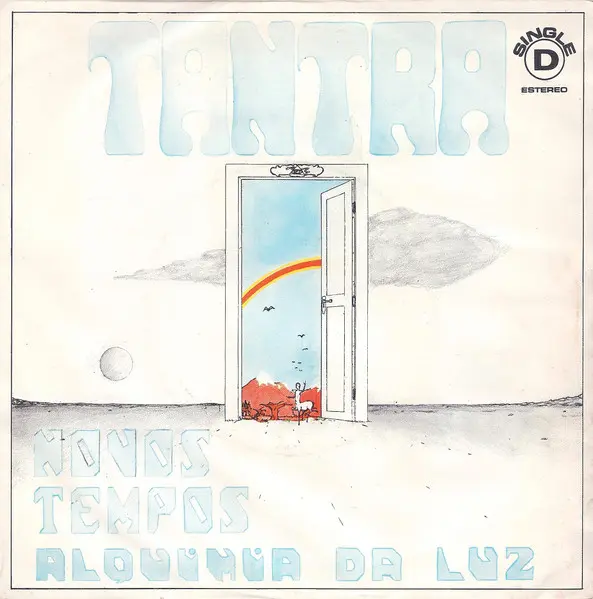 A. “Novos Tempos” [New Times] (4:31)
B. “Alquimia da Luz” [Alchemy of Light] (5:54)
Tantra self-produced both songs with string arrangements by Cardoso and Gama. The pair reconfigured Tantra as a quartet with Luis and drummer TóZé Almeida.
Mistérios e Maravilhas
 Tantra released their debut album, Mistérios e Maravilhas, in late 1977 on EMI.
The album presents a continuous sequence of symphonic movements shaped by rapid instrumental handoffs, contrapuntal keyboard/guitar layering, and abrupt shifts in tempo and meter.
Guitarist Manuel Cardoso interweaves acoustic passages and angular lines with flourishes from his TG55 guitar synthesizer, while keyboardist Armando Gama alternates between harpsichord textures, acoustic piano runs, and wide-tone analog voicings on the Farfisa Synthorchestra. Bassist Américo Luis underpins the material with a taut, elastic framework, locking with drummer TóZé Almeida’s blend of acoustic kit and Syndrum pads to form a backbeat that shifts freely between fluid and accentuated patterns.
“À Beira do Fim” opens with shifting rhythmic pressure and layered organ-synth voicings beneath declarative vocals. It pivots through bold tempo changes, abrupt volume drops, and short lyrical arcs that ride angular lines between guitar and keys. “Aventuras de um Dragão num Aquário” strips the pace down to acoustic guitar figures with light embellishment, acting as a transitional sketch before the title track introduces a more scattered instrumental frame.
On “Mistérios e Maravilhas,” the band lays out segmented themes with keyboard surges, bass flurries, and abrupt tonal detours that never quite resolve, leaving the side in a holding pattern. “Máquina da Felicidade” spreads disconnected instrumental fragments across its front half, peaking midway with a loose, midlength drum solo before tightening around a cycling keyboard figure. “Variações sobre uma Galáxia” functions as a subdued prelude, layering ambient synth flourishes over sparse piano without developing forward motion. “Partir Sempre” restores the balance with sung phrases that interact cleanly with synth and guitar ornamentation.”
A1. “À beira do Fim” [Edge of Oblivion] (11:01) – Cardoso
A2. “Aventuras de um dragão num aquário” [Adventures of a Dragon in Aquarius] (2:09) – Cardoso
A3. “Mistérios e Maravilhas” [Mysteries and Wonders] (6:19) – Luis, Almeida, Gama, Cardoso
B1. “Máquina da Felicidade” [Happiness Machine] (13:39) – Almeida
B2. “Variações Sobre uma Galáxia” [Variations on a Galaxy] (1:24) – Gama
B3. “Partir sempre” [Always Departing] (9:29) – Gama, Máximo
Tantra recorded the album in eight days between September 26 and October 7, 1977, with engineers Hugo Ribeiro and Joca at the Alto da Loba studios. They completed mixing across three overnight sessions. Mário Martins co-produced the album with Tantra, who arranged and performed all material. Miguel C. Monteiro designed the cover and Carlos Correia and Júlia Ventura supplied the back-cover photography.
Holocausto
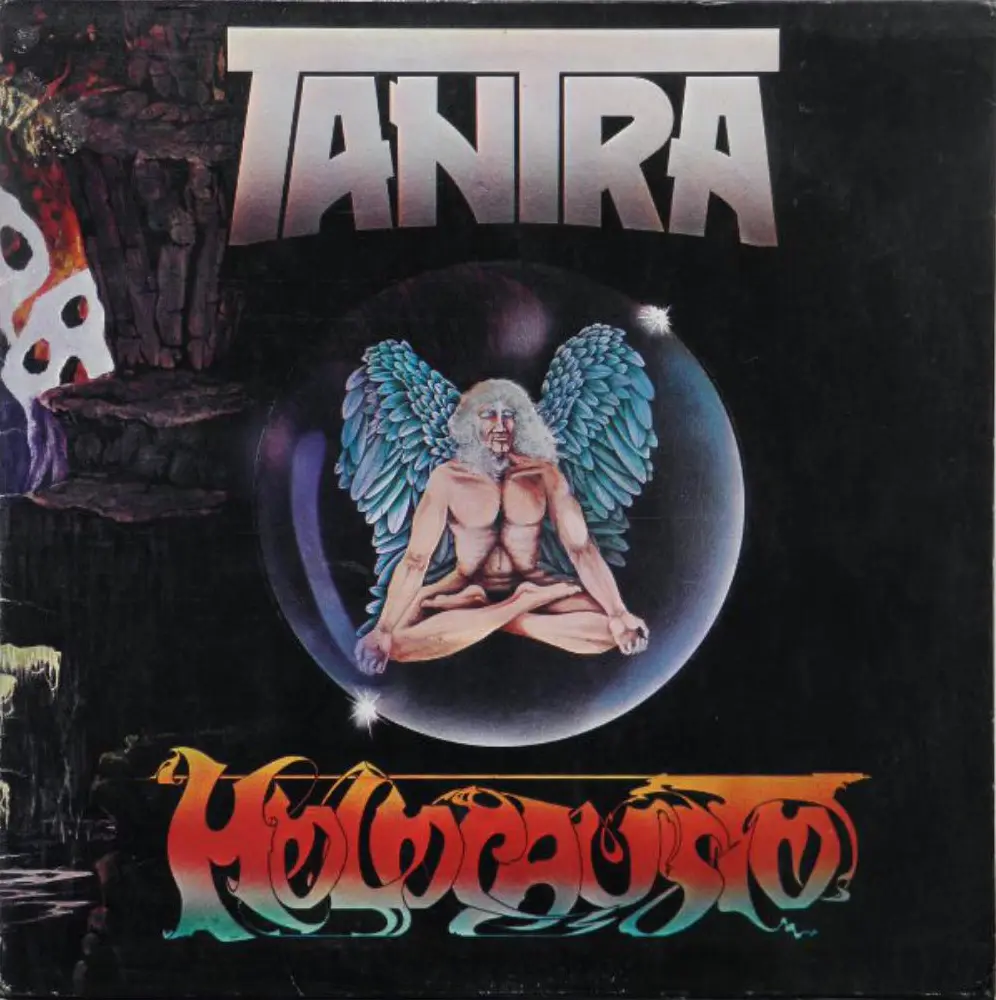 Tantra released their second album, Holocausto, in 1978 on EMI.
Holocausto stresses rapid transitions, tempo breaks, and sudden interjections with keyboard-driven intensity.
Manuel Cardoso balances sustain-driven Les Paul lines with acoustic overlays and frequency-split guitar synth phrases, while Pedro Luís spans Mellotron clusters, Polymoog sequences, and Rhodes inflections with rapid transitions and tonal interjections. Américo Luís grounds the material with a centered, flexible pulse that anchors the extended instrumental interplay, locking with Tózé Almeida’s backbeat of tubular bells, marimba bursts, and tempo-switching percussion. Musical guest Tony Moura adds electric leads and vocals on select passages.
“Om” opens in stillness with suspended synth textures that give way to layered rhythmic interplay between Rhodes and Moog, anchored by shifting bass pulses. The voice enters briefly, cutting through with narrow phrasing before a mid-track rupture collapses the arrangement into spare piano and floating textures. From there, a slow rebuild carries the piece into a closing section led by clavinet flurries and wide-filter synth sweeps. “Holocausto / Último Raio do Astro Rei” alternates between stabbing Moog figures, Mellotron swells, and rhythm-section pivots that stutter or lurch without warning. Guitar and clavinet cross paths in jagged alignment, then fracture into divergent solo passages that reset the pulse.
“Zephyrus” centers on whispered syllables laid over sitar and zither tones, while muted synths drift underneath and the drums stagger their entrances. “Talismã” moves between arpeggiated calm and full-group acceleration, with Moog themes threading in and out of guitar counterlines. “Ara” starts on a plaintive vocal lead with open guitar voicings before flipping into an up-tempo stretch marked by a tightly phrased Minimoog solo over clipped rhythm shifts. “Pi” closes the album with staggered piano-guitar interplay that yields to swinging, jazz-inflected meters, with alternating episodes of acoustic reflection and rapid synth-guitar co-soloing.
A1. “ॐ” [Om] (8:47) – Cardoso
A2. “Holocausto / Último Raio do Astro Rei” [Holocaust / Last Ray of the Star King] (10:53) – Cardoso, Almeida
A3. “Zephyrus” (2:50) – Tantra
B1. “Talismã” [Talisman] (8:44) – Luís, Cardoso, Pedro Luís
B2. “Ara” (4:54) – Luís, Cardoso
B3. “Ji” (7:29) – Pedro Mestre, Cardoso
Tantra recorded Holocausto at Estúdios Arnaldo Trindade with engineers Manuel Cunha and Moreno Pinto. They co-produced the album with Nuno Rodrigues. Júlia Ventura handled studio photography and Manuel Dias designed the artwork and graphics. Valentim de Carvalho CI SARL manufactured and distributed the album on behalf of The Gramophone Co. Ltd.
Humanoid Flesh
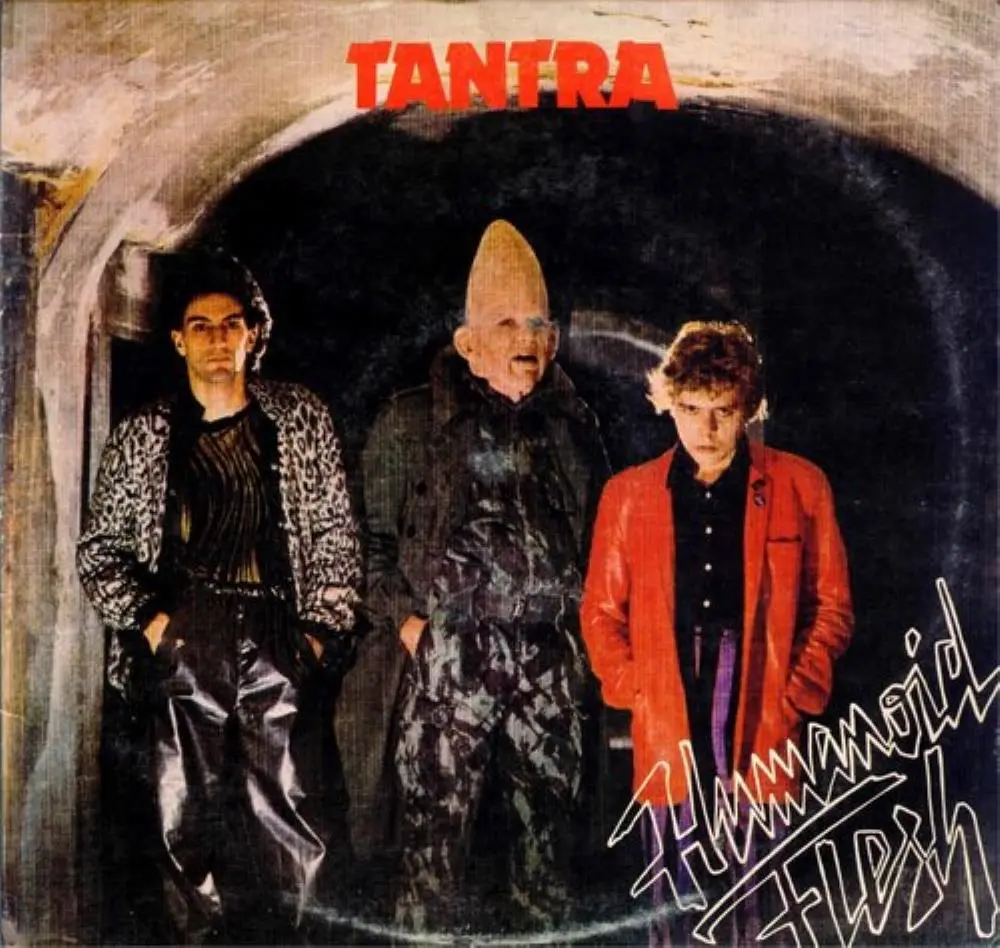 Tantra released their third album, Humanoid Flesh, in 1981 on Valentim de Carvalho.
The album shifts toward tighter, rhythm-based arrangements that foreground vocal phrasing and shorter instrumental figures while retaining interplay between tonal and electronic elements.
Guitarist Manuel “Frodo” Cardoso shapes each track with terse figures and clipped phrasings that counter or reinforce Pedro Luís’s keyboard overlays, which alternate between sharp analog lines and chordal bursts. Bassist Pedro Ayres Magalhães underpins the material with a forward, punctuated low-end that steadies the ensemble’s phrasing, while drummer Tózé Almeida maintains an active backbeat with controlled transitions and steady pulse orientation.
A1. “Girl in the Head” (3:35) – Tantra
A2. “Crazy Rock’N’Roll” (3:25) – Tantra
A3. “What Have Your Eyes Done to Me?” (2:32) – Tantra
A4. “Magic” (3:17) – Tantra
A5. “Verdes Anos” (3:00) – Carlos Paredes
B1. “Dangerous Works” (4:00) – Tantra
B2. “Humanoid Flesh” (3:28) – Tantra
B3. “Just Another Lie” (4:05) – Tantra
B4. “African Sands” (4:40) – Tantra
Tantra recorded Humanoid Flesh at Estúdios Valentim de Carvalho with production credited to the band and SR. Valentim de Carvalho CI SARL handled manufacturing and distribution. Ana Esquivel and Eduardo Gageiro contributed studio and promotional photography, including the cover pic with Frodo in a conehead mask.
Postlude
In 1982, Cardoso and Luís wrote six songs for Tutti Frutti, the Frodo-produced second album by the Portuguese girl group Cocktail. Meanwhile, Frodo released Noites de Lisboa, a synthpop solo album on Discos VDC.
Discography:
- “Novos Tempos” / “Alquimia da Luz” (1976)
- Mistérios e Maravilhas (1977)
- Holocausto (1978)
- Humanoid Flesh (1981)
Sources:
Artist/Album Pages:
The Younghearts were an American soul group from Los Angeles that scored R&B hits with “Oh I’...
Le Mat was an English art-rock/psychedelic band behind the 1983 album The Waltz of the Fool on Wha...
Hyldemor was a Danish psych-rock band behind the 1978 CBS album Glem det Hele. They evolved from ...
Ace was an English soul-rock band from Sheffield that released three albums on Anchor between 1974...
Témpano are a Venezuelan art-rock band that debuted with the 1979 Vinyl Internacional release Åtab...
Magazine was an English rock band led by original Buzzcocks frontman Howard Devoto. They debuted wit...
Patti Austin is an American soul and jazz singer who released nine albums between 1976 and 1990 a...
Minako Yoshida — 吉田美奈子 (April 7, 1953) — is a Japanese singer/songwriter who debuted with an album...
The Raincoats were an English post-punk band that released three albums between 1979 and 1984 on R...
Folly’s Pool was an American symphonic folk-rock band from Fresno, Calif., that issued a 1977 self...
Rod Stewart (born Jan. 10, 1945) is an English rock vocalist from London who fronted several R&am...
Alf Emil Eik is a Norwegian musician, composer, and vocalist who made the 1979 Harvest album Joy a...