

Al Di Meola is an American guitarist who emerged in the jazz-rock supergroup Return to Forever, playing on the 1974–76 albums Where Have I Known You Before, No Mystery, and Romantic Warrior. As a solo artist, he’s issued more than 40 albums, starting with the 1976/77 Columbia titles Land of the Midnight Sun and Elegant Gypsy.
Background
He was born Al Laurence Dimeola on July 22, 1954, to an Italian family in Jersey City, N.J., and grew up in nearby Bergenfield. Inspired by The Ventures, he took up guitar at age eight. His instructor trained him on jazz and bluegrass standards, including the works of guitarists George Benson, Kenny Burrell, Clarence White, and Doc Watson.
In the early 1970s, Di Meola attended the Berklee College of Music in Boston. One year into his studies, he met pianist Barry Miles and joined his backing band, succeeding guitarists Pat Martino and John Abercrombie.[1] The following year, he attended a concert by the jazz-rock supergroup Return to Forever. Vying for a slot in the band, he sent his audition tape to keyboardist and bandleader Chick Corea, who hired the 19-year-old as Bill Connors’ replacement in April 1974.
Return to Forever
Corea and Di Meola, along with bassist Stanley Clarke and drummer Lenny White, constituted the classic RtF lineup that issued three albums between 1974 and 1976. On the first, Where Have I Known You Before, Di Meola plays electric and 12-string acoustic guitar. His playing veers between lightning-fast electric runs and Latin-tinged filigree. The group-composed “Earth Juice” was his first writing credit.
In 1975, RtF released No Mystery, a fusion of jazz-rock and funk. Di Meola contributed the side one epic “Flight of the Newborn” and co-composed the fiery “Excerpt From the First Movement of Heavy Metal.” That same year, he and fellow jazz-rock guitarist Larry Coryell (then of The Eleventh House) played on the 11-minute “Prince of the Sea,” the closing epic on White’s debut solo album Venusian Summer.
In February 1976, RtF recorded Romantic Warrior, a 45-minute collection that crosses jazz-rock, symphonic-rock, Latin rock, and funk. Di Meola — credited with electric and acoustic guitar, plus soprano guitar (a smaller nylon-stringed acoustic), handbell, and slide whistle — contributed “Majestic Dance,” the floodgate of side two. After the band toured the album that summer, Corea dissolved the lineup.
Go
Concurrent to the Warrior sessions, Di Meola contributed to Go, the collaborative effort of percussionist Stomu Yamashta, drummer Michael Shrieve, singer/keyboardist Steve Winwood, and electronic musician Klaus Schulze. Di Meola plays on the conjoined tracks “Man of Leo” / “Stellar” and “Carnival” / “Ghost Machine,” plus the penultimate number “Time Is Here.” On June 12, 1976, he performed the album live with the group at the Palais des Sports in Paris, France. That show spawned the live document Go Live from Paris, released later that year.
Land of the Midnight Sun
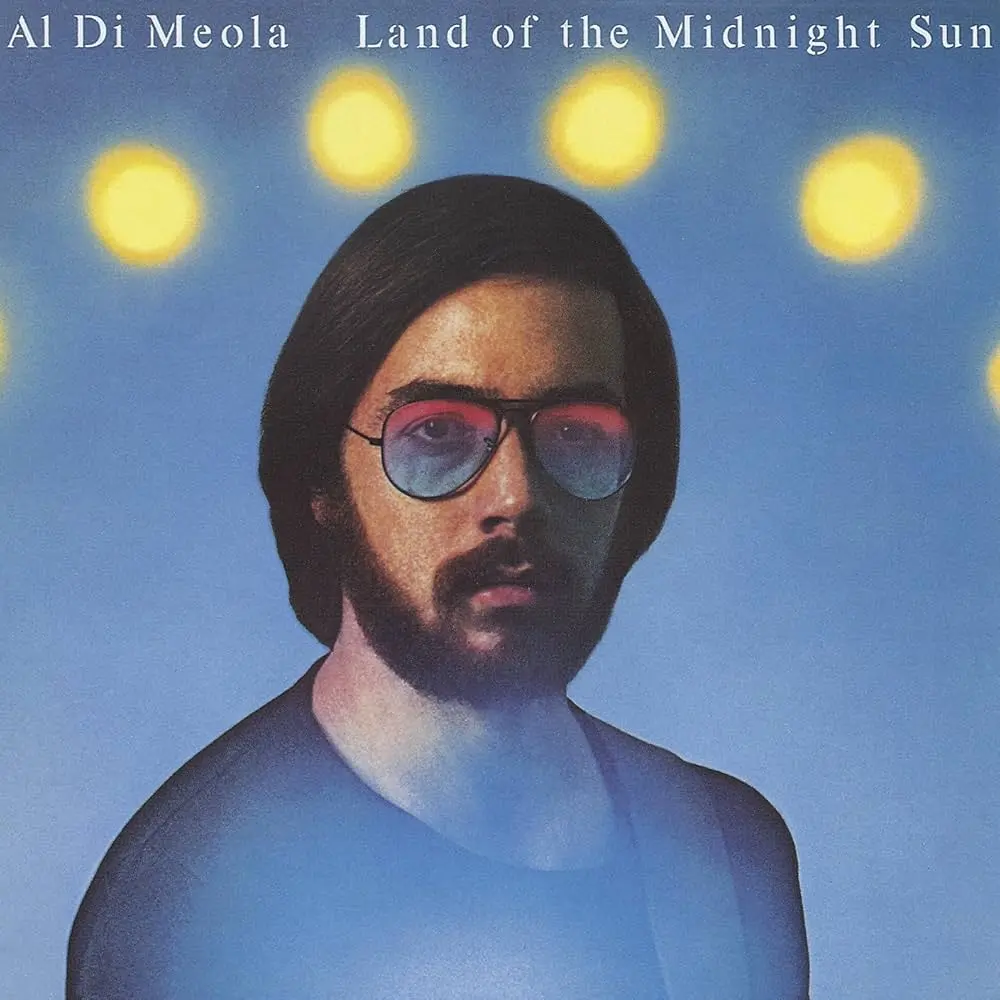 Al Di Meola released his debut solo album, Land of the Midnight Sun, on October 25, 1976, on Columbia.
Land of the Midnight Sun presents a high-velocity jazz-rock debut with sharp shifts between electric guitar intensity and acoustic introspection, charting a distinct solo path after Di Meola’s tenure in Return to Forever.
Di Meola plays electric and acoustic guitars, synthesizer, percussion, and voice, backed on select tracks by four ongoing sidemen: bassist Anthony Jackson, Stuff drummer Steve Gadd, Berklee classmate Barry Miles, and RTF predecessor Mingo Lewis (a percussionist on the pre-Di Meola Hymn of the Seventh Galaxy). The album also features drummer Alphonse Mouzon, Weather Report bassist Jaco Pastorius, and Al’s current RTF bandmates: Chick Corea (piano, marimba), Stanley Clarke (bass, vocals), and Lenny White.
Di Meola composed four of the six original pieces and arranged one Bach composition. Mingo Lewis supplied the opening track, and Chick Corea contributed the closing number.
“The Wizard” opens with layered hand percussion, brisk drum bursts, and interlocking guitar motifs that rise into sharp, climbing figures and staggered rhythmic shifts. “Land of the Midnight Sun” alternates between suspended phrases and clustered rhythmic jabs, with the guitar cutting angular trails through stop-start grooves and rapid chord turnovers. The “Golden Dawn” suite opens on tight unison riffing, then relaxes into tapering keyboard patterns and rotating electric themes underpinned by gliding bass lines. “From Ocean to the Clouds” rides a loping backbeat through locked jams and climbing, overlaid synth–guitar exchanges. “Short Tales of the Black Forest” closes on a spiraling acoustic–piano duet that unfolds in waves of contoured phrasing and escalating interplay.
A1. “The Wizard” (6:46) — written by Mingo Lewis, with Jackson, Gadd
A2. “Land of the Midnight Sun” (9:10) — with Jackson, White, Miles (e-piano, Mini-moog), Lewis
A3. “Sarabande from Violin Sonata in B Minor” (1:20) — composed by Johann Sebastian Bach
A1. “Love Theme from ‘Pictures of the Sea’” (2:25) — with Clarke, Lewis, vocalist Patty Buyukas
B1. “Suite – Golden Dawn” (9:49) — Pastorius, Mouzon, Miles, Lewis
a) “Morning Fire”
b) “Calmer of the Tempests”
c) “From Ocean to the Clouds”
B2. “Short Tales of the Black Forest” (5:41) — with Chick Corea (piano, marimba)
Sessions occurred in July and August 1975 at Different Fur (San Francisco) and Electric Lady (New York City) with production by Al Di Meola.
Elegant Gypsy
 Al Di Meola released his second solo album, Elegant Gypsy, in April 1977 on Columbia.
Elegant Gypsy sharpens the attack of Di Meola’s debut with a denser fusion of electric virtuosity and acoustic flair, introducing Mediterranean flavors and flamenco interplay to his expanding stylistic range.
Di Meola plays electric and acoustic guitars, piano, synthesizer, and percussion. Key collaborators include Spanish guitarist Paco de Lucía, Czech keyboardist Jan Hammer, RTF colleague Lenny White, and Midnight Sun players Barry Miles, Anthony Jackson, Steve Gadd, and Mingo Lewis (congas, ARP synthesizer, organ, percussion).
Di Meola composed five tracks while Mingo Lewis supplied the opener. Miles and Hammer each appear on select tracks, with de Lucía dueting on the flamenco-inspired centerpiece.
On “Flight Over Rio” a slow‑build unfolds: hushed keys and fluid bass usher in a measured motif, then (at 1:38) Di Meola launches into rapid, clipped guitar bursts that spin around a tightening rhythm. “Mediterranean Sundance” begins with shimmering nylon strings and muted accents, then accelerates into a flurry of flamenco‑inspired picking, shifting dynamically between left‑channel and right‑channel duelling guitars.
In “Race with Devil on Spanish Highway” the pace steadies into a locked bass figure and steady percussion, then the guitar breaks into off‑kilter bursts and angular runs before yielding to a quieter midpoint and a final surge of clustered harmonies. “Elegant Gypsy Suite” opens with gently rotating acoustic phrases, then layers in keyboard shimmer and percussion, escalating into brisk, criss‑crossed guitar figures and descending tonal shifts before it closes on a sustained chord‑fade.
A1. “Flight Over Rio” (7:16) — written by Mingo Lewis as a thematic follow-up to “Flight Never Ending,” the title-track to his 1976 solo album.
A2. “Midnight Tango” (7:28)
A3. “Mediterranean Sundance” (5:14)
B1. “Race with Devil on Spanish Highway” (6:18)
B2. “Lady of Rome, Sister of Brazil” (1:46)
B3. “Elegant Gypsy Suite” (9:16)
Sessions occurred between December 1976 and January 1977 with production by Al Di Meola.
Elegant Gypsy features cover art with model Janice Dickinson.
Casino
 Al Di Meola released his third solo album, Casino, in February 1978 on Columbia.
Casino expands Di Meola’s compositional scope with multi-part suites and contrasting timbres, building on the Latin-fusion stylings of its predecessor while widening the rhythmic and tonal palette.
Di Meola plays electric and acoustic guitars, mandolin, percussion, and handclaps, backed again by Barry Miles, Anthony Jackson, Steve Gadd, Mingo Lewis, and second percussionist Eddie Colon.
Di Meola composed five tracks while Mingo Lewis penned “Chasin’ the Voodoo.” The “Fantasia Suite for Two Guitars” unfolds in four movements. They also cover “Señor Mouse,” a Latin-style Chick Corea composition from the pre-Di Meola, Mingo-era RTF album Hymn of the Seventh Galaxy.
“Egyptian Danza” opens on a spectral organ drone and snaps into action with staggered hand percussion and tense, synchronized riffing between guitar and bass. “Chasin’ the Voodoo” rides a pulsing Latin backbeat with eruptive staccato solos and a tight crossfire of cymbals and clustered fills. “Dark Eye Tango” slows the pace with limber brushwork and vibrato-flecked phrasing over a measured groove and swelling electric keys.
“Señor Mouse” adopts a steady swing with open measures and reverberant soloing, building to clipped unison themes and sudden modal pivots. “Fantasia Suite for Two Guitars” (recorded double-tracked) moves through sharp accents and nimble flamenco motifs with brisk transitions and call–response flourishes. The nine-minute title track begins on sweeping electric chords and gradually modulates between slow-building themes, quieter interludes, and an ascending finale of layered counterpoint and tremolo fanfare.
A1. “Egyptian Danza” (5:56)
A2. “Chasin’ the Voodoo” (5:05) — written by Mingo Lewis
A3. “Dark Eye Tango” (5:23)
B1. “Señor Mouse” (7:21) — written by Chick Corea
B2. “Fantasia Suite for Two Guitars” (5:11)
a) “Viva La Danzarina”
b) “Guitars of the Exotic Isle”
c) “Rhapsody Italia”
d) “Bravoto Fantasia”
B3. “Casino” (9:29)
Sessions occurred from May to September 1977 at Electric Lady Studios (New York City) with production by Al Di Meola.
Splendido Hotel
 Al Di Meola released his fourth solo album, the two-record Splendido Hotel, on May 10, 1980, on Columbia.
Splendido Hotel expands his sonic palette across four sides of diverse material, incorporating orchestral strings, electric fusion, chamber elements, and Latin themes with a broader cast of collaborators and instruments.
Di Meola plays electric and acoustic guitars, mandocello, keyboards, drums, percussion, and voice. His supporting cast includes Chick Corea (piano), Jan Hammer (Moog solo), Philippe Saisse (keyboards, marimba, vocals), Anthony Jackson and Tim Landers (bass), Steve Gadd and Robbie Gonzalez (drums), Eddie Colon and Mingo Lewis (percussion), a string quartet, and The Columbus Boychoir.
Di Meola composed nine of the album’s twelve tracks. Philippe Saisse wrote “Roller Jubilee” and co-composed “I Can Tell.” “Spanish Eyes” is a cover of the Bert Kaempfert standard. “Isfahan” pairs Chick Corea’s music with lyrics by Tony Cohan.
Musically, Splendido Hotel merges high-intensity jazz-rock with laid-back acoustic textures and stylistic detours, offering a showcase of Al Di Meola’s studio precision and compositional reach. Side A opens with the blistering “Alien Chase on Arabian Desert,” a multi-section epic of Spanish-Middle Eastern phrasing, rapid electric outbursts, and complex shifts in tempo and density. “Silent Story in Her Eyes” counters with layered acoustic interplay and Caribbean overtones, enriched by a full-band arrangement with Chick Corea and Anthony Jackson. Philippe Saisse’s “Roller Jubilee” introduces smooth marimba leads and celesta amid a light funk rhythm section, while “Two to Tango” places Di Meola’s steel-string guitar in sparse but charged dialogue with Corea’s muted grand piano. “Al Di’s Dream Theme” blends electric solos and polyrhythmic keyboard work over changing cadences, culminating in a climactic fusion jam.
The second half balances extended fusion statements with acoustic duets and stylistic departures. “Dinner Music of the Gods” unfolds in fragmented motifs, transitioning between tangled guitar–keyboard exchanges, ornate harpsichord passages, and off-kilter syncopation. “Splendido Sundance” is a tightly wound multitrack acoustic showcase, while “I Can Tell” introduces Di Meola as a singer–drummer in a brief foray into pop-funk. On Side D, “Spanish Eyes” pairs him with Les Paul for a vintage-style exchange, and “Isfahan” — a Chick Corea composition — places Di Meola in a slow-developing chamber fusion piece with orchestral strings and a boys’ choir. The closing “Bianca’s Midnight Lullaby” ends the set in understated acoustic lyricism.
A1. “Alien Chase on Arabian Desert” (8:54)
A2. “Silent Story in Her Eyes” (7:32)
B1. “Roller Jubilee” (4:42) — composed by Philippe Saisse
B2. “Two to Tango” (4:12)
B3. “Al Di’s Dream Theme” (6:48)
C1. “Dinner Music of the Gods” (8:33)
C2. “Splendido Sundance” (4:48)
C3. “I Can Tell” (3:59) — lyrics by Al Di Meola, music by Di Meola and Philippe Saisse
D1. “Spanish Eyes” (5:07) — composed by Bert Kaempfert
D2. “Isfahan” (11:35) — lyrics by Tony Cohan, music by Chick Corea
D3. “Bianca’s Midnight Lullaby” (1:53)
Sessions occurred throughout 1979 and early 1980 with production by Al Di Meola.
Splendido Hotel reached No. 119 on the Billboard 200 and No. 8 on the Top Jazz Albums chart. Saisse cut two subsequent albums with Delight, a Manhattan soul-funk band primarily marketed in Argentina and France.
Friday Night in San Francisco
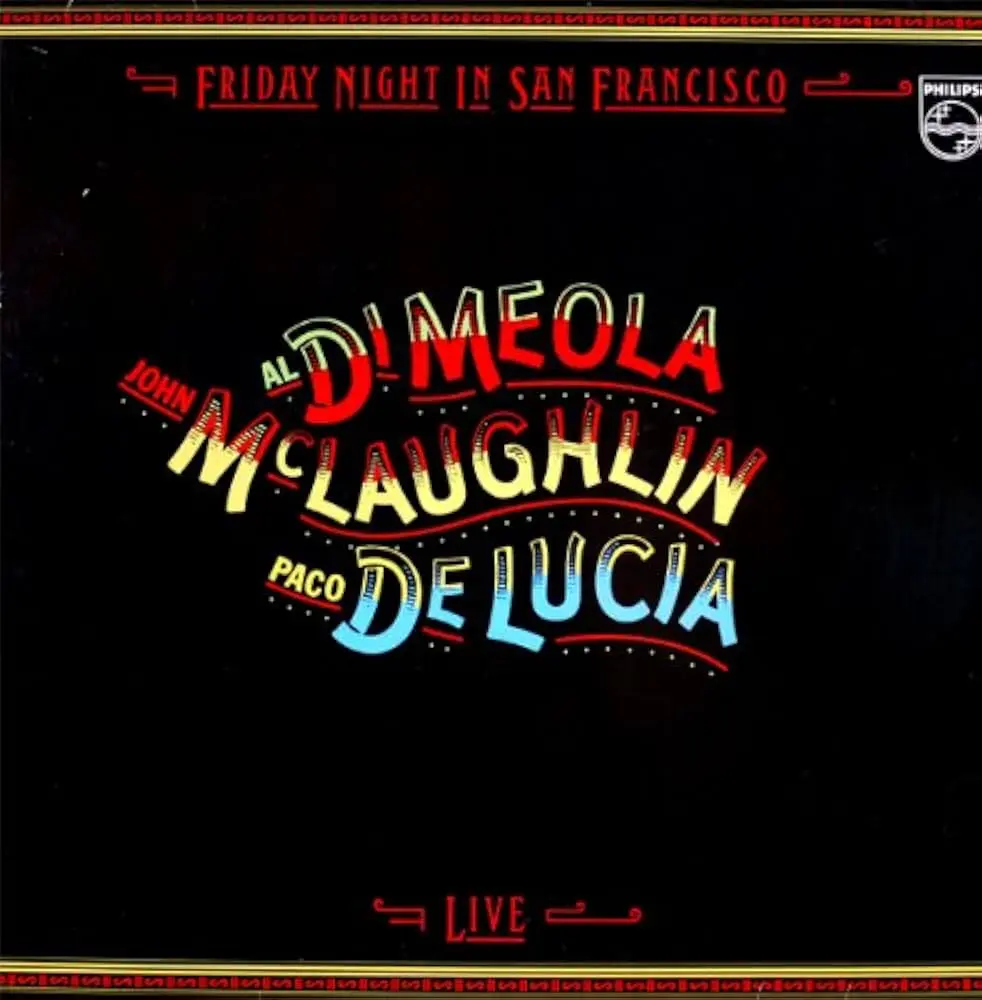 In May 1981, Columbia issued Friday Night in San Francisco, a live group performance by Al Di Meola, John McLaughlin, and Spanish flamenco guitarist Paco de Lucía.
Friday Night in San Francisco captures Di Meola in a live acoustic trio setting, trading rapid-fire lines, syncopated rhythmic exchanges, and dynamic phrasing with two of his closest collaborators in an all-improvised concert that draws on flamenco, jazz, and Latin traditions.
Di Meola plays steel-string acoustic guitar throughout the set. He composed “Fantasia Suite” and co-wrote the opening duet “Mediterranean Sundance / Río Ancho” with de Lucía. The set also features his interpretation of Chick Corea’s “Short Tales of the Black Forest,” a piece Di Meola previously recorded with Corea on Land of the Midnight Sun.
A1. “Mediterranean Sundance / Río Ancho” (11:31) — written by Al Di Meola & Paco de Lucía
A2. “Short Tales of the Black Forest” (8:43) — written by Chick Corea
B1. “Frevo Rasgado” (7:55) — written by Egberto Gismonti
B2. “Fantasia Suite” (8:50) — composed by Al Di Meola
B3. “Guardian Angel” (4:01) — composed by John McLaughlin
The concert was recorded on December 5, 1980, at the Warfield Theatre in San Francisco. The closing track, “Guardian Angel,” was recorded at Minot Sound in White Plains, New York, in May 1981. The album was co-produced by Al Di Meola, John McLaughlin, and Paco de Lucía.
Friday Night in San Francisco reached No. 97 on the Billboard 200 and No. 6 on the Top Jazz Albums chart.
Electric Rendezvous
 Al Di Meola released his fifth solo studio album, Electric Rendezvous, in March 1982 on Columbia.
Electric Rendezvous returns to an electric format with a tighter, more refined production approach. The album balances high-speed guitar figures with textured keyboard layers and a single acoustic duet.
Di Meola plays electric and acoustic guitars. Key collaborators include Jan Hammer and Philippe Saisse (keyboards), Paco de Lucía (acoustic guitar on “Passion, Grace & Fire”), Anthony Jackson (bass), Steve Gadd (drums), and Mingo Lewis (percussion).
Di Meola composed five tracks. James Mingo Lewis wrote “God Bird Change,” Jan Hammer contributed “Cruisin’,” and Philippe Saisse penned “Black Cat Shuffle.”
The album opens with a dense, polyrhythmic percussion piece, “God-Bird-Change,” driven by clavinet and fast funk pulse. The title track unfolds in shifting motifs and meters, with Di Meola and Hammer trading sharp unison lines and solos atop a driving rhythm. “Passion, Grace and Fire” presents a stereo-separated duet with Paco de Lucía, centered on layered acoustic interplay and contrapuntal phrasing.
Side B moves through “Cruisin’,” a surf–funk hybrid with Hammond and guitar lead trade-offs; and “Black Cat Shuffle,” a compact electric blues framed by keyboard voicings. “Ritmo de la Noche” shifts between Latin-inflected melodies and dynamic organ passages. “Somalia” is a brief, layered acoustic sketch, and “Jewel Inside a Dream” closes with a slow, ambient duet between Di Meola’s understated guitar and Hammer’s melodic synth lines.
A1. “God Bird Change” (3:51) — written by James Mingo Lewis
A2. “Electric Rendezvous” (7:47)
A3. “Passion, Grace & Fire” (5:34)
B1. “Cruisin’” (4:16) — written by Jan Hammer
B2. “Black Cat Shuffle” (3:00) — written by Philippe Saisse
B3. “Ritmo de la Noche” (4:17)
B4. “Somalia” (1:40)
B5. “Jewel Inside a Dream” (4:02)
Sessions occurred between May and July 1981 at Electric Lady Studios and The Power Station (New York City), Minot Sound (White Plains), and Cherokee Studios (Hollywood), with production by Al Di Meola and co-production by Dennis Mackay.
Electric Rendezvous reached No. 55 on the Billboard 200 and No. 3 on the Top Jazz Albums chart.
Passion Grace & Fire
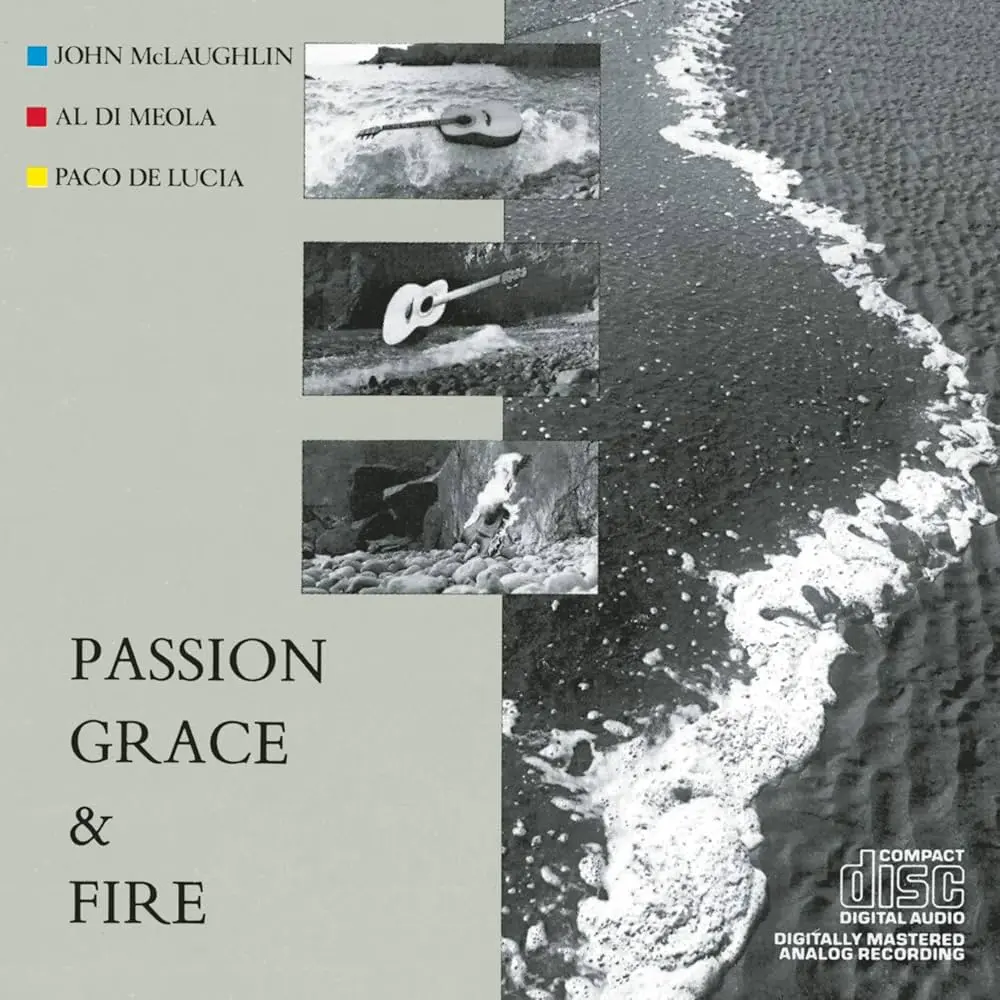 In March 1983, Philips issued Passion Grace & Fire, the second group effort by Al Di Meola, John McLaughlin, and Paco de Lucía.
Passion, Grace & Fire presents a studio counterpart to the earlier live collaboration, centering all-acoustic interplay among the three guitarists. Di Meola performs in the left channel on steel‑string acoustic, anchoring the trio’s rhythmic drive while contributing two major compositions that shape the album’s arc.
Di Meola plays Ovation steel‑string acoustic guitar and contributes “Orient Blue Suite” and the title track. McLaughlin performs nylon‑string acoustic guitar in the center channel, while de Lucía plays Spanish nylon‑string guitar in the right channel.
Each guitarist contributes two pieces: McLaughlin provides the opening “Aspan” and the mid-album “David.” Di Meola supplies “Orient Blue Suite” and “Passion, Grace & Fire.” De Lucía contributes “Chiquito” and “Sichia.”
A1. “Aspan” (4:09) — composed by John McLaughlin
A2. “Orient Blue Suite” (7:08) — composed by Al Di Meola
A3. “Chiquito” (4:46) — composed by Paco de Lucía
B1. “Sichia” (3:50) — composed by Paco de Lucía
B2. “David” (6:30) — composed by John McLaughlin
B3. “Passion, Grace & Fire” (5:26) — composed by Al Di Meola
Sessions occurred between September and October 1982 at Marcus Music (London) with production jointly credited to McLaughlin, Di Meola, and de Lucía.
The album peaked at No. 171 on the Billboard 200 and reached No. 9 on the Jazz Albums chart.
Scenario
 Al Di Meola released his sixth solo studio album, Scenario, in November 1983 on Columbia.
Scenario marks a shift toward electronic textures, integrating Fairlight CMI programming, drum machines, and synthesizer layers through Di Meola’s expanded collaboration with Jan Hammer. The album introduces a more modernist fusion aesthetic with heavier emphasis on rhythm programming and atmospheric guitar overlays.
Di Meola plays electric guitar, Roland guitar synthesizer, mandocello, acoustic and 12‑string guitars, Fairlight CMI, and drums on select tracks. Jan Hammer handles keyboards, Moog bass, Fairlight programming, and drum machines. Additional players include Tony Levin (stick bass), Phil Collins (drums), and Bill Bruford (electronic drums).
Di Meola composed most of the material, with Hammer contributing “Island Dreamer” and co-writing “African Night” and “Hypnotic Conviction.” Hammer’s drum‑machine and Fairlight arrangements frame Di Meola’s guitar themes across the album.
Scenario explores early digital instrumentation with Jan Hammer contributing Fairlight CMI textures, Moog bass, and programmed rhythms alongside Di Meola’s electric and acoustic guitar layers. “Mata Hari” opens with melodic patterns over ambient synth pads and sequenced percussion, incorporating Eastern modal phrasing. “African Night” places fluid guitar motifs over slow, percussive frameworks with layered keyboard backdrops. “Island Dreamer,” featuring Phil Collins, emphasizes steady rhythm with sustained chords and clean guitar lines.
The title track presents an acoustic duet of fingerpicked guitar and piano with alternating lead voices. “Sequencer” merges rigid electronic pulse with rapid guitar phrasing and contrapuntal keyboard exchanges. “Cachaca” blends staccato funk riffs with syncopated guitar voicings and clustered motifs. “Hypnotic Conviction” and “Calliope” extend the set’s electronic character, with the latter shaped by Bill Bruford’s shifting meter and Tony Levin’s bass lines. “Scoundrel” alternates between rock phrasing and digitally processed breaks, concluding with a guitar–synth exchange between Di Meola and Hammer.
A1. “Mata Hari” (6:04)
A2. “African Night” (4:51) — co-written with Jan Hammer
A3. “Island Dreamer” (4:06) — written by Jan Hammer
A4. “Scenario” (3:56)
A5. “Sequencer” (4:06)
B1. “Cachaca” (5:34)
B2. “Hypnotic Conviction” (3:51) — co-written with Jan Hammer
B3. “Calliope” (4:19)
B4. “Scoundrel” (3:44)
Sessions occurred at Caribou Ranch (Nederland, Colorado) with production by Al Di Meola and co-production/engineering by Dennis Mackay.
Scenario features album design by John Berg with photography by David Michael Kennedy.
The album reached No. 128 on the Billboard 200 and No. 8 on the Top Jazz Albums chart.
Cielo e Terra
 Al Di Meola released his seventh studio album, Cielo e Terra, in May 1985 on Manhattan Records.
Cielo e Terra marks a retreat from electric fusion toward acoustic introspection, pairing Di Meola’s classical‑leaning guitar writing with Synclavier textures and sparse percussion accents. The music emphasizes space, tone, and phrasing over velocity, signaling a new phase in his stylistic evolution.
Di Meola plays acoustic guitar and Synclavier guitar throughout the album. Brazilian percussionist Airto Moreira appears on “Traces (of a Tear),” “Cielo e Terra,” “When You’re Gone,” and “Solace,” adding subtle rhythmic coloration. They perform nine Di Meola originals and Keith Jarrett’s “Coral.”
Cielo e Terra presents a shift toward minimalism and atmosphere, built around layered acoustic guitar phrasing and sparse, ambient textures. Di Meola performs in a mostly solo setting, often using overdubbed lines and rubato phrasing to shape free-form structures. “Vertigo Shadow” and “Atavism of Twilight” both develop extended arpeggio patterns across modally shifting figures, with dynamic variation in tempo and articulation.
The title track functions as a multi-part suite with percussion accents, synthetic textures, and acoustic motifs that alternate between flamenco phrasing and pan-ethnic tonalities. “Traces (Of a Tear)” and “Etude” emphasize diatonic lyricism through descending figures and harmonically open voicings. Di Meola’s rendition of Keith Jarrett’s “Coral” maintains the original’s stillness with restrained, melodic interpretations. Throughout the album, layered Synclavier tones and low-mixed percussion provide subtle contrast to the prevailing acoustic guitar emphasis.
A1. “Traces of a Tear” (7:50)
A2. “Vertigo Shadow” (3:12)
A3. “Cielo e Terra” (10:50)
A4. “Enigma of Desire” (2:43)
B1. “Atavism of Twilight” (5:16)
B2. “Coral” (3:17) — composed by Keith Jarrett
B3. “When You’re Gone” (4:21)
B4. “Etude” (7:01)
B5. “Solace” (4:42)
Sessions occurred in 1985 at Right Track Recording (New York City) with production by Al Di Meola and engineering by David Baker.
Cielo e Terra reached No. 18 on the US Top Jazz Albums chart.
Soaring Through a Dream
 Al Di Meola released his eighth studio album, Soaring Through a Dream, in late 1985 on Manhattan.
Soaring Through a Dream extends his acoustic‑leaning direction with Synclavier textures, expanded percussion colors, and a chamber‑like interplay between guitar, piano, and rhythm section. The album follows Cielo e Terra in emphasizing tone, phrasing, and atmosphere over electric fusion velocity.
Di Meola plays acoustic, electric, classical, and Synclavier guitar. Supporting players include Phil Markowitz (Steinway grand piano, synthesizers), Chip Jackson (acoustic and electric bass), Danny Gottlieb (drums), and Airto Moreira (percussion, vocals).
Di Meola composed most of the material and co‑wrote three tracks with Moreira, who adds percussion frameworks to “Capoeira,” “Marina,” and the closing title piece.
Soaring Through a Dream continues Di Meola’s focus on acoustic textures, blending nylon-string guitar work with layered keyboards and atmospheric percussion. The nine-minute opener “Capoeira” sets a tone of ambient lyricism with circular guitar figures, floating synth chords, and wordless vocals by Airto Moreira. “Traces (Of a Tear)” centers on Phil Markowitz’s piano and synthesizer interplay, developing a slow arc of melodic exchanges over sparse rhythmic support.
The twelve-minute title track unfolds in episodic movements, alternating between solo acoustic passages, piano interludes, and percussive motifs, with marked shifts in dynamic intensity and tempo. “Broken Heart” and “Marina” both emphasize subdued pacing and major-key lyricism, while “July” moves in layered cascades of gently modulated textures over rubato phrasing. Throughout the album, ambient synth beds and acoustic instrumentation form the basis for textural and melodic interplay.
A1. “Capoeira” (9:21) — written by Al Di Meola & Airto Moreira
A2. “Traces (of a Tear)” (9:00)
A3. “Broken Heart” (5:00)
B1. “July” (5:25)
B2. “Marina” (4:45) — written by Al Di Meola & Airto Moreira
B3. “Soaring Through a Dream” (12:26) — written by Al Di Meola & Airto Moreira
Sessions occurred in 1985 at Right Track Recording (New York City) with production by Al Di Meola and co‑production/engineering by David Baker.
Soaring Through a Dream reached No. 14 on the Billboard Top Jazz Albums chart.
Tirami su
 Al Di Meola released his ninth studio album, Tirami su, in 1987 on Manhattan.
Tirami Su revisits a fuller electric ensemble while integrating the world‑music elements of Di Meola’s mid‑1980s work. The album balances tightly arranged fusion passages with acoustic textures, Brazilian influences, and vocal coloration.
Di Meola plays electric and acoustic guitars and arranges and produces the album. His supporting musicians include Kei Akagi (keyboards), Anthony Jackson (bass), Harvie S (double bass), Tom Brechtlein (drums), Mino Cinelu (percussion, vocals), and Clara Sandroni (vocals).
Di Meola wrote most of the pieces, contributes the arrangements, and co‑wrote “Maraba” with vocalist Clara Sandroni. The album also includes a version of Chick Corea’s “Song to the Pharaoh Kings.”
Tirami Su expands Al Di Meola’s integration of world music and acoustic-electric fusion with a full-band approach. The opener “Beijing Demons” layers syncopated acoustic motifs over programmed textures and rhythmic shifts. “Arabella” blends Spanish phrasings with Afro-Latin cadences and vocalizations, progressing into an electric fusion climax. “Smile From a Stranger” builds gradually from subdued keyboard washes to lyrical guitar passages.
“Rhapsody of Fire” alternates rapid acoustic runs with synthesized harmonic support, while Di Meola’s shorter take on Chick Corea’s “Song to the Pharaoh Kings” incorporates modal phrasing over brisk rhythmic motion. “Andonea” and “Maraba” draw on flamenco and Latin American influences with sparse vocals and percussive accompaniment. The closing track, “Song With a View,” transitions from bucolic acoustic lines to an extended solo marked by understated phrasing and melodic contour. Throughout, Di Meola navigates folk and jazz idioms within tightly arranged compositions supported by a sextet that includes bassist Anthony Jackson and percussionist Mino Cinelu.
A1. “Beijing Demons” (6:22)
A2. “Arabella” (7:08)
A3. “Smile from a Stranger” (5:40)
A4. “Rhapsody of Fire” (5:03)
B1. “Song to the Pharaoh Kings” (8:44) — composed by Chick Corea, first presented on Where Have I Known You Before, Di Meola’s first album with Return to Forever.
B2. “Andonea” (3:01)
B3. “Maraba” (5:18) — written by Al Di Meola & Clara Sandroni
B4. “Song with a View” (6:20)
B5. “Tirami Su, Part 1” (1:10)
Sessions occurred in April 1987 at Power Station and Atlantic Studios (New York City) with production by Al Di Meola and engineering by Dennis Mackay.
Tirami Su reached No. 190 on the Billboard 200 and No. 14 on the Billboard Top Contemporary Jazz Albums chart.
Discography:
- Land of the Midnight Sun (1976)
- Elegant Gypsy (1977)
- Casino (1978)
- Splendido Hotel (2LP, 1980)
- Electric Rendezvous (1982)
- Scenario (1983)
- Passion Grace & Fire (1983 • John McLaughlin, Al Di Meola & Paco de Lucía)
- Cielo e Terra (1985)
- Soaring Through a Dream (1985)
- Tirami su (1987 • Al Dimeola Project)
- Latin (1987 • Γιώργος Νταλάρας συμμετέχει ο Al Di Meola)
- World Sinfonia (1991)
- Kiss My Axe (1991 • The Al Di Meola Project)
- World Sinfonia: Heart of the Immigrants (1993)
- Orange and Blue (1994)
- The Rite of Strings (1995 • Stanley Clarke, Al Di Meola & Jean-Luc Ponty)
- Di Meola Plays Piazzolla (1996)
- The Guitar Trio (1996 • Paco de Lucia, Al Di Meola & John McLaughlin)
- The Infinite Desire (1998)
- Winter Nights (1999)
- World Sinfonia – The Grande Passion (2000)
- Flesh on Flesh (2002)
- Cosmopolitan Life (2005 • Al Di Meola & Leonid Agutin)
- Vocal Rendezvous (2006)
- Consequence of Chaos (2006)
Sources:
References:
- Berklee: “Al Di Meola in His Own Words” (Feb. 1, 2016)
Artist/Album Pages:
Ego on the Rocks was a German space-rock duo formed by ex-Eloy members Detlev Schmidtchen and Jürg...
Topper was an American psych-rock band from Independence, Mo., that released the 1977 album At La...
J. J. Johnson (Jan. 22, 1924 — Feb. 4, 2001) was an American trombonist, composer, and arranger f...
Ekatarina Velika was a Yugoslav new wave band from Beograd in modern-day Serbia. Between 1985 and ...
Steve Grossman (Jan. 18, 1951 — Aug. 13, 2020) was an American post-bop jazz saxophonist from Broo...
Kaseva was a Finnish pop/rock band behind the 1974–76 albums Silloin kun and Kun maailma elää on L...
Roger Voudouris (Dec. 29, 1954 — Aug. 3, 2003) was an American vocalist and songwriter who release...
John Tropea is an American jazz-funk guitarist who emerged as a New York sessionist and made the ...
The Günther Fischer Quintett was an East German jazz-rock band that made five albums between 1973 ...
Jacques Thollot (October 9, 1946 — Oct. 2, 2014) was a French keyboardist, percussionist, and comp...
Fly by Night was an American progressive hard-rock band from Pennsylvania that released the 1980 ...
Novo Combo was an American melodic-rock band behind the 1981/82 Polydor albums Novo Combo and The...