

NEU! was a German experimental duo from Düsseldorf that released three albums on Brain between 1972 and 1975. Formed by ex-Kraftwerk members Michael Rother and Klaus Dinger, they pioneered the minimalist “motorik” rhythm and a layered, texture-based approach to rock. Their work bridged ambient abstraction and proto-punk force, presaging future post-punk, electronic, and art rock styles.
Members: Klaus Dinger (vocals, drums, guitar, keyboards, shamisen, percussion, bandoneon), Michael Rother (vocals, guitar, keyboards, bass, piano, violin, zither, percussion, electronics), Eberhard Kranemann (bass, slide guitar, 1972), Uli Trepte (bass, 1972), Thomas Dinger (drums, 1975), Hans Lampe (drums, 1975), Konrad Mathieu (bass, 1985-86), Georg Sessenhausen (drums, 1985-86)
Background
NEU! formed in 1971 in Düsseldorf, Nordrhein-Westfalen, in then-West Germany, where guitarist Michael Rother and drummer Klaus Dinger aligned after a short period with Kraftwerk.
Dinger (b. March 24, 1946, Scherfede) grew up in Düsseldorf after an early childhood in war-damaged Westphalia. At 17, he drummed in the school band Swing Combo and briefly studied architecture before landing gigs in multiple beat groups (The No, The Smash) and a nameless free jazz unit. Rother absorbed non-Western tonal ideas in travels across Germany, England, and Pakistan. Back in Düsseldorf, he developed a guitar style based on repetition and sustained texture.
In 1970, Dinger joined Ralf Hütter and Florian Schneider midway through sessions for their debut album as Kraftwerk. Rother entered shortly afterward following his work with the Düsseldorf group Spirits of Sound. In Hütter’s subsequent absence, Rother and Dinger performed as a trio with Schneider and undertook studio sessions at the Windrose facility of producer Conny Plank. The efforts stalled over creative conflicts, which led Rother and Dinger to form a separate unit with Plank’s support, while Hütter and Schneider reunited as Kraftwerk.
Dinger selected the name NEU!—“new!”—from the vocabulary of Düsseldorf’s advertising culture, which he treated as a direct, declarative marker.
NEU! (album)
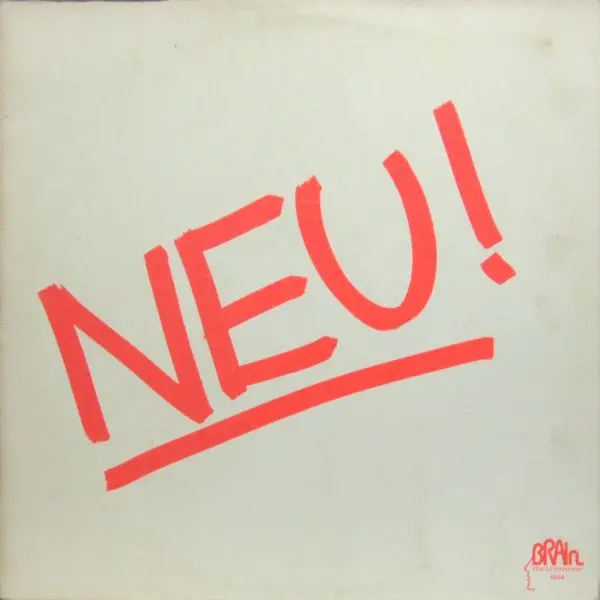 NEU! released their self-titled debut album in 1972 on Brain.
The album presents a minimalist, texture-focused sound based on extended patterns and alternating pulses between guitar and percussion. Michael Rother shifts between sustained tonal overlays and abrupt, contoured phrases on electric guitar and bowed bass, while Klaus Dinger counters with cyclic drumming and distorted string figures. Together, they developed the “motorik” pattern that underpins the ten-minute opener and recurs with higher tension across later pieces.
Dinger introduced his “endless straight” rhythm pattern—later dubbed “motorik” by others—on both “Negativland” and “Hallogallo,” laying the groundwork for future applications in subsequent German experimental rock.
A1. “Hallogallo” (10:07)
A2. “Sonderangebot” [Special Offer] (4:51)
A3. “Weissensee” [White Lake] (6:46)
Jahresüberblick [Year in Review]
B1. “Im Glück” [In Luck] (6:53)
B2. “Negativland” [Negative Land] (9:47)
B3. “Lieber Honig” [Dear Honey] (7:18)
Rother and Dinger recorded the album over four nights in December 1971 at Star Studios in Hamburg with producer-engineer Conny Plank, who worked in sequence on albums by Ash Ra Tempel, Association P.C., Eiliff, Eloy, Grobschnitt, Guru Guru, Ibliss, Jane, Kin Ping Meh, Kluster, Lucifer’s Friend, Night Sun, Parzival, Scorpions, Thirsty Moon, and Virus.
NEU! started with “Negativland,” where Dinger used a taishōgoto—an electrified Japanese zither—processed through filters and mixed against Rother’s recurring figures. That track set the template for their working method: minimal takes, layered treatments, and parallel tracking rather than jam-based arrangements. Plank managed the sessions and served as an intermediary between the two musicians, who maintained distinct and often opposing instincts in structure and tone.
In the summer of 1972, NEU! recorded two single sides: “Super,” a brisk proto-punk number backed with “Neuschnee,” a mid-paced motorik track.
A. “Super” (3:07)
B. “Neuschnee” [New Snow] (3:59)
NEU! cut both sides at Conny Plank’s Cologne studio.
NEU! 2
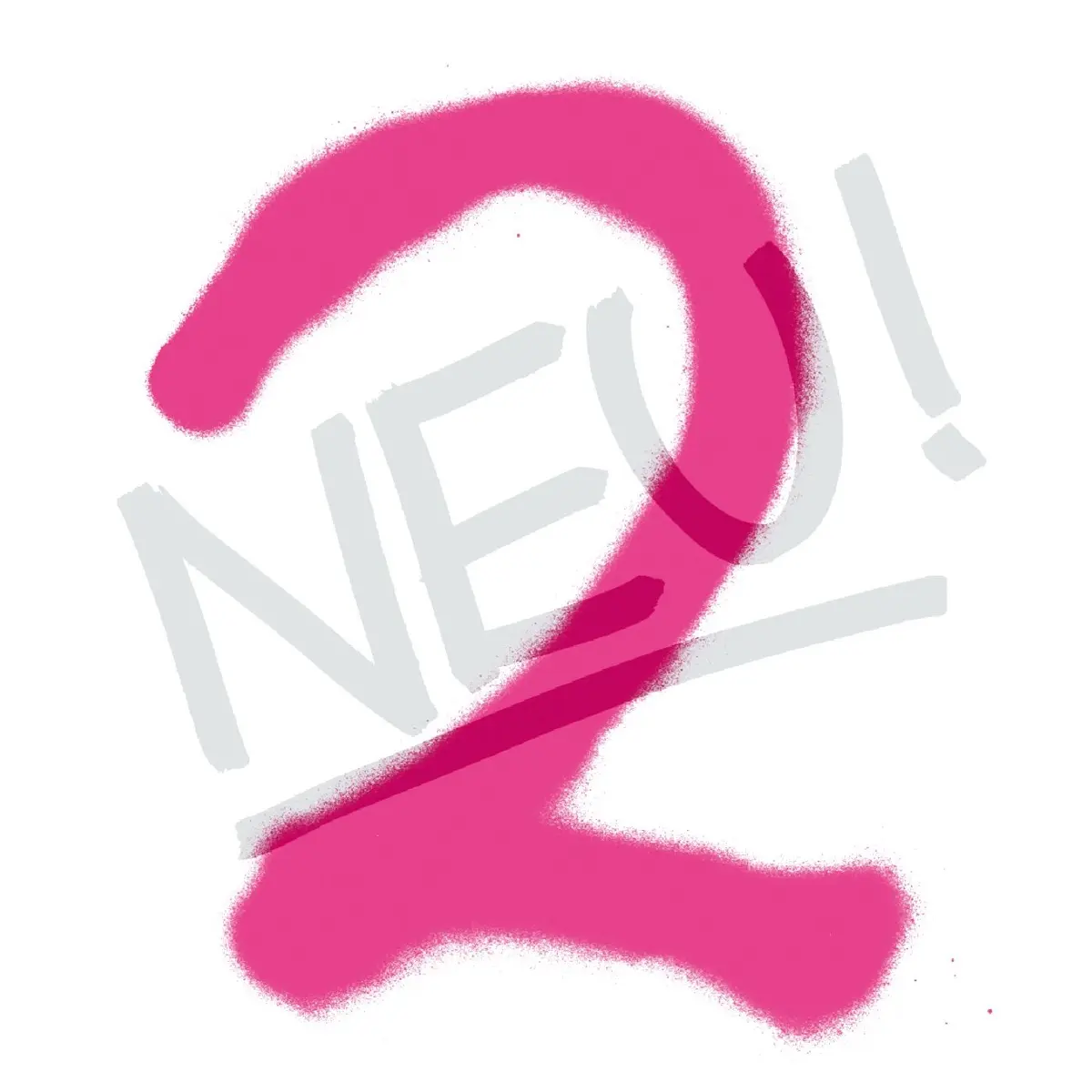 NEU! released their numerical second album on May 7, 1973, on Brain.
The album opens with a focused expansion of the duo’s signature pulse-driven format, anchored by Michael Rother’s layered sustain and ascending arpeggios against Klaus Dinger’s unwavering rhythmic patterns and electronic color. Rother adds zither, violin, and processed textures; Dinger contributes koto and Farfisa accents, along with distorted 11-string guitar and treated vocal bursts.
The first side contains four fully realized tracks, led by “Für Immer,” a central piece built from overdubbed cycles and durational structure. “Lila Engel” emerged from jam-based sessions with manipulated vocal overlays and shared credit between both members. Side B features alternate versions of their 1972 standalone tracks “Super” and “Neuschnee,” each manipulated with tape-speed variances, cassette looping, and turntable warping to reframe the original material.
A1. “Für Immer” [Forever] (11:17)
A2. “Spitzenqualität” [Top Quality] (3:35)
A3. “Gedenkminute (für A + K)” [Minute of Silence (for A + K)] (2:06)
A4. “Lila Engel” [Lilac Angel] (4:37)
B1. “Neuschnee 78” [Fresh Snow 78] (2:32)
B2. “Super 16” (3:39)
B3. “Neuschnee” (4:07)
B4. “Cassetto” [Cassette] (1:48)
B5. “Super 78” (1:36)
B6. “Hallo Excentrico!” [Hello Eccentric!] (3:44)
B7. “Super” (3:11)
Sessions for NEU! 2 occurred in January/February 1973 at Windrose-Dumont-Time Studios in Hamburg. Conny Plank co-produced the album and handled engineering duties alongside Hans Lampe. They tracked Side A live without overdubs and compiled Side B with pre-recorded single masters, manipulated with tape-speed shifts (“Super 78,” “Neuschnee 78”), cassette manipulation (“Cassetto”), and layered turntable edits (“Hallo Excentrico!”). Their methods of track transformation presaged remix culture. The Spanish Movieplay label made of promo 7″ titleed “Hallogallo” (1ª/2ª Parte).
NEU! paused for eighteen months when Rother teamed with Cluster in Harmonia, which made the the 1974–75 Brain albums Musik von Harmonia and Deluxe. Dinger produced the Lilac Angels, a Düsseldorf hard-rock quartet named after the NEU! 2 track. Their first album, I’m Not Afraid To Say “Yes”!, appeared in 1973 on Dinger-Land.
NEU! ’75
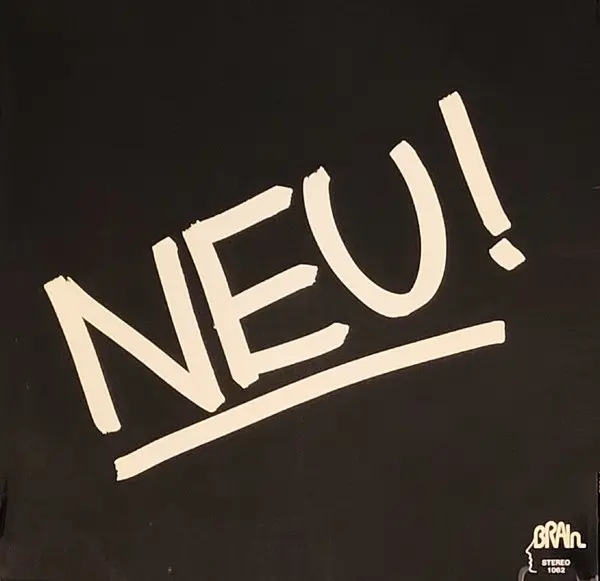 NEU! released their time-stamped third album in 1975 on Brain.
The album splits into two distinct sides. On Side A, Michael Rother opens with layered guitar and keyboard textures over Klaus Dinger’s measured pulse on “Isi,” then proceeds alone on the remaining tracks. Side B takes a sharper turn as Dinger shifts to guitar and vocals, backed by new collaborators—his younger brother Thomas Dinger and percussionist Hans Lampe—on dual drum kits.
Rother adds sharp melodic figures and closes the album with a guitar solo on “After Eight.” Dinger, as a first-time lyricist, draws on a recent breakup that colors “Hero” and the closing track. Throughout, synths enmesh with phased effects, contrasting ambient restraint and forward momentum.
A1. “Isi” (5:06)
A2. “Seeland” (6:54)
A3. “Leb’ Wohl” [Goodbye] (8:50)
B1. “Hero” (7:11)
B2. “E. Musik” (9:57)
B3. “After Eight” (4:44)
Sessions spanned December 1974 and January 1975 at Conny Plank’s studio in Cologne. Plank co-produced and engineered the sessions in sequence with albums by Creative Rock, Exmagma, Hoelderlin, Joachim Kuhn, Kraan, Pork Pie, Sixty-Nine, and Toto Blanke.
“Isi” appeared as a June 1975 UK single backed with “After Eight.”
Postlude
Lampe and the Dinger brothers released three albums between 1976 and 1980 as La Düsseldorf. Michael Rother went solo with the 1977 Sky Records release Flammende Herzen.
Discography:
- NEU! (1972)
- NEU! 2 (1973)
- NEU! ’75 (1975)
- Neu! 4 (1995)
- Neu! ’86 (archival, 2010)
Sources:
Artist/Album Pages:
Jean-Pierre Ferland (June 24, 1934 – April 27, 2024) was a Québécois chanson singer-songwriter, larg...
T. Rex was an English rock band best known for the UK hits "Ride a White Swan," "Hot Love," "Teleg...
Luiz Bonfá (Oct. 17, 1922 — Jan. 12, 2001) was a Brazilian samba-jazz guitarist and composer who e...
Rosetta Hightower (June 23, 1944 — Aug. 2, 2014) was an American soul singer from Philadelphia who...
Andromeda was a German organ-rock/psych band that released a self-titled album on Vogue in 1970. ...
D. Beaver was an American art-pop band from Memphis behind the 1973 album Combinations on TMI Rec...
Montage was an American chamber-pop/psych band from New York that released a self-titled album on...
Genesis was an English rock band that released fifteen studio albums between 1969 and 1997. They for...
Anawa was a Polish folk/pop/jazz band, active across four decades. They backed lyricist-composer M...
Joni Mitchell is a Canadian singer–songwriter who released nineteen studio albums between 1968 and 2...
Alquin was a Dutch band on Polydor that released the 1972–73 jazz-rock albums Marks and The Mounta...
Irma Thomas is an American soul singer who emerged with the 1959 R&B hit "Don't Mess with My ...