

T. Rex was an English rock band best known for the UK hits “Ride a White Swan,” “Hot Love,” “Telegram Sam,” “Metal Guru,” and the transatlantic evergreen “Bang a Gong (Get It On).” They released two 1970–71 albums on Fly Records, followed by six albums between 1972 and 1977 on the eponymous imprint T. REX.
T. Rex evolved from singer Marc Bolan’s earlier folk-psych combo Tyrannosaurus Rex, which made four 1968–70 albums on Regal Zonophone.
Members: Marc Bolan (vocals, guitar), Mickey Finn (congas, vocals, 1970-75), Steve Currie (bass, 1970-76), Bill Legend (drums, 1970-74), Gloria Jones (keyboards, vocals, 1973-76), Jack Green (guitar, 1973-74), David Lutton (drums, 1974-76), Dino Dines (keyboards, 1974-77), Miller Anderson (guitar, 1976-77), Herbie Flowers (bass, 1976-77), Tony Newman (drums, 1976-77)
Background
Marc Bolan was born Mark Feld on September 30, 1947, in Hackney, London, to Russian–Polish lorry driver Simeon Feld and Englishwoman Phyllis Winifred (née Atkins). At age nine, he received his first guitar and embraced the onslaught of American rock ‘n’ roll.
Feld attended Northwold Primary School, where he formed a skiffle trio, Susie and the Hula Hoops, with singer and classmate Helen Shapiro (then twelve). On lunch breaks, he played guitar before crowds of fellow pupils. School officials expelled Bolan at age fifteen for bad behavior.
In 1964, Feld cut “All at Once,” a boy ballad credited to Bellamy. (In 2008, T. Rex archivists Madman Records pressed the intended single under the billing Danielz & Caron Willans).
Feld adopted the stagename Toby Tyler and recorded 1965 covers of songs by Bob Dylan (“Blowin’ In the Wind”), Dion (“The Road I’m On (Gloria)”), and Betty Everett (“You’re No Good”), the last submitted as a possible EMI a-side. Amid wrangles with inexperienced music managers, the tracks wound up vaulted and presumed lost for three decades.
In August 1965, Feld signed with Decca under a new stagename: Marc Bolan, a presumed contraction of the name Bob Dylan (or possibly that of English actor James Bolam, star of the mid-sixties BBC sitcom The Likely Lads). Bolan cultivated the mod image and appeared as an extra in the ITV thriller series Orlando. He briefly worked as a catalog model and appeared in a mod fashion feature in Town magazine.
Marc Bolan Singles
 In August 1965, Marc Bolan signed to Decca Records. His first release, “The Wizard,” appeared on November 19, 1965. Bolan cut the whimsical, imagery-laden number with session guitarist Jimmy Page, Big Jim Sullivan on rhythm, and the Ladybirds on backing vocals.
“The Wizard” channels the fantastical lyricism of Donovan and mid-period Dylan, a quality echoed on its B-side “Beyond the Risin’ Sun,” which he wrote under the alternate spelling Bölan.
A. “The Wizard” (1:50)
B. “Beyond the Risin’ Sun” (1:41)
Jim Economides produced the session with Mike Leander handling musical direction. “The Wizard” reappeared on various archival collections, including The Beginning of Doves.
On June 3, 1966, Decca issued Bolan’s second single, “The Third Degree,” a plaintive, minor-key meditation paired with “San Francisco Poet,” a lyrical tribute to Beat-era figures. Both tracks retain his acoustic-folk sensibility with stripped-back arrangements and poetic flourishes. These sides reflect Bolan’s deep literary influences and remain early blueprints of his narrative voice.
A. “The Third Degree” (2:29)
B. “San Francisco Poet” (1:41)
On November 25, 1966, Parlophone released Bolan’s third solo single, “Hippy Gumbo,” produced by Simon Napier-Bell.
With its eerie, baroque-folk arrangement and brooding tone, “Hippy Gumbo” marked a departure from his Decca material and hinted at the gothic mystique he’d soon refine in Tyrannosaurus Rex. The flipside, “Misfit,” carried a rawer edge with playful lyrical abstraction.
A. “Hippy Gumbo” (2:05)
B. “Misfit” (1:55)
The session initiated Bolan’s working relationship with Napier-Bell, and “Hippy Gumbo” later resurfaced on 1974’s The Beginning of Doves and the 1982 overdubbed collection You Scare Me to Death.
John’s Children
 In March 1967, Marc Bolan joined the flamboyant freakbeat outfit John’s Children, replacing guitarist Geoff McClelland at the suggestion of manager Simon Napier-Bell.
John’s Children formed in early 1966 from the ashes of Leatherhead beatsters The Clockwork Onions (aka The Few and The Silence). They gained infamy with their riotous stage antics and prior two Columbia–EMI singles: “Smashed Blocked,” “Just What You Want – Just What You’ll Get.” The non-release of their third single, “Not the Sort of Girl (You’d Like to Take to Bed),” prompted their label-switch to Track Record, started by Who manager Kit Lambert.
Napier-Bell positioned Bolan, an acoustic-oriented lyricist, as the group’s electric frontman. Though his tenure lasted only four months, Bolan left a distinct imprint through five songs recorded during and after his time with the band.
During April 1967, John’s Children toured Germany as support for The Who. Determined to compete with their instrument-smashing headliners, the band escalated their theatrics: Bolan whipped his guitar with chains, while singer Andy Ellison and bassist John Hewlett staged mock fights and pillow explosions. The chaos peaked in Düsseldorf and Ludwigshafen, nearly derailing the shows. The Who, fed up, had the band ejected mid-tour.
On April 29, 1967, John’s Children took part in The 14 Hour Technicolor Dream, a sprawling overnight happening held at London’s Alexandra Palace in support of International Times, the UK’s leading underground newspaper. The event brought together dozens of musicians, poets, dancers, and performance artists in a landmark celebration of the emerging psychedelic counterculture. Acts included Pink Floyd—who headlined at dawn—Soft Machine, The Move, The Crazy World of Arthur Brown, Tomorrow, The Pretty Things, Alexis Korner, Denny Laine, Graham Bond, and Yoko Ono, whose performance was witnessed by John Lennon. Situated inside the palace’s Great Hall, the event featured two main stages, light towers, avant-garde film screenings, and even a helter-skelter ride, creating an immersive, all-night spectacle. John’s Children performed among the chaos, shortly after their return from the Who tour. The Syn commemorated the occasion in their single “14 Hour Technicolour Dream,” issued later that year.
On May 24, 1967, John’s Children issued “Desdemona,” their debut single on Track Record. Written and sung by Bolan, the track’s provocative lyric (“Lift up your skirt and fly”) triggered a BBC ban. He recorded the song with the band and studio players under Napier-Bell’s direction. The B-side, “Remember Thomas à Becket,” was a leftover from their prior Columbia lineup, credited to singer Andy Ellison and bassist John Hewlett.
A. “Desdemona” (2:25) – reimagines Shakespeare’s tragic heroine as a liberated figure of the 1960s counterculture. The lyrics challenge generational conservatism, advocating for sexual and artistic freedom through surreal, poetic imagery and personal liberation.
Just because Toulouse Lautrec
Painted some chick in the rude
Doesn’t give you the right
To steal my night
And leave me naked in the nude
This verse critiques hypocrisy in moral judgment, suggesting that society romanticizes provocative art while condemning real expressions of passion and intimacy. The speaker feels exposed and betrayed by someone who flirts with freedom but denies it in practice. The song references Desdemona, the innocent and noble wife of Othello, but flips the narrative: rather than a victim of jealousy, Bolan’s Desdemona becomes a symbol of sexual agency and rebellion. The title invokes the Shakespearean character as a name loaded with historical connotation, yet recontextualizes her as a muse of modern bohemian freedom.
B. “Remember Thomas à Becket” (2:15)
In June 1967, they cut “Midsummer Night’s Scene” backed with “Sara, Crazy Child.” Bolan’s growing discontent with Napier-Bell’s production on these tracks prompted his departure. “Midsummer” remained unreleased until decades later, though the B-side was retained for reuse. Bolan’s increasingly literary lyricism merged fantastical imagery with cryptic phrasing, a tone he would carry into his next project.
A. “Midsummer Night’s Scene” (2:35)
B. “Sara, Crazy Child” (2:29)
Bolan quit over this non-release, disillusioned by the musical direction and management interference.
On July 14, 1967, Track salvaged the unreleased “Sara, Crazy Child” with a new A-side: “Come and Play with Me in the Garden,” a rewritten version of the earlier “Remember Thomas à Becket.” Bolan had already exited by this point, but his lyrical residue shaped the band’s direction.
A. “Come and Play with Me in the Garden” (2:20) – Ellison, Hewlett
B. “Sara, Crazy Child” (2:29)
 On October 6, 1967, John’s Children released “Go-Go Girl,” another Bolan composition written during his time with the band. Its B-side, “Jagged Time Lapse,” credited to Hewlett and McClelland, revisited the band’s earlier freakbeat roots. Bolan later recast “Go-Go Girl” as “Mustang Ford” on the first Tyrannosaurus Rex album.
A. “Go-Go Girl” (2:10)
B. “Jagged Time Lapse” (2:50) – Hewlett, McClelland
Meanwhile, Bolan retreated to writing—songs, poems, and mytho-fantastic novellas (The Krakenmist and Pictures of Purple People)—while claiming mystical encounters and adopting a neo-romantic persona. This phase catalyzed his transition into Tyrannosaurus Rex, where he merged acoustic modes with esoteric imagery, drawing from both his beat-poet fascinations and emerging underground folk currents.
Tyrannosaurus Rex
In July 1967, Marc Bolan formed Tyrannosaurus Rex following his departure from John’s Children and a failed solo run. After a chaotic debut as a four-piece electric band at the Electric Garden on July 22, Bolan dismissed the other members and reconfigured the group as an acoustic duo with 17-year-old drummer Steve Porter, who adopted the name Steve Peregrin Took, inspired by Tolkien’s Lord of the Rings. Took had recently played with mod outfit the Waterproof Sparrows and responded to Bolan’s ad in International Times.
 Tyrannosaurus Rex built a devoted following in the London underground with stripped-back performances centered on Bolan’s elfin vocals and acoustic guitar, and Took’s array of hand percussion, including bongos, pixiphone, African drums, and gong.
The duo’s style drew influence from Ravi Shankar’s modal structures and the tribal-acoustic aesthetic of the UK’s psychedelic folk scene. Their songs, laced with mystic rhymes and surreal imagery, resonated with the flower-power audience that gathered in clubs, parks, and countercultural events. BBC Radio One DJ John Peel secured them a growing platform, which soon led to a recording contract and their first single.
After acoustic sessions failed to take hold at Track Records, Bolan and Took caught the attention of producer Tony Visconti, who signed them to Regal Zonophone in March 1968.
On April 19, 1968, Tyrannosaurus Rex debuted with “Deborah” backed with “Child Star.” Produced by Tony Visconti, the single paired Bolan’s whimsical lyrical meter with Took’s ornate hand percussion and soft harmonies.
A: “Deborah” (3:05) – features Bolan’s earliest experiments with phonetically playful couplets.
B: “Child Star” (2:30) – expands his astral-child mythology.
My People Were Fair and Had Sky in Their Hair… But Now They’re Content to Wear Stars on Their Brows
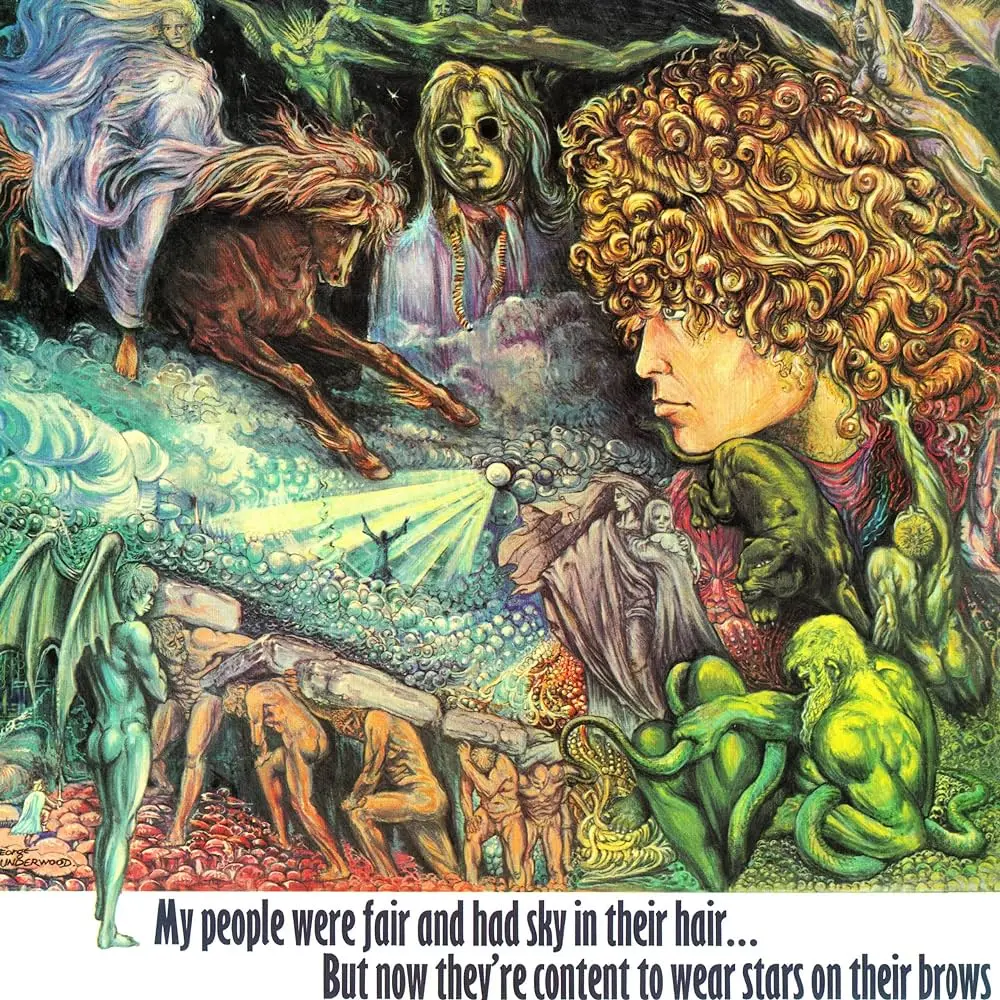 Tyrannosaurus Rex released their debut album, My People Were Fair and Had Sky in Their Hair… But Now They’re Content to Wear Stars on Their Brows, on July 5, 1968, on Regal Zonophone.
It features the pre-released B-side “Child Star” and two reworked songs from Bolan’s brief tenure in John’s Children (“Hot Rod Mama” and “Mustang Ford”) along with nine newly composed tracks, including “Chateau in Virginia Waters” and “Frowning Atahuallpa (My Inca Love),” which concludes with a Hare Krishna chant and a narrated fantasy tale by DJ John Peel.
Marc Bolan plays acoustic guitar and guides the record’s narrative arc through childlike meter and mythic wordplay, while Steve Peregrin Took adds bongos, pixiphone, Chinese gong, and harmony vocals that deepen the duo’s modal interplay. The track “Scenescof,” which mocks a self-serious villain of the underground scene, and “Dwarfish Trumpet Blues,” which describes a genie emerging from a deaf man’s trumpet, showcase Bolan’s emerging surrealist-poetic style. “Mustang Ford” initiates Bolan’s recurring car imagery, while “Chateau in Virginia Waters” dates back to the Track-era sessions, one of several songs first recorded with Joe Boyd and bassist Danny Thompson in late 1967.
A1. “Hot Rod Mama” (3:09)
A2. “Scenescof” (1:41)
A3. “Child Star” (2:52)
A4. “Strange Orchestras” (1:47)
A5. “Chateau in Virginia Waters” (2:38)
A6. “Dwarfish Trumpet Blues” (2:47)
B1. “Mustang Ford” (2:56)
B2. “Afghan Woman” (1:59)
B3. “Knight” (2:38)
B4. “Graceful Fat Sheba” (1:28)
B5. “Weilder of Words” (3:19)
B6. “Frowning Atahuallpa (My Inca Love)” (5:55)
My People Were Fair was produced by Tony Visconti at Advision Studios in April 1968 using newly installed Scully 8-track recording equipment. Bolan and Took signed to Regal Zonophone the prior month after Visconti discovered them and arranged demo rehearsals in his London flat. Recording lasted four days—two for tracking, two for mixing—with minimal overdubbing. Bolan later criticized the stereo mix as “thin and nasty,” citing inexperience with the new equipment. Visconti also played bass on the demos.
The album packaging features a fantasy-themed cover painting by George Underwood, inspired by Gustave Doré’s illustrations for Inferno, and includes a sleeve dedication “to Aslan and the Old Narnians.” Peel’s liner notes frame the duo as mystical inheritors of the post-hippie underground.
My People Were Fair peaked at No. 15 on the UK Albums Chart and later reached No. 1 in April 1972 when Fly Records reissued it alongside Prophets, Seers & Sages as a double LP.
“One Inch Rock” / “Salamanda Palaganda”
 On August 23, 1968, Tyrannosaurus Rex released the single “One Inch Rock” backed with “Salamanda Palaganda” on Regal Zonophone. Marc Bolan wrote both tracks and performs vocals and acoustic guitar, accompanied by Steve Peregrin Took on bongos and percussion.
A. “One Inch Rock” (1:45) – condenses Bolan’s lyrical whimsy into a brief acoustic burst driven by rhythmic interplay and clipped vocal phrasing.
B. “Salamanda Palaganda” (2:14) – expands his imaginative language into a surreal procession of animal totems, mystical characters, and dreamlike settings. The title evokes a hybrid incantation—equal parts nursery rhyme, tribal chant, and exotic place-name. Its structure suggests a coded invocation, with “Salamanda” echoing the mythic fire spirit and “Palaganda” invented to rhyme, adding to the track’s incantatory cadence and its blend of folklore, fantasy, and invented mythos.
Tony Visconti produced the session for Straight Ahead Productions.
Prophets, Seers & Sages: The Angels of the Ages
 Tyrannosaurus Rex released their second album, Prophets, Seers & Sages: The Angels of the Ages, on November 1, 1968, on Regal Zonophone. It opens with a revised version of their first a-side (“Deborah”) re-titled “Deboraarobed.”
The album opens with a backward-spliced revision of their debut single “Debora,” now titled “Deboraarobed,” and includes two reworkings of earlier compositions (“Eastern Spell,” first demoed in 1966, and “Juniper Suction,” which references Bolan’s then-partner June Child) alongside new material such as “Trelawny Lawn,” “The Friends,” and “Scenescof Dynasty,” which extends the narrative of “Scenescof” from the debut album.
Marc Bolan plays acoustic guitar and supplies the lyrics and compositions, while Steve Peregrin Took handles bongos, African drums, kazoo, pixiephone, Chinese gong, and background vocals. Tony Visconti produced the sessions, balancing the arrangements around sparse instrumentation and vocal layering.
A1. “Deboraarobed” (3:33)
A2. “Stacey Grove” (1:59)
A3. “Wind Quartets” (2:57)
A4. “Conesuala” (2:25)
A5. “Trelawny Lawn” (1:46)
A6. “Aznageel the Mage” (1:59)
A7. “The Friends” (1:19)
B1. “Salamanda Palaganda” (2:15)
B2. “Our Wonderful Brownskin Man” (0:51)
B3. “Oh Harley (The Saltimbanques)” (2:19)
B4. “Eastern Spell” (1:41)
B5. “The Travelling Tragition” (1:48)
B6. “Juniper Suction” (1:13)
B7. “Scenescof Dynasty” (4:07)
The band began recording on April 22, 1968, at Olympic Studios with early versions of “One Inch Rock” and “Conesuala,” then shifted to Trident Studios, where they completed the rest of the album between May 16 and August 8. They finished most tracks in a few takes, though “Eastern Spell” took twelve. Bolan created “Deboraarobed” in mid-July by reversing portions of the original 1968 single “Debora.” The sessions also yielded several non-album tracks and alternates, including “Nickelodeon,” “Our Wonderful Brownskin Man,” and a revised “Wind Quartets,” with overdubs added in June. Visconti engineered and mixed the album at Trident, while Bolan supervised the process to avoid the technical flaws he had encountered on the debut.
Prophets, Seers & Sages appeared in both mono and stereo pressings. It peaked at No. 44 on the UK Albums Chart and was later reissued on April 14, 1972, as part of a double-LP set with My People Were Fair, which reached No. 1 during the T. Rex chart boom.
“Pewter Suitor”
 On January 17, 1969, Tyrannosaurus Rex released their third standalone single, “Pewter Suitor” backed with “War Lord of the Royal Crocodiles,” on Regal Zonophone.
“Pewter Suitor” pairs acoustic guitar and hand percussion with Bolan’s surrealist lyricism and phrasing. The B-side, an eventual album track, continues in the duo’s established modal-folk style, driven by Bolan’s acoustic patterns and Steve Peregrin Took’s layered percussion.
A. “Pewter Suitor” (3:06) – depict a dreamlike figure—“Pewter suitor tangled in the bracken / dancing daily with his gaily wavy baton”—surrounded by images of fate and longing.
B. “War Lord of the Royal Crocodiles” (2:05)
Tony Visconti produced both tracks for Straight Ahead Productions Ltd. during sessions for their upcoming album.
Unicorn
 Tyrannosaurus Rex released their third album, Unicorn, on May 16, 1969, on Regal Zonophone.
Unicorn features the recent b-side “Warlord of the Royal Crocodiles” and fifteen additional Marc Bolan originals, including “Catblack (The Wizard’s Hat),” “She Was Born to Be My Unicorn,” and the closing suite “Romany Soup,” which features narration by John Peel.
Bolan plays acoustic and electric guitars, harmonium, phonofiddle, and organ, while Steve Peregrin Took adds bongos, African talking drum, pixiphone, gong, drums, percussion, piano, and bass. Their instrumental interplay—built on layered overdubs—extends the duo’s earlier acoustic style into denser, multi-tracked arrangements.
Tony Visconti adds piano on “Catblack (The Wizard’s Hat)” and oversees the production. Peel’s narration continues the “Woodland Story” begun on My People Were Fair. The lyrics draw heavily from Romantic and mythical imagery, influenced by Bolan’s first poetry book The Warlock of Love, published shortly before the album’s release.
A1. “Chariots of Silk” (2:26)
A2. “‘Pon a Hill” (1:14)
A3. “The Seal of Seasons” (1:49)
A4. “The Throat of Winter” (1:59)
A5. “Catblack (The Wizard’s Hat)” (2:55)
A6. “Stones for Avalon” (1:37)
A7. “She Was Born to Be My Unicorn” (2:37)
A8. “Like a White Star, Tangled and Far, Tulip That’s What You Are” (3:49)
B1. “Warlord of the Royal Crocodiles” (2:11)
B2. “Evenings of Damask” (2:26)
B3. “The Sea Beasts” (2:26)
B4. “Iscariot” (2:53)
B5. “Nijinsky Hind” (2:20)
B6. “The Pilgrim’s Tale” (2:07)
B7. “The Misty Coast of Albany” (1:43)
B8. “Romany Soup” (5:40)
Tyrannosaurus Rex recorded Unicorn between November 5, 1968, and February 2, 1969, at Trident Studios with Tony Visconti producing and Malcolm Toft engineering. Initial sessions yielded early versions of “‘Pon a Hill,” “Evenings of Damask,” and “The Seal of Seasons.” On November 14, they recorded “Warlord of the Royal Crocodiles,” “The Sea Beasts,” and “Throat of Winter.” Recording resumed in January with “Catblack (The Wizard’s Hat),” “Chariots of Silk,” “Nijinsky Hind,” and other core tracks. Visconti’s piano on “Catblack” and the 22 overdubs on “Romany Soup” shaped the album’s dense, acoustic sound wall.
The cover photography, taken in John Peel’s kitchen by Pete Sanders, frames Bolan and Took among books and items referencing the album’s lyrical themes.
Unicorn reached No. 12 on the UK Albums Chart, the band’s highest placement to date. In 1972, Cube Records reissued it alongside A Beard of Stars as a double LP, which charted at No. 44. Unicorn marked the final album by the original duo, as Bolan dismissed Took after their US tour later that year.
“King of the Rumbling Spires”
 On July 25, 1969, Tyrannosaurus Rex released their fourth non-album single, “King of the Rumbling Spires” backed with “Do You Remember,” on Regal Zonophone.
Marc Bolan composed both tracks and performs lead vocals and electric guitar. Steve Peregrin Took plays a toy drum kit and percussion, with Tony Visconti on bass and electric organ. The A-side marked the duo’s first use of electric guitar on record and previewed Bolan’s shift away from acoustic psychedelia.
A. “King of the Rumbling Spires” (2:07) – combines lyrical mysticism with amplified energy, introducing a heraldic figure—“It’s the King and he’s coming home”—amid images of wind, eagles, and priestess-guarded visions. Bolan layers electric parts on a Fender Stratocaster in a break from the duo’s previous folk arrangements.
B. “Do You Remember” (2:15) – reverts to the familiar acoustic format, closing out Took’s final recorded appearance with the group.
Change In Partnership
By mid-1969, tensions surmounted between Bolan and Took. Bolan, focused on songwriting and living quietly with June Child, rejected Took’s desire to contribute material to the band’s fourth album. Took, immersed in Ladbroke Grove’s underground culture and aligned with anarchic groups like The Deviants, pushed for equal creative input. In response, he recorded two songs for Twink’s Think Pink album and expanded his circle to include Syd Barrett and David Bowie.
The turning point came at the UK launch party for Rolling Stone magazine, where someone spiked the punch with STP; Bolan suspected Took, who already had a reputation for such pranks. Though the duo fulfilled their U.S. tour obligations that summer, Took’s onstage antics—such as shirtless self-flagellation in the style of Iggy Pop—heightened tensions. Bolan and his management issued Took a termination notice before the tour ended.
After his dismissal, Took formed the first version of the Pink Fairies with Twink and Mick Farren, performing briefly in autumn 1969. He then co-founded Shagrat in early 1970 with Farren, guitarist Larry Wallis, and drummer Phil Lenoir. Following Farren’s departure, Took led the band through studio and live work, including a set at the Phun City festival and later home demos recorded with Wallis. Although Shagrat dissolved in 1971, Took continued performing solo on acoustic guitar, opening for Hawkwind, the Pink Fairies, and MC5, and gaining a small following through radio appearances and Southwest England gigs.
Bolan returned from the U.S. in September and sought a new partner. He recruited percussionist Mickey Finn in October and completed the fourth Tyrannosaurus Rex album, the last under that name.
A Beard of Stars
 Tyrannosaurus Rex released their fourth album, A Beard of Stars, on March 13, 1970, on Regal Zonophone.
The album marks Marc Bolan’s full transition to electric guitar within a folk-rock framework, with expanded textures layered over compact arrangements. Bolan plays electric and acoustic guitar, bass, organ, and chord organ across the set, with Mickey Finn adding tabla, Moroccan clay drums, finger cymbals, and occasional bass overdubs. Visconti contributes piano and oversees production.
A Beard of Stars pivots between hushed acoustic invocations and bristling electric passages, marking Bolan’s shift from whispered fantasy to outward projection. The opening half alternates lean rhythmic chants like “A Day Laye” and “Woodland Bop” with short modal vignettes (“Prelude,” the title track) and breathy incantations framed by chord organ and flickers of fuzz. “Fist Heart Mighty Dawn Dart” paces with overlapping phrases and flicked inflections, while “Organ Blues” flattens into a low-cast pattern that suspends melody beneath choppy percussion and monotone keys.
“By the Light of a Magical Moon” balances clipped phrases against spaced electric fills before the set turns colder. “Wind Cheetah” unfolds with spoken lines and enveloping distortion underpinned by organ and static resonance. “Lofty Skies” layers soft, arcing vocals over brittle guitar curves and receding cymbals. “Elemental Child” closes in two halves: a curt, riff-based song leads into an unbroken solo section where Bolan floods the mix with layered distortion and clipped fret stabs, completing the transition from impressionistic chant to confrontational presence.
A1. “Prelude” (1:04)
A2. “A Day Laye” (1:56)
A3. “Woodland Bop” (1:39)
A4. “Fist Heart Mighty Dawn Dart” (2:45)
A5. “Pavilions of Sun” (2:49)
A6. “Organ Blues” (2:47)
A7. “By the Light of a Magical Moon” (2:51)
A8. “Wind Cheetah” (2:38)
B1. “A Beard of Stars” (1:37)
B2. “Great Horse” (1:42)
B3. “Dragon’s Ear” (2:37)
B4. “Lofty Skies” (2:54)
B5. “Dove” (2:06)
B6. “Elemental Child” (5:33)
Bolan began composing material for a fourth album in spring 1969 during strained sessions with percussionist Steve Peregrin Took. Tensions rose as Took pushed to contribute his own songs and became increasingly involved in the Ladbroke Grove scene. Four tracks from these sessions—including “Wind Cheetah” and “Great Horse”—were later salvaged, with Bolan and Finn overdubbing new parts and muting Took’s contributions.
Finn’s first session with Bolan yielded “A Day Laye,” “Fist Heart Mighty Dawn Dart,” and the instrumental title track. Additional sessions produced “Lofty Skies,” “Prelude,” “Dove,” “Dragon’s Ear,” “Pavilions of Sun,” “Woodland Bop,” and “Elemental Child,” the latter assembled from a standalone acoustic song and a separate extended electric coda. Eric Clapton purportedly tutored Bolan in lead guitar during its development. Bolan introduced “Dove” during a BBC broadcast on January 1, 1970, describing it as his first love song.
 Tony Visconti produced and mixed the album at Trident and played piano on select tracks. Engineer Malcolm Toft assisted with recording. Pete Sanders shot the cover photos—Bolan on the front, Finn on the back. Original UK pressings included an insert with lyrics printed over a photo of a pan-flute figurine; US editions featured the artwork as a gatefold.
“By the Light of a Magical Moon” appeared as the group’s fifth and final Tyrannosaurus Rex single in January 1970, backed with the session outtake “Find a Little Wood.” It did not chart, but the album reached No. 21 on the UK Albums Chart and No. 27 in Australia. In November 1972, Cube Records reissued A Beard of Stars with Unicorn as a double album, which charted at No. 44 during the height of Bolan’s popularity as T. Rex.
On September 19, 1970, Bolan and Finn headlined the inaugural Glastonbury Festival, performing alongside Family, David Bowie, Mighty Baby, Traffic, Fairport Convention, Gong, Pink Fairies, Hawkwind, Melanie, and Skin Alley. The festival embraced a communal spirit rooted in medieval and countercultural traditions, laying the groundwork for future editions.
After this appearane, Bolan trimmed the duo’s name to T. Rex., reflecting a tighter musical outlook.
“Ride a White Swan”
 On October 2, 1970, Marc Bolan and Mickey Finn rebranded as T. Rex with “Ride a White Swan.”
The single announces a pivot in style, with Bolan layering four electric guitars over a steady handclap-tambourine rhythm captured in the reverb of Trident Studio’s tiled bathroom. He plays the overdubbed parts himself, including a capoed Fender Precision bass borrowed from Tony Visconti, who also added a string section and looped the closing vocal vamp to extend the track’s runtime. Drums are absent; the rhythmic pulse emerges entirely from syncopated tambourine and claps.
Bolan wrote “Ride a White Swan” at home in West London, reportedly after an LSD-spiked encounter at the UK launch party for Rolling Stone magazine. The lyrics string together archaic and mythic symbols across four brief stanzas, two of which repeat. The flipside contains one original, “Is It Love?,” and the Eddie Cochran cover “Summertime Blues.”
A. “Ride a White Swan” (2:14)
B1. “Is It Love?” (2:36)
B2. “Summertime Blues” (2:44)
Visconti produced and mixed “Ride a White Swan” on July 1, 1970, looping Bolan’s final line six times to bring the piece to full single length. Both were completed at Trident. An alternate track, “Jewel,” also prepared in July, would instead appear on the band’s next album.
“Ride a White Swan” climbed gradually through the UK chart in late 1970 and peaked at No. 2 in January 1971, blocked from the top by Clive Dunn’s novelty single “Grandad.” It reached No. 9 in New Zealand and charted modestly in North America. Two televised Top of the Pops appearances, featuring Bolan in plain clothes with Finn miming bass, helped establish the single’s impact.
T. Rex
 T. Rex released their eponymous fifth album on December 18, 1970, on Fly Records (UK) and Reprise (US).
The album presents a compact set of electric and acoustic arrangements with clipped guitar patterns, staggered rhythms, and layered overdubs. Marc Bolan alternates rhythmic strums with phased electric leads and interwoven recorder and organ textures, supported by Tony Visconti on piano, bass, and orchestration. Mickey Finn adds Pixiphone, finger percussion, and backing vocals in call-and-response phrases and layered harmonies.
Bolan wrote the material across spring and summer 1970, assembling new songs alongside reworked earlier pieces. “The Wizard” first appeared as his 1965 solo single and reemerges here in extended form. “One Inch Rock,” originally released as a 1968 Tyrannosaurus Rex single, was cut anew with an added vocal intro developed during live sets. “The Visit” recounts a hallucinatory encounter, and “Childe” draws from his long-standing mythic lexicon. “The Children of Rarn” and its reprise frame the album with string-lined interludes from an unrealized suite. “Diamond Meadows,” “Suneye,” and “Is It Love?” focus on direct lyrical phrasing, while “Seagull Woman” features early vocal support from Howard Kaylan, credited alongside Mark Volman. Bolan considered alternate titles for the album—including The Wizard and The Children of Rarn—before finalizing the self-titled name.
A1. “The Children of Rarn” (0:53)
A2. “Jewel” (2:46)
A3. “The Visit” (1:55)
A4. “Childe” (1:41)
A5. “The Time of Love Is Now” (2:42)
A6. “Diamond Meadows” (1:58)
A7. “Root of Star” (2:31)
A8. “Beltane Walk” (2:38)
B1. “Is It Love?” (2:34)
B2. “One Inch Rock” (2:28)
B3. “Summer Deep” (1:43)
B4. “Seagull Woman” (2:18)
B5. “Suneye” (2:06)
B6. “The Wizard” (8:50)
B7. “The Children of Rarn (Reprise)” (0:36)
T. Rex recorded the album at Trident Studios between May 14 and August 31, 1970, with Tony Visconti producing and Roy Thomas Baker engineering. Visconti arranged the album’s string sections and played bass, piano, and recorder on select tracks. Sessions yielded several outtakes, including the instrumental “Deep Summer” and an early version of “King of the Mountain Cometh.”
Bolan used Pete Sanders’ cover photography to signal the new electric image, applying white pancake makeup and posing with his Gibson guitar. The printed lyrics carry a dedication: “To All Who Are And Will Be Forevermore.” Original copies appeared in a semi-gatefold with a horizontal shot of Marc Bolan and Mickey Finn (back cover) that folds at their necks and half-closes on the brown inner-gate.
The album climbed to No. 7 on the UK Albums Chart. It remained on the charts for a total of 25 weeks and reached No. 37 in Australia. Fly and Reprise issued variant editions; the US LP substituted “Ride a White Swan” for the reprise of “The Children of Rarn.”
“Hot Love”
 On February 19, 1971, T. Rex released “Hot Love,” a standalone single that established the band’s expanded four-piece format and marked their first use of a full drum kit.
Guitarist Marc Bolan builds the track on sharp rhythm strums with overdubbed fills, countered by pianist Tony Visconti and backing vocalists Howard Kaylan and Mark Volman. Steve Currie supports the midrange with bass, while Bill Fifield plays drums for the first time on a T. Rex recording. Mickey Finn adds tambourine and handclaps, sharpening the track’s percussive drive and linking the duo’s acoustic past to its electric reinvention.
A. “Hot Love” (4:53)
B1. “Woodland Rock” (2:33)
B2. “King of the Mountain Cometh” (3:53)
Bolan debuted “Hot Love” during a December 1970 BBC broadcast as a sparse, slower arrangement. He cut the official version on January 21–22, 1971, at Trident Studios, then returned on January 26 to layer backing vocals with Kaylan and Volman. Fifield, brought in at Visconti’s suggestion, impressed Bolan and was soon hired as a full member under the stage name Bill Legend. “Woodland Rock” emerged from the same session and features the full lineup, while “King of the Mountain Cometh” was started the previous July during sessions for T. Rex and completed as a trio with Finn and Currie.
Visconti produced and arranged all three tracks, with string lines added to the A-side. The single appeared on Fly Records on February 19, 1971, and reached No. 1 on the UK Singles Chart, where it held the top position for six weeks. It charted in multiple territories, including Australia (No. 4), New Zealand (No. 7), and South Africa (No. 12), while reaching No. 72 on the Billboard Hot 100.
Electric Warrior
 T. Rex released their sixth album, Electric Warrior, on September 24, 1971, on Fly and Reprise.
Bolan directs the record’s flamboyant, electric character with melodic phrasing and distorted effects routed directly into the board. Saxophonist Ian McDonald (baritone, alto) and trumpeter Burt Collins (flugelhorn) punctuate key moments with bold, punchy lines. Pianist Rick Wakeman interacts with Bolan’s guitar on “Get It On,” layering rhythmic glissandos. The backing vocals of Howard Kaylan and Mark Volman add androgynous texture that amplifies the album’s theatrical tone.
Electric Warrior revolves around alternating pulses of stripped-down propulsion and shimmering introspection, often pivoting from electric swagger to acoustic unease within a track or across a side. “Mambo Sun” opens with a low-slung rhythm where fuzzed-out guitar threads through hand percussion and clipped backing vocals, retreating briefly before erupting in a taut, half-sung solo.
“Cosmic Dancer” mirrors its predecessor’s motifs with reversed emotional tone—its mournful strings and staggered drum fills suspend Bolan’s falsetto between theatrical detachment and private desperation. “Jeepster” introduces sharper pace, driven by a galloping beat and swaggered guitar that drags the rhythm just behind the beat to create a coiled, teasing tension. “Monolith” sprawls with gospel-tinged backing vocals and measured guitar phrases that pull the tempo downward into stoned hypnosis. “Lean Woman Blues” adopts a slower shuffle, but layers its simplicity with squealing feedback tones and textural interjections.
Side two stretches the template while exposing tonal fractures. “Bang a Gong (Get It On)” anchors the album with stacked textures—gliding rhythm guitar, sudden brass bursts, rock piano, and staggered tambourine locked into a tight interplay that keeps momentum despite little harmonic movement. “Planet Queen” borrows the opener’s meter and key, but alters phrasing and delivery to a more hypnotic, elliptical form. “Girl” builds around acoustic strums and syncopated phrases, letting horn flourishes and rhythm shifts offset its sparser frame.
“The Motivator” folds repeated lyrical fragments into a circular form, closing each verse with a distorted descent as strings mirror the fuzz guitar’s fall. “Life’s a Gas” strips back to acoustic wistfulness, shifting between major and minor voicings as electric leads weave under the chorus. “Rip Off” erupts with shout vocals, atonal saxophone, and jarring tempo jolts, its stuttering energy collapsing into chaotic string drones that end the album on a note of fractured, overloaded excess .
A1. “Mambo Sun” (3:40)
A2. “Cosmic Dancer” (4:30)
A3. “Jeepster” (4:12)
A4. “Monolith” (3:49)
A5. “Lean Woman Blues” (3:02)
B1. “Get It On” (4:27)
B2. “Planet Queen” (3:13)
B3. “Girl” (2:32)
B4. “The Motivator” (4:00)
B5. “Life’s a Gas” (2:24)
B6. “Rip Off” (3:40)
Sessions began on March 5, 1971, at Trident Studios with early versions of “Planet Queen,” “Mambo Sun,” and “Cosmic Dancer.” After initial tracking, T. Rex departed for a US tour, during which they recorded further material with producer Tony Visconti at Wally Heider in Los Angeles and Mediasound in New York. Flo & Eddie added backing vocals during the US sessions, which included “Get It On,” “Monolith,” and “Girl.” Back in London, Bolan and Visconti recorded “Rip Off,” “The Motivator,” and possibly “Life’s a Gas” at Advision on May 12. The album was finalized with overdubs and compiled to master tape at Trident on July 21, with a revised running order from the original draft.
 Bolan lifted “Get It On” as a single on July 2, 1971, backed with “There Was a Time” and “Raw Ramp.” He developed the riff from Chuck Berry’s “Little Queenie” and quoted its closing line during the fade. He co-arranged the song’s rhythm with drummer Bill Legend in New York before cutting the master version at Trident, where Ian McDonald handled saxophone overdubs and Rick Wakeman performed the piano glissandos that punctuate the chorus.
B1. “There Was a Time”
B2. “Raw Ramp”
“Get It On” entered the UK chart in early July and reached No. 1 on July 24, where it remained for four weeks. It became T. Rex’s biggest seller and their only Top 10 US hit, charting at No. 10 on the Billboard Hot 100 and No. 12 on Cash Box in March 1972. The single also hit No. 1 in Ireland, No. 3 in Switzerland and Germany, No. 12 in Canada, and No. 14 in Australia. T. Rex mimed “Get It On” for the July 8 and August 5 Top of the Pops broadcasts, then returned for the December 27 holiday episode, where Elton John mimed along on piano. In 1985, the Power Station repopularized the song in the US with their hi-tech cover, sung by Robert Palmer.
 “Jeepster” followed on November 5, 1971, backed with “Life’s a Gas” and “Rip Off.” Though Fly Records issued it without Bolan’s consent, the single climbed to No. 2 on the UK Singles Chart. Bolan, displeased with the release, gave it limited promotional support, but it sustained momentum for Electric Warrior through the holiday season and reaffirmed the album’s chart presence.
Tony Visconti produced and mixed the album, handled string arrangements, and brought in engineer Roy Thomas Baker and tape operator Martin Rushent to assist at Trident, AIR, and Advision. George Underwood illustrated the inner sleeve portraits, and Hipgnosis designed the cover using Kieron “Spud” Murphy’s concert photo of Bolan from May 14, 1971. Early UK and German pressings included a folded poster. Electric Warrior topped the UK Albums Chart for eight weeks and remained on the chart for 44 weeks total. It reached No. 32 in the US and charted across Europe, peaking at No. 14 in Germany, No. 12 in Norway, and No. 15 in Australia.
The Slider
 T. Rex released their seventh album, The Slider, on July 21, 1972, on T. REX (UK) and Reprise.
Built around overlapping layers of clipped guitar phrases, glissando piano runs, doubled string lines, and falsetto harmonies, the album leans into a sleeker, more compressed take on the Electric Warrior template. Bolan overlays his vocal with distorted runs on guitar while string arranger Tony Visconti doubles select lines with flute or arco strings. Bolan’s overdubbed rhythm and lead lines dart between orchestral accents and vocal inflections, while background singers Mark Volman and Howard Kaylan reinforce key phrasings with androgynous phrasing.
The Slider expands Bolan’s compact songwriting with denser layering and darker shadings, building on Electric Warrior’s skeletal flair with bolder walls of fuzz guitar, compressed string accents, and fuller choral overlays. “Metal Guru” opens in a blur of clipped distortion and stacked falsetto lines that barrel forward in tight formation, giving the record an immediate sense of weight. “Rabbit Fighter” slips into a slower churn, built around a lurching riff and destabilized vocal phrases that coil and unravel with each verse.
“Rock On” and “Baby Boomerang” channel bolted-down rhythms into clipped, hard-edged refrains, while “Main Man” drags the tempo to a thick crawl, drawing tension from the contrast between Bolan’s airy upper register and the song’s low-end saturation. In quieter passages, such as “Mystic Lady” and “Spaceball Ricochet,” the acoustic strumming rests beneath pillowed harmonies and string swells, but even here, Visconti’s production thickens the mix rather than isolating it. Across all thirteen tracks, Bolan trades past mysticism for a punchier, compression-heavy intensity, filtering his imagery through a gritted theatricalism with an undercurrent of melancholia.
A1. “Metal Guru” (2:25) – Bolan referred to the title character as a non-denominational godhead and called it a “festival of life” anthem. Initial takes were stripped-down and acoustic before the addition of strings, electric guitars, and layered harmonies.
A2. “Mystic Lady” (3:09)
A3. “Rock On” (3:26)
A4. “The Slider” (3:22)
A5. “Baby Boomerang” (2:17)
A6. “Spaceball Ricochet” (3:37)
A7. “Buick MacKane” (3:31)
B1. “Telegram Sam” (3:42) – The lyrics reference Bolan’s manager Tony Secunda (“main man”) and include verses about alter-egos like Bobby, Purple Pie Pete, and Jungle Faced Jake. Bolan also works himself into the lyric with a brief self-description referencing his “corkscrew hair.”
B2. “Rabbit Fighter” (3:55)
B3. “Baby Strange” (3:03)
B4. “Ballrooms of Mars” (4:09)
B5. “Chariot Choogle” (2:45)
B6. “Main Man” (4:14)
Bolan conceived the material in late 1971 while touring the UK and finalized arrangements during a break between singles. He initially tracked “Telegram Sam” and “Baby Strange” with producer Tony Visconti at Rosenberg Studios in Copenhagen in November 1971, along with two non-album B-sides and an early take of “Spaceball Ricochet.” After overdubbing at Trident in London, the group relocated to Château d’Hérouville in France for primary recording in March 1972, inspired by Elton John’s recommendation to escape British tax laws.
 Sessions at Strawberry Studios yielded the bulk of the album, with additional work back at Rosenberg in April, including “Buick MacKane” and “Chariot Choogle.” The final mixdown and Flo & Eddie vocal overdubs took place at Elektra Studios in Los Angeles. Visconti provided all orchestral arrangements and contributed background vocals alongside Bolan on tracks where Flo & Eddie were unavailable. The album’s front and back cover photos were credited to Ringo Starr, though Visconti later claimed he shot the rolls of film used during the Born to Boogie filming at Tittenhurst.
“Telegram Sam” appeared as the album’s first single on January 21, 1972, backed with “Baby Strange” and the non-album “Cadilac.” It became the band’s third UK No. 1, staying at the summit for two weeks, but charted only modestly in the US at No. 67 on the Billboard Hot 100. In 1980, gothic post-punk band Bauhaus issued a raw, fuzz-heavy version of “Telegram Sam” as their third single on 4AD.
B. “Cadilac”
 “Metal Guru” followed on May 5, 1972, backed with the non-album tracks “Thunderwing” and “Lady.” It became the band’s fourth and final UK No. 1, staying on the chart for fourteen weeks and topping charts in West Germany and Ireland. It reached No. 45 in Canada and No. 8 in Australia but failed to chart in the US.
B1. “Thunderwing”
B2. “Lady.”
The Slider entered the UK chart on August 5, 1972, and peaked at No. 4, selling 100,000 copies in its first four days. It remained on the chart for eighteen weeks but faced saturation from concurrent Bolan-related releases like Bolan Boogie and the Tyrannosaurus Rex reissue double-LP. In the US, The Slider peaked at No. 17, bolstered by television promotion of “Chariot Choogle.”
“Children of the Revolution”
 On September 8, 1972, T. Rex released “Children of the Revolution,” a standalone single recorded after the Slider sessions. Marc Bolan drives the track with a sharp, descending guitar riff bolstered by overdubbed piano from Elton John and drums by Ringo Starr on the early Apple Studios version, while Flo & Eddie supply stacked backing vocals that punch through the refrain. Their voices, layered behind Bolan’s lead, add contrast and flare without overwhelming the distorted guitar lines. In its final version, the track tightens around a snarling rhythm and brief runtime, distilling the expansive glam textures into a direct and heavy sound that reflects its layered genesis.
The song first emerged as a lengthy jam recorded on March 31, 1972, at Rosenberg Studios in Copenhagen. Clocking in at over twelve minutes, this initial take included full band improvisation and bore a handwritten note on the tape box marked “for the attention of Ringo,” nodding toward the eventual participation of Starr in the project. On April 6, Bolan cut a new version at Apple Studios for Ringo Starr’s film Born to Boogie, with Elton John on piano and Starr on drums. This session also produced a loose cover of “Tutti Frutti.” A third, tighter version took shape in early August during the first Tanx sessions and mixed at AIR Studios in mid-August for imminent release.
Its B-side, “Jitterbug Love,” originated from an August 2 session at Château d’Hérouville, though only the drum track from this take remained intact. Bolan overdubbed guitars and vocals at AIR on August 11, finishing the song in a radically different space from its rhythm base. “Sunken Rags,” the second B-side, dated from the final Slider sessions in March 1972 and had previously appeared on the Glastonbury Fayre triple-album under Bolan’s name alone.
A1. “Children of the Revolution” (2:29)
B1. “Jitterbug Love” (2:57)
B2. “Sunken Rags” (2:45)
Tony Visconti produced the single and supervised the edits across multiple studios. The final release was compiled and mixed at AIR Studios in London, building from elements recorded in France and Denmark earlier in the year.
“Children of the Revolution” peaked at No. 2 on the UK Singles Chart, breaking T. Rex’s streak of four consecutive No. 1s but still topping both the Melody Maker and NME charts. It also reached No. 1 in Ireland, No. 4 in Germany, and placed within the Top 10 in Austria and the Top 15 in Australia and Spain. It became one of T. Rex’s most iconic tracks and has since inspired numerous cover versions, including a 1986 version by the Violent Femmes.
“Solid Gold Easy Action”
 On December 1, 1972, T. Rex released “Solid Gold Easy Action,” a standalone single recorded between summer and autumn sessions spanning AIR Studios and Château d’Hérouville.
Marc Bolan drives the track with staccato guitar bursts and rapid-fire vocal phrasing, reinforced by a string overlay arranged and conducted by Tony Visconti. Backing vocalists Sue and Sunny replace Flo & Eddie, doubling Bolan’s lead with compressed harmonies that blend tightly with the string and rhythm parts, while Visconti adds a secondary vocal line to widen the texture. The arrangement sustains an ultra-fast pace without excess layering, contrasting the thicker sonic approach of recent T. Rex sides.
Bolan wrote “Solid Gold Easy Action” in mid-1972, initially demoing a rough take titled “Fast Blues Easy Action” during the early Tanx sessions at Château d’Hérouville on August 2. He cut the final version at the same location between October 21–25, refining its structure for a high-speed single release. A custom mix prepared for Top of the Pops included isolated string and backing vocal parts, noted by Bolan as “for show only,” with handwritten tape instructions emphasizing “girl low low strings” and “track loud.” The track’s lyrics opened with an unusual image—“Easy as picking foxes from a tree”—that later drew attention due to the 1977 car crash that claimed Bolan’s life, involving a Mini with the license plate “FOX 661L.” Whether coincidence or premonition, the line became part of the broader Bolan mythos. In interviews, Bolan acknowledged that the single’s tempo and revised backing vocal arrangement aimed to subvert the expected “T. Rex formula.”
The B-side “Born to Boogie” originated during the same period and shares the same brisk pacing and clipped phrasing. Bolan frontloads the track with a 12-second spoken holiday message, later labeled “Xmas Riff” in archival releases. Despite its brevity, the song captures the same taut interplay between Bolan’s guitar and Visconti’s arrangement, held tight by Mickey Finn’s congas and a compact rhythm section.
A1. “Solid Gold Easy Action” (2:14)
B1. “Born to Boogie” (2:04)
Tony Visconti produced both tracks, contributing string arrangements, backing vocals, and overall sonic cohesion. He recorded and mixed the single across sessions in France and London. The final single was prepared for immediate release following Bolan’s fall tour activity.
“Solid Gold Easy Action” reached No. 2 on the UK Singles Chart, held back from the top spot for one week by Little Jimmy Osmond’s “Long Haired Lover from Liverpool.” It also climbed to No. 4 in Ireland, No. 5 in Norway, No. 6 in Germany, and No. 13 in Austria, sustaining T. Rex’s international profile through the year-end season. Though it didn’t appear on a studio album, EMI included the track on the Great Hits compilation, issued December 1972 to cap the band’s dominant run.
“20th Century Boy”
 On March 2, 1973, T. Rex released their third straight non-album single:
“20th Century Boy,” a jagged, riff-heavy anthem tracked during their Japanese tour in December 1972. Marc Bolan cut the core rhythm and vocal parts at Toshiba Studios in Tokyo during a 10-hour overnight session. Mick O’Halloran oversaw the tape as acting producer in place of Tony Visconti, who retained official credit but did not attend the session. Bolan later added acoustic layers, handclaps, saxophones, and background vocals in London, where Visconti mixed the track. Guitar phrasing remains taut and syncopated throughout, while the horn lines punch through the break sections with clipped phrasing and doubled energy.
Bolan claimed the lyrics adapted phrases from Muhammad Ali interviews, particularly “sting like a bee,” adding a combative, declarative tone. Though initially considered for the Tanx tracklist, “20th Century Boy” was issued separately just days ahead of the album. A rough full-length mix—nearly seven minutes of extended jamming—later surfaced on the Bump ‘n’ Grind comp, revealing the track’s rawer origins before final edits.
Its B-side, “Free Angel,” originated during the initial Tanx sessions held August 1–4, 1972, at Château d’Hérouville. T. Rex cut the rhythm track live to tape and completed final mixing at AIR Studios on December 16, shortly after returning from their Far East tour.
A1. “20th Century Boy” (3:39)
B1. “Free Angel” (2:14)
T. Rex recorded “20th Century Boy” amid a rare Visconti absence, but the final mix aligns with his orchestration style, especially the integration of horns and vocal overdubs. Bolan played all guitars and directed the post-production process, consolidating parts from the Tokyo and London sessions. The single followed the band’s breakneck studio pace between The Slider and Tanx but stood alone from both albums in concept and execution.
“20th Century Boy” debuted at No. 3 on the UK Singles Chart on March 10 and held that position for three weeks, ultimately spending nine weeks in the Top 75. It topped the Irish charts and reached No. 8 in West Germany, No. 9 in Norway, and No. 28 in Spain. Though it missed the US charts, it became one of T. Rex’s enduring singles, returning to No. 13 in the UK in 1991 following its use in a Levi’s commercial.
Numerous artists have covered the song, including Siouxsie and the Banshees, whose 1979 B-side version appeared on the flip of “The Staircase (Mystery),” and Girlschool, who recorded a version for their Play Dirty LP in 1983 under the direction of Noddy Holder and Jim Lea of Slade. Girlschool’s version reached No. 8 on the UK Metal Singles chart.
Tanx
 T. Rex released their eighth album, Tanx, on March 16, 1973, on EMI (UK) and Reprise (US).
The album expands on the group’s established electric aesthetic with new stylistic inflections, layering gospel harmonies and soul phrasings over Marc Bolan’s fuzzed-out guitar riffing and an intensified presence of saxophone, mellotron, and piano. Bolan trades riffs with saxophonist Howard Casey, intersperses string phrases from Tony Visconti, and underscores choruses with backup vocals from Madeline Bell, Lesley Duncan, Sue and Sunny, Vicki Brown, and Barry St. John on select tracks.
Tanx moves with condensed contrast and restless momentum, veering between brief, percussive rockers and string-lined miniatures that break from the structure of The Slider. Bolan threads riffs through tightly coiled arrangements, allowing horns and Mellotron to flare and dissolve across tracks like “Mister Mister” and “The Street and Babe Shadow,” where sax and strings collide under ascending backup vocals. On “Tenement Lady,” he sets a staged intro with layered Mellotron before halving the tempo into a plaintive comedown, a shape he reworks in “Electric Slim and the Factory Hen,” where sparse phrasing and subdued pacing recall his Tyrannosaurus Rex-era manner.
“Rapids” drapes clipped phrasing across a dry, stuttered riff, while “Born to Boogie” hits with abrupt riff cycles and recoiling leads. On the ballads, Bolan draws sharper lyric contrasts—“Broken Hearted Blues” floats resignation on soft horns and falsetto phrasing; “Life Is Strange” pivots its introspection on dissonant intervals; and “Left Hand Luke” stretches beyond the album’s brevity norm into a slow-burning gospel march with layered piano and reverb-heavy choruses. Each element loops and recurs, but the tonal weight shifts with every return.
A1. “Tenement Lady” (2:55)
A2. “Rapids” (2:48)
A3. “Mister Mister” (3:29)
A4. “Broken Hearted Blues” (2:02)
A5. “Shock Rock” (1:43)
A6. “Country Honey” (1:47)
A7. “Electric Slim and the Factory Hen” (3:03)
B1. “Mad Donna” (2:16)
B2. “Born to Boogie” (2:04)
B3. “Life Is Strange” (2:30)
B4. “The Street and Babe Shadow” (2:18)
B5. “Highway Knees” (2:34)
B6. “Left Hand Luke and the Beggar Boys” (5:18)
Sessions commenced August 1–4, 1972, at Château d’Hérouville’s Strawberry Studios in France, yielding initial takes of “Born to Boogie,” “Life Is Strange,” “Highway Knees,” and multiple B-sides. A second batch recorded in October produced “Tenement Lady,” “Rapids,” “Mister Mister,” “Broken Hearted Blues,” “Country Honey,” “The Street and Babe Shadow,” and “Left Hand Luke,” the latter featuring gospel-inspired choruses overdubbed in London. Final overdubs and mixes took place at AIR Studios between October 27 and December 3, with Bolan cutting three additional tracks in Tokyo, including “Electric Slim” and “Shock Rock.” Though “20th Century Boy” was initially slated as the closer, Bolan removed it from the final LP.
Tanx marked a sonic shift as Bolan leaned into American R&B and early funk while experimenting with structure. “Tenement Lady” opens with a cosmic mellotron intro that reappears on “Mister Mister,” “Street and Babe Shadow,” and “Highway Knees.” Bolan anchors choruses with repeated minimalist lines on “Country Honey” and “Shock Rock,” offsetting the ornate orchestration elsewhere. “Left Hand Luke” closes with gospel textures and a barroom piano reminiscent of New Orleans R&B. Visconti recalled the sessions as relaxed, though tour manager Mick Grey noted Bolan’s increasing instability during this period.
No singles were issued from Tanx, a rarity for T. Rex. However, the album followed on the heels of the stand-alone single “20th Century Boy,” which reached No. 3 in the UK and No. 1 in Ireland. Despite the absence of a hit single, Tanx peaked at No. 4 on the UK Albums Chart, No. 3 in Germany, and No. 5 in Norway. Its elaborate packaging, designed by John Kosh, featured Bolan astride a toy tank and omitted a lyric insert for the first time in the band’s LP run.
“The Groover”
 On June 6, 1973, T. Rex released “The Groover,” issued on Bolan’s own T. Rex Wax Co imprint through EMI. Marc Bolan structures the track around clipped guitar stabs and a rolling hand‑percussion pulse, driving toward an extended fuzz‑guitar coda that stretches beyond the issued fade on the original master.
A. “The Groover” (3:24)
B. “Midnight” (3:00)
Recording took place on March 20, 1973, at Rosenberg Studios in Copenhagen, where Bolan cut the basic tracks before returning to London for overdubs later that month. Tony Visconti added backing vocals and handled production layers while Mickey Finn reinforced the rhythmic texture on congas, with Steve Currie and Bill Legend completing the studio lineup. The unedited tape preserves several additional minutes of Bolan’s closing guitar as the performance expands into a loose studio jam.
The single entered the UK Singles Chart and held a nine‑week run, peaking at No. 4.
“Truck On (Tyke)”
 On November 16, 1973, T. Rex released “Truck On (Tyke),” issued on the T. Rex Wax Co. Marc Bolan centers the track on a blunt two‑chord riff with staggered vocal phrasing and clipped responses that cut across the instrumental breaks.
A. “Truck On (Tyke)” (3:09)
B. “Sitting Here” (2:34)
Sessions took place in summer 1973 at Musicland Studios in Munich with Tony Visconti overseeing production. Bolan tracked guitar, lead vocals, and hand percussion with backing vocals by Visconti and American R&B singer Gloria Jones. Mickey Finn played congas, supported by the rhythm team of Steve Currie and Bill Legend.
The single entered the UK Singles Chart and stayed for eleven weeks, peaking at No. 12.
Zinc Alloy and the Hidden Riders of Tomorrow
 T. Rex released their ninth album, Zinc Alloy and the Hidden Riders of Tomorrow, on March 1, 1974, on T.REX (UK) and Ariola (Germany). This was their only studio release billed as Marc Bolan & T. Rex.
Bolan expands the band’s sound with an overt fusion of funk, orchestral soul, and acid-laced hard rock. The album marks a departure from earlier glam-based templates, diving into denser arrangements with prominent clavinet, wah-wah leads, stacked harmonies, and ornate orchestrations.
Strings arranged by Tony Visconti arc across phased leads by guitarist Marc Bolan. Lonnie Jordan (of War) adds clavinet and electric piano, with contrapuntal interplay from B.J. Cole on pedal steel. Gloria Jones and Sister Pat Hall, dubbed the Cosmic Choir, contribute layered gospel-style backing vocals on multiple tracks. Mickey Finn punctuates with auxiliary percussion, often doubling Bolan’s rhythmic accents.
Zinc Alloy and the Hidden Riders of Tomorrow shifts T. Rex into a more layered and densely arranged sound, marked by falsetto harmonies, saturated fuzz guitar, and expanded use of strings and backing vocals. Side A presents a series of compact, textural tracks: “Venus Loon” opens with wiry distortion and stacked vocal refrains, leading into “Sound Pit,” which alternates between staggered phrases and spiraling keyboard patterns. “Explosive Mouth” heightens the intensity with clipped guitar stabs and sharp rhythmic pacing beneath Gloria Jones’ elevated vocal interjections. “Change” adopts a slower, mid-tempo pulse, anchored by sparse instrumentation and low-register bass motion. “Teenage Dream” unfolds as a long-form ballad with extended phrasing and a gradual build that contrasts the side’s earlier compression.
Side B leans further into segmented, multi-part structures and varied pacing. “Liquid Gang” centers on a repeated vocal motif over shifting textures, while “Carsmile Smith and the Old One” follows a descending piano line with interlocking rhythmic accents. “Interstellar Soul” moves with a brisk shuffle, carried by clipped guitar phrases and background exclamations. “The Avengers (Superbad)” opens with thematic drive but diverges into a theatrical, ensemble-style arrangement. “The Leopards Featuring Gardenia and the Mighty Slug” combines spoken narration with loosely arranged instrumentation, closing the album on a subdued and spacious note. Across both sides, the album emphasizes studio layering, contrasting short-form lyrical repetition with extended instrumental overlays.
A1. “Venus Loon” (3:01)
A2. “Sound Pit” (2:50)
A3. “Explosive Mouth” (2:26)
A4. “Galaxy” (1:48)
A5. “Change” (2:47)
A6. “Nameless Wildness” (3:06)
A7. “Teenage Dream” (5:45)
B1. “Liquid Gang” (3:17)
B2. “Carsmile Smith & the Old One” (3:16)
B3. “You’ve Got to Jive to Stay Alive – Spanish Midnight” (2:35)
B4. “Interstellar Soul” (3:26)
B5. “Painless Persuasion v. the Meathawk Immaculate” (3:26)
B6. “The Avengers (Superbad)” (4:28)
B7. “The Leopards Featuring Gardenia & the Mighty Slug” (3:36)
In early 1973, Bolan pursued a funk-soul crossover sound inspired by US radio and his growing creative partnership with Gloria Jones, a former Motown songwriter and session vocalist known for her 1965 single “Tainted Love” and her prominence on the Northern Soul circuit. Bolan first met Jones in 1969 when she appeared in the Los Angeles cast of Hair, and the pair reconnected at London’s Speakeasy Club in 1972 before she joined T. Rex as a backing vocalist on their US tour. Their renewed association quickly developed into a romantic relationship that ran parallel with their studio collaboration.
Sessions commenced on March 20 at Rosenberg Studios in Copenhagen with rough versions of “Liquid Gang,” “Superbad” (early title for “The Avengers”), and “The Groover.” Additional recordings followed at Wally Heider (Los Angeles), Sound Pit (Atlanta), and Electric Lady (New York). Most of the album, however, took shape in June at Musicland Studios in Munich, where Bolan consolidated creative control, reworking multiple songs and tracking new material with Jones and Hall.
Final overdubs and mixes took place at AIR Studios in London between September and October 1973. Bolan, increasingly isolated and dependent on cocaine, dominated the sessions and blocked Visconti’s input, ending their longstanding collaboration. Following the album’s completion, drummer Bill Legend left the band, citing Bolan’s lack of regard for the other members.
“Teenage Dream” appeared on February 9, 1974, backed with “Satisfaction Pony.” Bolan tracked it during the US tour at Elektra Studios with piano by Lonnie Jordan and arrangements by Visconti. Lushly orchestrated and structurally expansive, the song reflects Bolan’s lyrical introspection and studio ambitions. He considered it his best lyric, and Jones later echoed the sentiment. The single spent five weeks in the UK Top 40 and peaked at No. 13.
The album reached No. 12 on the UK Albums Chart and remained for three weeks. Reprise dropped the band before a US release could materialize; instead, Light of Love appeared later in the year, using three Zinc Alloy tracks and additional sessions from 1974.
“Light of Love”
On July 13, 1974, T. Rex released “Light of Love,” issued on the T. Rex Wax Co imprint through EMI. Marc Bolan drives the track with a clipped guitar pattern and syncopated clavinet stabs, intercut with falsetto refrains and layered backing vocals.
A. “Light of Love” (3:17)
B. “Explosive Mouth” (2:28)
Bolan produced both tracks at Musicland Studios in Munich during early 1974 sessions. He played guitar, piano, and percussion with Gloria Jones contributing backing vocals and clavinet on the A-side. The rhythm section features Steve Currie on bass and Davey Lutton on drums, with additional keyboard textures by Dino Dines.
The single spent five weeks on the UK Singles Chart, peaking at No. 22.
Bolan’s Zip Gun
 T. Rex released their tenth album, Bolan’s Zip Gun, in February 1975 on T.REX and Ariola.
The album narrows the funk–soul experiments of Zinc Alloy into stripped-down, percussive frameworks led by trebly guitar, sharp clavinet accents, and dual-drum kit configurations. Marc Bolan’s phased leads intersect with keyboardist Dino Dines’ swirling synths and electric piano, while Gloria Jones underscores the rhythm with clavinet and layered harmonies. Drummers Davy Lutton and Paul Fenton lock into tight unison on “Solid Baby,” and Howie Casey adds saxophone lines to select tracks.
Bolan’s Zip Gun centers on tight, rhythm‑driven constructions shaped around chant‑style refrains and layered female responses. “Light of Love” moves at a steady, bouncing pace with clipped guitar accents and handclap punctuation, while “Solid Baby” rides a brisk backbeat under short, repeating vocal lines and staccato sax bursts. “Token of My Love” slows the tempo and spreads the arrangement, placing fuzz guitar against Jones’ high-register calls in a call‑and‑response frame.
Mid‑album tracks such as “Space Boss” and “Think Zinc” hinge on single‑phrase choruses delivered over rigid, mid‑tempo cycles and thick backing stacks. “Girl in the Thunderbolt Suit” sharpens the momentum with syncopated guitar jabs and swaggering vocal phrasing that pushes against the beat. “Till Dawn” stretches into a slower ballad form, allowing sustained chords and wider vocal spacing. “Golden Belt” shifts into a piano‑led pulse with suspended harmonies and choral overlays, then “Zip Gun Boogie” closes with a driving keyboard riff, compressed percussion, and relentless vocal repetition that locks the album into its stark, chant‑based framework.
A1. “Light of Love” (3:16)
A2. “Solid Baby” (2:37)
A3. “Precious Star” (2:53)
A4. “Token of My Love” (3:40)
A5. “Space Boss” (2:49)
A6. “Think Zinc” (3:25)
B1. “Till Dawn” (3:02)
B2. “Girl in the Thunderbolt Suit” (2:20)
B3. “I Really Love You Babe” (3:33)
B4. “Golden Belt” (2:41)
B5. “Zip Gun Boogie” (3:26)
Sessions began in February 1974 at Scorpio Sound in London, where Bolan also produced tracks for Sister Pat Hall. Initial recordings included “Think Zinc,” “Solid Baby,” “Teen Angel,” and “Space Boss,” followed by overdubs in March with saxophone by Casey. After an unproductive round of sessions in Munich that yielded early takes of “Light of Love,” Bolan regrouped in Hollywood, where he resumed work at MRI Studios with Gary Ulmer as engineer. These sessions, running from May through August, included “Precious Star,” “Golden Belt,” “Girl in the Thunderbolt Suit,” and outtakes from Bolan’s long-shelved Children of Rarn concept. “Till Dawn,” the only track featuring original drummer Bill Legend, dates back to the August 1973 Zinc Alloy sessions.
Bolan assumed full production control on the album and excluded several band members from the Hollywood sessions. The leaner instrumentation and loop-based lyrics marked a reaction to the backlash against the orchestrated excess of Zinc Alloy. Bolan emphasized repetition and futuristic themes, often working alone or with only a small core of collaborators. Final overdubs and mixing concluded by late summer 1974, with John Kosh handling the album’s artwork and design.
“Light of Love” appeared on July 5, 1974, backed with “Explosive Mouth.” It marked the first single by the new lineup featuring Lutton and Jones, and the first to feature Dines. Though its glam-funk pulse aligned with Bolan’s American soul interests, it stalled at No. 22 on the UK chart—his lowest placement since “King of the Rumbling Spires.”
“Zip Gun Boogie” followed on November 1, credited to Marc Bolan on initial UK pressings and backed with “Space Boss.” Though Bolan issued it as a solo statement, the track carried forward the new album’s sonic identity, with burly guitar tone, chant vocals, and call-and-response breaks. It charted at No. 41, marking the lowest UK showing of any T. Rex-related single during his lifetime.
Bolan’s Zip Gun failed to chart in the UK, despite featuring eight songs already released the previous year on the US-only Light of Love album. It became the first T. Rex album to miss the UK Albums Chart entirely. Shortly after its release, Bolan dismissed Mickey Finn, ending the longest-standing lineup in the band’s history.
Futuristic Dragon
 T. Rex released their eleventh album, Futuristic Dragon, on January 30, 1976, on EMI.
Marc Bolan blends string-laden rock with disco-influenced rhythms and soul textures across a dense, effects-laden soundstage. Trebly guitar lines thread through keyboardist Dino Dines’ electric piano and synth swells, while Gloria Jones adds clavinet and layered harmonies. Bolan employs Moog flourishes and sound effects, particularly on transitional pieces like the title intro and “Theme for a Dragon,” while Jimmie Haskell’s string arrangements heighten the lush production.
Futuristic Dragon blends rhythmic compression with layered orchestration, grounding its compact forms in programmed pulses, clipped guitar figures, and vivid string overlays. “New York City” rides a clipped shuffle beneath repeated phrasing and blunt chord turns, while “Jupiter Liar” opens side one with processed textures and a descending vocal cadence that locks into the rhythm section. “Chrome Sitar” moves at half-pace with tremolo effects and dry hand percussion beneath Bolan’s contoured vocal rise. “Calling All Destroyers” launches with a distorted riff over staggered accents and sharp vocal interjections, while “My Little Baby” layers Jones’ harmonies over upward vocal loops, yielding a stacked, circular refrain.
“Dreamy Lady” pivots to disco tempo with straight pulse and bright synth padding, while “Dawn Storm” stretches across slow cymbal rolls, mid-range piano, and suspended strings, pushing Bolan’s phrasing into a drifting upper register. “Sensation Boulevard” places stabbing horns and background shouts over a two-chord vamp, while “Casual Agent” closes with syncopated transitions between minor-key fragments. Across the album, fuzzed guitar lines blend with synth lines and backing layers, narrowing the tonal spectrum while reinforcing each track’s pacing and internal motion.
A1. “Futuristic Dragon (Introduction)” (1:52)
A2. “Jupiter Liar” (3:40)
A3. “Chrome Sitar” (3:13)
A4. “All Alone” (2:48)
A5. “New York City” (3:55)
A6. “My Little Baby” (3:06)
A7. “Calling All Destroyers” (3:53)
B1. “Theme for a Dragon” (2:00)
B2. “Sensation Boulevard” (3:48)
B3. “Ride My Wheels” (2:25)
B4. “Dreamy Lady” (2:51)
B5. “Dawn Storm” (3:42)
B6. “Casual Agent” (2:53)
Bolan recorded Futuristic Dragon at multiple studios between late 1974 and mid-1975, splitting time between MRI Studios in Hollywood, Paragon in Chicago, and Scorpio Sound in London. Most tracks originated from the same sessions that produced Bolan’s Zip Gun, but Bolan set these songs aside for a future release. By mid-1975, he returned to the earlier material, adding Moog layers, treated guitars, and vocal overdubs with Gloria Jones. He expanded on the disco and soul impulses of the previous album, emphasizing string parts, phased transitions, and dance-inflected rhythms. George Underwood designed the surreal cover art, returning to the Bolan fold for the first time since 1968’s My People Were Fair.
“New York City” appeared on July 12, 1975, backed with “Chrome Sitar.” The song cycles a two-line chant over a minimal funk rhythm, pairing tongue-in-cheek surrealism with taut repetition. It entered the UK chart at No. 25 and climbed to No. 15 during a seven-week run. Some international versions used “Solid Baby” from the previous album as the B-side.
“Dreamy Lady” followed on September 26, credited to “T. Rex Disco Party” and backed with Bolan-led covers of “Do You Wanna Dance?” and Otis Redding’s “(Sittin’ On) The Dock of the Bay.” The A-side introduces strings and a pulsing disco beat while stripping back the guitar presence. It spent five weeks on the UK Singles Chart, peaking at No. 30, and marked Bolan’s most overt turn toward club-oriented music.
Futuristic Dragon entered the UK Albums Chart in February 1976 and peaked at No. 50. Bolan toured the album with Dino Danes and three new recruits: bassist Herbie Flowers (Hungry Wolf, Rumplestiltskin), drummer Tony Newman (May Blitz, Boxer), and second guitarist Miller Anderson (Keef Hartley Band, Dog Soldier).
“London Boys”
 On February 21, 1976, T. Rex released “London Boys,” issued on the T. Rex Wax Co imprint through EMI. Marc Bolan centers the track on clipped vocal phrasing and jagged rhythm guitar, punctuated by staccato keyboard figures and tight handclap fills.
A. “London Boys” (2:21)
B. “Solid Baby” (2:37)
Bolan cut the track during late 1975 sessions for an unrealized rock opera project titled The London Opera, with additional plans to include it in Billy Super Duper. He produced the single at Decibel Studios in London with Gloria Jones on backing vocals and keys, Dino Dines on synthesizer, and Davey Lutton on drums.
The single entered the UK chart on release and held for three weeks, peaking at No. 40.
“I Love To Boogie”
 On June 11, 1976, T. Rex released “I Love to Boogie” on EMI. Marc Bolan anchors the track to a shuffling boogie rhythm and clipped lead vocal lines, framed by trebly rockabilly guitar and a brisk 2/4 backbeat.
A. “I Love to Boogie” (2:16)
B. “Baby Boomerang” (2:15)
Bolan recorded and mixed the track in a single day during May 1976 at Decibel Studios in Stamford Hill, with engineer Ian Maidman. The B-side, “Baby Boomerang,” originates from the 1972 album The Slider. Gloria Jones and Dino Dines add vocal and keyboard parts, with Davey Lutton on drums.
The single entered the UK chart and maintained a nine-week run, peaking at No. 13.
“Laser Love”
 On October 2, 1976, T. Rex released “Laser Love” on the T. Rex Wax Co label through EMI. Marc Bolan threads the song with clipped rhythm guitar and a punchy lead vocal set against rapid, distorted fills and percussive keyboard jabs.
A. “Laser Love” (3:37)
B. “Life’s an Elevator” (2:40)
Bolan produced both sides at AIR Studios with contributions from Dino Dines on keyboards and Gloria Jones on backing vocals. Neither track appeared on a T. Rex studio album during the group’s lifetime, though both were later appended to deluxe reissues of Futuristic Dragon.
The single entered the UK chart for a four-week run and peaked at No. 41.
Dandy in the Underworld
 T. Rex released their twelfth album, Dandy in the Underworld, on March 11, 1977, on EMI.
It marked a stylistic recalibration and partial resurgence for Marc Bolan, whose songwriting and performance regained clarity after years of excess and diminishing returns.
The album blends taut glam rhythms with concise melodic writing and pared-down production. Guitarist Marc Bolan lays down tight leads across compact, riff-driven arrangements anchored by keyboardist Dino Dines and bassist Herbie Flowers. Steve Harley provides chorus harmonies on the title track, with backing support from Gloria Jones, Alfalpha, and members of the Harley family.
Dandy in the Underworld opens with the title track, a staggered mid-tempo climb that threads clipped guitar through layered synth accents and brooding string lines, with Bolan’s phrasing stretched across upward-tilting contours and abrupt pauses. “Crimson Moon” builds on a tighter rhythmic axis, pairing bright lead guitar with rigid piano and snare punctuation. “Visions of Domino” locks into a low-set funk pattern with dry rhythm guitar and warped vocal filtering, while “Pain and Love” pulls back into minor-key territory, its slow pacing and vocal moans drawn over sparse piano. “The Soul of My Suit” alternates clipped verses with rising chorus shouts, underpinned by gated reverb and sharp instrumental breaks.
“I Love to Boogie” narrows into a compressed shuffle with stop-start dynamics and brisk callout phrasing. “I’m a Fool for You, Girl” softens the texture with fluttering strings and airy harmony layers, while “Jason B. Sad” shifts into narrative pacing, marked by descending piano and subdued strings. “Teen Riot Structure” closes with abrupt tempo pivots and syncopated transitions, veering between chant-like refrains and halted instrumental gaps. Throughout, electric guitar supports rather than leads, woven between synths, horns, and overdubbed percussion. Bolan’s vocals sit forward in the mix, driving each track’s phrasing through densely layered arrangements.
A1. “Dandy in the Underworld” (4:33)
A2. “Crimson Moon” (3:22)
A3. “Universe” (2:43)
A4. “I’m a Fool for You Girl” (2:16)
A5. “I Love to Boogie” (2:14)
A6. “Visions of Domino” (2:23)
B1. “Jason B. Sad” (3:22)
B2. “Groove a Little” (3:24)
B3. “The Soul of My Suit” (2:37)
B4. “Hang-Ups” (3:28)
B5. “Pain and Love” (3:41)
B6. “Teen Riot Structure” (3:33)
Sessions began in May 1976 with “I Love to Boogie,” tracked at Decibel Studios with bassist Steve Currie, drummer Davey Lutton, and pianist Dino Dines. Subsequent sessions occurred at MRI Studios in Los Angeles and continued at AIR and Trident Studios in London. Bolan reworked “Funky London Childhood” into “Visions of Domino” with revised lyrics after playing the song live on the 1976 tour. The production, handled by Bolan, emphasized immediacy and a return to stripped arrangements, distancing itself from the orchestral soul layers of the preceding albums.
 “I Love to Boogie” appeared first on June 11, 1976, backed with “Light of Love.” It reached No. 13 in the UK and served as Bolan’s most successful single in three years. “The Soul of My Suit” followed on March 18, 1977, backed with “All Alone.” Originally titled “You Damaged the Soul of My Suit,” it had roots in Bolan’s 1975 sessions at Musicland. Bolan described it as a response to personal and industry betrayals; the single reached No. 42 and remained in the Top 50 for three weeks.
B. “All Alone”
“Dandy in the Underworld” was issued as the third single on May 27, 1977, paired with “Groove a Little” and “Tame My Tiger.” The song, inspired by Orpheus Descending and The Picture of Dorian Gray, was remixed with new vocals and string overdubs for single release. Bolan removed a repeated verse and altered the lyric “Exalted companion of cocaine nights” to “T. Rex nights” to avoid BBC censure. Despite efforts, the single failed to chart, though it received airplay on regional independent stations and was featured on Get It Together and Bolan’s ITV show Marc.
B. “Tame My Tiger”
Dandy in the Underworld peaked at No. 26 on the UK Albums Chart, the band’s highest placement since Zinc Alloy and the Hidden Riders of Tomorrow. T. Rex embarked on a late-winter tour with The Damned as their opening act. They played their final concert on March 24, 1977, at Gröna Lund in Stockholm, Sweden.
“Celebrate Summer”
 On August 12, 1977, T. Rex released “Celebrate Summer” as a non-album single on EMI. Bolan leads with bristling guitar lines and a clipped vocal cadence, flanked by Herbie Flowers on bass and Tony Newman on drums. The track injects fast, jagged phrasing and lean production inspired by the energy of punk.
A. “Celebrate Summer” (2:38)
B. “Ride My Wheels” (2:28)
Bolan produced the single at AIR Studios in April 1977 following sessions at Decibel. It marked the final new T. Rex release issued before his death. EMI packaged the UK pressing in a special picture sleeve. Though overlooked by BBC Radio, the song gained rotation on Radio Luxembourg and Radio Clyde and was promoted across three episodes of Marc, Bolan’s Granada TV series.
Marc
Marc was a six-episode pop music television series hosted by Marc Bolan and produced by Granada Television for ITV. It aired weekly from August 24 to September 28, 1977, with each episode running 25 minutes. The program was developed by producer Muriel Young and director Nicholas Ferguson. Designed as a youth-oriented showcase for current music trends, Marc gave Bolan a platform to mix glam nostalgia with punk’s new energy, inviting emerging bands alongside regular performances by T. Rex. Bolan’s charisma dominated the show—introducing acts with wit and ease, often flanked by the Heart Throb dancers, and lip-syncing recent singles and older hits while strumming an unplugged guitar. He treated the show as an extension of his stage persona, blending charm, irreverence, and showmanship into a loose, homemade format.
Despite its low budget, Marc captured a cross-section of 1977 British music, balancing new wave with glam revivalism and pop. T. Rex performed three songs per episode, while Bolan engaged informally with guests between numbers. The final episode, filmed September 7, was broadcast posthumously after Bolan’s death on September 16. Plans for a second series were halted. A 2005 DVD featured only T. Rex’s performances; a full six-episode release followed in Japan in 2007.
Show 1 – August 24, 1977
- Marc Bolan with T. Rex – “Sing Me a Song,” “I Love to Boogie,” “Celebrate Summer,” “Jeepster”
- The Jam – “All Around the World”
- Stephanie de Sykes – “Cool Wind From the North”
- Radio Stars – “No Russians in Russia”
- Heart Throb – danced to “You Made Me Believe in Magic” (Bay City Rollers)
- Showaddywaddy – “You Got What It Takes”
Show 2 – August 31, 1977
- Marc Bolan with T. Rex – “Celebrate Summer,” “New York City,” “Ride a White Swan,” “Endless Sleep”
- Heart Throb – danced to “Roots Rock” (Desmond Dekker)
- Alfalpha – “If I Can Just Get Through Tonight”
- Bay City Rollers – “You Made Me Believe in Magic”
- Mud – “Just a Little Tenderness”
- 10cc – “People in Love”
Show 3 – September 7, 1977
- Marc Bolan with T. Rex – “Sing Me a Song,” “Groove a Little,” “Let’s Dance,” “Hot Love”
- The Boomtown Rats – “Looking After Number One”
- Jamie Wild – “You’re My Baby”
- Heart Throb – danced to “Celebrate Summer”
- Alan David – “Get Your Love Right”
- Hawkwind – “Quark Strangeness and Charm”
Show 4 – September 14, 1977
- Marc Bolan with T. Rex – “New York City,” “I Love to Boogie,” “Endless Sleep,” “Dandy in the Underworld”
- Denis Conly – “Idolizer”
- Steve Gibbons Band – “Tulane”
- Robin Askwith – “Confessing”
- Roger Taylor (Queen) – “I Wanna Testify”
Show 5 – September 21, 1977
- Marc Bolan with T. Rex – “Sing Me a Song,” “Celebrate Summer,” “Get It On”
- Rosetta Stone – “Sunshine of Your Love”
- Heart Throb – danced to “Get On” (Hurriganes)
- Blue – “Bring Back the Love”
- Radio Stars – “No Russians in Russia”
- Thin Lizzy – “Dancing in the Moonlight (It’s Caught Me in Its Spotlight)”
Show 6 – September 28, 1977
- Marc Bolan with T. Rex – “Debora,” “Groove a Little,” “Ride a White Swan”
- Generation X – “Your Generation”
- Lip Service – “I’m a Fighter”
- Heart Throb – danced to “Ain’t it Strange” and “I Haven’t Stopped Dancing Yet” (Gonzalez)
- Eddie and the Hot Rods – “Do Anything You Want to Do”
- David Bowie – “Heroes”
- David Bowie & Marc Bolan – “Sleeping Next to You” (instrumental jam, interrupted)
The last segment of Marc featured David Bowie performing “Heroes” solo before joining Bolan and T. Rex for an intended duet on “Sleeping Next to You.” As Bowie began to sing, Bolan tripped over a cable and fell, laughing as he recovered. The moment, preserved in the final broadcast on September 28, captured their playful chemistry. Though the duet was cut short, the two began sketching a song called “Madman” shortly after, which was later recorded by Cuddly Toys. The final episode aired just days after Bolan’s funeral, attended by Bowie and other friends, closing the curtain on his brief but vivid television venture.
Death
On the morning of September 16, 1977, Marc Bolan was killed when the purple Mini 1275 GT driven by his partner Gloria Jones struck a tree near Gipsy Lane on Queens Ride, Barnes, southwest London. The crash occurred after the pair left Morton’s Club in Mayfair. Bolan died instantly, just two weeks shy of his 30th birthday; Jones sustained serious injuries.
His funeral took place on September 20 at Golders Green Crematorium in North London, where his ashes were interred beneath a rose bush. Among those in attendance were David Bowie, Rod Stewart, Tony Visconti, and Steve Harley. In April 1978, the T. Rex label lifted the Dandy track “Crimson Moon” as a posthumous single.
Discography:
- T. Rex (1970)
- Electric Warrior (1971)
- The Slider (1972)
- Tanx (1973)
- Zinc Alloy and the Hidden Riders of Tomorrow (1974 • Marc Bolan & T. Rex)
- Bolan’s Zip Gun (1975)
- Futuristic Dragon (1976)
- Dandy in the Underworld (1977)
Sources:
- Discogs: T. Rex
- 45cat: T. Rex
- RYM: T. Rex
- MusicBrainz: T. Rex
- Bolan Word (exhuastive fan site)
- TVRDb.com: Top of the Pops – T. Rex
Artist/Album Pages:
Axis was a Paris-based psych-rock band of expatriated Greek musicians. They released six singles a...
Sylvia Robinson (May 29, 1935 — September 29, 2011) was an American singer, songwriter, producer, ...
Ophiucus was a French folk/psych band that released two albums and three singles between 1971 and ...
Kissing the Pink was an English synthpop band that released three albums between 1983 and 1986 on ...
Blind Fury was an English Tyneside hard-rock/metal band behind the 1985 Roadrunner album Out of Re...
Ruby Andrews is an American soul singer who released fifteen singles on Zodiac Records, including...
Annette Peacock (born 1941) is an American avant-garde jazz vocalist and composer from Brooklyn w...
GÄA was a German Krautrock band that made the 1974 album Auf der Bahn zum Uranus on Kerston. Track...
Horrific Child was an avant-electronic studio project by French producer Jean-Pierre Massiera, who...
Truth and Janey were an American Midwest hard-rock trio that issued two singles and the 1976/77 p...
Pigbag was an English new wave jazz-funk band, best known for the 1982 UK hit "Papa's Got a Brand ...
Il Baricentro was an Italian jazz-rock band that released the 1976–78 EMI Italiana albums Sconcert...