

Night Sun was a German hard-rock band that released the 1972 album Mournin’ on Zebra Records.
Members: Edmund Seiboth (trumpet, 1970-71), Knut Rössler (organ, piano, trumpet, bassoon, saxophone), Freddie Münster (saxophone, vocals, 1970-71), Hans Brandeis (guitar, vocals), Ulrich “Uli” Staudt (drums, 1970-73), Wolfgang Vornlocker (bass, vocals), Bruno Schaab (vocals, bass, 1971-73), Walter “Jimi” Kirchgässner (guitar, 1970-72), Joachim Romeis (trumpet, violin, 1970-71), Ernst Vöster (bass, 1970-71)
Background
Night Sun formed in 1970 in Mannheim from the remnants of Take Five, a jazz-rock outfit active in the Rhine–Neckar region. Guitarist Walter Kirchgässner, influenced early by Hendrix and Blackmore, joined after a jam with drummer Ulrich Staudt, whose prior band merged horn-driven rock in the mold of Blood, Sweat & Tears. Keyboardist Knut Rössler—trained in multiple instruments—led the group’s transition from brass-heavy arrangements toward harder, more riff-based structures.
In late 1970, vocalist Bruno Schaab, formerly of The Thinks, joined Night Sun on both vocals and bass. The group settled in Heidelberg, where they shared a house and refined their sound through daily rehearsals and sporadic live gigs, which soon caught the attention of Polydor’s experimental Zebra imprint.
Mournin’
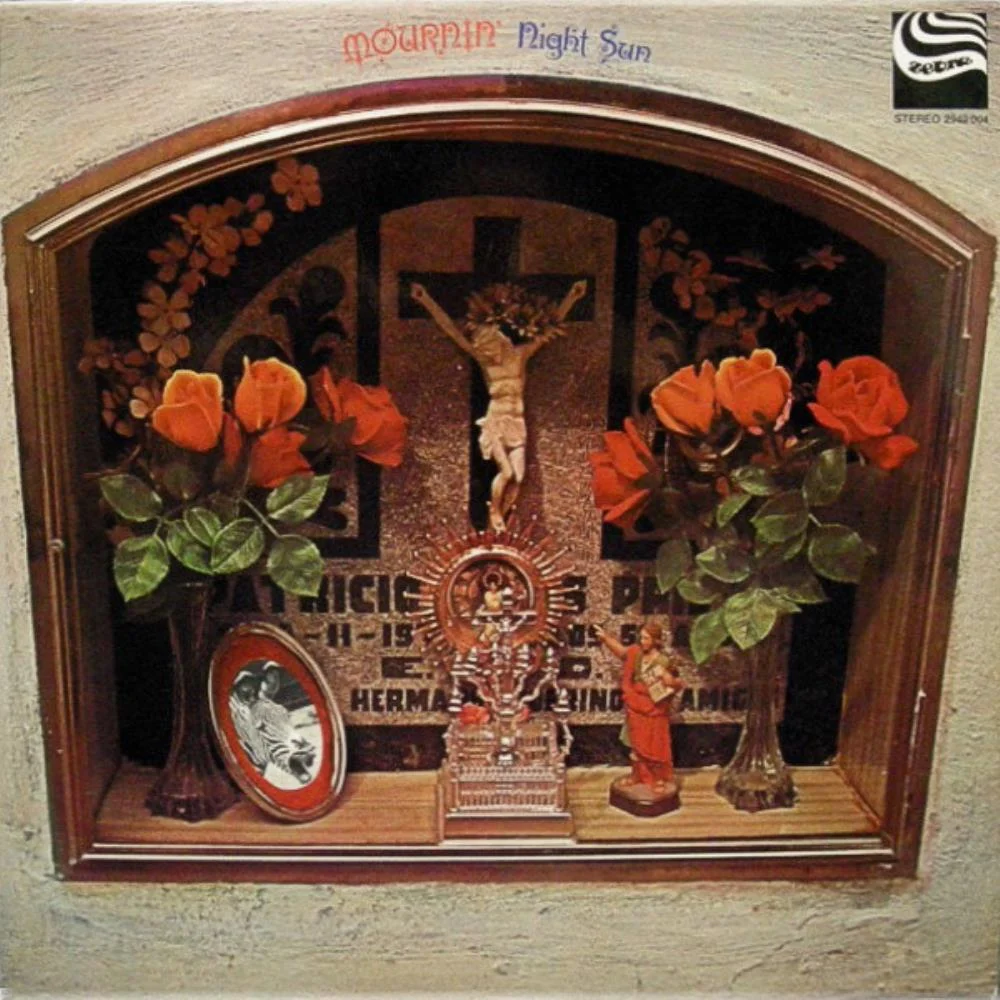 Night Sun released their singular album, Mournin’, in 1972 on Zebra.
The album shifts between fast staccato attacks, throttled riffwork, and brief psych-informed interludes, binding each transition through tight organ–guitar exchanges and aggressive, pressure-locked rhythms. Guitarist Walter Kirchgässner and keyboardist Knut Rössler trade charged, dissonant lines across the album’s volatile arrangements. Rössler shapes the harmonic density with variable turns on organ, piano, trumpet, and bassoon. Bruno Schaab and Ulrich Staudt form a fulcrum of fuzzed-out bass and fractured percussion, locking the band’s aggressive shifts in rhythm and tone.
Mournin’ opens in a full-throttle blur with “Plastic Shotgun,” where sharp, breakneck guitar runs shadow a distorted organ line under vocal phrasing that yelps and jabs in clipped bursts. “Crazy Woman” builds its charge from blurred organ tones and thick-cut riffs, unfolding into solo passages without dropping its pace. “Got a Bone of My Own” stretches through atmospheric fades and a staggered instrumental buildup before the rhythm locks into a hardened mid-tempo drive with alternating lead breaks and sharp meter shifts, holding vocals until the final third. “Slush Pan Man” drops the tempo but thickens the texture with guitar–organ unisons over a narcotic pulse.
“Living With the Dying” opens with a strained, gravel-throated vocal and rotates through drum-saturated breakdowns, filtered soloing, and brief episodes of guitar–organ sparring. “Come Down” floats on clean organ and subdued bass beneath one of the album’s few soft vocal refrains before erupting mid-track into a heavier variation on its opening sequence. “Blind” and “Nightmare” bring back the taut forward motion, with fast rhythm guitar and organ runs pacing compact vocal sections. “Don’t Start Flying” layers alto sax into the mix, rounding the album on a rhythm-driven uptempo frame that fractures the tonal density with brassy overtones.
A1. “Plastic Shotgun” (2:35) – Kirchgässner
A2. “Crazy Woman” (4:16) – Rössler
A3. “Got a Bone of My Own” (7:49) – Schaab, Plank, Kirchgässner
A4. “Slush Pan Man” (4:25) – Kirchgässner
B1. “Living With the Dying” (5:29) – Rössler
B2. “Come Down” (5:49) – Rössler, Kirchgässner
B3. “Blind” (4:23) – Kirchgässner
B4. “Nightmare” (3:15) – Kirchgässner
B5. “Don’t Start Flying” (3:06) – Kirchgässner
Night Sun recorded the album under Aamok Musikproduktion at Windrose Studios with engineer Conny Plank and assistant Hans “Flipper” Lampe. Plank oversaw Mournin’ in sequence with 1972 albums by Achim Reichel & Machines, Cluster, Grobschnitt, Guru Guru, Ibliss, Jane, Kin Ping Meh, Lucifer’s Friend, Neu!, Scorpions, and Thirsty Moon.
Postlude
Bruno Schaab joined Guru Guru for their 1973 self-titled fourth album. He later backed the folk duo Zupfgeigenhansel and cut one album with polit-rockers Schlachtvieh while keeping a steady gig with Bernies Autobahn Band, a popular Deutsch rock quintet.
Knut Rössler resurfaced in Chameleon, a jazz-rock combo that morphed after one album into the Fuchs-Goos-Band. He also played on two albums each by Orexis and Zauberfinger amid ongoing work with Joachim Fuchs-Charrier.
Discography:
- Mournin’ (1972)
Sources:
Artist/Album Pages:
McLuhan was an American symphonic/jazz-rock band that released the 1972 album Anomaly on Brunswick...
Catalyst was an American jazz-funk band that released four albums between 1972 and 1975. Their fir...
Love was an American psych-rock band from Los Angeles that released four albums between 1966 and ...
Buckingham Nicks were an American folk-pop duo from California that released a self-titled album ...
Blue Mountain Eagle was an American psych-rock band from Los Angeles that released a 1970 self-tit...
Stone the Crows were a Scottish soul-rock band that released four albums between 1970 and 1972 on ...
Krzysztof Sadowski (born December 15, 1936) is a Polish jazz keyboardist, composer, and bandleader...
Oktober was a German symphonic-rock/cabaret band behind the 1976 Trikont album Uhrsprung, followed...
Warhorse was an English hard-rock band that made the 1970–72 Vertigo albums Warhorse and Red Sea. ...
Yusef Lateef (October 9, 1920 — December 23, 2013) was an American reedist and composer with a six...
Fludd was a Canadian pop-rock band behind a 1971 self-titled album on Warner Bros., followed by t...
Kiki Dee is an English pop-rock singer who cut nine singles (1963–67) on Fontana, which issued her...