

Catalyst was an American jazz-funk band that released four albums between 1972 and 1975. Their first, a self-titled release on Cobblestone, features future Weather Report bassist Alphonso Johnson. After the label was acquired by Muse Records, Catalyst released the albums Perception, Unity, and A Tear & A Smile.
Members: Eddie Green (keyboards, vocals), Alphonso Johnson (bass), Tyrone Brown (bass), Sherman Ferguson (drums, percussion, marimba), Odean Pope (saxophone, flute, oboe)
Background
Catalyst formed in Philadelphia as a jazz-funk quartet comprised of keyboardist Eddie Green, bassist Alphonso Johnson, drummer/percussionist Sherman Ferguson, and reedist Odean Pope. After the first album, Johnson cleared way for bassist Tyrone Brown.
Green and Brown played on the 1966 single “Ebony Woman” (b/w “Go to Hell”), the debut release by soul singer Billy Paul (released as Mr. Billy Paul). They also played on Pat Martino‘s 1968 Prestige release East! and Paul’s 1971 PIR debut Going East. Separately, Green played on a pair of 1969/70 Prestige titles by saxophonist Sonny Criss; Brown appeared on the 1967 Alfa Records release Emerges by the D. B. Shrier Quartet.
Ferguson played on three tracks credited to Leon Thomas on the 1970 multi-artist Flying Dutchman release Super Black Blues: Volume II.
Catalyst
 Catalyst released their self-titled debut album in 1972 on Muse.
The album blends electric jazz with tightly arranged funk and exploratory modal passages. Keyboardist Eddie Green leads multiple extended themes with Fender Rhodes lines that wrap around the tenor saxophone and flute of Odean Pope. Guitarist Norman Harris contributes to the opening cut, while Pope trades off between oboe, tenor, and flute across side A. Bass duties alternate between Alphonso Johnson and Anthony Jackson, with drummer Sherman Ferguson anchoring the rhythm section throughout with precise and insistent momentum. Green wrote four of the six tracks.
A1. “Ain’t It the Truth” (2:42) – Green
A2. “East” (8:03) – Brown
A3. “Catalyst Is Coming” (8:13) – Green
B1. “Jabali” (8:44) – Ferguson
B2. “New-Found Truths” (5:44) – Green
B3. “Salaam” (1:34) – Green
Sessions took place on March 3, March 27, and April 16, 1972, at Sigma Sound Studios in Philadelphia. Producers Dennis Wilen and Skip Drinkwater oversaw the sessions with engineering by Joe Tarsia, Carl Paruolo, and Jay Mark. The album features additional percussion by Ferguson and poppy pod shaker textures from Drinkwater. Spencer Zahn designed the sleeve and photographed the group for the package, issued by Cobblestone and distributed by Buddah Records.
Perception
 Catalyst released their second album, Perception, in 1973 on Muse.
The album expands the quartet’s exploratory range with lengthened forms and richer ensemble textures. Keyboardist Eddie Green alternates between Rhodes and ARP textures in constant dialogue with tenor saxophonist and flutist Odean Pope, whose lines navigate layered melodic territory on the title track and “Celestial Bodies.” Bassist Tyrone Brown underpins the extended pieces with steady pulse and modal foundation, while drummer Sherman Ferguson shapes the time with sharp accents and responsive detail. Green wrote two of the album’s five numbers.
A1. “Perception” (15:10) – Green
A2. “Uzuri” (2:59) – Brown
B1. “Celestial Bodies” (9:20) – Green
B2. “Ile Ife” (7:02) – Pope
B3. “Got to Be There” (2:44) – Elliot Willensky
Sessions took place from November 21 to November 27, 1972, at Sigma Sound Studios in Philadelphia with Carl Paroulo engineering. Producers Dennis Wilen and Skip Drinkwater oversaw the sessions. Norman Harris contributes guitar, and Pat Gleason adds ARP synthesizer on selected passages. Percussionists Farel Johnson and Billy Hart provide additional color across both sides, with Anthony Jackson handling bass on the closing track. The album appeared in a glossy sleeve with photography and design by Spencer Zahn. Pressing took place at PRC in Richmond, Indiana.
Unity
 Catalyst released their third album, Unity, in 1974 on Muse.
The group expands their palette with string and woodwind textures while maintaining a core focus on electric jazz interplay. Keyboardist Eddie Green frames each theme with Rhodes motifs that pivot around the phrasing of saxophonist and flutist Odean Pope. Guest violinist John Blake interacts fluidly with Pope on “Athene,” while Gail Murdaugh and Connie Hamilton fill the harmonic field with layered counterpoint. Bassist Tyrone Brown and drummer Sherman Ferguson anchor the ensemble with measured pulse and sustained low-end momentum across all but one track, where Alphonso Johnson and Billy Hart step in.
A1. “A Country Song” (6:20) – Green
A2. “Little Miss Lady” (4:53) – Green
A3. “Maze” (5:17) – Green
B1. “Athene” (5:27) – Green
B2. “Mail Order” (6:12) – Green
B3. “Shorter Street” (3:53) – Green
Sessions took place in January 1974. Skip Drinkwater produced the album with mastering at Frankford/Wayne and pressing by PRC in Richmond, Indiana. Billy Hart contributes percussion on three tracks in addition to drums on “A Country Song.” Three violinists and three flutists augment the textures on “Athene,” arranged around Green’s harmonic structure. John Blake delivers the featured violin solo. All compositions are credited to Green.
A Tear & A Smile
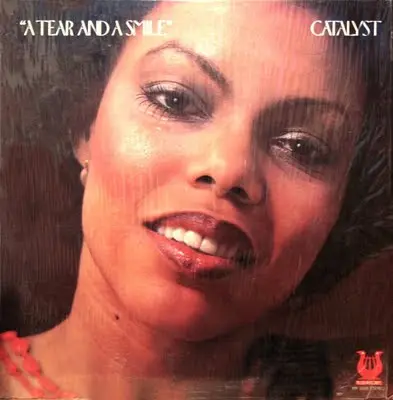 Catalyst released their fourth album, A Tear & A Smile, in 1975 on Muse.
The album expands their compositional range with chamber elements and layered ensemble voicings, blending acoustic and electric timbres within their established modal-funk structures.
Keyboardist Eddie Green alternates between acoustic piano, Fender Rhodes, and Moog textures while interacting with tenor saxophonist and flutist Odean Pope. Guitarist Charles Ellerbe contributes incisive phrasing under and around Pope’s lines, while the rhythm section—anchored by Tyrone Brown’s fluid shifts between upright and electric bass and Sherman Ferguson’s hybrid kit-percussion approach—underpins each passage with a flexible, polyphonic base. Green wrote all seven tracks.
A1. “The Demon Pt. 1” (4:10) – Green
A2. “The Demon Pt. 2” (3:10) – Green
A3. “A Tear and a Smile” (4:34) – Green
A4. “Fifty Second Street Boogie Down” (3:56) – Green
B1. “Suite for Albeniz” (6:15) – Green
B2. “A Prayer Dance” (5:54) – Green
B3. “Bahia” (6:15) – Green
Sessions took place at Society Hill Studios in Philadelphia. Producer Skip Drinkwater oversaw the recordings, with Bob Kosiba and Joel Fein engineering. Mixing took place at Wally Heider Recording in San Francisco with mastering by George Horn at Columbia Studios. Guest violinist John Blake returns as soloist on “Suite for Albeniz,” joined by a full string and wind ensemble that includes flutists Shirley Byrne Brown and Steve Tanzer, clarinetist George Taylor, and cellist Michael Peebles. Sharon Scott provides lead vocal support on “The Demon Pt. 2,” with chant and auxiliary percussion by Farel Johnson. Packaging features photography by Hugh Bell and design by Ron Warwell. Pressing took place at PRC Richmond.
Discography:
- Catalyst (1972)
- Perception (1973)
- Unity (1974)
- A Tear & A Smile (1975)
Sources:
Artist/Album Pages:
Hans Koller Free Sound was an Austrian avant-jazz/rock super-band behind the 1972 MPS/BASF album P...
Panna Fredda was an Italian symphonic-rock band that released the 1971 album Uno on Vedette Record...
Gloria Barnes is an American soul singer from NYC who released the 1971 album Uptown. https://ope...
West Wing was an American soul group that released a self-titled album on 20th Century in 1975, p...
Frederic Rabold Crew was a German jazz-rock band that released six albums between 1972 and 1980, m...
Sundance was a Swedish jazz-rock band that released a 1976 self-titled album on EMI Harvest. Mem...
Skafish was an American new wave/art-rock band from Chicago headed by Jim Skafish, an eccentric si...
Inner Vision was an American jazz-rock band behind a 1975 self-titled album recorded at CBS Studio...
Stone Alliance was an American jazz-rock ensemble formed in New York City by bassist Gene Perla, d...
Tuxedomoon was an American art-rock band from San Francisco. They started as an avant-garde perfor...
Beckett was an English rock band from Newcastle that released a self-titled album on Raft Records in...
Paladin was an English jam-rock band that released the 1971/72 albums Paladin and Charge! on Bronz...