

Strapps was an English hard-rock band that made the 1976–78 Harvest albums Strapps, Secret Damage, Prisoner of Your Love, and the 1979 Japanese Eastworld title Ball of Fire. They featured veteran drummer Mick Underwood (Episode Six, Quatermass), who subsequently joined Gillan.
Members: Ross Stagg (guitar, vocals), Joe Read (bass, vocals), Mick Underwood (drums), Noel Scott (keyboards, 1974-?), Ray Mariner (guitar, vocals, ?-1979)
Background
Strapps formed in 1975 when Australian-born guitarist Ross Stagg teamed with bassist Joe Read, keyboardist Noel Scott, and ex-Quatermass drummer Mick Underwood.
Stagg cut the 1974 UK Dawn single “I’ll Never Be a Star (But I Might)” (b/w “Oh Captain”). Underwood played in numerous prior bands, including The Outlaws, The Herd, Episode Six, Quatermass, Peace, and Sammy. Read hailed from Leicester and rounded out the classic lineup with Scott.
The group signed with EMI’s Harvest division and linked with Underwood’s former E6 bandmate Roger Glover, fresh off a three-album production liaison with Nazareth.
Strapps
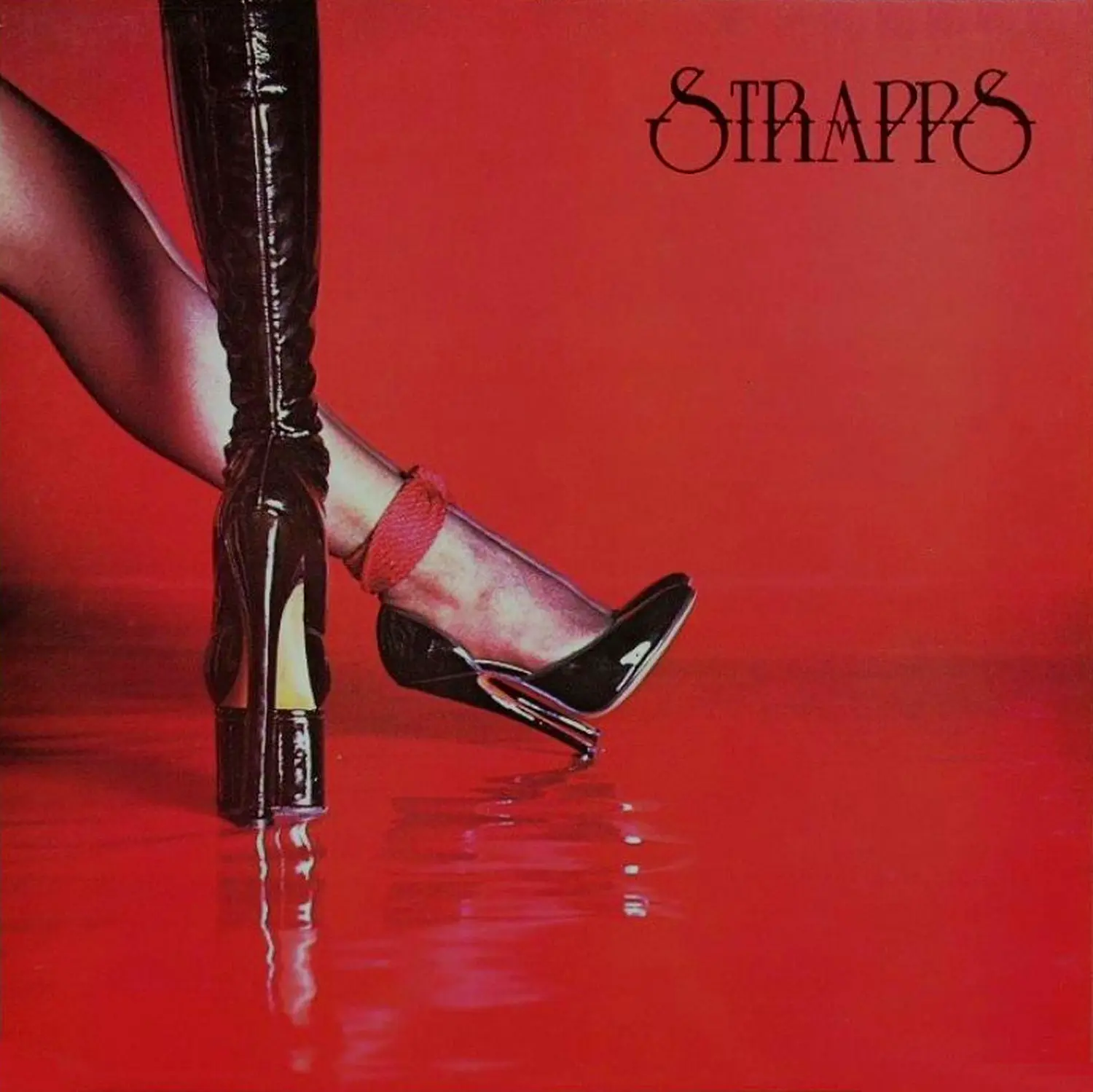 Strapps released their self-titled debut album in March 1976 on Harvest.
The album contains eight Stagg originals, which inject hard-rock with blues, funk, and occasional traces of cabaret and symphonic-rock. Strider guitarist Gary Grainger guests on the last two cuts.
“School Girl Funk” struts across a hard backbeat with clipped riffs and a near-rapped lead line. “Dreaming” curls syncopated low-end figures into a more open ensemble turn. “Rock Critic” swerves through theatrical section changes amid interlocked guitar/keyboard figures. “In Your Ear” barrels through a brisk boogie refrain with compact verses. “Suicide” grows from acoustic figures and restrained lines to swelled chorus heights and orchestral sweep, arranged by Martyn Ford.
A1. “School Girl Funk” (4:21)
A2. “Dreaming” (4:59)
A3. “Rock Critic” (4:14)
A4. “Oh! the Night” (4:37)
B1. “Sanctuary” (3:56)
B2. “I Long to Tell You Too” (5:16)
B3. “In Your Ear” (3:20)
B4. “Suicide” (6:59)
Sessions occurred in February 1976 at Kingsway Recorders in London, where Roger Glover produced Strapps in sequence with Calling Card by Rory Gallagher. Kingsway staffer Louis Austin engineered the album amid projects by Danny Kirwan, Leo Sayer, Steve Hackett, Stretch, Sweet, and Wizzard’s Convention.
Strapps displays imagery by Mick Rock, a longtime Queen and Bowie photographer credited on recent albums by Cockney Rebel, Mr. Big, Seventh Wave, and Thin Lizzy. The cover shows a horizontal nylon-clad leg in with strapped ankles in 6″ stilettos, crossed with a standing leg in vinyl stretch pants and platform heels. Rock’s deep-red setting reflects 1976 covers for Be-Bop Deluxe, Lalo Schifrin, Sylvia Robinson, and the Spiders from Mars.
Harvest lifted “In Your Ear” as a March 1976 UK single (b/w “Rita B”).
Secret Damage
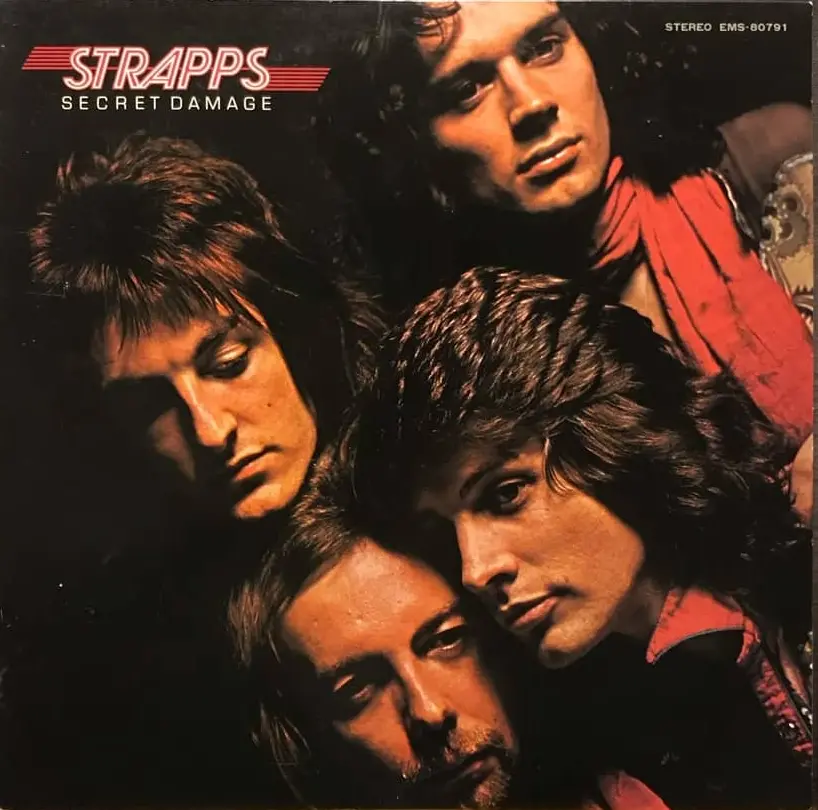 Strapps released their second album, Secret Damage, in February 1977 on Harvest.
The album contains seven songs by Stagg and retains the Stagg–Read–Underwood–Scott lineup.
“Down to You” surges from a keyboard-led opening into hard riff motion, then breaks into a bright Moog solo. “The Pain of Love” grinds through blues-marked lead work and blunt chorus accents. “Child of the City” lifts the refrain with a gospel-shaded inflection. “In Your Ear” hustles through brisk boogie accents and a direct title refrain.
“I Wanna Know” pounds the same uptempo lane with a longer ride on the refrain. “Soft Touch” hammers hard-edged accents beneath paired upper-register figures. “Violent Love / Secret Damage” stretches from a blues-toned lead passage into a title-section riff and large chorus close.
A1. “Down to You” (6:25)
A2. “The Pain of Love” (5:17)
A3. “Child of the City” (3:44)
A4. “Never Never Wanna Go Home” (3:06)
B1. “I Wanna Know” (5:25)
B2. “Soft Touch” (4:36)
B3. “Violent Love / Secret Damage” (8:04)
Strapps recorded Secret Damage between November and December 1976 at Island Studios (Basing Street, London) with producer/engineer Chris Kimsey, who worked in sequence with Automatic Man, Bad Company, F.B.I., Peter Frampton, Piper, and Widowmaker.
Mick Rock designed and photographed the Secret Damage cover package with inner-bag images by Gerd Ludwig, Hiro, Michael C. White, and Peter Read. Rock used a close group portrait against a dark field with pink title lettering.
Harvest lifted “Child of the City” as a February 1977 UK single (b/w “Soft Touch”).
Prisoner of Your Love
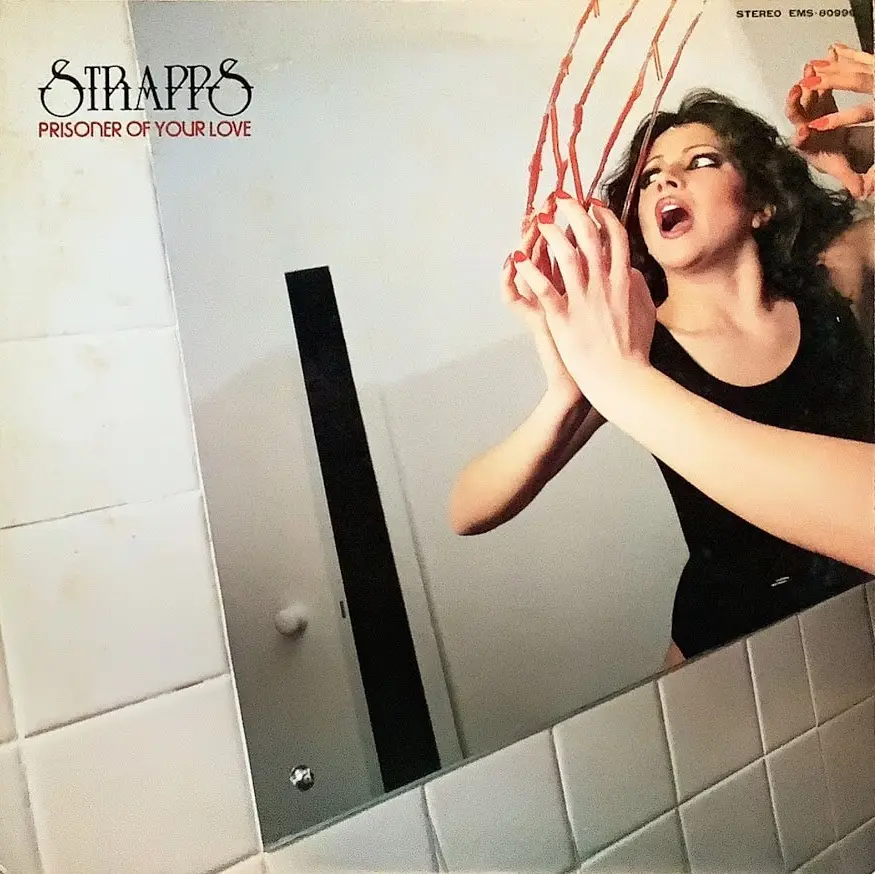 Strapps released their third album, Prisoner of Your Love, in 1978 on EMI/Harvest in Japan.
The album contains ten hard-rock songs with Scott keyboard parts and Williams brass-and-string arrangements. Stagg wrote seven songs and co-wrote “Bound for Glory” with Underwood. Read submitted “Rock ’n’ Roll Sensation” and “Look to the East.”
“Bound for Glory” charges on a sharp riff and bright organ glare. “Prisoner of Your Love” twangs through hard accents before horns lift the refrain. “Let the Music Play” drags long lead phrases across a thin-toned ensemble bed. “All Through the Night” smooths the verse-chorus shape into cleaner line placement. “It’s Your Dream” leans on heavy bends and slow-boil phrasing without the extended section play of the earlier albums.
A1. “Bound for Glory” – Underwood/Stagg
A2. “Prisoner of Your Love” – Stagg
A3. “Let the Music Play” – Stagg
A4. “Rock ’n’ Roll Sensation” – Read
A5. “All Through the Night” – Stagg
B1. “It’s Your Dream” – Stagg
B2. “Be Strong” – Stagg
B3. “Might or Maybe” – Stagg
B4. “Look to the East” – Read
B5. “Need Your Love (To Break My Fall)” – Stagg
Strapps recorded Prisoner of Your Love between November 1977 and February 1978 at The Manor and Marquee Studios with producer Pip Williams and engineer John Eden. Williams arranged the brass and string parts at Threshold Studios.
Prisoner of Your Love features photography by Pete Vernon and art direction by Brian Palmer. The sleeve places a monochrome group portrait inside a grey field, with the album title above the image and the band name below the photograph.
EMI lifted “All Thru’ the Night” as a December 1977 Japanese single (b/w “Understand It”).
Ball of Fire
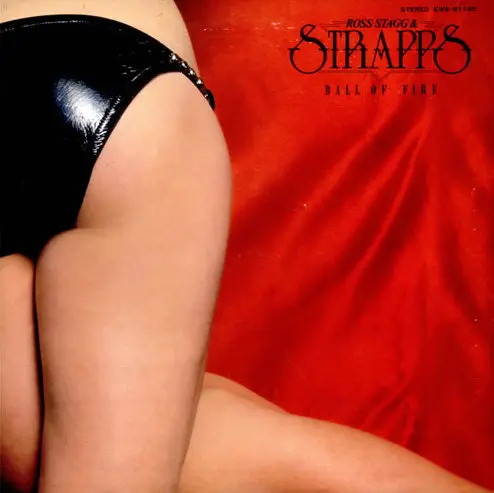 Ross Stagg & Strapps released their fourth album, Ball of Fire, in 1979 on Eastworld in Japan.
The album contains nine hard-rock songs from a two-guitar lineup. Stagg wrote five songs. Read wrote “One Way Love” and “Angry.” Underwood co-wrote “Power in Her Soul” with Read, and McRiner wrote “The Heat’s On,” the album closer. Strapps add guitarist and backing vocalist Ray McRiner alongside singer-guitarist Ross Stagg, bassist Joe Read, and drummer Mick Underwood.
Ball of Fire hardens the Strapps format around twin-guitar riff songs and blunt chorus motion. “Bring On The Thunder” grinds through a gritty opening riff. “Silent Slaughter” gallops with taut accents and a forward-leaning backbeat. “One Way Love” lunges through fast riff movement and hard-edged lead breaks. “Evil” punches its chorus with direct title stress and compact verse motion. “Angry” rides blues-marked bends and stomping accents.
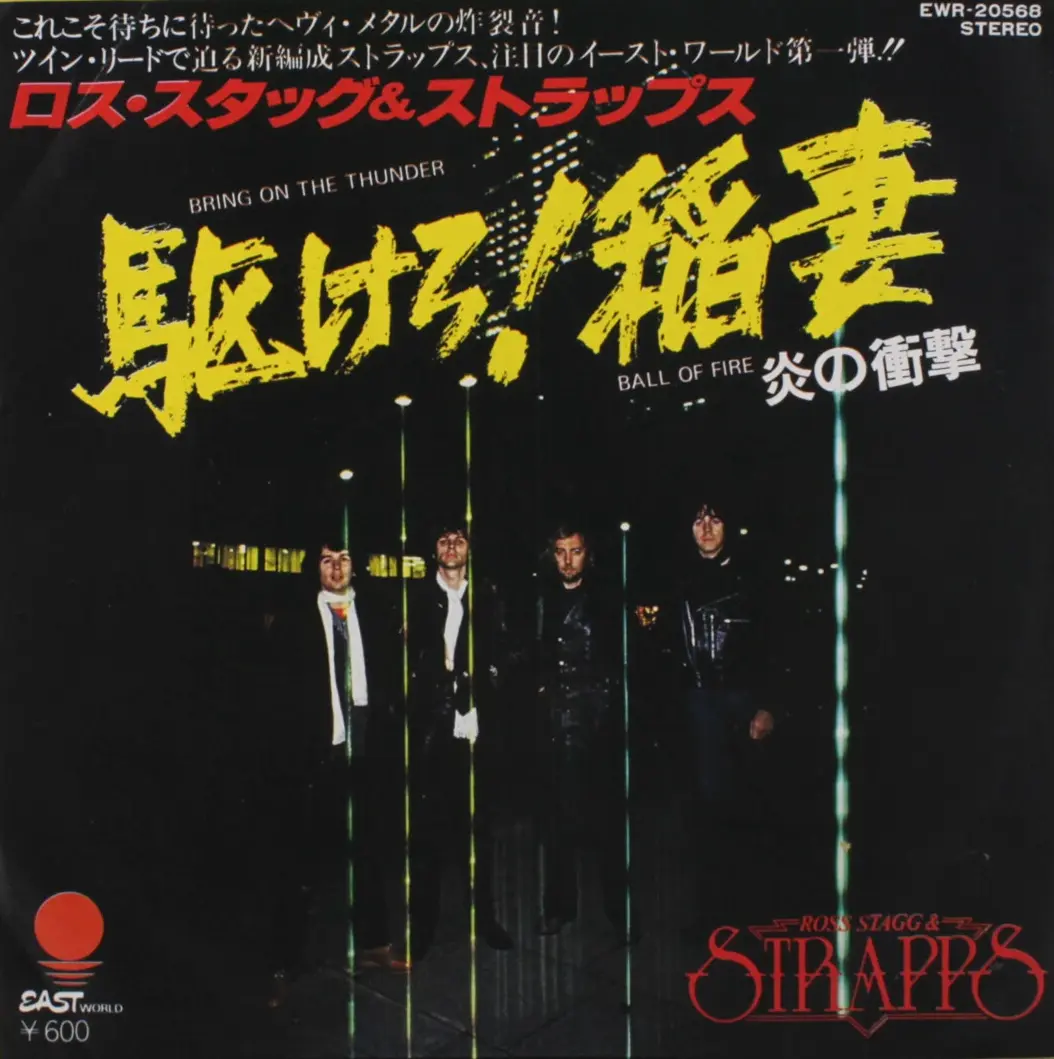 A1. “Bring on the Thunder” (4:58) – Stagg
A2. “Silent Slaughter” (4:00) – Stagg
A3. “One Way Love” (3:32) – Read
A4. “Evil” (4:02) – Stagg
A5. “Power in Her Soul” (4:15) – Underwood/Read
B1. “Angry” (4:12) – Read
B2. “Storm of Love” (5:00) – Stagg
B3. “Ball of Fire” (3:50) – Stagg
B4. “The Heat’s On” (4:03) – McRiner
Strapps produced Ball of Fire between November and December 1978 at Kingsway Recorders in London with engineer Bob Broglia.
Ball of Fire features sleeve photography by Hiro Ohno, whose front-cover image shows a cropped figure in a black garment against a red fabric field. The back cover places a night group portrait below the tracklist and recording credits.
Eastworld lifted “Bring on the Thunder” as a May 1979 Japanese single (b/w “Ball of Fire”).
Postlude
Mick Underwood joined Gillan for their 1979 second album Mr. Universe and remained for their duration. He resurrected the Quatermass name with the 1997 album Long Road. In 2012, he formed Mick Underwood’s Glory Road for Gillan and Quatermass repertory.
Joe Read moved to Los Angeles and joined Code Blue for their 1983 second album True Story. After a stint with The Call for their 1984 third album Scene Beyond Dreams, he joined The Textones for their 1984–87 albums Midnight Mission and Cedar Creek. He later ran N8 Recording, a London production studio. In 1995, Read scored the Discovery Channel series The Spanish American Wars. He issued solo albums through the 2025 disc Paradox & Mystery.
Ross Stagg returned to Australia and formed Shooting School, which cut the 1984 Mercury single “You Won’t Listen” (b/w “Bring Me Water”) and toured nationally as a Dragon support act. Stagg later taught and wrote curriculum for TAFE New South Wales, including work at Nirimba Contemporary Music Centre and TAFE Entertainment in Sydney.
Guitarist Ray McRiner joined the 1979 touring lineup of Sweet, which included the McRiner songs “Too Much Talking” and “Give the Lady Some Respect” on their 1980 album Water’s Edge.
Discography:
- Strapps (1976)
- Secret Damage (1977)
- Prisoner of Your Love (1978)
- Ball of Fire (1979)
Sources:
- Discogs: Strapps
- 45worlds: Strapps
- 45cat: Strapps
- RYM: Albums by English S Artists (page 8)
- MusicBrainz: Strapps
Artist/Album Pages:
Mini was a Hungarian rock band that made three singles as Mini Együttes. Between 1978 and 1983, th...
5 Hand Reel was an English/Scottish folk-rock band that released three albums between 1976 and 197...
Don "Sugarcane" Harris (June 19, 1938 — Nov. 30, 1999) was an American jazz-funk violinist from P...
Dick Heckstall-Smith — aka Richard Malden (Sept. 26, 1934 — Dec. 17, 2004) — was an English jazz-r...
Radomir Mihajlović Točak is a Yugoslav rock guitarist, principally known as the driving force behi...
Ace was an English soul-rock band from Sheffield that released three albums on Anchor between 1974...
Tokyo Union was a Japanese jazz-funk big band, headed from 1966 by saxophonist Tatsuya Takahashi (...
The Artwoods were an English R&B/beat quintet that cut six Decca singles between 1964 and 1967, ...
Tabula Rasa was a Finnish symphonic-folk band that released two albums and a standalone single bet...
P.P. Zahl was a German symphonic-rock project named after an imprisoned author, whose poetry becam...
Tranquility was an English rustic-rock/folk band assembled by manager-producer Ashley Kozak around...
Barbara Thompson (July 27, 1944 — July 2, 2022) was an English saxophonist who emerged as a guest ...