

Ache was a Danish post-psych band that released the 1970/71 albums De Homine Urbano and Green Man. After a four-year pause, a revised lineup surfaced with the 1976/77 albums Pictures From Cyclus 7 and Bla Som Altid.
Members: Torsten Olafsson (bass, vocals, 1970-71), Finn Olafsson (guitar), Peter Mellin (Hammond organ, piano), Glenn Fischer (drums, percussion, sound effects, 1970-71), Stig Kreutzfeldt (vocals, percussion, 1976), Johnnie Gellett (vocals, percussion, acoustic guitar, 1976), Steen Toft Andersen (bass, 1976), Gert Smedegaard (drums, 1976)
Background
Ache formed in Copenhagen in 1968 around four musicians whose paths crossed through the city’s beat scene. Brothers Torsten Olafsson and Finn Olafsson played together since their teens, while keyboardist Peter Mellin and drummer Glenn Fischer came out of the local group The Harlows; Torsten briefly joined that band on bass after Mellin stepped away, and he and Finn also ran a separate blues unit, the McKenzie Set. When Mellin re-entered the picture with a Hammond M3, the group’s core sound took shape around his organ and Finn’s guitar, with rehearsals and long jam sessions developing in Fischer’s basement. Their influences included The Artwoods, The Nice, Procol Harum, Vanilla Fudge, Jethro Tull, and Hansson & Karlsson.
The band spent spring and summer 1968 tightening its material through collective improvisation, with riffs and themes emerging directly from rehearsal. One early piece, “Acheron,” became a key concert number, and the band name itself came from the bass-note pattern A-C-H-E (using the Danish notation where H equals B natural). Ache quickly built a local following through a residency at Copenhagen’s Klub 27, appearances on the Danish beat circuit, and support slots for visiting acts, while the Tezcatlipoca light-show collective began working alongside them and later became part of the visual staging for their early ballet performances.
A February 1969 radio broadcast on Danish Beat brought Ache to journalist Torben Hoyer, who introduced the group to dancer-choreographer Peter Schaufuss, then planning a new “beat ballet.” Ache began working with Schaufuss that spring, and during an Easter-week stay in Hornbæk they mapped out the plot and arranged the music to fit the choreography. When Schaufuss needed a recording for competition use, he contacted producer Johnny Reimar at Polydor/Philips in Denmark. Reimer, an erstwhile guitarist, played years beforehand in The Cliffters, a Danish instrumental rock band that (along with The Shadows and The Spotnicks) sparked Finn’s early musical interests.
De Homine Urbano
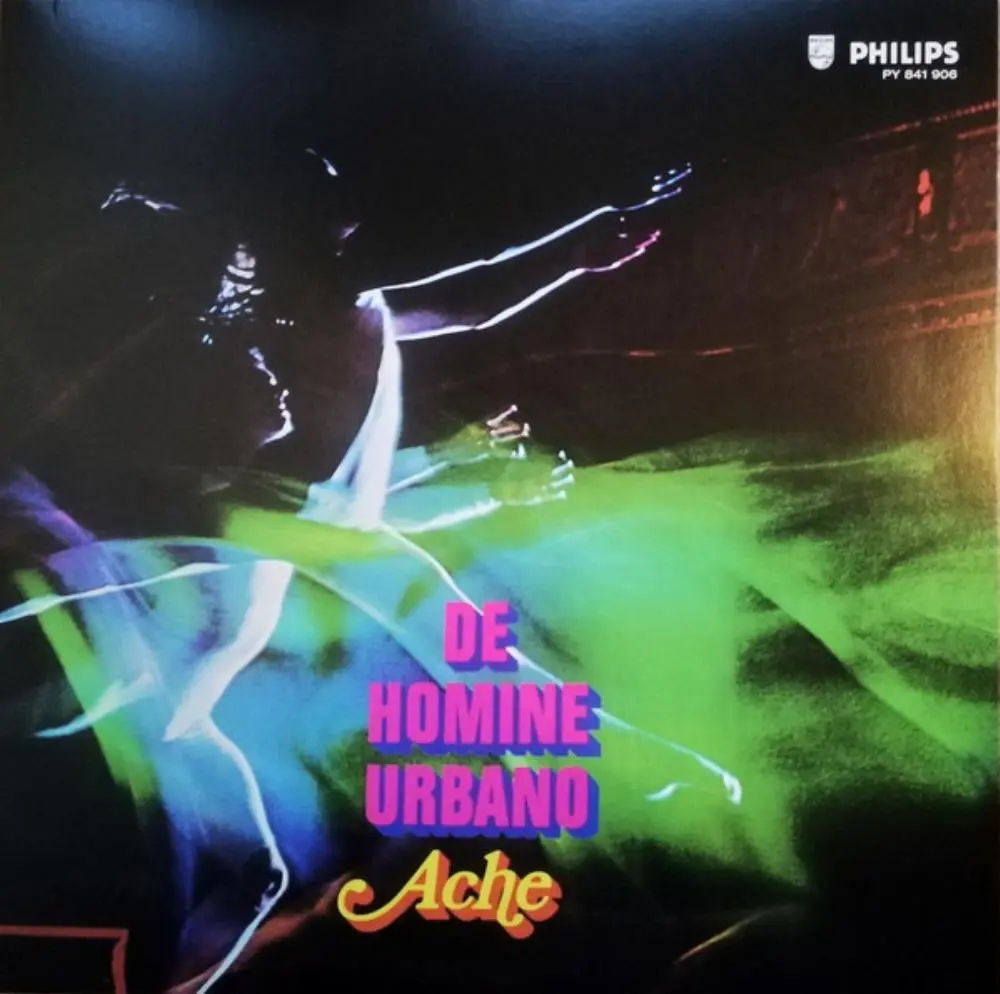 Ache released their debut album, De Homine Urbano, in February 1970 on Philips. The title is Latin for “About the Urban Man” or “Concerning the City Dweller.”
On De Homine Urbano, Ache builds two side-long suites around Hammond-led momentum, with organ and piano trading the foreground while distorted guitar answers in short bursts or extended leads, and the rhythm section keeps a restless push under frequent tempo turns. They formed Side A around music for a ballet by Peter Schaufuss.
Guitarist Finn Olafsson and keyboardist Peter Mellin (Hammond organ, piano) trade lead space and interlock lines across the long forms while bassist-vocalist Torsten Olafsson and drummer-percussionist Glenn Fischer underpin both suites, co-written by Peter and Torsten. Finn plays a Rickenbacker with the Marshall Supafuzz pedal.
The title piece moves as a chain of micromovements: loud, bright organ statements snap into brief calms, then return in heavier surges where guitar and organ lock into repeated figures; gentle piano passages give way to jagged, psyched-out stabs, and the ending breaks into a more experimental stretch where dense noise and clashing parts pile up before the music drops into a quieter close. “Little Things” shifts the palette and structure toward a looser sequence of sections, with intermittent vocals and spoken lines that add a theatrical edge; marching drum patterns and organ fanfare open the side, then the suite pivots into darker, tenser blocks shaped by somber organ drones, stalking piano, thicker bass weight, and longer instrumental extensions, with moments of acoustic guitar relief before the final build tightens around repetitive bass, rising organ swells, and a harder-driving finish.
A. “De Homine Urbano” (19:01)
— i. Overture
— ii. Soldier Theme
— iii. Ballerina Theme
— iv. Pas de deux
— v. Ogre Theme
— vi. Awakening
— vii. The Dance of the Demons
— vii. Pas de trois
— ix. The Last Attempt
— x. Finale
B. “Little Things” (18:37)
Ache recorded and mixed the title suite in a single day in early June 1969 at Metronome Studio A in Copenhagen, then returned in October to cut and mix “Little Things.” Johnny Reimar produced the album in sequence with the self-titled debut by Aunt Mary.
Schaufuss won the 1970 Moscow ballet competition and appropriated “Little Things” into his subsequent act at Copenhagen’s New Theatre.
Green Man
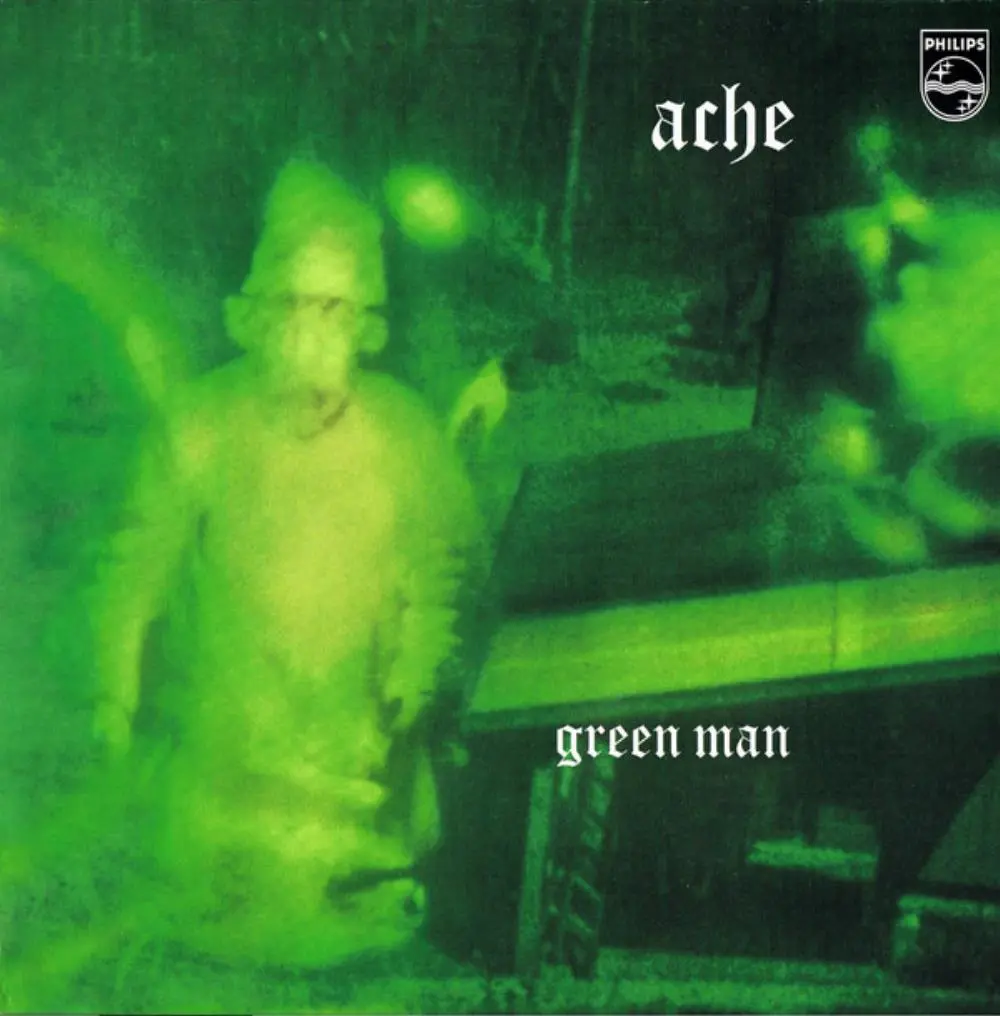 Ache released their second album, Green Man, in June 1971 on Philips.
The record keeps the long-form, section-driven approach of the debut while shifting to a full LP program of band-written material, with lyrics credited to Torsten Olafsson. Guitarist Finn Olafsson and keyboardist Peter Mellin (organ, piano) trade lead lines and counterfigures, Gregers Bjørn Poulsen threads in special effects. Torsten anchors Green Man with drummer-percussionist Glenn Fischer, whose backbeat drives the livelier passages. Finn plays the Fender Strat and Shaftesbury Les Paul models.
Green Man shifts Ache into shorter, vocal-forward cuts that keep the band’s core tension between Hammond weight and distorted-guitar edge, with frequent pivots from plain, mid-paced figures into denser instrumental episodes. “Equatorial Rain” opens on brief sound effects, then drops into a slow, organ-led verse where the vocal line sits low and grave, before the arrangement breaks out into more animated organ-and-guitar passages. “Sweet Jolly Joyce” rides a quicker pulse and a tight, repeatable riff, with the organ pressing hard against spoken or half-spoken vocal phrasing and short bursts of band-wide emphasis.
“The Invasion” stretches time: the tempo stays slow and trance-set, the Hammond holds long spans, and the track saves its lift for a late push where guitar and drums take a clearer lead. “Shadow of a Gypsy” centers on sustained Hammond chords and layered, deep backing harmonies that thicken the chorus lines, while “Acheron” turns sharper at the edges as keyboard and guitar trade lines over a more articulated bass-and-drum base. The title track starts close to a simple acoustic strum and spare snare, then gains weight as electric guitar and Hammond enter and the arrangement grows more insistent. The album closes on “We Can Work It Out/Workin’,” which recasts the Beatles classic as a slow organ-and-drum dirge that expands into a longer, more rhythmic midsection with chant-like vocals and extended guitar work.
A1. “Equatorial Rain” (6:58) — Olafsson
A2. “Sweet Joly Joice” (3:47) — Olafsson
A3. “The Invasion” (5:57) — Mellin/Olafsson/Olafsson/Fischer
A4. “Shadow of a Gipsy” (4:37) — Mellin
B1. “Green Man” (4:38) — Olafsson/Olafsson
B2. “Acheron” (4:46) — Mellin
B3. “We Can Work It Out” (8:42) — Ache/John Lennon/Paul McCartney
Ache recorded the album with produced Johnny Reimar and engineer Bent Hulshøj, a fellow Aunt Mary soundman who also worked on the 1971 album by Mánar. For these sessions, Ache trimmed three tracks — “Equatorial Rain,” “The Invasion,” and “We Can Work It Out” — down from the lengthier arrangements of their live set.
Philips lifted “Shadow of a Gipsy” as a single with “Over the Fields,” a non-album group original.
A. “Over the Fields” (3:53)
Soon after this release, the classic Ache lineup played their final show on June 25 at the Djursland Festival, a two-day Kolind event with sets by Alrune Rod, Cinderella, Culpeper’s Orchard, Day of Phoenix, Dr. Dopo Jam, and Peter Thorup.
After a four-year pause, Finn Olafsson and Peter Mellin reformed Ache with C. V. Jørgensen drummer Gert Smedegaard and the duo of Stig Kreutzfeldt and Steen Toft Andersen, who recorded two albums in 1972/73 as Stig & Steen.
Pictures From Cyclus 7
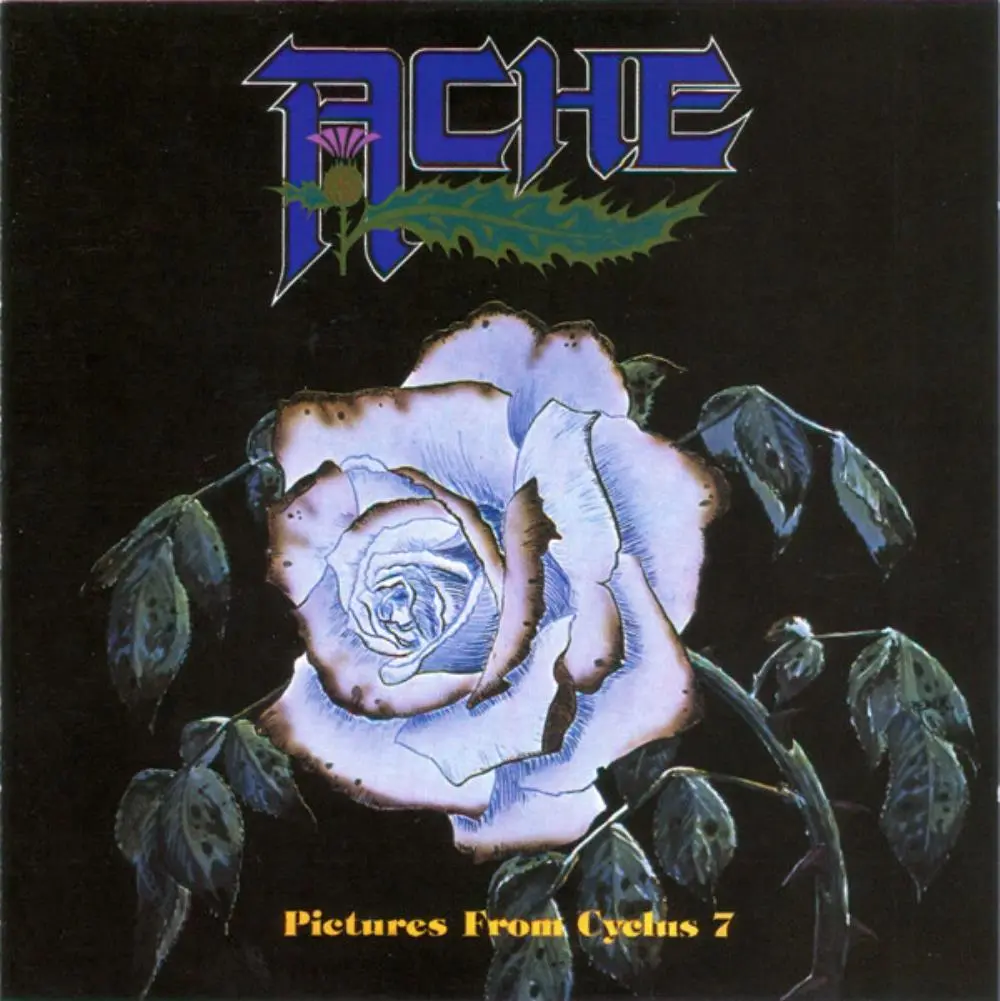 Ache released their third album, Pictures From Cyclus 7, in April 1976 on CBS.
Pictures From Cyclus 7 presents a unified cycle composed by Peter Mellin with lyrics by Bo Lillesöe.
Olafsson and Mellin lead the revised lineup with singer and rhythm guitarist Johnnie Gellett, who splits vocals with percussionist Stig Kreutzfeldt while bassist Steen Toft Andersen and drummer Gert Smedegaard underpin the suite.
Pictures From Cyclus 7 features mid-paced songs with verse-chorus structures and instrumental expansions. “Introduction” opens with a plain pulse and close, bright harmonies, then thickens as Hammond and piano stack sustained chords and the guitar adds phased, high-end texture. “Roses (Registering)” and “Our Lives” alternate quieter acoustic passages with fuller blocks where organ, piano, and light synthesizer layers widen the harmonic bed, and the vocals trace more angular turns across the changes. “(Still Hungry) Vampire Song” holds a slower, heavier tread, with the chorus carried by sustained organ chords and tightly grouped vocal lines, while the guitar stays in a restrained lead role above the rhythm section. Across the album, Mellin centers the arrangements on organ-and-piano layers with occasional synth shading, and Olafsson answers with sustained, color-saturated lines that sit inside the keyboard mass.
A1. “Cyclus 7. Introduction” (3:18)
A2. “Roses (Registering)” (6:13)
A3. “Still Hungry (Vampire Song) – What Can We Do” (7:50)
A4. “Still Registering” (2:53)
B1. “Our Lives” (5:50)
B2. “Last Part 1” (1:02)
B3. “Outtroduction” (4:07)
B4. “Last Part 2” (1:45)
B5. “Expectation” (6:48)
Ache recorded the album with producer Nils Henrichsen and engineer Freddy Hansson. Peder Bundgaard handled design and illustration with photography by Mikkel Scharff, Nils Vest, and Steen Møller Rasmussen.
Between albums, Finn Olafsson debuted as a solo artist with Savannah, recorded with Gert, Steen, Gellett, and the long-inactive Torsten Olafsson.
Bla Som Altid
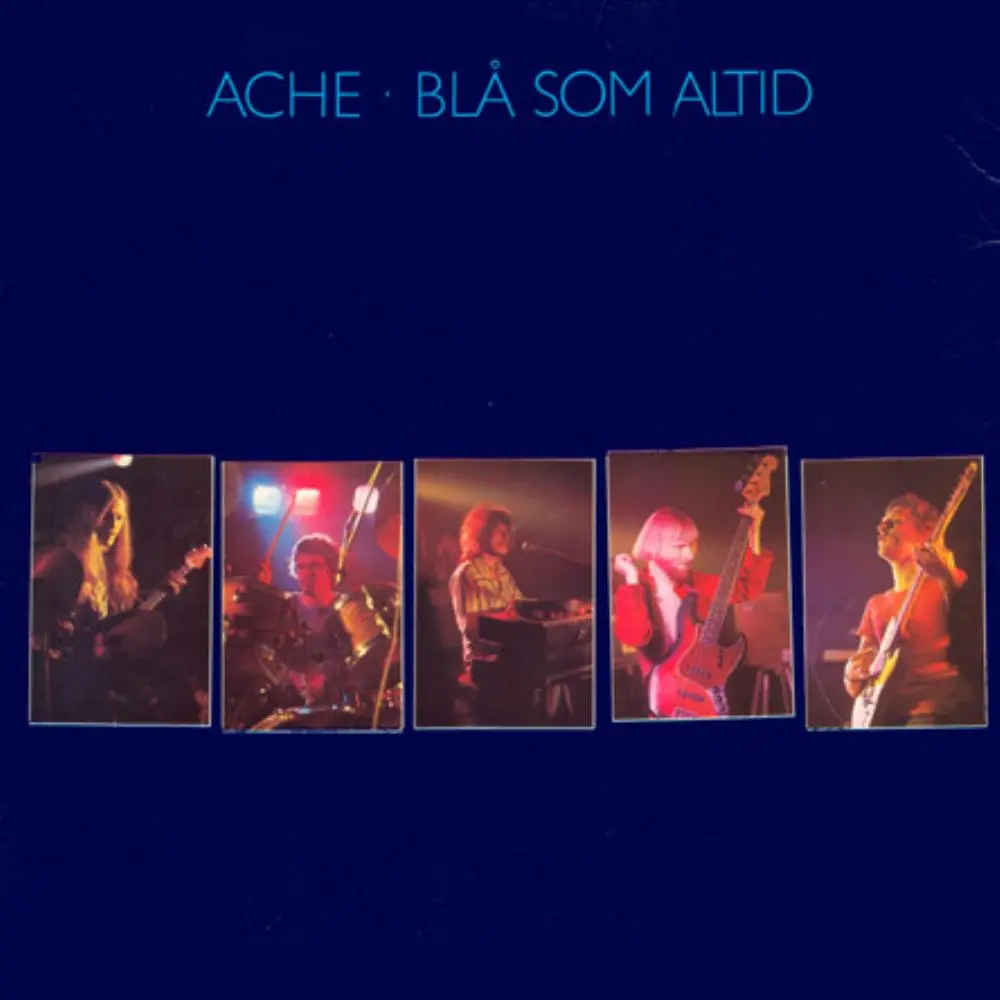 Ache released their fourth album, Bla Som Altid, in late 1977 on KMF. The title is Danish for “Blue as Always.” This was their first and only Danish-sung album.
Blå som altid documents Ache in a tightened five-piece and keeps the material in constant motion, balancing long-form writing with shorter set pieces and faster themes shaped by riff-based guitar figures against Hammond blocks that answer in short, forceful exchanges. Guitarists Johnnie Gellett and Finn Olafsson trade front-line space against keyboardist Per Wium, while bassist-harpist Steen Toft Andersen and drummer Gert Smedegaard act as the anchor and backbeat that keep the shifting sections aligned.
Select tracks pivot between slower, ballad-leaning spans and quicker passages where the rhythm section pushes a firmer pulse, the guitars move in paired lines, and the arrangement opens into longer lead spots before tightening back to the vocal frame. Hammond parts recur as the main color and often take the first statement, with guitar responses that shift from clipped phrases to sustained runs; one mid-album peak sets up a clear guitar–Hammond duel where each side trades the lead over a steady pulse. Danish lead vocals sit inside stacked backing harmonies, and the arrangements use brief jazz-tilted turns—chord pivots, short instrumental link sections, and keyboard figures that steer transitions—while keeping the album’s forms compact and section-driven.
A1. “Den Mellemliggende Tid” [The Intervening Time] (7:14) — Andersen
— “Du Får Vinger Nu” [You Get Wings Now]
— “Aida” — Christer Irgens-Møller/Karsten Houmark-Nielsen
— “Husker Du Den 27.” [Do You Remember the 27th]
— “Trist Som Uret Går” [Sad As the Clock Goes]
— “I Vort Lille Univers” [In Our Little Universe]
— “Nylon Næsten Nok” [Nylon Almost Enough]
A2. “Kilometerstenen” [The Milestone] (5:07) — Gellett
A3. “Pantomime” (5:41) — Wium/Andersen
B1. “Evig Søndag” [Eternal Sunday] (6:18) — Peter Mellin/Andersen
B2. “Perafinn” (1:35) — Olafsson/Wium
B3. “Se Dig Omkring” [Look Around You] (4:36) — Olafsson/Lars Mellin
B4. “Ingen Returbillet” [No Return Ticket] (5:34) — Gellett/Lars Mellin
Ache self-produced the album between June and August 1977 and handled arrangements collectively. Blå som altid features cover photography by Steen Møller Rasmussen.
Discography:
- De Homine Urbano (1970)
- Green Man (1971)
- Pictures From Cyclus 7 (1976)
- Bla Som Altid (1977)
Sources:
Artist/Album Pages:
Toe Fat was an English hard-rock/blues band that released a self-titled album on Parlophone in 197...
Dear Mr. Time is an English symphonic-rock/psych band that released the album Grandfather on A Squar...
George-Edwards was an American art-pop duo from Detroit that self-pressed the 1977 album 38:38 an...
Ñu was a Spanish hard-rock band that released four albums on Chapa between 1978 and 1984, followed...
Burnier & Cartier were a Brazilian samba-folk duo that made a 1974 self-titled album on RCA, f...
Nébu was a Québécois jazz-rock band that made the 1978–80 Cadence albums Nébu and Motus. Members...
Bootsy's Rubber Band was an American funk band from Detroit that released four albums between 1976...
Dave Kamien Division was a German jazz-rock band that released the 1977 album Terra Contact on HÖR...
Status Quo was an English hard-rock/boogie band from London that initially cut three beat singles ...
Lightnin' Rod — aka Jalaluddin Mansur Nuriddin (July 24, 1944 — June 4, 2018) — was an American ra...
Paul Winter (born Aug. 31, 1939) is an American soprano saxophonist from Altoona, Penn., who issue...
Caldera was an American Latin jazz-rock band that released four albums between 1976 and 1980 on Ca...