

Placebo was a Belgian jazz-funk band that made the 1971–73 albums Ball of Eyes and 1973, followed by a 1974 self-titled release on Harvest. Keyboardist Marc Moulin made a 1975 solo album, Sam’ Suffy, and did subsequent stints with Cos, Aksak Maboul, and Telex.
Members: Marc Moulin (Wurlitzer, clavinet), Nic Fisette (trumpet), Alex Scorier (saxophone), Richard Rousselet (trumpet), Nicolas Kletchkwowsky (bass), Freddy Rottier (drums) and Johnny Dover (saxophone), Philip Catherine (guitar), Yvan De Souter (bass), Francis Weyer [Francis Goya] (guitar)
Background
Placebo formed in 1971 in Waterloo, Belgium, as a collective of established jazz and session musicians converging to explore modern jazz and fusion concepts.
Keyboardist Marc Moulin (b. August 16, 1942; Ixelles, Brussels) had studied classical piano and jazz at the Royal Conservatory of Brussels before joining the St. Tropez Jazz Octett, gaining early experience as a composer and arranger.
Reedist Johnny Dover (b. May 26, 1929; Brussels) trained in woodwinds and saxophone, performing in local jazz ensembles and leading his own big band.
Trumpeter and flugelhornist Richard Rousselet developed classical and jazz technique from an early age, contributing to Belgian big bands.
Bassist and guitarist Nick Kletchkovsky (b. 1935; Belgium) studied double bass and guitar, performing on both Fifties-era and contemporary Belgian jazz recordings.
Drummer Frédéric Rottier trained in percussion, performing across small jazz combos in Brussels and recorded extensively with mid-century Belgian artists.
Saxophonist and flutist Alex Scorier (b. June 6, 1931; Ottignies, Belgium) studied classical and jazz saxophone, joining touring jazz ensembles in the 1960s.
Trumpeter Nicolas Fissette (b. 1928; Belgium) combined formal conservatory training with big band performance experience.
Formation
The members first connected through overlapping engagements in Belgian jazz orchestras, including the St. Tropez Jazz Octett.
Moulin made his recorded debut on the 1968 Octett album Jazz Goes Swinging, which also featured Rottier, Scorier, Dover, and Fissette.
Rousselet backed American trumpeter Clark Terry on the 1970 Polydor release At the Montreux Jazz Festival.
Kletchkovsky played on mid-Fifties titles by the Quintette Henri Carels and recent albums by vibraphonist Fats Sadi.
Rottier debuted behind German organist Klaus Wunderlich and played on recent titles behind Sadi and American trumpeter Jon Eardley. He interacted with Fissette on Sadi’s 1969 album Super Stereo Brazen Brass. As Placebo got underway, Rottier appeared with Kletchkovsky and Scorier on The Talent of Fud Candrix, a 1971 honorary release by Belgian swing legend Fud Candrix (1908–1974).
Ball of Eyes
 Placebo released their debut album, Ball of Eyes, in 1971 on CBS.
The album marks the first recorded project by Belgian keyboardist and composer Marc Moulin, who leads a large jazz ensemble through a series of electric, rhythm-driven pieces that bridge late-60s soul-jazz with emerging European jazz-rock. Moulin plays piano, electric piano, electric harpsichord, and melodica alongside bassist Nick Kletchkovsky, drummer Freddy Rottier, trumpeters Nic Fissette and Richard Rousselet, trombonists Frans Van Dyk, Michel Herinck, and Roger De Smet, and reedists Alex Scorier and Johnny Dover, who double on flutes and clarinets.
Moulin wrote six of the album’s eight numbers. The remaining two are covers of songs popularized by Marvin Gaye (“Inner City Blues”) and Sam & Dave (“You Got Me Hummin’”). Vocalist Guy Theisen appears on those two tracks and on the brief closing piece.
“Inner City Blues” opens with percussive piano and layered vocal lines that alternate between chant and lyric, followed by flute breaks and a call-and-response horn section. “Planes” unfolds as a syncopated instrumental with shifting tempos and an angular electric piano lead. “You Got Me Hummin’” blends R&B phrasing with bright brass figures. The short “Humpty Dumpty” recalls Canterbury-style jazz-rock with clipped electric piano phrasing and punctuated horn accents. “Aria” introduces a calm, open arrangement centered on clavinet and flute passages. “Showbiz Suite,” the album’s longest track, moves through several sections of electric piano improvisation and counterpointed brass interplay. “Ball of Eyes” features solo piano in a sparse, reflective mood, while “Oh La La” closes the set with a brief, choral refrain.
A1. “Inner City Blues” (6:09) — originated as a 1971 soul track by Marvin Gaye, written by Marvin Gaye and James Nyx Jr.
A2. “Planes” (2:56)
A3. “You Got Me Hummin’” (6:15) — first recorded in 1966 by Sam & Dave, written by Isaac Hayes and David Porter.
A4. “Humpty Dumpty” (2:31)
B1. “Aria” (5:02)
B2. “Showbiz Suite” (7:28)
B3. “Ball of Eyes” (2:03)
B4. “Oh La La” (0:59)
Sessions took place on August 23–26, 1971, under producer Jean Huysmans. Recording occurred at CBS Studios with engineering by Robert Pernet.
Ball of Eyes features cover design by Micheline Stainier and photography by Robert Pernet (front) and Marc Francart (inside).
Between albums, Placebo reconfigured with bassist Yvan De Souter (b. 1949; Koksijde), drummer Bruno Castellucci (b. Jan. 10, 1944; Châtelet), and guitarist François Weyer. All three hailed from the JJ Band and played on the 1972 Pink Elephant release Plus with American trumpeter Douglas Lucas.
1973
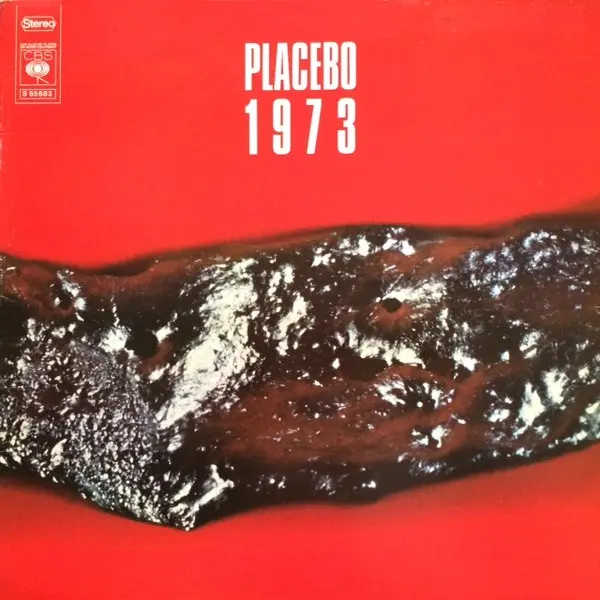 Placebo titled their second CBS album after its release year, 1973.
The album expands Marc Moulin’s jazz-rock concept into denser, rhythm-driven fusion with heavier electronic presence. Retaining the horn section and rhythm team from Ball of Eyes, he enriches the sound with layered synthesizer textures and deeper harmonic interplay between brass and keyboards.
Moulin composed and arranged all eight pieces, continuing his focus on instrumental forms and syncopated jazz structures. His keyboard parts—split between electric piano, synthesizer, and clavinet—define the tone, while trumpeters Richard Rousselet and Nick Fissette, trombonist Frans Van Dijk, and reedist Alex Scorier contribute sharp counterlines and sustained harmonic movement. Bassists Nick Kletchkovsky and Yvan De Souter handle alternating sides, joined by drummers Freddy Rottier, Bruno Castellucci, and Garcia Morales. Guitarist Francis Weyer guests on one track.
The material alternates between layered, funk-inflected themes and slow atmospheric studies. “Bolkwush” and “Temse” emphasize compact ensemble dynamics built around circular keyboard patterns and brass punctuations. “Phalène,” recorded live, stretches into a slower, smoky interplay of Fender Rhodes, reeds, and subdued percussion. “Balek” centers on an early synthesizer loop, while “Polk” and “Only Nineteen” tighten the pace with rhythmic electric piano lines and syncopated horn breaks. “Red Net” slows the tempo to ballad range, and “Re-Union” closes in an ambient electronic drone.
A1. “Bolkwush” (4:40)
A2. “Temse” (4:40)
A3. “Phalène” (7:50)
A4. “Balek” (4:20)
B1. “Polk” (3:20)
B2. “Only Nineteen” (3:50)
B3. “Red Net” (5:40)
B4. “Re-Union” (5:20)
Sessions occurred at Start Studio in Buizingen with producer Jean Huysmans and engineers Willy Pâques and Léon Geuens.
1973 features cover design by Micheline Stainier with photography by Huysmans.
Placebo
 Placebo released their self-titled third album in 1974 on Harvest.
The album presents Marc Moulin’s final exploration of jazz-rock through his long-running octet, which by this point included holdovers from his early 1970 sessions—trumpeters Nicolas Fissette and Richard Rousselet, reedist Alex Scorier, and guitarist Francis Weyer—augmented by new members guitarist Philip Catherine, drummer Garcia Morales, and bassist Yvan De Souter. Moulin’s compositions and arrangements center on electric piano, clavinet, and synthesizer textures that anchor a balance of tight rhythmic structures and open, improvisational brass passages.
Moulin wrote seven of the album’s eight pieces, continuing his signature use of electric piano ostinatos and sectional horn interplay. Guitarist Francis Weyer composed the closing number, “S.U.S.”
The material alternates between reflective, rhythmic themes and uptempo brass-driven pieces. “N.W.” and “Plotseling” unfold as layered mid-tempo workouts, each built around cyclical keyboard figures and shifting horn arrangements. “Bosso” and “Dag Madam Merci” tighten the tempo, combining syncopated drum patterns with sharp, punctuated brass lines and guitar interjections. “Hop Hop” introduces contoured rhythm lines and light acoustic phrasing by Catherine, while “Tanga” contrasts accordion and synthesizer motifs. The lengthy “Stomp” sustains a rigid rhythmic framework over which brass and keyboard voices trade terse statements. “S.U.S.” closes the album in a subdued tone with trumpet, flute, and echo-treated percussion.
A1. “N.W.” (6:38)
A2. “Plotseling” (7:37)
A3. “Bosso” (3:20)
A4. “Dag Madam Merci” (3:10)
B1. “Hop Hop” (4:32)
B2. “Tanga” (3:33)
B3. “Stomp” (7:35)
B4. “S.U.S.” (4:20) — written by guitarist Francis Weyer
Sessions occurred in February 1974 at Studio Madeleine in Brussels with producer Jean Huysmans and engineer Roland Leclercq.
Placebo features album design and logotype by Gilles Fiszman with photography by A & A Photographic & Communications and Alain Marc.
Harvest issued Placebo as a standalone release, marking the final studio project by the ensemble before Moulin transitioned to his solo work Sam Suffy later that year.
Postlude
Marc Moulin made his solo debut with the 1975 CBS release Sam Suffy, a future jazz-funk classic. He produced the 1976 second Cos album, Viva Boma, and joined Aksak Maboul for their 1977 debut Onze Danses Pour Combattre la Migraine. In 1978, he formed the synth-pop trio Telex, which scored European hits with “Twist à Saint Tropez” and “Moskow Discow.”
Castellucci regrouped with Kletchkovsky and Rousselet in Solis Lacus, a jazz-funk quintet that made a 1975 album on IBC.
Souter and Castellucci backed Doug Lucas on his 1974 RKM release Niara, which also featured ex-Pazop keyboardist Frank Wuyts.
Rousselet backed keyboardist Koen De Bruyne on his 1974 album Here Comes the Crazy Man! The two also played on Funky Tramway, a 1975 jazz-funk album credited to Mad Unity, a project led by Janko Nilovic.
Fissette played on 1976/77 albums by Jan Ptaszyn Wróblewski (Skleroptak) and Barış Manço (Nick the Chopper).
Discography:
- Ball of Eyes (1971)
- 1973 (1973)
- Placebo (1974)
Sources:
Artist/Album Pages:
Masabumi Kikuchi — 菊地 雅章 (Oct. 19, 1939 — July 6, 2015) — was a Japanese jazz pianist and composer...
Gnidrolog was an English symphonic-folk-rock band that released the albums ...In Spite of Harry's To...
Eumir Deodato is a Brazilian pianist, composer, arranger, and producer who emerged from the Rio de...
The Boston Tea Party was an American psychedelic garage-rock band from Burbank, California, that c...
Yaqui was an American Latin-rock band from Los Angeles that released a 1973 self-titled album on ...
Jackal was a Canadian post-psychedelic hard-rock band that released the 1973 album Awake on Periwi...
The Staple Singers were an American soul group from Chicago, formed in 1948 and active for the ent...
Judee Sill (October 7, 1944 — November 23, 1979) was an American singer/songwriter from Oakland wh...
The West Coast Revival was an American soul trio from California that cut three early Seventies si...
Christopher was an American psych-rock powertrio from Houston that released a 1970 self-titled al...
The Guess Who is a Canadian rock band that emerged from Chad Allan and the Expressions in Winnipeg...
If was an English sax-rock band from London that released two albums on Island in 1970, followed b...