

Christopher was an American psych-rock powertrio from Houston that released a 1970 self-titled album on Metromedia. They weren’t related to the South Carolina band (also known as Jonathan Hooker Manuscript) behind the 1969 album What’cha Gonna Do?
Members: Doug Tull (drums), Doug Walden (bass, vocals), Richard Avitts (guitar, vocals), Leon Rudnicki (bass), Terence Hand (drums), Ron Kramer (percussion), John Simpson (drums)
Background
Christopher evolved from United Gas, a Houston powertrio formed in 1968 by guitarist Richard Avitts, bassist Doug Walden, and drummer Doug Tull. In 1969, they took root in Los Angeles with residencies at the Barons of Earth biker club and Gazzarri’s on the Sunset Strip.
Metromedia signed them but ordered a new name to avoid confusion with Pacific Gas & Electric. They chose Christopher, unaware of the recent SC band. As sessions got underway, drummers Terence Hand and John Simpson stepped in for Tull, who returned to Texas and joined fellow Houston rockers Josefus. Simpson hailed from Seattle folk-rockers Calliope, an early vehicle for Danny O’Keefe.
The Album
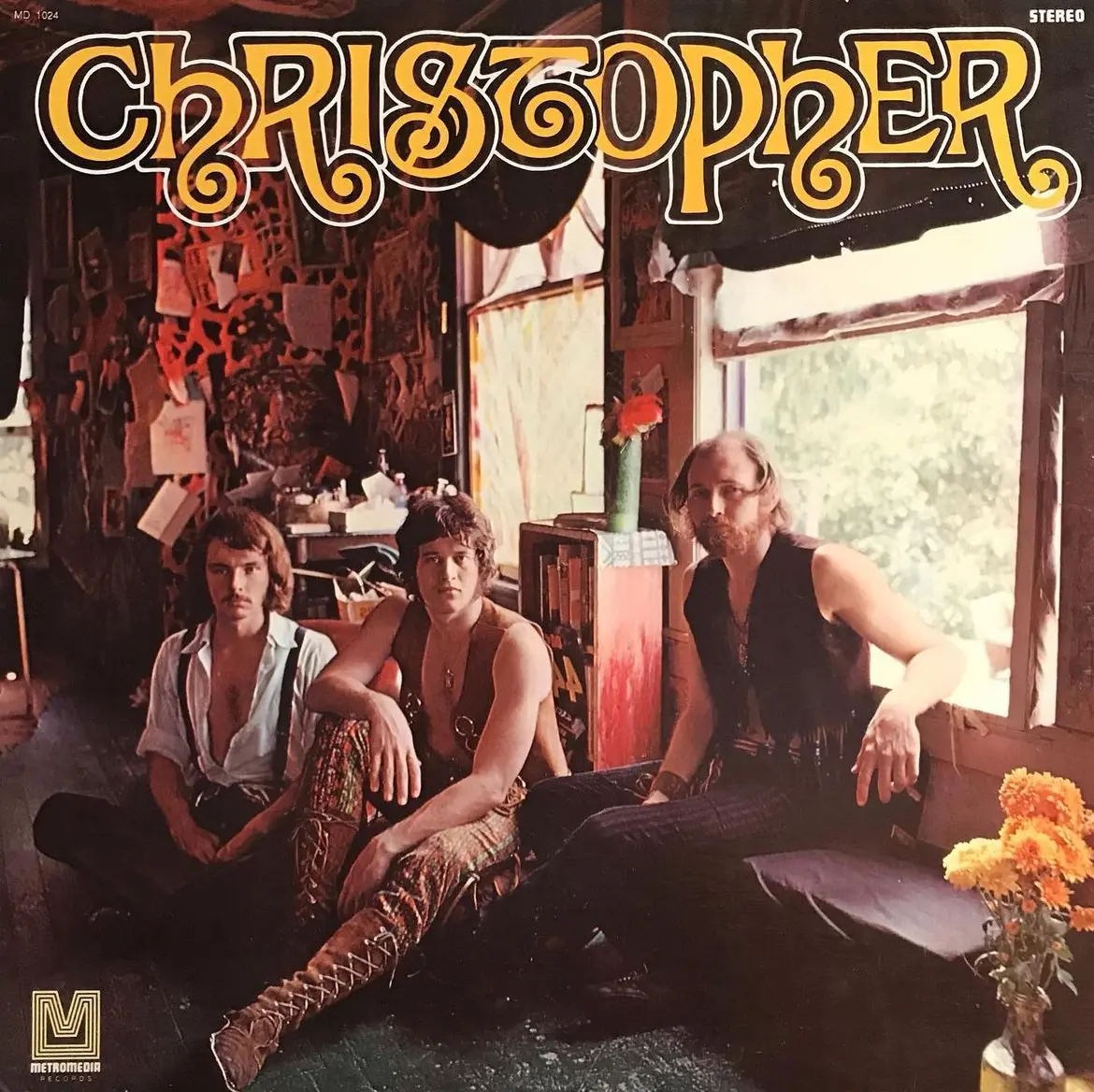 Christopher released their self-titled album in April 1970 on Metromedia.
The album contains ten group-credited songs. John Simpson and Terence Hand alternate on drums alongside guitarist Richard Avitts and bassist–keyboardist Doug Walden, who also plays recorder.
Christopher opens with “Dark Road,” a jagged-paced rocker driven by clipped riff cycles and phased distortion. “Magic Cycles” shifts to a drifting, pastoral tempo with layered vocal lines and soft recorder overlays from Walden. “Wilbur Lite” resets the tempo with descending guitar figures and dense rhythmic churn, followed by “In Your Time,” a slow-building ballad with lyrical piano flourishes. “Beautiful Lady” closes side one with a crisp, tom-heavy rhythmic base and stately vocal phrasing.
Side B starts with “Lies,” a sharp, urgent cut with terse verse-delivery and a sudden dynamic swell. “Disasters” follows with tighter rhythmic compression and a tense, minor-key descent. “The Wind” stretches into moody, slow-blues territory with spacious phrasing and lean guitar accents. “Queen Mary” brings a fast, near-frenzied pace with hard-charging leads and clipped refrains. “Burns Decision” closes the album in a mid-tempo sprawl, marked by alternating tension and release.
A1. “Dark Road” (2:54)
A2. “Magic Cycles” (5:05)
A3. “Wilbur Lite” (3:57)
A4. “In Your Time” (5:28)
A5. “Beautiful Lady” (2:32)
B1. “Lies” (3:08)
B2. “Disaster” (3:46)
B3. “The Wind” (5:03)
B4. “Queen Mary” (3:25)
B5. “Burns Decision” (5:17)
Sessions occurred at Sound City in Van Nuys with producer Ron Kramer and engineer Dale Batchelor. The LP was pressed at Columbia’s Pitman plant and issued in a small run, estimated at 1,000 copies.
Postlude
Soon after Christopher, Richard Avitts joined the Church of Jesus Christ of Latter-day Saints.
John Simpson died in a 1973 plane crash.
Doug Walden played in blues bands through the late Seventies. From 1989, he worked as a Goodyear maintenance tech. He died in June 2007 in Lawton, Oklahoma.
Doug Tull played on the two 1970 Josefus albums: Josefus and Dead Man. He committed suicide in 1991 while incarcerated in Austin.
Christopher later gained cult status among heavy psych collectors.
Discography:
- Christopher (1970)
Sources:
Artist/Album Pages:
Joachim Kühn (born March 15, 1944) is a German pianist who appeared on more than 400 recordings ac...
Colin Scot (1941–1999) was an English–Canadian singer–songwriter who released a self-titled album in...
Orang-Utan was the name assigned to Hunter, an English hard-rock/psych band whose intended 1970 al...
Shape of the Rain was an English rustic-rock band that released the 1971 album Riley, Riley, Wood ...
Sandy Coast are a Dutch Nederbeat/psych band from Voorburg that cut seven 1965–67 singles on Delta...
Ten Wheel Drive was an American brass-rock big band from New Jersey led by singer Genya Ravan. She...
Tony Hazzard (born Oct. 31, 1943) is an English singer/songwriter from Liverpool who released a 19...
Fleetwood Mac are an English–American rock band formed in 1967 by drummer Mick Fleetwood and guitari...
Family was an English rock band that released six albums on Reprise between 1968 and 1972, followed ...
Skin Alley was an English jazz-rock/jam band that released the 1970 CBS albums Skin Alley and To P...
The James Gang was an American hard-rock band that debuted with the 1969 Bluesway release Yer' Al...
Bennie Maupin (born Aug. 29, 1940) is an American jazz-funk multi-reedist from Detroit. After work...