

Thirsty Moon was a German jazz-rock band that released four albums on Brain between 1972 and 1976, followed by a standalone single on Boccaccio in 1977 and a final album on Sky in 1981.
Members: Norbert Drogies (drums, percussion), Michael Kobs (electric piano, organ), Erwin Noack (congas, percussion), Willi Pape (soprano saxophone, tenor saxophone, clarinet, flute, percussion), Harald Konietzko (bass, 12-string guitar, percussion, vocals, cello), Jürgen Drogies (guitar, percussion), Hans-Werner Ranwig (organ, percussion, vocals), Siegfried Pisalla (vocals, guitar, percussion), Rainer Neumann (saxophone, clavinet), Serge Weber (electric piano, clavinet, synthesizer), Junior Weerasinghe (drums, congas, vocals)
Background
Thirsty Moon formed around the Bremen-based Drogies brothers, Jürgen (guitar) and Norbert (drums). They first performed in a mid-’60s beat group, The Outcasts. During the psychedelic era, they formed the theater-music combo DRP (Drogies-Ranwig-Pickert) with organist Hans-Werner Ranwig.
In 1970, Ranwig and the Drogies teamed with bassist Harald Konietzko, keyboardist Michael Kobs, reedist Willi Pape, and percussionist Erwin Noack. They took the name Thirsty Moon from an export beer brand, which Pape knew from his recent job at an advertising agency.
After months of gigs and rehearsals, the Drogies took a liking to the self-titled album by Ikarus. They found the address of the album’s producer, Jochen Petersen, and sent him their demo. The ensuing meetup led to a contract with the newly formed Krautrock label Brain with Petersen in the producer’s chair.
Thirsty Moon
 Thirsty Moon released their self-titled debut album in December 1972 on Brain (cat# brain 1021).
The album contains five group-composed numbers, including “Yellow Sunshine,” an extended jam that constitutes Side B.
Each member doubles on sundry percussion apart from Michael Kobs, whose electric piano counters the organ of Hans-Werner Ranwig, a vocalist along with Harald Konietzko, who handles bass and 12-string. Willi Pape plays dual saxophone (soprano, tenor), clarinet, and flute.
A1. “Morning Sun” (5:20)
A2. “Love Me” (4:48)
A3. “Rooms Behind Your Mind” (3:12)
A4. “Big City” (9:16)
B1. “Yellow Sunshine” (21:25)
Thirsty Moon was recorded at Studio Maschen and engineered by Conny Plank, who also did technical work on 1972 albums by Achim Reichel & Machines, Association P.C., Cluster, Creative Rock, Frankie Dymon, Guru Guru, Grobschnitt, Ibliss, Jane, Kin Ping Meh, Kraftwerk, Lucifer’s Friend, NEU!, and Night Sun.
Original copies of Thirsty Moon are housed in a gatefold sleeve illustrated by Gil Funccius, their ongoing visual associate. It shows a glacial water mass, frozen and wound into the shape of a hand, which holds a flaming comet under night sky. The inner-spread shows the seven members standing apart on an icy flat plain. Funccius also illustrated covers for Witthüser + Westrupp (Trips + Träume), Annexus Quam (Osmose), Wallenstein (Blitzkrieg), Mythos (Mythos), Embryo (Rocksession), and Emergency (No Compromise).
In early 1973, Ranwig left the band. Thirsty Moon hired singer/guitarist Siegfried Pisalla as their new seventh member. Pisalla worked previously with Konietzko in the unrecorded psych band Tomorrow Too. In June, Thirsty Moon made its singular TV appearance on the ARD program Diskus. Konietzko laid low in the weeks that followed to avoid recognition from conscription officers.
You’ll Never Come Back
 Thirsty Moon released their second album, You’ll Never Come Back, in October 1973 on Brain.
Like its predecessor, the album contains five group-composed numbers. “Trash Man” and the title track exceed twelve minutes.
Michael Kobs doubles on electric piano and organ while Siegfried Pisalla and Jürgen Drogies hold mutual roles on guitar and percussion. Harald Konietzko juggles bass and cello, the two main instruments on the middle-stretch of “You’ll Never Come Back,” which also showcases Willi Pape’s saxophone.
A1. “I See You” (7:00)
A2. “Trash Man” (14:20)
B1. “Tune In” (4:56)
B2. “You’ll Never Come Back” (12:26)
B3. “Das Fest der Völker” (5:02)
Sessions occurred in July 1973 at Studio Maschen with Petersen and engineer Volker Heintzen, a subsequent Ougenweide and Randy Pie soundman.
Gil’s Come Back gatefold art shows a cloudy-haired woman bum-deep in glacial water, sky-writing into a postcard frame. The inner-gates feature a bluescape landscape shot of the long-haired band.
You’ll Never Come Back (cat# brain 1041) appeared between Brain titles by Curly Curve and the UK supergroup Greenslade (Bedside Manners Are Extra).
“Das Fest der Völker” appears on German Rock Scene, a 1973 Brain comp with cuts by Embryo (“Radio Marrakesch”), Guru Guru (“Samantha’s Rabbit”), Kollektiv (“Baldrian”), and Novalis (“Banished Bridge”).
Blitz
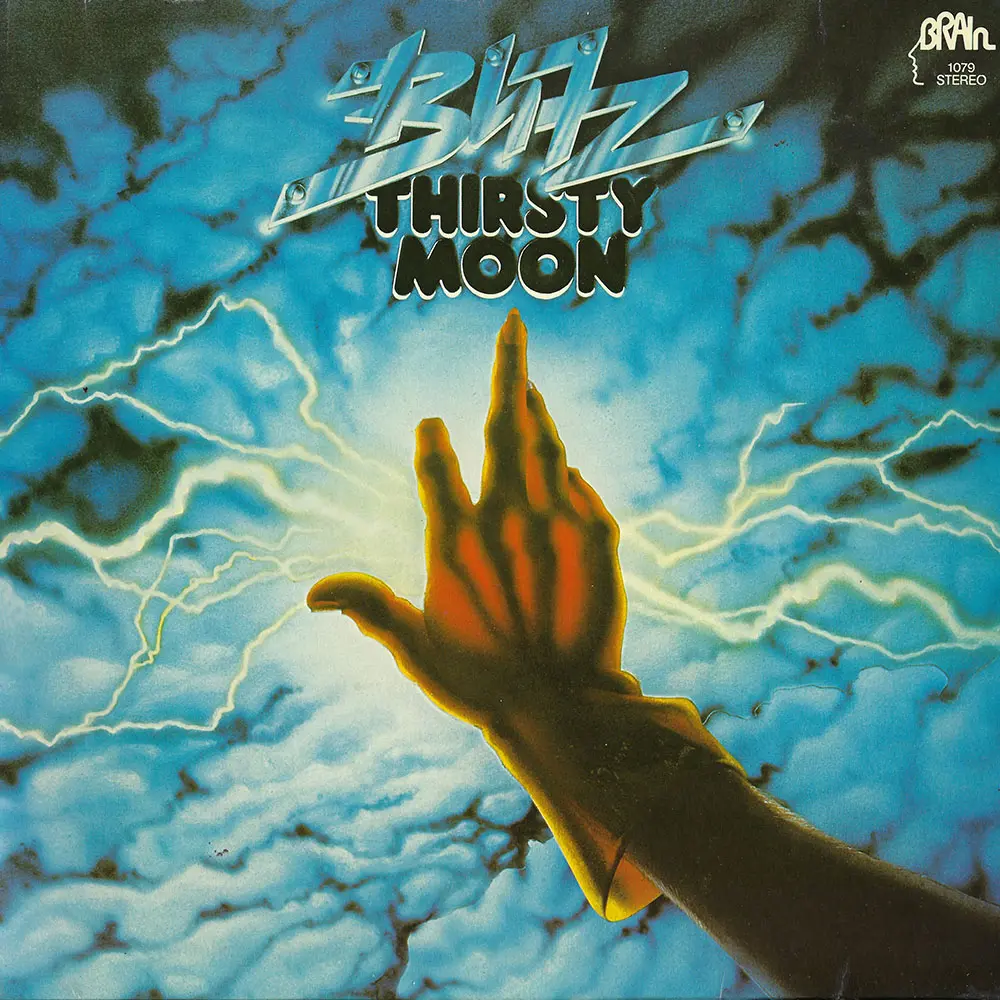 Thirsty Moon released their third album, Blitz, in 1975 on Brain.
The album presents the Drogies as an instrumental duo with Jürgen on guitar and keyboards and Norbert as a one-man rhythm section. They intended to call their new project Blitz but Brain (which resigned them only after they assembled a new band) applied the Thirsty Moon name.
Blitz contains nine Jürgen originals, which blend elements of space rock, jazz-funk, and library music.
A1. “Lord of Lightning” (3:40) contains the phrase “Are you ready for me?” sung backwards and played in reverse. Jurgen borrowed the phrase from Tina Turner, who greeted her audience with those words during a performance at Bremen’s City Hall.
A2. “Riding in the Rain” (3:11)
A3. “Magic Moon” (4:37)
A4. “It Was Love” (3:13)
A5. “Speak for Yourself” (2:50)
B1. “Südwind” (3:47)
B2. “Rainbow” (5:06)
B3. “The Jungle of Your Mind” (7:24)
B4. “Crickets don’t Cry” (5:11)
The Drogies self-produced Blitz on 8-track at the Bremen studio of Rolf Simson, a onetime Schlager singer. Gil’s art depicts a gloved hand conducting thunder with the bones illuminated through the rubber.
In Australia, Blitz appeared on Clear Light of Jupiter, the label of Cybotron mastermind Steve Maxwell Von Braund.
An outtake from the sessions, “Clouds,” appears on the 2006 Blitz reissue by French archivists Long Hair.
A Real Good Time
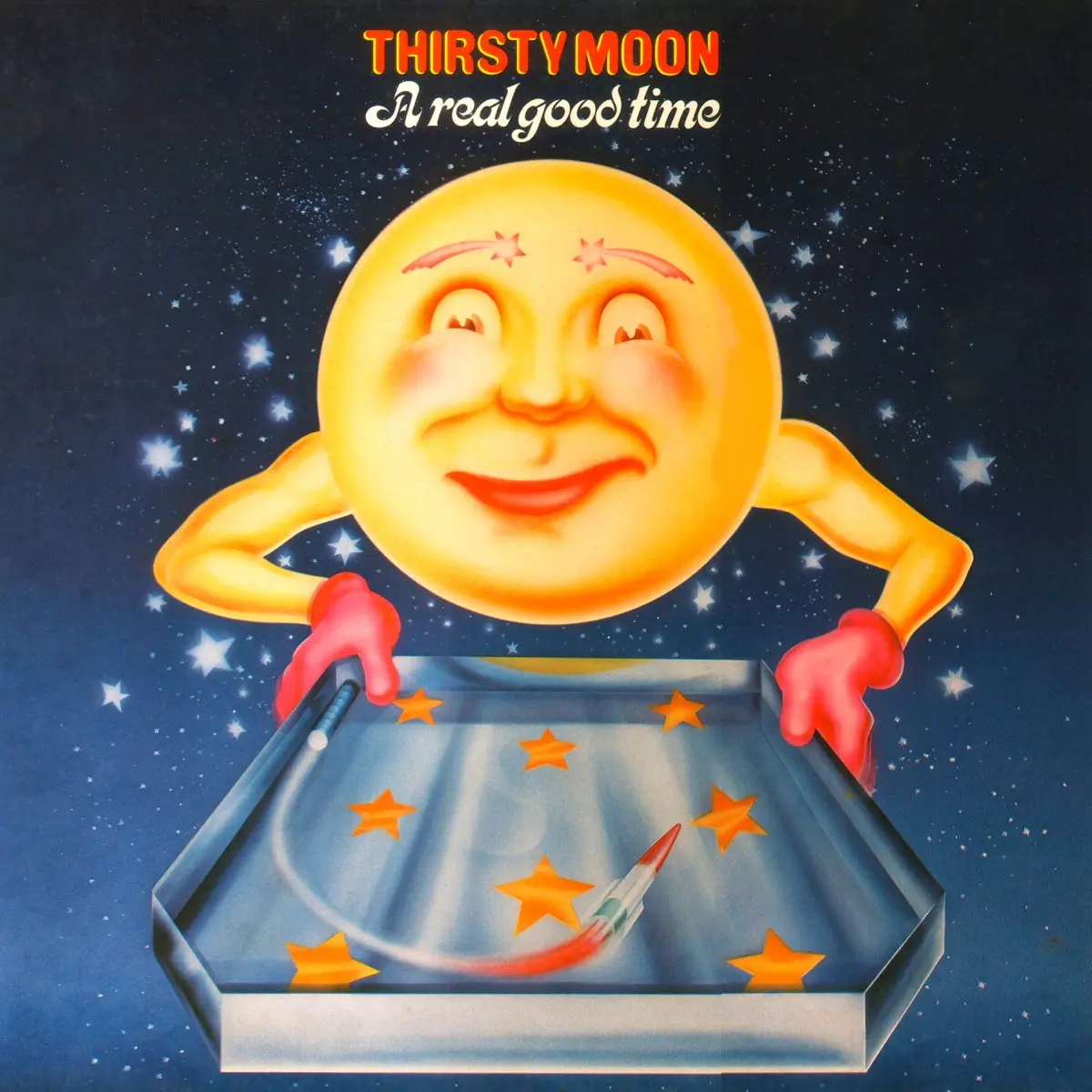 Thirsty Moon released their fourth album, A Real Good Time, in 1976 on Brain.
The album presents a new quintet led by the Drogies brothers — Jürgen (guitar, synthesizer) and Norbert (bass, percussion) — drummer Junior Weerasinghe, saxist/clarinetist Rainer Neumann, and keyboardist Serge Weber, who plays electric piano, clavinet, and synthesizer.
A Real Good Time contains ten Jürgen originals. Weber wrote “Sundance,” one of two songs (along with “Candles”) with backing vocals by one Sigrid Muth.
A1. “The End of the Tv-Programme” (0:57)
A2. “On a Saturday Night” (3:41)
A3. “A Real Good Time” (3:32)
A4. “Talk of the Town” (2:41)
A5. “Candles” (3:49)
A6. “Cloudy Sky” (5:38)
B1. “Sundance” (3:25)
B2. “Burn it Down” (3:48)
B3. “Distant Stars” (3:52)
B4. “Song for Sandy” (5:46)
B5. “Dreaming” (6:33)
Sessions occurred in Bremen at Studio Boccaccio, where the Drogies co-produced A Real Good Time, which Norbert co-engineered with Rolf Simson.
The cover shows a sentient moon that looks in befuddlement at a rocket game within a case of glass.
In 1977, Thirsty Moon released a non-album Boccaccio label single: “I’ll Sing Your Song” backed with “Caught,” both Jürgen-penned live numbers performed with Weerasinghe and keyboardist Uli Harmssen at the Gulfhaus, Vechta. The single came with an eight-page info insert.
Starchaser
 Thirsty Moon released their fifth and final album, Starchaser, in 1981 on Sky.
The Drogies brothers retained Good Time drummer Junior Weerasinghe and summoned original singer Hans-Werner Ranwig for Starchaser, which features violin and backing vocals by Wolfgang Roloff, a onetime schlager singer.
Starchaser contains six Drogies originals, including two songs over the ten-minute mark.
A1. “Lovers on the Run” (5:57)
A2. “Who’s Gonna Save the World” (10:45)
A3. “The Seals” (4:50)
B1. “Do You Believe In Flying Saucers?” (11:00)
B2. “Road to Freedom” (6:43)
B3. “Starchaser” (2:52)
Sessions occurred at Roloff’s Studio-Nord-Bremen, where Wolfgang and the Drogies co-produced Starchaser.
Discography:
- Thirsty Moon (1972)
- You’ll Never Come Back (1973)
- Blitz (1975)
- A Real Good Time (1976)
- “I’ll Sing Your Song” / “Caught” (1977)
- Starchaser (1981)
Sources:
- Discogs: Thirsty Moon
- ProgArchives: Thirsty Moon
- MusicBrainz: Thirsty Moon
- Zaragon: Albums from Germany
Artist/Album Pages:
Mingo Lewis is an American percussionist from N.Y.C. who briefly played with Santana and Return to...
Fermáta are a Slovak jazz-rock band that released seven albums between 1975 and 1984 on Opus Recor...
Antônio Carlos Jobim (Jan. 25, 1927 — Dec. 8, 1994) was a Brazilian composer, pianist, guitarist, ...
Daryl Hall is an American vocalist, musician, songwriter, and producer from Philadelphia who rose ...
Mother Goose was a New Zealander art-rock band behind the 1977–79 Mushroom albums Stuffed and Don'...
Le Match was a Québécois symphonic-folk quintet from Laval that released the singular album Légend...
FM was a Canadian symphonic|space-rock band that released three albums between 1977 and 1980 on Pa...
Crawler was an English/American hard-rock band that evolved from Back Street Crawler after the dea...
Augustus Pablo (June 21, 1954 — May 18, 1999) was a Jamaican dub/reggae melodica player, keyboardi...
John Abercrombie (Dec. 16, 1944 — Aug. 22, 2017) was an American jazz guitarist who played in the ...
Didier Bocquet is a French electronic musician who released the 1977 album Eclipse on Le Kiosque D...
Flying Island was an American jazz-rock band that released two albums in 1975 and 1976 on Vanguard...