

The Muffins were an American jazz-rock band that released two proper albums: the Canterbury-style Manna / Mirage (1978) and the No Wave-inspired 185, both on the avant-garde DC label Random Radar Records. Tracks from their earlier incarnation (circa 1975–76) later surfaced on the Cuneiform CD Chronometers.
They backed Fred Frith on his 1980 Ralph Records release Gravity. Multi-reedist Tom Scott teamed with RRR partner (and subsequent Cuneiform founder) Steven Feigenbaum on the duo album Things Are More Like They Are Now Than They Ever Were Before. Drummer Paul Sears later surfaced in Chainsaw Jazz.
Members: David Newhouse (piano, organ, baritone saxophone, tenor saxophone, bass clarinet, percussion), Billy Swann (bass, guitar, percussion, vocals), Michael Zentner (guitar, violin, 1973-76), Tom Scott (alto saxophone, soprano saxophone, alto clarinet, soprano clarinet, oboe, bassoon, cantor, trumpet, flute, percussion, keyboards, 1974-present), Stuart Abramowitz (drums, 1975-76), Paul Sears (drums, percussion, guitar, trombone, 1976-present)
Background
The Muffins arose from jam sessions between three DC-area musicians: bassist Billy Swann, guitarist–violinist Michael Zentner, and saxophonist–keyboardist Dave Newhouse. They bonded over a shared love for English jazz-rock of the Canterbury school (Soft Machine, Caravan, Egg, Gong, Matching Mole) and rehearsed at Buba Flirf, their communal farmhouse in Gaithersburg, Maryland. After some months as a nameless trio, a friend walked in with a tray and said “The muffins are here!”
In 1974, The Muffins welcomed Tom Scott*, a multi-reedist with a background in classical and big-band jazz who shared the band’s Canterbury fixation. They filtered through multiple drummers before Stewart Abramowitz joined as a fifth member. (*Not the jazz-funk saxophonist and theme composer from Los Angeles who led L.A. Express.)
In November 1975, they entered Paragon Studios in Silver Spring, Maryland, and recorded twenty Newhouse compositions (many under two minutes) on half-track stereo tape. Another round of sessions occurred in May–June 1976 at Buba Flirf, where they recorded Dave’s “Chronometers,” a 23-minute suite. Soon after, Abramowitz and Zentner left the band, which continued as a bass|reed trio with shared percussion roles until the late 1976 arrival of drummer Paul Sears, whose adventurous style galvanized The Muffins.
In 1977, they co-founded Random Radar Records, a DC-area record label operated between multiple parties, including Steven Feigenbaum, a local enthusiast of international avant-garde music. The Muffins made their vinyl debut with “Peacocks, Leopards, and Glass,” a Paragon cut included on Radar’s inaugural release, A Random Sampler (RRR 666), which also features tracks by Feigenbaum (“Borrowed Inspiration,” “Enharmonic Toads”) and Scott’s side project Logproof (“Monster Comes to the City”), plus contributions by fellow DC outsiders Mars Everywhere, English saxophonist Lol Coxhill (ex-Delivery), and guitarist Fred Frith, a co-founder of Henry Cow, the musical forefather of RRR’s output.
Manna / Mirage
 The Muffins released their debut album, Manna / Mirage, in 1978 on Random Radar Records.
The album combines Canterbury-style jazz-rock with avant-garde improvisation and extended ensemble passages that align them with the British RIO school. Its four tracks alternate between composed sections of intricate counterpoint and open, exploratory stretches marked by shifting meters and instrumental layering.
The Muffins comprised Dave Newhouse (piano, organ, piccolo flute, alto and baritone saxophones, bass clarinet, whistle, percussion), Tom Scott (piccolo and concert flutes, soprano and alto saxophones, clarinet, oboe, recorder, percussion), Billy Swann (bass, piano, guitar, percussion), and Paul Sears (drums, vibraphone, xylophone, gong, percussion). Guest players include trombonist Doug Elliot, trumpeters Larry Elliot and Greg Yaskovich, and guitarist Steve Feigenbaum.
Keyboardist and reedist Dave Newhouse wrote three of the four tracks and co-wrote “Amelia Earhart” with drummer Paul Sears.
“Monkey With the Golden Eyes” introduces the album with an impressionist tone poem built on layered flute and oboe voicings over electric piano and vibraphone. “Hobart Got Burned” moves from fractured percussion and atonal horn bursts to a pulsating midsection with chromatic phrasing and complex ensemble exchanges. The fifteen-minute “Amelia Earhart” opens with light percussion and distant winds before pivoting into a bright, rhythmically shifting progression led by bass and saxophone, then expands into contrasting segments of collective improvisation and subdued ambience. Side two is devoted to “The Adventures of Captain Boomerang (For Mike Forrester),” a twenty-three-minute suite that alternates between jazz-rock motifs, abstract textures, and extended instrumental dialogues, culminating in a dense, spontaneous ensemble passage.
A1. “Monkey With the Golden Eyes” (3:50)
A2. “Hobart Got Burned” (6:10)
A3. “Amelia Earhart” (15:40)
B1. “The Adventures of Captain Boomerang (For Mike Forrester)” (23:00)
Sessions occurred at Catch-A-Buzz Studios with The Muffins arranging and mixing, engineered by Colleen Scott and Tom Scott, and mastered by Pete Helffrich.
Manna / Mirage features front-cover sculpture by Lynn Pruitt and back-cover sculpture by Ellen Vincent, photographed by Steve Abramovitz and Shawn Pruitt.
The album established The Muffins as a leading American exponent of Canterbury-influenced experimental jazz-rock and served as a precedent for later U.S. avant-prog groups such as However, Rascal Reporters, and French TV.
Air Fiction (live, 1979)
Air – Fiction is a self-released LP from 1979, pressed in roughly 1,000 copies and distributed at gigs or by mail order.
Side A features studio recordings, often highly improvised, with bass, drums, sax, flute, and keys trading roles in loosely structured passages that flirt with Free Jazz and R.I.O.-style unpredictability. Some moments hint at the compositional density of the debut, but the overall approach leans toward dissonance, experimentation, and spontaneous interplay.
Side B captures a live performance at Psychedelly in Bethesda, Maryland, on March 3, 1979, presenting extended, abstract renditions of prior material in a minimalistic, freeform manner, emphasizing texture and interaction over conventional structure. The release functions as a document of the band exploring extreme improvisation and open-ended sonic freedom.
185
 The Muffins released their second proper album, 185, in 1981 on Random Radar Records.
The album marked a sharp turn from the Canterbury-influenced chamber fusion of Manna / Mirage toward the harsher, angular aesthetic of the Rock in Opposition movement. Its material merges improvisation, jazz-punk urgency, and textural collage in a manner comparable to Fred Frith’s contemporaneous work with Massacre and the New York downtown scene.
The Muffins consisted of Dave Newhouse (piano, organ, alto and soprano saxophones, baritone saxophone, clarinets), Tom Scott (alto and soprano saxophones, flute, bass clarinet), Billy Swann (guitar, bass, tenor saxophone, noises), and Paul Sears (drums, percussion, saxophone, vocal noise). They were joined by guitarist–violinist Fred Frith, who produced the sessions and contributed to five tracks, and clarinetist Dave Golub, who appeared on three.
Keyboardist and reedist Dave Newhouse wrote five of the album’s ten pieces; bassist and guitarist Billy Swann composed one, and saxophonist Tom Scott contributed one. Three tracks were credited collectively to the band, including two short improvised interludes.
“Angle Dance” opens the set with serrated ensemble interplay driven by fractured rhythms and darting reed exchanges. “Antidote to Drydock” and “Zoom Resume” expand on this density with overlapping wind figures and guitar stabs from Frith. “Horsebones” unfolds as a compact piece of percussive noise and vocal shouts, while “Subduction” bridges the two sides with a brief, turbulent statement. Side two intensifies the contrast between structure and spontaneity: “Dreambeat” layers minimalist percussion and processed winds; “Under Dali’s Wing” drifts through oblique textures and tonal swells; “These Castle Children” builds from a cyclical bass pattern to an explosive reed-driven finale. “Queenside” features fuzz bass and rhythmic accents bordering on heavy rock, and the closing “Street Dogs” ends the sequence in terse, chaotic fashion.
A1. “Angle Dance” (4:12)
A2. “Antidote to Drydock” (4:55)
A3. “Zoom Resume” (7:15)
A4. “Horsebones” (2:25)
A5. “Subduction” (1:00)
B1. “Dreambeat” (3:30)
B2. “Under Dali’s Wing” (3:07)
B3. “These Castle Children” (7:40)
B4. “Queenside” (5:37)
B5. “Street Dogs” (1:10)
Sessions occurred from September 24 to 28, 1980, at Track Recorders in Silver Spring, Maryland, with Fred Frith producing and Bill McCullough engineering.
185 features cover design by Jym Slavin.
Initially released in a small pressing, 185 later appeared in a 1996 Cuneiform reissue containing both the original Frith-mixed version and a band-supervised remix closer to their live sound. The album’s aggressive textures and improvisational framework positioned The Muffins as an American counterpart to Henry Cow and a key precursor to later U.S. RIO acts such as Thinking Plague.
Open City (outtakes)
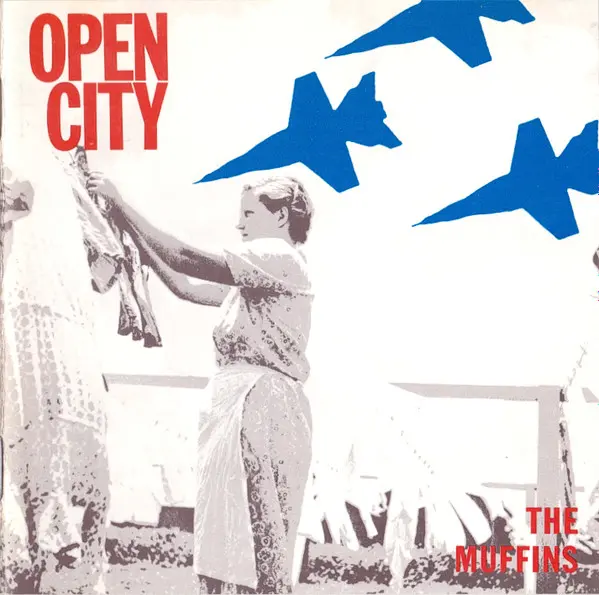 In 1985, Cuneiform Records issued Open City, an eight-track LP of Muffins studio outtakes and live numbers; reissued in 1994 with six additional cuts.
The compilation charts the group’s stylistic range from Canterbury-inspired ensemble work to the abrasive, improvisatory sound that linked them to the Rock in Opposition circle. The material alternates between intricate written pieces and spontaneous passages of rhythmic tension, balancing chamber-like wind arrangements with moments of dense, electric drive.
The Muffins consisted of Dave Newhouse (piano, organ, baritone, alto and soprano saxophones, bass clarinet, percussion), Tom Scott (flutes, oboe, clarinets, alto and soprano saxophones, percussion), Billy Swann (electric bass, guitar, percussion, vocals), and Paul Sears (drums, percussion). Guests include guitarist–pianist Fred Frith, who plays on “Vanity, Vanity” and “Dancing in Sunrise, Switzerland,” and Aksak Maboul alto saxophonist Mark Hollander on “Vanity, Vanity.”
Keyboardist and reedist Dave Newhouse wrote eight tracks and co-wrote two with the band. Swann contributed one piece, and Tom Scott wrote one. Frith composed two, while three group improvisations close the set.
“Queenside” opens with distorted bass and percussive piano accents that lead into overlapping horn figures and shouted lines. “Hobart Got Burned,” originally from Manna / Mirage, appears in a rawer, more compact take with sharper instrumental phrasing. “Antidote to Drydock,” “Zoom Resume,” and “Horsebones” display the quartet’s command of shifting time and tonal contrast, while “Boxed & Crossed” alternates vocal chants and angular instrumental breaks. Frith’s two tracks—“Vanity, Vanity” and “Dancing in Sunrise, Switzerland”—introduce a wiry, post-punk energy that foreshadows his Gravity period. Early material such as “Blind Arch,” “In the Red,” and “Not Alone” stretches into freer, jazz-oriented forms with extended improvisation and subtle electric piano undercurrents.
1. “Queenside” (5:19)
2. “Hobart Got Burned” (2:40)
3. “Horsebones” (2:40)
4. “Antidote to Drydock” (5:06)
5. “Zoom Resume” (1:28)
6. “Boxed & Crossed” (5:38)
7. “Under Dali’s Wing” (3:17)
8. “Vanity, Vanity” (2:47)
9. “Dancing In Sunrise, Switzerland” (3:11)
10. “Blind Arch” (8:51)
11. “Expected Freedom” (2:21)
12. “In the Red” (5:08)
13. “Not Alone” (13:38)
14. “Open City” (0:52)
Tracks 1–7 were recorded live to tape on February 21, 1980, at the band’s Maryland rehearsal space. “Vanity, Vanity” and “Dancing in Sunrise, Switzerland” were cut between November 1979 and January 1980 at Catch-A-Buzz and Sunrise Studios with Fred Frith. “Blind Arch” was taped live on June 4, 1977, and “Expected Freedom,” “In the Red,” “Not Alone,” and “Open City” were recorded at Sounds Reasonable Studios between March and June 1977. Steven Feigenbaum and Tom Scott mixed the material to stereo at Black Pond Studios.
Open City features cover design by Saro Dedayan and photography by Shawn Pruitt.
The album’s expanded 1994 edition was remastered by Kit Watkins and Steven Feigenbaum at Linden Oaks Studios and SAE Mastering. It documents The Muffins’ transitional phase between the Manna / Mirage and 185 sessions and preserves their close creative link to Fred Frith’s Gravity ensemble work.
Chronometers (archival)
 In 1993, Cuneiform issued Chronometers, a 72-minute archival disc of The Muffins’ 1975/76 pre-album material.
The lineup comprised reedist Tom Scott (clarinet, alto clarinet, flute, soprano saxophone, alto saxophone, oboe), keyboardist and saxophonist Dave Newhouse (electric piano, organ, percussion, xylophone), bassist Billy Swann (electric zoom bass, organ, percussion), guitarist and violinist Mike Zentner, and drummer Stuart Abramowitz.
Newhouse composed most of the material, apart from “Chronometers,” a group improvisation, and one track apiece by Swann and Zentner.
The title track, a 23-minute suite recorded at the Muffin House in Gaithersburg, Maryland, blends intricate jazz passages and Canterbury-style interplay with surreal Zappa-like inserts and spoken excerpts from The Wizard of Oz. It segues between rapid thematic exchanges, reed polyphony, angular guitar lines, and ambient chamber stretches. The remaining 20 shorter pieces, tracked earlier at Paragon Studios in Silver Spring, explore quick-turn instrumental sketches and tone-shift vignettes that range from freeform interplay (“Joe Crop on a Toxic Planet”) and humor-laced miniatures (“Three Days That Won’t Soon Fade”) to delicate chamber fragments (“Blind Cave Tetra,” “Evening Hataiya”) and kinetic jazz passages (“Apparently,” “Come What Molten Cloud”).
1. “Chronometers” (23:00) — group improvisation recorded at Muffin House, Gaithersburg, MD, May–June 1976
2. “Come What Molten Cloud” (2:52)
3. “Apparently” (3:31)
4. “Courtesy of Your Focal Interest Span” (0:44)
5. “Please Do Not Open Dr. Fischer” (2:23)
6. “The Manilla Robots” (2:21)
7. “Joe Crop on a Toxic Planet” (5:09)
8. “The Bush” (2:41)
9. “Mammoth Hide” (1:34)
10. “Creature Comforts” (1:29)
11. “Like a Machine That Only Works When It’s Working Right” (1:59)
12. “Look at the Size of That Sponge” (1:45)
13. “Early American Ears” (1:15)
14. “Three Days That Won’t Soon Fade” (2:53)
15. “You Eat Them Pears” (5:05)
16. “Peacocks, Leopards, and Glass” (3:38)
17. “Crezner OK” (3:40)
18. “Blind Cave Tetra” (2:46)
19. “Evening Hataiya” (1:37)
20. “Six Thick Thistle Sticks” (0:31)
21. “L” (1:24)
Sessions took place at Paragon Sound Studios in Silver Spring, MD, and the Muffin House in Gaithersburg. Original recordings were engineered by Dave Newhouse and Brian Rapp. Digital transfers, EQ, and mixdown occurred at Linden Studios, Virginia, in 1991–92 by Kit Watkins and Steven Feigenbaum, with final mastering by SAE Mastering in Phoenix.
The cover features illustrations by Matt Howarth, known for his Post Brothers comics and art for artists on the Cuneiform label.
Chronometers documents The Muffins’ formative stage, merging Canterbury, RIO, and avant-jazz idioms into a fluid prelude to their 1978 debut.
Discography:
- Manna / Mirage (1978)
- Air Fiction (1979)
- 185 (1981)
- Open City (1985)
- Chronometers (1993, recorded 1975–1976)
Sources:
Artist/Album Pages:
Ys was a French folk band that released the 1976 Philips album Madame la Frontière. Members: René...
M was the recording moniker of English musician, singer, and songwriter Robin Scott, who released ...
The Rance Allen Group was an American soul/gospel group from Monroe, Mich., led by singer, guitari...
Einzelgänger — German for "individualist" — was the name used by Italian keyboardist/producer Gior...
Georges Rodi is a French studio musician who released numerous library albums between 1975 and 198...
Ruphus was a Norwegian symphonic/jazz-rock band that released six albums between 1973 and 1979 on ...
Lily (りりィ) — 鎌田小恵子 (Feb. 1952 — Nov. 11, 2016) — was a Japanese singer/songwriter who released ten...
Paul Gaffey is an Australian vocalist who made one album, Mephistopheles, in 1974 on Festival Record...
Blue Motion was a Swiss avant-classical keyboard trio that sprung from the ashes of Circus. They sn...
The Human League are an English synthpop band best known for their 1981 global No. 1 hit "Don't You ...
Madison Dyke was a German symphonic-rock band behind the 1977 album Zeitmaschine on Racket Records...
Roy Haynes (March 13, 1925 — November 12, 2024) was an American jazz drummer and bandleader from ...