

Massacre was an English-American avant-rock/No Wave trio based in NYC that released the album Killing Time on Celluloid in 1981. The band comprised guitarist Fred Frith (Henry Cow, Art Bears, Skeleton Crew), bassist/producer Bill Laswell (Material), and drummer Fred Maher, who subsequently joined Scritti Politti. In 1998, the Material nameplate was resurrected with drummer Charles Hayward (Quiet Sun, This Heat, Camberwell Now, The Hat Shoes) for the album Funny Valentine on John Zorn’s Tzadik label, which issued three live discs by the band in the early 21st century.
Members: Fred Frith (guitar), Bill Laswell (bass), Fred Maher (drums, 1980-81), Charles Hayward (drums, 1998-2003)
Background
Massacre formed in early 1980 when guitarist Fred Frith, recently relocated to New York City following the breakup of Henry Cow, assembled a new trio with bassist Bill Laswell and drummer Fred Maher, both members of the downtown ensemble Material. The occasion was a Valentine’s Day concert by Peter Blegvad at Soundscape, for which Frith volunteered the yet-unnamed group as an opening act. Performing under the name Massacre, the trio debuted as a high-volume power unit with an aggressive improvisational edge.
Killing Time
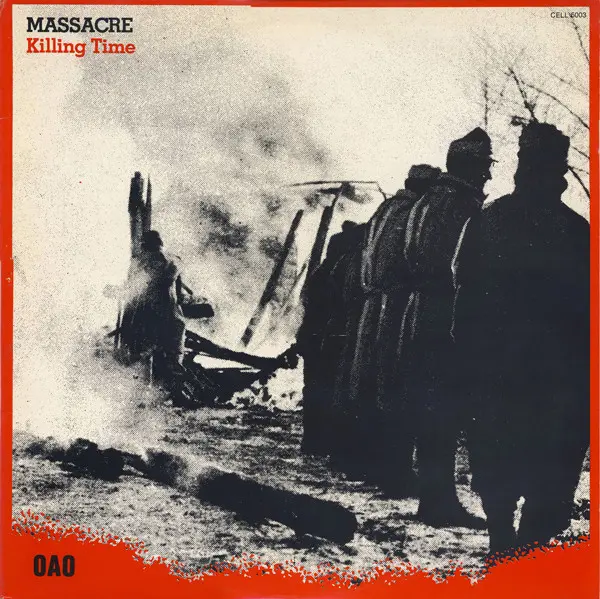 Massacre released their debut album, Killing Time, in September 1981 on Celluloid.
The album compiles live and studio material recorded over a two-month period in 1981 by the American experimental trio of Fred Frith, Bill Laswell, and Fred Maher. It captures the group’s early activities in both the New York avant-garde circuit and the European art-music underground, shortly before their disbandment later that year. Massacre recorded six tracks at Martin Bisi’s OAO Studio in Brooklyn in June and performed the remainder live at 24 rue Dunois in Paris in April.
Killing Time operates on sharp contrasts of restraint and outburst, with each piece built from asymmetrical shapes and precision-detonated interplay. “Legs” serves as a hinge point, where staggered, syncopated bass locks into an offbeat pulse beneath frayed, high-register guitar figures and pointillist percussion—one of the few tracks to suggest an underlying lilt. “Aging With Dignity” threads intricate motifs through clipped phrases, fracturing into knotty, midtempo sequences that dissolve as quickly as they assemble.
On the suite “Corridor / Lost Causes / Not the Person We Knew,” each player assumes the foreground in turn: feedback and scrap-metal harmonics give way to subdued, slow-curl bass and precise, ricocheting drumwork. “Bones” and “Tourism” operate in sparse formation, driven by dry-tone riff cells and halting breaks, while “Know” and “Third Street” strip the rhythm section back to shadowy thumps and bent-string shrieks. “Surfing” turns elastic with elastic bass and brushed cymbals underpinning bleating trumpet from Laswell, while “As Is” stretches over seven minutes of episodic drift, grounded by circular low-end pacing and scattered debris from Frith’s effects rack. Even in moments of calm (“After,” “Carrying,” “Gate”), tension clings to the air, each gesture angular and momentary.
Throughout, the trio resists climax in favor of relentless excavation, with Frith’s guitar sounding less like a melodic instrument than a conduit for shaped electricity. Frith, Laswell, and Maher co-composed and/or improvised everything.
A1. “Legs” (2:04) – OAO Studio, June 1981
A2. “Aging with Dignity” (3:06) – OAO Studio, June 1981
A3. “Subway Heart” (2:45) – Live at 24 Rue Dunois, April 1981
A4. “Killing Time” (2:54) – OAO Studio, June 1981
A5. “Corridor” (1:58) – Live at 24 Rue Dunois, April 1981
A6. “Lost Causes” (3:15) – Live at 24 Rue Dunois, April 1981
A7. “Not the Person We Knew” (3:17) – Live at 24 Rue Dunois, April 1981
B1. “Bones” (1:41) – OAO Studio, June 1981
B2. “Tourism” (4:12) – Live at 24 Rue Dunois, April 1981
B3. “Surfing” (1:15) – OAO Studio, June 1981
B4. “As Is” (8:06) – Live at 24 Rue Dunois, April 1981
B5. “After” (5:01) – Live at 24 Rue Dunois, April 1981
B6. “Gate” (2:38) – OAO Studio, June 1981
Sessions took place in April 1981 at 24 rue Dunois, Paris, and in June 1981 at OAO Studio, Brooklyn. Fred Frith produced the album. Engineering was handled by Martin Bisi (New York), Jean‑Marc Foussat (Paris), and Greg Curry (additional tape work).
The original LP features photography by Tina Curran and Thi-Linh Le, with sleeve design by Thi-Linh Le and Jan Luss.
Killing Time reappeared as a CD in 1993 on RecRec Music with six bonus tracks, and again in 2005 on Fred Records with eight additional tracks, including a live cover of “F.B.I.” by The Shadows. The Fred version restored the original speed and pitch of the recordings, correcting prior mastering changes. In 2016, RēR Megacorp issued a remastered three-sided double-LP, with the original sequence on sides A and B and all bonus material on side C.
Postlude
Frith used the Massacre lineup for the second half of his 1981 solo album Speechless. The group gave its final performances at Manhattan’s Inroads space during the July 4th weekend of 1981, after which Maher departed and the project disbanded.
In 1983, Frith and Laswell performed with drummer Anton Fier in The Golden Palominos, a collective that briefly acted as a Massacre surrogate. A trio set at Boston’s Two Against One concert in February 1985 featured the three performing Killing Time material under The Golden Palominos name. This lineup also appeared in Tokyo the same year.
Massacre reformed in 1998 with Charles Hayward (ex–This Heat) replacing Maher. The new trio released Funny Valentine (1998), a studio improvisation album, followed by three live sets on John Zorn’s Tzadik label: Meltdown (2001), recorded unedited at Robert Wyatt’s curated Meltdown Festival; Lonely Heart (2007), compiled from 2003 Paris and Denmark recordings; and Love Me Tender (2013), drawn from 1999 and 2008 performances in Europe.
Discography:
- Killing Time (1981)
- Funny Valentine (1998)
- Meltdown (live, 2001)
- Lonely Heart (live, 2007)
- Love Me Tender (live, 2013)
Sources:
Artist/Album Pages:
Abus Dangereux was a French jazz-rock band that released three studio albums and a live disc on as...
The Jazz Passengers are an American avant-jazz band from NYC that emerged with the 1987/88 albums...
Teruo Nakamura — 中村照夫 (born March 3, 1942) — is a Japanese jazz bassist behind the 1973 Three Blin...
The Resurrection Band was an American Christian hard-rock unit that self-released two cassette alb...
The Members were an English punk-pop/reggae band that debuted with the track "Fear of the Streets"...
Nightwinds were a Canadian symphonic-rock band from Ontario that recorded an album's worth of mat...
John Entwistle (1944–2002) was an English rock bassist and songwriter, known as "the quiet one" in...
Hugh Hopper (April 29, 1945 — June 7, 2009) was an English bassist from Whitstable, Kent, that gai...
The Glaxo Babies were an English post-punk/dub band from Bristol cut the 1979 EP This Is Your Lif...
Pražský Výběr was a Czech art-rock band, formed in 1976 by keyboardist Michael Kocáb, who led thei...
Fingerprintz was a Scottish new wave band signed to Virgin Records. Between 1979 and 1981, they re...
Makoto Matsushita — 松下誠 (born Nov. 16, 1955) — is a Japanese city pop guitarist and composer behin...