

Patrick Moraz is a Swiss keyboardist and composer who emerged in the post-psych act Mainhorse, which issued a 1971 album on Polydor. He then teamed with the rhythm section of The Nice in the super-trio Refugee, which issued a self-titled album on Charisma in 1974. Months later, Yes hired him as Rick Wakeman‘s replacement for their 1974 album Relayer.
While still a member of Yes, Moraz debuted as a solo artist with the 1976 Atlantic release The Story of i. By 1977, they parted ways and he released his second solo album Out in the Sun. He’s since released more than 15 albums, including two with drummer Bill Bruford. In 1978, he began a 13-year stint in the Moody Blues, replacing the band’s original keyboardist Mike Pinder.
Background
He was born Patrick Philippe Moraz on a plane en route to Morges, Switzerland, on June 24, 1948. His father once worked for Polish pianist and composer Ignacy Jan Paderewski. As a child, Moraz played the violin, piano, and percussion. He studied jazz and classical music till age 13, when a skating accident left him with four broken fingers. Through concentration and practice, he regained his skills and became ambidextrous.
At sixteen, Moraz became the youngest player to win the Best Soloist award at the Zurich jazz festival. He continued to win awards at the festival as a soloist and jazz-band player for the next five years. In 1964, he spent time at the Portlligat home of Salvador Dalí, where he performed for guests. At seventeen, Moraz apprenticed under French-Italian jazz violinist Stéphane Grappelli and performed in several African nations. When his jazz band triumphed at the 1965 Zurich jazz festival, they were invited on a European tour with American saxophonist John Coltrane.
Mainhorse, Refugee, Yes
In 1969, Moraz settled in England, having overcome previous opposition from the UK musician’s union. Looking to form an organ-psych combo, he enlisted bassist/singer Jean Ristori, drummer Bryson Graham, and singer/guitarist Peter Lockett. As Mainhorse, they released a self-titled album on Polydor in 1971, followed by a standalone single for the French drama film La Salamandre.
After Mainhorse split, Moraz toured Japan and Hong Kong as the musical director of a Brazilian ballet. He then composed soundtrack music for the 1973 Swiss comedy The Invitation and the 1974 French romantic-drama The Middle of the World.
In late 1973, Moraz got a call from bassist/singer Lee Jackson, formerly of The Nice and the recently disbanded Jackson Heights. He wished to reform The Nice with Moraz in lieu of keyboardist Keith Emerson, who was now occupied in the mega-successful Emerson, Lake & Palmer. With Nice drummer Brian Davison, they formed Refugee and recorded a self-titled album in February 1974. Released on Charisma, it contains three five-minute songs and two multi-movement suites composed almost entirely by Moraz.
Refugee practiced intensively and toured behind the album. However, Moraz got a call that August to join Yes as the replacement for keyboardist Rick Wakeman. Moraz auditioned for the band on equipment left behind by Greek keyboardist Vangelis, who they’d recently summoned for a tryout. Yes did an in-studio rendition of its newly formed piece “Sound Chaser,” then asked Moraz to add a part. On the spot, Moraz came up with a keyboard intro that ended up on the completed album, Relayer, released in late 1974.
Moraz toured as a member of Yes into mid-1975, when the band took a break to let its members record solo albums.
The Story of i
 Patrick Moraz released his debut solo album, The Story of i, in June 1976 on Charisma (UK) and Atlantic (North America).
The album presents a continuous 46-minute suite divided into 14 indexed segments, weaving jazz fusion, Brazilian rhythms, orchestral passages, and layered synthesizer textures into a narrative allegory about desire, ascent, and transcendence. Moraz alternates between rapid-fire keyboard sequences, lush string overlays, and immersive percussive breaks, framing a concept centered on a mythic tower whose climbers meet a fateful end. Side one leans on rhythmic propulsion and melodic interplay, while side two heightens the narrative through cinematic motifs and recurring themes.
Moraz composed the entire work, including French lyrics on “Intermezzo” and English lyrics co-written with John McBurnie. He plays multiple keyboards, marimba, percussion, and alpine horn, and arranged the score with orchestral elements and layered ensemble parts. Vocal duties are shared by McBurnie and Vivienne McAuliffe.
A1. “Impact” (3:28)
A2. “Warmer Hands” (3:31)
A3. “The Storm” (0:53)
A4. “Cachaca (Baiao)” (4:09)
A5. “Intermezzo” (2:49)
A6. “Indoors” (3:44)
A7. “Best Years of Our Lives” (4:01)
B1. “Descent” (1:43)
B2. “Incantation–Procession” (1:52)
B3. “Dancing Now” (4:38)
B4. “Impressions (The Dream)” (2:48)
B5. “Like a Child in Disguise” (4:05)
B6. “Rise and Fall” (5:34)
B7. “Symphony in the Space” (3:01)
Sessions occurred in autumn 1975 at Aquarius Studios in Geneva. Moraz produced the album with engineering by Jean Ristori and Chris Penycate. Additional tracking took place in Rio de Janeiro with Gilson de Freitas’ percussion ensemble, recorded over two days in August 1975.
Moraz is joined by Ray Gomez (guitars), Jeff Berlin (bass), Alphonse Mouzon and Andy Newmark (drums), and multiple percussionists from Brazil including Paulinho Braga, Chico Batera, and Gordinho. Ristori also plays cello and acoustic string bass; Philippe Staehli adds tympani and percussion; René Moraz contributes tap dance and castanets. Orchestral sections and electronic textures were shaped in consultation with synthesizer pioneer Robert Moog.
The Story of i reached No. 132 on the US Billboard 200 and charted at No. 34 on the UK Rock & Metal Albums chart upon its 2019 reissue. Excerpts appeared as background music in the original Hitchhiker’s Guide to the Galaxy radio series. The album’s symbol-based title, originally untypeable, led to the widespread use of its subtitle for reference.
Out in the Sun
 Patrick Moraz released his second solo album, Out in the Sun, in August 1977 on Charisma (UK) and Import (US).
Out in the Sun expands the rhythmic and percussive ideas introduced on The Story of i, incorporating layered Brazilian instrumentation across a looser, more song-oriented structure. Moraz interlaces electric piano, synthesizer, and vibraphone lines with congas, surdo, and field-recorded elements from Rio de Janeiro. Vocal sections alternate between high-energy passages and lyrical interludes, while the four-part closing suite integrates themes Moraz first developed for an unused Yes arrangement.
Moraz composed all music and arranged the material. He co-wrote lyrics with John McBurnie, who sings six tracks; François Zmirou contributes to one, and Vivienne McAuliffe appears on backing vocals. Ray Gomez plays guitar and mandolin. Bass parts are split between Wornell Jones, Jean Ristori, and Isla Eckinger; Andy Newmark returns on drums.
A1. “Out in the Sun” (4:25) — written by Moraz and McBurnie
A2. “Rana Batucada” (5:30)
A3. “Nervous Breakdown” (3:20) — written by Moraz and McBurnie
A4. “Silver Screen” (4:28) — written by Moraz and McBurnie
B1. “Tentacles” (3:31) — written by Moraz and McBurnie
B2. “Kabala” (4:55)
B3. “Love-Hate-Sun-Rain-You” (4:48) — written by Moraz and Zmirou
B4. “Time for a Change” (9:00)
a. “Time to Fly”
b. “Big Bands of Ancient Temples”
c. “Serenade”
d. “Back to Nature” — final section co-written with McBurnie
Sessions took place during February and March 1977 at Phonogram Studios in Rio de Janeiro and Aquarius Studios in Geneva. Moraz produced the album with Jean Ristori, who also engineered and played bass on “Kabala.” Phillipe Staehli plays timpani on “Time for a Change.” Percussionists from Rio de Janeiro, led by Gilson de Freitas, perform on “Rana Batucada,” with Testa Chacal featured on “Kabala.” Mastering was done by Ray Staff at Trident.
Out in the Sun reached No. 44 on the UK Albums Chart. Its finale, “Time for a Change,” incorporates melodic material Moraz initially conceived as an overture for the Yes composition “Awaken.”
Patrick Moraz
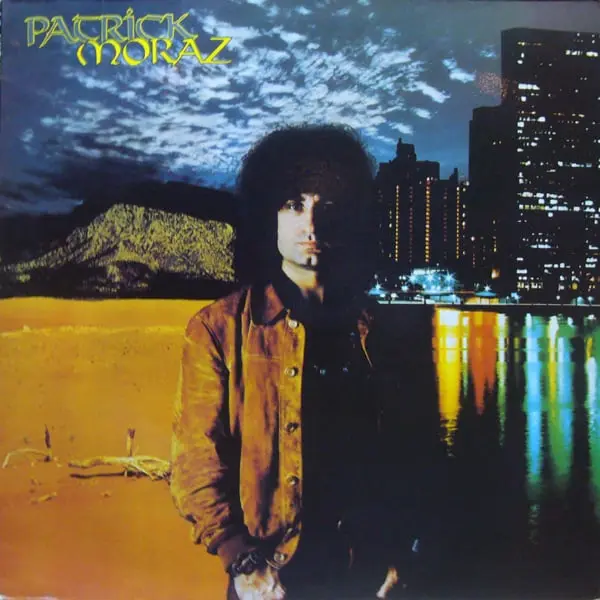 Patrick Moraz released his self-titled third solo album in 1978 on Charisma.
The album continues Moraz’s integration of Brazilian rhythmic concepts with layered keyboard arrangements, this time structured around the contrast and convergence between primitive (acoustic) and modern (electronic) musical cultures. The three-part suite “The Conflict” traces a rising arc of tension and resolution with clustered sequences and percussion-heavy interludes. Side two opens with the vocoder-treated “Primitivisation,” followed by shorter vocal and instrumental pieces that blend tone-bending synthesizers with lyrical piano figures and Afro-Brazilian textures.
Moraz composed all music and lyrics, arranged all sections, and played a wide range of instruments including grand piano, vibraphone, marimbas, harpsichord, Yamaha CP-70, Minimoog, Polymoog, Oberheim, ARP Pro Soloist, Micromoog, Mellotron, vocoder, and custom electronics. He also produced the album and performs vocals on select tracks. Joy Yates sings lead on “Keep the Children Alive.”
A1. “Jungles of the World” (5:56)
a. “Green Sun”
b. “Tribal Call”
c. “Communion”
A2. “Temples of Joy” (6:07)
a. “Opening of the Gates”
b. “Overture”
c. “The Feast”
A3. “The Conflict” (9:35)
a. “Chamada (Argument)”
b. “Opposing Forces”
c. “The Battlefield”
d. “Dissolution”
e. “Victory”
B1. “Primitivisation” (5:24)
B2. “Keep the Children Alive” (3:27) — vocals by Joy Yates
B3. “Intentions” (3:56)
B4. “Realization” (4:17)
Sessions occurred across two continents: tracking took place June 22–24, 1978, at Phonogram Studios in Rio de Janeiro, and resumed in August at Aquarius Studios in Geneva. The album was mixed using an Aphex Aural Exciter, E.M. stereo enlarger, and LSP processor. Jean Ristori and Alan Leeming served as engineers, with additional assistance by Erroll Maibach, Joaõ, and Norman Goodman.
Percussionist Djalma Corrêa contributes cuica, berimbau, reco-recos, apitos, and other indigenous instruments across the album, assisted by The Percussionists of Rio de Janeiro. Tommy Strebel plays snare drum on select passages.
Patrick Moraz was released in a standard single sleeve with artwork and photography by Brian Cooke, Doctor Phildius, and Jesus Moreno.
Future Memories
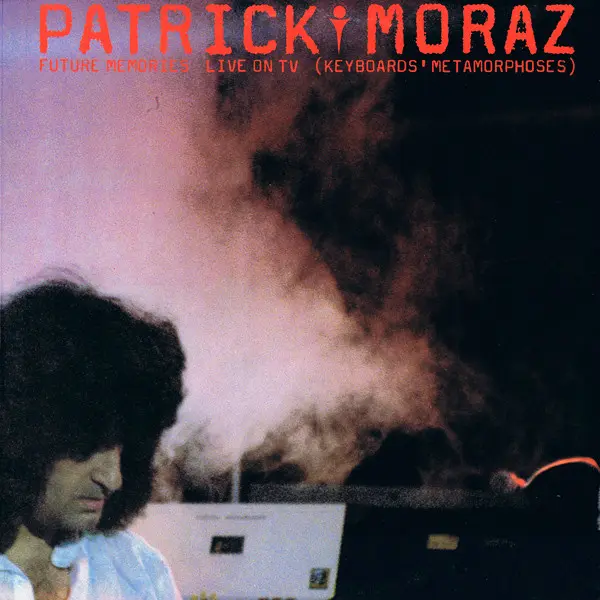 Patrick Moraz released his first live album, Future Memories, in 1979 on Carrère (France). In 1984, PVC Records issued the album in North America as Future Memories Live on TV.
Future Memories captures a solo performance recorded live to tape during a Swiss television broadcast from Aquarius Studios, Geneva, on November 13–14, 1979. The album consists entirely of keyboard-based works composed, performed, and mixed in real time by Moraz using an array of analog synthesizers, sequencers, and piano.
Side one features the extended three-part suite “Metamorphoses,” which layers multi-voiced textures and rhythm modules across a sustained formal arc. Side two shifts to more atmospheric material with “Eastern Sundays,” followed by “Black Silk,” a chromatic piano-driven piece that returns the focus to Moraz’s acoustic phrasing.
Moraz composed, performed, recorded, and produced all material. The performance was engineered and mixed by Jean Ristori and co-produced for broadcast by François Jaquenod, with equipment handled by Erroll Maibach and Pat Buckley.
A1. “Metamorphoses” (18:50)
1st Mov’t (6:21)
2nd Mov’t (4:42)
3rd Mov’t (7:27)
B1. “Eastern Sundays” (8:48)
Part I (4:58)
Part II (3:50)
B2. “Black Silk” (10:13)
Part I (4:08)
Part II (6:05)
The recording was made directly to tape over two days at Aquarius Studios, Geneva, using a live multi-synthesizer setup with no post-production overdubs. The album was issued by Future Memories Music and pressed in France by Disco France. Cover design is credited to JPB and RP, with photography by Monique Delley. The 1984 PVC reissue includes the subtitle Live on TV to clarify its origin.
Coexistence
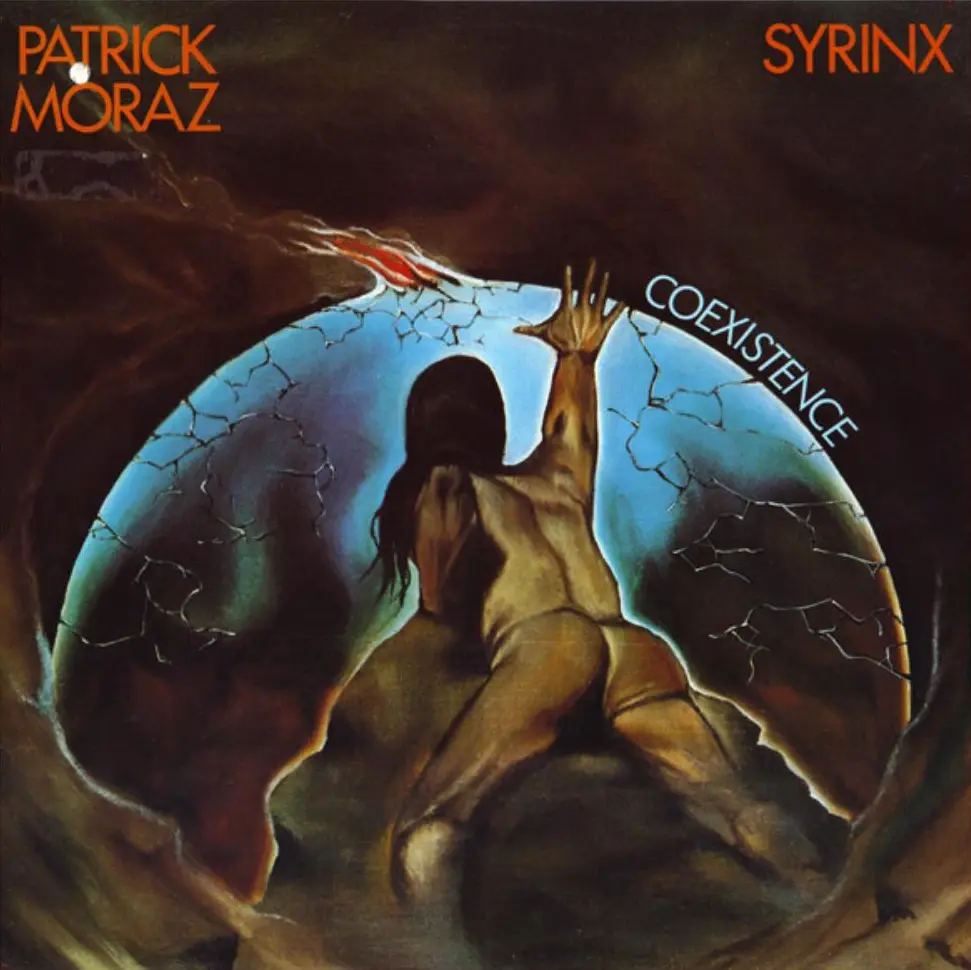 Patrick Moraz teamed with Romanian panpipist Simion Stanciu (aka Syrinx) for Coexistence, released in 1980 on Carrère (France) and Passport (Canada).
The album blends electronic instrumentation with acoustic pan flute melodies across nine compositions that explore tonal contrast, rhythmic interplay, and spatial texture. Side one emphasizes discrete electro-acoustic sketches—ranging from the percussive syncopation of “Mind Your Body” to the solemnity of “Adagio for a Hostage.” Side two presents a four-movement suite titled Coexistence, where sustained synthesizer chords, modal flute themes, and layered percussion evolve through a slow-building dynamic arc.
Moraz composed all five tracks on side one, and co-wrote four pieces with Syrinx for side two. Both artists arranged their respective parts. Moraz performs on keyboards, synthesizers, vocoder, percussion, and electronic drums; Syrinx contributes melodic pan flute parts and co-arranged the suite.
A1. “Mind Your Body” (4:15)
A2. “Boonoonoonoos” (4:10)
A3. “Soundrise” (4:35)
A4. “Adagio for a Hostage” (4:15)
A5. “Freedom to…” (2:45) — co-written with Syrinx
B. Coexistence
a. “Black Gold” (3:45) — co-written with Syrinx
b. “Moments of Love” (4:45) — co-written with Syrinx
c. “Chain Reaction” (6:15) — co-written with Syrinx
d. “Peace on the Hills” (4:22)
Sessions occurred between November 1979 and May 1980 at Aquarius Studios in Geneva. Moraz produced the album with Jean Ristori as chief engineer and Errol Maibach and Norman Goodman assisting. John Wooloff plays guitar on select tracks. Percussion duties are shared by Djalma Corrêa, Eric Albiez, and drummer Richie Morales, who also adds gong.
Coexistence was issued on vinyl by Carrère (France) and Passport (Canada), pressed by Disco France and printed by France Imprimerie Sorel.
Music for Piano and Drums
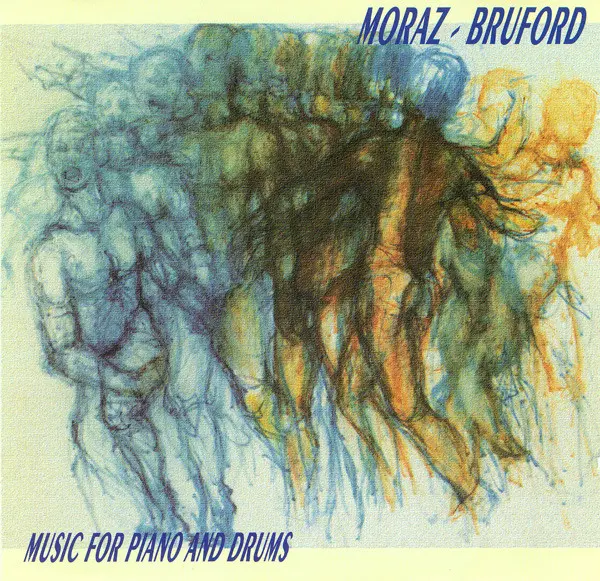 In October 1983, Patrick Moraz recorded Music for Piano and Drums, his first of two collaborative jazz-improv albums with Bill Bruford for E’G.
The album marks the first of two collaborative recordings between Moraz and Bruford, built entirely on acoustic improvisations without overdubs or electronic augmentation. Moraz performs on grand piano while Bruford plays a compact drum kit focused on tonal variation and subtle dynamic control. Each piece explores a distinct mood or thematic premise, ranging from the spiraling counterpoint of “Children’s Concerto” to the loosely structured interplay of “Any Suggestions” and the impressionistic drift of “Hazy.”
Moraz composed five of the eight tracks. Bruford contributed two compositions and co-wrote “Any Suggestions.” Both musicians share production credit.
A1. “Children’s Concerto” (4:53)
A2. “Living Space” (3:52) — written by Bruford
A3. “Any Suggestions” (5:37) — written by Moraz and Bruford
A4. “Eastern Sundays” (6:48)
B1. “Blue Brains” (4:48)
B2. “Symmetry” (3:40)
B3. “Galatèa” (5:24)
B4. “Hazy” (6:22)
The album was recorded at Gallery Studios with engineering by Barry Radman. Lacquers were cut at Trident Studios and pressed by PRS Ltd. Cover painting is by Ralph Augsburger with design and photography by Geoff Halpin and Jon Barraclough. Music for Piano and Drums was marketed by Polydor and issued across Europe and North America on E.G. Records.
Future Memories II
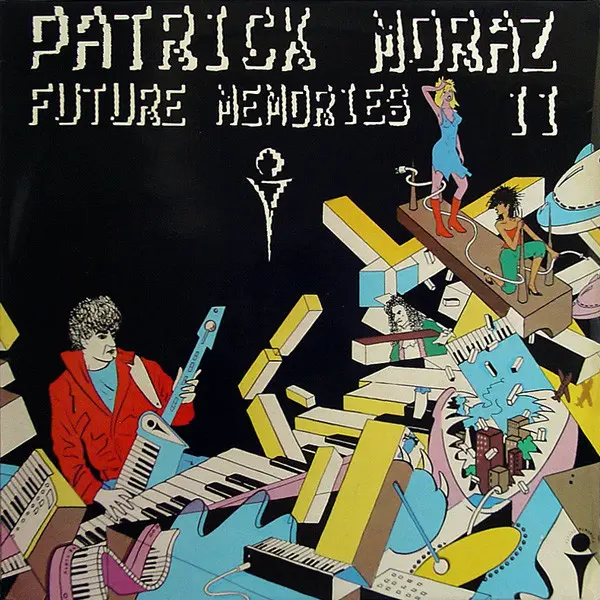 In 1984, the French Carrère label issued Future Memories II, a followup to Patrick’s 1979 release.
Future Memories II consists of eight instant compositions performed live in the studio on electronic keyboards and percussion, presented as a multi-part audiovisual suite. Each track explores a conceptual setting, ranging from the cinematic propulsion of “Heroic Fantasy” to the layered rhythmic sequences of “Pilot’s Games” and the brief ambient close of “After the Year After…” The project was developed as a TV-video co-production with Swiss broadcasters SSR/TVR and visual producer François Jaquenod, continuing the multimedia direction initiated on the first volume.
Moraz composed, arranged, and performed all material using real-time synthesis and sequencing. The sessions took place at Aquarius Studios in Geneva, with multiple engineers contributing to various tracks.
A1. “Heroic Fantasy” (6:54)
A2. “Video Games (How Basic Can You Get)” (4:07) — recorded by Gregg Jackman
A3. “Satellite” (6:39)
A4. “Navigators” (7:18)
B1. “Flippers” (4:17)
B2. “Pilot’s Games” (6:54)
B3. “Chess” (6:19)
B4. “After the Year After…” (2:30) — recorded by Norman Goodman
Production was overseen by Eric Christen. Tracks A1 and A3 through B3 were recorded by Jean Ristori and Barry Radman. Mastering was handled at Sterling Sound in New York City. The album was produced in conjunction with the Mainhorse Establishment and Coex Music SA.
Timecode
 Patrick Moraz released his fourth vocal studio album, Timecode, in 1984 on Lamborghini.
Timecode presents a polished synth-funk sound built around electronic drums, programmed sequences, and layered vocals. Moraz performs all keyboard, synth, and programming parts, anchoring the album’s eight vocal tracks and one instrumental with dense electronic arrangements. Vocalist John McBurnie reappears as lyricist and lead singer on several tracks, while John Avila handles additional lead vocals. Lyn Collins contributes recurring backing vocals, and drummer Gregory Scott Alban appears on three tracks. Bill Bruford plays Simmons drums on “Life in the Underworld.”
Moraz composed all music and co-wrote lyrics on four tracks with McBurnie, while handling all instrumentation, production, and chant vocals.
A1. “No Sleep Tonight (Includes Take Off)” (4:50) — music by Moraz, lyrics by McBurnie; vocals by John Avila
A2. “I Want U” (3:57) — music by Moraz, lyrics by McBurnie
A3. “Beyond the Pleasure” (3:48) — written by Moraz and McBurnie; additional chanting by Gregg Jackman
A4. “Life in the Underworld” (4:13) — music by Moraz, lyrics by McBurnie; additional Simmons drums by Bill Bruford
A5. “Overload” (3:27) — written by Moraz and McBurnie; vocals by John Avila
B1. “Black Brains of Positronic Africa” (5:00) — instrumental
B2. “Elastic Freedom (In Search Of)” (4:14) — music and lyrics by Moraz; lead vocals by Kitty Bruce
B3. “Shakin’ With Passion” (3:59) — music by Moraz, lyrics by McBurnie
B4. “You Are the Vision of My Dream” (4:05) — music and lyrics by Moraz; lead vocals by John Avila
Sessions were split across multiple studios: Aquarius (Geneva), Time Code (Los Angeles), Strawberry, RAK, and Rock City. Barry Radman co-produced, engineered, programmed, and remixed the album alongside Moraz, and also handled final mixes at Aquarius. Greg Calbi mastered the album at Sterling Sound. Photography is by Martyn Goddard, with art direction and design by Shoot That Tiger!
Timecode was published by Zoram Music and Copyright Control, and pressed in the U.S. by Hub-Servall.
Flags
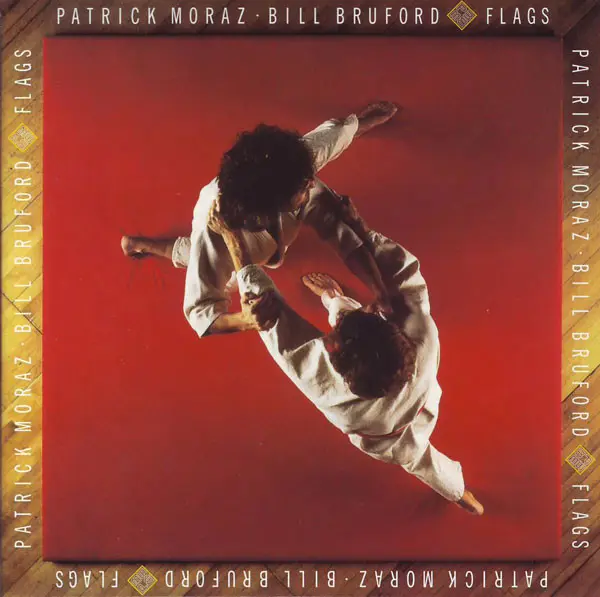 In January 1985, Patrick Moraz and Bill Bruford recorded Flags, their second collaborative album for E’G.
Flags builds on the acoustic interplay of 1983’s Music for Piano and Drums, expanding the palette with the introduction of electronic keyboards and structured composition. Moraz performs on grand piano and synth textures, while Bruford alternates between acoustic kit and electronic percussion. The album balances precision arrangements—such as the title track and the polyrhythmic “Split Seconds”—with freer segments like “Impromptu, Too!” and the sparse solo feature “The Drum Also Waltzes.” “Temples of Joy” reworks a theme first introduced on Moraz’s 1978 solo album, while “Karu” revisits a melody previously embedded in 1984’s Timecode.
All music was composed and arranged by Moraz and Bruford, who also share production credit. Their duet emphasizes interlocking rhythmic phrasing and contrapuntal development across nine concise tracks and one long-form closer.
A1. “Temples of Joy” (4:51)
A2. “Split Seconds” (4:37)
A3. “Karu” (3:45)
A4. “Impromptu, Too!” (3:30)
A5. “Flags” (4:27)
B1. “Machines Programmed by Genes” (5:13)
B2. “The Drum Also Waltzes” (2:51)
B3. “Infra Dig” (3:12)
B4. “A Way With Words” (1:36)
B5. “Everything You’ve Heard Is True” (6:09)
Sessions took place at Aquarius Studios in Geneva with Barry Radman and Jean Ristori as engineers. Radman also mixed the album. Errol Maibach handled technical assistance. The project was issued on LP and cassette by E.G. Records and published by E.G. Music Ltd., with cover design referencing themes of motion and precision.
Discography:
- The Story of i (1976)
- Out in the Sun (1977)
- Patrick Moraz (1978)
- Future Memories (1979)
- Coexistence (1980 • Patrick Moraz & Syrinx)
- Music for Piano and Drums (1983 • Moraz • Bruford)
- Future Memories II (1984)
- Timecode (1984)
- Flags (1985 • Patrick Moraz • Bill Bruford)
- Human Interface (1987)
Sources:
- Discogs: Patrick Moraz
- ProgArchives: Patrick Moraz
- RYM: Patrick Moraz
- MusicBrainz: Patrick Moraz
- 45worlds: Patrick Moraz
Artist/Album Pages:
Casiopea are a Japanese jazz-funk band that averaged two albums per year between 1979 and 1987 on ...
Música Urbana was a Spanish jazz-rock band that released the 1976–78 albums Música Urbana and Iber...
Ashton, Gardner & Dyke were an English organ-rock trio that released a 1969 self-titled album on...
Partner was a Dutch pop-rock quartet that scored a 1977 hit with “Kayuta Hill” and made the 1978–8...
Fuchsia was an English folk-rock band from Exeter, Devon, that released a self-titled album on the P...
Nya Ljudbolaget was a Swedish jazz-rock/folk band behind a 1981 self-titled album on MNW. Member...
Rare Bird was an English organ-rock quartet that released two albums on Charisma in 1969 and 1970, f...
Cressida was an English post-psych band behind the 1970/71 albums Cressida and Asylum on the Vertigo...
Paul Jackson (March 28, 1947 — March 18, 2021) was an American jazz-funk bassist from Oakland, be...
Led Zeppelin was an English rock band, formed in 1968 and active till 1980. Guitarist Jimmy Page for...
Leroy Brown (aka Leroy Turner) is a Jamaican reggae singer, songwriter, and producer who emerged i...
Kim Jung Mi (김정미, born April 23, 1953) is a South Korean singer who recorded seven albums through ...