

Uni Sono was a Finnish jazz-rock supergroup comprised of distinguished players on the Helsinki music scene. The band released a 1975 self-titled album on Hi-Hat.
Members: Paroni Paakkunainen (saxophone, flute, percussion), Olli Ahvenlahti (electric piano, synthesizer), Reino Laine (drums), Mike Koskinen (trumpet, 1973-?), Hasse Walli (guitar, 1973-?), Make Lievonen (bass, 1973-?), Pekka Pohjola (bass, ?-1975), Nono Söderberg (guitar, ?-1975)
Background
Uni Sono (Unison) formed in Helsinki in 1973 when reedist and percussionist Seppo “Paroni” Paakkunainen (saxophone, flute, percussion) assembled keyboardist Olli Ahvenlahti, drummer Reino “Reiska” Laine, trumpeter Mike Koskinen, guitarist Hasse Walli, and bassist Markku “Make” Lievonen.
Paakkunainen studied at the Sibelius Academy during the early sixties. He later played with Tuohi Quartet before he led Karelia in the years before Uni Sono.
Koskinen worked in Finnish soul settings and free-improvisation groups with drummer Edward Vesala. He also played with saxophonist Juhani Aaltonen and pianist Heikki Sarmanto before studies at Berklee College of Music in Boston.
Ahvenlahti had early-seventies studio credits and broadcast credits, including the 1973 Mike Koskinen Orchestra session at Liisankatu Studios.
Laine played in Eero Koivistoinen lineups during the late sixties, then became a regular drummer for Finnish bandleaders including Koivistoinen and Ahvenlahti. He also worked with saxophonist Juhani Aaltonen.
Walli started as a drummer, then passed through The Islanders and The Electric Five. He later worked with The Nameless, The Typhoons, and Jormas before guitar work in Blues Section. A 1969 car accident interrupted his career.
Lievonen led Markku Lievonen Quintet at Pori Jazz with Ahvenlahti, Walli, saxophonist Pekka Untovuori, and drummer Ari Valtonen in the 1972 festival program.
The first Uni Sono lineup toured Poland before Koskinen and Walli left the group. Paakkunainen, Ahvenlahti, Laine, and Lievonen performed as Unisono Quartet at Liisankatu Studios in Helsinki on September 26, 1973. Lievonen also played in Taivaantemppeli later that year with Ahvenlahti, flutist Matti Jakola, guitarist Pekka Rechardt, drummer Upi Sorvali, and percussionist Tapani “Nappi” Ikonen.
Bassist Pekka Pohjola entered Uni Sono after piano and violin studies at the Sibelius Academy, work with The Boys, and a 1970–1974 run in Wigwam. He had also issued the 1972–74 solo albums Pihkasilmä Kaarnakorva and Harakka Bialoipokku.
Guitarist Nono Söderberg entered the 1975 lineup after work with Eero ja Jussi & The Boys and Needles. He also played with Kapteeni Nemo/Nemo before Uni Sono entered its mid-seventies studio period.
Uni Sono
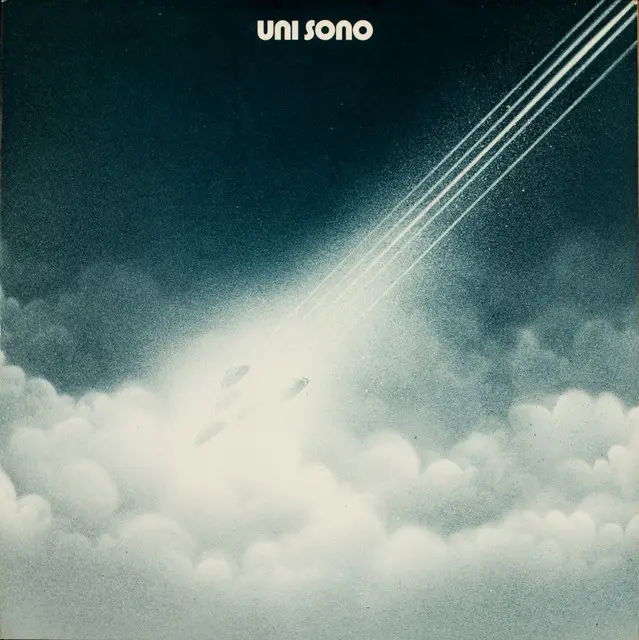 Uni Sono released their self-titled debut album in August 1975 on Hi-Hat.
The album features five instrumental jazz-rock pieces performed by the final quintet of Pohjola, Söderberg, and co-founders Laine, Paakkunainen (flute, alto/soprano saxophone, percussion), and Ahvenlahti (electric piano, grand piano, Moog Satellite, string synthesizer, organ).
“TVL” strides through loose solo turns, short breaks, and quick foreground shifts. “Chorea Urbana” opens with a reed-led line, drops into a low solo break, and settles into a slow keyboard-bass passage. “Boulevard Blues” lingers in a hurriless cadence amid hovering e-piano glow. “Jedi and Rekku” starts with dog barks, then wanders through slow ensemble turns. “Iltatähti” settles into a broken-beat pattern while its lead phrases answer each other across the rhythm section.
A1. “TVL” (6:15) – Laine
A2. “Chorea Urbana” (8:30) – Paakkunainen
A3. “Boulevard Blues” (6:45) – Ahvenlahti
B1. “Jedi and Rekku (Redi Jekku, Pennut)” (11:22) – Paakkunainen
B2. “Iltatähti” [Evening Star] (9:31) – Paakkunainen
Uni Sono recorded Uni Sono in May 1975 at Marcus Music in Stockholm with engineer Leif Mases; Paroni Paakkunainen and Olli Ahvenlahti produced the album. Paakkunainen dedicated “Chorea Urbana” to Matti Kurkinen, the Kalevala guitarist who died at age 24 in a June 1975 car accident.
Jorma Auersalo created the Uni Sono cover art: a blue-black cloud scene crossed by bright diagonal beams.
Postlude
In tandem with Uni Sono, Olli Ahvenlahti launched his bandleader career with the 1975 Love Records release Bandstand, followed in 1976 with The Poet. In 1978, he reunited with Pekka Pohjola in The Group.
Nono Söderberg went solo with the 1976 Hi-Hat release Nono, followed in 1982 with Rare Bird.
Pohjola resumed his solo career with the 1977 Love release Keesojen Lehto, recorded with Mike Oldfield and Sally Oldfield. He released eleven further albums through the 21st century.
Discography:
- Uni Sono (1975)
Sources:
Artist/Album Pages:
Modern Music Band was a Swedish jazz-rock/funk group that made a 1972 self-titled album on Spark R...
Maxine Weldon is an American soul singer who released the 1970/71 albums Right On and Chilly Wind...
Space Circus was a Japanese jazz-rock band behind the 1978/79 RCA albums Funky Caravan and Fantast...
Mother Freedom Band was an American soul-funk band that released the 1977 album Cutting the Chord ...
Gollum was the de facto moniker of a nameless Austrian jazz-rock quintet that first gigged as Posi...
Heavy Joker was a Danish jazz-rock band that released a 1976 self-titled Polydor album and the 197...
Quantum Jump was an English supergroup that fused jazz-funk and space-rock on their 1976–77 albums Q...
Antonello Venditti (born March 8, 1949) is an Italian singer/songwriter who emerged in the duo The...
The Outlaws were an American hard-rock band from Tampa that formed during the late 1960s and reach...
Papete (José de Ribamar Viana, November 8, 1947 – May 26, 2016) was a Brazilian percussionist, sin...
Yes are an English rock band that released twenty-one studio albums between 1969 and 2014. Formed in...
The Fatback Band was an American soul-funk rhythm ensemble from New York City, formed in 1970 by d...