

Kilburn and the High Roads were an English R&B/rock band from London, active for five years prior to their 1975 singular album Handsome, issued on Dawn upon the group’s disbandment. In 1976, singer Ian Dury and saxophonist Davey Payne assembled a new lineup that became the Blockheads. Kilburn guitarist Keith Lucas reemerged as 999 singer Nick Cash.
Members: Ian Dury (vocals), Ted Speight [aka Ed Speight] (guitar), Charlie Hart (bass), George Khan (saxophone), Russell Hardy (piano, 1970-74), Terry Day (drums, 1970-73), Davey Payne (saxophone), Humphrey Ocean (bass), Keith Lucas [aka Nick Cash] (guitar, 1973-75), Ian Smith (bass, 1973-74), Charlie Sinclair (bass, 1974-?), David Newton-Rohoman (drums, 1973-75), Rod Melvin (piano, 1974-75)
Background
Kilburn and the High Roads formed in 1970 when singer/lyricist and art teacher Ian Dury formed a writing partnership with pianist Russell Hardy. The original lineup featured guitarist Edward “Ted” Speight, bassist Charlie Hart, saxophonist George Khan, and drummer Chris Lucas. They took their name from Kilburn High Road, the main thoroughfare of Kilburn, an area of northwest London.
Hart hailed from the Battered Ornaments and played on their 1969 debut album, A Meal You Can Shake Hands With in the Dark. Hardy and Khan played in The People Band, a free-jazz big band that cut a 1970 album for Transatlantic Records, produced by Charlie Watts.
Kilburn and the High Roads first operated as an after-school rehearsal band. In December 1971, they gave their first performance at Croydon Art School. During 1972 and 1973, they gained followers on London’s pub circuit with a mix of Fifties-style rock and Sixties R&B, akin to contemporaries Bazooka Joe. In time, Speight, Khan, and Lucas cleared (respectively) for guitarist Keith Lucas, saxist Davey Payne, and jazz drummer Terry Day. Lucas studied art under Dury. Day played beforehand with Hardy and Khan in The People Band, which featured Payne in a post-record lineup.
In November 1973, Kilburn and the High Roads opened for The Who on three UK Quadrophenia dates: King’s Hall, Manchester (Nov. 1–2) and the Lyceum, London (11/13). Day cleared for Guyanese jazz drummer David Newton-Rohoman.
In 1974, Kilburn and the High Roads recorded an album for Raft Records, a short-lived subsidiary of Warner Bros., which shelved the project after the label’s collapse. Meanwhile, they came under the managerial wing of Tommy Roberts, a London haberdasher and prior operator of Mr. Freedom, a World’s End boutique first located at 430 King’s Road before Malcolm McLaren and Vivienne Westwood overtook the space with their first venture, Let It Rock.
Another Dury student, Humphrey Ocean, stepped in for Hart, who joined Ronnie Lane’s Slim Chance. By mid-1974, bassist Charlie Sinclair took over from Hart, who pursued his painting career with credits on album covers for 10cc (The Original Soundtrack), Wings (Wings at the Speed of Sound), and Madness (Absolutely).
Roberts linked the Kilburns with Dawn Records, a subsidiary of Pye. They linked with Procol Harum soundman Chris Thomas for their first single: “Rough Kids” backed with “Billy Bentley (Promenades Himself In London).”
After co-writing an album’s worth of material, Hardy cleared for Rod Melvin, a Chelsea School of Art alumnus who toured Germany with The Moodies, an unsigned cabaret group. Kilburn and the High Roads commenced work on an album under the working title No Hand Signals.
Handsome
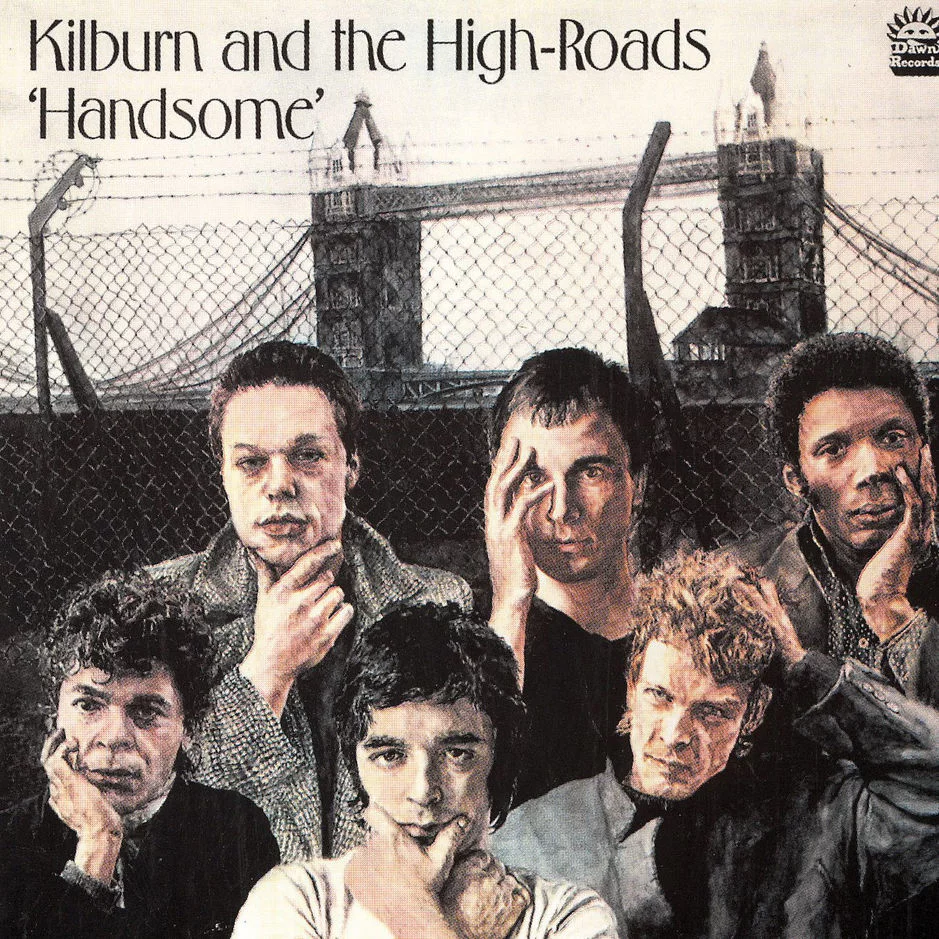 Kilburn and the High Roads released their singular album, Handsome, on May 23, 1975, on Dawn.
The album contains nine compositions by original pianist Russell Hardy with lyrics by Ian Dury, including “The Roadette Song,” “Pam’s Moods,” “Upminster Kid,” and “The Badger and the Rabbit.” Dury co-wrote “Father” with bassist Charles Sinclair and two tracks (“Broken Skin,” “Thank You Mum”) with Hardy’s replacement, pianist Rod Melvin.
Dury recorded the album post-Hardy with Melvin, Sinclair, guitarist Keith Lucas, saxist Davey Payne, and drummer David Newton-Rohoman.
A1. “The Roadette Song” (3:25)
A2. “Pam’s Moods” (3:40)
A3. “Crippled with Nerves” (3:45)
A4. “Broken Skin” (2:16)
A5. “Upminster Kid” (5:18)
B1. “Patience (So What?)” (3:13)
B2. “Father” (2:00)
B3. “Thank You Mum” (1:21)
B4. “Rough Kids” (2:26)
B5. “The Badger and the Rabbit” (3:56)
B6. “The Mumble Rumble and the Cocktail Rock” (4:39)
B7. “The Call-Up” (4:07)
Sessions occurred in 1974 at Pye Studios in London with veteran producer Hugh Murphy, a recent soundman for Jackson Heights, Jack the Lad, Laurie Styvers, and String Driven Thing. Here Come the Warm Jets soundman Phil Chapman engineered Handsome in sequence with titles by Badfinger and the Heavy Metal Kids.
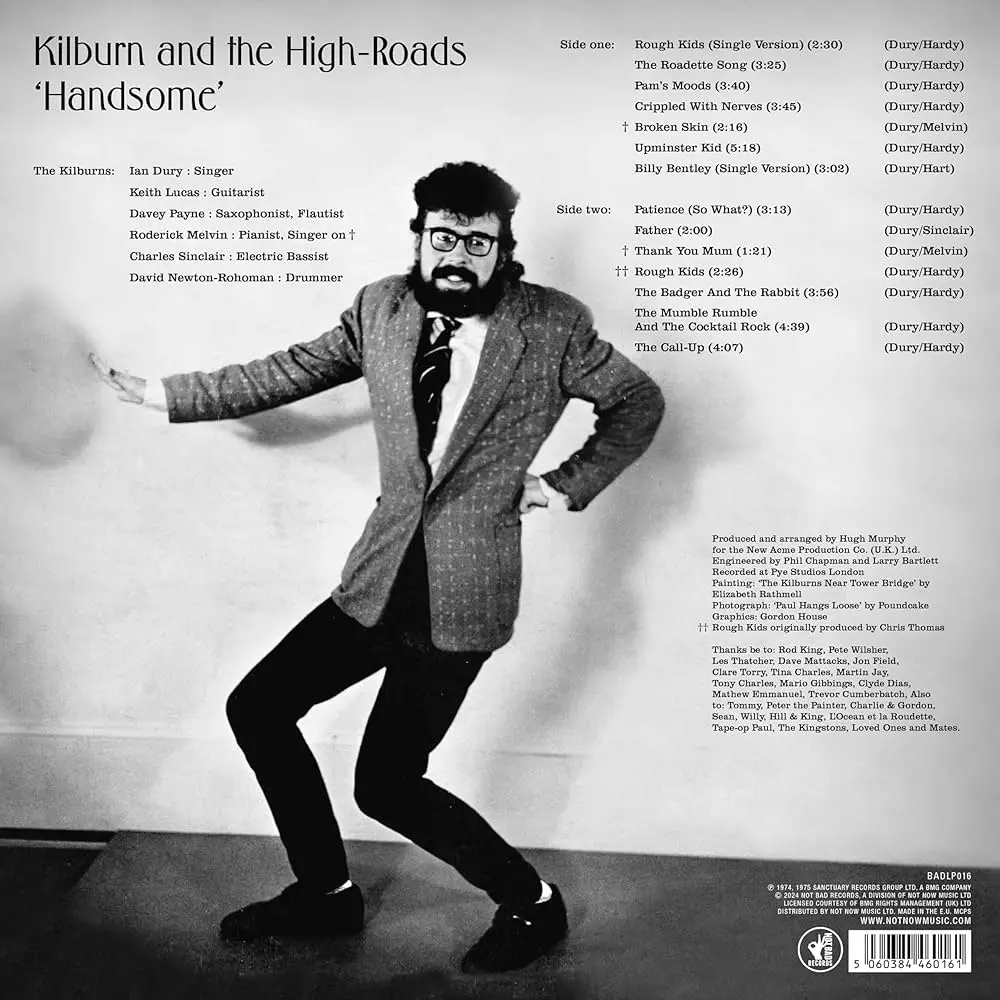 Ian’s then-wife, Elizabeth Rathmell, created the cover image: a paint-enhanced photo of the short-haired, disheveled Kilburns huddled foreground with the London Bridge seen behind in disrepair. Dury (under the pseudonym Duncan Poundcake) photographed the back-cover subject: a bearded, bespectacled Teddy Boy in a duckwalk pose — a purported inspiration for the “nutty train” pose of Madness on the cover of their debut album, One Step Beyond….
Dawn lifted “Crippled with Nerves” as a single, backed with the non-album “Huffety Puff.”
Breakup
Soon after Handsome, health problems forced Dury into temporary retirement. In late 1976, he reteamed with Payne in a new band, the Blockheads. Elsewhere, Lucas adopted the stage name Nick Cash and formed 999, a first-wave London punk band. In 1977, Dawn reissued Handsome to capitalize on Dury’s commercial breakthrough.
Wotabunch!
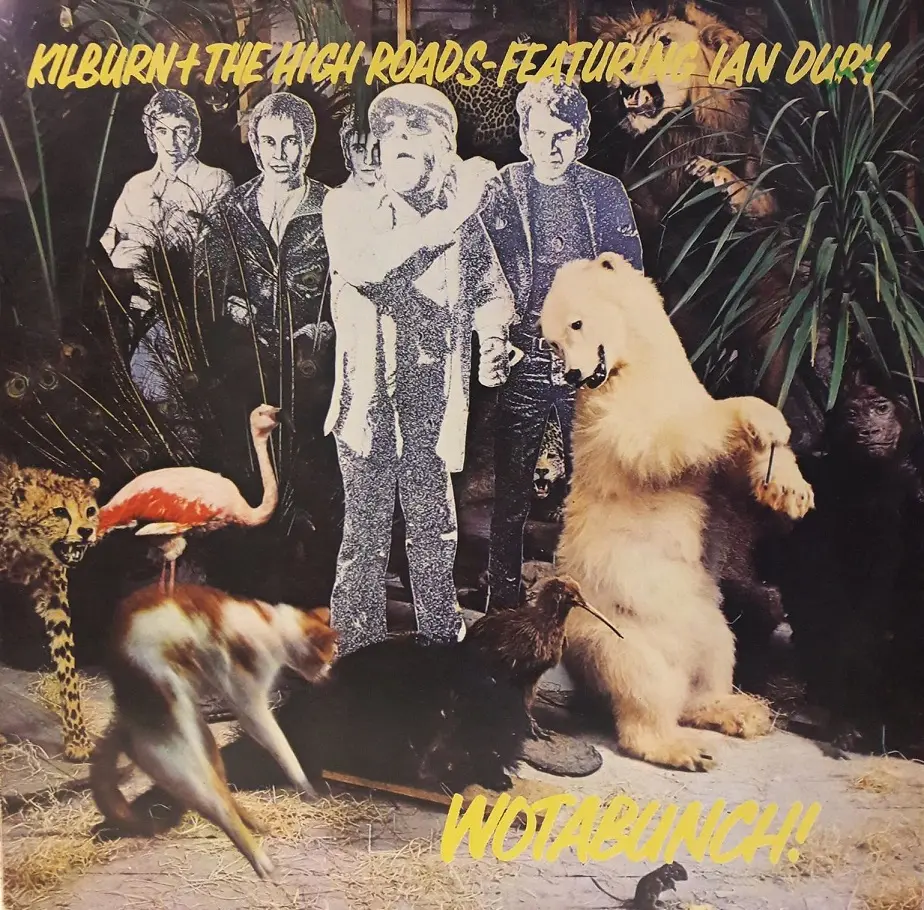 In 1978, Warner Bros. issued Wotabunch!, a collection of demos from the Raft-era Kilburns lineup.
Wotabunch! gathers eleven songs co-written by Ian Dury and Russell Hardy: eight later re-recorded (post-Hardy) for Handsome and three (“You’re More Than Fair,” “Huffety Puff,” and “The Roadette Song”) unique to this set. Dury co-wrote the fourth exclusive (“Billy Bentley”) with original bassist Charlie Hart.
A1. “The Call Up” (2:26)
A2. “Crippled With Nerves” (3:07)
A3. “Patience (So What?)” (2:03)
A4. “You’re More Than Fair” (3:05) appeared on the b-side of Dury’s second solo single, “Sweet Gene Vincent.”
A5. “Upminster Kid” (3:33)
A6. “Billy Bentley” (3:40)
B1. “Huffety Puff” (2:16)
B2. “Rough Kids” (3:19)
B3. “The Roadette Song” (3:10)
B4. “The Badger and the Rabbit” (2:42)
B5. “The Mumble Rumble and the Cock Tail Rock” (3:47)
B6. “Pam’s Moods” (3:00)
Tony Ashton (Ashton Gardner & Dyke) produced the 1974 demos in sequence with titles by Medicine Head, Stackridge, and his partnership with Jon Lord on First of the Big Bands.
Wotabunch! appeared in a sleeve credited to Tony Littler FMM. It shows the band as xerox cutouts in a wild jungle.
Discography:
- Handsome (1975)
Sources:
- Discogs: Kilburn and the High Roads
- RYM: Kilburn and the High Roads
- MusicBrainz: Kilburn and the High Roads
Artist/Album Pages:
Mick Ronson (May 26, 1946 — April 29, 1993) was an English guitarist and producer who rose to prom...
Lou Reed (March 2, 1942 — Oct. 27, 2013) was an American singer, musician, and songwriter from Bro...
Duncan Mackay is an English keyboardist and composer, known for his stints in Steve Harley & Coc...
Daddy Warbucks were an American pop-rock band from Los Angeles whose album appeared in 1976 on th...
The Rich Kids were an English rock band that made the 1978 EMI album Ghosts of Princes in Towers. ...
Ronnie Foster is an American organist and arranger who released eight albums between 1972 and 1986...
Michael Jackson (Aug. 29, 1958 — June 25, 2009) was an American soul-pop singer and songwriter who...
Benoît Widemann (born 1957) is a French pianist and composer who emerged at age 18 in a mid-1970s ...
Godot were an English coldwave/synthpop combo from Liverpool that self-released a four-song EP in...
Brian Auger's Oblivion Express were an English jazz-rock ensemble that released six studio albums an...
XTC was an English rock band that released ten albums on Virgin between 1978 and 1992, followed by t...
Jethro Tull are an English rock band that released twenty studio albums between 1968 and 1999. They ...