

Secret Oyster was a Danish jazz-rock band that released four albums between 1973 and 1976 on CBS. Formed by alumni of Burnin Red Ivanhoe and Coronarias Dans, the group combined high-level composition with electric fusion instrumentation and toured extensively across Europe. Posthumous archival releases—Striptease and Mermaid—preserve their work for ballet and later live projects.
Members: Claus Bøhling (guitar), Karsten Vogel (saxophone, keyboards), Mads Vinding (bass), Bo Thrige Andersen (drums), Jess Stæhr (bass), Ole Streenberg (drums), Kenneth Knudsen (keyboards, ?-1976)
Background
Secret Oyster coalesced in 1972 when two members of Burnin Red Ivanhoe, saxophonist Karsten Vogel and drummer Bo Thrige Andersen, teamed with ex-Hurdy Gurdy guitarist Claus Bøhling and erstwhile Coronarias Dans keyboardist Kenneth Knudsen. They debuted their new band that September at Jazzhus Montmartre, then embarked on a national tour. Bassist Mads Vinding, who played on Ivanhoe’s debut M 144, rounded out the new band for their first album, recorded in June 1973 at Quali-Sound Studio, Nibe, Denmark.
Secret Oyster [aka Furtive Pearl]
 Secret Oyster released their self-titled debut album in November 1973 on Danish CBS. In the US, the album appeared on Peters International Records as Furtive Pearl.
The album fuses the instrumental side of Burnin Red Ivanhoe with the newly established jazz-rock style from the US (Mahavishnu Orchestra, Return to Forever) and Europe (Passport, Perigeo).
Karsten Vogel plays soprano/alto saxophone and organ, interlocked with electric pianist Kenneth Knudsen, guitarist Claus Bøhling, bassist Mads Vinding, and drummer Bo Thrige Andersen.
Furtive Pearl opens with “Dampexpressen,” which lurches into motion with distorted electric piano and throbbing bass before locking into a propulsive pulse under Vogel’s spiraling alto sax and Böhling’s clipped guitar phrasing. “Fire & Water” builds from a subdued, staggered rhythm into a layered mid-tempo drive marked by echo-laced guitar shapes and dense organ overlays, eventually bursting into free-flowing, percussive textures that sustain high kinetic energy without losing clarity. “Vive la Quelle?” contrasts a taut, riff-based opening with a loosely structured central jam, where clipped guitar shards and abstract electric piano passages pivot against a restless, spotlighted drum sequence.
“Blazing Lace” centers on a cycling riff with sharp turns between sections, supporting angular sax and jagged, fuzzed guitar with steady rhythmic reinforcement. “Public Oyster” unfolds in phases, starting with cymbal scatter and chromatic piano figures, later solidifying into a low-slung vamp under interwoven sax and wah-saturated guitar gestures that escalate into a climax of simultaneous noise and structure before receding into a sparse, clipped coda. “Mis(s) Fortune” briefly suspends motion with a subdued duet of softly voiced piano and bass, while “Ova-X” closes the set in freeform: sputtering wind tones, dissonant clusters, and percussive fragments scatter across an unstable ground of synth-like resonance, dissolving the album’s rhythmic frame into pure atmosphere.
A1. “Dampexpressen” (4:24) — written by Vogel
A2. “Fire & Water” (5:34) — written by Vogel
A3. “Vive la Quelle?” (8:50) — written by Vogel
B1. “Blazing Lace” (4:45) — written by Bøhling
B2. “Public Oyster” (10:46) — written by Knudsen
B3. “Mis(s) Fortune” (1:28) — written by Knudsen
B4. “Ova-X” (4:56) — written by Vogel
Throughout, the band maintains control across sudden shifts in pacing, alternating tight interplay with exploratory looseness and sculpted ambient passages. Sessions occurred June 25–27, 1973, at Quali-Sound Studio in Nibe, Denmark, with engineering by Palle Juul. Secret Oyster self-produced the album.
All five members shared credit for the album’s cover design, executed with Peder Bundgaard. Knudsen also supplied photography, with the front image credited to Stjernefoto.
The album marked the formal emergence of Secret Oyster as a live and studio unit, consolidating their early compositional output and establishing their presence across Scandinavian venues and, later, the US jazz-rock circuit through the Furtive Pearl release.
Sea Son
 Secret Oyster released their second album, Sea Son, in November 1974 on CBS.
The album followed a major lineup reshuffle after the first record. Bassist Mads Vinding left to work full-time with violinist Svend Asmussen, and drummer Bo Thrige Andersen departed due to personal issues. Their replacements were Jess Stæhr—formerly of Burnin Red Ivanhoe—and Ole Streenberg, who had previously played with Kenneth Knudsen.
This new rhythm section stabilized the lineup and defined the group’s “classic” formation. With heightened ambition and momentum from steady live work, the band developed a broader repertoire, driven by compositions from Karsten Vogel, Knudsen, and Claus Bøhling. The album includes multiple collaborations and integrated string and brass arrangements.
Vogel (soprano, alto) plays organ alongside Knudsen (piano, Moog), guitarist Bøhling, and the Stæhr/Streenberg rhythm section. Guest trumpeter Palle Mikkelborg arranged strings for two tracks, joined by cellist Erling Christensen, violist Bjarne Boie Rasmussen, and violinists Finn Ziegler and Hans Nielsen. Kasper Winding adds congas and percussion on “Pajamamafia.”
Sea Son opens with “Oysterjungle,” a layered, kinetic piece that pivots between punchy string accents, wah-filtered keys, and tightly coiled ensemble bursts. “Mind Movie” stretches across nine minutes with a slow-rising, modal progression that alternates minimalist electric piano patterns with controlled guitar swells. Claus Bøhling’s phrasing intensifies across the second half, delivering long-tailed bends and contoured sustain over a rhythm section that tightens and releases in waves. “Pajamamafia” opens with a hazy acoustic sequence before breaking into a shifting compound-meter figure anchored by slaplike bass pulses and angular brass ornamentation.
“Black Mist” sets its pace early with jagged sax bursts and a clipped guitar-synth interchange that accelerates into frenetic unison lines. “Painforest” builds on a minimal string motif, then shifts to a suspended, ambient section carried by slow-burning guitar phrasing and sustained keyboard textures that resist harmonic resolution. “Paella” closes with the album’s most saturated layering: multiphonic trumpet, phase-driven organ, and oscillating Moog lines stack over polyrhythmic drums and percussive low-end figures, driving the piece into a high-density climax.
A1. “Oysterjungle” (2:57) — written by Vogel; includes strings arranged by Mikkelborg, with performances by Ziegler, Nielsen, Boie Rasmussen, and Christensen
A2. “Mind Movie” (9:14) — written by Vogel
A3. “Pajamamafia” (6:07) — written by Bøhling and Knudsen; includes trumpet by Mikkelborg and percussion by Winding
B1. “Black Mist” (3:40) — written by Bøhling
B2. “Painforest” (5:40) — written by Knudsen; includes strings arranged by Mikkelborg
B3. “Paella” (8:23) — written by Vogel; includes trumpet by Mikkelborg
Across the album, Secret Oyster balances cyclical phrasing with dynamic contrast, alternating sparse intervals and densely arranged sections without losing structural clarity. The instrumentation rotates frequently between lead and support roles, producing a constantly shifting focal point across each track’s internal movements.
Sessions took place July 4–7, 1974, at Rosenberg Studio in Copenhagen, with mixing completed on September 16–19 at the same location. Freddy Hansson served as engineer. Poul Bruun produced the album. Peder Bundgaard handled illustration and art direction; Erik Bredahl supplied photography. CBS pressed the album in Haarlem, Netherlands.
The spine of the original LP erroneously reads Sea Sun, while both the front cover and labels display the correct title.
A single appeared in 1974 with “Oysterjungle” (A-side) and “Black Mist” (B-side), both taken directly from the album. These two tracks also led off each side of the LP, marking them as representative pieces during promotion.
Vidunderlige Kælling (Astarte)
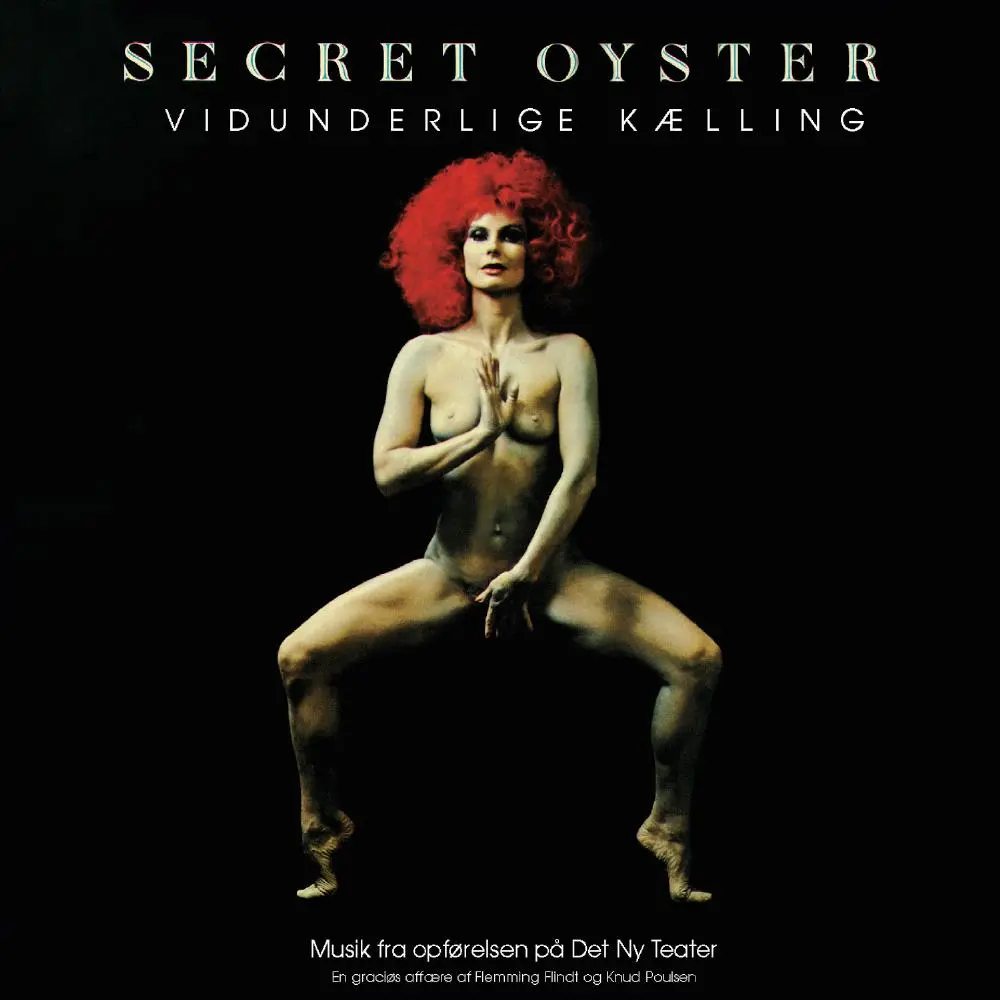 In 1975, Secret Oyster released Vidunderlige Kælling (Wonderful Bitch), a ballet score on Danish CBS. In the Netherlands, CBS retitled the album Astarte.
In the Netherlands, CBS issued the album under the alternate title Astarte, taken from the fourth track. The album comprises a suite of music commissioned for a ballet-cabaret production based on texts by Danish poet Jens August Schade. Performances of the piece gained notoriety for their risqué staging and marked the band’s first experience receiving guaranteed compensation per performance.
The lineup retains Vogel, Knudsen, Bøhling, Stæhr, and Streenberg, with Knudsen expanding to string synthesizer and Vogel adding ARP Solina. Guests include Mikkelborg (trumpet, string synth on B2), Winding (percussion on A3 and B3), and Keld Jensen (mandolin on B4).
Astarte unfolds with tightly arranged cues tailored for movement, contrasting Secret Oyster’s freer earlier work with more sculpted, mood-driven forms. “Intro” establishes a brief overture of warbled electric piano arpeggios and phased percussion. “Stjernerne på Gaden” stretches into slower, sustained layers, with thick synth tones and expressive Moog lines weaving through subdued guitar textures. “Sirenerne” opens in 5/4 with a clipped, arpeggiated guitar figure mirrored by electric piano before sax and rhythm section lock into a slow-driving sequence built on repeated pulses. “Astarte” extends the piece with sitar drones, layered soprano sax, and an ostinato descent that anchors its hypnotic frame.
The tone shifts on “Solitude,” a sparse piano soliloquy with subtle synthetic shading and restrained chord motion. “Tango-Bourgeoise” inserts sharp stylistic contrast with a rigid martial rhythm and decorative synth punctuations, while “Bellevue” pivots back to a syncopated, mid-tempo pulse layered with sharp brass bursts and electric piano stabs. “Valse du Soir” pairs slow waltz timing with accordion phrasing (real or simulated), evoking a disoriented ballroom feel. “Outro” returns to full ensemble dynamics, with Vogel’s sax darting between clustered keyboard lines and Claus Bøhling’s phrasing cutting through the heavy bass and cymbal-rich percussion. While the album limits open improvisation, it uses timbral shifts and thematic recurrences to sustain tension across brief tableaux, shaped around narrative pacing rather than instrumental showcase.
A1. “Intro” (2:10) — written by Vogel
A2. “Stjernerne På Gaden” [The Stars in the Street] (5:41) — written by Vogel
A3. “Sirenerne” [The Sirens] (5:03) — written by Bøhling; percussion by Winding
A4. “Astarte” (6:28) — written by Bøhling
B1. “Solitude” (4:07) — written by Knudsen
B2. “Tango-Bourgoisie” [Tango-Bourgeoisie] (2:47) — written by Knudsen; trumpet and string synth by Mikkelborg
B3. “Bellevue” (3:20) — written by Bøhling; percussion by Winding
B4. “Valse du Soir” (1:55) — written by Knudsen; mandolin by Jensen
B5. “Outro” (5:06) — written by Vogel
Poul Bruun produced the album in autumn 1975 at Rosenberg Studio during the same period as their next studio album. Freddy Hansson engineered the sessions, which coincided with heavy touring schedules across Denmark, Germany, Sweden, Norway, and France.
Peder Bundgaard handled the back cover photography and layout; Jørn Freddie supplied the front cover photograph. CBS pressed the LP in Haarlem, Netherlands. The Danish pressing was printed by Notex Offset. The Astarte variant used the same recordings with alternate artwork and English-language titling.
By this time, the group had established a stable lineup and worked as a collaborative unit, with each principal composer—Vogel, Knudsen, and Bøhling—contributing distinct material. The music was recorded to tape and used in playback for the theatrical performances, allowing the band to focus on studio production and ongoing live commitments.
Straight to the Krankenhaus
 Secret Oyster released their fourth album, Straight to the Krankenhaus, in July 1976 on CBS.
The album title emerged during a German tour, inspired by frequent road signs for local hospitals, to which the band jokingly appended the phrase “Straight to,” reflecting their hectic schedule and internal strain at the time.
Recorded during the Astarte sessions with the same lineup, Krankenhaus features one song by Bøhling and four each by Knudsen and Vogel. Winding reappears for additional percussion on the title track. Throughout the album, the band alternates between high-speed ensemble precision and slow-released phrasing, structuring each piece with dense rhythmic layering and staggered entrances rather than static figures or solo-based frameworks. The arrangements rely on timbral contrasts and abrupt dynamic turns, with emphasis shifting continually between Bøhling’s phrasing, Knudsen’s Moog and electric piano textures, and Vogel’s tone-focused sax lines.
Straight to the Krankenhaus opens with “Lindance,” a brief overture of dense, pulsing synth and clipped guitar bursts that spills directly into the title track, where frenetic percussion and clustered electric piano phrases lock into fast-cycling saxophone lines and octave-spanning keyboard fills. “My Second Hand Rose” relaxes into a slow-walking pace, centered on supple alto sax phrasing that stretches over suspended chord beds and subtle, single-note guitar accents. “High Luminent Silver Pattern” pivots sharply, layering distorted Moog flourishes over a forward-driving snare pattern, with quick-switch transitions between rising keyboard motifs and syncopated guitar cuts. “Delveaux” stretches the pace, opening with free-time Moog textures and layered phrasing before settling into a sparse, sax-led coda underpinned by electric piano voicings and brushed percussion.
“Stalled Angel” merges upbeat funk rhythm patterns with stabbing sax fragments, intermittent wah guitar, and a solo section where Claus Bøhling alternates between short scalar bursts and bent sustain figures. “Rubber Star” adopts a more meditative frame, with lightly phased piano pulses and arpeggiated guitar serving as a backdrop for slow-descending sax refrains. “Traffic & Elephants” builds in tension with a cycling, ascending bass line under tightly clustered sax motifs that fracture into a layered crescendo of synth and tom-heavy percussion. “Leda & the Dog” closes with delayed, arcing guitar phrasing over atmospheric keyboard pads, gradually thickening into distorted melodic lines that intersect with cymbal-driven swells and descending Moog contours.
A1. “Lindance” (1:11) — written by Knudsen
A2. “Straight to the Krankenhaus” (2:45) — written by Vogel; percussion by Winding
A3. “My Second Hand Rose” (4:14) — written by Vogel
A4. “High Luminent Silver Patterns” (5:34) — written by Knudsen
A5. “Delveaux” (7:51) — written by Vogel
B1. “Stalled Angel” (3:54) — written by Knudsen
B2. “Rubber Star” (4:09) — written by Knudsen
B3. “Traffic & Elephants” (6:10) — written by Vogel
B4. “Leda & the Dog” (5:47) — written by Bøhling
Postlude
Following the release of Straight to the Krankenhaus, Secret Oyster briefly continued activity before disbanding in autumn 1977. However, material recorded before the breakup resurfaced decades later in two archival projects tied to Karsten Vogel’s personal archive.
One of these, Striptease, stemmed from a planned follow-up to Vidunderlige Kælling, again involving choreographer Flemming Flindt. Composed primarily by Vogel and Kenneth Knudsen, the music was partly tracked in the studio and partly recorded during rehearsals. The ballet was never staged due to Flindt’s relocation to Dallas, but Vogel preserved the tapes, which were eventually released more than forty years later on both vinyl and CD. The CD edition also included previously unreleased live material.
In parallel, Vogel launched Mermaid, a new project distinct from Secret Oyster or Burnin Red Ivanhoe. It featured Ole Fick on vocals and guitar, supported by the rhythm section from Young Flowers. The project initially met poor reception—hampered by illness, poor acoustics, and venue mismatch—but later gained traction on a tour of Norway, where several concerts were recorded.
After Secret Oyster’s dissolution, Vogel reactivated his earlier project title Birds of Beauty for a final 1977 concert booking at Saltlageret in Copenhagen. Rather than reforming an existing band, he assembled a new group of musicians to perform his compositions under that banner. This fluid ensemble served as a kind of live studio collective, with a revolving cast that included future local notables like Morten Kærså, Klaus Menzer, and Moussa Diallo.
Discography:
- Secret Oyster [AKA Furtive Pearl] (1973)
- Sea Son (1974)
- Astarte (1975)
- Straight to the Krankenhaus (1976)
Sources:
Artist/Album Pages:
Auracle was an American jazz-rock band behind the 1978/79 Chrysalis albums Glider and City Slicker...
GÄA was a German Krautrock band that made the 1974 album Auf der Bahn zum Uranus on Kerston. Track...
Cortex was a French samba-jazz/funk combo that released two albums and a standalone single between...
Bandit was an English hard-rock/funk band that released a self-titled album in 1976 on Arista, fol...
Barry Miles (born March 28, 1947) is an American jazz pianist, keyboardist, composer, and former d...
The Group was a Finnish jazz-rock super-band behind a 1978 self-titled album on Dig It. They feat...
Pôle was a French avant-garde/electronic group that made the 1975 albums Kotrill and Inside the Dr...
Kyrie Eleison was an Austrian symphonic-rock band that released the 1976 album The Fountain Beyond...
Al Foster (Jan. 18, 1943 — May 28, 2025) was an American jazz-funk drummer who first recorded in 1...
Return to Forever was an American jazz-rock supergroup that evolved from a namesake 1972 solo albu...
Totty was an American hard-rock/boogie band from Tulsa that released two albums on self-press Our...
Rozz was a German jazz-rock band behind the 1980/81 Telefunken albums Prüfungsangst and Eisbrecher...