

Perigeo was an Italian jazz-rock band that released five albums between 1972 and 1976 on RCA Italiana.
Members: Tony Sidney (guitar), Franco D’Andrea (keyboards), Claudio Fasoli (saxophone), Giovanni Tommaso (bass, double bass, vocals), Bruno Biriaco (drums, percussion)
Background
Perigeo formed in 1971 when bassist Giovanni Tommaso (b. January 10, 1941), active since the 1950s in Roman jazz circles and a founding member of Third Stream group Sesto Continente, assembled a new electric project after returning from the United States. In 1970, while playing with the Enrico Rava Quartet, Tommaso met Venetian keyboardist Franco D’Andrea (b. March 8, 1941), a classically trained pianist who backed Gato Barbieri, Jean-Luc Ponty, and played in the Modern Art Trio and Quartetto di Lucca.
D’Andrea brought in saxophonist Claudio Fasoli (b. November 29, 1939), a fellow alumnus of the RAI Big Band and a fixture on the Milan jazz scene with the Giorgio Gaslini Octet. They soon welcomed American guitarist Tony Sidney (b. 1946), who relocated from New York to Italy and played in jazz-rock and soul groups around Rome. The lineup solidified with drummer Bruno Biriaco (b. June 10, 1938), a seasoned sessionist from Rome’s beat and jazz-pop scenes who’d backed Piero Umiliani and Fred Bongusto.
Perigeo debuted in mid-1971 with a residency at the Folkstudio club in Rome, where they developed an electro-acoustic setlist that blended modern jazz with Italian instrumental color. Signed to RCA Italiana, they recorded their first album in early 1972 and emerged as one of Italy’s first major jazz-rock ensembles with strong classical and avant-garde affiliations.
Azimut
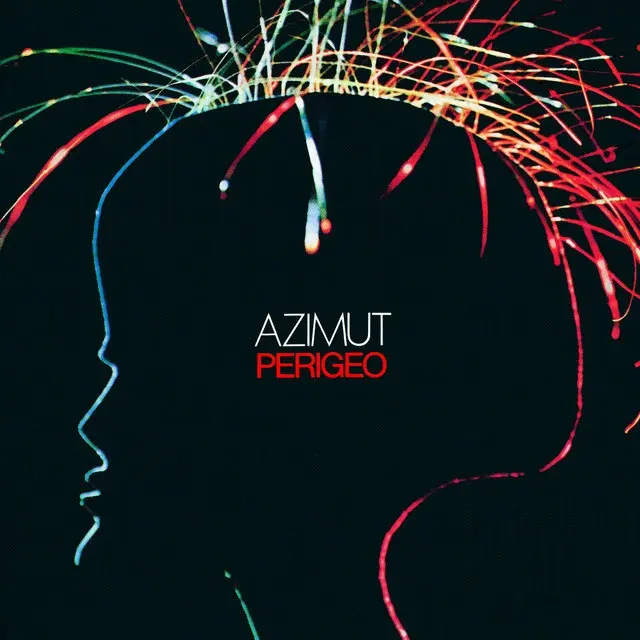 Perigeo released their debut album, Azimut, in September 1972 on RCA Italiana.
Composer Giovanni Tommaso plays electric and contrabass, anchoring pianist Franco D’Andrea, who leads transitions and melodic passages on Steinway and Fender Rhodes. Claudio Fasoli plays alto and tenor saxophone, alternating expressionist attack with modal fluidity. Tony Sidney’s guitar enters in bursts of distortion and rhythmic counterpoint, while Bruno Biriaco underpins with syncopated, often tom-heavy fills with dynamic shifts.
Azimut opens with two extended pieces that define Perigeo’s core approach: “Posto di non so dove” merges atmospheric piano and vocalise with a midsection of collective improvisation and clustered rhythm breaks; “Grandangolo” follows with an angular funk pulse under electric piano and guitar lines that dissolve into a frenzied, dissonant coda. Shorter tracks like “Aspettando il nuovo giorno” and “Un respiro” emphasize electric textures and brief vocal-sax interplay, acting as reflective interludes.
The title track evolves from sparse, bowed bass and tuned percussion into an episodic midsection of call-and-response figures, concluding with a dense piano solo. Closer “36° Parallelo” unfolds as a high-energy suite with successive solo segments for guitar, drums, bass, and saxophone, showcasing each member’s improvisational control.
A1. “Posto di non so dove” [Place I Don’t Know Where] (6:12) — opens with reverbed piano and Tommaso’s vocalise; transitions into a rhythmic section with chanted syllables and freeform interplay
A2. “Grandangolo” [Wide Angle] (8:22) — bass-driven structure with Fender Rhodes and distorted guitar; ends in a chaotic ensemble spiral
A3. “Aspettando il nuovo giorno” [Waiting for the New Day] (3:55) — subdued electric piano sets the tone for layered sax and guitar over pulsed cymbals
B1. “Azimut” (7:18) — begins with bowed contrabass, tuned percussion, and pointillist piano; shifts midway to group arrangement with solo piano centerpiece
B2. “Un respiro” [A Breath] (1:37) — soft interlude with low vocal tones and sax harmonics
B3. “36° Parallelo” (9:51) — ensemble statement with alternating solos for guitar, drums, bass, and sax over phased electric textures
Sessions occurred in 1972 with producer Gianni Grandis and engineer Sergio Patucchi.
On the cover, Azimut shows the outline of a human head in profile, traced in faint neon lines against a black background with sparks of colorful fiber‑optic light—red, orange, green, and blue—suggesting an explosion of thought, synaptic energy, or technological fusion. Centered within the silhouette is the minimalist text “AZIMUT” in white and “PERIGEO” in bold red, reinforcing the visual emphasis on clarity and direction. The design evokes themes of cerebral exploration and modernity, aligning with the group’s hybrid of jazz, rock, and electronic elements.
Abbiamo tutti un Blues da Piangere
 Perigeo released their second album, Abbiamo tutti un Blues da Piangere, in September 1973 on RCA Italiana.
Abbiamo preserves the original Azimut lineup while introducing broader compositional input from members beyond bassist Giovanni Tommaso, who still guides the arrangements and tone. The material retains the group’s exploratory jazz foundation but expands into layered rhythmic interplay, dense solo passages, and a heightened emphasis on contrast between restraint and dissonance.
Giovanni Tommaso plays acoustic and electric bass, shapes the overall architecture of the music, and sings lead on the opening track. Franco D’Andrea commands both acoustic piano and Fender Rhodes, alternating between atmospheric support and fractured bursts. Claudio Fasoli plays soprano and alto saxophones with phrasing that veers from plaintive to agitated, often steering the ensemble’s dynamic arcs. Tony Sidney foregrounds his guitar with distorted interjections and sharpened leads, taking a more central role than on the debut. Bruno Biriaco imparts drums and percussion with abrupt metric shifts and tom-heavy motion.
Tommaso composed five of the seven tracks; D’Andrea authored “Nadir,” while “Rituale” is co-credited to Tommaso, D’Andrea, and Biriaco.
Abbiamo opens with “Non c’è tempo da perdere”, which shifts between hushed piano and cymbal layers and eruptions of chaotic ensemble interplay, anchored by Tommaso’s droning, chant-like vocalizations. “Déjà vu” introduces uncredited bowed strings beneath a modal piano-sax progression that slips in and out of dissonance. “Rituale” unfolds through percussive fragments, sustained guitar wails, and sax figures that build into a layered jam before breaking down into rotating solo cadences.
The title track contrasts fingered acoustic guitar lines with a slow, unfolding bluesy motif, eventually overtaken by a prolonged soprano sax statement. The final side opens with “Country”, a compact Rhodes-and-sax sketch, followed by “Nadir”, which begins in ambient understatement before escalating into sharp guitar-sax interplay. Closer “Vento, pioggia e sole” opens in abstract disarray and resolves through successive solos with extended saxophone phrasing, declamatory electric guitar runs, and tom-heavy drums, culminating in the band’s most expansive and turbulent performance.
A1. “Non c’è tempo da perdere” [There’s No Time to Lose] (8:46) — vocals over ambient piano and cymbals; midsection erupts into full-band discord before returning to vocal refrain
A2. “Déjà vu” (4:57) — bowed violin underpins acoustic piano and saxophone; includes brief vocalization over static harmonic phrasing
A3. “Rituale” [Ritual] (7:28) — percussion intro gives way to phased piano and guitar; evolves into layered ensemble jam with successive solos
B1. “Abbiamo tutti un blues da piangere” [We All Have a Blues to Cry] (6:07) — acoustic guitar intro leads into slowly built groove; soprano sax dominates second half
B2. “Country” (3:03) — tight Rhodes-driven interlude with punctuated sax phrasing
B3. “Nadir” (3:45) — ambient Rhodes and soprano sax opening; gains momentum with distorted electric guitar
B4. “Vento, pioggia e sole” [Wind, Rain and Sun] (9:39) — starts in abstract texture and dissonant sax; unfolds through cascading solos with shifting rhythmic base
Sessions occurred in mid-1973 with producer Gianni Grandis and engineer Rodolfo Grappa, assisted by Roberto Rosati.
Dario Campanile painted the cover: a desolate surrealist landscape beneath a deep indigo sky, pierced by a pale blue comet streaking diagonally across the upper left. Along the horizon sits a moon-like dome, partially obscured by shadowy hills. The barren plain is dotted with subtle textures—coral-like outgrowths, a gnarled leafless tree, and skeletal vegetation—while a mysterious hand-like form emerges from the ground at center. The overall palette fades from ochre earth tones to luminous blues, creating a sense of eerie stillness.
Genealogia
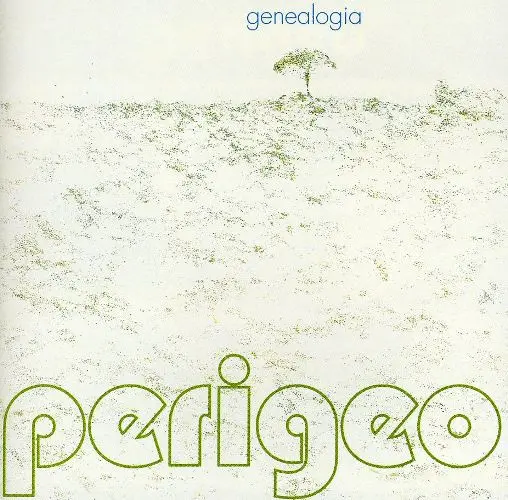 Perigeo released their third album, Genealogia, in September 1974 on RCA Italiana.
The album retains the Abbiamo lineup but widens the compositional range with each member contributing at least one piece. Compared to its predecessor, Genealogia places greater emphasis on instrumental coloration and mood shifts, combining atmospheric electronics, acoustic instrumentation, and post-bop rhythmic phrasing. Wordless vocals appear intermittently but the material is otherwise entirely instrumental.
Giovanni Tommaso plays electric and upright bass and introduces the Moog synthesizer on three pieces. His arrangements incorporate modal interplay, bowed textures, and melodic suspensions. Saxist Claudio Fasoli (soprano/alto) alternates between expansive lyricism and spiraled phrasing. Franco D’Andrea commands Steinway and Rhodes with a focus on harmonic framing and rhythmic modulation. Tony Sidney plays electric and acoustic guitar with occasional distortion and rhythmic punctuations. Bruno Biriaco drives sectional changes with controlled cymbal rolls and dynamic fills.
Tommaso composed four of the album’s nine pieces. D’Andrea authored three, Fasoli contributed one, and Sidney co-wrote the closing track with Tommaso.
The title track opens with phased Moog oscillations and suspended piano harmonics, gradually unfolding into a rotational motif with bowed bass and sax in modal alternation, creating a medieval-inflected pulse. “Polaris” develops around electric piano and sax phrasing, over a rising rhythm that incorporates fuzzed-out organ and swirling percussion. “Torre del lago” contrasts spacious piano with legato sax lines, punctuated by subdued vocal tones. “Via Beato Angelico” begins with ambient synth swells and accelerates into a Latin-tinged groove with syncopated percussion and sharp electric guitar breaks.
Side two begins with “(In) Vino Veritas,” which moves from compact electric phrasing into clustered sax and electric guitar solos over dense rhythmic foundations. D’Andrea’s “Monti pallidi” and “Old Vienna” alternate between serene piano-sax passages and heightened ensemble interplay, with the latter reaching peaks of fuzzed electric guitar distortion. Fasoli’s “Grandi spazi” layers ambient sax over spare piano and bowed bass, with an emphasis on tone and atmosphere. The final track, “Sidney’s Call,” opens on a sedate motif with acoustic guitar and congas, then transitions into an uptempo midsection featuring a drum solo and a full-group reprise before resolving in a hushed, wordless vocal refrain.
A1. “Genealogia” (8:24) — Moog effects and bowed bass shape a modal structure beneath sax phrasing and fuzz organ; develops into an ensemble cycle with layered improvisation
A2. “Polaris” (5:02) — Biriaco; sax over Rhodes and syncopated rhythm; includes synth accents and a brief fuzz interjection
A3. “Torre del lago” [Lake Tower] (3:09) — piano and sax in slow dialogue with background vocal tones
A4. “Via Beato Angelico” [Beato Angelico Street] (4:57) — ambient Moog prelude yields to Latin-inflected groove with rhythmic guitar, percussion, and sax layering
B1. “(In) Vino Veritas” [Wine Truth] (6:45) — electric piano and sax trade over shifting rhythm; midsection features distorted guitar and a reprise of the opening figure with rising dissonance
B2. “Monti pallidi” [Pale Mountains] (3:31) — acoustic piano and saxophone in recurring alternation, joined by bass and drums in extended phrasing
B3. “Grandi spazi” [Large Spaces] (3:39) — ambient sax lines over spare electric piano and bowed bass with subdued rhythmic support
B4. “Old Vienna” (3:24) — fast-paced ensemble exchange with distorted guitar, electric piano, and rapid drum/bass motion
B5. “Sidney’s Call” (4:58) — acoustic guitar and congas build to mid-track sax and drum interchange; concludes with wordless vocal closure
Perigeo recorded the album with producer Gianni Grandis and engineer Rodolfo Grappa under the music direction of Roberto Rosati.
The cover presents a sparse, near-monochrome landscape of soft beige overlaid with fine green stippling that outlines a faint terrain. A lone, stylized tree stands at the horizon’s center, drawn in minimal green pointillism and evoking ideas of ancestry or origin. Above it, the album title genealogia appears in small, light blue lowercase, while the band’s name perigeo spans the bottom third in large, outlined lowercase lettering with rounded forms and bright green trim. The minimal, open design conveys introspection and organic connection, complementing the album’s introspective and textured instrumental approach.
La Valle dei Templi
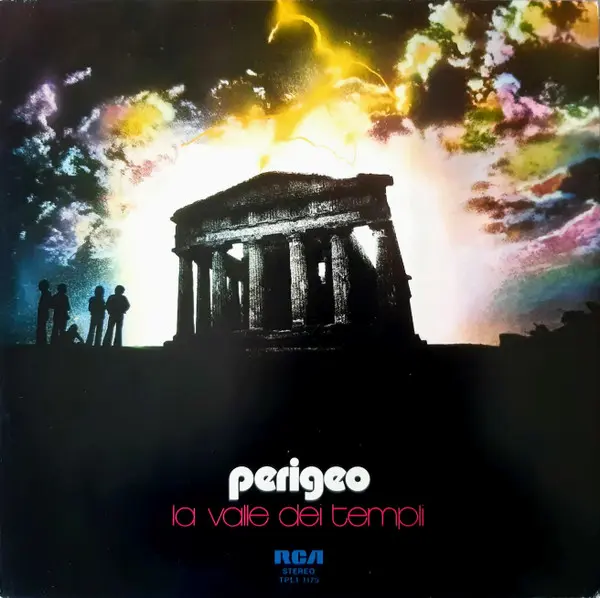 Perigeo released their fourth album, La Valle dei Templi, in 1975 on RCA Italiana.
This fourth studio album marked the group’s first with outside production under Renato Coppola and the guest addition of Neapolitan percussionist Tony Esposito. It broadens their prior fusion formula with a heightened sense of cohesion and internal contrast between atmospheric interludes and structured ensemble statements. For the first time, Tommaso composed less than half the material, with all five members contributing compositions, including two multi-author pieces.
Giovanni Tommaso plays electric and acoustic bass, bowed contrabass, synthesizer, and vocals. His foundational phrasing defines the modal centers and transitions across the record, particularly on the rhythmically dynamic longer pieces. Claudio Fasoli plays soprano, alto, and tenor saxophones, often leading melodic lines with gradually uncoiled phrasings or tight modal repetitions, and composed two short linked tracks.
Franco D’Andrea alternates between acoustic piano, electric piano, and synthesizer, shifting from impressionistic coloration to propulsive ostinato. Tony Sidney uses acoustic and electric guitars in both rhythm and lead roles, with textures ranging from fluid arpeggios to angular distortion. Bruno Biriaco contributes drums, percussion, and piano on the title track, handling transitions with cymbal rolls, cross-rhythmic fills, and tumbling tom runs. Esposito adds supplemental percussion to two tracks, including congas and hand-struck accents.
Tommaso composed four tracks, Biriaco two, D’Andrea two, Fasoli two, and Sidney one. The title track is credited to all five members.
“Tamale” opens the album with electric piano, phrased guitar leads, and a sharp rhythmic drive. The title track unfolds in two sections: the first layers bowed bass, piano, and slow-moving sax; the second rises into a mid-tempo ensemble groove led by Sidney’s guitar solo. “Looping” and “Pensieri” are shorter modal sketches that offset the more expansive pieces. “Mistero della Firefly” alternates between layered counterpoint and percussion-driven motion, using dynamic contrast to highlight guitar and sax exchanges.
“Periplo” builds gradually with saxophone and rhythm guitar phrasing before expanding into clustered group statements. Fasoli’s “Eucalyptus” and “Alba di un mondo” act as linked ambient vignettes, leading into D’Andrea’s “Cantilena,” which restores equilibrium with gentle melodic phrases. “2000 e due notti” begins in abstraction and swells into a moody, syncopated suite led by saxophone and effects-treated guitar. Closer “Un cerchio giallo” opens on acoustic guitar and accumulates intensity as sax and piano interweave above bowed bass, ending with a fadeout.
A1. “Tamale” (4:35) — electric piano and rhythmic guitar set a fast-paced opener with strong bass and drumming
A2. “La valle dei templi” [Valley of the Temples] (6:18) — bowed bass and piano open the first section; transitions into a group passage led by distorted guitar and sax
A3. “Looping” (3:03) — alternating sax-led themes and rhythm section counterpoints
A4. “Mistero della Firefly” [Mystery of the Firefly] (6:03) — layered percussion and sax-guitar dialogue; guitar solo anchors the midsection
A5. “Pensieri” [Thoughts] (2:15) — brief acoustic piano-centered interlude with suspended resolution
B1. “Periplo” [Circumnavigation] (5:04) — tight ensemble figures with offset sax and guitar leads
B2. “Eucalyptus” (0:58) — solo sax theme introduces the next piece
B3. “Alba di un mondo” [Dawn of a World] (2:53) — ambient sax and synthesizer with fragmented rhythmic backdrop
B4. “Cantilena” [Singsong] (4:03) — electric piano and sax phrasing in slow, melodic interplay
B5. “2000 e due notti” [2000 and Two Nights] (5:40) — opens in abstraction; develops into a brooding rhythmic motif with layered improvisation
B6. “Un cerchio giallo” [A Yellow Circle] (4:30) — acoustic guitar intro, bowed bass and piano join in gradual build; fades during ensemble climax
Perigeo recorded the album with producer Renato Coppola and engineer Rodolfo Grappa.
The cover features a silhouetted ancient Greek‑style temple set against a dramatic sky streaked with vivid, multicolored clouds and flashes of light. The darkened silhouette of the temple occupies the central foreground, with a group of small human figures standing to its left, emphasizing scale and monumental presence. Above the structure, riotous hues of yellow, orange, and violet appear to radiate or break through cloud cover, creating a contrast between the stark ruins and an electric, almost otherworldly atmosphere.
Non è poi così Lontano
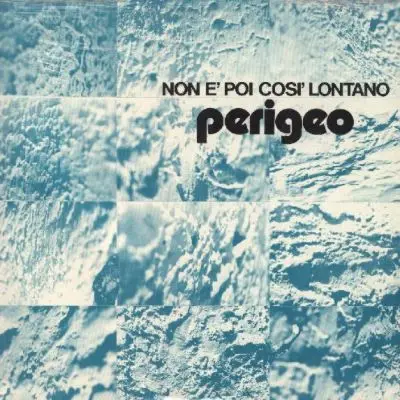 Perigeo released their fifth album, Non è poi così Lontano, in 1976 on RCA Italiana. The title translates as It’s Not That Far Away. In the US, the album appeared as Fata Morgana with different cover art.
Lontano marks a distinct phase in the group’s trajectory, recorded outside Italy at RCA Studios in Toronto with producers Ian Guenther and Willi Morrison of Three Hats Production. It refines the band’s blend of modal fusion and ensemble texture while adding strings, external percussion, and subtle production sheen. Despite the studio relocation and added instrumentation, the core quintet remains unchanged.
Giovanni Tommaso plays acoustic and electric bass, contributes vocal interjections, and composed two tracks. His playing on this record features sharp upper-register phrasing and rounded harmonic accents, especially on acoustic passages. Claudio Fasoli plays soprano, alto, and tenor saxophones, leading melodic development with intervallic phrasing that anchors both freer and orchestrated settings. Franco D’Andrea performs on acoustic and electric piano and synthesizer, often alternating between chordal underlay and chromatic runs, and contributes one of the album’s lengthier compositions. Tony Sidney plays acoustic and electric guitar, ranging from delicately phrased introspection to multi-tracked rhythmic textures, and contributes one solo composition. Bruno Biriaco drives metric shape with tightly controlled snare accents and propulsive fills, and contributes two compositions, including the briefest track.
Additional contributions come from percussionist Dick Smith, who appears on several tracks, and Pete Pedersen, who arranged and conducted added strings.
“Fata Morgana” opens the album with string-enhanced electric textures and collective writing that emphasizes modal shifts and chromatic overlays. Sidney’s “Tarlumbana” unfolds in two contrasting sections, opening on acoustic guitar and developing into a complex electric vamp with interlocking phrasing from saxophone and piano. “Myosotis,” one of two Biriaco compositions, functions as a percussive transition with flute-like keyboard voicing and quiet interjections. Tommaso’s “Take Off” employs electric rhythm figures and contrapuntal lines over a propulsive mid-tempo structure.
“Acoustic Image,” the longest piece, layers bowed bass, Rhodes textures, and phased sax phrasing in a multi-part format. Fasoli’s “Terra rossa” develops in circular sax lines over modal piano, driven by a shifting rhythmic base. The album closes with “New Vienna,” a D’Andrea piece that features clustered piano voicings and interplay between electric guitar and synth lines.
A1. “Fata Morgana” (4:47) — ensemble-written piece with string overlays, phased textures, and modal saxophone phrasing
A2. “Tarlumbana” (7:24) — acoustic guitar intro opens into layered electric motifs with sax and piano in rhythmic counterpoint
A3. “Myosotis” (2:33) — ambient percussion and flute-like keyboard textures; transitional mood piece
A4. “Take Off” (3:39) — driving rhythm section under interlaced sax and electric piano phrasing
B1. “Acoustic Image” (8:26) — bowed bass, Rhodes, and sax interplay over gradual build; centerpiece of the album
B2. “Terra rossa” [Red Earth] (4:19) — modal sax over circular piano motif with shifting percussion support
B3. “New Vienna” (6:13) — chromatic piano textures and electric guitar-synth interactions in rotating motif
Sessions occurred at RCA Studios in Toronto, Canada, with engineer Hayward Parrot, assistant Colin Murphy, and producers Ian Guenther and Willi Morrison, the Three Hats Production team.
Non è poi così Lontano shows panels of white/blue ice, arranged in a tiled grid by designer Ren Pearson. Each square captures variations of rugged, windswept surfaces—some resembling rock formations, others evoking frozen landscapes or microscopic textures—creating a sense of abstract, organic terrain. The overall composition conveys distance and texture through repetition and tonal coldness.
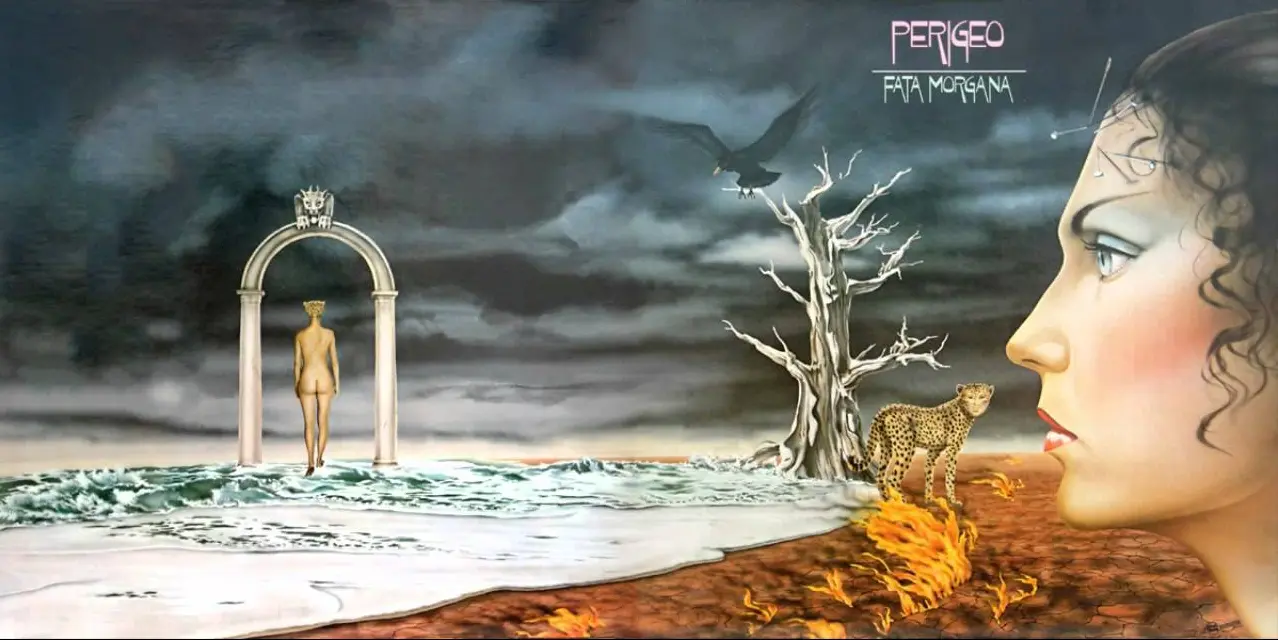 In North America, the album was released as Fata Morgana with alternate artwork. The surreal cover depicts a symbolic desert seascape under a turbulent sky. At the center, a nude figure walks through a Greco-Roman archway standing in the surf, facing away toward the horizon. To the right, a bare white tree, a perched black bird, and a leopard occupy a scorched landscape of dry earth and curling flames. A large female face, rendered in profile and heavily stylized, dominates the right foreground with an expression of focus or trance, adorned with a small constellation on her temple. The entire scene merges classical imagery with dreamlike elements, conveying ambiguity, tension, and transformation.
Alice
Perigeo released their sixth and final studio album, Alice, in 1980 as Perigeo Special.
Though framed as a reunion, the album features only Giovanni Tommaso from the classic quintet on every track, with intermittent contributions from the original members and a large roster of guest vocalists, studio musicians, and orchestral players.
Conceptualized by lyricist Maurizio Monti, Alice reimagines Lewis Carroll’s Alice in Wonderland as a surreal, contemporary coming-of-age narrative. Structured as a double LP, the album combines through-composed jazz-fusion, art-pop balladry, voice-acted narration, and theatrical interludes. It functions as a hybrid concept album and musical drama, alternating between instrumentals, sung sections, and character monologues. Eight of the thirteen tracks feature narration by actress Lina Sastri, with additional voice roles by children Simona Di Sabatino and Carlotta Miti.
Giovanni Tommaso composed twelve of the thirteen tracks, plays electric and acoustic bass, synthesizer, and sings on two cuts. He also co-produced the album. Franco D’Andrea (piano, Rhodes, synthesizer), Bruno Biriaco (drums), Claudio Fasoli (saxophone), and Tony Sidney (guitar) each appear on select tracks. The broader ensemble includes string and horn sections, multiple guitarists, percussionists, and keyboardists, including Paolo Rustichelli on Mellotron and synths. Pete Pedersen did not return; arrangements were handled internally with orchestration performed by members of L’Unione Musicisti di Roma and the vocal group I Cantori Moderni di Alessandroni.
Monti penned all lyrics, except “Bullo e pupa,” co-written with Nino Buonocore, who also sings lead on that track. Additional vocal cameos include Ivan Cattaneo, Lucio Dalla, Rino Gaetano, Maria Monti, Anna Oxa, and Jenny Sorrenti. The ensemble unites for the finale, “Confusione gran confusione,” which combines courtroom dialogue, satirical interjections, and ensemble choruses.
A1. “Bella la città” [Beautiful Is the City] (3:50) — compact opener with electric piano, multi-guitar arrangement, and tight rhythm section interplay
A2. “Il viaggio (ovvero sogghigni e sesso)” [The Journey (or: Smirks and Sex)] (4:47) — narrated by Lina Sastri; synth programming and guitar create an episodic backdrop
A3. “Al bar dello sport” [At the Sports Bar] (5:04) — character voices by Rino Gaetano and Maria Monti; features alternating sax, piano, and shifting dialogue exchanges
B1. “Il decalogo” [The Decalogue] (4:49) — instrumental with modal piano phrasing and layered ensemble arrangement under voice fragments
B2. “Il bruco” [The Caterpillar] (3:46) — sax-led narrative with interjections by Fasoli; features atmospheric synth layers
B3. “Mammina!” [Mummy!] (4:38) — lead vocals by Jenny Sorrenti over layered electric pianos and tumba percussion
B4. “Il quartiere” [The Neighborhood] (2:03) — instrumental interlude with multi-tracked guitars and flute overlays
C1. “Tea party” [Tea Party] (4:27) — features Lucio Dalla and Anna Oxa; electric piano and horn arrangement underscores satirical vocal exchanges
C2. “Il festival (ovvero Perigeo in concerto)” [The Festival (or: Perigeo in Concert)] (7:55) — instrumental showcase with solos by Sidney and Biriaco, framed as a meta-performance
C3. “Regina pop star” [Pop Star Queen] (3:23) — Ivan Cattaneo leads over distorted guitar, saxophone bursts, and punchy synth stabs
D1. “Bullo e pupa” [Bully and Babe] (3:25) — co-written with and sung by Nino Buonocore; features Mellotron and brass lines
D2. “La quadriglia delle aragoste” [The Lobster Quadrille] (5:13) — instrumental with child narration, harp, and atmospheric synth passages
D3. “Confusione gran confusione (ovvero il processo)” [Confusion, Great Confusion (or: The Trial)] (4:39) — final ensemble number with layered vocals, courtroom motifs, and multi-character reprise
Sessions spanned 1979–1980 at RCA Studio B in Rome with producers Maurizio Monti and Giovanni Tommaso.
Alice appeared in a gatefold with photos by Ren Pearson. RCA also issued a five-track Qdisc with alternate cover art, condensing the double album.
Discography:
- Azimut (1972)
- Abbiamo tutti un blues da piangere (1973)
- Genealogia (1974)
- La Valle dei Templi (1975)
- Non è poi così lontano (1976)
- Alice (1980 • Perigeo Special)
Sources:
- Discogs: Perigeo
- MusicBrainz: Perigeo
- RYM: Perigeo
- JazzMusicArchives: Perigeo
- ItalianProg: Perigeo
- ProgArchives: Perigeo
Artist/Album Pages:
Mémoriance was a French symphonic-rock band that released two albums and a standalone single betwe...
The Norman Haines Band was an English post-psych act led by the keyboardist and mastermind of Loco...
Dick Heckstall-Smith — aka Richard Malden (Sept. 26, 1934 — Dec. 17, 2004) — was an English jazz-r...
Burlesque was a comedic English sax-rock quintet that released back-to-back albums on Arista. Formed...
John Cale (born March 9, 1942) is a Welsh multi-instrumentalist and songwriter who emerged on the ...
Rhythm Machine was an American soul-funk septet from Indianapolis that released a self-titled albu...
Salamander was an English symphonic-rock band that released the album The Ten Commandments on Youn...
Analogy was a post-psychedelic rock band formed by German students in Italy. They released a 1972 al...
Murasaki was a Japanese hard-rock band from the island of Okinawa. They made the 1975/76 Bourbon a...
Lee Michaels is an American organist, singer, and songwriter who released six studio albums and a li...
The Perfect Circle was an American soul-funk band from Oakland that released a 1977 self-titled al...
Blues Creation was a Japanese hard-rock band that debuted with a 1969 Polydor album, followed by t...