

The Eleventh House was an American jazz-funk-rock supergroup led by guitarist Larry Coryell. They issued a self-titled album in 1974 on Vanguard, followed by the 1975–1976 Arista albums Level One and Aspects. Noted participants included drummer Alphonse Mouzon, keyboardist Mike Mandel, and trumpeters Randy Brecker and Terumasa Hino.
Members: Larry Coryell (guitar), Randy Brecker (trumpet, 1973-74), Mike Mandel (keyboards), Danny Trifan (bass, 1973-74), Alphonse Mouzon (drums, 1973-75), Michael Lawrence (trumpet, 1974-76), John Lee (bass, 1974-76), Gerry Brown (drums, 1975-76), Terumasa Hino (trumpet, 1976)
Background
The Eleventh House was formed in New York City in 1973 by jazz-rock guitarist Larry Coryell. Their first-recorded lineup featured trumpeter Randy Brecker, keyboardist Mike Mandel, bassist Danny Trifan, and drummer Alphonse Mouzon.
At the time of formation, Coryell had eight albums on assorted labels, starting with his 1969 self-titled release on Vanguard. He’d also played on albums by Chico Hamilton, Don Sebesky, Gary Burton, and Steve Marcus. His prior band, The Free Spirits, cut a pioneering jazz-rock crossover album in 1967. Recently, he partook in the Kraut-jazz ensemble Et Cetera.
Brecker, half of the famous Brecker Brothers duo, hailed from brass-rock initiators Blood Sweat & Tears, playing on their heralded 1968 debut Child Is Father to the Man. Along similar lines, he formed Dreams with brother Michael Brecker and drummer Billy Cobham. They released two albums in 1970/71: Dreams and Imagine My Surprise.
A well-established session player, Brecker played on more than 50 albums between 1966 and 1973, including titles by Air, Joe Beck, Horace Silver, Hal Galper, Leon Thomas, Lou Reed, The Free Design, The Escorts, and Todd Rundgren (A Wizzard, a True Star). His one prior solo release, Score (1969), features Coryell.
Mouzon was part of the jazz-funk supergroup Weather Report for their 1971 debut album. He’d also played on albums by Roy Ayers, Wayne Shorter, Eugene McDaniels, Bobbi Humphrey, Les McCann, Norman Connors, Doug Carn, and McCoy Tyner (Sahara). In 1973, he debuted as a solo artist with the Blue Note release The Essence of Mystery.
Mandell was a mainstay of Coryell’s backing band, having played on the guitarist’s 1969–73 titles Coryell, Barefoot Boy, Offering, and The Real Great Escape. Trifan, a relative newcomer, played on Buzz Linhart’s 1972 release Buzzy.
Introducing The Eleventh House With Larry Coryell
 The Eleventh House released their debut album, Introducing The Eleventh House With Larry Coryell , in May 1974 on Vanguard.
The album marked Coryell’s full pivot into tightly arranged jazz-rock with a high-powered quintet drawn from the New York fusion scene. It emphasized rapid ensemble figures, sharp sectional shifts, and compact structures designed for individual solo showcases. Sessions occurred one year prior to release, placing it in direct conversation with Mysterious Traveller, Hymn of the Seventh Galaxy, and Birds of Fire.
Coryell plays electric guitar throughout, matched in speed and invention by trumpeter Randy Brecker and keyboardist Mike Mandel, who alternates between Fender Rhodes and early synth textures. Alphonse Mouzon handles drums and percussion with high density and attack, while bassist Danny Trifan supports the low end with assertive pedal-point and sprinting patterns.
Coryell composed five of the album’s ten tracks, including the opener “Birdfingers” and the ambient “Theme for a Dream.” Mouzon contributed two numbers (“The Funky Waltz,” “Right on Y’all”), and Mandel wrote the funk-infused “Adam Smasher” and “Joy Ride.” German pianist Wolfgang Dauner contributed “Yin.” Brecker takes the bulk of the lead brass work, alternating between open and muted trumpet and occasional French horn.
“Birdfingers” begins with a tight drum fill and ascending scalar riff passed rapidly between trumpet, Rhodes, and guitar. “The Funky Waltz” unfolds in slow 3/4, with wah-toned guitar, pulsing Rhodes, and fluttering muted trumpet. “Low-Lee-Tah” holds a suspended tempo, layering distant horn and bend-heavy guitar over staggered rhythm. “Adam Smasher” and “Joy Ride” ride funk undercurrents, both shifting gears to allow Mandel’s synth voicings to alternate with Brecker and Coryell’s effects-driven solos. “Yin” builds from rhythmic abrasion into fast unison lines under searing leads. “Theme for a Dream” floats with soft guitar and trumpet phrasings over sparse piano clusters. “Gratitude A So Low” interjects a short, echo-laden guitar étude. “Ism-Ejercicio” cycles between slow-heavy riffs and fast breaks, ending in a complex tempo ramp. “Right on Y’all” closes the album with tight changes, trumpet-led charges, and brief drum solos under bright synth tones.
A1. “Birdfingers” (3:10)
A2. “The Funky Waltz” (5:12)
A3. “Low-Lee-Tah” (4:20)
A4. “Adam Smasher” (4:33)
A5. “Joy Ride” (6:11)
B1. “Yin” (6:06)
B2. “Theme for a Dream” (3:29)
B3. “Gratitude A So Low” (3:24)
B4. “Ism-Ejercicio” (4:02)
B5. “Right on Y’all” (4:20)
Sessions occurred in June 1973 at Vanguard 23rd Street Studio in New York City with producers Danny Weiss and Larry Coryell.
Vanguard issued the album in May 1974 on its Apostolic jazz imprint (VSD 79342), pressed with yellow labels and housed in a gatefold sleeve. The cover features a surreal cosmic landscape with floating spheres, alien flora, and a dual-faced winged figure by Jacques Wyrs, whose visual style recalls sci-fi paperback and Moebius aesthetics. The backside includes a full-band photo and liner notes outlining the album’s lineup and formation.
Level One
 The Eleventh House released their second album, Level One, in 1975 on Arista.
The album retained the group’s tightly coiled, high-velocity fusion sound while introducing a refreshed lineup and added brass textures. Bassist John Lee and trumpeter Michael Lawrence replaced Danny Trifan and Randy Brecker, joining returning keyboardist Mike Mandel and drummer Alphonse Mouzon. Coryell contributed three compositions but emphasized a democratic structure with writing and solo space shared evenly across the band.
Coryell plays electric guitar throughout, alternating jagged riffing with phase and wah-drenched solo flights. Mandel supplies electric piano and early analog synth textures, including thick brass patches and liquid runs. Lee’s fretless bass cuts sharply into the lower register while Mouzon drives each arrangement with heavy articulation and fluctuating polyrhythms. Lawrence alternates between open and muted trumpet and flugelhorn with bright dynamic phrasing.
Mandel composed two of Side One’s tracks, including the opening title cut, while Mouzon contributed two funk-fusion numbers. Coryell’s contributions dominate Side Two, including the tripartite “Suite.” Lee closes the album with “That’s the Joint,” a brassy sendoff. Guest musician Steve Khan plays 12-string guitar on the opening track, which he co-wrote.
“Level One” opens with stacked, staccato ensemble riffs that fracture into syncopated breaks under Coryell’s clipped phrasing. “The Other Side” rides a fast rhythm section pattern, eventually shifting into a bright trumpet passage and a distorted guitar solo over punctuated hits. “Diedra” pulls back into Rhodes voicings and ambient textures before unleashing modal brass and smooth guitar counterpoint. “Some Greasy Stuff” churns in a tight brass–guitar exchange before shifting abruptly into clipped solo sections. “Nyctaphobia” opens in double-time with breakneck syncopation, pitting wide trumpet lines against fast unison bursts and fractured synth tones.
“Suite” unfolds in three parts, beginning with electric density (“Entrance”), dropping into a slow trumpet ballad over oceanic bass (“Repose”), and concluding with a Latin-coded acceleration (“Exit”). “Eyes of Love” offers a solo acoustic piece with clipped patterns and open tuning harmonics. “Struttin’ with Sunshine” alternates marching rhythm guitar with keyboard bursts and brief horn phrases. “That’s the Joint” layers muted trumpet and distorted guitar over brisk rhythmic pacing.
A1. “Level One” (3:02) — written by Mike Mandel and Steve Khan
A2. “The Other Side” (4:35) — written by Michael Lawrence
A3. “Diedra” (3:56) — written by Mike Mandel
A4. “Some Greasy Stuff” (3:30) — written by Alphonse Mouzon
A5. “Nyctaphobia” (4:04) — written by Alphonse Mouzon, who re-recorded the track for his 1977 album Virtue.
B1. “Suite: Entrance / Repose / Exit” (5:32) — written by Larry Coryell
B2. “Eyes of Love” (2:25) — written by Larry Coryell
B3. “Struttin’ with Sunshine” (3:20) — written by Larry Coryell
B4. “That’s the Joint” (4:03) — written by John Lee
Sessions occurred in early 1975 at Electric Lady Studios in New York City with producers Skip Drikwater, Vince Cirrincione, and Tom Tom Paine. The production emphasized tight rhythm section tracking and close-miked horn layers, using multi-mono isolation to highlight Mandel’s keyboards and Coryell’s pedal-processed guitar tone.
Arista issued the album (AL 4042) in a single sleeve designed around a diamond-framed photo grid with spotlight fades. The front shows individual portraits of the five members—including Coryell, Mouzon, Khan, Lee, and Lawrence—against a burnt orange background, styled by photographer David Gahr.
Level One reached No. 23 on the Billboard Jazz Albums chart and No. 163 on the Billboard 200.
Aspects
 The Eleventh House released their third album, Aspects, in 1976 on Arista.
The album introduced a deeper funk influence and a more layered sonic architecture with guest brass and percussion players. Drummer Gerry Brown and bassist John Lee form the core rhythm team, with Japanese trumpeter Terumasa Hino replacing Randy Brecker. Coryell interweaves funk, fusion, and acoustic stylings, alternating between band-driven tracks and solo guitar excursions.
Coryell plays electric and acoustic guitar, shifting between aggressive fuzz-toned leads and clean acoustic passages. Keyboardist Mike Mandel adds analog textures and electric piano across most tracks. Hino solos on trumpet and flugelhorn, joined on occasion by Randy Brecker (trumpet), Michael Brecker (tenor sax), and David Sanborn (alto sax). Steve Khan plays acoustic on one number, while Danny Toan contributes rhythm guitar. James Mtume adds percussion on select cuts.
Coryell composed three of the album’s eight tracks, including the acoustic “Rodrigo Reflections” and the closing title piece. Mandel contributes two, while bassist John Lee co-wrote “Yin-Yang” with Brown and composed “Ain’t It Is.” Rhythm guitarist Toan penned “Titus,” and Mandel’s “Pyramids” continues his role as the group’s keyboard composer.
“Kowloon Jag” opens with distorted guitar and sharp ensemble hits under a phased funk-rock rhythm. “Titus” layers wah guitar and R&B horns into a compressed funk groove, punctuated by Sanborn’s alto sax solo. “Pyramids” builds on slinky handclaps, slap bass, and blues guitar phrasing over phased keyboard runs. “Rodrigo Reflections” strips the band down to solo acoustic guitar with tabla-like effects, cycling through plucked arpeggios. “Yin-Yang” opens Side Two with full brass and a clipped funk cadence; syncopated hits make space for horn–guitar tradeoffs. “Woman of Truth and Future” floats on electric piano with a repeating ostinato phrase that gains intensity as synth leads and guitar soloing enter the foreground. “Ain’t It Is” builds from bass ostinato through horn voicings and clavinet riffs into layered brass and compressed guitar distortion. “Aspects” closes the album at high speed with a dense rhythmic core and cascading brass–guitar lines.
A1. “Kowloon Jag” (5:48) — written by Larry Coryell
A2. “Titus” (5:30) — written by Danny Toan
A3. “Pyramids” (5:22) — written by Mike Mandel
A4. “Rodrigo Reflections” (4:38) — written by Larry Coryell
B1. “Yin-Yang” (4:44) — written by John Lee and Gerry Brown
B2. “Woman of Truth and Future” (6:08) — written by Mike Mandel
B3. “Ain’t It Is” (5:03) — written by John Lee
B4. “Aspects” (4:25) — written by Larry Coryell
Sessions occurred in 1976 at 23rd Street Studio in New York City with producer Danny Weiss. The album features overdubbed horn sections and layered percussion, captured in staggered sessions to accommodate the guest lineup of Brecker brothers, Sanborn, Mtume, and Khan.
Arista issued the album (AL 4095) in a standard sleeve with a moody, sepia-toned photo of a translucent female figure descending a staircase, captured in motion blur. The photograph was taken by Moshe Brakha, and the layout features minimalist Helvetica text placement on black framing.
Larry Coryell & The Eleventh House at Montreux
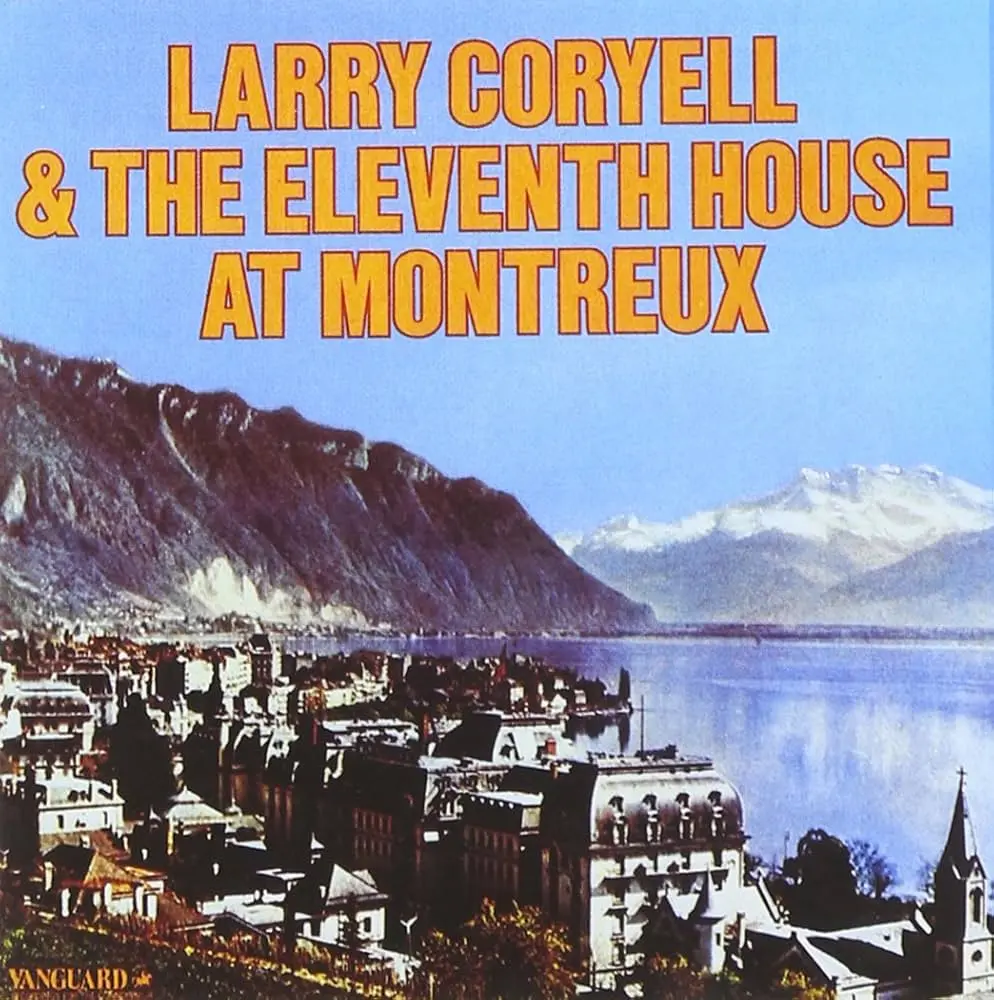 In July 1978, Vanguard issued Larry Coryell & The Eleventh House at Montreux, a document of their set at the 1974 Montreux Jazz Festival (7/4/74).
The set captures the original touring lineup midway between their debut and Level One, featuring early material and otherwise unrecorded compositions. Though released four years later, the album functions as a de facto fourth Eleventh House release, offering studio-quality sound and original repertoire that rivals their official studio output.
Coryell plays both acoustic and electric guitar, opening the set with a classical prelude before switching to heavily amplified phrasing. Mike Mandel adds electric piano and synth accents. Trumpeter Mike Lawrence fronts the brass work, with Danny Trifan on bass and Alphonse Mouzon on drums. The band maintains tight formation across tempo shifts, mixing blues progressions, fast modal runs, and funk-oriented segments.
Coryell opens with “Improvisation on Villa Lobos,” a solo piece adapted from Prelude No. 4 in E Minor. Mouzon’s “Tamari” follows with layered rhythmic figures and bright melodic phrasing across its syncopated structure. Mandel’s “Joyride” appears in an extended version with elongated keyboard interludes and compressed guitar lines. “Rasputin” blends smooth funk phrasing with biting trumpet voicings. “Song for a New York Rainmaker” shifts between ballad textures and syncopated passages. “The Eleventh House Blues” closes the set with slow thematic variation, trumpet–guitar call-and-response, and a climactic unison breakdown.
A1. “Improvisation on Villa Lobos – Prelude No. 4 in E Minor” (3:07) — solo acoustic guitar
A2. “Tamari” (4:32) — written by Alphonse Mouzon
A3. “Joyride” (9:35) — written by Mike Mandel
B1. “Rasputin” (4:13) — written by Mike Mandel
B2. “Song for a New York Rainmaker” (4:25) — writer unlisted
B3. “The Eleventh House Blues” (8:40) — writer unlisted
Sessions occurred live on July 4, 1974, at the Montreux Jazz Festival in Switzerland. The album was produced by Danny Weiss and released by Vanguard Recording Society, Inc.
Larry Coryell & The Eleventh House at Montreux captures the band in peak live form and stands as a vital entry alongside their studio trilogy.
Discography:
- Introducing The Eleventh House With Larry Coryell (1974)
- Level One (1975 • The Eleventh House featuring Larry Coryell)
- Aspects (1976 • The Eleventh House Featuring Larry Coryell)
- Larry Coryell & The Eleventh House at Montreux (1978 • Larry Coryell & The Eleventh House)
- Seven Secrets (2017)
Sources:
- Discogs: The Eleventh House
- 45worlds: The Eleventh House
- RYM: Directory of Jazz-Funk Albums
- ProgArchives: The Eleventh House
Artist/Album Pages:
Fiona Flanagan is an American hard-rock singer who debuted with the 1985 Atlantic release Fiona, w...
Jimmy Jackson (1945–2003) was an American soul singer from Harlem who released the 1976 album Rol...
Maelstrom was a Québécois symphonic-art-rock band that recorded an album's worth of material in 1976...
Zanov is the performance name of French electronic musician Pierre Salkazanov, who released two albu...
Gregory James Edition was an American jazz-funk trio that released the 1973 album Prophets of Soul...
Beckett was an English rock band from Newcastle that released a self-titled album on Raft Records in...
Cherry Five was an Italian symphonic-rock band that released a 1975 self-titled album on Cinevox. ...
Frode Thingnæs (May 20, 1940 — Nov. 15, 2012) was a Norwegian trombonist, composer, and arranger w...
Andy Fraser (July 3, 1952 — March 16, 2015) was an English bassist and songwriter who rose to prom...
Jon Faddis (born July 24, 1953) is an American jazz-funk trumpeter, conductor, and composer from ...
A-440 was an American rock band from Houston that released three local garage-psych singles in 19...
Dave Valentin (April 29, 1952 — March 8, 2017) was an American jazz-funk and Latin-jazz flutist fr...