
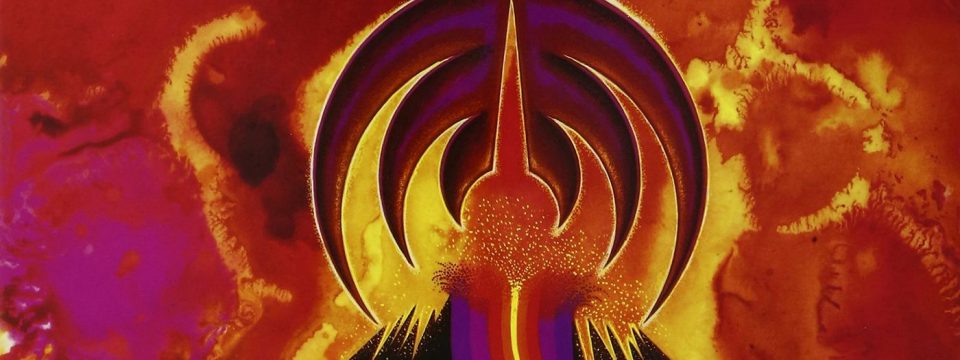
 1001° Centigrades — initially titled Magma 2 — is the second album by the French Zeuhl ensemble Magma, released on October 5, 1971, on Philips.
The narrative from their first album continues as the Kobaïans return to Earth and share their knowledge, ultimately meeting resistance that culminates in confinement and ideological tension.
Louis Toesca and multi-reed player Yochk’o Seffer expand the group’s tonal palette. Drummer Christian Vander provides one composition; saxophonist Teddy Lasry and pianist François Cahen each supply one.
The side-long opening movement unfolds with large-ensemble density, while the flip side divides into two jazz-leaning constructions marked by nocturnal harmonic colors, insistent ostinati, and declamatory vocal activity.
Sessions occurred at Studio Europa Sonor in Paris with producer Roland Hilda and engineer Dominique Blanc-Francard.
A1. “Rïah Sahïltaahk” (21:45)
The piece opens with sustained wind chords that establish harmonic ambiguity before the ensemble tightens around a pulsating rhythmic pattern. Vander directs incremental intensity as piano figures cycle in regimented cells. Trumpet and saxophone enter in staggered responses, generating friction between ascending and descending lines. The vocals articulate ritualistic cadences that land on clipped consonants, pushing against shifting meters.
As the central theme gains momentum, bass cycles anchor the movement while clustered horns surge in parallel motion, thickening registral space. A contrasting midsection withdraws into a looser piano-led landscape where reeds trade angular gestures above lightly brushed percussion. Transitional phrases realign as brass punches cue a return to march-like propulsion. Vocal proclamations escalate in density, riding cymbal splashes and bass ostinati toward a climactic passage marked by tightly voiced brass harmonies.
The final segment compresses these materials into terse exchanges, ending on a decisive chord that preserves unresolved narrative tension.
B1. “Iss Lanseï Doïa” (11:23)
The track enters on a subdued harmonic plane where piano outlines repeating shapes against quietly pattered percussion. A lyrical saxophone phrase drapes over the texture, soon tightened by trumpet accents. Vander gradually increases rhythmic subdivision, prompting the horns to answer in overlapping intervals. Bass clarifies the pulse with a measured ostinato, giving the vocals room to enter in elongated syllables that hover above the ensemble.
Midway, the winds adopt sharper articulations and pivot into dissonant chord stacks, producing a sense of encroaching pressure. Piano chords harden into percussive strikes, while cymbals broaden the dynamic ceiling. A brief reduction isolates reeds against bass clarinet murmurs, creating a transitional space before the ensemble reassembles.
Near the conclusion, voice and brass converge into martial declarations, using short repeated cells that narrow harmonic mobility. The piece settles on a curt final gesture, leaving harmonic residue suspended.
B2. “Ki Ïahl Ö Lïahk” (8:36)
An opening fanfare of trumpet and alto sax sets a compact motif that the ensemble expands rhythmically. Bass aligns in tight intervals with piano punctuations, shaping a forward-angled groove. The vocals enter with clipped, percussive syllables that press into the meter, intensifying momentum. Reeds adopt swirling countermelodies, cascading across harmonic pivots while the piano anchors the progression. A contrasting interior passage withdraws into hushed electric-piano figures, allowing bass clarinet to color the low register.
Gradually, drums inflate the texture with rolling tom patterns that cue a rising brass line. The final ascent stacks horns in vertical harmonies against shouted vocal fragments, tightening rhythmic spacing until the ensemble lands on a sharply terminated cadence.
Closing Summary
Across three compositions, 1001° Centigrades heightens Magma’s ensemble precision through dense wind voicings, regimented rhythmic frameworks, and a more pronounced jazz orientation than its predecessor. The absence of guitar opens harmonic space for brass and reeds to dominate thematic exchanges. Vocal strategies grow sharper, interacting with instrumental patterns rather than floating above them. By compressing narrative conflict into focused structures, the album advances the Kobaïan storyline and sets the foundation for the ensemble’s escalating stylistic identity in the years to follow.
Tracklist:
A. “Rïah Sahïltaahk” (21:51)*
B1. “”Iss” Lanseï Doïa” (11:45)**
B2. “Ki Ïahl Ö Lïahk” (8:38)
*(:01-4:36-7:50-10:35–12:20-13:15-18:38–21:00)
**(:01-3:40, 4:55-9:50)
Credits:
Klaus Blasquiz — vocals, percussion
François Faton Cahen — piano, fender rhodes electric piano
Francis Moze — bass
Christian Vander — drums, vocals, percussion
Teddy Lasry — clarinet, saxophone, flute, vocals
Jeff Seffer — saxophone, bass clarinet
Louis Toesca — trumpet
Louis Sarkissian — manager
Roland Hilda — producer
Dominique Blanc-Francard — recording engineer
Artist/Album Pages:
Patrick Gauthier is a French keyboardist and composer who played in Heldon, Magma, and Weidorje du...
Frumpy 2 is the second album by German symphonic/hard-rock/soul outfit Frumpy, released in 1971 on P...
Tarkus is the second studio album by the English symphonic-rock trio Emerson, Lake & Palmer, rel...
Time of the Last Persecution is the second of two 20th century albums by English singer/songwriter B...
Battle Hymn is the first of two albums by English hard-rock/folk band Wild Turkey, released in 1971 ...
The Inner Mounting Flame is the debut album by multinational jazz-rock ensemble the Mahavishnu Orche...
Air is the singular album by the namesake American jazz-pop quartet, produced by Herbie Mann and rel...
Thirds is the third album by American hard-rock/art-rock band the James Gang, released in 1971 on AB...
Acquiring the Taste is the second album by English art-rock sextet Gentle Giant, released in 1971 on...
Of Wondrous Legends is the singular album by the namesake American psychedelic folk ensemble, altern...
Fuchsia is the singular album by the namesake English chamber-folk/rock combo, released in 1971 on P...
Offering was a French jazz-rock/Zeuhl project headed by Magma mastermind Christian Vander. The pro...