

Gina X Performance was a German electronic project led by Gina Kikoine and producer Zeus B. Held, known for merging vocoder textures, sequencer architecture, and performance art into a distinctive synthetic language. Their early tracks “No G.D.M.” and “Nice Mover” became underground club staples across Europe for their clipped rhythms and stylized vocal presence. Between 1979 and 1984, they released four albums that traced a trajectory from minimalist electronic cabaret to dense, Fairlight-driven abstraction.
Members: Gina Kikoine (vocals), Zeus B. Held (production, multi-instrumentalist)
Background
The Gina X Performance was assembled in Cologne, Germany, in 1978, by singer/lyricist Gina Kikoine (aka Claudia De Held) and keyboardist/producer Zeus B. Held. Drummer László Czigány was the other constant member for the first three albums.
Held (b. Bernd Held, 1950) was fresh off a five-year stint with hard-rockers Birth Control, where he served as keyboardist, co-writer, and occasional brass and string arranger on the albums Rebirth, Plastic People, Backdoor Possibilities, and Increase. He also guested on the 1975 second album by Hoelderlin. Most recently, he issued the solo album Zeus’ Amusement.
Nice Mover
 Gina X Performance released their debut album, Nice Mover, in November 1979 on EMI.
Zeus B. Held constructed the music from a matrix of interlocked analog synths, vocoder layers, and sequenced pulses, shifting tones across Mini Moog, Polymoog, ARP 2600, and ARP String Ensemble with interjections from Fender Rhodes and grand piano. Marcel Blanche added guitar textures in dialogue with Zeus’s modular figures, while Ralph Morgenstern and Serge Turek supported select arrangements. Gina wrote all the lyrics to Held’s music.
Nice Mover oscillates between clipped sequencer-driven cuts and slow-motion synthetic tableaux, with Zeus B. Held orchestrating each piece through tightly sequenced analog textures, vocoder overlays, and layered counterlines. The title track hinges on a recoiling bassline and stacked arpeggios under Kikoine’s elongated vowels, while “No G.D.M.” marches forward on a rigid loop with detours into code-switching and wry commentary. “Casablanca” unfurls slowly over a piano-synth ostinato, brushed with fugue-like phrases and layered vocoder textures that blur into an extended fade. “
Exhibitionism” opens with a reverberant synth ping and places Kikoine’s lucid phrasing against luminous overlays and a clipped stylophone break. “Plastic Surprise Box” spins with a mechanical urgency, twisting oscillated pulses around a steadily rising pitch-bend spiral. “Black Sheep” carries a bobbing bass pulse and interjects bright synth stabs before cutting to an arching ARP interlude. “Tropical Comic Strip” stages its entry with ambient field noise before a detuned piano figure drifts beneath spoken phrases that slide in and out of metric alignment. Across the album, Held favors balance and restraint, spacing every phrase with faint modulations and allowing parts to drift and retract without collapse. Kikoine’s vocal presence veers from arch and declarative to hushed and vaporous, often phasing into the synthetic bed rather than sitting above it.
A1. “Nice Mover” (4:30)
A2. “No G.D.M. (Dedicated to Quentin Crisp)” (5:55)
A3. “Plastic Surprise Box” (3:05)
A4. “Casablanca” (5:35)
B1. “Be a Boy” (4:00)
B2. “Exhibitionism” (5:00)
B3. “Black Sheep” (3:45)
B4. “Tropical Comic Strip” (5:05)
They recorded and mixed the album in summer 1978 at The Sound Experience Studio at Dom, Cologne, with Martin Hömberg overseeing engineering, mixing, and additional sequencing. Zeus produced the album and executed all keyboard arrangements, with László Czigány supplying live drums. They processed the tracks using analog and digital delays and flangers to deepen the tonal motion.
The Nice Mover cover shows a fashion-forward Kikoine sporting mesh gloves and an unzipped, studded leather jacket over a lace bra, foreshadowing ’80s-era Madonna wardrobes by more than five years. Photographer Dieter Eikelpoth (Key, Silvia) and the typographic firm Ink Studios (Cream, Family, Jack Bruce, Kraftwerk) took credit for the album’s visual package.
EMI issued “Do It Yourself” backed with “No G.D.M.” as a UK single on October 12, 1979 (EMI 2997). “No G.D.M.,” written in tribute to English writer Quentin Crisp, whom Kikoine personally knew, became a breakthrough for the group and led to a 14,000-capacity festival performance in Vienna alongside Boney M.
X-traordinaire
 Gina X Performance released their second album, X-traordinaire, in September 1980 on EMI.
Zeus B. Held constructed the arrangements around electronic textures and brass overlays, weaving layers of sequenced synthesizers with saxophone, harmonica, and tape-delay treatments. Guitarist Dierk Hill traded punctuated lines against Held’s keyboards, while clarinetist Petrol Willman and trombonist Curtis Cool framed select arrangements with low-end contrast. Gina Kikoine authored the lyrics; Zeus B. Held composed the music on all tracks except “Nowhere Wolf,” co-written with co-producer Jimmy Hömberg.
X-traordinaire pivots between processed intimacy and ornamental excess, with Zeus B. Held arranging an expanded palette of brass, wah-pedaled guitar, and synthetic percussion around Gina Kikoine’s sharpened phrasing. “Strip Tease” opens on a tight, mid-tempo pulse with horns placed in angular bursts, rising and falling against her syllabic delivery. “Do It Yourself” inserts harmonica and saxophone into a clipped rhythm cycle, while “Cologne Intime” slows the pace into an exposed, fragmentary setting that highlights her phasing between spoken and sung tone. “Opposite Numbers” folds in darker textures over suspended harmonic figures, contrasting with the darting, spaced-out overlays of “Vendor’s Box,” which stretches the stereo field with bright ascending tones and breathy layers.
“Ciao Caruso” floats across near-stillness, framing Kikoine’s phrasing between static synth clusters, sampled opera fragments, and incidental motifs that fade into each other. “Nowhere Wolf” layers stuttering rhythm elements against a downcast melodic contour, shadowed by low textures and a flat vocal cadence that leans into thematic drift. Zeus disperses the elements with precision, spacing bursts of rhythm and tonality while allowing stray accents—brass, echo, or synthetic shimmer—to reframe the vocal in shifting light.
A1. “Strip Tease” (5:18)
A2. “Do It Yourself” (5:26)
A3. “Opposite Numbers” (4:30)
A4. “Cologne Intime” (6:02)
B1. “Weekend Twist” (3:01)
B2. “Nowhere Wolf” (4:50)
B3. “Vendor’s Box” (4:35)
B4. “Ciao Caruso” (10:15) – dedicated to Andalusian poet Federico García Lorca and Italian tenor Enrico Caruso, with a sample of Caruso singing “O Libiamo Ne` Lieti Calici” from La Traviata.
They recorded X-traordinaire in Cologne as a ZORRO Production with Zeus B. Held and Jimmy Hömberg handling production. Held programmed and performed all keyboards, electronics, and percussion. Jimmy Hömberg co-produced the sessions and contributed to arrangement and sound design. László Czigány returned on drums. Herman Schulte directed the album’s visual presentation. Voice Versa published the material under license from Zorro Musikverlag GmbH.
EMI UK issued “Weekend Twist” backed with “Nice Mover” as a single on May 9, 1980 (EMI 5062). Electrola followed with “Strip Tease” backed with “Cologne Intime” (1C 006-45 996) in Germany later that year.
Voyeur
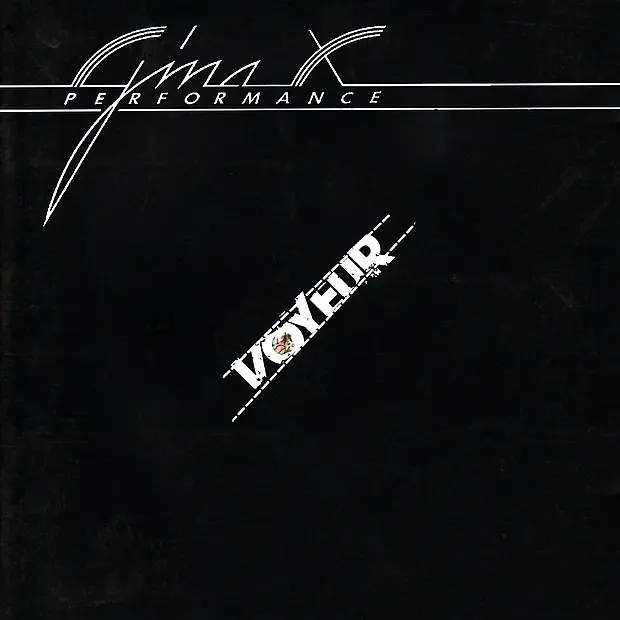 Gina X Performance released their third album, Voyeur, in 1981 on EMI.
Zeus B. Held sequenced the electronic arrangements with layered textures built from vocoder, synthesizer, and electronic percussion, framed by co-writer Jimmy Hömberg’s harmonic structures on two tracks. Guitarist Dirk Hill added synthetic guitar lines that thread through Held’s pulsed keyboard shapes. Gina Kikoine conceived the lyrics and visual direction; Zeus B. Held composed the music on most tracks, with Jimi Hömberg co-authoring “Kaddish” and “Hom Intern.”
Voyeur tightens Gina X’s sound into a colder, nocturnal frame, with Zeus B. Held building rigid sequencer grids and clipped synth attacks that leave wide negative space around Gina Kikoine’s phrasing. “Babylon Generation” drives with an electronic sprint—fast, insistently metered, and stacked with bright, slightly skewed lead tones—while “Video Dragueur” slows into a somnambulist march, its motion defined by repeat-patterns and delayed accents that keep the pulse half-lit. “Hypnosis / Hypnose” sustains a steady, trance-like cycle, then “Pederast Dissection” pushes the tension higher through dramatic rises and hard-edged breaks.
“Kaddish” folds ritualistic spoken passages into an uneasy structure where a sudden synth lead feels deliberately misplaced against the subject matter. “Hom Intern” stretches into a longer, feverish build with prominent chorus voices and escalating density, then “Kiruna” closes in an incantatory mode, more about sustained atmosphere and repetition than release. Across the album, Held privileges rhythmic architecture over flowing lines, letting mechanical insistence and abrupt tonal turns carry the emotional weight.
A1. “I.C. Code” (3:26)
A2. “Horror Vacui” (4:40)
A3. “Babylon Generation” (4:07)
A4. “Kaddish” (4:16)
A5. “Video Dragueur” (4:47)
B1. “Hypnosis / Hypnose” (4:19)
B2. “Pederast Dissection” (4:01)
B3. “Hom Intern” (5:55)
B4. “Kiruna” (5:16)
They recorded Voyeur in Cologne with Held and Martin Hömberg producing and mixing the music tracks. Gina Kikoine handled the vocal sessions, assisted by Held, who also arranged and recorded all vocal tracks. Sessions took place in March and April 1981 at The Sound Experience studio. Zeus played all keyboards and vocoder parts. Dirk Hill acted as co-arranger on “Hom Intern” and played synthesized guitar across the album. Bassist Bernd Renn and drummers Zeebee and László Czigány contributed to various tracks. Ralph Morgenstern and Hinrich Sickenberger supplied backing vocals, with Sickenberger also playing kettle drums and gong. M.A.F. Räderscheidt designed the cover art, with graphics by Thomas Schneider.
EMI UK issued “I.C. Code” backed with a short version of “No G.D.M.” as a single on February 12, 1982 (EMI 5274).
In 1982, Gina sang guest vocals on “Love Shadow,” a single from Fabrique, the Held-produced second album by Brummie new-popsters Fashion.
Yinglish
 Gina X released her fourth album, Yinglish, in 1984 on Statik.
Zeus B. Held constructed the tracks from intersecting layers of Fairlight programming, synthetic textures, and processed electrovoice effects, counterpointed by guitarist Dierk Hill’s clipped accents and voice interjections. Hill and Held traded phrases across sequencer beds shaped by J.J. Jeczalik, while Gina Kikoine supplied all lyrics and conceptual direction. Most of the music was composed by Zeus, with Christian Gence co-authoring “BB 50” and Jimi Hömberg absent for the first time since 1980.
Yinglish opens on a rigid, extended reading of “Drive My Car,” where processed syllables stretch across a mechanical pulse with bright accents spaced at regular intervals. “Harley Davidson” inserts clipped rhythm guitar over a narrow loop and places Gina’s phrasing in both exaggerated and underplayed forms. “Kanal Banal” rides on a mid-tempo sequence, layered with block-like patterns and voice interjections that dissolve into the backing track.
“Martyr to Music” overlays choral voices with a flanged shimmer and syncopated delay, while “BB 50” pieces together angular parts—chopped samples, Fairlight splinters, voice fragments—into a descending cadence that feels both diffuse and deliberate. Across the album, Held and Jeczalik render the electronic elements in polished layers, placing each phrase into clean, insulated compartments that isolate Gina’s shifting presence in English, German, and French.
A1. “Drive My Car” (6:12)
A2. “Die Kunst des Liebens (The Art of Loving)” (3:38)
A3. “Harley Davidson” (3:06)
A4. “Thanatos Tanzt” (6:38)
A5. “French Lift” (3:54)
B1. “Kanal Banal” (3:17)
B2. “Londra” (3:27)
B3. “Waiting” (4:20)
B4. “En Vogue” (3:34)
B5. “BB 50” (4:52)
B6. “Martyr to Music” (4:52)
They recorded and mixed the album at Studio Saint-Nom-la-Bretèche outside Paris, with additional sessions held at Odyssey Studios, The Garden, and The Barge in London. Held produced the album and handled all keyboards, electrovoice, and supplemental recording. Christian Gence and Denis Vanzetto engineered the main sessions, with Marc Frank contributing additional recording in London. J.J. Jeczalik programmed and coordinated Fairlight operations. Drummer Mel Gaynor contributed additional percussion. Kikoine handled the album’s conceptual layout and artistic direction. Bill Smith designed the front cover; Johnny Rozsa supplied the photography.
 Statik issued “Drive My Car” backed with “Waiting” in 1984 (TAK 21). A second single paired “Harley Davidson” with “Kanal Banal (Basic Move Part 1)” (TAK 26). Statik also pressed a limited expanded edition of Yinglish with alternate mixes and additional tracks on bonus 12″ vinyl, including “Dance the Car,” “Drive on Film,” and reworked versions of “Die Kunst des Liebens,” “Londra,” and “Waiting.”
Discography:
- Nice Mover (1979)
- X-traordinaire (1980)
- Voyeur (1981)
- Yinglish (1984 • Gina X)
Sources:
- Discogs: Gina X Performance
- RYM: Gina X Performance
- 45cat: Gina X Performance
- MusicBrainz: Gina X Performance
- LTM Recordings: Gina X Performance
Artist/Album Pages:
Propaganda was the German synthpop band behind the 1984 EP Present the Nine Lives of Dr. Mabuse an...
Ocean was an American jazz-rock band that self-released the 1982 album Sunrise on Ocean Sounds Rec...
Odin was an English-Continental hard-rock/psych band based in Bayern, Germany, that released a 197...
The UK Players were an English funk band that released three singles on A&M circa 1980/81, fol...
John Valenti is an American vocalist and drummer from Chicago who played in the Motown brass-rock ...
Sicher was a Swiss symphonic-rock band that self-released an eponymous album in 1981. Profile ...
Trickster was an English rock band that released the album Find the Lady on Jet in 1977, followed ...
The Meditations are a Jamaican roots-reggae vocal trio formed in 1974 by Ansel Cridland, Danny Cla...
Frank Zappa (December 21, 1940 — December 4, 1993) was an American musician, composer, producer, ...
Falco (Feb. 19, 1957 — Feb. 6, 1998) was an Austrian new wave singer and songwriter who landed a n...
Taurus was a Dutch symphonic-rock band behind the 1981 album Illusions of a Night on Multi Records...
Metropolis was a German symphonic-rock band that released a self-titled album in 1974 on PAN. Me...