

The Happy Family was a Scottish new wave/art-pop band on 4AD, formed by Josef K bassist Dave Weddell with singer/songwriter Nick Currie, who later recorded as Momus. After their 1982 EP Puritans, drummer Ian Stoddart cleared for Josef K alumnus Ronnie Torrance, who played on the lone Happy Family album, The Man on Your Street.
Members: Nick Currie (vocals), Malcolm Ross (guitar), Davy Weddell (bass), Ian Stoddart (drums), Ronnie Torrance (drums)
Background
The Happy Family formed in Edinburgh in 1981 when literature student Nick Currie left college to start a band with bassist Dave Weddell and guitarist Malcolm Ross, both of the recently disbanded Josef K. Drummer Ian Stoddart completed the initial lineup, which soon lost Ross to Orange Juice. The group landed at 4AD and entered 1982 with one EP already in hand.
Puritans
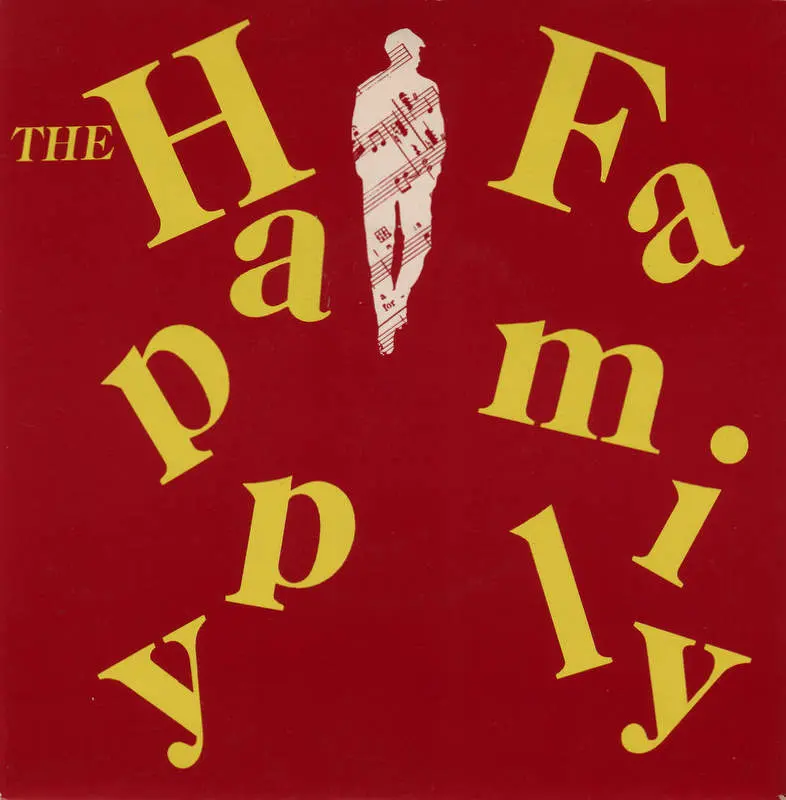 In March 1982, The Happy Family released Puritans, a three-track EP on 4AD.
Nick Currie fronts the first-recorded lineup with bassist Dave Weddell, drummer Ian Stoddart, and guitarist Paul Mason, while Malcolm Ross remains closely tied to the release and receives a sleeve thank-you. Currie wrote the two B-sides alone and shared the title track with Weddell and Ross.
“Puritans” chimes through staccato accents and ringing guitar figures under dry, unsparing production. “Innermost Thoughts” settles over a fully flanged bass figure with a delicate, portentous cast. “The Mistake” lingers in doleful resonance beneath a pained lead delivery.
A. “Puritans” (3:15) — A relationship has reached emotional stasis as the couple watches other lovers for signs of the intimacy missing from their own lives. A telling passage studies strangers’ faces for evidence of emotional connection.
B1. “Innermost Thoughts” (3:18) — The narrator recalls proposing marriage to a woman who has already spoken of leaving for Australia, while both treat complete self-disclosure as the basis of love. Their conversations resemble exchanged diary entries, turning intimacy into continuous confession.
B2. “The Mistake” (4:46) — Economic pressure teaches the couple to measure work, time, and personal worth through money, but they attempt to recover another set of values through commitment. The central image has the narrator reach for his wallet and accidentally draw out his heart, equating expenditure with the loss of life itself.
The Happy Family recorded Puritans at Palladium Studios in Edinburgh. Julie Duncan added flute, Tape One mastered the disc, and Gillian supplied the photography. Side A plays at 45 RPM and side B at 33⅓ RPM.
After Puritans, Stoddart left for Everest the Hard Way. Former Josef K and Boots for Dancing drummer Ronnie Torrance then joined, and keyboard player Neill Martin expanded the band to a five-piece for its album phase.
The Man on Your Street
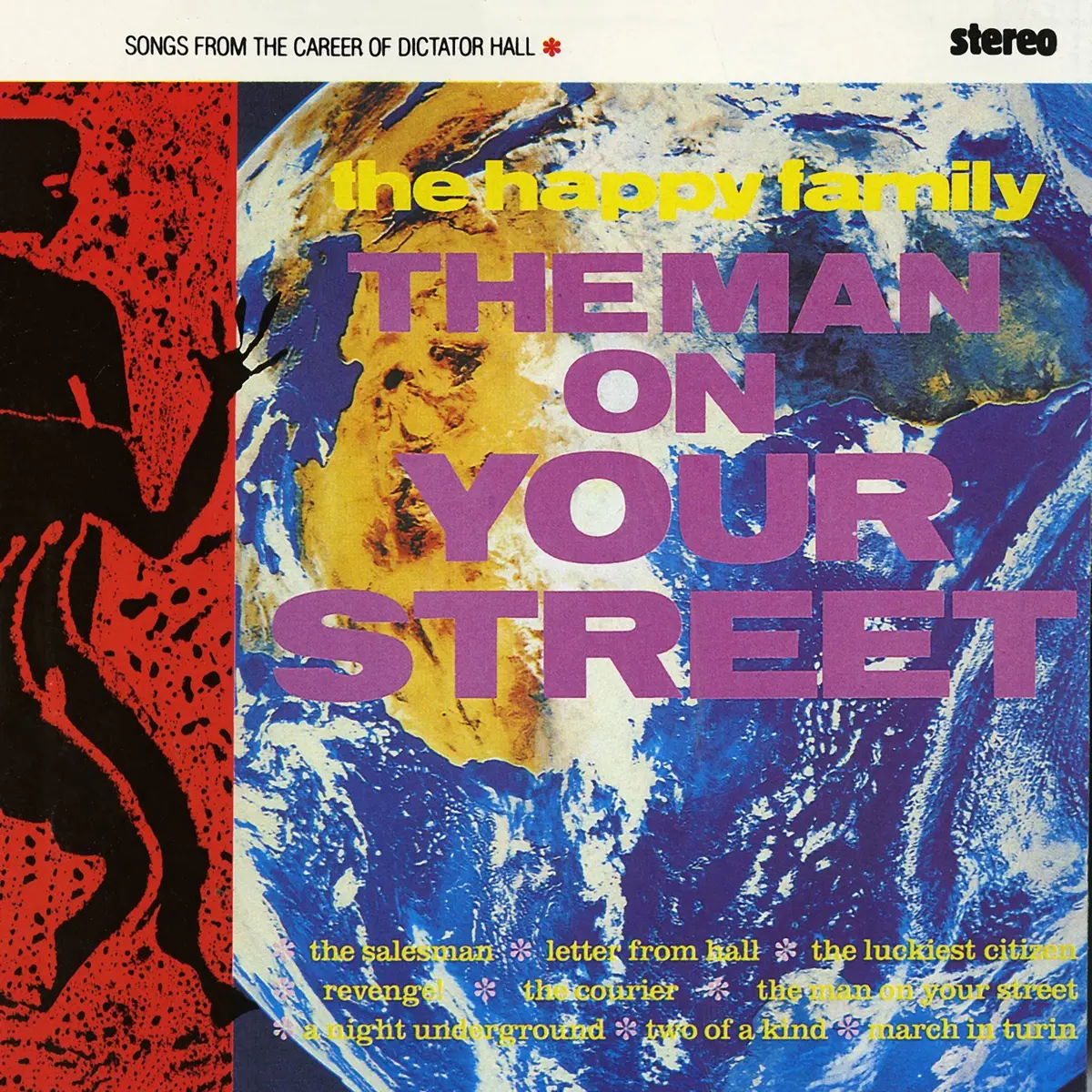 The Happy Family released their singular album, The Man on Your Street, on November 1, 1982, on 4AD.
Nick Currie leads a broadened lineup with guitarist Paul Mason, bassist Dave Weddell, keyboardist Neill Martin, and drummer Ronnie Torrance. Currie wrote eight of the nine songs. The album carries the subtitle Songs From the Career of Dictator Hall.
Musical guests include singer–violinist Kirsteen McCormick and reedist Steve Kettley, who adds flute and saxophone.
“The Salesman” winds through a nursery-like figure and whistled phrases with sing-song theatricality. “Letter from Hall” mounts slow verses into a circus-tinged chorus; a later bridge precedes a broad synth figure. “The Luckiest Citizen” waves bright verses on a buoyant bass figure, with recurring minor-key turns and a contrasting middle section. “Revenge!” glides through handclaps and saxophone accents. “The Courier” gathers dead narrators into a group-sung chorus.
“The Man on Your Street” pivots through sharply differentiated sections toward a calm spoken monologue under a melancholy cast. “A Night Underground” coasts through bright, jaunty phrases over a rubbery synth pattern. “Two of a Kind” loops through an extended wordless coda of repeated da-da and do-do phrases. “March in Turin” lingers over slower acoustic guitar accompaniment before a descending run of church bells.
A1. “The Salesman” (3:19) — An itinerant detergent salesman turns his sales pitch into evangelical doctrine, promising physical cleanliness and moral purification while presenting his own life as economic martyrdom. He contrasts the outward success of the self-made man with inward corruption and his own apparent failure with spiritual worth.
A2. “Letter From Hall” (3:39) — Hall writes from Lake Geneva after a lottery win, attacks democracy, invites the salesman’s wife to join him, and predicts that their children will become terrorists. By the close, the salesman recognizes Hall’s influence when his wife begins repeating ideas drawn from the letter.
A3. “The Luckiest Citizen” (4:34) — Hall addresses the salesman’s former partner as both mistress and political subject, joining sexual possession with authoritarian power while warning that she now knows too much to leave. He admits that domestic contentment bores the “father of the nation,” who requires rebellion even inside his own household.
A4. “Revenge!” (4:27) — The dying salesman summons his son Samuel and orders him to avenge the family by killing Hall and Maria. He imagines inherited violence as a means of keeping the shattered family connected after his death.
A5. “The Courier” (3:31) — Samuel becomes a messenger for competing political interests as he moves toward Hall, now married to his mother and elevated by wealth and electoral power. The dead men directing him want murder, commerce, assassination, and war to continue so later generations repeat the same destructive cycle.
B1. “The Man on Your Street” (4:46) — Hall recounts dictatorship as an extension of ordinary ambition, rationalizing coercion, political manipulation, sexual exploitation, and abuse while insisting on his essential normality. One image places his portrait on the nation’s currency, converting personal vanity into state authority.
B2. “A Night Underground” (4:57) — Samuel joins the Red Brigades and becomes involved with Hall’s daughter, whose hatred of her father follows his sexual assault on her. Revolutionary commitment, personal revenge, and erotic attachment converge as the militants pursue political immortality through violence.
B3. “Two of a Kind” (4:15) — Samuel and Hall’s daughter travel through Switzerland toward Italy as lovers and terrorists before the lyric reveals that they share the same mother and are half-siblings. At the frontier, a guard mistakes them for honeymooners; Samuel identifies them instead as terrorists.
B4. “March in Turin” (5:16) — The pair hides in Turin while awaiting the rescheduled assassination of a political target, treating conspiracy as both revolutionary duty and an intensified form of love. An embassy entrance becomes the defining image as they imagine its marble soon marked by blood while they wait for the operation to proceed.
The Happy Family engineered the album at Castlesound Studios with engineer Calum Malcolm and handled the production and arrangements themselves. Gillian McCormick supplied the front drawing, Mike Shepley shot the back-cover photo, and 4AD included a lyric sheet.
Postlude
The Happy Family split in 1983. Currie moved straight into solo work and soon adopted the name Momus. Malcolm Ross continued with Orange Juice, then joined Aztec Camera for their 1984 release Knife. Ronnie Torrance and Dave Weddell formed Heyday, which went undocumented. Stoddart later surfaced in electro-posters Win with former Fire Engines frontman David Henderson.
Les Temps Modernes issued This Business of Living as a cassette in July 1984. It gathered the band’s pre-4AD demo plus seven demos for The Man on Your Street. The tape ran in a plastic wallet with a 16-page booklet of interviews and press cuttings, and only about fifty copies were made. Its track list mixed album songs with otherwise unavailable material such as “The Distance” and “My Double,” which left it as a small-run odds-and-ends document rather than a formal second album.
Discography:
- The Man on Your Street (1982)
- Puritans (EP, 1982)
Sources:
- Discogs: The Happy Family
- RYM: The Happy Family
- 45cat: The Happy Family
- MusicBrainz: The Happy Family
Artist/Album Pages:
Jane Siberry is a Canadian singer, songwriter, and multi-instrumentalist who debuted with a 1981 f...
Cabaret Voltaire was an English electro/experimental band from Sheffield that released seven singl...
Charge was an English punk-rock/goth band that debuted with a 1980 live album on Trikont, surround...
Fingerprintz was a Scottish new wave band signed to Virgin Records. Between 1979 and 1981, they re...
B-Movie was an English new wave band that released two EPs in 1980 on Dead Good Records. They rele...
Rodolfo Alchourrón (April 25, 1934 — May 16, 1999) was an Argentinian jazz guitarist, composer, arra...
Bandhada are a Chilean classical/jazz-rock band behind a 1984 self-titled album and a 1987 cassett...
Kwick was an American soul-funk band from Memphis that released two albums on EMI America in 1980 ...
John Abercrombie (Dec. 16, 1944 — Aug. 22, 2017) was an American jazz guitarist who played in the ...
Heaven & Earth were an American soul group from Chicago behind the 1976 GEC album I Can't See...
Kaméléon was a Québécois new wave/synthpop band that released a 1981 self-titled album on Pro-Cult...
Dynasty was an American soul-funk band from Los Angeles that debuted with the 1979 Solar release Y...