

Aztec Camera was a Scottish new wave band led by guitarist–singer and songwriter Roddy Frame. They released two 1981 Postcard singles and the 1983 Rough Trade album High Land, Hard Rain, an acclaimed set with the underground hits “Oblivious,” “Pillar to Post,” and “Walk Out to Winter.”
Dire Straits frontman Mark Knopfler produced Aztec Camera’s 1984 WEA release Knife. Their 1987 Sire release Love contains the college-radio spun “Deep & Wide & Tall” and the UK hit “Somewhere in My Heart.” Frame duets with Clash co-founder Mick Jones on “Good Morning Britain,” a hit from the 1990 fourth Aztec album Stray.
Members: Roddy Frame (vocals, guitar), Dave Mulholland (drums, 1980-82), Campbell Owens (bass, 1980-83), Bernie Clarke (keyboards, 1982-83), David Ruffy (drums, 1982-90), Craig Gannon (bass, 1983-85), Malcolm Ross (guitar, 1983-85), Guy Fletcher (keyboards, 1983-85)
Background
Aztec Camera stemmed from Neutral Blue, an unsigned East Kilbride post-punk band with Roddy Frame and drummer David Mulholland. The initial trio featured Frame, Mulholland, and bassist Campbell Owens.
Frame (b. January 29, 1964) found early inspiration in his older sister’s Beatles and Rolling Stones records. He took up guitar as a child and learned the chords to the inaugural David Bowie hit “Space Oddity,” a Frame-household staple. Additional early influences included The Byrds, Love, and the Velvet Underground. As a tween, Frame modeled himself on Wilko Johnson, the kinetic Dr. Feelgood guitarist. With the advent of punk, guitarist John McGeogh (Magazine, Siouxsie & The Banshees) became Roddy’s primary role model.
 Aztec Camera first appeared with three songs (“Abbatoir,” “Stand Still,” “Real Tears”) on Urban Development, a nineteen-track cassette compilation on Pungent Records, a two-press associated with Fumes fanzine. (Urban Development also marked the first appearance of Glaswegian new wavers Positive Noise, who made three 1981–85 albums on Statik.)
1981
Aztec Camera signed with Postcard Records, a Glasgow indie founded by post-punk entrepreneur Alan Horne, who signed them as his fourth act after Aussie popster’s The Go-Betweens and local upstarts Josef K and Orange Juice.
Postcard Singles
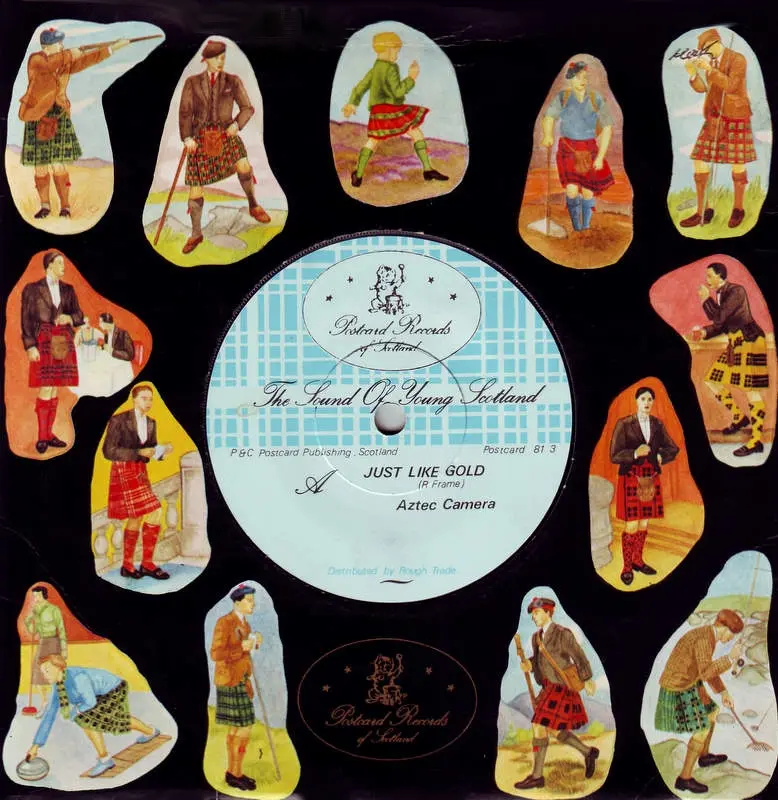 On April 17, 1981, Aztec Camera released their first single “Just Like Gold” backed with “We Could Send Letters” (Postcard 81-3).
A. “Just Like Gold” (3:19)
B. “We Could Send Letters” (5:02) dates from 1979, when Frame was fifteen.
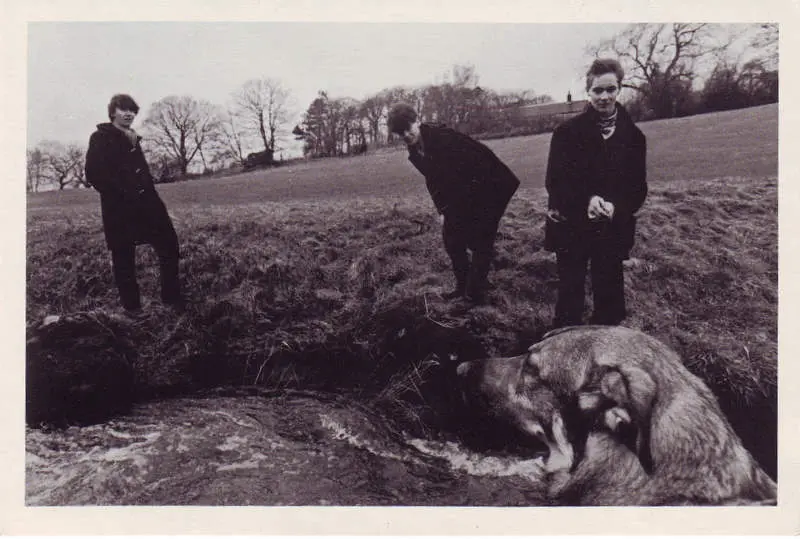
“Just Like Gold” appeared in a Postcard sleeve with vintage illustrations of young men in kilts, designed by Robert Sharp (Positive Noise, The Recognitions). The same sleeve housed neighboring Postcard singles by Orange Juice (“Poor Old Soul,” 81-2) and Josef K (“Chance Meeting,” 81-5). The single included a postcard with a b&w creekside group pic and handwritten “Just Like Gold” lyrics (personal message style) addressed to the label’s then-location at 185 West Princes St. in Glasgow.
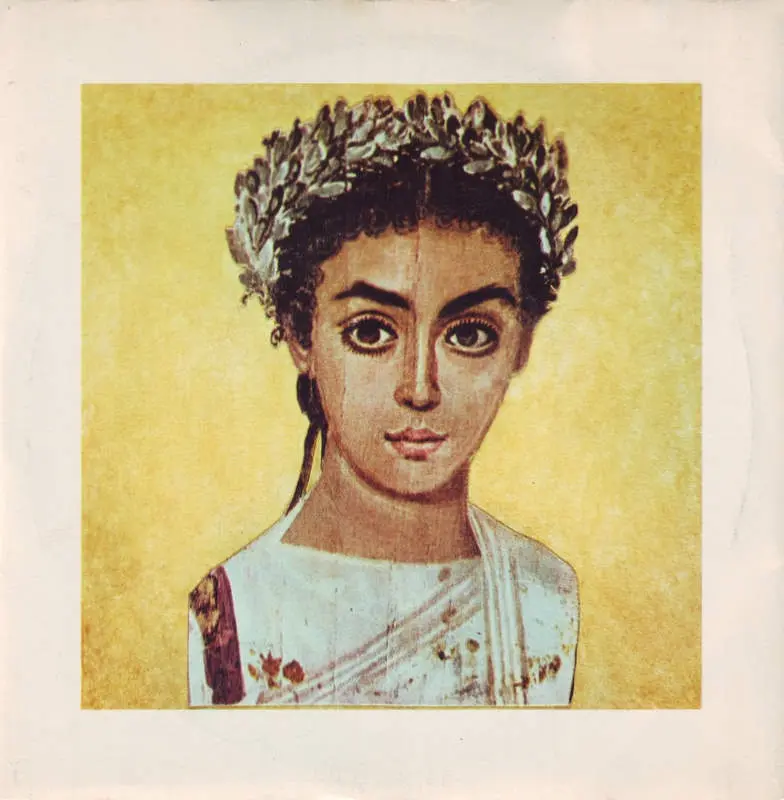 On August 14, 1981, Aztec Camera released their second single “Mattress of Wire” backed with “Lost Outside the Tunnel.”
A. “Mattress of Wire” (2:49)
B. “Lost Outside the Tunnel” (3:31) dates from the Neutral Blue era.
The “Mattress of Wire” sleeve features a 2nd century Roman Egyptian painting dubbed “Fayum mummy portrait of a young lady.”
Aztec Camera recorded “Mattress of Wire” with producer Adam ‘Skipper’ Kidron, a soundman on recent titles by Blue Orchids, Delta 5, Essential Logic, Monochrome Set, The Pop Group, The Raincoats, Rip Rig + Panic, Robert Wyatt, Scritti Politti, The Slits, and other acts on the London-based Rough Trade label, which signed Aztec Camera for subsequent releases.
1982
Postcard planned but then scrapped Green Jacket Grey, a proposed Aztec Camera album. By late 1981, Mulholland cleared for drummer Dave Ruffy, who played on The Ruts‘ 1979/80 output and Kevin Coyne’s 1980 album Sanity Stomp.
Aztec Camera became a four-piece with keyboardist Bernie Clarke, an alumnus of Alvin Lee’s Ten Years Later and Decca singles act The Clovers (with ZED drummer Graham Jarvis). Clarke’s session credits included 1979–81 albums by Anthony Moore, Bram Tchaikovsky, Fingerprintz, Manfred Mann’s Earth Band, and Sapho.
 On August 27, 1982, Aztec Camera released their third single “Pillar to Post” backed with “The Queen’s Tatoos.”
A. “Pillar to Post” (3:54)
B. “The Queen’s Tatoos” (2:11)
Aztec Camera recorded “Pillar to Post” at Town House Studio, a West London complex owned by Virgin co-founder Richard Branson. Ruts DC soundman John Brand engineered both sides in sequence with 1982 titles by Lili Drop and The Members.
“Pillar to Post”appeared in a picture sleeve with a portrait painting of a cowgirl by Scottish artist David Band, an Altered Images illustrator who created subsequent Spandau Ballet visuals. The back-sleeve and label misspell the word “tattoos.” Rough Trade also issued a picture-disc version with fishe-eyed street views of the band.
1983
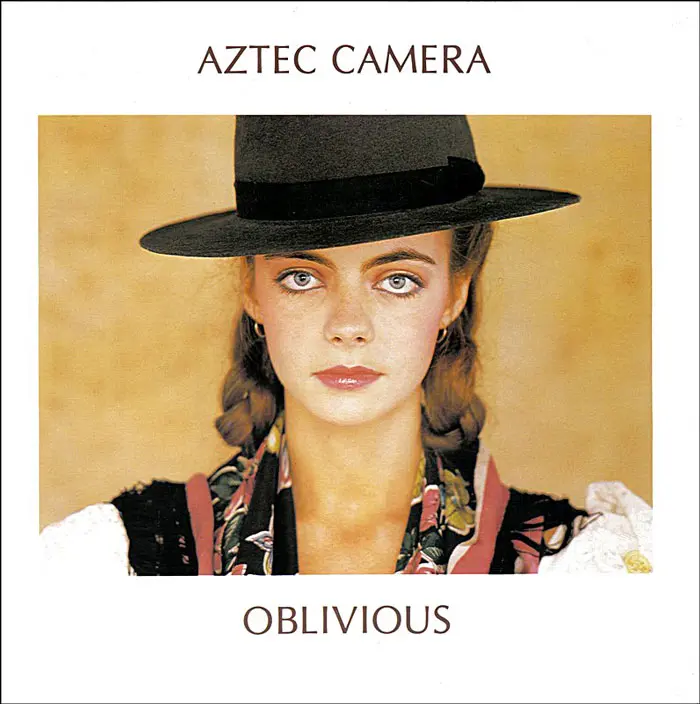 On January 21, 1983, Aztec Camera released “Oblivious,” a taster from their upcoming album, backed with the exclusive “Orchid Girl.” Rough Trade issued 7″ and 12″ versions, the latter with a third exclusive, “Haywire.”
A. “Oblivious”
B1. “Orchid Girl” (2:35)
B2. “Haywire“
Clarke and Brand co-produced the single, which features another cowgirl portrait painting by David Band, whose artwork appears framed in white (7”) and crimson (12”). After Aztec Camera’s album release, WEA reissued “Oblivious” in an ivory sleeve with a simple guitar sketch.
In the “Oblivious” video, Aztec Camera perform in a tree house on the grounds of a Palladian property where a group of children and black men play games of Cowboys and Indians as tarot cards flash on the screen. Roddy Frame sports a brown suede fringe jacket with his hair styled in a frazzled pixie (ala Ian McCulloch), a look he’d subsequently alternate with a standard neo-mod image.
High Land, Hard Rain
 Aztec Camera released their debut album, High Land, Hard Rain, on April 19, 1983, on Rough Trade (UK, Japan), WEA (Europe), Powderworks (Oceania), and Sire (North America).
The album features ten originals by singer–guitarist Roddy Frame, including the recent a-side “Oblivious” and the followup fifth single “Walk Out to Winter,” plus re-recorded versions of the 1982 a-side “Pillar to Post” and the 1981 b-sides “We Could Send Letters” and “Lost Outside the Tunnel.”
Roddy and producer/keyboardist Bernie Clarke created a thick acoustic sound with double-tracked layers of Frame’s Masano guitar.
1. “Oblivious” (3:09)
2. “The Boy Wonders” (3:13)
3. “Walk Out to Winter” (3:23)
4. “The Bugle Sounds Again” (2:56)
5. “We Could Send Letters” (5:43)
6. “Pillar to Post” (3:59)
7. “Release” (3:41)
8. “Lost Outside the Tunnel” (3:40)
9. “Back on Board” (4:50)
10. “Down the Dip” (2:10) was first titled “The Diplomat.”
 Aztec Camera plugged High Land with “Walk Out to Winter,” lifted as an April single with “Set the Killing Free,” an exclusive b-side. Rough Trade issued the single in two formats: as a standard 7″ and and a double-pack with the picture disc of their earlier single “Pillar to Post” (b/w “The Queen’s Tatoos”).
B. “Set the Killing Free” (3:45)
Apart from the “Oblivious,” sessions spanned three weeks in January 1983 at ICC Studios, an Eastbourne, Sussex, complex where Clarke co-produced the album with John Brand, who engineered High Land amid projects by The Go-Betweens and The Poison Girls.
High Land and its accompanying single feature Mexican-style art by David Brand and graphic layouts by Martyn Lambert, a magazine designer whose visuals also appear on appears on 1983 sleeves for Pigbag (Lend An Ear) and Paz (Look Inside).
In October, Rough Trade/WEA re-released the “Oblivious” / “Orchard Girl” single, which reached No. 18 on the UK Singles Chart; twenty-nine places higher than its earlier issue. The re-release also appeared as a double-pack with “We Could Send Letters” and “Back on Board.”
Aztec Camera mimed “Oblivious” for the November 17 and December 1 broadcasts of the BBC music program Top of the Pops, which also featured in-studios by Madness (“The Sun and the Rain”), Ozzy Osbourne (“Bark at the Moon”), Slade (“My Oh My”), and Vince Clarke’s Assembly (“Never Never”), plus videos by Billy Joel (“Uptown Girl”), Cliff Richard (“Please Don’t Fall In Love”), Genesis (“That’s All”), The Rolling Stones (“Undercover of the Night”), and Paul McCartney & Michael Jackson (“Say Say Say”). The Aztec segment occurred on a balloon-laden sunken stage amid flashing pink/blue lights and neon rings with young stylish dancers swarmed around the pit.
High Land reached No. 22 on the UK Albums Chart and placed in the middle-third of the US Billboard 200. Clarke left Aztec Camera to concentrate on a new client, Fiat Lux. Frame hired Malcolm Ross, a guitar/singer with prior stints in Aztec’s two former Postcard labelmates, Josef K and Orange Juice.
Knife
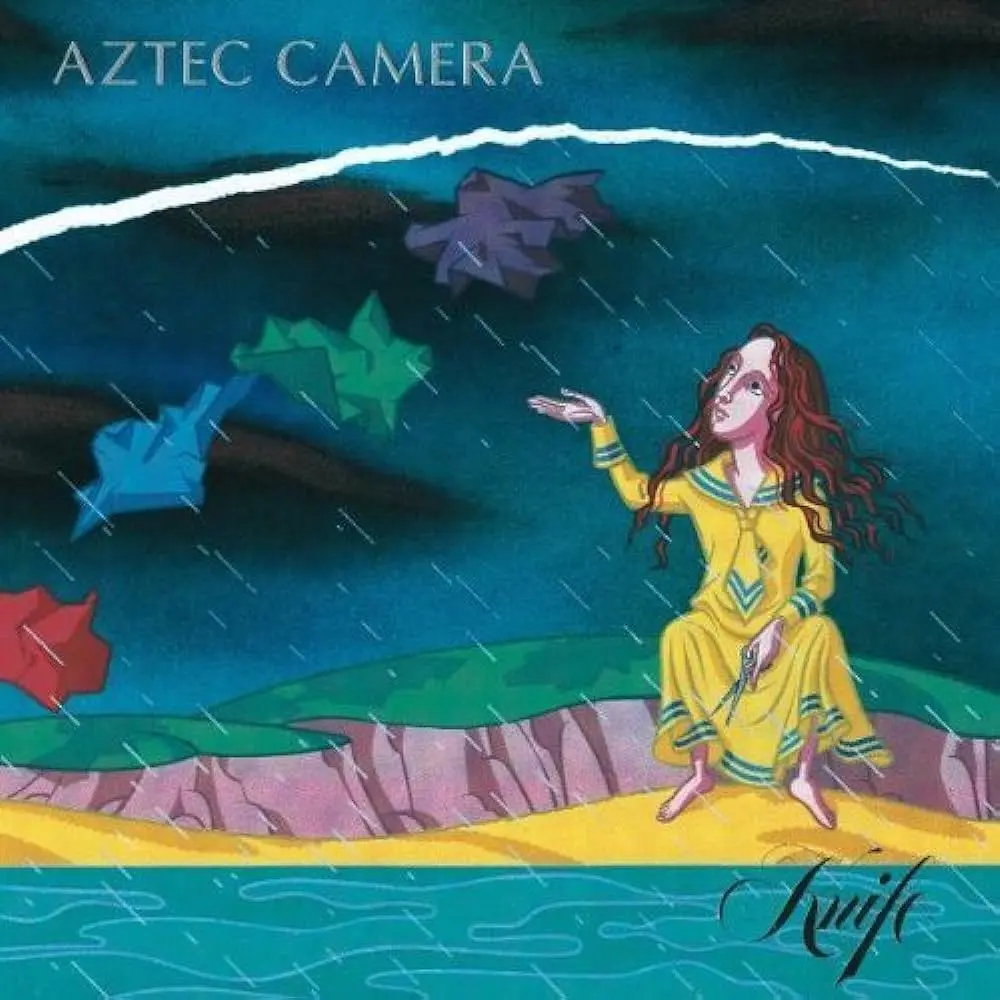 Aztec Camera released their second album, Knife, on September 21, 1984, on Sire (US/Canada) and WEA (everywhere else).
Knife contains nine Frame originals, including the nine-minute title track and the singles “Still On Fire” and “All I Need Is Everything.” Musically, the songs take an ambient, poetic approach in stark contrast to the sprightly acoustic pop of prior Aztec Camera material.
For the album’s production, Roddy Frame enlisted Dire Straits frontman Mark Knopfler. The album features Malcolm Ross and the veteran Aztec rhythm section, Campbell Owens and David Ruffy, augmented by Straits keyboardist Guy Fletcher. Select passages feature percussionist Frank Ricotti, saxophonist Chris White, and trumpeter Martin Drover.
1. “Still on Fire” (3:56)
2. “Just Like the USA” (4:03)
3. “Head Is Happy (Heart’s Insane)” (4:16)
4. “The Back Door to Heaven” (5:22)
5. “All I Need Is Everything” (5:44)
6. “Backwards and Forwards” (4:13)
7. “The Birth of the True” (2:42)
8. “Knife” (9:05)
 “All I Need Is Everything” preceded Knife as an August 1984 single. The video showcases Frame in assorted watery locations (dockside, beach) before he takes a drive in heavy downpour. For the b-side, he covered “Jump,” a recent Van Halen hit.
B. “Jump”
Sessions spanned February through June of 1984 at Air Studios in Oxford Circus, where Knopfler produced Knife amid work on the soundtrack to Cal, an Irish drama starring Helen Mirren. Knife was his second major outside production credit after Infidels, Bob Dylan’s 1983 album.
Air staffer Nigel Walker engineered Knife in sequence with the Dire Straits live release Alchemy and David Sylvian‘s debut solo album, Brilliant Trees.
Knife appeared in a single sleeve illustrated by one Linda Gray, whose image of a little lakeside girl in torrential weather extends to the backside, the source of an arching lightning bold and flying confetti stream. The inner-sleeve and corresponding singles feature posed, angle-lighted member pics by David Levine, whose photography also appears on contemporary sleeves for Culture Club, Hazel O’Connor, Helen Terry, and Spear of Destiny.
 Guest player Ricotti had roughly 150 credits since the late Sixties, notably a 1971 collaborative album (eventual ELO bassist) Michael de Albuquerque. In 1984 alone, his percussion appeared on titles by Barclay James Harvest, Clannad, David Essex, and Meat Loaf.
White played sax on recent albums by Mezzoforte, Shakatak, and former Haircut One Hundred frontman Nick Heyward. Drover had Seventies stints with Keef Hartley, John Surman, Bryan Ferry, and Gonzalez. Most recently, he played on albums by Wham!, UK Players, Cliff Richard, John Miles, and the Invisible Men.
In November 1984, Aztec Camera lifted “Still On Fire” as a second single, backed with a live version of the High Land number “Walk Out to Winter.” WEA packaged the single in two forms: a shaped picture disc (of an ‘Aztec Camera’) and a standard Roddy picture sleeve (cropped monochrome portrait style). Aztec Camera mimed “Still On Fire” amid pink-lit flared bar fixtures for the September 13 TotP broadcast, which also featured in-studio numbers by Depeche Mode (“Master and Servant”) and Orchestral Manoeuvres In the Dark (“Tesla Girls”).
Knife reached No. 14 on the UK Albums Chart and No. 29 in Sweden. Aztec Camera toured the album with Remipeds keyboardist Eddie Kulak. Tracks from their October 1984 shows in Glasgow (10/6: Barrowlands Ballroom) and London (10/16: Dominion Theatre) constitute their 1985 live EP Backwards and Forwards, which features “Jump” ad two numbers each from Knife (“The Birth of the True,” “Backwards and Forwards”) and Hard Rain (“The Boy Wonders,” “The Bugle Sounds Again”), plus the earlier “Mattress of Wire.”
Love
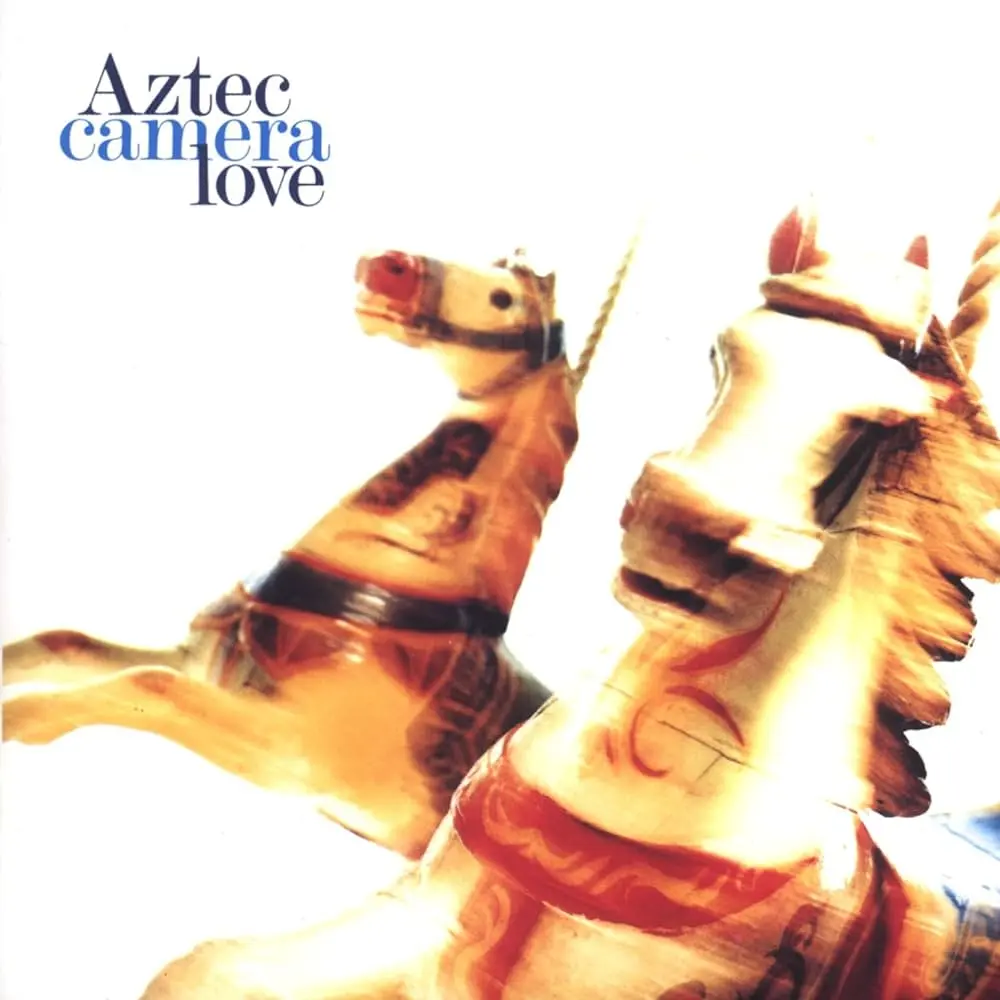 Aztec Camera released their third album, Love, on November 9, 1987, on WEA and Sire. It spawned four singles, including “Working in a Goldmine” and the hits “Deep and Wide and Tall” (a US alt radio staple) and “Somewhere In My Heart” (a UK Top 5).
Love is essentially a Roddy Frame solo album, recorded in America with twenty-five backing performers and eighteen sound people. Notable guests include singer Dan Hartman, keyboardist David Frank (The System), jazz-rock drummer Dave Weckl, and bassist Marcus Miller (a recent Miles Davis sideman).
Side One features the self-produced “More Than a Law” and tracks produced by Jonzun Crew’s Michael Jonzun (“Somewhere in My Heart”) and Phil Spector protege Russ Titelman (“Deep & Wide & Tall,” “Everybody Is a Number One”). Frame and R&B soundman Rob Mounsey produced all of Side Two apart from “Paradise,” a track co-produced (along with “How Men Are”) by keyboardist David Frank and A&R veteran Tommy LiPuma.
1. “Deep & Wide & Tall” (4:02)
2. “How Men Are” (3:38)
3. “Everybody Is a Number One” (3:25) features keyboardist Peter Beckett (Paladin, Player).
4. “More Than a Law” (4:39)
5. “Somewhere in My Heart” (4:00)
6. “Working in a Goldmine” (5:36)
7. “One and One” (4:10)
8. “Paradise” (4:29)
9. “Killermont Street” (3:16)
 “Deep and Wide and Tall” preceded Love in September 1987, backed with the non-album “Bad Education.”
B. “Bad Education”
Frame filmed a riverside video for “Deep and Wide and Tall” with a large group of backing players in classic neo-Fifties denim/leather wardrobes. The video aired recurrently on MTV’s 120 Minutes.
Sessions spanned April through August 1987 in New York. In January 1988, Frame lifted “How Men Are” as the second single, backed with “The Red Flag,” a traditional number.
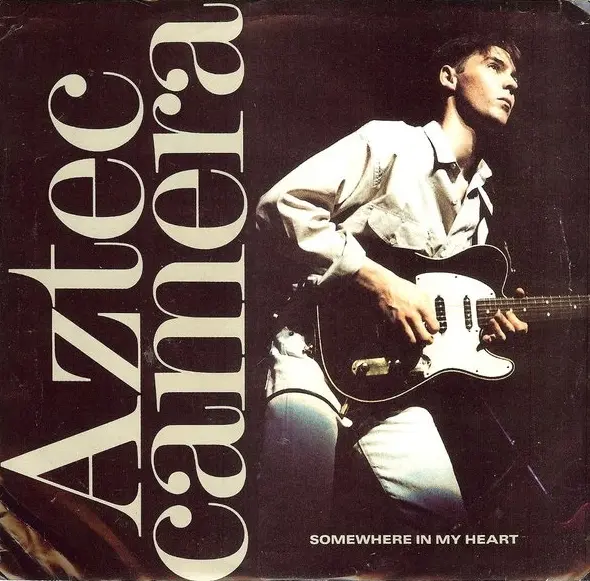 “Somewhere In My Heart” became the third single in April 1988, backed with a 1986 live version of “Everybody Is a Number One,” recorded in Boston. “Somewhere In My Heart” reached No. 3 on the UK Singles Chart.
In July, “Working In a Goldmine” became the fourth Love single, backed with a cover of “I Threw It All Away,” a 1969 Bob Dylan song. It peaked just outside the UK Top 30.
Love reached No. 10 on the UK Albums Chart.
Stray
 Aztec Camera released their fourth album, Stray, on June 4, 1990, on WEA and Sire.
1. “Stray” 5:34
2. “The Crying Scene” 3:34
3. “Get Outta London” 3:41
4. “Over My Head” 5:53
5. “Good Morning Britain” 4:02
6. “How It Is” 4:00
7. “The Gentle Kind” 5:32
8. “Notting Hill Blues” 6:41
9. “Song for a Friend” 2:27
Discography:
- High Land, Hard Rain (1983)
- Knife (1984)
- Love (1987)
- Stray (1990)
Sources:
- Discogs: Aztec Camera
- 45worlds: Aztec Camera
- 45cat: Aztec Camera
- John Peel Wiki: Aztec Camera
- RYM: Aztec Camera
- MusicBrainz: Aztec Camera
- TVRDb.com: Top of the Pops – Aztec Camera
Artist/Album Pages:
Saga are a Canadian rock band from Oakville, Ontario, formed in 1977. They achieved cult status wi...
Kissing the Pink was an English synthpop band that released three albums between 1983 and 1986 on ...
Moondancer was a Japanese symphonic-rock band behind a 1979 self-titled album on Alfa, recorded wi...
Wax was an American soul-funk septet that released the 1980/81 RCA albums Wax Attack and Do You Be...
In Spe was an Estonian symphonic-rock band that released two self-titled albums between 1983 and 1...
Kids in the Kitchen were an Australian new wave band that released nine singles and the 1985–87 al...
Glamour was a Spanish new wave synthpop band behind the 1981–83 Polydor albums Imágenes and Guarda...
Melissa Manchester is an American singer–songwriter who released two 1973–74 albums on Bell Record...
Orissa was a Japanese jazz-funk band behind a 1982 self-titled album on Better Days. Members: 高橋...
Känguru was a German jazz-rock band that made a 1981 album on Pingo, followed by the 1983 World of...
Ain Soph are a Japanese symphonic/jazz-rock band behind the 1980 Nexus album A Story of Mysterious...
Jabula was a London-based Afro-jazz/funk collective comprised mostly of South African and Ghanaian...