

Marshall Crenshaw is an American songwriter and guitarist from Detroit. He released six studio albums between 1982 and 1991, first for Warner Bros. and later for MCA. His chart singles include “Someday, Someway,” “Whenever You’re on My Mind,” and “Better Back Off.”
Background
Marshall Howard Crenshaw was born November 11, 1953, in Detroit and grew up in Berkley, Michigan. He started guitar at ten and later led Astigfa, a local group whose name came from the closing line of the Beatles song “Being for the Benefit of Mr. Kite!” Crenshaw graduated with the Class of 1971 at Berkley High School.
 In 1978, Crenshaw joined a touring production of Beatlemania as an understudy for the John Lennon role. He later took over the part and remained with the production until February 1980, when he settled in New York City. Marshall enlisted bassist Chris Donato in a rock trio with his drummer brother, Robert Crenshaw.
Shake Records issued the 1981 twelve-inch single “Something’s Gonna Happen” (b/w “She Can’t Dance”). Crenshaw co-produced the record with label founder Alan Betrock, whose earlier work included the first Blondie demos and releases by the dB’s. Robert Gordon recorded “Someday, Someway” for the 1981 album Are You Gonna Be the One and reached No. 76 on the Billboard Hot 100 chart. Interest from RCA and Warner Bros. followed, and Crenshaw signed with Warner.
Marshall Crenshaw
 Marshall Crenshaw released his self-titled debut album in April 1982 on Warner Bros.
Crenshaw retains bassist Chris Donato and drummer Robert Crenshaw from the New York trio. Bassist Tony Garnier enters on “The Usual Thing,” while percussionist Michael Osborn appears on “Girls…” The track sequence revisits the Shake single “She Can’t Dance” and includes “Soldier of Love,” first recorded by Arthur Alexander.
“There She Goes Again” glides on an upbeat shuffle as Crenshaw shades buoyant phrases with melancholy resignation. “Someday, Someway” rolls through lovelorn phrases within a lean arrangement. “Girls…” overjoys in the local eye-candy with laidback sway. “I’ll Do Anything” declares loyalty around a tight, angular key-change and flowing title promise. “Rockin’ Around in N.Y.C.” bounds through a springy beat and euphoric city-night phrasing. “The Usual Thing” shimmies with retro hepcat vibes.
“She Can’t Dance” skips with sock-hop accents and buoyant swing. “Cynical Girl” bounces through jangling figures as Crenshaw projects crisp, plainspoken lines. “Mary Anne” unfolds with tender consolation and uplift to a saddened love interest. “Soldier of Love” conjures a love vignette from yore with warmhearted welcome. “Not for Me” addresses a shattered subject with helpless resign yet newfound wisdom. “Brand New Lover” darts with brisk, peppy assurance as Crenshaw heads off in search of changes.
A1. “There She Goes Again” (2:40)
A2. “Someday, Someway” (2:54)
A3. “Girls…” (3:06)
A4. “I’ll Do Anything” (3:05)
A5. “Rockin’ Around in N.Y.C.” (3:11)
A6. “The Usual Thing” (3:06)
B1. “She Can’t Dance” (2:49) – Crenshaw, Rick Cioffi, Fred Todd
B2. “Cynical Girl” (2:38)
B3. “Mary Anne” (2:58)
B4. “Soldier of Love” (2:40) – Buzz Cason, Tony Moon
B5. “Not for Me” (2:39)
B6. “Brand New Lover” (2:30)
Crenshaw and Richard Gottehrer produced the album in January 1982 at the Record Plant in New York. Thom Panunzio engineered the recordings with assistant Jim Ball. Gottehrer recently co-produced the 1981 Go-Go’s album Beauty and the Beat, while Panunzio worked on the 1981 Aerosmith release Rock in a Hard Place.
Gary Green devised and photographed the cover image. Christina de Lancie translated the photograph into an oil-painted portrait, and Spencer Drate shaped the surrounding typography and package.
 Warner issued “Someday, Someway” in June 1982 (b/w “You’re My Favorite Waste of Time”). The single reached No. 36 on the Billboard Hot 100, No. 31 on the Cash Box Top 100, and No. 25 on the Billboard Rock Tracks chart.
On June 5, 1982, Crenshaw played Keystone Berkeley for a Westwood One (WW1) FM radio broadcast.>
“There She Goes Again” followed in September 1982 (b/w “The Usual Thing”) and reached No. 110 on the Bubbling Under the Hot 100 chart. Warner paired “Cynical Girl” with “Rave On” and “Somebody Like You” for a February 1983 single.
Marshall Crenshaw reached No. 50 on the Billboard 200 chart. Rhino expanded the album in 2000 with demos, alternate recordings, and concert tracks.
Field Day
 Marshall Crenshaw released his second album, Field Day, in June 1983 on Warner Bros.
Crenshaw retains Donato and Robert Crenshaw as the performing core. Producer Steve Lillywhite adds percussion and denser background parts around the trio. Bill Teeley co-writes “Whenever You’re on My Mind,” while David Weiss shares the credit on “Monday Morning Rock.” Crenshaw also records “What Time Is It?,” first released by the Jive Five.
“Whenever You’re on My Mind” bursts from an overdriven guitar figure into broad echo and urgent romantic projection. “Our Town” revs on a taut chug as Crenshaw threads homesick lines through rushing city images. “One More Reason” lopes through lean twang and compact romantic phrases. “Try” slows into a 12/8 shuffle as an unexpected key change unsettles the hesitant plea. “One Day With You” strides through twanging double-stops before Crenshaw breaks into a broad solo.
“For Her Love” swells under wide echo as Crenshaw projects each declaration with room-filling force. “Monday Morning Rock” careens through an upbeat rush, then calls out a key change at solo break. “All I Know Right Now” widens through reverb and a major-seventh turn before Crenshaw pours out a plaintive solo. “What Time Is It?” ticks through tongue-click percussion before backward reverb dissolves into a dreamlike wash. “Hold It” strums with broad resonance before tape-delay overwhelms the track.
A1. “Whenever You’re on My Mind” (3:19) – Crenshaw, Bill Teeley
A2. “Our Town” (4:13)
A3. “One More Reason” (3:36)
A4. “Try” (3:10)
A5. “One Day With You” (5:01)
B1. “For Her Love” (3:02)
B2. “Monday Morning Rock” (3:34) – Crenshaw, David Weiss
B3. “All I Know Right Now” (3:52)
B4. “What Time Is It?” (2:53) – Bob Feldman, Richard Gottehrer, Jerry Goldstein
B5. “Hold It” (3:45)
Crenshaw recorded Field Day in February 1983 at the Record Plant with producer Steve Lillywhite and engineer Scott Litt. Garry Rindfuss and John Babich assisted the sessions. Lillywhite also produced 1983/84 albums by U2 (War), Big Country (The Crossing), and Simple Minds (Sparkle In the Rain), while Litt commenced a sequence of projects with R.E.M.
Carol Bokuniewicz built the package around a Larry Williams photograph of Crenshaw outside Berkley High School. The location connects the sleeve to the school Crenshaw attended before his role in Beatlemania.
 Warner released “Whenever You’re on My Mind” in May 1983 (b/w “Jungle Rock”). The single reached No. 23 on the Billboard Rock Tracks chart and No. 103 on Bubbling Under the Hot 100.
Field Day reached No. 52 on the Billboard 200 chart. Wounded Bird issued the album on CD in 2005. Intervention Records paired the original sequence with the U.S. Remix material for a 2017 vinyl edition, and Yep Roc assembled a fortieth-anniversary release with demos and additional recordings in 2023.
1984 Remix EP
In 1984, Warner issued U.S. Remix in the United Kingdom.
John Luongo remixed “Our Town,” “For Her Love,” and “Monday Morning Rock” with engineers Jay Mark and Michael Hutchinson. “Little Sister” comes from a December 2, 1983, performance at Ripley’s Music Hall in Philadelphia and carries a separate mix by Crenshaw and Jim Ball.
A1. “Our Town”
A2. “For Her Love”
B1. “Monday Morning Rock”
B2. “Little Sister” – Doc Pomus, Mort Shuman
Downtown
 Marshall Crenshaw released his third album, Downtown, in September 1985 on Warner Bros.
Crenshaw replaces the fixed trio with a rotating studio cast. Drummers Mickey Curry and Jerry Marotta work with bassists David Miner and Tony Levin. Keyboardist Mitchell Froom and guitarist G.E. Smith widen the instrumental range. Steel guitarist Steve Fischel contributes to the country-derived arrangements, while T Bone Burnett adds electric sitar and programmed percussion. Crenshaw records Ben Vaughn’s “I’m Sorry (But So Is Brenda Lee)” and the Sylvester Bradford–Al Lewis song “Right Now.”
“Little Wild One (No. 5)” surges through bright chord figures with reckless, buoyant swing. “Yvonne” rolls on a primal beat beneath plainspoken romantic lines. “(We’re Gonna) Shake Up Their Minds” zigzags between syncopated guitar figures and percussion accents. “Like a Vague Memory” drifts through wistful phrases and softly rounded harmonies. “I’m Sorry (But So Is Brenda Lee)” lingers on restrained singing and a hushed plea.
 A1. “Little Wild One (No. 5)” (3:55)
A2. “Yvonne” (3:53)
A3. “Blues Is King” (3:49)
A4. “Terrifying Love” (4:05)
A5. “Like a Vague Memory” (4:07)
B1. “The Distance Between” (3:42)
B2. “(We’re Gonna) Shake Up Their Minds” (3:34)
B3. “I’m Sorry (But So Is Brenda Lee)” (3:21) – Ben Vaughn
B4. “Right Now” (2:38) – Sylvester Bradford, Al Lewis
B5. “Lesson Number One” (4:08)
T Bone Burnett and Crenshaw produced most of Downtown with Larry Hirsch. Crenshaw and Mitch Easter handled “Blues Is King” separately. Recording took place at Mediasound in New York and three Los Angeles studios: Sunset Sound, Ocean Way Recording, and Reflection Sound.
Hirsch also headed the engineering work, with Thom Panunzio and Steve Haigler assigned to additional sessions. Burnett entered the project fresh from the 1984 Los Lobos album How Will the Wolf Survive?, while Easter completed the 1984 R.E.M. release Reckoning with Don Dixon.
 Victoria Pearson photographed Crenshaw for the cover. Jeffrey Kent Ayeroff and Jeri McManus directed the package, while McManus worked with Gina Vivona on the design. The front sleeve places the portrait beneath a broad black title panel.
Warner issued “Little Wild One (No. 5)” in October 1985 (b/w “Like a Vague Memory”). “Blues Is King” and “The Distance Between” also appeared on singles drawn from the album.
Downtown reached No. 113 on the Billboard 200 chart. Wounded Bird returned the album to CD in 2005.
Film Work
Crenshaw portrayed Buddy Holly in La Bamba, the 1987 biographical drama starring Lou Diamond Phillips as Ritchie Valens, the Mexican–American rock ‘n’ roll singer who died on February 3, 1959, in the plane crash that also killed Holly and “Chantilly Lace” singer the Big Bopper. Despite similarities in presentation and style, Crenshaw long-downplayed the Holly influence but considered the comparisons a compliment.
Mary Jean & 9 Others
 Marshall Crenshaw released his fourth album, Mary Jean & 9 Others, in October 1987 on Warner Bros.
Robert Crenshaw returns beside bassist Graham Maby, a longtime Joe Jackson sideman. Guitarist Mitch Easter joins “Steel Strings,” and singer Marti Jones appears on “Wild Abandon.” Tom Teeley contributes guitar and background parts, while producer Don Dixon sings on selected tracks. Peter Case wrote “Steel Strings,” the sole outside composition in the ten-song sequence.
“This Is Easy” saunters as Crenshaw draws each phrase across a deceptively simple pattern. “Calling Out for Love (At Crying Time)” cries through higher harmony phrases and a plaintive plea. “This Street” darts between live-kit accents and a Casio loop before a manic guitar solo. “Mary Jean” rolls beneath buoyant “hey now” replies and a compact bridge. “‘Til That Moment” skips through a springy beat toward a frantic break.
A1. “This Is Easy” (3:51)
A2. “A Hundred Dollars” (4:08)
A3. “Calling Out for Love (at Crying Time)” (4:37) – Crenshaw, Don Dixon
A4. “Wild Abandon” (4:22)
A5. “This Street” (4:39)
B1. “Somebody Crying” (3:26)
B2. “Mary Jean” (4:10)
B3. “Steel Strings” (5:08) – Peter Case
B4. “’Til That Moment” (3:52)
B5. “They Never Will Know” (4:02)
Crenshaw recorded Mary Jean & 9 Others in January 1987 at Bearsville Studios with producer-engineer Don Dixon. John Hampton assisted the sessions. Dixon worked between the 1986 and 1988 Smithereens albums Especially for You and Green Thoughts, both recorded with engineer Mark Johnson.
Nick Egan designed the package around photography by Dean Chamberlain. The front cover presents Crenshaw against a dark field with the artist name and album title printed across the portrait. Egan designed recent sleeves for INXS and the Psychedelic Furs.
Warner issued “Mary Jean” and “This Is Easy” as 1987 singles. Wounded Bird released the album on CD in 2005.
Good Evening
 Marshall Crenshaw released his fifth album, Good Evening, in June 1989 on Warner Bros.
Crenshaw combines five co-written or original songs with material by Richard Thompson, John Hiatt, Diane Warren, and Bobby Fuller. Bassist Graham Maby returns, while drummer Kenny Aronoff enters the principal rhythm cast. Multi-instrumentalist Bob Marlette handles keyboards and selected rhythm parts. Slide guitarists Sonny Landreth and David Lindley appear on separate tracks, and James Burton joins “Whatever Way the Wind Blows.”
“You Should’ve Been There” bounds through bittersweet lines and layered self-harmonies. “Valerie” hurries through a breathless plea over locked percussion. “Someplace Where Love Can’t Find Me” surges beside a slide-guitar cry as Crenshaw belts an impassioned declaration. “Live It Up” careens through nervous accents and a barreling rhythm section. “She Hates to Go Home” drifts beneath spare accompaniment before a bare acoustic solo. “Radio Girl” glides from a slow fade into low-key nocturnal phrasing. “Some Hearts” races through a fiddle-led rush and gleeful harmonies. “On the Run” jolts through taut, jittery accents and anxious lines. “Let Her Dance” accelerates through jangling chord figures and relentless accents.
A1. “You Should’ve Been There” (3:53) – Leroy Preston, Crenshaw
A2. “Valerie” (3:35) – Richard Thompson
A3. “She Hates to Go Home” (4:46) – Preston, Crenshaw
A4. “Someplace Where Love Can’t Find Me” (4:02) – John Hiatt
A5. “Radio Girl” (4:06) – Crenshaw, Sam Llanas, Kurt Neumann
 B1. “On the Run” (3:15)
B2. “Live It Up” (3:37) – Chris Jasper, Isley Brothers
B3. “Some Hearts” (4:22) – Diane Warren
B4. “Whatever Way the Wind Blows” (3:25)
B5. “Let Her Dance” (2:56) – Bobby Fuller
David Kershenbaum produced Good Evening with Paul McKenna, who also engineered and mixed the album. John Volaitis and Kevin Smith worked on additional recording. Kershenbaum entered the sessions after producing the 1988 self-titled debut by Tracy Chapman.
Janet Levinson designed the package. Dean Chamberlain supplied the bicycle photograph on the front, while Jeff Katz photographed Crenshaw for the rear cover. Levinson directed packaging for the 1988 Rod Stewart album Out of Order.
Warner lifted “Some Hearts” (b/w “Whatever Way the Wind Blows”).
Life’s Too Short
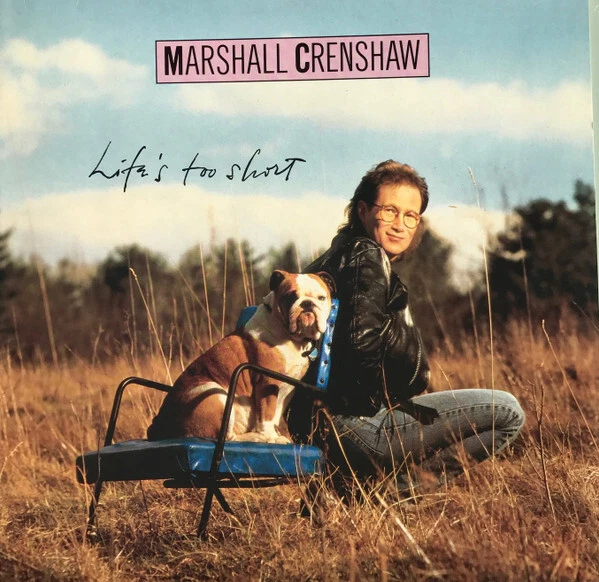 Marshall Crenshaw released his sixth album, Life’s Too Short, in May 1991 on MCA.
Drummer Kenny Aronoff returns beside bassist Fernando Saunders. Crenshaw supplements his guitar parts with piano, bass, and percussion. Slide guitarist Greg Leisz and harmonica player Peter Case appear on individual tracks. Keyboardist Paul Shaffer joins the session cast, while Rosie Flores and Steven Soles contribute background parts. Chris Knox wrote “Face of Fashion,” and Jules Shear shares the credit on “Everything’s the Truth.”
“Better Back Off” barrels over a two-step beat and crunchy guitar figure before a harmonica feature and extended solo. “Fantastic Planet of Love” swings through syncopated turns as Crenshaw projects exuberant lines. “Somewhere Down the Line” drifts through low-key accompaniment and subdued phrases.
1. “Better Back Off” (4:48) – Crenshaw, Tom Teeley
2. “Don’t Disappear Now” (4:11) – Crenshaw, Teeley
3. “Fantastic Planet of Love” (5:20)
4. “Delilah” (4:08) – Crenshaw, Leroy Preston
5. “Face of Fashion” (3:57) – Chris Knox
6. “Stop Doing That” (4:09)
7. “Walkin’ Around” (4:14)
8. “Starting Tomorrow” (4:17)
9. “Everything’s the Truth” (3:58) – Crenshaw, Jules Shear
10. “Somewhere Down the Line” (6:32)
Crenshaw recorded Life’s Too Short at Dreamland Recording with Ed Stasium, who produced and mixed the album. Paul Hamingson served as principal engineer. Stasium also produced 1990/91 albums by The Smithereens (11) and Motörhead (1916).
Toni Scott directed the artwork, and Richard Mantel designed the package around a portrait of Crenshaw by Timothy White, a photographer of contemporary covers for Whitney Houston and Aretha Franklin.
MCA issued “Better Back Off” as a 1991 single. The song reached No. 17 on the Billboard Modern Rock Tracks chart.
Later Activity
Razor & Tie issued the 1994 concert collection Live …My Truck Is My Home, followed by the 1996 studio album Miracle of Science. Crenshaw produced the latter and completed part of the recording at home. The label continued the sequence with the 1998 demo collection The 9 Volt Years, the 1999 studio album #447, and the 2003 release What’s in the Bag? Crenshaw also co-wrote the 1995 Gin Blossoms single “Til I Hear It from You” with Jesse Valenzuela and Robin Wilson.
Crenshaw returned with Jaggedland in June 2009 on 429 Records, his first studio album since What’s in the Bag? Guitarist Wayne Kramer and drummer Jim Keltner joined the sessions. Crenshaw later issued six ten-inch EPs between 2012 and 2015, combining new songs with cover versions and rerecorded catalog material. Red River collected twelve EP tracks and two additional recordings on the 2015 release #392: The EP Collection.
Film work continued with the title song for the 2007 comedy Walk Hard: The Dewey Cox Story. Crenshaw shared the lyric credit with John C. Reilly, Jake Kasdan, and Judd Apatow; the song received Golden Globe and Grammy nominations. From 2011 through 2017, Crenshaw hosted The Bottomless Pit on New York station WFUV, where he drew each program from his record collection.
In 2018, Crenshaw appeared with the Smithereens as a guest vocalist and continued to share that role with Robin Wilson at later concerts. He regained control of the Razor & Tie recordings and launched expanded Shiny-Tone editions with a revised Miracle of Science. Yep Roc issued fortieth-anniversary editions of Marshall Crenshaw and Field Day. The 2025 collection From the Hellhole assembled remixed and remastered material from the limited EP series.
Discography
Albums:
- Marshall Crenshaw (1982)
- Field Day (1983)
- Downtown (1985)
- Mary Jean & 9 Others (1987)
- Good Evening (1989)
- Life’s Too Short (1991)
- Miracle of Science (1996)
- #447 (1999)
- What’s in the Bag? (2003)
- Jaggedland (2009)
- From the Hellhole (2025)
- EPs:
- US Remix (1984)
- I Don’t See You Laughing Now (2012)
- Stranger and Stranger (2013)
- Drivin’ and Dreamin’ (2013)
- Red Wine (2014)
- Move Now (2014)
- Grab the Next Train (2015)
Sources:
- Discogs: Marshall Crenshaw
- RYM: Marshall Crenshaw
- 45cat: Marshall Crenshaw
- MusicBrainz: Marshall Crenshaw
Artist/Album Pages:
John Abercrombie (Dec. 16, 1944 — Aug. 22, 2017) was an American jazz guitarist who played in the ...
Aerial was a Canadian melodic-rock band from Toronto that released the 1978–80 Anthem albums In t...
Pages were an American adult-oriented rock band from Los Angeles that released the 1978–79 albums ...
Haircut One Hundred was an English new wave band that charted with the 1982 Arista album Pelican W...
Quinteto Violado was a Brazilian folk band that debuted in 1972 and made nine albums through 1979 ...
Pondus was a Swedish jazz-rock band behind the 1979 album Myrornas Frammarsch on Coop Records. M...
Michael Henderson (July 7, 1951 – July 19, 2022) was an American R&B bassist, vocalist, songwr...
Tapaztry was an American jazz-rock band behind a 1982 self-titled album on Mrald Records. ...
Obywatel G.C. (Aug. 29, 1957 — Dec. 22, 2001) was the performing alias of Polish coldwave musician...
Berlin was an American new wave band from Los Angeles, best known for the synthpop hits "Masquerad...
Heat was an American soul-funk trio that released the 1980/81 MCA albums Heat and Still Waiting. ...
The Parker Brothers were an American jazz-rock/soul band that issued a self-titled album in 1981. ...