

Rufus Zuphall was a German jazz-rock/psych band behind the 1970/71 albums Weiß der Teufel… and Phallobst.
Members: Klaus Gülden (flute, percussion), Günter Krause (guitar, vocals), Helmut Lieblang (bass), Udo Dahmen (drums, tablas), Erich Engels (percussion), Walter Sturm, Gero Körner (keyboards, 1999-present), Roland Hegel (drums, 1999-present)
Background
Rufus Zuphall formed in 1969 in Aachen at the Benelux border, where guitarist-singer Günter Krause teamed with flutist Klaus Gülden, bassist Helmut Lieblang, and drummer Udo Dahmen. Krause composed most of the group material, while Lieblang wrote lyrics for the band. Dahmen came from Aachen and later studied classical percussion at the Musikhochschule Rheinland in Aachen and Cologne, with further percussion study under Dante Agostini in Paris.
The group worked from Aachen near the Belgian and Dutch borders and aimed its early live activity toward neighboring Benelux stages. Rufus Zuphall played the Bilzen Jazz Festival in Belgium before a large 1970 audience on a bill with Black Sabbath, Cat Stevens, and May Blitz. The exposure gave the group a concrete pre-album platform outside West Germany.
Weiß der Teufel…
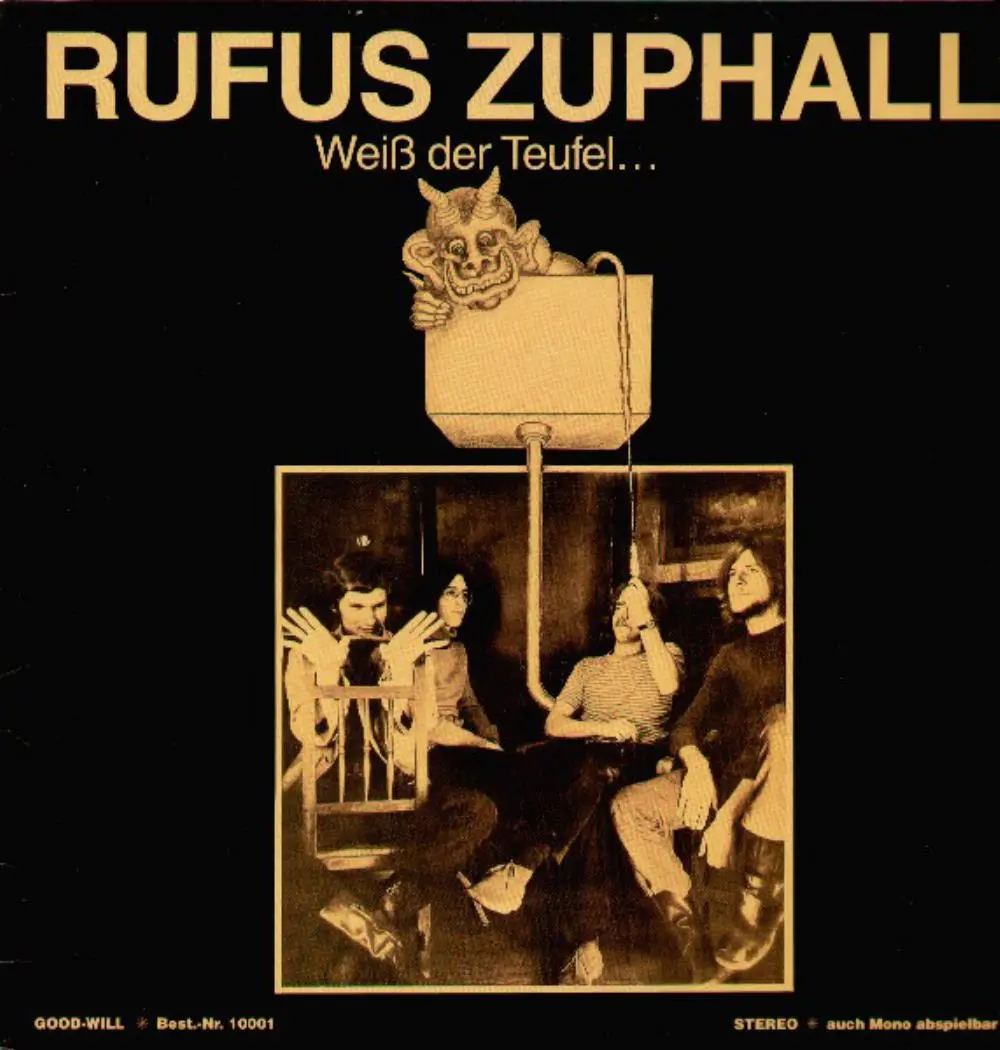 Rufus Zuphall released their debut album, Weiß der Teufel…, in 1970 on Good-Will. The title-piece (German for “The devil knows…”) constitutes Side B.
The album contains five pieces split between four Side A titles and the side-long title piece, performed by bassist Helmut Lieblang, drummer Udo Dahmen, guitarist Günter Krause, and multi-instrumentalist Klaus Gülden (flute, percussion, soprano saxophone). Rufus Zuphall cut the album live in the studio.
“Walpurgisnacht” snaps through unvarnished verse entries, bright flute lines, and a mid-song guitar break. “Knight of 3rd Degree” recedes from a heavy opening into acoustic-threaded verse space, then returns to its first accent pattern after the reserved vocal passage. “Spanferkel” barrels through clipped runs and hard accent turns, then cuts off on a spent breath. “Freitag” lopes through a rough backbeat, then swerves into a sharper solo break as the lead figure changes shape.
“Weiß der Teufel” grinds from a steady riff into a drum solo before low-register vocal entries pull the piece toward a fevered shout passage. The closing section returns to the opening drive after a quieter reset.
A1. “Walpurgisnight” [“Walpurgis Night”] (3:00) – Lieblang, Krause
A2. “Knight of Third Degree” (7:32) – Lieblang, Krause
A3. “Spanferkel” [“Suckling Pig”] (2:20) – Lieblang, Krause, Gülden, Dahmen
A4. “Freitag” [“Friday”] (7:14) – Krause
B. “Weiß der Teufel” [“The Devil Knows”] (17:09) – Lieblang, Krause, Gülden, Dahmen
Lutz Goebbels produced Weiß der Teufel…. Gabriel Feuerstein created the album artwork, which sets a sepia band photograph below a cartoon devil and cistern. Good-Will issued “Walpurgisnacht” as a 1970 single (b/w “Spanferkel”).
Phallobst
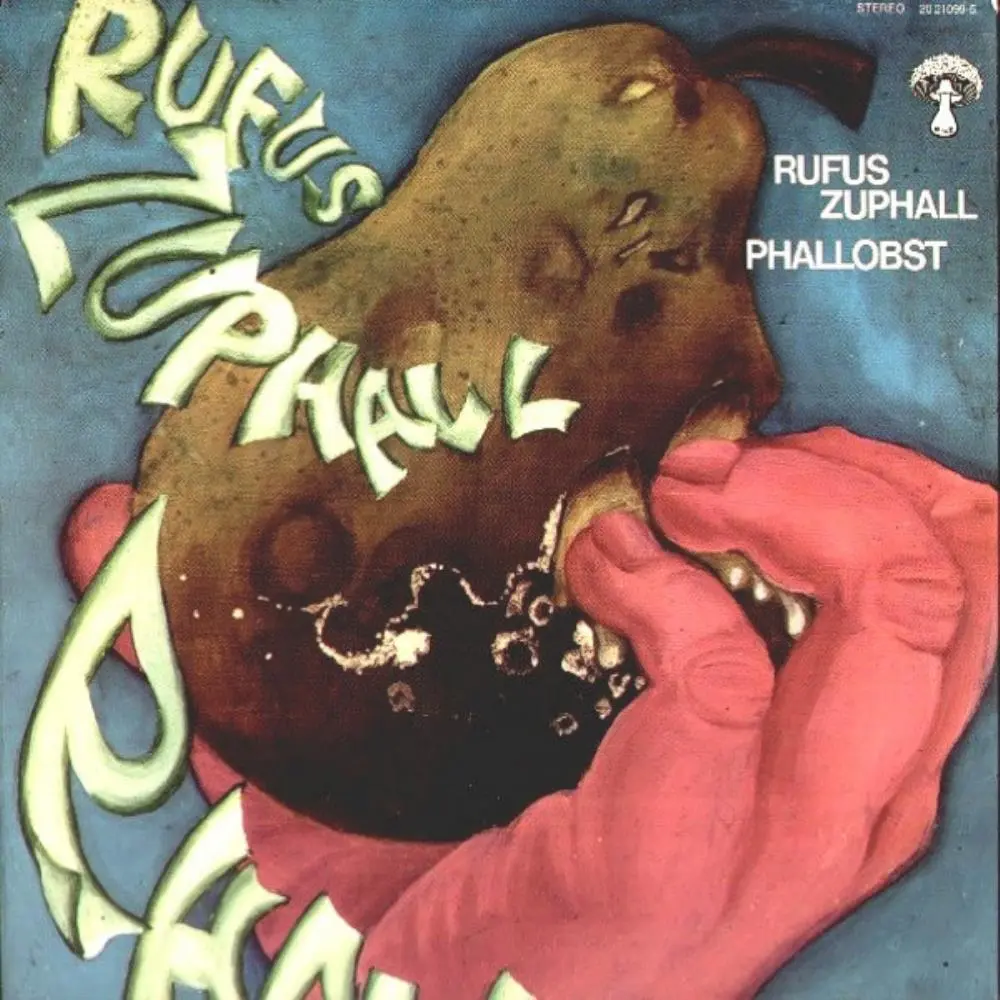 Rufus Zuphall released their second album, Phallobst, in October 1971 on Pilz. The title is German for “Phallus Fruit.”
The album contains eight group-written titles, performed by guitarist Günter Krause (electric guitar, acoustic guitar, steel guitar, Mellotron, vocals), guitarist Thomas Kittel (electric guitar, twelve-string guitar, Clavinet), flutist Klaus Gülden, bassist Manfred Spangenberg, and percussionist Udo Dahmen.
“Closing Time” quickens from close-set vocal lines into a brisk instrumental break after the early verse. “Wenn Schon, Denn Schon” drops from a firmer opening into interlocked acoustic guitar figures, then returns to its first pattern. “Schupfner” threads a medieval-colored line through alternating drive and retreat, with flute phrases over the quieter central passage. “Waste Land” slows into minor-key cadence, hushed vocal placement, and soft-edged refrain movement.
“Makröjel” charges through bright-edged instrumental runs, then shifts between quick lead figures and steadier ensemble response. “Prickel Pit” digs into low-end riff figures before a sharper middle break opens the track. “Portland Town” plants a brief Mellotron brass swell under a heavier vocal arrangement, then locks the folk-song contour to blunt riff figures. “I’m on My Way” gathers slow acoustic cadence, sustained keyboard haze, and a darker lead vocal into the closing refrain.
A1. “Closing Time” (3:21)
A2. “Wenn schon, denn schon” [“If So, Then So”] (3:35)
A3. “Schnupfer” [“Sniffer”] (5:13)
A4. “Waste Land” (5:10)
B1. “Makröjel” (5:53)
B2. “Prickel Pit” (3:51)
B3. “Portland Town” (3:52)
B4. “I’m on My Way” (5:01)
Rufus Zuphall recorded Phallobst between July and August 1971 at Dierks Studio in Stommeln with engineer Dieter Dierks. The gatefold cover shows a pink-gloved hand holding a bitten green pear against a blue field.
Discography:
- Weiß der Teufel… (1970)
- Phallobst (1971)
- Avalon and On (1993, recorded 1972)
Sources:
Artist/Album Pages:
Caravan are an English rock band from Canterbury that released ten studio albums between 1968 and 19...
Náttúra was an Icelandic psych-rock band led by guitarist Björgvin Gíslason through several lineup...
Sigmund Snopek III (born Oct. 21, 1951) is an American multi-instrumentalist, composer, and produc...
Fuse was an American Midwest psych-rock band that released a 1970 self-titled album on Epic. Me...
Morse Code was a Québécois symphonic/art-rock band that released two albums as Morse Code Transmis...
The Outsiders were a Dutch Nederbeat band from Amsterdam that made thirteen singles and the 1967/6...
Tommie Young is an American soul singer from Dallas who released the 1973 album Do You Still Feel...
Oregon are an American ethno-jazz band from Eugene, Ore., formed in 1970. The original lineup—guit...
C.K. Strong was an American soul-rock band from Los Angeles that released a self-titled album on Epi...
Missus Beastly was a German jazz-rock band that released a self-titled album on CPM in 1970. After...
Varis was a German jazz-rock band that self-released a 1979 eponymous album. Members: Ralf Pallm...
Duffy were an English hard-rock band that released the album Scruffy Duffy on PAN in 1973, followe...