

Billy Paul (Dec. 1, 1934 — April 24, 2016) was an American soul singer from Philadelphia, best known for his 1972 ballad “Me and Mrs. Jones,” a definitive crossover hit of the Philly Soul era. Between 1968 and 1988, he made twelve studio albums and scored further R&B hits with “Am I Black Enough for You?” and “Thanks for Saving My Life.”
Background
Billy Paul was born Paul Williams on December 1, 1934, in North Philadelphia, Pennsylvania. His mother bought 78 rpm records that ranged from Jazz at the Philharmonic releases to Nat King Cole sides, and Paul sang along with the records at home. Paul began his singing career at eleven on Philadelphia radio station WPEN. He studied voice at West Philadelphia Music School and Granoff School of Music.
Paul appeared in Philadelphia clubs as a teenager, including a one-week Club Harlem bill with saxophonist Charlie Parker. Paul’s manager Jules Malvin took him to the Apollo Theater in Harlem for a six-week engagement and gave him the Billy Paul stage name. Paul cut “Why Am I” and “That’s Why I Dream” for Jubilee Records in New York in April 1952 with pianist Tadd Dameron and organist Jackie Davis.
Feelin’ Good at the Cadillac Club
 Billy Paul released his debut album, Feelin’ Good at the Cadillac Club, in 1968 on Gamble Records.
The album presents club-scaled vocal jazz with piano-led trio accompaniment. Paul performs with pianist-arranger Stanley Johnson, bassist Bill Collick, and drummer Norman Fearrington. The program contains one song by Kenny Gamble and one traditional title.
“Billy Boy” scats through a spare trio cadence and places Paul in club-act address. “Bluesette” glides across tongue-twisting lines, elongated notes, and elastic accent placement. “On a Clear Day” sways in bossa-touched cadence as Paul bends the lyric through light phrase turns. “Feeling Good” lingers over theatrical ballad arcs and rises through extended vocal peaks. “Somewhere” closes the set with intimate lift and held phrase endings.
A1. “Billy Boy” (2:43) – traditional
A2. “Missing You” (2:45) – Gamble
A3. “Bluesette” (3:05) – Gimbel, Thielemans
A4. “Clear Day” (4:39) – Lerner, Lane
A5. “Just in Time” (3:56) – Comden, Green, Styne
B1. “That’s Life” (4:05) – Kay, Gordon
B2. “Don’t Think Twice, It’s All Right” (2:03) – Dylan
B3. “Feeling Good” (8:30) – Bricusse, Newley
B4. “Somewhere” (3:37) – Bernstein, Sondheim
Paul produced Feelin’ Good at the Cadillac Club in 1968 at Virtue Recording Studios in Philadelphia.
The original Gamble cover places large yellow Billy Paul lettering against a black field with a white kit drawing and colored circular heads.
In May 1969, Gamble lifted “Bluesette” as a single (b/w “Somewhere”).
Ebony Woman
 Billy Paul released his second album, Ebony Woman, in July 1970 on Neptune Records.
Ebony Woman blends soul-jazz ballads with mid-tempo songs. Paul leads a small combo with pianist-arranger Stanley Johnson, bassist James Glenn, and percussionist Sherman Ferguson.
The album includes songwriting contributions by Morris Bailey and Robert Martin, plus covers of The Association (“Windy”), Simon & Garfunkel (“Mrs. Robinson”), Sly & The Family Stone (“Everyday People”), Horace Silver (“Psychedelic Sally”), Classix IV (“Traces”), Michel Legrand (“The Windmills of Your Mind”), Creedence Clearwater Revival (“Proud Mary”).
“Ebony Woman” descends through dramatic strings and a lowered vocal entrance, then Paul widens the line into sharper peaks. “Mrs. Robinson” scatters a quick vocal introduction over piano and hand-marked accents. “The Windmills of Your Mind” suspends the verse in spacious cadence and slow-breathed lyric turns. “Everyday People” rushes through breakneck vocal lines and hard cymbal accents. “Let’s Fall in Love All Over Again” pleads across lush refrain phrases. “Psychedelic Sally” drives a fast chant through jazz-drenched piano figures and clipped lead lines. “Traces” strips the accompaniment back while Paul turns the cadence toward regret and held phrase endings.
A1. “Ebony Woman” (3:52) – Bailey
A2. “Mrs. Robinson” (4:31) – Paul Simon
A3. “The Windmills of Your Mind” (8:00) – Legrand, Alan and Marilyn Bergman
A4. “Everyday People” (3:55) – Sylvester Stuart
B1. “Let’s Fall in Love All Over” (3:51) – Martin
B2. “Windy” (2:50) – Ruthann Friedman
B3. “Psychedelic Sally” (2:58) – Silver
B4. “Traces” (4:01) – Buddy Buie, J. R. Cobb, Emory Gordy
B5. “Proud Mary” (2:23) – John Fogerty
Gamble and Huff produced Ebony Woman at Sigma Sound Studios in Philadelphia with engineer Joe Tarsia. Bobby Martin arranged “Let’s Fall in Love All Over” and the title track.
Dick Fowler designed the original Neptune package, whose cover shows a four-person studio portrait against a dark field. The 1973 Philadelphia International reissue used Ed Lee and Hiroshi Morishima design with Don Hunstein photography. Its cover shows Grace Jones in a close face portrait against a dark ground.
Neptune lifted “Let’s Fall in Love All Over” as a July 1970 single (b/w “Mrs. Robinson”). The original Neptune LP reached No. 183 on Billboard Pop Albums and No. 12 on Billboard Top Soul Albums. Philadelphia International reissued the album in 1973, and that edition reached No. 186 on Billboard Pop Albums and No. 43 on Billboard Top Soul Albums.
Going East
 Billy Paul released his third album, Going East, in October 1971 on Philadelphia International Records.
The album presents orchestral soul-jazz with broad string and horn arrangements, performed with pianist Eddie Green, vibraphonist Vince Montana, bassist Tyrone Brown, drummer Norman Farrington, and guitarists Norman Harris and Roland Chambers. Auxiliary players include reedist Tony Williams, conguero Robert Crippen, and percussionists Charles Jules and Gerald Roberts.
Bobby Martin arranged the closing side-two sequence from “I Wish It Were Yesterday” through “There’s a Small Hotel.” Lenny Pakula arranged “East.” Thom Bell arranged the five-song run from “(If You Let Me Make Love to You Then) Why Can’t I Touch You?” through “Magic Carpet Ride.”
“East” unfolds from spoken-word introduction into spiritual refrain lines and ornate ensemble swells. “Why Can’t I Touch You?” clips brisk vocal phrases against rasped brass punctuation. “This Is Your Life” floats Paul across a tender cadence and background-vocal lift. “Jesus Boy” surges through grand section changes and a rising lead. “Magic Carpet Ride” scats across a quick shuffle, airy flute breaks, and fast lyric recuts. “I Wish It Were Yesterday” leans into slow piano phrases and a pensive vocal line. “Compared to What” loosens into a bright ensemble passage with shouted brass replies. “Love Buddies” settles around vibes, low-register vocal phrasing, and late-night cadence.
A1. “East” (6:46) – Brown
A2. “(If You Let Me Make Love to You Then) Why Can’t I Touch You?” (2:42) – Courtney, Link
A3. “This Is Your Life” (4:16) – Webb
A4. “Jesus Boy (You Only Look Like a Man)” (4:17) – Jakke
B1. “Magic Carpet Ride” (5:19) – Cohn, Green, Makem
B2. “I Wish It Were Yesterday” (3:50) – Martin, Phillips
B3. “Compared to What” (5:20) – McDaniels
B4. “Love Buddies” (3:40) – Gamble, Huff
B5. “There’s a Small Hotel” (4:27) – Hart, Rodgers
Gamble and Huff produced Going East in 1971 at Sigma Sound Studios in Philadelphia with conductors Don Renaldo (strings) and Sam Reed (horns).
Roger Hane painted the cover art for a Ron Coro package. The image places a hat-wearing figure on an orange carpet above a blue-green landscape with domes, pyramids, and a camel. The back cover shows Paul seated beside a woman below the liner copy, with photography by Jim O’Neill.
Philadelphia International lifted “Magic Carpet Ride” as a November 1971 single (b/w “Love Buddies”). In March 1972, “This Is Your Life” followed (b/w “I Wish It Were Yesterday”).
Going East reached No. 197 on Billboard Pop Albums and No. 42 on Billboard Top Soul Albums.
360 Degrees of Billy Paul
 Billy Paul released his fourth studio album, 360 Degrees of Billy Paul, in October 1972 on Philadelphia International Records.
Paul leads an MFSB-rooted session group that includes guitarist Bobby Eli, organist Lenny Pakula, bassist Anthony Jackson, conguero Larry Washington, and returning sidemen Eddie Green and Vince Montana. Barbara Ingram recorded backing vocals with Carla Benson and Evette Benton.
The album contains songwriting input by Kenneth Gamble, Leon Huff, Phil Hurtt, Bunny Sigler, and Jean Lang, plus covers of Carole King, Al Green, and Bernie Taupin.
“Brown Baby” crests from a searing guitar lead into cascading strings and backing-vocal replies. “I’m Just a Prisoner” descends through slow strings while pain-marked scat phrases meet hard brass. “It’s Too Late” glides through open-spaced vocal lines and organ flashes. “Me and Mrs. Jones” lingers on elongated notes over patient strings and discreet replies.
“Am I Black Enough for You?” charges through a growling clavinet figure and bongo-marked backbeat before hard brass accents. “Let’s Stay Together” slows into low phrasing and wide pauses around the refrain. “Your Song” skips through horn bursts and gospel-toned backing replies. “I’m Gonna Make It This Time” lifts a determined lead over cascading lines and final vocal crests.
A1. “Brown Baby” (4:41) – Gamble, Huff
A2. “I’m Just a Prisoner” (8:05) – Gamble, Hurtt, Sigler
A3. “It’s Too Late” (4:39) – King, Toni Stern
A4. “Me and Mrs. Jones” (4:52) – Gamble, Huff, Gilbert
B1. “Am I Black Enough for You?” (5:22) – Gamble, Huff
B2. “Let’s Stay Together” (6:31) – Green, Al Jackson, Willie Mitchell
B3. “Your Song” (6:36) – John, Bernie Taupin
B4. “I’m Gonna Make It This Time” (4:28) – Lang, Sigler
Gamble and Huff produced 360 Degrees of Billy Paul in 1972 at Sigma Sound Studios in Philadelphia with engineer Joe Tarsia and orchestral arranger Don Renaldo.
Ed Lee designed the cover package. Don Hunstein photographed the front cover, whose image places three views of Paul in a black hat and glasses against a white field. Robert Davis photographed the back cover.
Philadelphia International lifted “Me and Mrs. Jones” as a September 1972 single (b/w “Your Song”), which reached No. 1 on the Billboard Hot 100 and No. 1 on Billboard R&B Singles.
“Am I Black Enough for You?” followed in 1973 (b/w “I’m Gonna Make It This Time”) and reached No. 79 on the Billboard Hot 100 and No. 29 on Billboard Soul.
360 Degrees of Billy Paul reached No. 17 on Billboard Pop Albums and No. 1 on Billboard Top Soul Albums.
War of the Gods
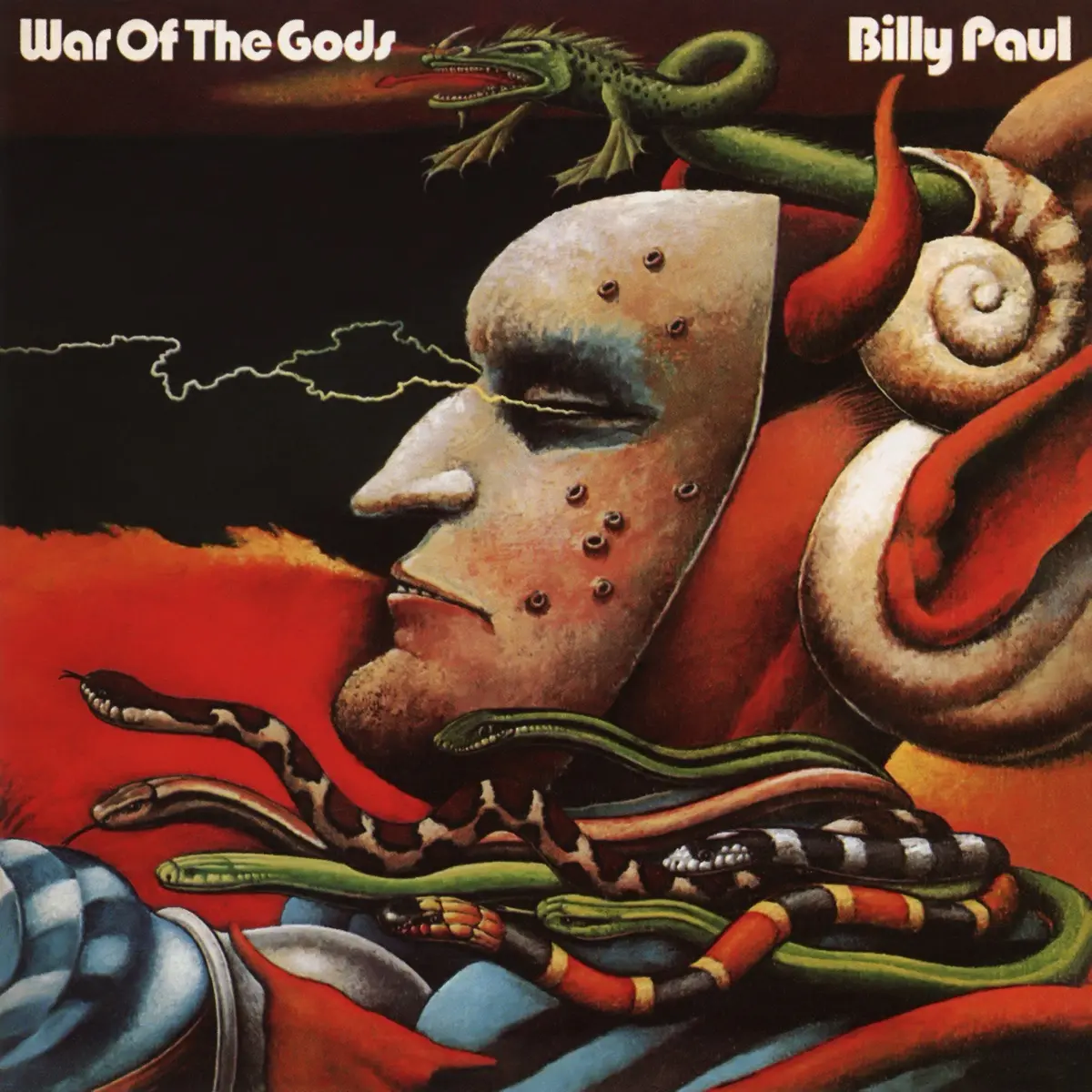 Billy Paul released his fifth studio album, War of the Gods, on October 12, 1973, on Philadelphia International Records.
The album presents six lavish numbers with extended vocal passages, choral entries, and orchestral rhythm-section support. Paul leads a ensemble of returning 360 players, joined by the Dandridge Choral Ensemble on “Peace Holy Peace.”
“I See the Light” opens with a slow keyboard line, then swells around reflective lead phrases and brass. “War of the Gods” unfurls from sirens into choral replies, then quickens through a jaunty middle passage. “The Whole Town’s Talking” quickens the refrain with punchy brass and cascading strings. “I Was Married” pleads over a slow saxophone line and regret-stained string swells. “Thanks for Saving My Life” swings through bright ensemble replies and compact vocal turns. “Peace Holy Peace” settles around meandering organ, with slow strings under choral backing.
A1. “I See the Light” (6:13) – Gamble, Huff, Sigler
A2. “War of the Gods” (10:07) – Gamble, Huff
B1. “The Whole Town’s Talking” (4:46) – Gamble, Huff
B2. “I Was Married” (7:19) – Gamble, Huff, Gilbert, Arc
B3. “Thanks for Saving My Life” (2:58) – Gamble, Huff
B4. “Peace Holy Peace” (6:53) – Gamble, Huff
Gamble and Huff produced War of the Gods in 1973 at Sigma Sound Studios in Philadelphia.
Roger Hane painted the cover artwork, whose outer image shows a horned mask-like profile, coiled snakes, a green dragon form, and a red-black sky. The inner gatefold shows a glowing head profile facing a raised hand within a dark abstract field.
Philadelphia International lifted “Thanks for Saving My Life” as a 1974 single (b/w “I Was Married”), which reached No. 37 on the Billboard Hot 100, No. 9 on Billboard Soul, and No. 33 on the UK Singles Chart.
War of the Gods reached No. 110 on Billboard Pop Albums and No. 12 on Billboard Top Soul Albums.
Live in Europe
 Billy Paul released his first live album, Live in Europe, in 1974 on Philadelphia International Records.
The album showcases concert-length versions of songs from War of the Gods and 360 Degrees of Billy Paul. Paul recorded the performances during his 1973 European tour. The live sequence extends “Brown Baby,” “Me and Mrs. Jones,” and “Your Song” beyond their studio durations. The first LP track combines a “War of the Gods” introduction with “Brown Baby,” which links the current-stage repertory to the prior studio album cycle.
A1. “War of the Gods Introduction / Brown Baby” (9:11) – Gamble, Huff; source studio albums: War of the Gods / 360 Degrees of Billy Paul
A2. “Thanks for Saving My Life” (4:19) – Gamble, Huff; source studio album: War of the Gods
B1. “Me and Mrs. Jones” (8:48) – Gamble, Huff, Gilbert; source studio album: 360 Degrees of Billy Paul
B2. “Your Song” (8:41) – John, Taupin; source studio album: 360 Degrees of Billy Paul
Paul and Caldwell McMillan arranged Live in Europe. Bobby Martin produced the album from December 1973 recordings at Hammersmith Odeon in London and Central Hall in Chatham. Bob Hall engineered the recordings, and Jay Mark remixed the album at Sigma Sound Studios in Philadelphia. Frankford/Wayne Recording Labs mastered the album.
Ed Lee directed the cover package with photography by Urve Kuusik. The cover places a large side-lit profile of Paul in a hat behind a smaller full-body performance image at a microphone.
Live in Europe reached No. 187 on Billboard Pop Albums and No. 10 on Billboard Top Soul Albums.
Got My Head on Straight
 Billy Paul released his sixth studio album, Got My Head on Straight, in early 1975 on Philadelphia International Records.
The album presents MFSB-backed Philadelphia soul with message-text songs, ballads, and mid-tempo arrangements. Paul welcomes keyboardist Dexter Wansel, who joins a large cast of returning 360/WotG players. Gamble and Huff co-wrote five tracks and collaborated on two with Gene McFadden and John Whitehead.
“July, July, July, July” bursts from wistful piano figures into blazing brass and hopeful lead peaks. “Billy’s Back Home” sinks into melancholy electronic tones and tender backing replies. “I’ve Got So Much to Live For” brightens through island-marked accents and grateful lead phrases. “Black Wonders of the World” broods over wah-wah guitar and moody bass while Paul recites civil-rights names with reverent cadence.
“Enlightenment” questions through pensive synths and serene harmonies. “When It’s Your Time to Go” bounces through buzzy accents and a punchy vocal close. “Be Truthful to Me” swings through big-band brass and warning-tone lead phrases. “Everything Must Change” bares open space around the lead line and late backing harmonies. “My Head’s On Straight” closes with celebratory brass and bright refrain lines before a clipped final cadence.
A1. “July, July, July, July” (5:30) – Gamble, Huff
A2. “Billy’s Back Home” (4:33) – Wansel
A3. “I’ve Got So Much to Live For” (4:51) – Gamble, Huff
A4. “Black Wonders of the World” (8:02) – Gamble, Huff, Paul, McFadden, Whitehead
B1. “Enlightenment” (4:53) – Gamble, Huff
B2. “When It’s Your Time to Go” (5:02) – Gamble, Huff
B3. “Be Truthful to Me” (3:08) – Gamble, Huff, Whitehead, McFadden
B4. “Everything Must Change” (5:23) – Ighner
B5. “My Head’s on Straight” (3:12) – Gamble, Huff, Paul
Gamble and Huff produced Got My Head on Straight at Sigma Sound Studios in Philadelphia with engineer Joe Tarsia. MFSB cut the backing tracks before Paul overdubbed vocals in fall 1974. Bobby Martin and Lenny Pakula arranged the album.
The cover uses a pale field with a front-facing portrait of Paul in a brimmed hat, white shirt, and aviator glasses.
Philadelphia International lifted “Be Truthful to Me” as a late-1974 single (b/w “I Wish It Were Yesterday”), which reached No. 37 on Billboard Soul.
“Billy’s Back Home” followed in 1975 and reached No. 52 on Billboard Soul. “July, July, July, July” also appeared as a 1975 single.
Got My Head on Straight reached No. 140 on Billboard Pop Albums and No. 20 on Billboard Top Soul Albums.
When Love Is New
 Billy Paul released his seventh studio album, When Love Is New, in late 1975 on Philadelphia International Records.
The album continues his mid-period Philly style with familiar backers, including Wansel, Pakula, Montana, Eli, Sigler, Washington, and Anthony Jackson.
“People Power” surges from chiming guitar and grand strings into fast lead phrases and female-vocal replies. “America (We Need the Light)” sweeps through quick cadence and hopeful upper-range lines. “Let the Dollar Circulate” marches on clipped economic text, full brass, and massed backing voices. “Malorie” scats through old-band swing accents and light vocal turns. “When Love Is New” lingers over spacious strings and gentle lead placement. “I Want Cha Baby” pleads across slow saxophone phrases and half-spoken vocal turns. “Let’s Make a Baby” settles into slow keyboard-led cadence before Paul crests on the closing vocal lines.
A1. “People Power” (4:18) – McFadden, Whitehead, Victor Carstarphen
A2. “America (We Need the Light)” (5:20) – Paul, Level, Gamble
A3. “Let the Dollar Circulate” (4:58) – Paul, Level
A4. “Malorie” (3:46) – Osborne
B1. “When Love Is New” (5:28) – Gamble, Huff
B2. “I Want ’Cha Baby” (6:18) – Gamble, Huff
B3. “Let’s Make a Baby” (7:11) – Gamble, Huff
Gamble and Huff produced When Love Is New in 1975 at Sigma Sound Studios in Philadelphia with engineer Joe Tarsia. Paul produced “Let the Dollar Circulate.” Jim Gallagher and Mike Hutchinson assisted the sessions.
Carl Barile and Ed Lee designed the cover package with photography by Don Hunstein. The front cover shows Paul reclining in a light suit against a pale ground.
Philadelphia International lifted “Let’s Make a Baby” as a 1976 single, which reached No. 83 on the Billboard Hot 100, No. 18 on Billboard Soul, and No. 30 on the UK Singles Chart.
“People Power” also appeared in 1976 and reached No. 82 on Billboard Soul and No. 14 on Billboard Dance.
When Love Is New reached No. 139 on Billboard Pop Albums and No. 17 on Billboard Top Soul Albums.
Let ’Em In
 Billy Paul released his eighth studio album, Let ’Em In, in 1976 on Philadelphia International Records.
The album presents lush soul with civic-themed material, Wansel-produced ballads, and a titular adaptation of the recent Wings hit, a Bicentennial-inspired marching band number. MFSB back Paul throughout the album.
“Let ’Em In” bursts through bright brass, sampled speech, and a rewritten roll-call refrain. “We All Got a Mission” drives a fast-paced message lead through backing-vocal responses and dramatic horn bursts. “How Good Is Your Game” drops into a softer cadence with sweet interjections around Paul’s lower vocal line. “Love Won’t Come Easy” quickens the pace with high lead phrases and brisk ensemble lift.
“Without You” climbs from piano into string-heavy peaks and grief-marked phrasing. “Word Sure Gets Around” sighs through regret-marked ballad lines and a broad dramatic crest. “Trust You” glides through tender lead phrases and restrained backing voices. “I Think I’ll Stay Home Today” shifts from slow strings into a two-part close with fuller brass and forward motion.
A1. “Let ’Em In” (5:11) – Paul McCartney
A2. “We All Got a Mission” (3:35) – Gamble, Gamble, Huff
A3. “How Good Is Your Game” (4:08) – Burton, Terry
A4. “Love Won’t Come Easy” (4:15) – Wansel
B1. “Without You” (3:16) – originated as a 1970 Badfinger ballad, written by Pete Ham and Tom Evans; popularized in 1972 by Harry Nilsson.
B2. “Word Sure Gets Around” (4:30) – Barrett, Gray
B3. “I Trust You” (4:20) – Gamble, Huff
B4. “I Think I’ll Stay Home Today” (6:19) – Wansel
Jack Faith produced and arranged “Let ’Em In.” Gamble and Huff produced “We All Got a Mission” and “I Trust You,” with Bobby Martin arrangements. Michael Burton and Phil Terry produced “How Good Is Your Game,” with a Dexter Wansel arrangement. Wansel produced “Love Won’t Come Easy,” “Without You,” “Word Sure Gets Around,” and “I Think I’ll Stay Home Today.” Sessions occurred at Sigma Sound Studios in Philadelphia, and Frankford/Wayne Recording Labs mastered the album.
Ed Lee designed the album package. The cover places a smiling close portrait of Paul in hat and glasses inside a green border.
Philadelphia International lifted “How Good Is Your Game” as a 1977 single (b/w “I Think I’ll Stay Home Today”), which reached No. 50 on Billboard Soul.
“Let ’Em In” followed (b/w “We All Got a Mission”) and reached No. 91 on Billboard Soul and No. 26 on the UK Singles Chart.
“I Trust You” became a later 1977 single (b/w “Love Won’t Come Easy”) and reached No. 79 on Billboard Soul.
Let ’Em In reached No. 88 on Billboard Pop Albums and No. 27 on Billboard Top Soul Albums.
Only the Strong Survive
 Billy Paul released his ninth studio album, Only the Strong Survive, in 1977 on Philadelphia International Records.
The album mixes Gamble–Huff material and outside songs, performed with Wansel and MFSB members, including bassist Michael “Sugarbear” Foreman, guitarist Herb Smith, and keyboardist Steve Gold.
“Only the Strong Survive” swells from quiet vocal entry into quicker cadence, rasped brass, and social-address refrain. “Take It to the Streets” preaches half-spoken lines over staccato delivery and shifting tempo. “Sooner or Later” floats through smooth midtempo lines, scatted turns, and punctuated brass.
“One Man’s Junk” pleads across chiming guitar and tender lead placement. “Everybody’s Breaking Up” slows into melancholy saxophone phrases and broad string support. “The Times of Our Lives” meanders through sparse piano and understated backing. “Don’t Give Up on Us” carries Paul’s emotional lead through woodwind, percussion, and shimmering accents. “Where I Belong” closes with full-bodied brass, punchy cadence, and loud vocal crests.
A1. “Only the Strong Survive” (5:38) – Gamble, Huff, Jerry Butler
A2. “Takin’ It to the Streets” (4:52) – Michael McDonald, originated on the titlesake 1976 Doobie Brothers album.
A3. “Sooner or Later” (5:36) – Marshall, Gray
A4. “One Man’s Junk” (3:17) – Gamble, Huff
B1. “Everybody’s Breakin’ Up” (5:05) – Gamble, Huff
B2. “The Times of Our Lives” (5:04) – Wansel
B3. “Don’t Give Up on Us” (3:38) – Macaulay
B4. “Where I Belong” (4:07) – Biggs, Wansel
Gamble and Huff produced “Only the Strong Survive,” “One Man’s Junk,” “Everybody’s Breakin’ Up,” and “Don’t Give Up on Us.” Jack Faith produced “Takin’ It to the Streets,” Sherman Marshall produced “Sooner or Later,” and Dexter Wansel produced “The Times of Our Lives” and “Where I Belong.” Carl Paruolo, Jay Mark, Jim Gallagher, and Joe Tarsia engineered the Sigma Sound Studios sessions in Philadelphia.
Teresa Fasolino created the artwork. The cover shows a red rose breaking through cracked floor tiles beneath blue stenciled title lettering.
Philadelphia International lifted “Only the Strong Survive” as a 1977 single (b/w “Where I Belong”), which reached No. 68 on Billboard Soul and No. 33 on the UK Singles Chart.
In 1978, “Sooner or Later” appeared as a single (b/w “Everybody’s Breakin’ Up”), followed by “Everybody’s Breakin’ Up” (b/w “One Man’s Junk”) in the UK and “Don’t Give Up on Us” (b/w “One Man’s Junk”) in the US.
Only the Strong Survive reached No. 152 on Billboard Pop Albums and No. 36 on Billboard Top Soul Albums.
First Class
 Billy Paul released his tenth studio album, First Class, in 1979 on Philadelphia International Records.
Paul sings over keyboard parts by Dexter Wansel and Leon Huff, with backing vocals by Barbara Ingram. Gamble and Huff co-wrote three songs, including “So Glad to See You Again” and “Treasure of My Life.” Paul co-wrote “Game of Life” with Charles B. Simmons, Joseph B. Jefferson, and Phillip Terry, then co-wrote “It’s Critical” with C. J. Clark and William Hatcher.
“False Faces” sinks into slow lead phrases, chiming guitar, organ punches, brass bursts, and sweeping strings. “Bring the Family Back” lifts a social-address refrain through uptempo handclaps, piano figures, and female backing replies. “Game of Life” presses half-spoken lines against reverberant synths and a frustration-marked lead. “It’s Critical” blazes through frantic brass punctuation and fast vocal turns. “Thank You (For This Blessing)” rises over prayerful phrasing and breathless female backing replies.
“What a Way to Love” glides through slow, jazz-leaning cadence and a brief flute line. “So Good to See You Again” swings through midtempo organ figures and guarded reunion text. “I Gotta Put This Life Down” mourns across woodwind, strings, and slow piano movement.
A1. “False Faces” (4:38) – Carl Gamble, Gamble, Huff
A2. “Bring the Family Back” (5:00) – Smith, Terry
A3. “Game of Life” (3:52) – Paul, Simmons, Jefferson, Terry
A4. “It’s Critical” (3:51) – Paul, Clark, Hatcher
A5. “Thank You (For This Blessing)” (2:57) – Rivers, Smith
B1. “What a Way to Love” (4:21) – Terry, Pugh
B2. “So Glad to See You Again” (4:43) – Gamble, Huff
B3. “Treasure of My Life” (4:38) – Gamble, Huff
B4. “I Gotta Put This Life Down” (4:41) – Gilbert, Green
Gamble and Huff produced “False Faces” and “Treasure of My Life.” Frank Smith and Phillip Terry joined them on “So Glad to See You Again.” Charles B. Simmons and Joseph B. Jefferson produced “Game of Life,” while Paul produced “It’s Critical.” Paul produced “Thank You (For This Blessing)” with Frank Smith and “I Gotta Put This Life Down” with Eddie Green. Phillip Pugh and Phillip Terry produced “What a Way to Love.”
The cover places Paul in a black top hat, black jacket, and glasses against a blue-gray field.
Philadelphia International lifted “Bring the Family Back” as a 1979 single (b/w “It’s Critical”). A 12-inch version reached No. 90 on Billboard Soul and No. 51 on Billboard Dance. “False Faces” followed as a 1979 single (b/w “I Gotta Put This Life Down”).
Lately
 Billy Paul released his eleventh studio album, Lately, in August 1985 on Total Experience Records.
The album presents Total Experience studio soul with keyboard-driven arrangements, electronic percussion, and standard-touched ballad material. Paul sings lead and backing parts with bassist Nathan East, drummer Gerry Brown, guitarist Jonah Ellis, and keyboardists Oliver Scott and Luis Cabaza. Electronic-percussion players Ellis and Scott use DMX, LinnDrum, and Simmons parts. Backing vocalists Carmen Twillie, Jonah Ellis, Julia Tillman Waters, Marva King, Maxine Waters, and Oliver Scott frame the lead parts.
Ellis wrote six songs and Scott wrote two songs. Marvin Jenkins wrote the title ballad. Paul also records songs by Al Dubin and Harry Warren (“I Only Have Eyes for You”) and Alan Jay Lerner and Burton Lane (“On a Clear Day”).
“Fire in Her Love” glows through wistful keyboards, machine-marked accents, and close backing replies. “Sexual Therapy” slows into a late-night refrain and close vocal placement. “Lately” settles into ballad cadence with a restrained lead line. “Let Me In” lowers the tempo around synths and tight backing replies. “Me and You” leans into a bassline, guitar bursts, and rising vocal power. “On a Clear Day” darkens around synth washes and piano responses, then Paul stretches the standard through upper-range turns.
A1. “Fire in Her Love” (4:21) – Ellis
A2. “Sexual Therapy” (4:35) – Ellis
A3. “Lately” (3:58) – Jenkins
A4. “I Search No More” (3:40) – Scott
A5. “I Only Have Eyes for You” (4:21) – Dubin, Warren
B1. “Hot Date” (4:15) – Ellis
B2. “Get Down to Lovin’” (4:31) – Ellis
B3. “Let Me In” (3:50) – Scott
B4. “Me and You” (4:21) – Ellis
B5. “On a Clear Day” (4:25) – Lerner, Lane
Jonah Ellis produced “Fire in Her Love,” “Sexual Therapy,” “I Only Have Eyes for You,” “Hot Date,” “Get Down to Lovin’,” “Me and You,” and “On a Clear Day.” Oliver Scott produced “Lately,” “I Search No More,” and “Let Me In.” Paul co-produced the album with executive producer Lonnie Simmons. Sessions occurred at Total Experience Recording Studios in Hollywood with engineers Jim Stader and Mark Shifman.
William Eastabrook photographed the cover, whose image places Paul seated on a chair beside a potted plant and sheer curtains.
Total Experience released “Lately” in the UK as a 1985 single (b/w “I Search No More”). “Sexual Therapy” followed in the UK (b/w “I Only Have Eyes for You”) and reached No. 80 on the UK Singles Chart.
Wide Open
 Billy Paul released his twelfth and final studio album, Wide Open, in July 1988 on Ichiban Records.
Wide Open presents Paul in a modern R&B setting with programmed rhythms and soft-edged ballads. “We Could Have Been” and “I Just Love You So Much” place Paul in slow-tempo material, while “Dirty Laundry” and “Wide Open” give the first side a firmer keyboard-and-rhythm frame. “Here to Eternity” closes the album with the longest track in the sequence.
A1. “Dirty Laundry” (4:32)
A2. “I’d Rather Be Alone” (4:01)
A3. “I Just Love You So Much” (5:32)
A4. “Wide Open” (4:30)
B1. “This May Be the Love” (4:39)
B2. “We Could Have Been” (3:52)
B3. “Love Ain’t Easy” (4:48)
B4. “Here to Eternity” (5:52)
Buzz Amato and Ice-9 produced Wide Open for Ichiban Records.
The cover places Paul in a grass field with pink title lettering. The back cover shows Paul in the same setting with arms extended above the tracklist and production credits.
Ichiban lifted “We Could Have Been” as a 1988 single (b/w “I’d Rather Be Alone”). “I Just Love You So Much” followed (b/w “This May Be the Love”).
Wide Open reached No. 61 on Billboard Top Soul Albums.
Discography:
- Feelin’ Good at the Cadillac Club (1968)
- Ebony Woman (1969)
- Going East (1971)
- 360 Degrees of Billy Paul (1972)
- War of the Gods (1973)
- Live in Europe (live, 1974)
- Got My Head On Straight (1975)
- When Love Is New (1975)
- Let ‘Em In (1976)
- Only the Strong Survive (1977)
- First Class (1979)
- Lately (1985)
- Wide Open (1988)
Sources:
Artist/Album Pages:
XTC was an English rock band that released ten albums on Virgin between 1978 and 1992, followed by t...
Third Eye was a Dutch jazz-rock band that released the 1976/77 albums Third Eye and Connexion on R...
The Group were a Finnish jazz-rock super-band that released a self-titled album on Finnlevy-subsi...
Ren Woods (born Jan. 1, 1958) is an American soul singer from Portland, Ore., who sang with the tr...
James Vincent (born Feb. 8, 1943) is an American guitarist, singer, and composer from Chicago who ...
Мелодия (Melodia) are a Russian jazz-funk big band from Moscow, started in 1973. The band released...
Randy California (Feb. 20, 1951 — Jan. 2, 1997) was an American psych-rock guitarist and composer ...
Marie Queenie Lyons is an American soul singer who released the 1970 album Soul Fever on DeLuxe R...
Beckett was an English rock band from Newcastle that released a self-titled album on Raft Records in...
John Tropea is an American jazz-funk guitarist who emerged as a New York sessionist and made the ...
Triangle was a French sax-rock/psych band that debuted with a pair of singles on Odeon in 1969, fo...
Jasper van't Hof (born June 30, 1947) is a Dutch pianist, keyboardist, composer, and bandleader ac...