
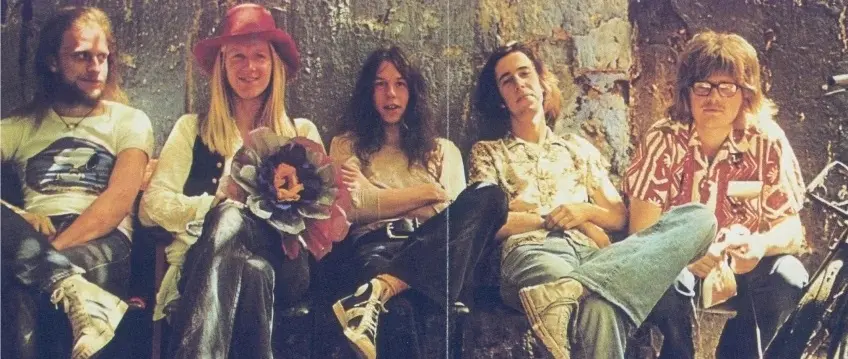
Agitation Free was a German Krautrock band behind the 1972/73 Vertigo albums Malesch and 2nd. They fused guitar improv with electronic soundscapes, jazz elements, and Middle Eastern influences. After their 1974 breakup, they reunited for the 1999 album River of Return and the 2023 release Momentum.
Members: Lutz Ulbrich (guitar, zither, organ, bouzouki, vocals), Michael Günther (bass, tapes, 1967-2014), Lutz Kramer [aka Ludwig] (guitar, vocals, 1967-70), Christopher Franke (drums, synthesizer, 1967-70), Micky Duwe [aka Mickie D] (vocals, guitar, 1967, 1974), Manfred Brück [aka John L.] (vocals, 1968-69), Ax Genrich (guitar, 1970), Jörg Schwenke (guitar, 1970-73), Gerd [Gerhard Klemke] (drums, 1970), Burghard Rausch (drums, percussion, Mellotron, marimba, vocals, 1971-74, 1998), Michael Hoenig (keyboard, synthesizer, electronics, steel guitar, 1971-74), Stephan Diez (guitar, 1973), Dietmar Burmeister (drums, percussion, 1973), Bernhard Arndt (organ, percussion, 1974), Manfred Opitz (keyboards, vocals, acoustic guitar), Gustl Lütjens (guitar, 1974)
Background
Agitation Free formed in September 1967 in West Berlin when guitarist Lutz “Lüül” Ulbrich and drummer Christoph Franke merged their school band The Sentries with an R&B group that featured bassist Michael “Fame” Günther and guitarist Lutz “Ludwig” Kramer.
Ulbrich took guitar lessons from age ten and formed The Tigers in 1965 with childhood friend Franke. The group later adopted the name The Sentries. Günther attended the Waldschule in Charlottenburg alongside Ulbrich and Franke. Singer Michael “Micki” Duwe briefly joined the new quartet.
Agitation Free initially played beat and R&B covers, which the musicians extended through lengthy instrumental improvisations. Visual artist Folke Hanfeld developed accompanying light projections, slides, and experimental films. Manager Volker Cornelius secured a residency at the Zodiak Free Arts Lab, where the group shared the stage with Tangerine Dream and Cluster. Singer Manfred Brück, known as John L., joined in 1968 and became a fixture of the live shows. Agitation adopted the Free suffix after a no-admission-charge appearance at the Quasimodo club.
In late 1969, violin teacher Frau Franke persuaded music-school director Konrad Latte to subsidize the group through the Volksmusikhochschule in Berlin-Wilmersdorf. Composer Thomas Kessler supervised the resulting Beat Studio on Pfalzburger Straße, where Agitation Free developed electronic experiments alongside Tangerine Dream and Ash Ra Tempel.
Kessler introduced the musicians to tape manipulation, analogue synthesis, and contemporary avant-garde soundscapes. In March 1970, Kramer left Agitation Free after a dispute with Günther, who recruited guitarist Ax Genrich as his replacement. Genrich appeared with the band at the First German Progressive Pop Festival in the Berlin Sportpalast on April 12, then joined Guru Guru. Agitation Free recruited Jörg “Joshi” Schwenke from The Shatters as their new guitarist that summer. Franke played his final concert with the group in September and moved to Tangerine Dream.
Ulbrich and Günther also performed with Manuel Göttsching, Klaus Schulze, and Conrad Schnitzler in the improvisational collective Eruption. In February 1971, Günther recruited schoolmate Michael Hoenig, who had worked with Kessler on tape experiments and participated in the Berlin Scratch Orchestra. Hoenig made his Agitation Free debut that month at the TU Alte Mensa without a drummer.
After a brief stretch with percussionist Gerd Klemke, Schulze introduced drummer Burghard Rausch, who joined in September and completed the Malesch quintet with Ulbrich, Schwenke, Günther, and Hoenig. Günther and Rausch also formed the Berlin trio Sopwith Camel with Australian singer-guitarist Richard Clapton. The musicians pursued a recording deal in Munich, but the namesake San Francisco band issued a cease-and-desist notice that prompted the German company to abandon the project.
In March 1971, German diplomat Christian Nakonz heard Agitation Free at the Quartier Latin in Berlin and proposed a concert tour of the Middle East. Kessler also introduced the musicians to Between keyboardist-composer Peter Michael Hamel, who connected them with Schott Music and the Music Factory label. After receiving a demo, Music Factory executives heard the quintet at the Kurfürstliches Schloss in Mainz in February 1972 and offered a recording contract. That April, Agitation Free toured Egypt, Lebanon, Cyprus, and Greece through the Goethe-Institut.
Günther captured local music and street sounds on a portable Uher tape recorder for use in the forthcoming album. In July, the musicians entered Audio Tonstudio in Berlin with guest organist Hamel and percussionist Uli Popp for the Vertigo debut Malesch.
Discography:
- Malesch (1972)
- 2nd (1973)
- Last (1976)
Sources:
References and notes
- Michael Günther — Early Days. Firsthand history of the 1965–70 school bands, formation, Zodiak residency, personnel changes, and establishment of the Beat Studio. (Agitation Free archive)
- Agitation Free — Concert and personnel chronology. Dated record of lineups, Eruption performances, the 1972 Mainz concert, Middle East itinerary, July studio sessions, and December album release. (Agitation Free archive)
- From the Photo Album of Agitation Free, Part 2 — 2016. Günther recollections concerning Schwenke, Hoenig, Franke, Rausch, the Music Factory demo, and the Mainz audition. (MIG Music)
- Michael Hoenig interview — Ferne Ziele, 2023. Detailed account of the Beat Studio, Thomas Kessler, early electronics, the personnel transition, Peter Michael Hamel, and the Schott contract. (Bernd Kistenmacher)
- Lutz Graf-Ulbrich interview — December 19, 2018. Childhood guitar studies, The Tigers, early concerts, the group name, Kessler, and the connection with Hamel and Vertigo. (It’s Psychedelic Baby Magazine)
- Agitation Free — A Lost Legend Returns, 1999. Identifies Christian Nakonz and the March 1971 Quartier Latin encounter behind the Middle East invitation. (DPRP)
- Michael Günther — Road to Cairo. Firsthand itinerary of the April 1972 tour, Goethe-Institut contacts, Uher field tapes, and Egyptian musical encounters. (Agitation Free archive)
- Agitation Free — Malesch. Official album credits identifying the five musicians, Hamel, Popp, producers, engineer Stan Regal, and Audio Tonstudio. (Official discography)
Artist/Album Pages:
Siloah was a German ethno-folk/psych band that self-issued a 1971 eponymous album, followed by the...
Sugarloaf was an American psych-rock band from Denver that made the 1970/71 Liberty albums Sugarl...
Dave Mason is an English singer-songwriter who emerged as the guitarist of Traffic during the late 1...
Les Séguin was a Québécois folk-rock duo comprised of the brother/sister team of Richard Séguin an...
Lonnie Liston Smith is an American jazz-funk keyboardist, composer, arranger, and band-leader who ha...
Circus 2000 was an Italian pop-psych band that released four singles and the 1970–72 Rifi albums C...
George Benson (March 22, 1943) is an American jazz-funk guitarist and singer from Pittsburgh. He ...
Kvartetten Som Sprängde was a Swedish jazz-rock/psych trio behind the 1973 album Kattvals on Gump....
Dancer was an English symphonic/folk-rock band that recorded an album's worth of material circa 19...
Aphrodite's Child was a Greek symphonic/psych-rock band that released numerous singles and three a...
Gary Ogan is an American singer/songwriter from Portland, Ore., who emerged in partnership with mu...
Bill Puka is an American pianist and singer-songwriter who released a self-titled album on Columbia ...