

 Death Walks Behind You is the second album by the English rock band Atomic Rooster, released in September 1970 on B&C Records.
Issued seven months after Atomic Roooster, this was their only album under the revised trio configuration of keyboardist Vincent Crane, guitarist–singer John Du Cann, and drummer Paul Hammond. Sessions occurred in August 1970 after the departures of bassist–singer Nick Graham and original drummer Carl Palmer. Crane filled Graham’s function with Hammond bass pedals.
The album served as the breakout showcase for Du Cann, who cuts through most tracks with strident leads that helped redefine guitarists as chief soloists in hard rock.
Side one presents large theatrical rockers while the second half alternates shorter songs and quieter cuts with an epic finale piece. Crane and Du Cann each wrote three songs and co-wrote two. Du Cann sings lead on the six vocal tracks.
Background and recording
In March 1970, one month after Atomic Roooster hit UK shelves, bassist Nick Graham departed just as plans loomed for that album’s US release. Meanwhile, Vincent Crane had second thoughts about the original guitar-free format and roped in John Du Cann to rectify matters. Du Cann recorded a 1969 album in Andromeda, a powertrio spun from The Attack. (Ironically, an unrelated German Andromeda released a 1970 album with more Rooster-like, organ-driven traits than Du Cann’s band.)
Crane replaced Graham’s bass parts with Hammond pedals and had Du Cann overdub guitar for the intended US version of Atomic Roooster. Despite its rejection by their US label, the revised version appeared as a second UK issue. Soon after, Carl Palmer left for Emerson Lake & Palmer. Horse drummer Ric Parnell deputized before the arrival of Paul Hammond.
Atomic Rooster self-produced Death Walks Behind You in the summer of 1970. The album appeared in a gatefold sleeve with a black-framed reproduction of Nebuchadnezzar, a 1795 monotype print by English painter, poet, and printmaker William Blake. Crane wrote the original sleeve notes, which explain several songs as studio constructions built from film work, stage numbers, or reworked riffs.
A1. “Death Walks Behind You” (7:28) | Du Cann, Crane | vocals: Du Cann
The title track opens with isolated piano notes and a stretched pause, then drops into one of the album’s central riff patterns. Crane wrote the opening after improvising alone at the piano during work tied to a short film he and Du Cann called The Vortex. The final record turns that opening into a long threshold before the main pulse arrives. Du Cann’s vocal enters above a repeating organ figure, and the whole piece gains force through recurrence, pressure, and widening instrumental weight.
Death walks behind you
Death walks behind you
John repeatedly states that death is following closely behind, creating an immediate sense of dread and inevitability.
Lock the door, switch the light
You’ll be so afraid tonight
Hide away from the bad
Count the nine lives that you’ve had, oh
He warns that locking the door and turning off the light will bring intense fear. He advises hiding from danger and counting one’s remaining lives, implying that time is running out.
Start to scream, shout for help
There is no one by your side
To forget what is done
Seems so hard to carry on, oh
He describes screaming and calling for help, only to realize no one is there to assist. He notes how difficult it is to move past past actions and continue living.
Luck is false, that it’s near
Bring yourself to understand
It’s your fate or what’s cast
Point the finger at yourself, ah
He declares that luck is an illusion. He urges acceptance that one’s fate is already determined and that blame should be directed inward at oneself.
Death walks behind you
Death walks behind you
Death walks behind you
He repeats the ominous warning that death continues to follow, reinforcing the inescapable presence of mortality.
Lock the door, switch the light
You’ll be so afraid tonight
Hide away from the bad
Count the nine lives that you’ve had, oh
He repeats the earlier instructions to lock the door and turn off the light, emphasizing the fear it brings and the need to hide while reflecting on how many lives one has left.
Start to scream, shout for help
There is no one by your side
To forget what is done
Seems so hard to carry on, oh
Seems so hard to carry on, carry on
He again depicts the act of screaming for help with no one present, highlighting the difficulty of forgetting past deeds and the struggle to keep going.
Death walks behind you
Death walks behind you, oh
Death walks behind you, oh
Death walks behind you, oh
Death walks behind you, oh
Death walks behind you, oh
Death walks behind you, oh
Death walks behind you
Death walks behind you
Death walks behind you, oh
The song closes with multiple repetitions of the central line, building a haunting and relentless sense that death is persistently following.
A2. “VUG” (4:57) | Crane | instrumental
“VUG” strips the vocal away and tightens the trio into unison attack. Crane’s sleeve note says he built the track from organ-and-guitar lines in unison over a heavy shuffle pulse, then deliberately mixed the voices out. That choice leaves the piece to run on attack, accent, and locked phrasing. Hammond drives the beat from underneath while Crane and Du Cann strike the line together, then split it open through short breaks and instrumental replies.
A3. “Tomorrow Night” (3:56) | Crane | vocals: Du Cann
“Tomorrow Night” compresses the album’s scale without lightening its touch. Crane opens on piano, then folds the song into a brisk riff pattern and a more compact chorus shape. The LP version carries the performance past the fade used for the mono single, which gives the album cut a rougher exit and lets it bleed forward into “7 Streets.” B&C later issued the song as a single backed with “Play the Game,” and it entered the Official Singles Chart on February 6, 1971, peaked at No. 11, and spent 12 weeks on the chart.
When I wake up in your bed
I can still hear what you said
Like a bad dream, I can’t fight
Tomorrow night
The narrator wakes up in his lover’s bed, still haunted by words spoken the night before. He compares the lingering feeling to a bad dream he cannot escape, all centered on the hope of making things right tomorrow night. He questions whether he is truly lying next to his lover and wonders if he genuinely needs to love her. He resolves to do things properly tomorrow night.
Time goes so slow when you’re gone
Days turn to years, seems so long, ah
He describes how time drags painfully when his lover is absent, making days feel like endless years.
If you still feel like today
If tomorrow’s the same way
Then I know it’ll be right
Tomorrow night, ah
He expresses that if his lover still feels the same as she does today and tomorrow continues in the same way, then he knows everything will finally be right tomorrow night.
Can’t you trust me? See it through
Can’t you wait till I see you?
When we’re working, you’re uptight
Tomorrow night
He pleads for his lover to trust him and see things through. He asks her to wait until they can be together again, noting that she becomes tense and uptight while they are working, with the hope that it will all resolve tomorrow night.
Time goes so slow when you’re gone
Days turn to years, seems so long, ah
He repeats how painfully slow time passes in her absence, turning ordinary days into what feels like years.
When I wake up in your bed
I can still hear what you said
Like a bad dream, I can’t fight
Tomorrow night
He returns to the opening image of waking in her bed, still hearing her words like an inescapable bad dream, with everything hinging on tomorrow night.
Oh am I lying next to you?
Am I thinking I need to really love you?
Oh do it right tomorrow night
He once again questions if he is really beside her and whether he truly needs to love her deeply, reaffirming his intention to do everything right tomorrow night.
Oh tomorrow night, tomorrow night
Tomorrow night, tomorrow night
Tomorrow night, tomorrow night
Tomorrow night, tomorrow night
Tomorrow night, oh summertime
He repeats “tomorrow night” obsessively, building a sense of anxious anticipation and longing that stretches into the summertime.
A4. “7 Streets” (6:40) | Du Cann | vocals: Du Cann
Du Cann built “7 Streets” by joining three riffs first written for separate pieces at different tempos. That stitched construction gives the track its sectional pull. Each return lands with a different weight because Crane changes the keyboard color around it; on the album he also used a special device to make the Hammond speak with a church-organ edge. The song moves through riff blocks and response figures, with guitar and organ pushing against each other inside a longer frame than the single-sized cuts around it.
Seven lonely streets, walking all alone
Never needing no one, always on my own
Since I left the world to live my own way
People I don’t see, no one’s in my day
The narrator describes walking alone through seven lonely streets, emphasizing his complete independence and isolation. He explains that since he chose to leave the world and live on his own terms, he sees no people and has no one in his daily life.
In my sleep, I hear but my eyes can’t see
Photos of my past, of my life to be
Ear faced to the wind to see all I can hear
The days would be so long, seven streets I fear, oh
He recounts how, in his sleep, he can hear but cannot see. Memories and images of his past and possible future appear like photos. He turns his ear to the wind to catch every sound, yet the days feel endlessly long, and he fears these seven streets.
Seven lonely streets, all on my own
Seven days I weep, oh I’m all alone, so all alone
Seven lonely streets, on my own, oh
He repeats that he walks the seven lonely streets completely alone. He weeps for seven days, overwhelmed by profound loneliness.
Seven lonely streets, walking all alone
Never needing no one, always on my own
Since I left the world to live my own way
People I don’t see, no one’s in my day, oh
He returns to the image of walking alone through the seven lonely streets, reaffirming his self-imposed solitude and the fact that no one is part of his daily existence.
Seven lonely streets, I’m all alone
Seven days I plead, oh I’m on my own
He concludes by stating he remains alone on the seven lonely streets and spends seven days pleading, trapped in his isolation.
B1. “Sleeping for Years” (5:24) | Du Cann | vocals: Du Cann
“Sleeping for Years” opens side two with a harder guitar presence and a straighter song frame. Crane’s notes identify it as Du Cann’s first contribution to Atomic Rooster’s book, and the track does carry a more guitar-led center. Hammond sets a firm beat, Crane stacks the organ behind the riff, and Du Cann lifts the middle with a concise lead break. The arrangement stays lean, but the band spaces the entries well enough to keep the pressure from flattening into one block.
Open your eyes
The day is growing near, wasted away
Sleeping off the years
The Narrator wakes from a long period of emotional numbness, realizing that time has slipped away while he remained passive and unaware.
Been around, stood around far too long
Run away, hide away, I was wrong
Couldn’t see, only me, ah, too bad
Now I know, how I know, you’ll stay the same, oh
He reflects on how he has lingered too long in the same place, avoiding change and making excuses. He admits his mistake in focusing only on himself and now understands that the other person will never change.
Give what you have
Can I know when I left it too late?
Guess I’ll never know just why, oh
He questions whether he can still offer something meaningful or if he has already waited too long. He resigns himself to never fully understanding why things turned out this way.
Been around, stood around far too long
Run away, hide away, I was wrong
Couldn’t see, only me, ah, too bad
Now I know, how I know, you’ll stay the same, oh
He repeats his regret over wasted time and self-centered blindness, coming to the painful realization once again that the other person remains unchanged.
What did I lose?
Going my way, taking no more
The light from my day
He wonders what he has truly sacrificed by following his own path and refusing to give any more. He feels that the brightness and hope have been drained from his life.
Been around, stood around far too long
Run away, hide away, I was wrong
Couldn’t see, only me, ah, too bad
Now I know, how I know, you’ll stay the same, oh no
You’ll stay the same, oh
He closes with the same cycle of reflection and regret, now with a heavier sense of finality — accepting that the other person will remain exactly as they are.
B2. “I Can’t Take No More” (3:32) | Du Cann | vocals: Du Cann
“I Can’t Take No More” cuts the side down to a faster, tighter form. Crane noted that the band considered it for single release before choosing “Tomorrow Night” instead. That instinct shows in the shape: the track moves quickly to the refrain, keeps the instrumental passages brief, and puts Du Cann’s vocal at the front of the attack. The song still carries the album’s organ weight, but it hits with less ceremony than the longer titles on either side.
Take it from the hand that feeds you well
Not giving any more
You’ve been lost but I don’t really care
I’m closing up my door
Had a chance, you let it drift away
You threw it in my face
Give it all I can, there’s nothing left
But what I’m left to waste, what I’m left to waste
The Narrator has reached his limit and refuses to give any more. He shuts the door on someone who has taken advantage of his generosity and thrown his efforts back in his face, leaving him drained and wasted.
Can’t take no more, can’t take no more
Get yourself another fool
One who’s gonna treat you well
Tell you I can’t take no more
You’ve taken all I had to give
He angrily declares that he can’t take any more and tells the person to find someone else who will put up with their behavior. He has nothing left to offer.
Take, take, take
Take, take, take
He bitterly highlights the constant taking with no regard for what it costs him.
You’re the one who laughed, though how I know
It makes no difference now
Used to take it all, just come and see
Decision by the hour
Such a shame it had to end this way
I used to really care
Feelings that I had for you have died
I just can’t take no more, I just can’t take no more
He reflects on how the other person laughed at him or the situation, but it no longer matters. What once mattered deeply has now died inside him, and he feels only exhaustion and finality.
Can’t take no more, can’t take no more
Snatch it from the hand that gives
Made with someone half the time
No good looking down on me
I really just don’t give a damn
He repeats his breaking point and accuses the person of greedily snatching whatever is offered while showing little respect or consistency. He no longer cares about their judgment.
Take, take, take
Take, take, take
He drives home the relentless pattern of taking one last time.
Can’t take no more, can’t take no more
Can’t take no more, can’t take no more
Can’t take no more, can’t take no more
Can’t take no more, can’t take no more
He ends with raw, exhausted repetition, hammering home that he has finally run out of patience and willingness to give.
B3. “Nobody Else” (4:58) | Crane, Du Cann | vocals: Du Cann
“Nobody Else” gives the record its one true recess. Crane described it as the album’s quiet piece, and the arrangement proves the point. Piano leads the harmony, the vocal drops into a more reflective line, and Hammond pulls the beat back to let the phrases breathe. After so much organ mass and riff repetition, this track clears a different kind of space. It does not break the album’s dark cast, but it changes the means through which that mood arrives.
My whole world is falling down
My whole world is falling down
Couldn’t see, you’re only me
Nobody else to blame
My whole world is gone away
The Narrator watches his entire world collapse around him. He realizes too late that he has only himself to blame for his isolation and loss.
My whole world is so alone
My whole world is so alone
Couldn’t see, you’re only me
Nobody else to blame
My whole world is gone away
He feels the crushing weight of loneliness that has replaced everything he once had. Once again he acknowledges that no one else is responsible — only his own blindness and self-centeredness.
My whole world is falling down
My whole world is falling down
Couldn’t see, you’re only me
Nobody else to blame
My whole world is gone away
The collapse returns even heavier. He repeats the painful truth that he alone caused his world to disappear.
Gone away
Gone away
Gone away
He ends in quiet, hopeless repetition as everything he cared about fades into nothingness.
B4. “Gershatzer” (7:58) | Crane | instrumental
“Gershatzer” closes the album with the broadest instrumental span on the record. Crane first wrote it as a concert number built around organ and drum solos, then brought it into the studio after strong response from radio performances. The recorded version keeps that stage-built character. Crane pushes the Hammond through long runs and sustained harmonic mass, while Hammond takes a featured solo near the close. The piece does not aim at song compression; it expands the trio’s live method inside a side-ending frame.
Release
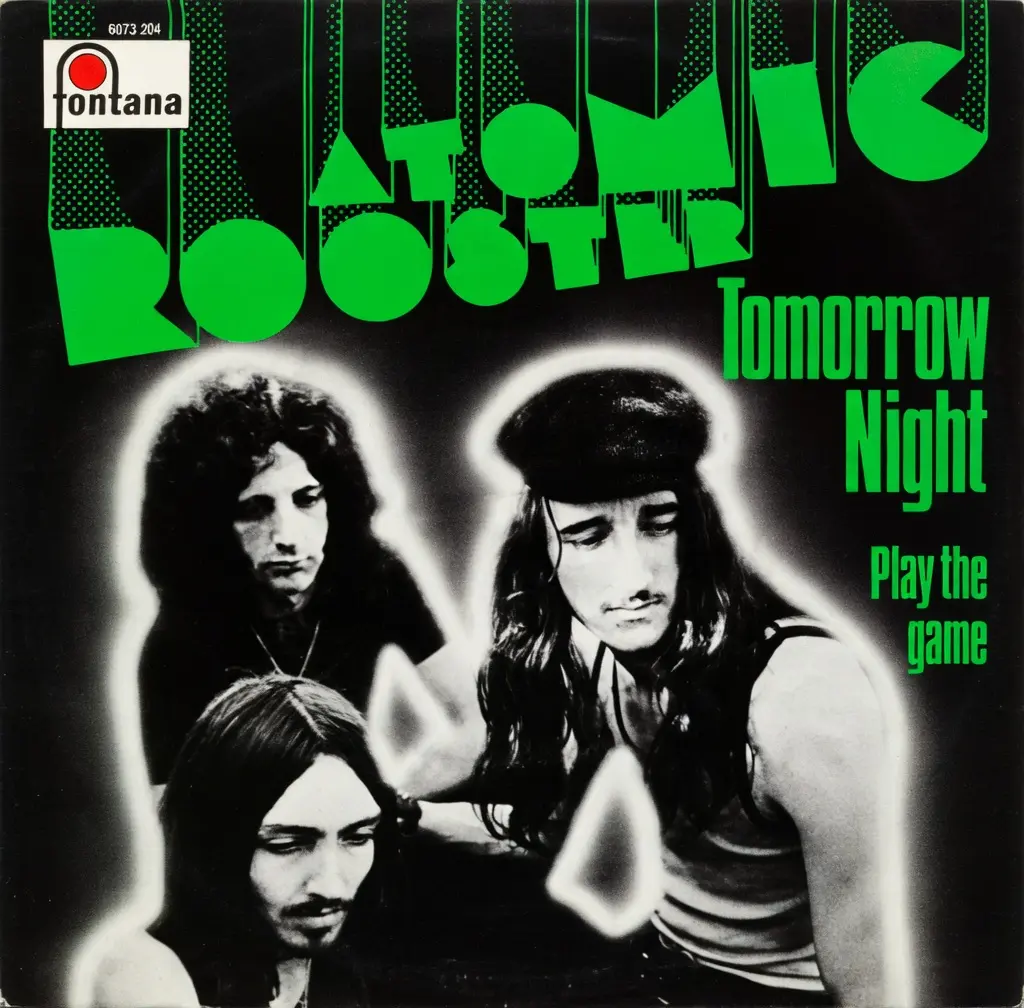 On September 25, 1970, B&C issued “Tomorrow Night” as a single, backed with the non-album “Play the Game.” Despite its slow crawl, the song reached No. 22 by the week of February 25, 1971, when Atomic Rooster mimed “Tomorrow Night” for Top of the Pops. Three weeks later, the song reached No. 11 on the UK Singles Chart.
Death Walks Behind You reached No. 12 on the UK Albums Chart and No. 13 on the Australian Kent Music Report.
B-side. “Play the Game” (4:47) | Crane
Opens with a spiraling staccato guitar figure and pile-driving drum-roll. Things tighten around a mid-tempo hard-rock boogie riff in G minor.
Step this way, let me show you how to win
Well yesterday, your chances are gonna happen
Oh gamble all, oh you can’t miss
Oh all you want, all you wish
Oh I’ll give it to you now
Oh baby, you won’t lose, whoa whoa
The Narrator confidently invites you closer and promises to teach you how to win. He assures you that your luck is about to change and that if you gamble everything, you can’t possibly lose — he’ll give you all you desire right now.
Play the game, let’s see just how you did
Well how’s your luck? I know that you’ve got better
Whoa, with my eyes, well I can’t see
Well it’s for real, I’ll tell you it’s for me
I’ll win from you now, baby, I’ll never lose
He urges you to play the game so he can see how you perform, claiming your luck is improving. With a sly twist, he reveals that he can’t lose — because he intends to win everything from you. The song resolves (at 2:50) with a reprisal of the spiraling opener, which carries out the final two minutes.
Complementary 1970/71 Albums
T2 – It’ll All Work Out in Boomland
Birth Control – Operation
Deep Purple – Deep Purple In Rock
Van Der Graaf Generator – H to He Who Am the Only One
Stray – Stray
Ginhouse – Ginhouse
Lucifer’s Friend – Lucifer’s Friend
Felt – Felt
Warhorse – Warhorse
Tracklist:
A1. “Death Walks Behind You” (7:23)
A2. “VUG” (5:00)
A3. “Tomorrow Night” (4:00)*
A4. “7 Streets” (6:44)
B1. “Sleeping for Years” (5:27)
B2. “I Can’t Take No More” (3:34)
B3. “Nobody Else” (5:01)
B4. “Gershatzer” (7:58)
*issued on 7″ b/w “Play the Game”
Credits
Vincent Crane — Hammond organ, piano, vocals
John Du Cann — guitar, lead vocals
Paul Hammond — drums, percussion
Atomic Rooster — production
Sources:
- Discogs: Death Walks Behind You
- RYM: Death Walks Behind You
- ProgArchives: Death Walks Behind You
- MusicBrainz: Death Walks Behind You
Artist/Album Pages:
Storyteller is the first of two albums by the namesake English folk-rock band, released in 1970 on T...
Every Time You Move is the first of two albums by the English orchestral folk band Hunter Muskett, r...
Electrum is the third album by Akira Ishikawa and the Count Buffalos, released in 1970 on Victor. ...
Fun House is the second album by the American hard-rock band The Stooges, released on July 7, 1970, ...
Burnin Red Ivanhoe is the second album by the Danish jazz/rock quintet of the same name, released in...
Sonho 70 is the second album by Brazilian samba-jazz musician/composer Egberto Gismonti, released in...
High Tide is the second of two albums by the namesake English/American hard-rock/psych band, release...
New Dawn is the second of two albums by English brass-rock ensemble Galliard, released in 1970 on De...
Airconditioning is the debut album by English symphonic/art-rock band Curved Air, released in 1970 o...
Your Daily Gift is the fourth album by Danish art-pop/psych band Savage Rose, released in 1970 on Gr...
Cold Fact is the first of two studio albums by American singer/songwriter Rodriguez, released in Mar...
Fly Away is the singular album by English folk trio Agincourt, released in 1970 on Merlin. Tr...