

Arti & Mestieri was an Italian jazz-rock band that released the 1974/75 albums Tilt (Immagini per un Orecchio) and Giro di Valzer per Domani. After a four-year pause, they issued three further albums between 1979 and 1985. Along with Area and Perigeo, they were Italy’s most prominent jazz-rock band of the 1970s.
Drummer Furio Chirico — often likened to Jon Hiseman (Colosseum/II), Billy Cobham, and Alphonse Mouzon — cut two prior albums with English/Italian symphonic rockers The Trip. Other members played in the jazz-rock bands Esagono and Venegoni & Co.
Members: Furio Chirico (drums), Beppe Crovella (Hammond organ, piano, Mellotron, synthesizer, ARP Solina string synthesizer, Moog, vocals, 1973-?), Gigi Venegoni (acoustic guitar, electric guitar, 1973-75), Marco Gallesi (bass, 1973-75), Arturo Vitale (saxophone, vibraphone, 1973-98), Giovanni Vigliar (violin, vocals, 1973-?), Gianfranco Gaza (vocals, 1975), Gigi Fregapane (bass)
Background
Arti & Mestieri was formed in 1973 by drummer Furio Chirico, a native of Turin. A noted virtuoso, he drummed beforehand in The Trip, a symphonic-rock band originally from the UK. He joined them in 1971 and played on their third and fourth albums, Atlantide (1972) and Time of Change (1973). Earlier, he played in Sixties beatsters I Ragazzi del Sole.
The original lineup of Arti & Mestieri also included keyboardist Beppe Crovella, bassist Marco Gallesi, guitarist Gigi Venegoni, saxophonist/percussionist Arturo Vitale, and violinist/singer Giovanni Vigliar. The last three hailed from the unrecorded jazz-rock combo Il Sogno di Archimede.
Tilt (Immagini per un Orecchio)
 Arti & Mestieri released their debut album, Tilt (Immagini per un Orecchio), in October 1974 on Cramps Records.
The album synthesizes rapid-fire ensemble fusion with symphonic elements, fluctuating between explosive instrumental segments and lyrical interludes, anchored by Chirico’s signature fluidity and structural volatility.
Chirico drives the material with continual dynamic shifts, inserting polyrhythms and textural contrast beneath intersecting melodies. Crovella’s keyboard arsenal includes electric piano, Hammond organ, ARP 2600 synthesizer, and Mellotron, shaping tonal layers with both rhythmic insistence and atmospheric support. Vigliar delivers soaring violin passages and occasional vocals. Venegoni alternates between delicate phrases and distorted counterpoint, often dialoguing with Vitale, whose baritone and soprano saxes, clarinets, and vibraphone extend the band’s range. Gallesi underpins each transition with stable, deep-toned bass phrasing.
All eight compositions are jointly credited to Chirico, Crovella, and Venegoni, who developed the material as a unified cycle with linked thematic and harmonic motifs. Vocal passages appear sparingly, with most tracks emphasizing tightly orchestrated instrumental development.
The album opens with “Gravità 9,81,” a compound-form instrumental that begins with a brief fanfare and recedes into chamber-like clarinet, violin, and Mellotron before launching into accelerated rhythmic interplay and contrapuntal development. The succeeding track, “Strips,” contrasts lyrical verses with staccato phrasing, Mellotron layers, and acoustic guitars. “Corrosione” operates as a bridging passage into “Positivo / Negativo,” which opens with strummed acoustic guitar and builds into a fast-rotating ensemble section that alternates solo turns for violin, sax, and guitar. “In Cammino” begins with a subdued saxophone melody and evolves through expanding ensemble motion, capped by electric guitar overlays.
Side B opens with “Farenheit,” a brief transitional miniature that introduces the 13-minute suite “Articolazioni,” a multipart composition structured around alternating vocal and instrumental sections. It moves through shifting meters, layered crescendos, and interludes of Mellotron and vibraphone before closing in a gentle decrescendo. “Tilt,” the concluding track, detaches from the preceding material with its abstract textures, dissonant electronics, and randomised tonal events suggestive of musique concrète.
A1. “Gravità 9,81” [Gravity 9.81] (4:05) — layered instrumental development from chamber intro to high-speed violin-led exchanges
A2. “Strips” (4:39) — contrasts acoustic verse vocals with staccato ensemble interludes; includes sax and Mellotron breaks
A3. “Corrosione” [Corrosion] (1:37) — brief ensemble bridge centered on Mellotron and sax riff
A4. “Positivo / Negativo” [Positive / Negative] (3:29) — begins with acoustic strumming and vibraphone; switches into rapid rotational solo section
A5. “In Cammino” [On the Path] (5:36) — opens with slow saxophone melody; accelerates into violin and keyboard exchanges
B1. “Farenheit” (1:15) — short interlude with piano, clarinet, and ensemble punctuations
B2. “Articolazioni” [Articulations] (13:24) — multipart suite with shifting rhythmic and harmonic sections, alternating vocals, and layered transitions
B3. “Tilt” (2:29) — abstract finale featuring dissonant Mellotron, ARP synth textures, and ad-lib reeds
Sessions took place at Chantalain Studio in Rome, engineered by Stuart “Buffalo” Glasser with assistant Tali Jackson. Co-production is credited to Venegoni and Area guitarist Paolo Tofani. Later CD reissues contains a bonus miniature track.
9. “Scacco Matto” [Checkmate] (0:52)
Tilt‘s visual concept and sound-image integration were developed by Raffaello Palma, who also handled art direction with Edoardo Sivelli. Initial copies came with a poster and a cardboard funnel insert designed to align with the album’s “images for an ear” subtitle.
The cover of Tilt (Immagini per un orecchio) shows a surreal anatomical study: a human head, sliced and flayed to reveal muscle, bone, and brain matter in vivid detail, floats above an abstract tiled surface. Suspended beside it, a faint sketch of a mouth hovers in disconnection, while a wire-frame halo encircles the exposed cranium. Medical diagrams collide with Dadaist montage, evoking both forensic detachment and conceptual disturbance. Designed by Gianni Sassi with photography by Paolo Mazzucchelli, the artwork mirrors the album’s title—Images for an Ear—by transposing inner sound into anatomical form.
Giro di Valzer per Domani
 Arti & Mestieri released their second album, Giro di Valzer per Domani, in December 1975 on Cramps.
The album introduced vocalist Gianfranco Gaza, marking a partial pivot toward structured song formats while retaining the ensemble’s core focus on instrumental fusion. With Gaza singing lead on several tracks, Arti & Mestieri began integrating lyrical expression into their compositional framework, broadening their melodic focus while maintaining high-caliber instrumental interplay. The overall approach favors shorter thematic segments with tightly arranged shifts over extended improvisation, signaling a move away from the explosive suite-based construction of Tilt.
Furio Chirico intensifies his role with more intricate, tightly articulated patterns that drive each composition. Guitarist Gigi Venegoni expands his tonal palette with blues-tinged phrasing and clean melodic motifs. Keyboardist Beppe Crovella, while less reliant on Mellotron than on the debut, inserts harpsichord, clavinet, spinet, celesta, and analog synth textures alongside electric piano and Hammond passages. Arturo Vitale widens the arrangement scope with layered saxophone, bass clarinet, vibraphone, and occasional vocals. Violinist Giovanni Vigliar alternates lyrical sweeps with tense flourishes and joins Gaza on supporting vocal parts. Bassist Marco Gallesi anchors the dynamic fluctuations with steady, sinewy counterpoint.
All seventeen tracks are credited to Vitale, Crovella, and Venegoni. Gaza sings lead on “Saper Sentire,” “Aria Pesante,” and “Rinuncia,” and is joined by uncredited guest Eugenio Finardi on “Rinuncia.” Though vocals are used more frequently than on Tilt, the majority of the album remains instrumental, with recurring motifs and thematic reprises linking multiple sections.
The title track “Valzer per Domani” opens the album with paired clarinet and violin over light syncopation and fluid time signatures, leading directly into “Mirafiori,” a dynamic ensemble piece with shifting grooves, extended solo flights, and layered section changes. “Saper Sentire” introduces Gaza’s vocal presence with a pulsed mid-tempo rhythm and syncopated keyboard breaks. A central suite unfolds across tracks A4–A7, beginning with the brief sax-and-drum miniature “Nove Lune Prima,” transitioning into “Mescal” with its Mahavishnu-like energy, continuing with the fragmentary insert “Mescalero,” and concluding in the more introspective “Nove Lune Dopo,” where layered keyboards and bass support a calm resolution.
Side B resumes with “Dimensione Terra,” a fast ensemble sketch that yields to “Aria Pesante,” where Gaza’s vocal phrasing alternates with a central sax-led interlude. A three-part midsection links “Consapevolezza Parte 1a,” “Sagra,” and “Consapevolezza Parte 2a,” combining vibraphone, Mellotron, and violin figures into a rhythmic arc that cycles between suspension and forward motion. “Rinuncia,” built as a generational dialogue, contrasts dual vocal parts over steady rhythmic backing. “Marilyn” builds from solo piano into an ensemble eruption of overlapping sax and drums, while “Terminal” closes the album with violin, vibraphone, and electric rhythm motifs layered over sustained textures.
A1. “Valzer per Domani” [Waltz for Tomorrow] (2:12) — violin and clarinet over brisk shifting meter; brief thematic overture
A2. “Mirafiori” (5:55) — multilayered ensemble instrumental with drum-forward energy and alternating solo sequences
A3. “Saper Sentire” [Knowing How to Feel] (4:40) — Gaza vocal track with funky keyboard phrasing and interlocking guitar passages
A4. “Nove Lune Prima” [Nine Moons Before] (0:55) — fragment for sax, drums, and organ; suite intro
A5. “Mescal” (2:00) — violin-led fusion in fast cycles with Mahavishnu-style phrasing
A6. “Mescalero” (0:35) — transition fragment with shifting harmonic fragments
A7. “Nove Lune Dopo” [Nine Moons After] (1:08) — electric piano, bass, and sax interplay closing the suite
B1. “Dimensione Terra” [Earth Dimension] (1:30) — fast miniature for ensemble
B2. “Aria Pesante” [Heavy Air] (3:53) — Gaza vocals over alternating piano and saxophone motifs
B3. “Consapevolezza Parte 1a” [Awareness Part 1a] (3:22) — violin and vibraphone-driven melodic arc
B4. “Sagra” [Feast] (3:06) — percussive ensemble break with rotating solos
B5. “Consapevolezza Parte 2a” [Awareness Part 2a] (1:12) — reprise of prior motifs with violin and keyboards
B6. “Rinuncia” [Renunciation] (2:48) — dialogue-based vocal piece featuring uncredited guest Eugenio Finardi
B7. “Marilyn” (2:40) — solo piano introduction followed by sax and drum expansion
B8. “Terminal” (2:20) — violin and vibraphone-driven closer with sustained electric textures
Arti & Mestieri recorded the album in late 1975 with producer Gigi Venegoni. Later CD issues contains a bonus track.
16. “Da Nord a Sud” [From North to South] (5:18)
Giro di Valzer per Domani displays a pair of pale blue satin ballet slippers hanging against a bare stucco wall. A small lizard rests delicately in one of the shoes, its tail curled around the edge. The juxtaposition of soft fabric and reptilian presence introduces a surreal and ambiguous tension. Cramps on-house artist Gianni Sassi designed the cover.
Quinto Stato
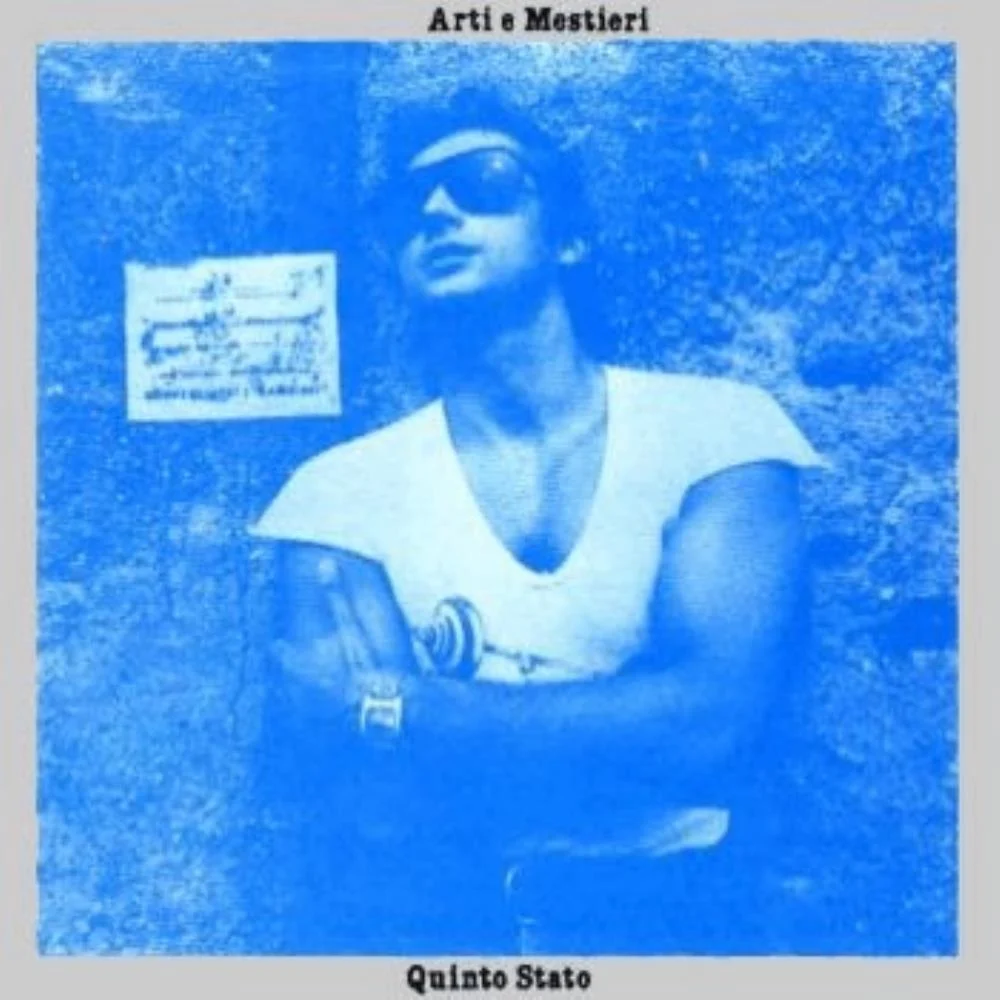 Arti & Mestieri released their third album, Quinto Stato, in 1979 on Cramps.
The album followed a four-year hiatus and introduced a reorganized lineup with keyboardist–producer Marco Cimino and guitarist–flutist Claudio Montafia joining holdovers Furio Chirico and Marco Gallesi. Former members Gigi Venegoni and Arturo Vitale appear as guests. Departing from the extended suite-based model of Tilt and the melodic segmentation of Giro di Valzer per Domani, Quinto Stato adopts a tighter, funk-tinged format that integrates politically pointed lyrics and cinematic instrumental sequences.
Drummer Furio Chirico scales back his volatility while maintaining precision and drive across tightly arranged tracks. Cimino leads with layered ARP and Moog synthesizers, electric piano, clavinet, and production duties, forming the album’s primary harmonic and rhythmic core. Montafia contributes both acoustic and electric guitar along with flute and vocals, while Gallesi alternates electric bass with Cimino on one track. Arturo Vitale adds soprano saxophone and acoustic piano, while guest Rudy Passuello provides lead vocals, bassoon, and appears in choral sections with Gigi Fregapane and Gino Torni. Flavio Boltro contributes trumpet on one track.
Compositions are split among Montafia, Cimino, Gallesi, and Vitale. Montafia supplies primary material for Side A and the brief B3 interlude, while Vitale and Cimino contribute instrumental tracks on Side B. Lyrics for “Quinto Stato (Emarginato),” “Arterio (Sclerosi),” and “D’Essay” are credited to the group.
“Quinto Stato (Emarginato)” opens the album with sharp rhythmic declamation over synth stabs, describing the isolation of a musician in ideological decline. “Vicolo” follows as an instrumental with clipped bass, sharp synth contours, and flute figures. “Arterio (Sclerosi)” delivers a satirical attack on gerontocratic politics, while “Torino nella mente” blends flute, electric piano, and rhythmic phrasing to evoke the atmosphere of urban introspection. On side B, “Mercato” replaces lyrics with layered vocal textures and soprano sax gestures over soft modal changes. “D’Essay” tells of a police raid at an art cinema screening a politically charged film. The brief instrumental “Arti” serves as a coda into “Sui Tetti,” a restrained closing piece featuring voice as texture, brushed cymbals, and a suspended saxophone line over quiet harmonic movement.
1.ª Parte
A1. “Quinto Stato (Emarginato)” [Fifth State (Outcast)] (4:35) — narrative of social marginalization amid political disillusionment
A2. “Vicolo” [Alley] (3:20) — instrumental with synth lead, slapping bass, and interwoven flute motifs
A3. “Arterio (Sclerosi)” [Arterio (Sclerosis)] (3:08) — satirical piece on entrenched political figures and bureaucratic inertia
A4. “Torino nella mente” [Turin in the Mind] (4:55) — instrumental evoking urban melancholy through electric piano and flute passages
2.ª Parte
B1. “Mercato” [Market] (5:25) — wordless vocal textures and soprano sax over ambient urban rhythm
B2. “D’Essay” (3:15) — narrative vignette on a police raid during an avant-garde cinema screening
B3. “Arti” [Arts] (2:25) — brief instrumental coda for flute and rhythm section
B4. “Sui Tetti” [On the Roofs] (6:05) — final instrumental with suspended harmony and layered melodic textures
Quinto Stato presents a gray-framed, blue-monochrome photo of Furio Chirico by Aldo Bonasia.
Acquario
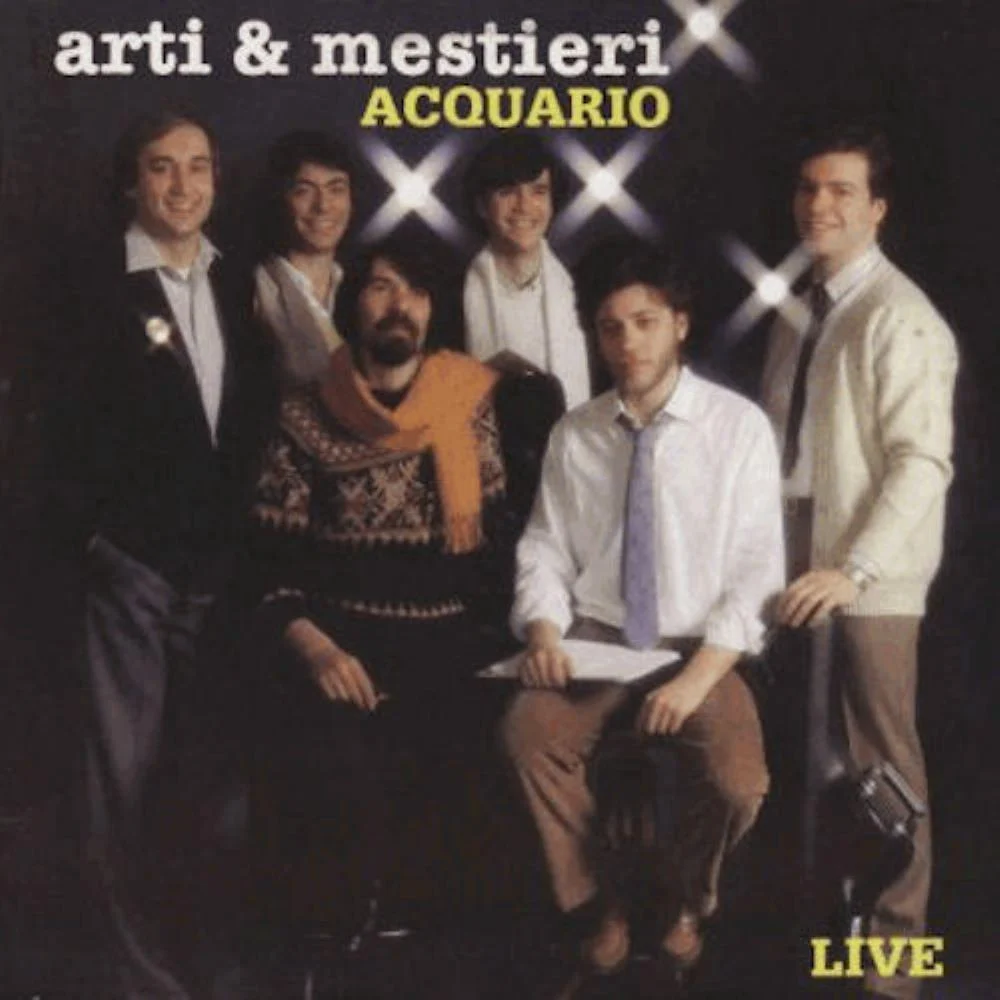 In 1983, Arti & Mestieri released Acquario, a live album with new material.
It marked the band’s return to activity after a four-year break, with drummer Furio Chirico as the sole remaining member from the 1970s lineup. Though technically a live recording, Acquario contains no prior repertoire and functions as a new studio album in performance format.
The new lineup introduced keyboardist and primary composer Antonino Salerno along with bassist Umberto Mari, guitarist Luigi Tessarollo, and saxophonists Siro Merlo (tenor, baritone) and Guido Scategni (contralto, flute).
Mestieri’s sound pivots from the structured symphonic passages of Quinto Stato to a tighter jazz-rock format centered on concise, high-energy compositions and rapid instrumental interplay. Chirico’s drumming remains a focal point, but the material favors group synergy over solos, with the exception of spotlight segments such as Salerno’s Emerson-style acoustic showcase on “Stagno e Debiti.” Without vocals, the album emphasizes momentum and thematic brevity, moving swiftly between dynamic episodes and abrupt codas.
A1. “Acquario” (6:20)
A2. “Funghi” (6:05)
A3. “Mescalito” (4:10)
A4. “Tiroxina” (4:40)
B1. “Rama” (4:36)
B2. “Muscle” (3:50)
B3. “Stagno e Debiti” (2:00)
B4. “Romantik Bidone” (5:00)
B5. “Bobinga” (2:02)
B6. “Containers” (2:50)
Sessions occurred between January 17–20, recorded directly onto a Telefunken two-track reel, with no post-production edits.
Acquario appeared exclusively in Japan in a limited vinyl pressing with OBI strip and bilingual insert. Reissued on CD by Electromantic Music.
Children’s Blues
 Arti & Mestieri released their fifth album, Children’s Blues, in 1985 on Studio.
The album marks a definitive shift toward modern jazz-funk and world fusion, with dense brass arrangements and layered textures across mostly long-form compositions.
Keyboardist Antonio Salerno assumes a central role, joined by electric guitarist Mario Petracca and bassist Umberto Mari. Horn duties rotate among Gigi Mucciolo (trumpet, flugelhorn), Claudio Bonadè (alto sax), Johnny Capriuolo (trombone), and Siro Merlo (tenor sax), with guest solos by Flavio Boltro. Percussionist Tony Palmieri appears on the ten-minute closer.
Tracks explore slow-building grooves and cross-rhythmic motifs, incorporating African themes (“Ouagadougou,” “Waiting for Laura at Banfora Hotel”) and modal interplay (“Mulele,” “Children’s Blues”). The ensemble emphasizes tightly arranged instrumental voicings with solo passages framed by sectional transitions. Chirico’s role is more subdued, favoring structure over virtuosic display. Salerno anchors much of the harmonic development with layered keyboard voicings and sound design.
A1. “Mulele” (8:51)
A2. “Eby” (1:51)
A3. “Children’s Blues” (10:04)
B1. “Ouagadougou” (6:48) — trumpet solo by Flavio Boltro
B2. “Next Time” (3:42) — tenor saxophone by Siro Merlo
B3. “Waiting for Laura at Banfora Hotel” (10:30) — congas by Tony Palmieri; trumpet solo by Flavio Boltro
Sessions occurred at Electromantic Studio and featured a revised lineup centered on drummer and bandleader Furio Chirico.
Furio Chirico plays drums and shares production and art direction duties. Antonio Salerno handles all keyboards and is also credited with art direction, graphics, cover photography, and co-production. Umberto Mari performs on electric bass, and Mario Petracca plays electric guitar throughout.
Gigi Mucciolo contributes trumpet and flugelhorn. Claudio Bonadè plays alto saxophone, and Johnny Capriuolo handles trombone parts. Siro Merlo performs tenor saxophone on “Next Time.” Flavio Boltro provides trumpet solos on “Ouagadougou” and “Waiting for Laura at Banfora Hotel,” which also features Tony Palmieri on congas.
Discography:
- Tilt (Immagini per un Orecchio) (1974)
- Giro di Valzer per Domani (1975)
- Quinto stato (1979)
- Acquario (live, 1983)
- Children’s Blues (1985)
- Live (1990, recorded 1974)
Sources:
- Discogs: Arti & Mestieri
- MusicBrainz: Arti & Mestieri
- RYM: Arti & Mestieri
- ItalianProg: Arti & Mestieri
- ProgArchives: Arti & Mestieri
Artist/Album Pages:
Perception was a French free-jazz/rock band that released two albums and a live disc between 1971 ...
Dalton was an Italian symphonic/hard-rock band that released the 1973–75 albums Riflessioni: idea ...
Folly’s Pool was an American symphonic folk-rock band from Fresno, Calif., that issued a 1977 self...
Osage Tribe was an Italian symphonic/hard-rock band from Genova, Liguria, that released the 1972 a...
Absolute Elsewhere was an English electro-symphonic project that yielded the album In Search of A...
The Graeme Edge Band was an English hard-rock trio responsible for the 1975 Threshold release Kick...
Ingram was an American soul-funk sextet that consisted of a namesake brother/sister musical clan f...
Nono Söderberg is a Finnish guitarist who emerged in the mid-1960s on the local R&B/beat scene...
Didier Bocquet is a French electronic musician who released the 1977 album Eclipse on Le Kiosque D...
Skyhooks were an Australian rock band from Melbourne that scored national hits with “Horror Movie,” ...
The Marshall Tucker Band was an American rustic-rock band that released seven albums between 1973 ...
Stephen Bishop (born Nov. 14, 1951) is an American singer/songwriter who debuted with the 1976 ABC...