

Area was an Italian avant-garde jazz-rock band that released the 1973–76 studio albums Arbeit macht frei, Caution Radiation Area, Crac!, and Maledetti (Maudits). They moved from Cramps to Ascolto for the 1978–80 albums 1978 gli dei se ne vanno and Tic & Tac.
Members: Patrizio Fariselli (keyboards), Giulio Capiozzo (drums, percussion, 1972-76, 1977-99), Victor Edouard Busnello (saxophone, 1972-74), Patrick Djivas (bass, 1972-74), Gaetano Leandro (keyboards, 1972), Johnny Lambizi (guitar, 1972-73), Demetrio Stratos (vocals, organ, percussion, 1972-79), Paolo Tofani (guitar, synthesizer, 1973-78, 2010-present), Ares Tavolazzi (bass, 1974-76, 1977-83, 2010-present), Larry Nocella (saxophone, 1980-83)
Background
Area was formed in 1972 Milan by Greek vocalist, lyricist, and keyboardist Demetrio Stratos. He’d played in ’60s Italian beatsters I Ribelli and appeared on the 1970 album Emozioni by singer/songwriter Lucio Battisti. The first-recorded lineup of Area also featured keyboardist Patrizio Fariselli, bassist Patrick Djivas, saxophonist Victor Edouard Busnello, drummer Giulio Capiozzo, and guitarist Paolo Tofani.
Djivas played on the 1968 psych-exotica album Les Maledictus Sound by French producer Jean-Pierre Massiera. Busnello hailed from a series of jazz combos by Serbian trumpeter Dusko Gojkovic. Capiozzo and Tofani both came from rock backgrounds: Capiozzo from beasters The Bo Bo’s Band and The Red Devils; Tofani from I Califfi and I Samurai.
Arbeit macht frei
 Area released their debut album, Arbeit macht frei, in 1973 on Cramps.
The album introduced a hybrid of avant-garde jazz-rock, politically charged vocals, and Mediterranean influences. It marked the arrival of singer Demetrio Stratos and guitarist Giampaolo Tofani, and laid the groundwork for Area’s signature blend of free improvisation, ethnic modalities, and structured rhythmic interplay.
Stratos alternates vocal parts with turns on organ and steelpan. Fariselli plays piano, electric piano, and VCS3 synthesizer, anchoring the harmonic framework. Tofani adds electric guitar and further VCS3 textures. Djivas alternates between bass guitar and contrabass, shaping the momentum with funk and walking lines. Capiozzo handles percussion and drums with a volatile, jazz-rooted attack. Busnello provides alto and tenor saxophone, enriched by guest reeds and electric violin on the opener.
The album maintains high tension through abrupt contrasts, compound meter, and extended improvisation. “Luglio, agosto, settembre (Nero)” merges ethnic motifs with electric noise and rapid tempo shifts. The title track begins in atmospheric abstraction and resolves into layered jazz-funk with emergent vocal passages. “Consapevolezza” and “Le labbra del tempo” pivot between dissonant sax-driven breaks and soft electric jazz phrasing. The instrumental “240 chilometri da Smirne” juxtaposes free jazz elements with fusion tightness, while “L’abbattimento dello Zeppelin” culminates in a fractured suite of dense interplay, vocal onomatopoeia, and avant-garde noise. Rhythmic complexity, abrupt formal changes, and the expressive range of Stratos’s vocals unify the record’s tension and trajectory.
Fariselli composed the music with lyrics credited to ‘Frankenstein’ and the poem in “Luglio, agosto, settembre (Nero)” sourced from Rafia Rashed.
A1. “Luglio, agosto, settembre (Nero)” [July, August, September (Black)] (4:00) — opens with a female voice reciting in Arabic, followed by a folk-dance melody shaped by synth and violin; alternates between catchy Eastern motifs and chaotic free-jazz sections with dissonant sax and electric organ
A2. “Arbeit macht frei” [Work Sets You Free] (7:56) — begins with drum solo and atmospheric effects, transitions into descending funk bassline with flute and Rhodes; later features frantic sax, distorted guitar, and a short vocal blues segment before a sudden close
A3. “Consapevolezza” [Awareness] (6:06) — starts with a bluesy sax–drum break; combines swinging jazz-rock riffs with volatile instrumental sections; returns to vocal-led refrain after a mid-song sax improvisation
B1. “Le labbra del tempo” [The Lips of Time] (6:00) — moves through changing time signatures and electric piano textures; includes a folky–jazzy midsection and closes with an orchestral synth-led crescendo
B2. “240 chilometri da Smirne” [240 Kilometers from Smyrna] (5:15) — instrumental led by virtuoso sax soloing, followed by a featured bass solo and successive passages for guitar, sax, and organ over agile drumming
B3. “L’abbattimento dello Zeppelin” [The Takedown of the Zeppelin] (6:52) — opens with ambient noise and repeats a jagged guitar figure; alternates between avant-garde vocalizations and dissonant passages; includes spacey sections with distorted keys and VDGG-like sax phrasing
Sessions occurred at Fonorama Studios in Milan with producer Gianni Sassi and engineer Gaetano Ria (credited as Meccanico Del Suono).
The cover, designed by Edoardo Sivelli, presents a disturbing assemblage sculpture: a headless, armless mannequin with a crude metal lock in place of genitalia, secured by a wooden chastity belt. Its torso is flanked by identical mannequin arms, while its neck is topped by a black cylindrical helmet with a realistic mouth, evoking themes of dehumanization, censorship, and mechanization. The image underscores the album’s critique of labor exploitation and fascist conformity, with the title—“Arbeit macht frei” (work sets you free)—a direct reference to Nazi concentration camp signage, provocatively subverted in the context of Area’s militant aesthetic.
Caution Radiation Area
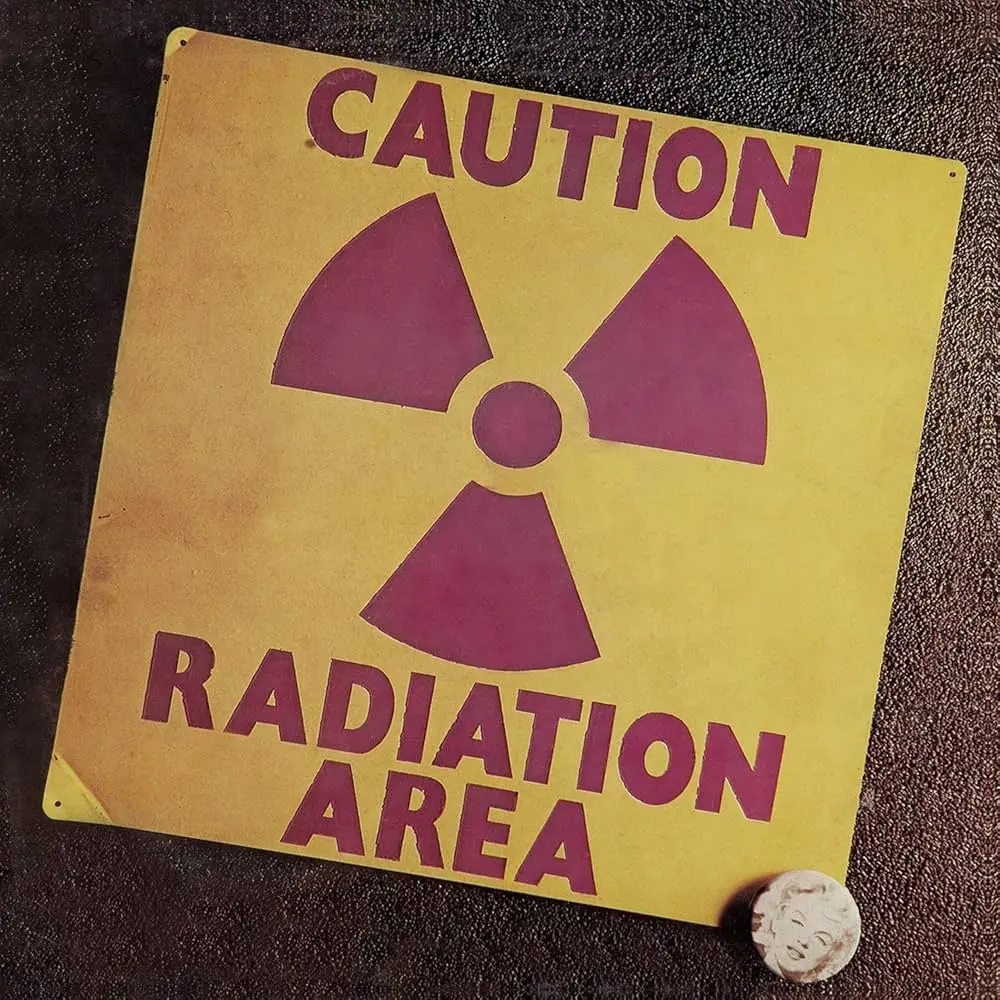 Area released their second album, Caution Radiation Area, on April 5, 1974, on Cramps.
The album marks a radical shift toward experimental forms, extending the avant-garde elements of Arbeit macht frei into more fractured, electronic, and confrontational territory. With the departure of saxophonist Victor Busnello and bassist Patrick Djivas, Area restructured their sound, recruiting Ares Tavolazzi on bass and trombone and moving away from melodic sax passages in favor of atonal textures and vocal abstraction.
Tavolazzi contributes electric and acoustic bass along with trombone in both rhythmic and atmospheric roles. Tofani expands his range on electric guitar, EMS synthesizer, and flute, often blending distorted tones with folkloric phrasing. Fariselli adds electric and acoustic piano, bass clarinet, ARP synth, and percussion, coordinating much of the album’s tonal density. Capiozzo drums with dynamic improvisation and abrupt meter changes. Stratos plays organ, harpsichord, steel drums, percussion, and employs his voice for expressive, nonverbal passages.
Caution alternates between tightly controlled fusion and unstructured experimentation. “Cometa rossa” sets an ethnic theme in Greek over a fluctuating fusion backdrop. “ZYG (Crescita zero)” begins with industrial textures and evolves into frenzied free jazz. “Brujo” juxtaposes percussive chaos with passages of ambient decay, then builds toward a climax of vocal onomatopoeia and piano-driven improvisation. “MIRage? Mirage!” unfolds as a long-form suite of avant-garde collage, using vocal layering, eerie drones, and disjointed ensemble interplay. The closer “Lobotomia” abandons instrumentation for pure electronic distortion, concluding the album in a state of deliberate sensory collapse.
Area group-wrote all five pieces. Lyrical elements are minimal or spoken, with Stratos using vocal abstraction as an instrument rather than delivering conventional verses.
A1. “Cometa rossa” [Red Comet] (3:58) — opens with an electronic rhythm, then shifts into Mediterranean folk sung in Greek with Arabic inflections; alternates between ethnic modalities and fusion sections with tight drums, organ, and vibrato vocals
A2. “ZYG (Crescita zero)” [ZYG (Zero Growth)] (5:29) — begins with distorted industrial noise and spoken phrases; moves into a distorted jazz-fusion structure with electric piano, trombone, and guitar solos; alternates between rhythmic motifs and free-form passages
A3. “Brujo” [Sorcerer] (8:02) — opens in layered cacophony, then collapses into ambient textures led by piano and double bass; midsection builds into full-band free jazz; ends with abstract vocalizations and rising ensemble intensity
B1. “MIRage? Mirage!” (10:28) — long-form suite with a dark opening of ambient clarinet and breathing effects; enters dense instrumental section, then breaks into polyphonic vocal theater; ends with monastic chants and fragmented jamming over double bass and synth
B2. “Lobotomia” [Lobotomy] (3:57) — electronic soundscape of distorted tones and alarms; layers high-pitched waves, signal fragments, and dissonant noise with no structured instrumentation
Sessions occurred at Regson Studios in Milan with engineer Piero Bravin, assisted by Ambrogio Ferrario.
Caution Radiation Area sports artwork by Edoardo Sivelli and photography by Gianni Ummarino under the art direction of Gianni Sassi.
Crac!
 Area released their third album, Crac!, in August 1975 on Cramps.
The album emerged after a prolific year of touring that followed Caution Radiation Area, including high-profile appearances at the Parco Lambro Festival and international anti-war events. With Crac!, Area pivoted from abstract sound collage toward a tighter form of jazz-rock fusion, emphasizing intricate ensemble interplay and virtuosic soloing. It became their first album distributed outside Italy, marking a new phase of international recognition.
The lineup remained stable from the previous album. Ares Tavolazzi plays electric and acoustic bass as well as trombone, providing foundational pulse and melodic counterpoint. Giampaolo Tofani contributes electric guitar, EMS synthesizer, and flute, often leading transitions with sharp attacks or tonal flourishes. Patrizio Fariselli plays electric piano, piano, ARP synthesizer, bass clarinet, and percussion, managing harmonic development and theme variation. Giulio Capiozzo plays percussion and drums with high-velocity precision. Demetrio Stratos supplies voice, organ, harpsichord, steel drums, and percussion, using vocal abstraction and melodic phrasing to span both lead and textural roles.
Crac! consists of Fariselli–Tavolazzi–Tofani compositions apart from “Area 5,” written by Juan Hidalgo and Walter Marchetti.
The album opens with compressed motifs and rhythmic complexity, then progresses through extended forms and momentary lyricism. “L’elefante bianco” shifts from unison piano–voice declarations into alternating electric bursts and folk-tinged melodies. “La mela di Odessa” layers free-time percussive noise with groove-based middle sections and narrated vocal interludes. “Megalopoli” emphasizes sustained rhythmic propulsion beneath overlapping solos, with Stratos’s wordless vocalizations replacing melodic lead lines.
On Side B, “Nervi scoperti” opens with unaccompanied bass and builds through sequential solos by piano, drums, and guitar. “Gioia e rivoluzione” offers a rare structured song form with acoustic guitars and a climactic group chorus. “Implosion” and “Area 5” explore looser constructions: the former as a linear fusion workout, the latter as a short study in voice and percussive noise.
A1. “L’elefante bianco” [The White Elephant] (4:33) — opens with emphatic piano–voice unison; alternates rapid ensemble fusion with brief vocal-led refrains and modal electric piano sequences
A2. “La mela di Odessa (1920)” [The Apple of Odessa] (6:39) — begins with free percussion and electronics; shifts into layered funk with trombone, synth, and spoken narration; closes in slow fade
A3. “Megalopoli” (7:53) — opens with layered synthesizers and vocal onomatopoeia; enters dense fusion with concurrent solos for drums, synth, and double bass; ends on restated vocal textures
B1. “Nervi scoperti” [Exposed Nerves] (6:35) — starts with isolated bass figures; evolves through piano and guitar solos; culminates in ensemble crescendo with tonal resolution
B2. “Gioia e rivoluzione” [Joy and Revolution] (4:40) — structured ballad with acoustic guitars, strummed rhythm, and melodic vocal lines; ends in extended chorus with clapping and layered voices
B3. “Implosion” (5:00) — begins in minimalist synth and piano; develops through unbroken sequence of instrumental solos; maintains mid-tempo pulse beneath linear arrangement
B4. “Area 5” (2:09) — composed by Juan Hidalgo and Walter Marchetti; short study for voice, piano, bass, and drums in free alternation; closes with layered abstractions
Piero Bravin engineered the sessions at Fonorama-Milano Sound Recording Spa, assisted by Ambrogio Ferrario. Area mixed the album at I.B.C. Sound Recording Studios Ltd. in London.
The cover design, credited to Gianni Sassi and Roberto Masotti, features four Warhol-style color panels depicting a cartoon egg labeled “area” being cracked open by a spoon, with jagged red lettering spelling “CRAC!” in each frame. The egg’s speckled shell and shattered surface evoke both violence and rebirth, while the repeated imagery and bold color contrasts (blue, red, green, and black) underscore the album’s rhythmic insistence and conceptual self-reference.
Are(A)zione
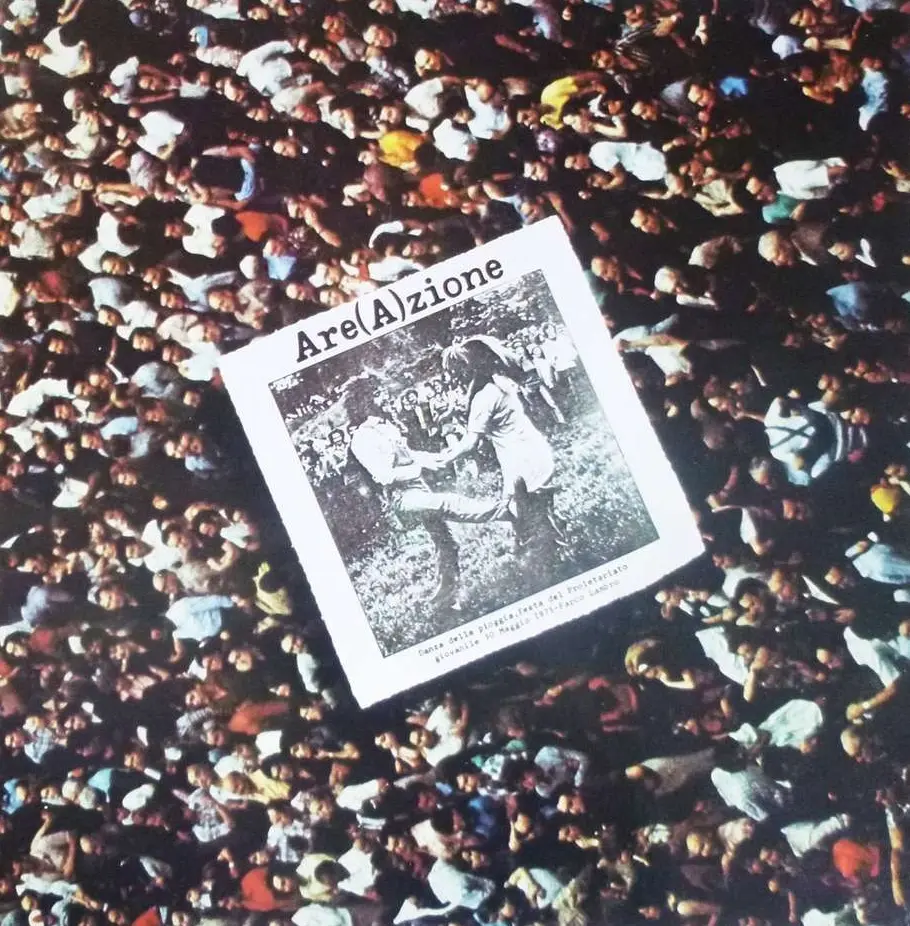 In late 1975, Area issued Are(A)zione, a live album sourced from four recent concerts.
The album compiles live performances from concerts held earlier that year in Milan (Parco Lambro), Naples (Festa dell’Unità), Rimini (Festa della Gioventù), and Reggio Emilia (Teatro Comunale “Ruggeri”). Issued between Crac! and Maledetti, it captures the band’s prime touring configuration and showcases their fusion of stage improvisation, rhythmic elasticity, and political theater.
Are(A)zione presents multi-instrumentation from Ares Tavolazzi (electric/acoustic bass, trombone, pocket trumpet), Paolo Tofani (electric guitar, EMS synthesizer, effects), Patrizio Fariselli (piano, ARP synthesizer, bass clarinet, percussion, e-piano), and vocalist Demetrio Stratos (organ, steelpan) while Giulio Capiozzo anchors the band on Slingerland drums and auxiliary percussion.
Three of the five tracks derive from prior studio albums. Two compositions—“Are(A)zione” and “L’Internazionale”—appear here in recorded form for the first time. The former serves as a longform group improvisation; the latter reimagines the socialist anthem with rhythmic tension and sonic irreverence.
A1. “Luglio, agosto, settembre (Nero)” (4:25) — condensed arrangement of the Arbeit macht frei opener; shifts between folk-dance motifs, frenetic rhythm, and vocal refrains; ends in chaotic collapse
A2. “La mela di Odessa” (11:10) — expanded from Crac! version; begins with freeform percussion and synth, segues into funk-jazz midsection with theatrical narration; includes staged apple-eating segment and abrupt tempo shifts
A3. “Cometa rossa” (5:40) — adapted from Caution Radiation Area; combines electric folk modalities, spaced-out organ and synth, and escalating fusion patterns
B1. “Are(A)zione” (14:37) — extended instrumental exclusive to this release; cycles through free-time drumming, dense groove sections, synth clusters, vocal textures, and tonal ruptures; previews rhythmic motifs later developed in “Giro, Giro, Tondo”
B2. “L’Internazionale” (3:20) — reinterpretation of the socialist anthem; moves between militant pulse, theatrical declamation, dissonant organ, and sudden bursts of ensemble noise
Area recorded these performances in Milan, Naples, Rimini, and Reggio Emilia. Engineers “Birillo” and Walter De Varcelli captured the sessions. Mixing took place at Fonorama-Milano Sound Recording Spa.
Gianni Sassi directed the art concept with design by Edoardo Sivelli.
Maledetti (Maudits)
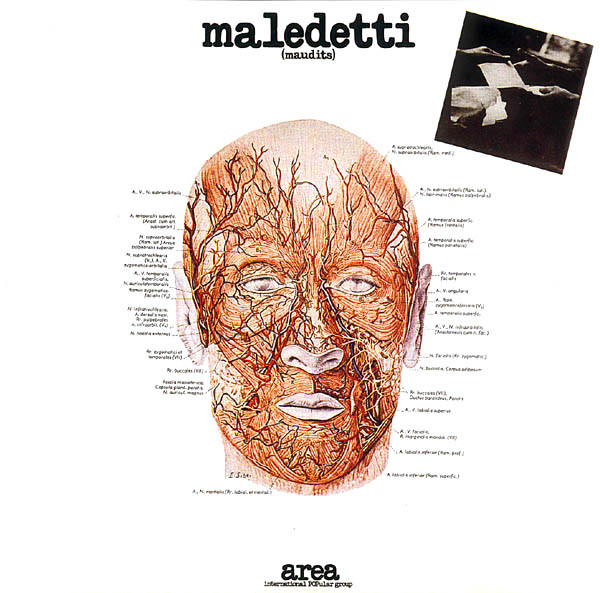 Area released their fourth studio album, Maledetti (Maudits), in December 1976 on Cramps.
The album marked a renewed turn toward the avant-garde intensity of Caution Radiation Area, but with broader instrumentation, conceptual ambition, and sociopolitical satire. Structured as a speculative fable on post-collapse power dynamics, it contrasts fictional futures governed by elders, women, and children. Guitarist Paolo Tofani makes his final studio appearance here, while guests contribute saxophone, strings, and regional folk instruments.
Tofani adds electronics, shaver-tone textures, and intermittent percussion, retreating from his earlier prominence in favor of ensemble abstractions and modular textures. Patrizio Fariselli handles piano, prepared piano, and synthesizer, often dominating the foreground in dense layers or rapid phrase cascades. Demetrio Stratos delivers some of his most extreme vocal experiments, ranging from phonetic abstractions to recited manifestos. The rhythm section alternates between core players Ares Tavolazzi and Giulio Capiozzo and guest pairings of Hugh Bullen and Walter Calloni, with supplemental input from Paul Lytton. Anton and José Arze play the txalaparta on one piece, while Steve Lacy appears on soprano sax across three tracks.
Most compositions are credited to Fariselli and Tofani. Stratos co-authors lyrical and text-based material. The string arrangement on “Il Massacro…” is by Fariselli, adapting and mutating thematic material from Bach’s Brandenburg Concerto No. 3. Texts for the album’s conceptual arc were developed in collaboration with art director Gianni Sassi.
The album juxtaposes structured fusion workouts, Balkan-folk inflections, serial dissonance, and open-form improvisation. “Diforisma Urbano” develops in alternating pulses with shifting bass roles between Tavolazzi and Bullen. “Gerontocrazia” layers txalaparta, modal refrains, and Eastern-tinged rhythms into a polyphonic escalation. “Scum” intersperses funk-leaning piano motifs with Stratos’s reading from Valerie Solanas’s SCUM Manifesto, processed through voice filters. “Giro, Giro, Tondo” employs looped vocal fragments and keyboard swells before accelerating into piano- and bass-driven collective motion. “Caos (Parte Seconda)” employs a graphic-score-derived approach, with each player interpreting drawn instructions or emotive states in temporal disjunction, culminating in a semi-improvised free-form collage.
Instrumental balance varies widely: Fariselli often leads, while Tofani’s guitar and electronics resurface mostly during the final track. Lacy’s saxophone occupies a pivot role, threading in and out of ensemble density. Stratos’s vocal performances range from guttural phonemics to theatrical oration, often avoiding semantic content in favor of sonic materiality.
A1. “Evaporazione” [Evaporation] (1:45) — spoken-word prologue on historical erasure, with layered electronic textures and electric razor tones
A2. “Diforisma Urbano” (6:18) — shifting funk-fusion suite with dual bass layers; Stratos vocalizes in glossolalia-like phrasing
A3. “Gerontocrazia” [Gerontocracy] (7:30) — opens with a Greek lullaby over txalaparta; unfolds through modal passages and vocal satire on elder rule
A4. “Scum” (6:30) — free-jazz composition with piano ostinato; Stratos recites excerpts from the SCUM Manifesto through a voice filter
B1. “Il Massacro di Brandeburgo Numero Tre in Sol Maggiore” [The Massacre of Brandenburg No. 3 in G Major] (2:20) — deconstructed string arrangement based on Bach’s Brandenburg Concerto No. 3, concluding with harmonic disruption
B2. “Giro, Giro, Tondo” [Ring Around the Rosie] (5:55) — alternates between vocal fragmentation and jazz ensemble interplay; lyrics imagine children wielding global power
B3. “Caos (Parte Seconda)” [Chaos, Part Two] (9:00) — collective improvisation based on drawn cues and random emotive states; includes Pink Panther–like motifs and fragmented vocal absurdity
Sessions took place at Fono-Roma Sound Recording Spa in Milan. Engineering credits are unlisted. The album was distributed by Baby Records.
Maledetti appeared in a cover designed by Edoardo Sivelli with illustrations by E. Siber and Hepier and Photography by Marcello Arfini and Toni Thorimbert.
1978 gli dei se ne vanno, gli arrabbiati restano!
 Area released their fifth studio album, 1978 gli dei se ne vanno, gli arrabbiati restano!, in 1978 on Ascolto.
The album followed the departure of founding guitarist Paolo Tofani and marked the final studio appearance of vocalist Demetrio Stratos, who died the following year. Without Tofani’s input, the band reoriented around acoustic instruments, studio layering, and expanded vocal and keyboard roles. The title—“The gods depart, the angry remain!”—reflects the group’s continued social commitment amidst the political disillusionment of the late 1970s.
Stratos alternates between text recitation, overtone experiments, and percussive phonetics, sometimes delivering satirical monologues and sound poetry. Patrizio Fariselli expands his use of synthesizers, adding Polymoog, Arp Pro-Soloist, Odyssey, and Omni textures to his piano and positive organ parts. Ares Tavolazzi plays electric and acoustic bass, trombone, mandola, and trumpet, contributing most of the album’s harmonic foundation and brass layering. Giulio Capiozzo, on Gretsch drums, underpins the shifting meters and drives dynamic transitions with unbroken intensity.
Stripped to a four-piece, they use multiple overdubs across the nine originals, written primarily by Fariselli in variable collaborations with Stratos, Tavolazzi, and Capiozzo.
The music moves between compact groove-based miniatures and abrupt intercut sections. “Il Bandito del Deserto” and “Ici On Dance!” layer rapid melodic phrasing in odd meter with tight bass and percussion cycles. “Return from Workuta” and “Guardati dal mese vicino all’aprile!” explore drone-backed vocal performance and percussion-forward suites, respectively. “Hommage à Violette Nozières” and “FFF” employ pastoral textures and solo drum motifs to offset the more angular material. “Acrostico in memoria di Laio” overlays theatrical monologue with tightly synched rhythm section figures. The closing “Vodka Cola” combines 7/8 and 10/8 rhythmic frameworks with electric piano lines, brass overdubs, and composite voice layers, mixing political irony with musique concrète elements. While the absence of guitar shifts the tonal range, the band retains its identity through performance intensity, modal arrangement, and rhythmic displacement.
A1. “Il Bandito del Deserto” [The Desert Bandit] (3:13) — based on a pre-Islamic Arabic poem; layered 11/8 phrasing, brass doubling, and satirical vocal interjections
A2. “Interno con Figure e Luci” [Interior with Figures and Lights] (4:07) — free-metered vibraphone and drum interplay under abstract phonetic vocal textures
A3. “Return from Workuta” (3:02) — contrabass and ARP textures frame overtone-based vocal phrasing; reflects on Soviet prison return
A4. “Guardati dal mese vicino all’aprile!” [Beware the Month Near April!] (5:12) — opens with siren and march rhythm; transitions into acoustic and rhythmic abstraction
A5. “Hommage à Violette Nozières” (3:18) — modal ballad with acoustic mandola and positive organ; lyrics reference 1930s feminist parricide case
B1. “Ici On Dance!” [Here We Dance!] (3:27) — funk-inflected suite named for a sign on the rubble of the Bastille; juxtaposes rhythmic joy with political satire
B2. “Acrostico in memoria di Laio” [Acrostic in Memory of Laius] (6:12) — jazz-rock structure with spoken monologue; explores generational violence and myth
B3. “FFF (Festa, Farina e Forca)” [Festival, Flour and Gallows] (3:49) — instrumental with drum solo, piano trio interplay, and shifting meter
B4. “Vodka Cola” (7:27) — collage piece with horns, mixed meters, and barking dog samples; critiques global consumer ideology
Recorded and mixed in April 1978 at Sciascia Sound Studios in Rozzano. Engineering by Allan “Beep” Goldsberg. Transfer by Pino Vicari at Milano Recording. Released under CGD with manufacturing and distribution by CGD Compagnia Generale del Disco and Messaggerie Musicali.
The album appeared in a cover designed by Studio Lapis with photography by Cesare Monti.
Event ’76
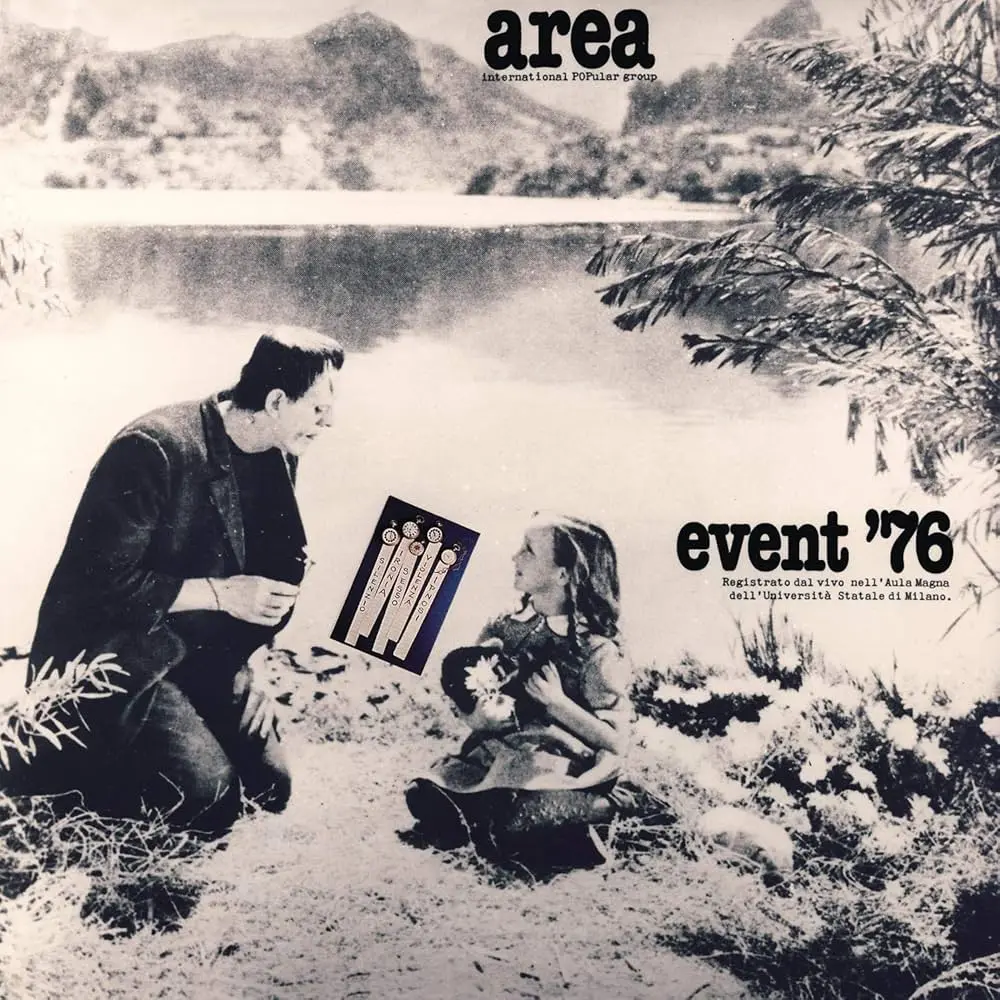 In 1979, Cramps issued Event ’76, sourced from a 1976 Area concert at the University of Milan.
Tic & Tac
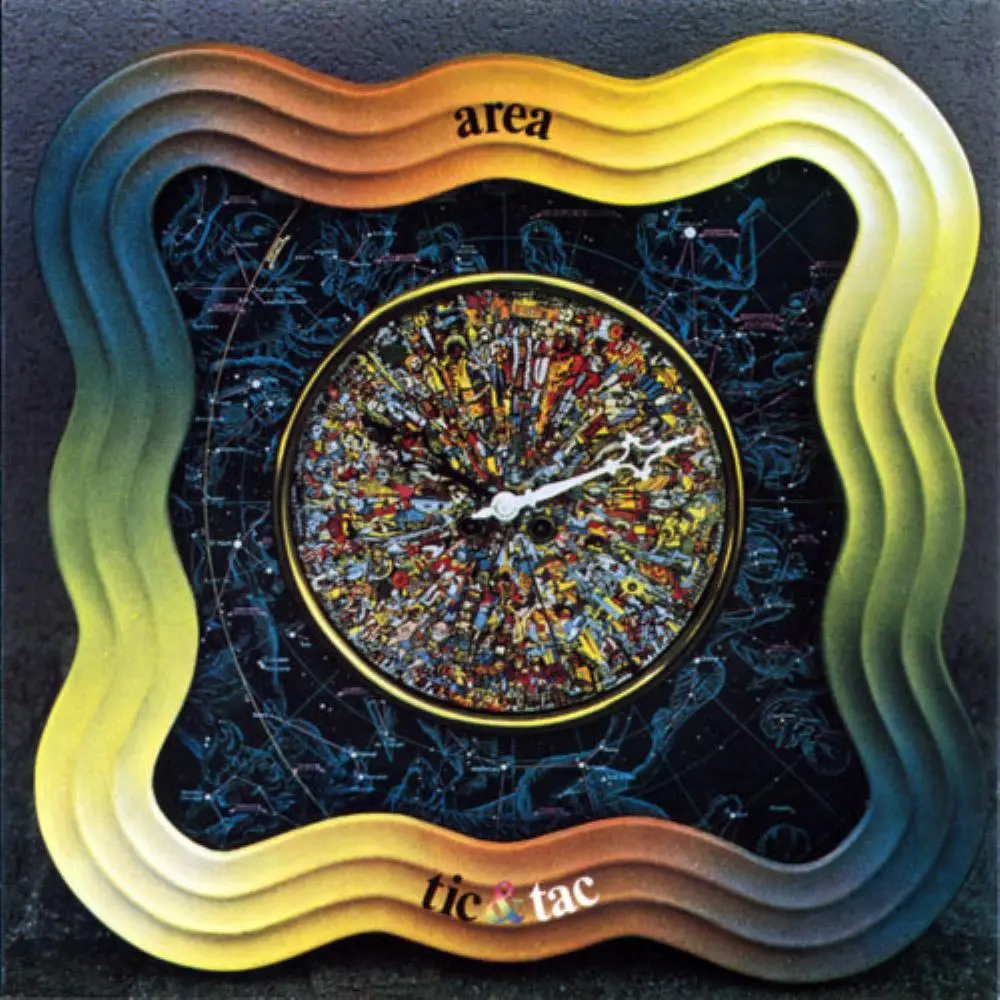 Area released their sixth studio album, Tic & Tac, in 1980 on Ascolto.
The album marked Area’s first studio effort following the death of Demetrio Stratos and their first without vocals as a structural element. Recorded as a trio—Giulio Capiozzo, Patrizio Fariselli, and Ares Tavolazzi—with guest contributions from tenor saxophonist Larry Nocella and two trumpet players, the album repositions Area as a contemporary jazz-fusion ensemble. The group’s decision not to replace Stratos, and instead pursue an instrumental direction, signals a shift from their earlier confrontational avant-garde style toward a more polished and traditionally structured mode.
Capiozzo plays kit drums and percussion throughout, shaping rapid unison runs and rhythmic contrasts. Fariselli alternates between acoustic piano, electric piano, Clavinet, and an array of analog synthesizers, including the M.C.S. 70, Prophet, Yamaha C60, and Arp. Tavolazzi plays electric bass, contrabass, electric guitar, piccolo bass, and provides background vocalizations on select tracks. He also contributes two compositions. Nocella plays tenor saxophone on five pieces, while trumpeters Guido Guidoboni and Luciano Biasutti appear on B3 and B5, respectively. Pino Vicari, the album’s technical supervisor, adds vocal interjections on the closing track.
Eight of the ten tracks are composed by Fariselli, who centers each piece around repeating motifs or layered rhythmic frameworks. The title track develops as a medium-tempo funk étude with hand-stitched phrasing between piano, bass, and drums. “La torre dell’alchimista” opens with layered synth motifs and transitions into swing-based ensemble lines. “Asa” and “Sibarotega” rely on modal riffing and tight ensemble modulation. “Danza ad anello” and “La luna nel pozzo” apply call-response phrasing between piano and horns.
Tavolazzi’s “Quartet” and “Chantee d’Amour” contrast the dominant compositional voice, using shorter thematic units and bowed contrabass textures. The closing “Antes de ablar abra la boca” reintroduces voice, albeit as an ensemble sound effect rather than a lyrical device. While no track recaptures the turbulence of the classic period, the album maintains high instrumental execution with emphasis on structured interplay and analog timbral depth.
A1. “La Torre dell’Alchimista” [The Alchemist’s Tower] (5:50) — multi-layered synth and piano motifs over funk bass and kit accents
A2. “Danza ad Anello” [Ring Dance] (5:13) — repetitive ostinato phrasing with electric bass and alternating piano-sax voicings
A3. “Asa” (4:34) — angular electric piano lines over mid-tempo swing pulse; saxophone joins in chorus statements
A4. “Lectric Rag” (1:50) — compact Clavinet and bass duet with staccato phrasing and metric breaks
A5. “La Luna nel Pozzo” [The Moon in the Well] (3:41) — piano-driven ballad with contrabass and vocal abstractions
B1. “Tic & Tac” (4:38) — title track structured on layered percussion and percussive piano; Tavolazzi and Capiozzo alternate accents
B2. “Quartet” (2:12) — Tavolazzi’s composition for bowed bass, tenor sax, and cymbal accents
B3. “Sibarotega” (4:16) — synth-heavy medium swing; trumpet and sax phrasing alternate with piano runs
B4. “Chantee d’Amour” (4:47) — tavern-like ensemble track with guitar, bass, trumpet, and vocal fragments
B5. “Antes de ablar abra la boca” [Before Speaking, Open Your Mouth] (4:22) — ensemble piece with piccolo bass, synths, and chorus overlays
Sessions took place at Idea Recording Studio. Engineering and mixing by Pino Vicari and DD, who also cut the lacquer at Studio Idea. Pressed by CGD.
Tic & Tac has a multicolored gatefold sleeve designed by Romeo Borzini. The front displays a distorted wall clock surrounded by a ripple-like frame with warm-to-cool gradients. The clock face is a collage of fragmented images forming a dense mosaic.
Discography:
- Arbeit macht frei (1973)
- Caution Radiation Area (1974)
- Crac! (1975)
- Are(A)zione (live, 1975)
- Maledetti (Maudits) (1976)
- 1978 gli dei se ne vanno, gli arrabbiati restano! (1978)
- Event ’76 (live, 1979)
- Tic & Tac (1980)
Sources:
Artist/Album Pages:
Small Wonder was a Canadian art-rock/pop band that released the 1976/77 Columbia albums Small Won...
Modern Sound Quartet was an Italian studio ensemble that released three albums of 1976–78 jazz-fun...
U.K. was an English symphonic-rock supergroup that released a self-titled album on Polydor as a fo...
Gene Harris (September 1, 1933 — January 16, 2000) was an American jazz pianist. He led The Three ...
Spjärnsvallet was a Swedish jazz-rock/folk band that released a 1975 self-titled album on MNW. M...
Blue was a Scottish pop-rock band that released the 1973–74 RSO albums Blue (as a trio) and Life ...
Connivence was a Québécois symphonic-folk band that released two albums between 1977 and 1979 on K...
Ramsey Lewis (May 27, 1935 - September 12, 2022) was an American pianist, composer, and bandleader...
Made in USA was an American soul-funk band from Brooklyn that released a 1977 self-titled album on...
Hawkwind are an English space-rock band, originally led by guitarist Dave Brock and reedist Nik Tu...
Ivan Boogaloo Joe Jones (Nov. 1, 1940 — May 15, 2026) was an American soul-jazz/funk guitarist wh...
Tom Harrell (born June 16, 1946) is an American post-bop/jazz-funk trumpeter, flugelhornist, comp...