

Venegoni & Co. were an Italian jazz-rock band that released the 1977–79 albums Rumore Rosso and Sarabanda.
Members: Luigi “Gigi” Venegoni (guitar, bass, percussion), Ludovico Einaudi (keyboards), Luca Francesconi (keyboards), Ciro Buttari (percussion, vocals, piano), Pietro Pirelli (percussion), Massimo Aimone (drums)
Background
Venegoni & Co. formed in Turin in 1977 when guitarist-composer Luigi “Gigi” Venegoni built an open working group after Arti & Mestieri. The first stable nucleus paired Venegoni with drummer Massimo Aimone, percussionists Ciro Buttari and Pietro Pirelli, and keyboardists Ludovico Einaudi and Luca Francesconi.
Venegoni had played with saxophonist Arturo Vitale and violinist Giovanni Vigliar in Il Sogno di Archimede before he joined Arti & Mestieri, the Turin group led by drummer Furio Chirico. Arti & Mestieri debuted at the Festival del Parco Lambro in Milan and signed with Cramps for the 1974/75 albums Tilt (Immagini per un orecchio) and Giro di Valzer per Domani.
Einaudi came from Turin and studied composition at the Milan Conservatory under Azio Corghi before further work with Luciano Berio. Francesconi started piano at age five and studied composition at the Milan Conservatory before his 1977 jazz studies at Berklee College of Music. Buttari was born in Palermo and settled in Turin after travel through the Middle East, Africa, East Asia, and London; during the same period, he made vocal demos for Paolo Conte songs at RCA.
Upon inception, Venegoni & Co. rehearsed in a Borgo San Paolo cellar and prepared their first album.
Rumore Rosso
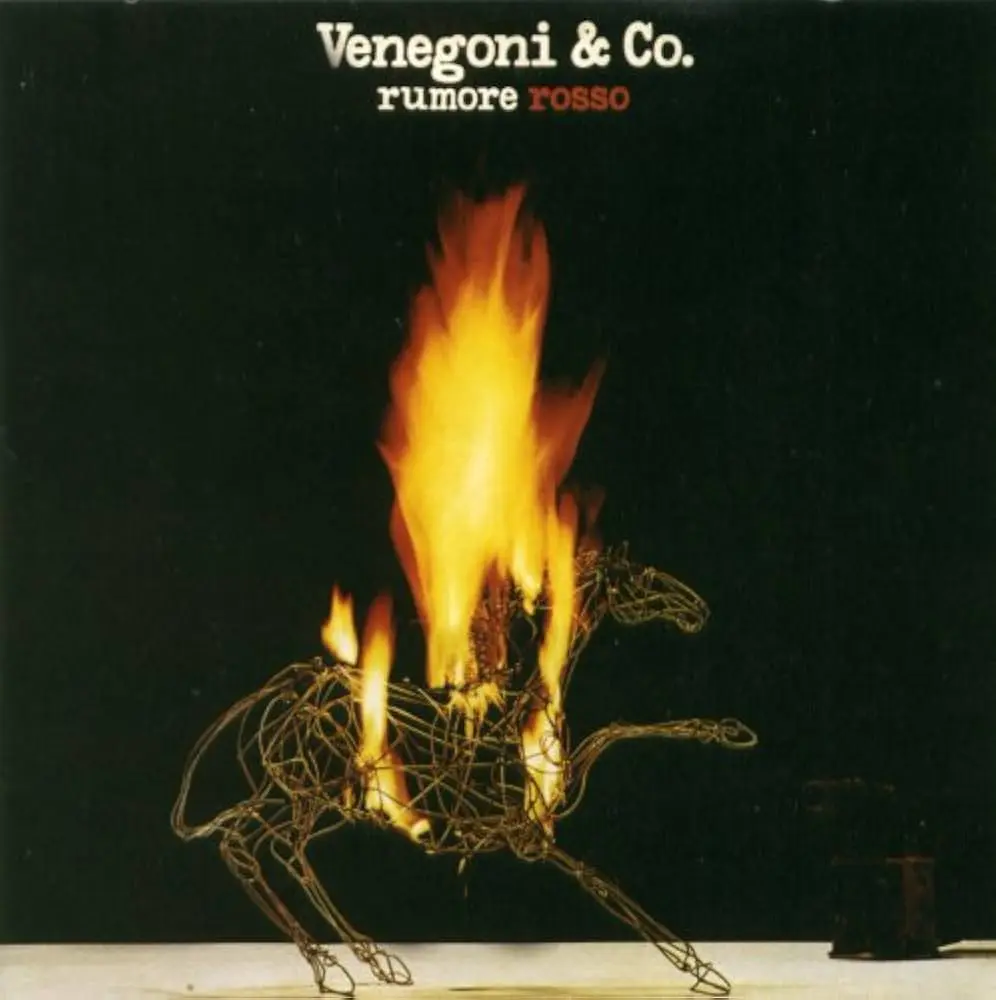 Venegoni & Co. released their first album, Rumore Rosso, in 1977 on Cramps.
The album presents instrumental jazz-rock with Latin percussion, performed by “Gigi” Venegoni with Aimone, Buttari, Pirelli, Einaudi, and Francesconi. Guests include vocalist Gualtiero Gatto, bassist Roberto Possanzini, saxophonists Claudio Pascoli and Maurizio Giannotti, and flutists Claudio Montafia and Francesco Revelli.
Musically, Rumore rosso leans on structured ensemble themes that loosen into solo passages with wiry electric lead and clipped keyboard figures. “Memoria” recasts the “Positivo/Negativo” theme in a compact instrumental setting. The longer pieces shift from stated themes into freer solo space, with saxophone lines cutting through the rhythm-section motion. Acoustic passages trade the electric front line for plucked figures, hand-marked accents, resonant sustain, and breath tones.
A1. “Coesione” [Cohesion] (5:19) – Venegoni
A2. “Danza della mutazione perenne” [Dance of Perennial Mutation] (4:17) – Venegoni / Buttari
A3. “Libertà definitiva” [Definitive Freedom] (6:05) – Venegoni
A4. “Memoria” [Memory] (3:30) – Venegoni
B1. “Ubud” (2:52) – Buttari
B2. “Positivo e…” [Positive and…] (3:45) – Venegoni
B3. “Coda tronca” [Truncated Coda] (1:04) – Venegoni
B4. “Libertà provvisoria” [Provisional Freedom] (4:37) – Venegoni
B5. “Cuica” [Cuíca] (4:15) – Venegoni
B6. “Morti di ideologia” [Deaths from Ideology] (3:16) – Venegoni / Buttari
Venegoni produced Rumore rosso with Gualtiero Gatto. The original Cramps LP appeared in a single sleeve with an inner sleeve.
Sarabanda
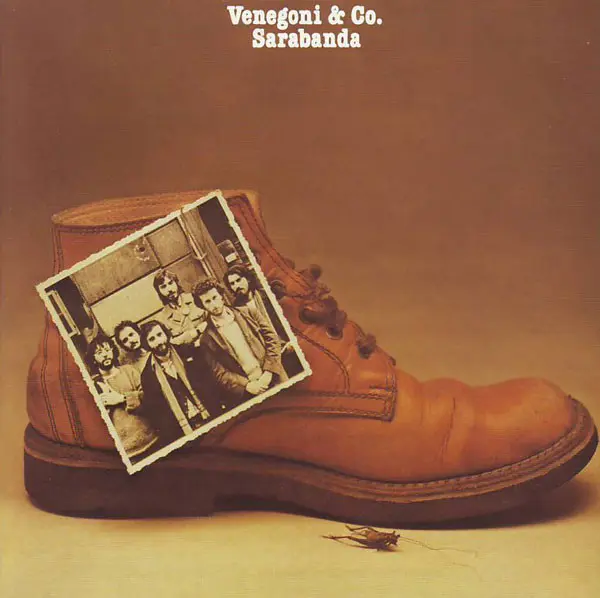 Venegoni & Co. released their second album, Sarabanda, in 1979 on Cramps.
The album reshapes the group around lengthier acoustic numbers performed by Gigi, Buttari, and Einaudi along with bassist Paolo Franchini, drummer Beppe Sciuto, and percussionist Marco Astarita. Session guests include violinist Giovanni Vigliar (“Mezzogiorno”), handclapper Gualtiero Gatto (“Opa”), and cellist Marco Cimino on the side-long title piece.
Sarabanda whirls through Mediterranean dance accents, quick ensemble turns, and hand-played folk detail. “Opa” and “Balon” flicker with rounded voices, whistles, and fast circular motion tied to tarantella-like accents. “Sarabanda” stretches extends through knotty section changes and near-symphonic turns with hand-marked rhythmic undercurrents.
A1. “Mezzogiorno” [Noon] (4:50) – Venegoni
A2. “Opa” [Opa] (9:12) – Buttari / Einaudi / Venegoni
A3. “Balon” [Balon] (5:19) – Einaudi / Venegoni
B1. “Sarabanda” [Sarabande] (18:42) – Buttari / Einaudi / Venegoni
Sarabanda appeared in a gatefold cover designed by al.sa with a printed inner sleeve; the front image shows a band photograph dangling from the laces of a brown boot against a plain brown ground.
Postlude
Venegoni & Co. ended regular activity in 1980 after roughly one hundred concerts. Gigi reactivated the name in 1982 for Mosaico, which remained vaulted until its 2001 CD release on Electromantic Music, which issued the group’s 1978–79 concert material on Rumore Rosso Vivo and Live… Somewhere in the Seventies…. Venegoni returned to Arti & Mestieri for the 21st-century discs Murales and Universi paralleli. He revived Venegoni & Co. for the 2007 disc Planetarium and 2017 double CD Canvas.
Einaudi issued the 1988 album Time Out, followed with Stanze and Le Onde. Francesconi backed Luciano Berio during the early 1980s and later co-founded AGON Acustica Informatica Musica. He directed Biennale Musica during the 2008–2011 term and premiered the 2011 opera Quartett at Teatro alla Scala.
Aimone later joined the revived Procession lineup for the 2007 CD Esplorare.
Discography:
- Rumore rosso (1977)
- Sarabanda (1979)
Sources:
- Discogs: Venegoni & Co.
- MusicBrainz: Venegoni & Co.
- RYM: Venegoni & Co.
- ItalianProg: Venegoni & Co.
- ProgArchives: Venegoni & Co.
Artist/Album Pages:
Ange are a French symphonic-rock band that released ten studio albums between 1972 and 1983 on Phi...
Tadeusz Woźniak (March 6, 1947 – July 8, 2024) was a Polish singer-songwriter from Warsaw who emer...
Pavlov's Dog was an American rock band from St. Louis that released the 1975 album Pampered Menial...
Aera was a German jazz-rock band that cut the 1975–79 Erlkönig titles Humanum est, Hand und Fuß, a...
Heavy Joker was a Danish jazz-rock band that released a 1976 self-titled Polydor album and the 197...
The Specials were an English ska band that released the 1979–80 albums The Specials and More Speci...
Roy Ayers (1940–2025) was an American vibraphonist, composer, and producer who debuted with the 19...
Akasha was a Norwegian symphonic/space-rock band that released a self-titled album on Bat in 1977....
Loudness was a Japanese hard-rock/metal band with guitarist Akira Takasaki. They debuted with the ...
Electric Sun was a German hard-rock/psych trio headed by ex-Scorpions guitarist Uli Jon Roth. They...
Prelude was a Belgian symphonic-rock band behind the 1979 album Voyage on Europroduction. Back...
Island was the Swiss symphonic-rock band behind the 1977 album Pictures on Round Records. In 1975,...