

Dalton was an Italian symphonic/hard-rock band that released the 1973–75 albums Riflessioni: idea d’infinito and Argitari.
Members: Aronne Cereda (guitar, vocals), Rino Limonta (bass, vocals), Walter Locatelli (drums, vocals), Temistocle Reduzzi (keyboards, vocals, 1972-74), Alex Chiesa (flute, vocals, 1972-74), Giancarlo Brambilla (keyboards, 1975-79)
Background
Dalton formed in 1972 in Bergamo, Lombardia, when guitarist/singer Aronne Cereda and bassist/singer Rino Limonta teamed with drummer Walter Locatelli, keyboardist Temistocle Reduzzi, and flutist/singer Alex Chiesa. The former pair hailed from I Puritani, a local beat band that also included future Pholas Dactylus members Valentino Galbusera and Giampiero Nava.
This Dalton bore no relation to I Dalton, a beat group from nearby Brescia that released four 1967–69 singles, including an Italian version of “Venus” by Shocking Blue. That earlier band featured bassist–vocalist Saponaro, guitarist–vocalist Belli, and drummer Bergamini (later replaced by Adamo). In 1970, their lineup expanded with Mauro Pagani, who soon joined I Quelli and co-founded Premiata Forneria Marconi. That group disbanded shortly thereafter, and the Dalton name passed to the Bergamo-based quintet that debuted in 1973.
Dalton’s first lineup—Cereda, Limonta, Locatelli, Reduzzi, and Chiesa—won a first-place prize at a Swiss pop festival in Zurich before releasing their debut album. Their early style paired guitar and flute leads with brief synth passages and alternating acoustic/electric textures, shaped around short-form suites.
Riflessioni: idea d’infinito
 Dalton released their first album, Riflessioni: idea d’infinito, in 1973 on Music Records.
The album consists of six compact tracks arranged around electric guitar, flute, and multiple keyboards, recorded by the original five-piece lineup. Though short in length, the material shifts between flute-driven hard rock passages, acoustic interludes, and full-ensemble mini-suites.
Guitarist Aronne Cereda and bassist Rino Limonta harmonize with drummer Tati Locatelli, flutist Alex Chiesam, and keyboardist Temistocle Reduzzi, whose arsenal includes piano, organ, Mellotron, and Moog.
Veteran pianist/conductor Edilio Capotosti composed all six tracks, which feature lyrics by Antonietta De Simone (Side A) and singer/songwriter Andrea Lo Vecchio (last two tracks).
“Idea D’infinito” opens with synth and flute sequences that give way to mid-tempo ensemble passages marked by shifting tonal centers and alternating keyboard tones. “Stagione Che Muore” emphasizes rhythm-section interplay and cadenced flute lines, while “Cara Emily” adopts a quiet ballad form with acoustic piano and delicate ensemble ornamentation.
“Riflessioni” follows a riff-based jam structure with tightly interlocked guitar and organ motifs. “Un Bambino, Un Uomo, Un Vecchio” presents strophic vocal phrasing over harpsichord figures. “Dimensione Lavoro” opens with drums and expands into the album’s longest multi-part piece, alternating dynamic keyboard sections and accelerating instrumental breaks before closing on layered synth figures.
A1. “Idea D’infinito” [Idea of the Infinite] (4:49) — synth intro gives way to mid-tempo sections with layered flute and organ; features a descending dual-synth figure near the close
A2. “Stagione Che Muore” [Dying Season] (4:20) — alternating bass and flute figures under expressive vocals; includes a late acceleration with snare and flute interplay
A3. “Cara Emily” [Dear Emily] (4:55) — slow ballad with acoustic piano and harpsichord; flute outro over receding acoustic guitar
B1. “Riflessioni” [Reflections] (3:50) — blues-based jam built on a guitar motif; interjections from organ and flute over a steady pulse
B2. “Un Bambino, Un Uomo, Un Vecchio” [A Child, A Man, An Old Man] (3:35) — vocal strophes over keyboard pulses and flute flourishes
B3. “Dimensione Lavoro” [Work Dimension] (6:42) — starts with drum solo, builds to rotating organ and guitar riffs; alternates between calm interludes and uptempo refrains
Sessions occurred in 1973 under Dalton’s direction. The album was issued on Music Records and published by SAAR Edizioni Musicali.
 Riflessioni: idea d’infinito features cover design by Sergio Balloni, with photography credited to Alabiso/A2.
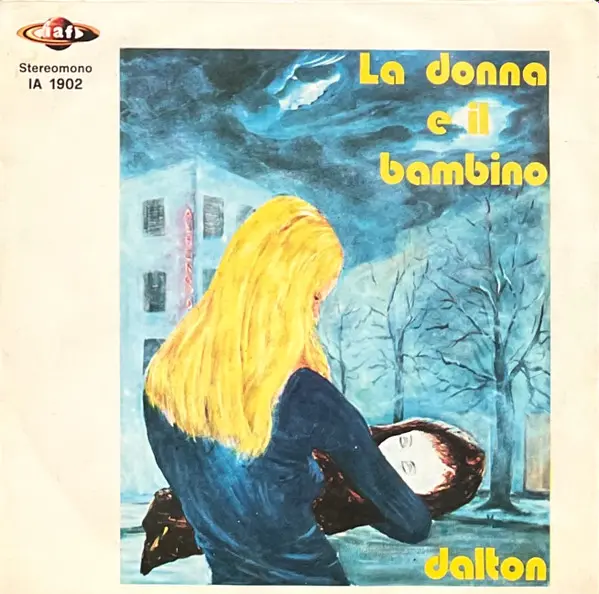
In 1974, Dalton released the single “La Donna e il Bambino” (b/w “Il Vuoto”).
A. “La Donna e il Bambino” [The Woman and the Child] (4:35)
B. “Il Vuoto” [The Void] (3:47)
“La Donna” was the final release by the original Riflessioni lineup. Soon after, Alex Chiesa and Temistocle Reduzzi made way for singer Massimo Moretti and keyboardist Giancarlo Brambilla, another I Puritani alumnus.
Argitari
 The album marks a restructured lineup and shift toward acoustic textures and shorter song forms. Compared with their debut, Argitari favors folk-tinged arrangements with intermittent symphonic passages and reduced instrumental density.
Cereda remains central on acoustic and electric guitar and takes lead vocals on all tracks. Rino Limonta plays contrabass throughout. Giancarlo Brambilla replaces Temistocle Reduzzi on keyboards, contributing organ, piano, synthesizer, and Mellotron. Drummer Tati Locatelli and guest flutist Alex Chiesa appear on select tracks. Massimo Moretti provides secondary vocals on multiple numbers.
Aronne Cereda composed or co-composed all tracks except the adaptation “La Riposta,” credited to Bob Dylan and lyricist Mogol. Giulio Pessi co-wrote four tracks; Brambilla, Gallina, and Cereda share credit on others.
“L’Impossibile È Possibile” and “La Forza di Dio” use accelerated acoustic strumming beneath vocal exchanges and keyboard fills. “Hai Visto Il Sole?” and “Ho Ritrovato La Mia Donna” develop mid-tempo progressions with alternating second vocals and light organ. “Argitari” frames its theme with cyclical acoustic–keyboard motifs. “La Riposta” reworks Dylan’s “Blowin’ in the Wind” with Italian lyrics and ensemble instrumentation.
“Visione di una Notte d’Estate” introduces modal keyboard layers across a stretched form. “Odiarti No” balances acoustic patterns with clipped phrases and duet vocals. “Il Vuoto,” reprised from their 1974 single, closes the album with a restrained arrangement and recitative vocal delivery.
A1. “L’Impossibile È Possibile” [The Impossible Is Possible] (3:00) — alternating acoustic strumming and vocal refrains over steady rhythm
A2. “Hai Visto Il Sole?” [Have You Seen the Sun?] (3:37) — paired vocals with light percussion and mid-tempo acoustic structure
A3. “Ho Ritrovato La Mia Donna” [I Found My Woman Again] (3:37) — piano and acoustic interplay with vocal calls and keyboard shading
A4. “Argitari” (3:38) — title track centered on acoustic–keyboard motifs with refrain–bridge sequencing
A5. “La Riposta” [The Answer] (4:17) — originated as the 1962 single “Blowin’ in the Wind” by Bob Dylan, rewritten in Italian by lyricist Mogol
B1. “Visione Di Una Notte D’Estate” [Vision of a Summer Night] (4:45) — extended track with modal organ and slow-building vocal development
B2. “Odiarti No” [To Hate You, No] (4:28) — slow alternation of acoustic guitar and voice with inserted vocal harmonies
B3. “La Forza Di Dio” [The Strength of God] (4:07) — brisk acoustic foundation with overlapping vocal parts and shifting accents
B4. “Il Vuoto” [The Void] (3:47) — reprise of 1974 single; slow, somber delivery with acoustic and piano layers
Sessions occurred in 1975 with Dalton credited as arrangers. Engineers Gianluigi Pezzera and Tonino Paulillo handled the technical work. The album was distributed by BTF srl.
Argitari features photography by Tito Alabiso and camera work by Luciano Bertelli. Giancarlo Rota remastered the CD reissue, which includes restored flute parts absent from the original vinyl mix.
“Presto Tornerò”
After a four-year gap, Dalton returned with the 1979 single “Presto Tornerò” (b/w “Mama Dog”).
A. “Presto Tornerò” [I’ll Be Back Soon] (3:51)
B. “Mama Dog” (3:22)
This marked the band’s final release. Drummer Walter Locatelli formed Mo.Do., which cut the 1980 album La Scimmia Sulla Schiena del Re.
Discography:
- Riflessioni: idea d’infinito (1973)
- Argitari (1975)
Sources:
- Discogs: Dalton
- MusicBrainz: Dalton
- RYM: Dalton
- 45cat: Dalton
- ItalianProg: Dalton
- ProgArchives: Dalton
Artist/Album Pages:
The Beginning of the End was a funk band from Nassau, Bahamas, that released two albums on Atlanti...
Ian Dury (May 12, 1942 — March 27, 2000) was an English singer, lyricist, and bandleader who emerg...
The Soft Boys were an English New Wave/psych band from Cambridge that debuted with a three-song EP...
Wally Gonzalez is a Filipino guitarist and singer who fronted Manila hard-rockers Juan de la Cruz...
Voyage was a French electro/space-funk band that released four albums between 1977 and 1982 on Sir...
Sunship were an American jazz-rock/soul band that released the album Into the Sun on Capitol in 19...
Universe City was an American funk band that released a self-titled album Midland International in...
The Originals were an American soul group from Detroit that released seven albums on Motown's Sou...
David Chalmers is an American folk-psych singer/songwriter from East Dubuque, Iowa, who released ...
Solar Plexus was an American jazz-rock band that released the 1975/76 albums Solar Plexus and Voic...
Milk 'n' Cookies were an American pop-rock band from New York that released a self-titled album in 1...
Randy Crawford is an American soul and jazz singer featured on albums by Harvey Mason, Steve Hacke...