

Patrick Vian (April 12, 1942 – February 24, 2023) was a French guitarist and keyboardist who played in the avant-psych band Red Noise during the early 1970s. In 1976, he released the popular electronic album Bruits et Temps Analogues on Barclay-subsidiary Egg.
Background
Patrick Vian was born on April 12, 1942, in Paris and raised in Angoulême. He was the son of jazz trumpeter and writer Boris Vian, who nicknamed him “Bisonnot.” After his parents’ divorce, he spent part of his youth in England and attended boarding school in Switzerland. Vian developed early musical skills through exposure to his father’s jazz circles and by learning guitar.
In 1968, while attending the Sorbonne, Vian formed the progressive rock band Red Noise with a group of students and musicians associated with the Parisian underground scene, including collaborators linked to Ame Son. Red Noise played its first shows amid the student occupation of the university, often extending until police intervention. The band combined Vian’s guitar work with a politically charged, experimental sound, and became known for its confrontational, improvised performances. Red Noise released its sole album, Sarcelles – Lochères, in 1970 before disbanding after a hash possession arrest in the Netherlands. The split divided the members along political lines, with the Trotskyist section continuing under the name Komintern.
Following Red Noise, Vian pursued solo and film-related projects, composing part of the score for Jérôme Laperrousaz’s 1975 film Hu-Man starring Jeanne Moreau and Terence Stamp. His solo experiments culminated in the formation of a backing group.
Bruits et Temps Analogues
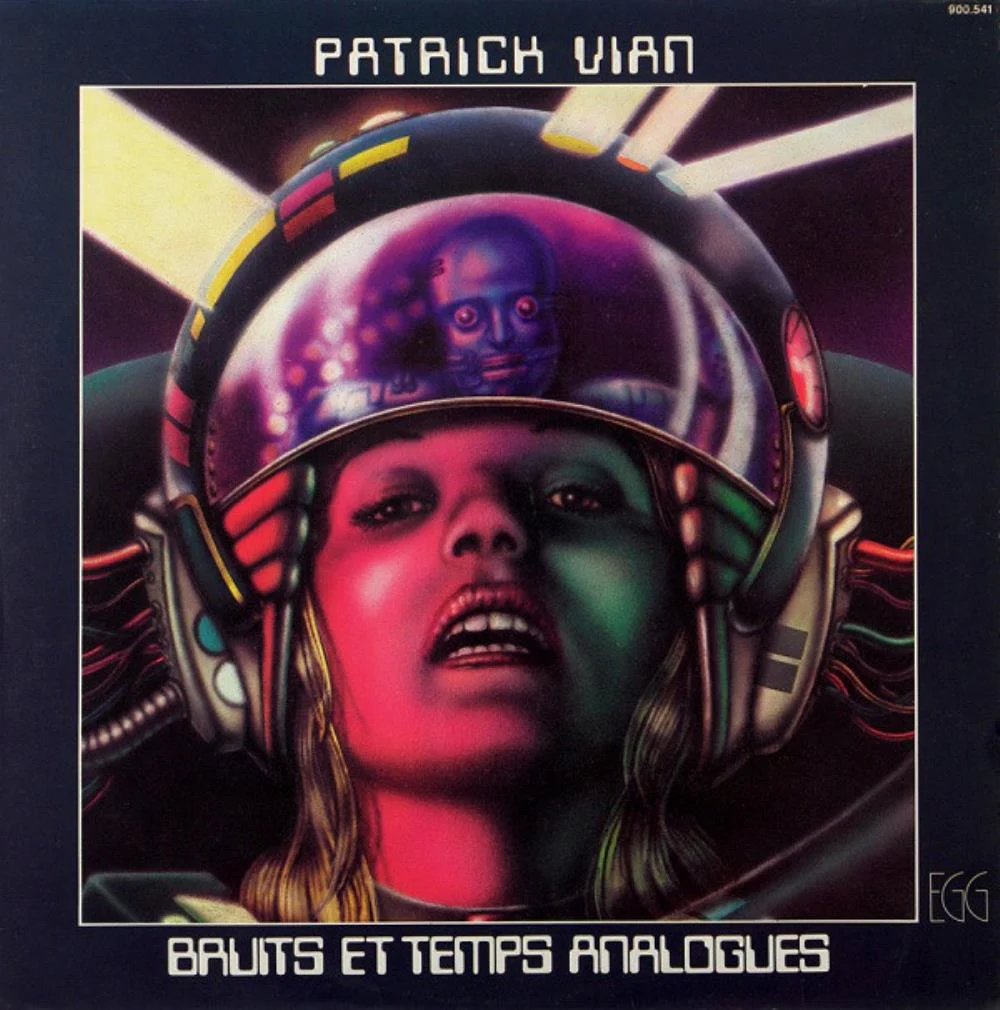 Patrick Vian released his singular album, Bruits et Temps Analogues, in October 1976 on Egg.
The album presents a hybrid of Berlin School electronic patterns, jazz/fusion improvisation, and world-music textures. Vian performs on Moog 2C, ARP 2600, Moog sequencer, and piano, supported by guitarist Bernard Lavialle, drummer Mino Cinelu, and keyboardist/percussionist Georges Granier, who contributes Fender Rhodes, marimba, and assorted noises. The album balances sequencer-driven hypnotic pulses with improvisatory guitar and percussion layers, creating unpredictable shifts in pace and tone across side-long explorations.
Vian composed all nine tracks and arranged the instrumentation, integrating contributions from Lavialle and Granier on select pieces. Cinelu adds drums and percussion to “Sphère” and “Oreknock,” expanding rhythmic complexity beyond the sequenced electronic frameworks.
The tracks divide into open-ended electronic journeys and shorter, textural interludes. “Sphère” opens with guitar and drums over sequencer loops, building into layered synth solos. “Grosse Nacht Musik” floats with melancholic electronics, while “Oreknock” blends marimba, percussion, and Moog bass lines in a world-music-inflected passage. “R & B Degenerit !” combines electric piano, synths, and funk-inflected guitar, and “Tunnel 4, Red Noise” escalates with contrapuntal sequencer patterns and dense electronic effects. The final tracks, including “Bad Blue” and “Tricentennial Drag,” explore piano-centric jazz textures and cut-up sound collages.
A1. “Sphère” (6:10) — percussion by Mino Cinelu; layered guitar and synth motifs drive an angular rhythm with improvisatory interplay.
A2. “Grosse Nacht Musik” [Great Night Music] (5:05)
A3. “Oreknock” (6:45) — percussion by Mino Cinelu, featuring marimba textures and electronic pulses.
A4. “Old Vienna” (2:10) — piano-centered, with synthesized bass underpinnings.
B1. “R & B Degenerit !” (6:10) — electric piano and synths form shifting textures beneath distorted guitar lines.
B2. “Barong Rouge” (4:10) — marimba, percussive effects, and Gong-inspired rhythmic gestures.
B3. “Tunnel 4, Red Noise” (4:30) — dense sequencer loops and swirling synth layers create chaotic, high-intensity passages.
B4. “Bad Blue” (1:56) — solo piano with subtle electronic undertones.
B5. “Tricentennial Drag” (2:20) — sound-collage incorporating drag race effects, military motifs, and electronic textures.
Sessions occurred in June 1976 at Studio I.P.P., Paris, with Jérôme Laperrousaz producing, Georges Granier on recording, and Alain Marcel assisting. The album was pressed by Pathé Marconi EMI in Chatou and distributed by C.P.F. Barclay.
The cover features an illustration by G. Lacroix and back photography by Millie, depicting abstract, futuristic imagery aligned with the album’s electronic and world-music hybrid aesthetic.
“Grosse Nacht Musik” appeared on Egg: The Most Progressive European Music Experience, a 1978 Egg Records compilation with cuts by Tim Blake, Alain Markusfeld, François Bréant, Larry Coryell, Vangelis, and Popol Vuh.
Discography:
- Bruits et Temps Analogues (1976)
Sources:
Artist/Album Pages:
Armand Frydman is a French library musician who released two albums on Sonimage between 1978 and 1...
Cortex was a French samba-jazz/funk combo that released two albums and a standalone single between...
Alpha du Centaure was a French jazz-rock band that released the album Contact on Spirales in 1979....
Eskaton was a French Zeuhl/chamber-rock band that self-released three albums and a standalone sing...
Edgar Froese (June 5, 1944 — January 20, 2015) was a German multi-instrumentalist best known as th...
Michael Hoenig (born Jan. 4, 1952) is a German keyboardist who played in the bands Agitation Free ...
Chute Libre was a French jazz-rock band that released the 1977/78 EMI albums Chute Libre and Ali B...
Triode was a French jazz-rock and folk band that released the 1971 album On n'a pas fini d'avoir t...
Hydravion was a French electronic combo that made a 1977 album on Cobra Records, followed by the 1...
White Noise was the electronic/experimental musical project of English keyboardist, composer, and ...
Dominique Guiot is a French electronic/library musician who issued six albums on assorted labels b...
Georges Grunblatt is a French keyboardist, guitarist, and saxist who was a member of Heldon betwee...