
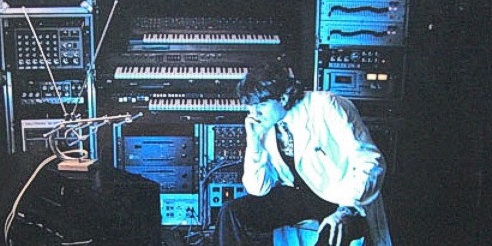
François Bréant is a French keyboardist, vocalist, and composer who played in the bands Cruciferius, Ergo Sum, and Nemo in the early 1970s. During the second half of the decade, he worked on albums by Albert Marcœur and Bernard Lavilliers. In 1979, Bréant released two solo albums of electronic music on Barclay-subsidiary Egg.
Background
François Bréant was born September 23, 1947, in Rouen, France, to painter and pianist Jean Bréant and theater costumer Claudine Bréant. He studied piano and voice at the Maîtrise Saint-Evode of Rouen Cathedral, where he sang sacred repertoire with the children’s choir at Sunday services. At fourteen, he played piano in a local free-jazz group.
Bréant entered the École des beaux-arts de Rouen in 1963 to study graphic art and illustration. His first paid music engagement came in summer 1965 with a jazz quartet at Saint-Cast-le-Guildo. Bréant played the engagement with bassist Denis Ozanne, drummer Bruno Dedieuleveult, and guitarist Charles Malétras. Manu Dibango, then leader of the casino orchestra, joined the quartet for jam sessions. Bréant acquired a Philips Philicorda organ in 1966 and played keyboards with the Beatsounds at the casino in Saint-Valery-en-Caux the following summer.
Cruciferius
Bréant moved to Paris in September 1967 and entered the École nationale supérieure des arts décoratifs on rue d’Ulm. He left the school in 1968 and pursued music alongside freelance illustration work. His first recording session came at Studio CBE on a four-song project by bassist Bernard Paganotti under the name Fatty Nauty. Bréant joined Paganotti in Cruciferius as organist, vibraphonist, and vocalist with guitarist/vocalist Marc Perru. Co-founder Christian Vander left for Italy roughly two weeks into Bréant’s tenure; drummer Patrick Jean completed the working quartet.
Cruciferius backed Ronnie Bird on a French tour in May 1968, while Bréant also played keyboards on a Bird session. The group spent three months at a club in Japan in 1969 and later opened for Vanilla Fudge at the Olympia in Paris. Cruciferius recorded A Nice Way of Life in May 1969 at Studios Barclay and Studio Davout for Egg, then dissolved the following year in Paris.
Bréant formed Kapak in 1970 with guitarist/vocalist Patrice Tison, bassist/vocalist Pascal Arroyo, and drummer/vocalist Albert Marcœur. The musicians worked from Jacques Denjean’s Studio Frémontel at Le Fidelaire in Eure, where they played sessions for visiting artists and used open studio hours for their own recordings.
Kapak completed an album that remained unreleased. Bréant and Arroyo took recordings from the group to the United States in 1971 and spent nine months between New York, Los Angeles, and the San Francisco Bay Area. They worked with saxophonist Fred Lipsius and established contacts around Blood, Sweat & Tears bassist Jim Fielder. An American manager signed the pair and asked for more direct song material. Bréant and Arroyo returned to Paris in 1972 with plans for another working group.
Nemo
Bréant, Arroyo, and Perru formed Nemo in Paris in 1972 with drummer Clément Bailly. Photographer Emmanuel Lacordaire entered the Saint-Ouen rehearsals as sound technician and second guitarist, then became the percussionist/guitarist in the lineup. Concurrently, Bréant and Perru appeared in the late live lineup of Ergo Sum.
Producer José Bartel placed Nemo with Agave/Sonopresse; Dominique Blanc-Francard recorded the 1973 debut at Château d’Hérouville. Nemo cut Doin’ Nuthin’ through sessions at Studio Frémontel and Château d’Hérouville, with further work at Aquarium and La Grande Armée in Paris. The group split in 1976 when Perru and Bailly embraced jazz-rock while Bréant, Arroyo, and Lacordaire moved toward rhythm-and-blues.
In 1976, Bréant worked briefly with Pierre Vassiliu and joined Bernard Lavilliers for a September appearance at the Fête de l’Humanité on a call from Lacordaire. Lavilliers retained Bréant on keyboards alongside bassist Pascal Arroyo, drummer Emmanuel Lacordaire, guitarist Patrice Tison, and percussionist Dominique Mahut. Bréant co-composed “Big Brother” with Arroyo and wrote “N’appartiens jamais à personne” for 15e Round, recorded on July 26, 1977, at Studios Barclay.
By 1978, Bréant and engineer André Harwood used nights and weekends at Studio de la Grande Armée for Bréant’s original pieces. Bréant built the arrangements from piano and ARP Odyssey parts in successive recorded layers, which became the sessions for his first solo album, Sons optiques, on Egg/Barclay.
Discography:
- Sons optiques (1979)
- Voyeur extra-lucide (1979)
Sources
- François Bréant official site — Rouen, 1947–1967: birth, parents, Maîtrise Saint-Evode, Beaux-Arts, Saint-Cast engagement, organ, Beatsounds, move to Paris. Bréant: Rouen 1947–1967
- Bibliothèque nationale de France authority record: September 23, 1947 birth date and Rouen birthplace. BnF authority record
- François Bréant official credits chronology: first Studio CBE session, Ronnie Bird session, Vassiliu work, Lavilliers entry. Bréant: francophone sessions
- Rock Made in France interview with Bréant: Saint-Cast, Arts Décoratifs, Cruciferius, Japan, Kapak tapes, US trip, manager contact, Nemo formation, September 1976 Lavilliers engagement. François Bréant interview
- Musea Records — Cruciferius: 1967 formation, Patrick Jean lineup, May 1969 Barclay/Davout sessions, Egg album. Cruciferius: A Nice Way of Life
- François Bréant official US chronology: 1971–72 trip with Pascal Arroyo, Bay Area contacts, Fred Lipsius sessions, record-industry approaches with Kapak tapes. Bréant and Arroyo in the US
- François Bréant official Nemo chronology: lineup, Saint-Ouen rehearsal base, José Bartel, recording locations, breakup. Bréant: Nemo
- Philharmonie de Paris — 15e Round: personnel, Bréant compositions, July 26, 1977 Barclay recording date. Philharmonie: 15e Round
- François Bréant official Sons optiques page: Studio de la Grande Armée, André Harwood, recording method, Egg/Barclay release and 1978 date. Bréant: Sons optiques
Artist/Album Pages:
Yellowjackets are an American jazz-rock band from Los Angeles. The group developed from the backin...
Master Cylinder was an American jazz-rock band that released the album Elsewhere in 1981. Member...
Fresh Air was a German jazz-funk band behind the 1982/83 albums Fresh Air and International Men, b...
Hikashu (ヒカシュ) was a Japanese new wave band that released three albums in 1980/81 on Eastworld, fo...
Holding Pattern was an American progressive-rock band founded by guitarist–composer Tony Spada an...
Masahiko Togashi — 富樫雅彦 (March 22, 1940 — Aug. 22, 2007) — was a Japanese jazz-drummer who played ...
Ippu-Do was a Japanese New Wave/synthpop trio that released four albums and a live disc between 1...
Organ was a Finnish synthpop unit that evolved from Argon, the duo behind the 1981 album Kone Ker...
The Suburbs were an American new wave band from Minneapolis that debuted with a self-titled 1978 E...
Fairchild was an American symphonic/hard-rock band from Minneapolis that released a 1978 self-titl...
Jean-Michel Jarre is a French keyboardist and sound technician who emerged in the early 1970s, fir...
Guy Skornik (born 1947) is a French art-pop musician and songwriter who released two EPs on in 196...