

Hydravion was a French electronic combo that made a 1977 album on Cobra Records, followed by the 1979 Carrère release Stratos Airlines.
Members: Philippe Besombes (Moog, synthesizers, Mellotron, electric piano, guitar, vocals), Cooky Rhinosceros (guitar), Patrick Verbeke (guitar), Christ Saint Roch (bass), Pierre Battaillet (drums), Dominique Esnault (drums)
Background
Hydravion began as a Paris studio project in 1976 when keyboardist-synthesist Philippe Besombes developed new material after his Pôle recordings. He first shaped the project alone, then made Hydravion a group with guitarist Cooky Rhinoceros and bassist Christ Saint Roch.
Besombes was born Philippe Pierre Dominique Besombes on January 21, 1946, in the sixth arrondissement of Paris. He earned a master’s in chemistry at the Sorbonne and completed doctoral research at the CNRS center in Gif-sur-Yvette. Besombes also built an electroacoustic studio.
In 1973, Besombes composed the Libra soundtrack for Groupe Pattern and served as technical director for the La Rochelle Festival of Contemporary Music. He joined Luc Ferrari’s Atelier de Libération de la Musique and recorded the 1975 electro-experimental double-album Pôle with keyboardist Jean-Louis Rizet.
By 1977, Besombes opened Hydravion to effects technician Christian Werbrouck, guitarist Patrick Verbeke, and drummers Pierre Bataillet and Dominique Esnault. In August, Besombes led a twelve-piece lineup at the Académie de Musique des Arcs.
Hydravion
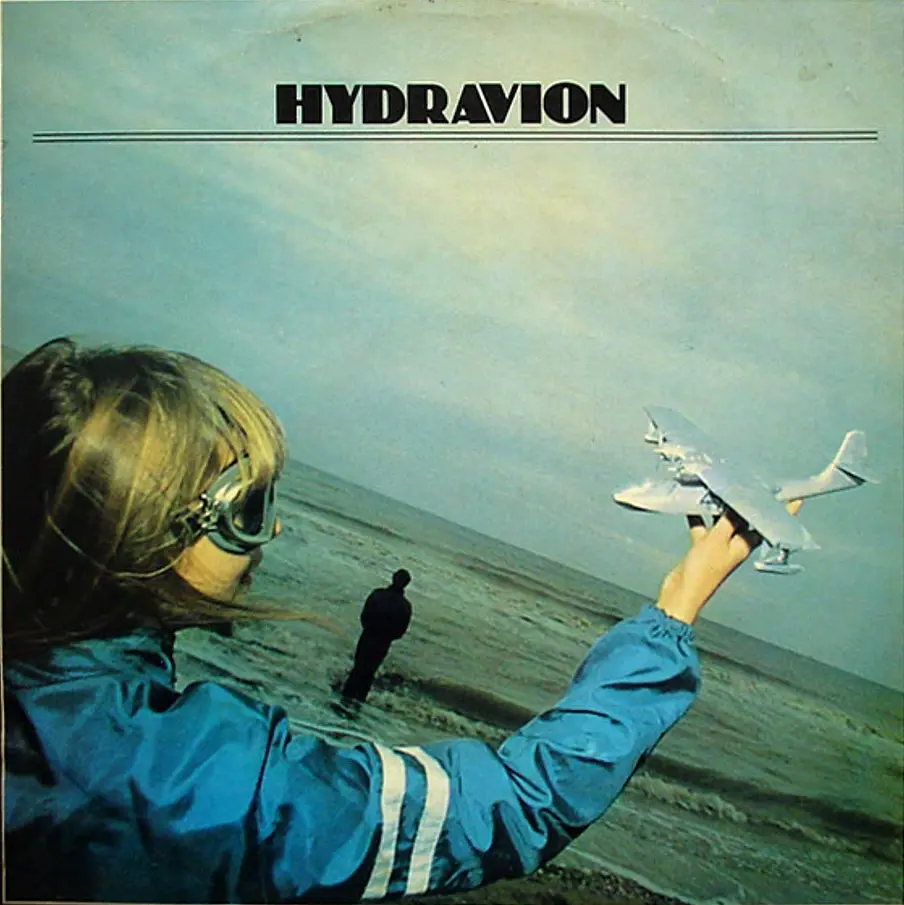 Hydravion released their self-titled debut album in December 1977 on Cobra.
Besombes performs five originals on effects-laden guitar, synthesizers, Mellotron, and Crumar electric piano; sequenced with synth-bass and dual-drum patterns.
“Metropolitain” cycles through a clipped sequencer line, recorded subway noise, and a short guitar figure beneath reverberant choir haze. “Triste Fin” stretches a somber electronic ascent across long-form sections, with explosion effects cutting into the analog drift.
“L’Hydravion D’Argent” glides through a darker mid-tempo pattern, with organ tone set low in the arrangement. “Etude en Do” sharpens the record’s keyboard-led side with brighter contour and firmer forward motion. “J’ai Pas Le Temps” recedes into analog atmospherics, with repeated figures and gradual fade behavior carrying the close.
A1. “Metropolitain” [Metropolitan] (3:36)
A2. “Triste Fin” [Sad End] (10:24)
B1. “L’Hydravion d’Argent” [The Silver Seaplane] (6:36)
B2. “Étude en do” [Study in C] (4:45)
B3. “J’ai pas le temps” [I Don’t Have Time] (7:05)
Hydravion recorded and mixed the album in October–November 1977 at Studio du Chesnay, where Besombes co-produced with assistant engineer Jean-Marc Galicia.
The album appeared in a sleeve concept by Studio de L’air.
Stratos Airlines
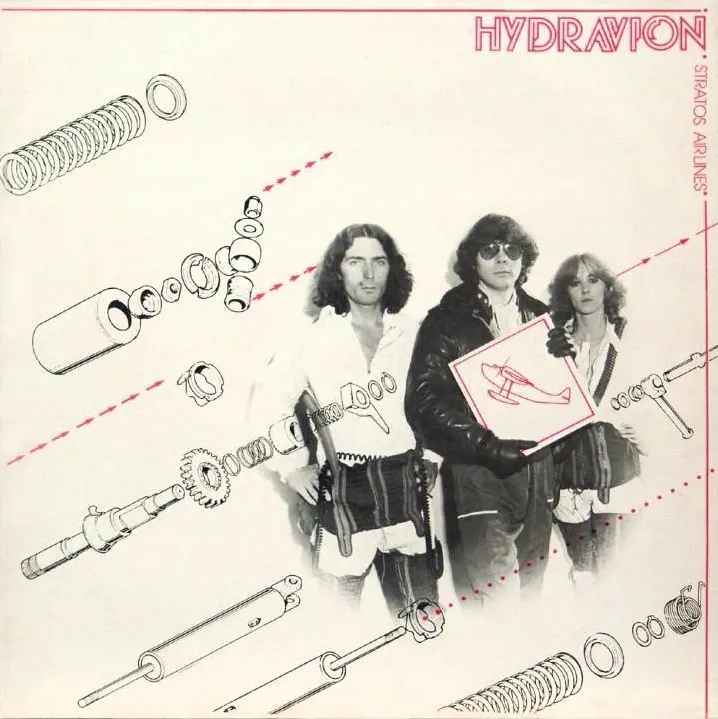 Hydravion released their second album, Stratos Airlines, in 1979 on Carrere.
The album contains six Philippe Besombes pieces and one Cooky Rhinoceros piece, “Singaraja,” performed by a revised Hydravion lineup with returning guitarist Cooky Rhinoceros and Christ Saint Roch on chorus parts. Besombes layers Moog, Oberheim, acoustic piano, Mellotron, clavinet, vocoder, sitar, guitar, and voice across short airport-themed pieces and the eight-minute “Singaraja.”
“Passadena Airport” lifts into phased strings and bright electronic figures, with the main pattern set in a clean airborne register. “Télécom” clips its title-world into a tighter signal pattern, with the arrangement shaped around synthetic overlays and repeated accents. “Singaraja” circles through extended electronic motion, with sectional length used for gradual pattern change.
“Ligne Équateur” bounces through an odd-angled refrain, with the rhythmic profile lighter than the surrounding tracks. “Carolyn Sud” dissolves into choir tones, with the sung element absorbed into the synthetic wash. “Santander” and “L’Amour Charter” keep the travel-suite vocabulary in shorter forms, with recurring patterns and smooth descents closing the program.
A1. “Passadena Airport” (4:08)
A2. “Télécom” [Telecom] (5:12)
A3. “Singaraja” (8:01)
B1. “Ligne Équateur” [Equator Line] (4:15)
B2. “Carolyn Sud” [South Carolyn] (4:52)
B3. “Santander” (5:12)
B4. “L’Amour Charter” [Love Charter] (3:48)
Hydravion recorded and mixed Stratos Airlines at Studio du Chesnay between July 1978 and April 1979 with engineers Philippe Besombes and Patrick Woindrich. The sessions feature inlcuded bassist Patrick Woindrich, flutist–chorus singer Jean-Pierre Le Normand, drummer Bernard “Minet” Wantier, and singer Dolores De Las Palmeras.
Stratos Airlines appeared in a cover package with art direction by Dolores De Las Palmeras, sleeve concept by Philippe Huart, and photography by Gilles Renais and Pierre Follain.
Postlude
Alongside Richard Pinhas, Cooky Rhinoceros backed Magma/Heldon keyboardist Patrick Gauthier on his 1981 album Bébé Godzilla.
Discography:
- Hydravion (1977)
- Stratos Airlines (1979)
Sources:
Artist/Album Pages:
The Silesian Blues Band — commonly billed as SBB — are a Polish symphonic/space-rock band that deb...
Travis Biggs is an American composer, producer, and multi-instrumentalist who made the 1976–79 album...
Eternité was a Québécois symphonic/space-rock duo behind the 1978 Polydor album Les chants de l'ét...
The Trammps were an American soul group from Philadelphia, formed in 1972. Early on, the group rel...
Prism was a Canadian hard-rock band that emerged in 1977 on GRT/Ariola and made six albums throug...
Mythos was a German space-rock band that made a 1972 self-titled album on Ohr. Between 1975 and 19...
Sugar Babe (シュガー・ベイブ) was a Japanese art-pop combo behind the 1975 album Songs on Niagara/Elec. Th...
Honeyelk was a French Zeuhl band that released the album Stoyz vi Dozévéloy on Oxygène in 1979. ...
Ike & Tina Turner were the R&B/soul-rock duo of American guitarist/bandleader Ike Turner and...
The Amazing Rhythm Aces were an American rustic-rock band from Memphis that released five albums ...
Babe Ruth was an English hard-rock/soul band led by singer Jenny Haan. They reached FM playlists w...
The Pointer Sisters were an American soul-pop group from Oakland, formed in 1969 by sisters Anita,...