

Ike & Tina Turner were the R&B/soul-rock duo of American guitarist/bandleader Ike Turner and his then-wife, singer Tina Turner. They came together in the late 1950s when Ike hired Tina as a backing vocalist for his band, the Kings of Rhythm. She first sang lead on the 1960 Sue Records single “A Fool In Love,” which prompted their rebilling as the Ike & Tina Turner Revue.
For 15 years, Ike and Tina toured nonstop with the Ikettes, a revolving-door trio of female singer/dancers. Their explosive live performances drew favorable comparisons to the James Brown Revue. Between 1961 and 1964, they scored further hits on Sue, including “I Idolize You,” “Poor Fool,” “Tra La La La La,” and “You Can’t Miss Nothing That You Never Had.” The first record billed solely to Tina was “Too Many Ties That Bind” (b/w “We Need an Understanding”), released in 1964 on Ike’s Sonja Records label.
In 1965, they charted with the Warner release Live! The Ike & Tina Turner Show and issued singles on assorted soul labels, including “Tell Her I’m Not Home” (Loma) and “Good Bye, So Long” (Modern), both Billboard R&B hits. Impressed with their stage act, producer Phil Spector got them to appear in his 1966 concert film The Big T.N.T. Show. He produced what became their signature song, “River Deep – Mountain High.” Released in May 1966 on Spector’s Philles label (US) and London (abroad), it was a Top 10 smash in Western Europe (UK #3, Spain #1).
The duo signed to Blue Thumb for the 1968/69 albums Outta Season and The Hunter, then moved to Liberty for the 1970/71 albums Come Together, Workin’ Together, and Live In Paris. During this period, they covered songs by Otis Redding (“I’ve Been Loving You Too Long”), Sly & the Family Stone (“I Want to Take You Higher”), The Beatles (“Get Back”), and The Rolling Stones (“Honky Tonk Woman”). In 1971, their cover of Creedence Clearwater Revival’s “Proud Mary” became their biggest US hit (#4).
Tina’s involvement as a songwriter increased when they moved to United Artists for their 1972 release Let Me Touch Your Mind, which features three of her compositions: “I Had a Notion,” “Popcorn,” and “Help Him.” She wrote five songs on their 1973 album Nutbush City Limits, including the fuzz-laden title-track (Austria #1, UK #4). Their 1974 release, Sweet Rhode Island Red, features seven of her songs, including the hits “Sexy Ida” and the title-track.
Tina left Ike after a violent encounter en route to Dallas on July 1, 1976. During the subsequent decade, he faced legal setbacks while she launched a successful solo career, marked by the multi-platinum success of her 1984 release Private Dancer and the chart-topping singles “What’s Love Got to Do With It” and “We Don’t Need Another Hero (Thunderdome).”
The Soul of Ike & Tina Turner
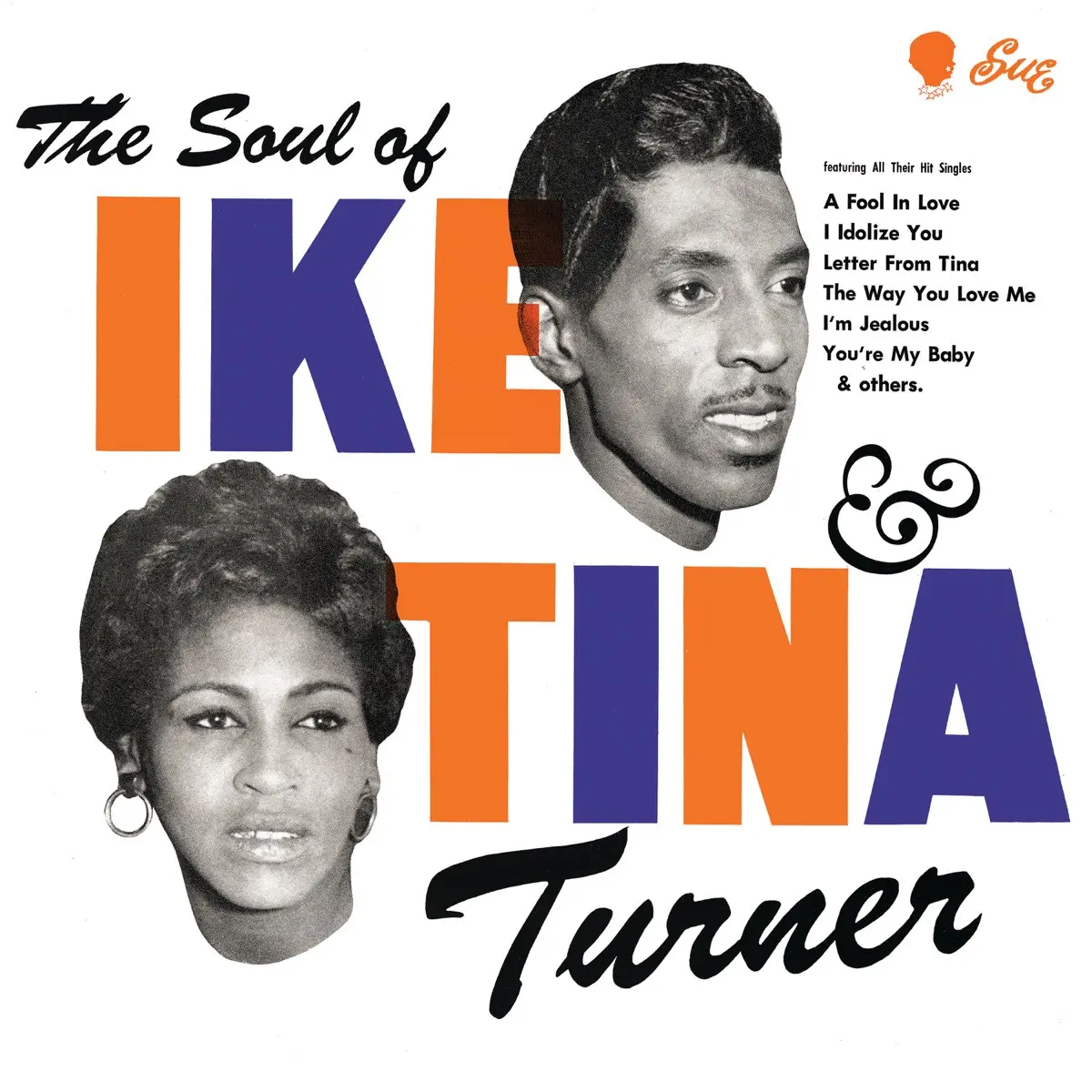 Ike and Tina Turner released their debut studio album, The Soul of Ike & Tina Turner, in February 1961 on Sue Records.
The album captures the Turners’ raw, early R&B style with pounding backbeats, sharp gospel shouts, and tightly arranged call-and-response refrains. Its twelve tracks showcase Tina’s brash, unrestrained vocals backed by Ike Turner and the Kings of Rhythm, with harmonies by the Ikettes. The sound leans heavily on late-1950s rhythm and blues forms, bridging gospel-rooted intensity with brisk club tempos.
Ike Turner wrote or co-wrote ten songs, including “I Idolize You” and “The Way You Love Me.” Jane Bussong co-wrote two numbers with Ike, including “I’m Jealous” and “Sleepless.” The set also includes covers of songs first popularized by Joe Morris (“I Had a Notion”). Ike sings co-leads with Tina on “You Can’t Blame Me” and “You’re My Baby.”
The uptempo “A Fool in Love,” with its shouted refrains and insistent backbeat, became their first national hit and centerpiece of the album. “I Idolize You” moves at a medium pace with layered harmonies and a prominent piano pattern. “Letter from Tina” channels doo-wop phrasing with close harmonies, while “If” reflects a swing-era big band cadence. “I’m Jealous” contrasts a stately rhythm with Tina’s forceful, open-throated delivery.
A1. “I’m Jealous” (2:13) — Written by Ike Turner and Jane Bussong. Issued as the album’s third single in early 1961, this shuffling midtempo blues features Tina Turner’s tense phrasing against a clipped backbeat and sparse piano fills. Lyrically, the song plays out as a confessional of suspicion and possession, her voice oscillating between restraint and eruption. Its structure—alternating spoken pleas and impassioned lines—bridges 1950s torch blues with the rising dramatics of early soul.
A2. “I Idolize You” (2:53) — Written and produced by Ike Turner, this track was their follow-up hit to “A Fool in Love.” It maintains the call-and-response interplay between Tina and the Ikettes, framed by a slow, stomping rhythm and piano-led accompaniment. The lyric centers on devotion verging on obsession, with Tina’s phrasing tightening as the arrangement builds. Ike & Tina re-recorded the song in 1966 for River Deep–Mountain High, and its intensity later drew covers from emerging soul vocalists who followed their early gospel-soul blueprint.
A3. “If” (2:10) — A rare track in the set that leans toward swing-era rhythm and phrasing, “If” threads its blues form with brisk horns and rhythm guitar punctuations. Tina’s vocal delivery is playful yet commanding, navigating the clipped contours of the melody. Though structurally rooted in 1950s R&B, her assertive articulation pushes beyond its era, foreshadowing her later performance style.
A4. “Letter from Tina” (2:38) — Written by Ike Turner, this song is framed as a spoken letter with sung interludes—a narrative device popular in late-1950s rhythm and blues. It blends doo-wop harmonies from the Ikettes with a Latin-tinged beat, underscoring the tale of longing and distance. The hybrid form—half confession, half conversation—reveals Turner’s early skill at theatrical storytelling within a pop-soul context.
A5. “You Can’t Love Two” (2:56) — Tina delivers the lyric with pointed control, alternating accusation and self-awareness. The rhythm section moves in clipped, deliberate steps, underlining the tension of divided affection. The arrangement’s open space—light piano figures, restrained horns—keeps her vocal front and center, capturing the moral unease at the heart of the lyric.
A6. “I Had a Notion” (2:58) — Written by Joe Morris, originally performed by his orchestra in the early 1950s, this cover carries over the original’s slow, late-night pulse but injects heavier rhythmic accents. Tina reshapes Morris’s urbane croon into raw urgency, bending phrases into near cries. The transformation illustrates the Turners’ approach to reworking earlier R&B material into a visceral soul performance.
B1. “A Fool in Love” (2:53) — Written and produced by Ike Turner, this 1960 debut single began as a demo for singer Art Lassiter, with Tina substituting lead at the last moment. Her commanding entrance—half sermon, half wail—electrified the recording, merging gospel fervor with blues formality. The Artettes (later Ikettes) echo her lines with disciplined fervor, creating a dense rhythmic exchange. The song became a national hit and one of the first rhythm and blues records to cross decisively into the pop charts, soon covered by artists across soul and rock circuits, including the Chants and the Ikettes themselves in later years.
B2. “Sleepless” (2:51) — Written by Ike Turner and Jane Bussong, this number sits in a slow, 12/8 tempo with organ accents and suspended piano chords. Tina’s delivery conveys restless yearning rather than overt despair, using phrasing that rides the rhythm rather than fights it. Its unhurried pace gives the album a rare moment of quiet tension.
B3. “Chances Are” (3:42) — A ballad form extending over three minutes, this is one of the most structured compositions on the record. Tina’s voice broadens from conversational tone to full-throated exclamation across verses, tracing emotional risk with deliberate escalation. The Kings of Rhythm lend subtle horn inflections and walking bass to frame her phrasing, suggesting the growing sophistication of Ike Turner’s production style.
B4. “You Can’t Blame Me” (2:13) — A duet between Ike and Tina Turner, this track balances his low, clipped baritone against her higher, fervent responses. The arrangement is rooted in slow blues but shaped by early soul harmony, with the Ikettes offering brief interjections. The lyric navigates mutual fault in love, and their vocal tension mirrors the theme’s dynamic push and pull.
B5. “You’re My Baby” (2:22) — Another Ike-and-Tina duet, “You’re My Baby” contrasts the prior track’s seriousness with light flirtation and rhythmic bounce. Built on a steady backbeat and bright guitar chords, it reflects the pair’s early attempt to craft dialogue songs reminiscent of Ray Charles’s male-female exchanges. The warmth of the exchange offsets the album’s heavier material.
B6. “The Way You Love Me” (1:50) — The shortest track on the album, “The Way You Love Me” closes with propulsive energy, Tina cutting through a rapid tempo with clipped phrasing and brief shouts. Originally the B-side of “A Fool in Love,” its brisk pace and syncopated rhythm drive the set to an emphatic finish, emphasizing the Kings of Rhythm’s tight control and the Ikettes’ rhythmic precision
Sessions took place at Technisonic Studios in St. Louis with Ike Turner producing and Juggy Murray co-producing for Sue Records.
Sue issued “A Fool in Love” (b/w “The Way You Love Me”) as the lead single in July 1960. It reached No. 2 on the Billboard R&B chart and No. 27 on the Hot 100. “I Idolize You” (b/w “Letter from Tina”) followed in November 1960 and hit No. 5 R&B and No. 82 Hot 100. “I’m Jealous” (b/w “You’re My Baby”) appeared in January 1961 and peaked at No. 117 on the Bubbling Under Hot 100.
The album’s title tracklist set the template for the Ike & Tina Turner Revue’s early-1960s touring repertoire, influencing their later soul–rock crossover period and serving as a foundation for subsequent live arrangements and re-recordings, including 1966 updates of “A Fool in Love” and “I Idolize You.”
Dynamite!
 Ike and Tina Turner released their second studio album, Dynamite!, in May 1962 on Sue Records.
Dynamite! blends early-60s R&B, pop, and rock with Tina Turner’s assertive lead vocals and Ike Turner’s driving guitar and arrangements. The album features original material by Ike Turner alongside covers of contemporary hits, including Joe Seneca’s “I Dig You” and Barbara George’s “I Know,” as well as songs from their debut, The Soul of Ike & Tina Turner.
Ike Turner wrote the majority of the songs, with six original compositions. Secondary writers include Rose Marie McCoy and Joe Seneca on “It’s Gonna Work Out Fine,” Joe Seneca and Maynor Steward on “I Dig You,” and Ike Turner and Jane Bussong on “I’m Jealous.” Mickey & Sylvia contributed guitar and background vocals to “It’s Gonna Work Out Fine.”
The album alternates between energetic R&B numbers, tender pop-soul ballads, and blues-infused tracks. “It’s Gonna Work Out Fine” and “Poor Fool” feature conversational vocal exchanges with punchy instrumentation. “Tra La La La La” and “You Should’a Treated Me Right” emphasize rhythmic drive and Tina’s dynamic phrasing, while ballads like “Won’t You Forgive Me” and “Sleepless” showcase a restrained intensity.
A1. “You Should’a Treated Me Right” (3:40) – Written and produced by Ike Turner, this sharp-paced R&B number delivers Tina Turner’s resolute address to a neglectful lover. Her phrasing moves between warning and command, underscored by Ike’s band’s tense rhythmic drive. The lyric asserts self-respect over romantic disappointment, closing the Dynamite! cycle of singles with fierce control.
A2. “It’s Gonna Work Out Fine” (3:03) – Written by Rose Marie McCoy (as James Lee) and Joe Seneca, with uncredited input from Sylvia Robinson, this call-and-response duet stages a conversation between partners negotiating trust and reassurance. Tina’s fervent declarations meet Mickey Baker’s spoken replies, while the Ikettes echo her resolve. Its shifting pace and clipped rhythm make the back-and-forth feel like a staged domestic dialogue set to motion.
A3. “A Fool in Love” (2:52) – Penned by Ike Turner, the duo’s breakthrough hit returns here as an anchor. Tina’s lead cuts through the measured arrangement with striking force, exposing emotional volatility beneath the song’s simple harmonic turns. The lyric follows the turmoil of devotion despite betrayal, balancing confession and performance in equal measure.
A4. “Poor Fool” (2:33) – Written and produced by Ike Turner, this brisk, percussion-driven track transforms romantic humiliation into accusation. Tina’s vocal phrasing alternates between laughter and scorn, tightening around the refrain. Its rhythmic urgency mirrors the lyric’s restless demand for accountability, while the chorus amplifies her confrontation.
A5. “I Idolize You” (2:51) – Another Ike Turner composition, this mid-tempo piece frames obsession as both devotion and surrender. Tina’s phrasing rides a circular rhythmic pattern that gives the lyric’s submission a sense of inevitability. The sparse instrumental setting leaves space for her vocal to swell and recede like a drawn-out confession.
A6. “Tra La La La La” (2:40) – Written and produced by Ike Turner, this song pairs a buoyant rhythm with clipped, chant-like refrains. Beneath its apparent playfulness, Tina’s delivery suggests control through repetition, turning a carefree phrase into assertion. The instrumental backing pulses with layered rhythm that propels rather than decorates the vocal line.
B1. “Sleepless” (2:50) – An Ike Turner composition from their earlier sessions, this slow-tempo piece centers on nocturnal longing. Tina’s delivery softens into resignation, her voice trailing behind the restrained rhythm section. The lyric traces insomnia as emotional fallout, the quiet pacing underscoring its solitude.
B2. “I’m Jealous” (2:15) – Written by Ike Turner and Jane Bussong, this song captures possessive tension in concise bursts. Tina’s clipped phrasing mirrors the lyric’s insecurity, while Ike’s guitar punctuations resemble interruptions in a quarrel. The compact structure heightens the emotional compression.
B3. “Won’t You Forgive Me” (2:42) – A duet between Ike and Tina Turner, this pop-soul ballad slows the album’s momentum. Their voices intertwine with measured restraint, expressing apology and fatigue. The harmonic simplicity lets the conversational tone of the lyric dominate, framing reconciliation as an act of endurance.
B4. “The Way You Love Me” (1:52) – Another Ike Turner original, this brief track unfolds like an interlude. Tina’s vocal alternates between gratitude and disbelief, matching the song’s shifting rhythm. Its brevity and repetition make it feel like an unfinished thought turned musical statement.
B5. “I Dig You” (2:22) – Written by Joe Seneca and Maynor Steward, this track merges playful language with clipped instrumental phrasing. Tina’s lines dart between affection and self-assurance, while the arrangement moves with deliberate pacing. The lyric’s light tone conceals a subtle insistence on equality in desire.
B6. “Letter From Tina” (2:34) – Credited to Ike Turner, this song is structured as a spoken-sung monologue. Tina addresses her absent lover with measured calm that builds into accusation. The steady rhythm beneath her words heightens the sense of withheld emotion, making the letter feel both intimate and performative.
Sessions occurred in 1961–1962 at Sue Records’ studios with Ike Turner producing and Juggy Murray co-producing. Tina Turner led vocals with backing from Mickey & Sylvia and the Ikettes, alongside Ike Turner on guitar and band arrangements.
Record label promoted the album with “It’s Gonna Work Out Fine” (b/w “Won’t You Forgive Me”), which peaked at No. 2 on the Billboard R&B chart and No. 14 on the Hot 100. “Poor Fool” followed in November 1961 (b/w “You Can’t Blame Me”), reaching No. 4 R&B and No. 38 Pop. “Tra La La La La” issued in March 1962 (b/w “Puppy Love”) hit No. 9 R&B and No. 50 Pop, and “You Should’a Treated Me Right” in June 1962 (b/w “Sleepless”) reached No. 21 R&B and No. 89 Pop.
“It’s Gonna Work Out Fine” earned Ike and Tina their first Grammy nomination for Best Rock & Roll Recording. Later covers include Manfred Mann (“It’s Gonna Work Out Fine,” 1964), The Spencer Davis Group (1965), Ry Cooder (1979), and Linda Ronstadt & James Taylor (1982). The Kings of Rhythm recorded an instrumental version in 1962.
Don’t Play Me Cheap
 Ike and Tina Turner released their third studio album, Don’t Play Me Cheap, in February 1963 on Sue Records.
Don’t Play Me Cheap emphasizes blues and R&B with Tina Turner alternating between commanding, urgent vocals and softer, intimate phrasing. Arrangements by Jesse Herring and René Hall highlight Ike Turner’s piano and guitar alongside the Kings of Rhythm and backing vocals from the Ikettes.
Ike Turner wrote the majority of the tracks, contributing nine original songs. Secondary writers include Curtis Mayfield on “The Real Me” and Edward Heyman and Victor Young on “Love Letters.”
The album alternates between assertive blues-driven numbers, reflective ballads, and mid-tempo R&B. Tracks like “Wake Up” and “Don’t Play Me Cheap” emphasize a brisk pace and call-and-response phrasing, while “I Made a Promise Up Above” and “My Everything to Me” allow Tina to explore tender, lyrical lines. “The Real Me” and “Love Letters” provide contemporary covers that integrate seamlessly with the album’s original material.
A1. “Wake Up” (2:05)
A2. “I Made a Promise Up Above” (2:19)
A3. “Desire” (2:58)
A4. “Those Ways” (1:45)
A5. “Mama Tell Him” (2:33)
A6. “Pretend” (1:47)
B1. “Don’t Play Me Cheap” (2:08)
B2. “The Real Me” (2:01) — written by Curtis Mayfield
B3. “Forever Mine” (2:15)
B4. “No Amends” (2:22)
B5. “Love Letters” (1:54) — written by Edward Heyman and Victor Young; originated as a 1945 popular song and covered by Nat King Cole (1957), Ketty Lester (1962), Elvis Presley (1966), and Alison Moyet (1987)
B6. “My Everything to Me” (2:30)
Sessions occurred at Sue Records’ studios with Ike Turner producing and Juggy Murray directing. Tina Turner led vocals with backing from the Ikettes and Ike Turner on piano and guitar.
Record label issued the single “Wake Up” in April 1963 with “Don’t Play Me Cheap” as the B-side. Another track, “I Made a Promise Up Above,” later appeared as the B-side to “Dear John” in 1966.
It’s Gonna Work Out Fine
 Ike and Tina Turner released their fourth studio album, It’s Gonna Work Out Fine, in June 1963 on Sue Records.
It’s Gonna Work Out Fine collects early R&B recordings from 1961–62, blending Tina Turner’s urgent, expressive vocals with Ike Turner’s piano and guitar. The album features up-tempo numbers, slow soul ballads, and reissued hits, including their first Grammy-nominated single, “It’s Gonna Work Out Fine.”
Ike Turner wrote the majority of the tracks, contributing ten originals. Sylvia McKinney and Rose Marie McCoy wrote the title track. Several songs, including “Poor Fool,” previously appeared on the 1962 album Dynamite!
The album alternates energetic danceable numbers with slower soul-inflected tracks. Tracks like “Gonna Find Me a Substitute,” “Mojo Queen,” and “I’m Gonna Cut You Loose” feature brisk pace and call-and-response phrasing. “Why Should I” and the title track slow the tempo and highlight contoured, expressive vocal lines, while “Poor Fool” and “This Man’s Crazy” emphasize tight rhythmic drive.
A1. “Gonna Find Me a Substitute” (2:41)
A2. “Mojo Queen” (2:06)
A3. “Kinda Strange” (2:44)
A4. “Why Should I” (1:29)
A5. “Tinaroo” (2:27)
A6. “It’s Gonna Work Out Fine” (3:02) — written by Sylvia McKinney and Rose Marie McCoy; Grammy-nominated track previously released as a single in June 1961
B1. “I’m Gonna Cut You Loose” (2:35)
B2. “Poor Fool” (2:33) — previously released as a single in November 1961
B3. “I’m Fallin’ in Love” (2:22)
B4. “Foolish” (3:47)
B5. “This Man’s Crazy” (1:49)
B6. “Good Good Lovin’” (2:17)
Sessions occurred at Sue Records’ studios with Ike Turner on piano and guitar and Juggy Murray producing. Tina Turner led vocals with backing from the Ikettes and the Kings of Rhythm.
The album compiled the singles “It’s Gonna Work Out Fine” and “Poor Fool,” both previously charting hits.
Get It – Get It
 Ike and Tina Turner released their fifth studio album, Get It – Get It, in early 1966 on Cenco.
Get It – Get It compiles recordings from 1964–66, blending Tina Turner’s urgent blues vocals with Ike Turner’s guitar and piano. The album includes previously released singles, live material, and reinterpreted Chicago blues standards, reflecting the duo’s work outside their Sue Records period.
Ike Turner wrote the majority of the tracks, contributing seven originals. Billy Preston wrote “Strange,” Elmore James wrote “I Believe,” Eddie Boyd wrote “Five Long Years,” Guitar Slim wrote “Things I Used to Do,” and Willie Dixon wrote “My Babe.” Jimmy Rogers’ “That’s Alright” appears as a cover.
The album balances original compositions with classic blues reinterpretations. Up-tempo tracks like “Get It – Get It” and “You Weren’t Ready” emphasize brisk rhythms and call-and-response phrasing. “I Believe” and “Five Long Years” highlight contoured, expressive vocal lines, while “My Babe” and “That’s Alright” draw on traditional Chicago blues structures.
Sessions occurred at various studios between 1964 and 1966 with Ike Turner producing and engineering. Tina Turner led vocals with backing from the Kings of Rhythm and the Ikettes; horns on later mixes included Phil Wright. Strings and orchestral overdubs were added on the 1971 reissue.
The album’s singles include “Strange” (1964) and “Get It – Get It” (1967). “I Can’t Believe What You Say (For Seeing What You Do)” reached No. 95 on the Billboard Hot 100 and No. 33 on the Record World R&B chart. The song was performed on Shindig! in 1965 and covered by Val McKenna, Dinah Lee with Max Merritt & The Meteors, Manfred Mann, The Defenders, Toots and The Maytals, and Henning Stærk in subsequent years.
The album was reissued as Her Man…His Woman in 1971 by Capitol Records with stereo mixes, added horns, and strings, peaking at number 201 on Billboard’s Bubbling Under the Top LPs.
River Deep – Mountain High
 Ike and Tina Turner released their sixth studio album, River Deep – Mountain High, in September 1966 on London (UK) and A&M (US).
The album pairs Phil Spector’s maximalist Wall of Sound arrangements with rough, stripped-back Ike Turner productions. Spector produced six tracks with an expanded Wrecking Crew ensemble, while Ike helmed remakes of earlier Ike & Tina material with a leaner, lo-fi R&B sound. The Ikettes, including P.P. Arnold, provide chorus vocals throughout the Turner-produced side.
Spector co-wrote four songs with Jeff Barry and Ellie Greenwich. Ike Turner wrote or co-wrote five numbers, all drawn from their early 1960s repertoire. The set also contains covers of songs by the Drifters (“Save the Last Dance for Me”), Arthur Alexander (“Every Day I Have to Cry”), and the Falcons (“You’re So Fine”).
“River Deep – Mountain High” opens with dense orchestration of layered horns, echo-smeared strings, and swelling chorus vocals around Tina’s forceful lead. “I Idolize You” and “A Fool in Love” preserve the duo’s early R&B sound with close-mic’d vocals and dry rhythm backing. “A Love Like Yours (Don’t Come Knocking Everyday)” stretches out over a massed choral arrangement, while “Hold On Baby” and “I’ll Never Need More Than This” show Spector’s sonic palette at its most extreme. Ike’s “Such a Fool for You” and “Oh Baby!” contrast these with raw, unfettered band takes.
A1. “River Deep – Mountain High” (3:38) — Written by Phil Spector, Jeff Barry, and Ellie Greenwich. Recorded at Gold Star Studios with Spector’s layered Wall of Sound, the track magnifies Tina Turner’s declaration of boundless devotion into near-mythic scale. Its lyric frames love as both spiritual and elemental, while the orchestral density and ascending modulation embody the lyric’s expansion toward emotional extremity.
A2. “I Idolize You” (3:46) — Written by Ike Turner. A reimagining of their 1960 single, this version replaces the original’s lean R&B structure with a broader, echo-laden arrangement. Tina Turner’s delivery moves from pleading to command, her phrasing tracing the fine line between adoration and dependency within a swelling rhythmic frame.
A3. “A Love Like Yours (Don’t Come Knocking Everyday)” (3:05) — Written by Brian Holland, Lamont Dozier, and Edward Holland Jr. Adapted from Martha and the Vandellas’ 1963 B-side, this version slows the original’s tempo, emphasizing longing over rhythm. Turner’s phrasing pulls the lyric toward prayerful intensity, while Phil Spector’s arrangement merges strings and percussion into a single surging pulse of persistence.
A4. “A Fool in Love” (3:13) — Written by Ike Turner. The duo’s 1960 breakthrough is recast here with denser instrumentation and sharpened vocal phrasing. Tina Turner narrates the contradictions of devotion under duress, her voice tightening around the refrain as if testing the emotional limits of its promise.
A5. “Make ’Em Wait” (2:22) — Written by Ike Turner. A brief, quick-paced piece driven by clipped guitar and call-and-response phrasing. The lyric advises restraint in affection, its command mirrored by the rhythmic precision of the arrangement, compressing tension into concise repetition.
A6. “Hold On Baby” (2:59) — Written by Jeff Barry and Ellie Greenwich. The lyric pleads for endurance in the face of doubt, its forward motion sustained by overlapping percussion and swelling strings. Tina Turner’s delivery balances vulnerability and assertion, embodying the push-and-pull between faith and exhaustion that anchors the composition.
B1. “Save the Last Dance for Me” (3:02) — Written by Doc Pomus and Mort Shuman. The Drifters’ 1960 classic is recast with orchestral weight and deliberate pacing. Turner’s controlled phrasing transforms the lyric’s gentle caution into a statement of ownership, as Spector’s production stretches the rhythm into suspended anticipation.
B2. “Oh Baby!” (2:46) — Written by Kent Harris. Driven by staccato rhythm guitar and hand percussion, the song’s narrator confronts betrayal through brisk exchanges of line and refrain. Turner’s clipped articulation conveys both fatigue and defiance, grounding the lyric’s regret in movement rather than reflection.
B3. “Every Day I Have to Cry” (2:40) — Written by Arthur Alexander. Originally recorded by Steve Alaimo in 1962, this version intensifies the lyric’s quiet sorrow through Spector’s reverberant layering. Tina Turner’s voice stretches each phrase into sustained lament, turning a modest heartbreak song into a declaration of endurance.
B4. “Such a Fool for You” (2:48) — Written by Ike Turner. A compact soul track centered on repetition and rhythmic tension. The lyric’s self-accusation unfolds through alternating restraint and release, as Turner’s voice edges between irony and confession across the unvarnished arrangement.
B5. “It’s Gonna Work Out Fine” (3:14) — Written by J. Michael Lee and Joe Seneca. Re-recorded from their 1961 hit, the song stages romantic reconciliation as dialogue. The interplay between Turner’s impassioned lead and Ike’s measured interjections frames commitment as negotiation, underscored by a steady instrumental pulse that keeps the exchange taut.
B6. “You’re So Fine” (3:14) — Written by Lance Finney, Willie Schofield, and Bob West. Originally recorded by the Falcons in 1959, this cover closes the album on a note of concise jubilation. Tina Turner’s phrasing stretches the lyric’s directness into rhythmic insistence, the band’s compact arrangement giving her vocal room to assert clarity within constraint.
Sessions occurred at Gold Star Studios in Los Angeles with producer Phil Spector and engineer Larry Levine on the Spector tracks. Ike Turner produced the remainder. Jack Nitzsche, Gene Page and Perry Botkin Jr. handled arrangements.
The album features multiple members of the Wrecking Crew: guitarist Barney Kessel, bassist Carol Kaye, drummer Earl Palmer, pianist Larry Knechtel, saxophonist Plas Johnson, and others among a large studio orchestra of guitars, keyboards, horns, reeds and percussion. Backing vocals on the Spector tracks were supplied by Darlene Love, Fanita James, Jean King, Gracia Nitzsche and Clydie King.
River Deep – Mountain High features cover photography by Dennis Hopper.
London promoted the album with “River Deep – Mountain High” (b/w “I’ll Keep You Happy”), which reached No. 3 on the UK Singles Chart and No. 1 in Spain. A&M reissued the single in 1969 to coincide with the album’s US release. “I’ll Never Need More Than This” followed in May 1967 (b/w “The Cash Box Blues”), reaching No. 64 in the UK. “A Love Like Yours (Don’t Come Knocking Everyday)” appeared as a third single and peaked at No. 16 in the UK.
The title track was later covered by Eric Burdon & the Animals and Deep Purple in 1968.
In May 1967, Ike & Tina Turner released “I’ll Never Need More Than This,” a Phil Spector/Jeff Barry/Ellie Greenwich composition backed with “The Cash Box Blues,” a Phil Spector instrumental. Phil Spector produced the single using his Wall of Sound technique. “I’ll Never Need More Than This” reached No. 114 on the Billboard Bubbling Under Hot 100.
A. “I’ll Never Need More Than This” (3:15) – written by Phil Spector, Jeff Barry, and Ellie Greenwich; arranged by Jack “Specs” Nitzsche; recorded at Gold Star Studios, Los Angeles
B. “The Cash Box Blues (Oops, We Printed the Wrong Story Again)” (2:00) – instrumental composed by Phil Spector; features The Ike Turner Band
“I’ll Never Need More Than This” appeared on the 1969 US reissue of River Deep – Mountain High.
So Fine
 Ike and Tina Turner released their seventh studio album, So Fine, in July 1968 on Pompeii.
So Fine blends soul, blues, and R&B, pairing Tina Turner’s urgent vocals with Ike Turner’s guitar and piano. The album is the duo’s first on Pompeii Records and includes remakes of early hits and covers of established R&B songs, alongside compositions by Mack Rice and others.
Ike Turner wrote or co-wrote five tracks, including a remake of their debut single “A Fool in Love.” Mack Rice wrote three tracks: “Bet’cha Can’t Kiss Me (Just One Time),” “It Sho Ain’t Me,” and “Too Hot to Hold.” Johnny Otis wrote “So Fine,” Otha Hayes, Verlie Rice, and Andre Williams wrote “Shake a Tail Feather,” and Lance Finney and Willie Schofield wrote “You’re So Fine.” Ike Turner co-wrote “I Better Get ta Steppin’” with Charles Harris and “We Need an Understanding” with Johnny Northern.
The album balances original material and reinterpretations of R&B standards. Up-tempo tracks like “Bet’cha Can’t Kiss Me (Just One Time)” and “So Fine” feature brisk rhythmic drive, while slower numbers such as “It Sho Ain’t Me” highlight contoured, expressive vocals and horn arrangements reminiscent of Stax-style soul. Covers such as “Shake a Tail Feather” and “A Fool in Love” emphasize call-and-response phrasing and Tina Turner’s commanding vocal delivery.
A1. “Bet’cha Can’t Kiss Me (Just One Time)” (2:51) – Written by Mack Rice, the track opens with sharp, syncopated piano lines and punchy brass accents. Tina delivers playful vocal contours that reflect teasing and anticipation in the lyrics.
A2. “Ain’t Nobody’s Business” (2:09) – Composed by Ike Turner, the song channels a direct, assertive narrative. Angular vocal phrasing navigates the steady, percussive instrumentation as Tina asserts personal autonomy.
A3. “It Sho Ain’t Me” (3:08) – Written by Mack Rice, this track features slow-building, blues-infused rhythms. Horns and organ punctuate the contoured vocal lines, emphasizing lyrical themes of denial and self-assertion.
A4. “Too Hot to Hold” (2:20) – Another Mack Rice composition, the song rides brisk, jittery instrumentation. Tina’s vocals weave through abrupt rhythmic shifts, expressing urgency and intensity in the narrative.
A5. “A Fool in Love” (2:49) – Originally penned by Ike Turner, the re-recording revisits the duo’s debut hit. Tina’s expressive delivery moves through sharp turns in phrasing over layered rhythmic accents, conveying emotional vulnerability.
B1. “I Better Get ta Steppin'” (2:49) – Written by Ike Turner and Charles Harris, the track emphasizes driving rhythm and clipped guitar figures. Vocals articulate resolution and determination, moving through angular melodic turns.
B2. “Shake a Tail Feather” (2:15) – Originated by The Five Du-Tones, composed by Otha Hayes, Verlie Rice, and Andre Williams, the track features brisk, percussive instrumentation. Tina navigates rapid vocal contours, energizing the song’s exhortation to dance.
B3. “So Fine” (2:41) – Originally a 1959 hit for The Fiestas, written by Johnny Otis, the track blends smooth, contoured vocal lines with punchy horn stabs. The lyrics celebrate admiration and allure, delivered with measured rhythmic emphasis.
B4. “We Need an Understanding” (2:43) – Composed by Ike Turner and Johnny Northern, the song explores relational clarity and communication. Sharp rhythmic turns and vocal inflections highlight the tension and resolution in the lyrics.
B5. “You’re So Fine” (2:26) – Written by Lance Finney and Willie Schofield, the track moves with steady percussion and angular phrasing. Tina’s vocal delivery emphasizes admiration and affirmation, punctuating the lyrical focus on affection.
Sessions occurred at Pompeii’s studio with Ike Turner producing. Tina Turner led vocals with the Ikettes providing backing vocals, supported by the Kings of Rhythm.
Singles from the album include “So Fine” (March 1968), which reached No. 50 on the Billboard R&B Singles chart and No. 117 on Bubbling Under the Hot 100. Other singles were “Bet’cha Can’t Kiss Me (Just One Time Baby)” (1966), “I Better Get ta’ Steppen” (1967), “We Need an Understanding” (August 1968), and “Too Hot to Hold” (November 1968).
So Fine was reissued as Too Hot to Hold by Pickwick/33 Records in 1974 and later included in the 2016 Goldenlane compilation The Complete Pompeii Recordings (1968–1969).
Outta Season
Ike and Tina Turner released their eighth studio album, Outta Season, in March 1969 on Blue Thumb.
Outta Season foregrounds blues and soul, emphasizing Tina Turner’s expressive vocals alongside Ike Turner’s guitar and piano. The album blends reinterpretations of blues standards with original compositions, produced by Tina Turner and Bob Krasnow, and includes their live staple “I’ve Been Loving You Too Long.”
Ike Turner wrote or adapted four tracks, including “Mean Old World,” “Dust My Broom,” and the instrumental “Grumbling.” Tina Turner contributed “I Am a Motherless Child.” The album covers include Otis Redding and Jerry Butler’s “I’ve Been Loving You Too Long,” B.B. King and Jules Taub’s “3 O’Clock in the Morning Blues” and “Please Love Me,” Lowell Fulson’s “Reconsider Baby,” Willie Dixon’s “My Babe,” and B.B. King and Joe Josea’s “Rock Me Baby.” Sonny Boy Williamson wrote “Crazy ’Bout You Baby.”
The album opens with emotional soul interpretations like “I’ve Been Loving You Too Long” and “I Am a Motherless Child,” contrasting with brisk, rhythmic blues such as “Dust My Broom” and “Grumbling.” Mid-tempo arrangements like “Five Long Years” and “Mean Old World” emphasize contoured horn lines and call-and-response backing vocals, while Ike Turner’s guitar punctuates each track with sharp, punctuated turns. Covers retain the essence of the originals but are colored with the Turners’ energetic interplay.
A1. “I’ve Been Loving You Too Long” (3:40) – Written by Otis Redding and Jerry Butler, the song conveys longing and restrained desperation. Tina Turner’s vocals navigate elongated, contoured phrases, while Ike’s understated guitar and supporting horns underscore the tension in the lyric’s emotional plea.
A2. “Mean Old World” (2:20) – Adapted by Ike Turner from traditional blues sources, the track details struggle and betrayal. The vocal lines twist around punctuated guitar chords, with rhythmic shifts that mirror the song’s narrative of hardship.
A3. “3 O’Clock in the Morning Blues” (2:35) – B.B. King and Jules Taub’s composition is rendered with slow, deliberate pacing. Tina’s voice curves through sharp, expressive turns, echoing the loneliness and fatigue suggested by the lyrics.
A4. “Five Long Years” (3:20) – Eddie Boyd’s postwar blues classic recounts endurance and relational betrayal. The arrangement alternates between forward-driving piano and measured percussion, while Tina emphasizes angular phrasing to convey the cumulative weight of disappointment.
A5. “Dust My Broom” (2:30) – Adapted by Ike Turner from Robert Johnson’s original, the track emphasizes departure and self-assertion. Guitar patterns interlock with vocal inflections, producing tense, propulsive movements that trace the song’s Delta blues lineage.
A6. “Grumbling (instrumental)” (2:35) – Ike Turner’s instrumental highlights interplay between guitar lines and rhythm sections. Angular motifs and sudden dynamic shifts create a sense of conversation among the instruments, echoing the album’s blues core.
A7. “I Am a Motherless Child” (3:30) – Tina Turner interprets the spiritual “City Called Heaven,” framing loss and longing through contoured vocal runs. Sparse instrumentation supports the solemn tone, emphasizing lyrical meditation and reflective pauses.
B1. “Crazy ‘Bout You Baby” (3:25) – Written by Sonny Boy Williamson, the track conveys infatuation through measured rhythmic propulsion. Tina’s phrasing bends around accented guitar lines, creating tension between urgency and restraint.
B2. “Reconsider Baby” (2:40) – Lowell Fulson’s West Coast blues standard addresses reconciliation and desire. The arrangement alternates crisp, punctuated guitar licks with sharp vocal turns, emphasizing emotional insistence.
B3. “Honest I Do” (2:20) – Ewart Abner and Jimmy Reed’s composition explores fidelity and doubt. Tina’s vocal lines rise and fall with angular emphasis, supported by steady, minimalist instrumental backing that underscores lyrical clarity.
B4. “Please Love Me” (2:10) – B.B. King and Jules Taub’s song frames a plea for affection. Turner’s delivery uses dynamic contouring to convey vulnerability, while guitar and rhythm patterns respond with measured, echoing accentuations.
B5. “My Babe” (1:50) – Written by Willie Dixon for Little Walter, this Chicago blues standard narrates betrayal and correction. Vocals and instruments interplay in concise, tight phrases, producing tension through sharp rhythmic contrasts.
B6. “Rock Me Baby” (2:45) – B.B. King and Joe Josea’s adaptation of “Rockin’ and Rollin’” emphasizes desire and intimacy. Tina’s voice navigates sharply contoured lines over steady, propulsive guitar motifs, conveying both urgency and anticipation.
Sessions occurred at Blue Thumb studio with Tina Turner and Bob Krasnow producing. Ike Turner handled arrangements and guitar. Tina Turner led vocals with backing from the Kings of Rhythm and the Ikettes.
Tom Wilkes directed art, Barry Feinstein handled photography. The album cover features Ike and Tina in whiteface, eating watermelon, a sardonic commentary on white audiences’ interest in blues.
Singles included “I’ve Been Loving You Too Long” (April 1969), which reached No. 23 on the Billboard R&B chart and No. 68 on the Hot 100, and “Crazy ’Bout You Baby” (July 1969), released in the UK.
Cussin’, Cryin’ & Carryin’ On
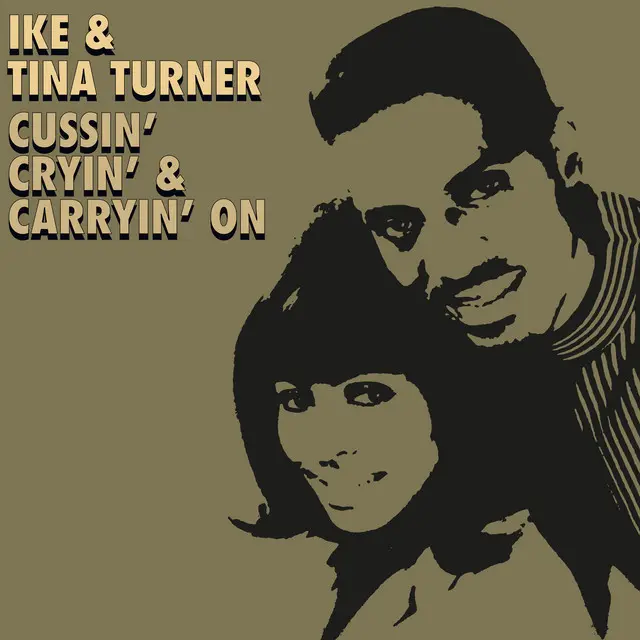 Ike and Tina Turner released their ninth studio album, Cussin’, Cryin’ & Carryin’ On, in July 1969 on Pompeii.
Cussin’, Cryin’ & Carryin’ On blends R&B, soul, and funk rock, featuring Tina Turner’s commanding vocals alongside Ike Turner’s guitar and arrangements. The album incorporates previously released singles, tracks by the Ikettes, and instrumentals from Ike Turner’s A Black Man’s Soul.
Ike Turner wrote or co-wrote six tracks, including instrumentals “Thinking Black” and “Black Beauty,” as well as “So Blue Over You” and “I’m Fed Up.” Tina Turner contributes vocals across multiple tracks, while Fontella Bass shares lead on “Poor Little Fool.” The album covers Wayne Carson Thompson’s “Cussin’, Cryin’ & Carryin’ On” and “You Got What You Wanted,” Oliver Sain’s “Poor Little Fool,” and Venet/Wine’s “Beauty Is Just Skin Deep.”
The material divides between vocal-driven songs, lead by Tina Turner or the Ikettes, and instrumentals showcasing Ike Turner’s guitar and piano. Tracks like the title song and “You Got What You Wanted” feature contoured phrasing and rhythmic drive, while instrumentals “Thinking Black” and “Black Beauty” emphasize tight ensemble interplay. Covers retain their recognizable structures but are energized by the duo’s performance.
A1. “Cussin’, Cryin’ & Carryin’ On” (2:39) — Wayne Carson Thompson; title track emphasizes Tina Turner’s commanding phrasing and call-and-response with horns
A2. “Poor Little Fool” (2:47) — Oliver Sain; lead vocals shared by Fontella Bass and Tina Turner, reissued from Sonja label 1964
A3. “So Blue Over You” (2:32) — Ike Turner; performed by the Ikettes, rhythmic soul with contoured instrumental lines
A4. “Nothing You Can Do Boy (To Change My Way)” (2:27) — Ike Turner; mid-tempo R&B emphasizing vocal intensity
A5. “I’m Fed Up” (2:14) — Ike Turner; funk rock energy with sharp turns in guitar and piano
A6. “You Got What You Wanted” (2:25) — Wayne Carson Thompson; Tina Turner’s vocal with backing by the Kings of Rhythm
B1. “Make ’Em Wait” (2:18) — Ike Turner; performed by the Ikettes, brisk R&B with accentuated rhythm
B2. “Beauty Is Just Skin Deep” (2:14) — Steve Venet, Toni Wine; Ikettes lead vocals, cover of the Motown hit
B3. “Thinking Black” (2:40) — Ike Turner; instrumental highlighting tight ensemble interplay and guitar lines
B4. “Black Beauty” (2:30) — Ike Turner; instrumental with contoured piano and guitar motifs
B5. “I Better Get Ta Steppin’” (2:50) — Charles Harris; previously released on So Fine, rhythmic soul performance
Sessions occurred at Pompeii studio with Ike Turner producing and engineering, Tina Turner on vocals, backed by the Kings of Rhythm and the Ikettes.
Singles included “Make ’Em Wait” (November 1968) by the Ikettes, “You Got What You Wanted” (November 1968, Tina Turner with Ike Turner & the Kings of Rhythm), “Cussin’, Cryin’ & Carryin’ On” (June 1969), and “Poor Little Fool” (November 1969, reissued on Vesuvius label).
The Hunter
 Ike and Tina Turner released their tenth studio album, The Hunter, in October 1969 on Blue Thumb.
The album leans into heavy electric blues with a lean, uncluttered sound shaped around Ike Turner’s rhythm guitar and piano and Tina Turner’s brash, explosive vocals. Sessions feature electric blues guitarist Albert Collins, whose uncredited playing sharpens the bite on key tracks. The material draws heavily on postwar blues standards alongside original cuts from the duo.
Tina Turner co-wrote one song and shared a co-credit on another, while the balance of the album comprises covers of songs popularized by Albert King (“The Hunter”), Willie Cobbs (“You Don’t Love Me”), Jimmy Reed (“You Got Me Running”), Bobby Blue Bland (“I Smell Trouble”), Guitar Slim (“The Things That I Used to Do”), Chuck Willis (“You’re Still My Baby”), and Barbara George (“I Know”). Ike and Tina also rework the traditional number “Early in the Morning.”
The title track stretches over six minutes with jagged guitar lines and call-and-response interplay between Tina’s voice and the band. “Bold Soul Sister” rides a fast, clipped rhythm with Collins’ guitar cutting across Ike’s piano, contrasting with the slower, sustained phrases of “You Don’t Love Me” and “I Smell Trouble.” “I Know,” the closer, tilts toward soul with sharp phrasing and backing vocal emphasis.
Sessions occurred at various Los Angeles studios with Bob Krasnow producing and Ike Turner arranging. Albert Collins recorded his contribution in a single session, tracked live with the band.
Blue Thumb promoted The Hunter with “The Hunter” (b/w “Crazy ’Bout You Baby”) in June 1969. The single reached No. 37 on the Billboard R&B chart and No. 93 on the Hot 100. “I Know” followed in October 1969 with “Bold Soul Sister” as the B-side. “Bold Soul Sister” entered the Hot 100 independently, peaking at No. 59 and reaching No. 22 on the R&B chart. “You Don’t Love Me (Yes I Know)” appeared as a third single in France in 1971. Ike and Tina promoted “Bold Soul Sister” on The Ed Sullivan Show in January 1970.
Tina Turner received a Grammy nomination for Best R&B Vocal Performance, Female for “The Hunter” at the 12th Annual Grammy Awards. Albert Collins’ uncredited guitar work on “Bold Soul Sister” later became a point of interest for collectors.
Come Together
 Ike and Tina Turner released their eleventh studio album, Come Together, in April 1970 on Liberty Records.
The album blends soul and rock, following their tour with The Rolling Stones, which inspired a heavier electric approach. Tina Turner’s commanding vocals drive the material, while Ike Turner arranges and produces, supported by the Ikettes’ backing vocals. The record includes covers of contemporary rock hits and originals that mix blues, funk, and sharp-edged rhythms.
Ike Turner wrote the majority of the songs, contributing seven original tracks. Covers include songs by The Beatles (“Come Together”), The Rolling Stones (“Honky Tonk Women”), and Sly & the Family Stone (“I Want to Take You Higher”). Tina adopted “Evil Man” from “Evil Woman,” a 1969 track by brass-rockers Crow, also covered by Black Sabbath for their recent debut single.
The tracklist alternates between upbeat, rhythm-driven numbers and more soulful, narrative tracks. “Honky Tonk Women” and “Come Together” highlight angular guitar lines and sharp vocal phrasing, while originals like “It Ain’t Right (Lovin’ to Be Lovin’)” and “Too Much Woman (For a Henpecked Man)” emphasize punchy rhythms and call-and-response arrangements. “Doin’ It” closes with a stripped-down, sexually charged jam.
Sessions occurred at various Los Angeles studios with Ike Turner producing and arranging, capturing live energy with Tina Turner and the Ikettes.
Blue Thumb released “Come Together” as a single in December 1969, which reached No. 57 on the Billboard Hot 100 and No. 21 on the R&B chart. “I Want to Take You Higher” followed in May 1970, peaking at No. 34 on the Hot 100 and No. 25 on the R&B chart.
Later artists covering tracks from this album include Tina Turner’s own reinterpretations of “Come Together” in live sets, and various funk and rock acts performing “I Want to Take You Higher” in the 1970s.
Workin’ Together
 Ike and Tina Turner released their twelfth studio album, Workin’ Together, on November 9, 1970, on Liberty.
The album blends their soul–R&B revue sound with funk-oriented rhythms and rock covers aimed at the wider album market. It features their touring band the Kings of Rhythm and the Ikettes on backing vocals, with Ike Turner handling guitar, keyboards, and production.
Ike Turner wrote or co-wrote five songs, including the title track, credited to his alias Eki Renrut. Tina’s sister Alline Bullock contributed “Funkier Than a Mosquita’s Tweeter.” The set also includes revived Turner numbers from the 1960s (“The Way You Love Me,” “Goodbye, So Long”) and covers of songs popularized by the Beatles (“Get Back,” “Let It Be”), Creedence Clearwater Revival (“Proud Mary”), and Jessie Hill (“Ooh Poo Pah Doo”).
The title track sets a mid-tempo pulse with a political lyric about social division. Side one pairs Ike’s originals with Beatles covers, while side two mirrors their live set pacing: they vamp through “Funkier Than a Mosquita’s Tweeter,” build “Ooh Poo Pah Doo” from a slow intro into a stomping call-and-response, and launch into their signature reading of “Proud Mary.” Tina delivers an understated spoken intro before the song erupts into its climactic, uptempo back half. “Goodbye, So Long” reprises a mid-1960s single in an updated arrangement. The closing cover of “Let It Be” is driven by restrained gospel-style piano.
Sessions took place at Bolic Sound in Inglewood with Ike Turner producing and Brent Maher engineering.
Liberty promoted the album with “Workin’ Together” (b/w “The Way You Love Me”) in October 1970. It reached No. 41 on the Billboard R&B chart and No. 105 on Bubbling Under the Hot 100. “Proud Mary” followed on January 14, 1971 (b/w “Funkier Than a Mosquita’s Tweeter”) and reached No. 4 on the Hot 100 and No. 5 R&B, earning Ike & Tina Turner the 1972 Grammy Award for Best R&B Vocal Performance by a Group. “Ooh Poo Pah Doo” appeared as a third single in April 1971 (b/w “I Wanna Jump”) and peaked at No. 31 R&B and No. 60 Hot 100.
Nina Simone covered “Funkier Than a Mosquita’s Tweeter” in 1974. “Proud Mary” became one of Tina Turner’s signature songs and remained a centerpiece of her solo tours in the 1980s and 1990s.
‘Nuff Said
 Ike and Tina Turner released their thirteenth studio album, ‘Nuff Said, in November 1971 on United Artists.
The album leans on soul and funk, with Tina Turner’s vocals front and center over Ike Turner’s dense arrangements. The record features extended instrumental passages, including a two-part title track, and displays the duo’s ongoing integration of contemporary R&B and funk textures.
Ike Turner wrote or co-wrote seven tracks. Covers and secondary contributions include “I Love What You Do to Me” (Calvin Lane, Philip Reese), “Baby (What You Want Me to Do)” (Aillene Bullock), and collaborative compositions with Leon Ware and Tina Turner on tracks such as “Sweet Flustrations” and “Moving into Hip Style – A Trip Child!”
The album balances rhythm-driven funk cuts with soulful narratives. “I Love What You Do to Me” and “Baby (What You Want Me to Do)” emphasize punchy basslines and sharp vocal phrasing, while “‘Nuff Said (Part I & II)” unfolds as a two-part instrumental suite. “Moving into Hip Style – A Trip Child!” and “Pick Me Up (Take Me Where Your Home Is)” highlight playful rhythmic shifts and layered horn arrangements.
A1. “I Love What You Do to Me” (2:32)
A2. “Baby (What You Want Me to Do)” (3:27)
A3. “Sweet Flustrations” (2:55)
A4. “What You Don’t See (Is Better Yet)” (3:15)
A5. “‘Nuff Said (Part I)” (3:12)
B1. “Tell the Truth” (2:53)
B2. “Pick Me Up (Take Me Where Your Home Is)” (4:23)
B3. “Moving into Hip Style – A Trip Child!” (2:47)
B4. “I Love Baby” (2:20)
B5. “Can’t You Hear Me Callin’” (2:26)
B6. “‘Nuff Said (Part II)” (2:01)
Sessions occurred at Bolic Sound in Los Angeles with Ike Turner producing and engineering alongside Jim Saunders and Steve Waldman. Tina Turner performed lead vocals with a backing band including guitar Jackie Clark, bass Warren Dawson, drums Soko Richardson, organ Ike Turner, baritone saxophone J.D. Reed, tenor saxophone Mary Reed, trombone Edward Burks, and trumpet McKinley Johnson.
United Artists issued “What You Don’t See (Is Better Yet)” as a single in Brazil in 1972.
The album reached No. 108 on the Billboard Top LPs chart and No. 21 on the Soul LPs chart, marking another high point in the duo’s prolific early-1970s output.
Feel Good
 Ike and Tina Turner released their fourteenth studio album, Feel Good, in July 1972 on United Artists.
Feel Good blends rock-infused soul with early funk, emphasizing Tina Turner’s vocals and songwriting. The record includes one cover, the Beatles’ “She Came In Through the Bathroom Window,” and the remainder features Tina’s compositions, highlighting her growing role as a songwriter.
Tina Turner wrote nine tracks, with co-writing credits on the title track shared with Jesse G. James. Ike Turner contributed arrangements and production alongside Gerhard Augustin.
The album alternates rhythm-driven funk cuts with sharp, angular vocal performances. “Feel Good” and “If You Can Hully Gully (I Can Hully Gully Too)” feature layered percussion and brass. “Bolic” and “Black Coffee” showcase intricate guitar work over steady, propulsive rhythm, while “She Came In Through the Bathroom Window” transforms the Beatles’ original into a vocal-led soul arrangement.
A1. “Chopper” (2:36) – Written by Tina Turner, the track opens with brisk rhythmic pulses and angular vocal lines that traverse sharp tonal shifts. The lyrics suggest urgency and assertiveness, mirrored in the tightly interwoven guitar and percussion patterns.
A2. “Kay Got Laid (Joe Got Paid)” (2:59) – Tina Turner’s composition delivers a narrative of desire and consequence. Contoured vocal phrasing rides over syncopated, driving rhythms, accentuating the story’s playful tension.
A3. “Feel Good” (3:25) – Written by Tina Turner and Jesse G. James, this title track balances brisk tempo with punctuated instrumentation. Tina’s vocals spiral through angular contours, expressing liberation and spirited affirmation.
A4. “I Like It” (1:58) – A concise Tina Turner composition with rhythmic variations that emphasize lively vocal turns. The track celebrates attraction and enjoyment through pointed, forward-moving phrasing.
A5. “If You Can Hully Gully (I Can Hully Gully Too)” (3:30) – Tina Turner reinterprets the traditional dance theme with sharp vocal inflections and elastic pacing. Rhythmic accents and precise guitar figures underscore playful competition in the lyrics.
B1. “Black Coffee” (2:42) – Tina Turner’s original explores longing and late-night reflection. Vocals trace contoured rises and falls over restrained, syncopated piano and guitar lines, conveying introspection.
B2. “She Came In Through the Bathroom Window” (2:32) – Lennon-McCartney’s composition is reimagined with brisk, propulsive rhythms. Tina navigates angular vocal turns that articulate curiosity and intrigue embedded in the narrative. Joe Cocker popularized this song soon after its first appearance in the Abbey Road suite.
B3. “If I Knew Then (What I Know Now)” (2:47) – Tina Turner examines hindsight and personal growth. Vocals fold over sharp-turning guitar motifs and subtle tempo shifts, reflecting the song’s reflective theme.
B4. “You Better Think of Something” (3:20) – Tina Turner delivers counsel and warning through rhythmic precision and pointed vocal contours. Intermittent percussion accents underscore the lyrical insistence.
B5. “Bolic” (2:28) – Tina Turner’s composition emphasizes instrumental dexterity with tight, interlaced guitar and piano lines. Vocal phrasing rises and falls sharply, complementing the track’s layered rhythmic movement.
Sessions occurred at Bolic Sound in Inglewood, California, with Ike Turner and Gerhard Augustin producing. Ike Turner, Barry Keene, and Jim Saunders engineered the sessions. Tina Turner performed lead vocals with a backing ensemble including guitar (uncredited session players), bass, drums, organ, and a horn section arranged by Ike Turner and Claude Williams.
United Artists issued “Feel Good” as the lead single in April 1972 (b/w “Outrageous”), which reached No. 48 on the Cash Box R&B chart and No. 95 on Record World Singles. The Beatles cover “She Came In Through the Bathroom Window” was released in the Netherlands while the duo toured Europe.
The album peaked at No. 160 on the Billboard Top LPs chart and No. 28 on the Soul LPs chart. “Black Coffee” was later covered by Humble Pie in 1973.
Let Me Touch Your Mind
 Ike and Tina Turner released their fifteenth studio album, Let Me Touch Your Mind, in January 1973 on United Artists.
Let Me Touch Your Mind highlights Tina Turner’s dynamic vocals over a mix of blues, R&B, and soul, blending original compositions with select covers. The album features the title track written by Oliver Sain and includes reinterpretations of Little Richard’s “Early One Morning,” The Midnighters’ “Annie Had a Baby,” Goffin–King’s “Up on the Roof,” John Barry and Don Black’s “Born Free,” and the Stevie Wonder ballad “Heaven Help Us All.”
Oliver Sain wrote the title track, while Tina Turner wrote four songs and co-wrote “Help Him.” Ike Turner contributed arrangements and production alongside Andre Williams.
The album divides into emotive ballads, driving blues numbers, and reinterpretations of classics. The title track stretches over a sensuous vocal performance. “Annie Had a Baby” and “Popcorn” display sharp rhythmic shifts, while “Early One Morning” channels Little Richard’s original energy through Tina’s vocal phrasing. Covers like “Up on the Roof” and “Born Free” receive contoured, soul-driven treatments, and “Heaven Help Us All” emphasizes a steady, propulsive pace under Tina’s commanding delivery.
A1. “Let Me Touch Your Mind” (3:59) – Written by Oliver Sain, the track is a slow, sensuous ballad in which Tina Turner pleads for emotional openness. Vocals contour with expressive rises and falls over restrained piano and subtle percussion, conveying vulnerability and intimacy.
A2. “Annie Had a Baby” (2:43) – Composed by Henry Glover and Lois Mann, originated as a 1954 response to “Work With Me, Annie” by The Midnighters. This song narrative tracks the story of Annie’s unexpected child. Tina’s vocals trace sharp inflections across brisk, playful rhythmic patterns, emphasizing the song’s storytelling.
A3. “Don’t Believe Her” (2:52) – Written by Ike Turner, the track warns against deception and mistrust in relationships. Vocals navigate angular phrases over percussive, staccato guitar lines that accentuate lyrical caution.
A4. “I Had a Notion” (2:44) – Tina Turner’s composition examines personal resolve and reflection. Her voice arcs across tight turns, interlacing with syncopated rhythms that heighten the song’s contemplative tone.
A5. “Popcorn” (3:08) – Another Tina Turner original, the song features rapid-fire vocal contours that mirror the energetic pacing of the instrumentation. The track conveys playful assertiveness through its sharply articulated phrasing.
B1. “Early One Morning” (3:38) – Written by Little Richard (credited to Roger Whittaker), derived from Big Joe Turner’s “Wee Baby Blues.” The Turners’ cover draws on classic blues rock. Tina’s vocals ride contoured, expressive lines over driving piano and guitar rhythms, emphasizing dawn’s introspective tension.
B2. “Help Him” (3:42) – Composed by Tina Turner, the track presents a narrative of guidance and intervention. Vocals fold over shifting rhythmic patterns, reflecting the lyrical concern and urgency.
B3. “Up On the Roof” (2:55) – Gerry Goffin and Carole King’s composition, originally a 1962 Drifters hit, reanimates here with deliberate pacing and angular vocal phrasing. Tina’s interpretation emphasizes retreat and solace as the lyrics depict a refuge from life’s pressures.
B4. “Born Free” (3:20) – Written by John Barry and Don Black for the 1966 film Born Free, the song’s rendition employs sweeping vocal contours over steady, contemplative instrumentation. The lyrics reflect liberation and expansiveness.
B5. “Heaven Help Us All” (3:12) – Composed by Ron Miller, released in 1970 by Stevie Wonder. The track addresses social and spiritual concern. Tina’s vocals arc across expressive rises and falls while percussion and piano maintain varied rhythmic propulsion, underscoring the song’s urgent message.
Sessions occurred at Bolic Sound in Inglewood, California, with Ike Turner and Andre Williams producing. Engineering was handled by Ike Turner. Tina Turner performed lead vocals with an ensemble including guitar, bass, drums, keyboards, and horns under Ike Turner’s arrangements.
United Artists issued “Let Me Touch Your Mind” as the lead single in September 1972 (b/w “Chopper”), which reached No. 30 on Record World’s R&B chart. “Early One Morning” followed in January 1973 (b/w non-album track “With a Little Help from My Friends”), reaching No. 47 on Billboard Soul Singles.
The album package resembled a paper fortune teller. Tracks like “Help Him” later appeared as B-sides to the Nutbush City Limits single.
Nutbush City Limits
 Ike and Tina Turner released their sixteenth studio album, Nutbush City Limits, in November 1973 on United Artists.
The album pairs driving funk–rock rhythms with lean soul arrangements built around Ike Turner’s guitar and keyboard parts and Tina Turner’s sharp, high-impact vocal phrasing. Sessions took place at their Bolic Sound facility with members of the Kings of Rhythm and the Ikettes.
Tina Turner wrote five songs, including the title track, “That’s My Purpose,” “Fancy Annie,” and “Club Manhattan,” which references the St. Louis club where she met Ike in the 1950s. Ike Turner contributed two songs, including “Make Me Over” and “Get It Out of Your Mind.” They also revisit Phil Spector’s “River Deep – Mountain High” and cover songs popularized by Dobie Gray (“Drift Away”) and Jimmie Davis (“You Are My Sunshine”).
“Nutbush City Limits” opens the album with angular guitar figures, stabbing horns, Moog synth accents, and Tina’s pointed account of life in her Tennessee hometown. “Fancy Annie” and “Club Manhattan” draw on autobiographical subject matter. Ike’s “Make Me Over” drives a dense rhythmic pattern with call-and-response vocals from the Ikettes. Side two shifts between reworked showpieces like “River Deep – Mountain High” and bright covers framed by concise arrangements.
A1. “Nutbush City Limits” (2:55) – Written by Tina Turner and produced by Ike Turner, the track recounts life in Nutbush, Tennessee, with clipped vignettes of rural customs and modest pleasures. Its sharp rhythmic drive, proto-punk buzzsaw guitar, synth accents, and taut brass lines frame Tina’s brisk, almost percussive delivery, transforming autobiography into anthem. She reflects on the small-town southern life, the local landmarks and strict social rules.
A2. “Make Me Over” (3:05) – Ike Turner’s composition merges plea and reinvention, with Tina voicing a woman seeking renewal after disillusionment. The arrangement pivots between clipped funk rhythm and sustained organ tones, heightening the sense of restless introspection.
A3. “Drift Away” (3:20) – Written by Mentor Williams and first recorded by Mike Berry, the song finds Tina reshaping its plea for musical salvation into an assertion of creative endurance. The Turners replace the original’s relaxed pace with a firmer rhythmic thrust, lending the lyric’s surrender a harder edge.
A4. “That’s My Purpose” (4:38) – A Tina Turner original that links perseverance to self-worth. Her vocal alternates between restraint and outcry, underscored by Ike’s dense, guitar-centered arrangement that mirrors the tension between resolve and fatigue.
A5. “Fancy Annie” (2:20) – Tina Turner’s portrait of a woman drawn to luxury and attention unfolds through terse, image-laden verses. The rhythm section presses forward relentlessly, accentuating the character’s impulsive chase of status.
B1. “River Deep, Mountain High” (4:02) – Written by Phil Spector, Jeff Barry, and Ellie Greenwich, the Turners revisit their 1966 classic with a leaner, live-in-studio feel. Stripped of Spector’s orchestration, Tina’s phrasing becomes sharper and more immediate, recasting devotion as determination.
B2. “Get It Out of Your Mind” (3:20) – Ike Turner’s lyric pairs psychological advice with physical insistence, urging release from obsession. The rhythm alternates between clipped propulsion and brief, suspended breaks, echoing the push-and-pull of the message.
B3. “Daily Bread” (2:45) – Written by Tina Turner, the song situates faith and endurance within everyday struggle. The tempo’s steady pace and minimal harmonic shifts evoke routine, while Tina’s phrasing lifts the lyric into quiet affirmation.
B4. “You Are My Sunshine” (3:22) – Credited to Jimmie Davis and Charles Mitchell, the 1940s country standard is reframed as a minor-key lament. Ike’s re-harmonization and Tina’s weary tone convert its familiar refrain into a reflection on fragility rather than comfort.
B5. “Club Manhattan” (2:50) – Tina Turner’s autobiographical tribute to the East St. Louis nightclub where she met Ike Turner. The lyrics celebrate the formative nights of their partnership, while the brisk rhythm and bright horns capture the kinetic energy of their beginnings.
Sessions occurred at Bolic Sound in Inglewood with Ike Turner producing and Brent Maher engineering.
United Artists promoted the album with “Nutbush City Limits” (b/w “Help Him”), issued in August 1973. The single reached No. 11 on the Billboard R&B chart, No. 22 on the Hot 100, and No. 4 in the UK. A re-recorded version of “River Deep – Mountain High” followed in March 1974 as a French single.
“Nutbush City Limits” has since been covered by Bob Seger & The Silver Bullet Band and Alvin Lee. Tina Turner later re-recorded the song for her solo career in 1988 and 1991, reviving it as a concert centerpiece.
The Gospel According to Ike & Tina
 Ike and Tina Turner released their seventeenth studio album, The Gospel According to Ike & Tina, in April 1974 on United Artists.
The Gospel According to Ike & Tina presents new arrangements of gospel standards, combining Tina Turner’s vocals with Ike Turner’s guitar, piano, and early synthesizer work. The album emphasizes spiritual intensity while experimenting with electronic textures via ARP and Minimoog synthesizers provided at their Bolic Sound studio.
Ike Turner arranged and adapted all songs, including the Grammy-nominated single “Father Alone.” Tina Turner contributes lead vocals throughout, and Ike Turner provides lead on “Father Alone” and other tracks. The album covers John Newton’s “Amazing Grace,” Thomas A. Dorsey’s “Take My Hand Precious Lord,” Joseph M. Scriven/Charles Crozat Converse’s “What a Friend We Have in Jesus,” and the traditional “When the Saints Go Marching In.”
Songs divide between contemplative hymns, mid-tempo spirituals, and celebratory gospel numbers. Tracks like “Father Alone” and “Glory, Glory” feature contoured vocal lines supported by synthesizer textures, while “When the Saints Go Marching In” builds in pace toward a climactic ensemble vocal. Covers retain their recognizable melodies but are energized by Ike & Tina’s interpretations.
Sessions occurred at Bolic Sound studio in Inglewood, California, with Ike Turner producing and engineering, utilizing Minimoog and ARP synthesizers alongside piano, guitar, and rhythm section.
The single “Father Alone” was released in 1974 and received a Grammy nomination for Best Soul Gospel Performance.
Sweet Rhode Island Red
 Ike and Tina Turner released their eighteenth studio album, Sweet Rhode Island Red, in October 1974 on United Artists.
Sweet Rhode Island Red combines funk, rock, and soul with Tina Turner’s commanding vocals leading original compositions and selective covers. Tina Turner wrote the majority of the tracks, including the title song, while the album features reinterpretations of Stevie Wonder’s “Living for the City” and “Higher Ground,” Barbara George’s “I Know,” and John Rostill’s “Let Me Be There.”
Tina Turner wrote six songs and co-wrote the title track, with Ike Turner and Claude Williams contributing arrangements and production. Rock guitarist Marc Bolan appears on “Sexy Ida (Part 2).”
The album divides into funk-driven numbers, blues-tinged tracks, and soulful reinterpretations. The opener “Let Me Be There” delivers contoured phrasing over a pop-country foundation, while “Living for the City” emphasizes restrained intensity. Original compositions like “Sweet Rhode Island Red” and “Sugar Hill” use rhythmic shifts and punchy brass lines. “Sexy Ida” parts 1 and 2 highlight inventive guitar lines and synthesizer flourishes, with Part 2 pushing into a faster rock pace.
Sessions occurred at Bolic Sound in Inglewood, California, with Ike Turner, Claude Williams, Warren Dawson, Soko Richardson, and Gerhard Augustin producing. Ike Turner handled engineering alongside production duties, with Tina Turner on lead vocals and a band composed of multiple guitarists, keyboardists, horn players, and rhythm section contributors.
United Artists promoted the album with “Sweet Rhode Island Red” (b/w “Get It Out of Your Mind”), which reached No. 43 on the Billboard R&B chart and No. 51 in the UK. “Sexy Ida” followed in August 1974 as two parts: Part 1 reached No. 29 on Billboard Hot Soul Singles and No. 65 on the Hot 100; Part 2 featured Marc Bolan and reached No. 85 on the Hot 100 and No. 49 on Soul Singles.
Later reissues paired Sweet Rhode Island Red with The Gospel According to Ike & Tina on CD by BGO Records in 2012. Tracks like “Higher Ground” and “I Know” had prior cover versions by artists including Fats Domino, Cher, and Bonnie Raitt.
Discography:
- The Soul of Ike & Tina Turner (1961)
- Dynamite! (1962)
- Don’t Play Me Cheap (1963)
- It’s Gonna Work Out Fine (1963)
- Get It – Get It (1966)
- River Deep – Mountain High (1966)
- So Fine (1968)
- Outta Season (1969)
- Cussin’, Cryin’ & Carryin’ On (1969)
- The Hunter (1969)
- Come Together (1970)
- Workin’ Together (1970)
- ‘Nuff Said (1971)
- Feel Good (1972)
- Let Me Touch Your Mind (1973)
- Nutbush City Limits (1973)
- The Gospel According to Ike & Tina (1974)
- Sweet Rhode Island Red (1974)
- Delilah’s Power (1977, recorded 1975)
- Airwave (1978, recorded 1975)
- The Edge (archival, 1980)
Sources:
- Discogs: Ike & Tina Turner
- 45worlds: Ike & Tina Turner
- 45cat: Ike & Tina Turner
- RYM: Ike & Tina Turner
- MusicBrainz: Ike & Tina Turner
Artist/Album Pages:
Hatfield and the North were an English jazz-rock band that released the 1974/75 Virgin albums Hatf...
Maxine Weldon is an American soul singer who released the 1970/71 albums Right On and Chilly Wind...
Stray was an English hard-rock band that released five albums between 1970 and 1974 on Transatlant...
Gnidrolog was an English symphonic-folk-rock band that released the albums ...In Spite of Harry's To...
John Coltrane (September 23, 1926 — July 17, 1967) was an American post-bop/jazz saxophonist and ...
Whitney Houston (Aug. 9, 1963 — Feb. 11, 2012) was an American soul-pop singer and actress. She r...
After Tea was a Dutch pop-psych band from Delft, Zuid-Holland, that released five pop-psych single...
Patti Austin is an American soul and jazz singer who released nine albums between 1976 and 1990 a...
Zoo was a French brass-rock band that released three albums between 1969 and 1972 on Riviera. M...
Landscape was an English electronic band that released the 1977–78 jazz-rock EPs U2XME1X2MUCH and Wo...
Rodriguez (July 10, 1942 – August 8, 2023) was an American singer/songwriter from Detroit who rele...
The Spinners were an American soul group, best known for the 1970s hits “It’s a Shame,” “I’ll Be A...