

Edgar Froese (June 5, 1944 — January 20, 2015) was a German multi-instrumentalist best known as the mastermind behind electronic pioneers Tangerine Dream, which he founded in 1967 and led for nearly five decades. In 1974, he debuted as a solo artist with the album Aqua on Brain Metronome. Between 1975 and 1983, he released five further solo albums on Virgin.
He began formal music training at age 12 with piano lessons and shifted focus to guitar at 15, performing in clubs frequented by Navy and Army personnel around Berlin during the mid-1960s. However, Froese’s initial ambitions were visual, not musical. He enrolled at the Academy of the Arts in Berlin, where he trained as a sculptor and painter, holding several exhibitions even during his student years. To support himself, he designed advertising posters for Berlin’s bus system. Simultaneously, he undertook studies in psychology and philosophy, completing a doctorate on Kant’s categorical imperative, though he eventually left academia, disillusioned with its rigidity.
In 1965, Froese formed The Ones, a rock group that played psychedelic material and R&B standards. Their brief career included a single on Star-Club Records (“Lady Greengrass” b/w “Love of Mine”) and a pivotal trip to Spain, where they performed at Salvador Dalí’s villa in Cadaqués. Froese’s encounter with Dalí proved formative, inspiring him to pursue originality through sound as a surrealist extension of artistic expression. When The Ones disbanded in 1967, Froese resolved to channel his creative ideas through a more experimental musical platform.
Returning to Berlin, he recruited musicians for a new venture aimed at free-form, avant-garde sonic exploration. This ensemble became Tangerine Dream. Drawing on his classical interests (notably Bach, Debussy, and Bartók), Froese forged an approach to music rooted in timbre, texture, and improvisation—eschewing traditional rock structure in favor of extended electronic soundscapes. The group’s earliest recordings, such as Electronic Meditation, showcased this method. Their transition into purely electronic instrumentation marked Froese as a pioneer in synthesizer music, setting the stage for his lifelong mission to blend art, technology, and transcendental experience into a unified musical language.
Amid sessions for their fifth album, Phaedra, Froese recorded his first solo project.
Aqua
 Edgar Froese released his first solo album, Aqua, in June 1974 on Brain.
Aqua presents four extended synthesizer-based instrumentals that expand on Froese’s parallel work with Tangerine Dream. The album adopts a more meditative and ambient character, avoiding rhythmic pulse in favor of glacial development and sustained atmospheres.
Froese structures the material around isolated electronic events—filtered sweeps, arpeggiated flutters, and modulated tonal washes—layered with spatial effects to evoke both natural and interstellar imagery. The mood ranges from aquatic stillness to cosmic detachment, emphasizing texture over theme and movement over melody.
Froese plays all instruments on the album, relying on voltage-controlled synthesizers, tape manipulation, and processed field recordings. He uses custom sequencer systems, analog echo units, and synthetic tone generators, with select passages enhanced by microphone recordings captured through an artificial dummy head, particularly on “NGC 891,” where this binaural technique simulates 3D spatial positioning for headphone listeners. Guitars and treated organ textures occasionally surface but remain secondary to the modular synth frameworks that dominate the sonic field.
A1. “NGC 891” (13:50)
A2. “Upland” (6:10)
B1. “Aqua” (17:00)
B2. “Panorphelia” (9:25)
Froese recorded Aqua between November 1973 and March 1974 in his Berlin studio using a multitrack tape setup and custom-built electronic hardware. He produced the album himself and treated the project as a sonic laboratory, using the opportunity to explore auditory environments unsuited to the more collaborative format of Tangerine Dream.
The album was issued in two separate mixes: a German version on Brain and an international version on Virgin, each with slightly different track lengths and sequencing. The original Brain LP represents Froese’s preferred sequence, placing the celestial opener “NGC 891” first and ending with the ornate “Panorphelia.”
Epsilon in Malaysian Pale
 Edgar Froese released his second solo album, Epsilon in Malaysian Pale, in September 1975 on Virgin.
Split into two side-long compositions, the album captures impressions from Tangerine Dream’s recent tour through Southeast Asia and Australia. Froese translates those environments into an ambient soundscape that fuses natural evocation with early analog electronics. Unlike the modular-driven structures of Aqua, this album shifts toward lyrical atmospheres, pairing the humid overgrowth of the title piece with the luminous drift of its Australian counterpart. The music foregoes rhythmic sequences in favor of extended tone painting, resulting in one of Froese’s most immersive and organic solo works.
On “Epsilon in Malaysian Pale,” Froese performs layered Mellotron phrases to simulate a dense, breathing forest canopy. The piece flows slowly, modulating color and texture without relying on pulse or motif. “Maroubra Bay,” by contrast, features sustained synth lines with enveloped tone swells and rising harmonic movement, closer in method and sound to Tangerine Dream’s concurrent Rubycon sessions. Froese plays all instruments, blending Mellotron flutes and strings with modular synthesizers and tape effects to articulate a personal impression of the environments that inspired him.
A. “Epsilon in Malaysian Pale” (17:00)
B. “Maroubra Bay” (17:15)
Froese recorded the album in Berlin during June and July 1975 immediately after Tangerine Dream’s Australian tour. Each side evokes a specific locale encountered during that journey—Malaysian jungle for Side A and the Pacific coastline of Sydney’s Maroubra Bay for Side B. Froese produced the album himself using the Virgin studio facilities, with no external collaborators. Sessions occurred between Tangerine Dream’s spring tour behind their 1975 album Rubycon and the autumn dates documented on their first live album, Ricochet.
Brain Records released the album in Germany under the alternate title Ypsilon in Malaysian Pale, but both versions share the same two tracks. The piece “Maroubra Bay” was later included on Electronic Dreams in a mistakenly reversed mastering. Froese would later revisit this album in a 2004 re-recording on his Eastgate label.
Macula Transfer
 Edgar Froese released his third solo album, Macula Transfer, in October 1976 on Brain.
Conceived during airline flights taken while touring with Tangerine Dream, the album reflects a sense of in-transit isolation and aerial detachment. Each of the five tracks is named after a specific flight number, anchoring the compositions in the liminal experience of long-distance travel. Froese frames the album as a set of tone poems—abstract, fluid, and texturally sparse.
In contrast to the Mellotron landscapes of his previous album, Macula Transfer emphasizes processed guitar lines and slow-developing synth environments, veering further into atmospheric minimalism and tonal drift.
Froese plays all instruments, combining layered analog synthesizers with tape-processed electric guitar, sequenced motifs, and faint organ textures. He sustains each track through modulated tones and overlapping harmonic movement rather than thematic variation or rhythmic momentum. “OS 452” sets the tone with cycling guitar phrasing beneath a subdued pulse. “AF 765” builds gradually with organ overlays and rising synth tension. “Quantas 611” contracts the scope with slower pace and ambient restraint, while “PA 701” uses choral filters and panning textures. The closing “IF 810” returns to compact phrasing and filtered leads, bringing the cycle to a quiet landing.
A1. “OS 452” (7:56)
A2. “AF 765” (11:04)
B1. “PA 701” (7:36)
B2. “Quantas 611” (4:58)
B3. “IF 810” (4:26)
Froese recorded Macula Transfer in June 1976 at Amber Studios in Berlin, producing the album himself as a solo effort between sessions with Tangerine Dream, whose concurrent Stratosfear (recorded in August) hit shelves the same month as Macula.
The original Brain LP remained unreleased on CD until an unauthorized edition briefly surfaced in 1998 through Manikin Records. Froese responded by remixing the original recordings and adding new material to produce a revised version under his own Eastgate imprint, using the reissue as a means to reassert copyright control over the work. Despite these later editions, the original LP stands as a transitional piece in Froese’s discography—shifting from exotic impressions to a more neutral, detached sonic architecture rooted in transient experience.
Ages
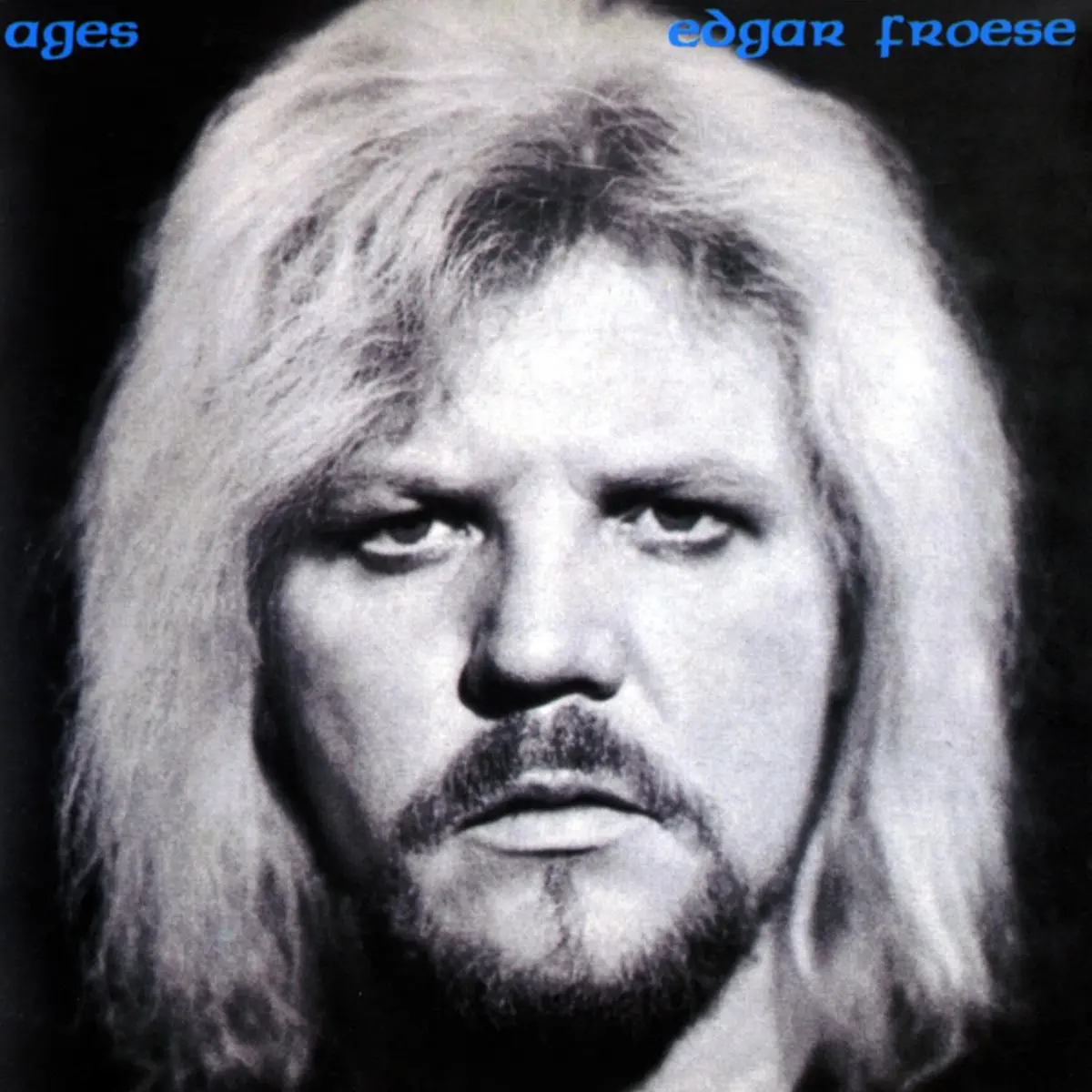 Edgar Froese released his fourth solo album, Ages, in January 1978 on Virgin.
Spanning four vinyl sides, the album marks Froese’s most expansive solo work to date, blending freeform ambient textures with layered sequences and live percussion. He balances extended modular synth movements with more rhythmically grounded pieces, often invoking historical, mythological, or surrealist imagery through abstract titling.
The album ranges from spacious soundscapes to tighter, more kinetic passages, bridging the environmental drift of his earlier albums with a more physical and sculptural sense of form. With Ages, Froese distills the Berlin-School aesthetic into a wide-lens reflection on transition, decay, and archetype.
Froese performs all guitar, keyboard, and synthesizer parts, using a wide arsenal of analog synths, sequencers, and signal processors. He integrates electric guitar for harmonic tension and melodic fragments, occasionally folding in filtered solo lines. Percussionist Klaus Krüger contributes live drums across multiple tracks, adding an organic dynamic to Froese’s layered electronics. The contrast between sequenced rhythm blocks and responsive drum patterns drives pieces like “Metropolis” and “Era of the Slaves,” while side-length works like “Tropic of Capricorn” shift gradually between phases of texture and pulse. Froese plays with structural dissolution, often ending pieces in open-ended fades or unexpected modulations.
A1. “Metropolis” (11:00)
A2. “Era of the Slaves” (8:05)
B. “Tropic of Capricorn” (21:06)
C1. “Nights of Automatic Women” (9:00)
C2. “Icarus” (9:07)
C3. “Childrens Deeper Study” (4:21)
D1. “Ode to Granny A.” (4:39)
D2. “Pizarro and Atahuallpa” (7:30)
D3. “Golgotha and the Circle Closes” (8:30)
Froese recorded Ages between August and November 1977 at Amber Studio in Berlin. He produced the album himself, with Krüger—then a member of Tangerine Dream—contributing drums in several sessions. Prior to the album’s release, an excerpt of “Ode to Granny A.” appeared in abridged form as “Hobo March,” the B-side to Tangerine Dream’s “Encore” live single.
He later remixed the album in 2005 for his Eastgate label, altering durations and omitting the original closing track. Elements from Ages, particularly “Nights of Automatic Women,” resurfaced in Tangerine Dream’s Cyclone, reinforcing the fluid boundary between Froese’s solo vision and the band’s evolving sound.
Stuntman
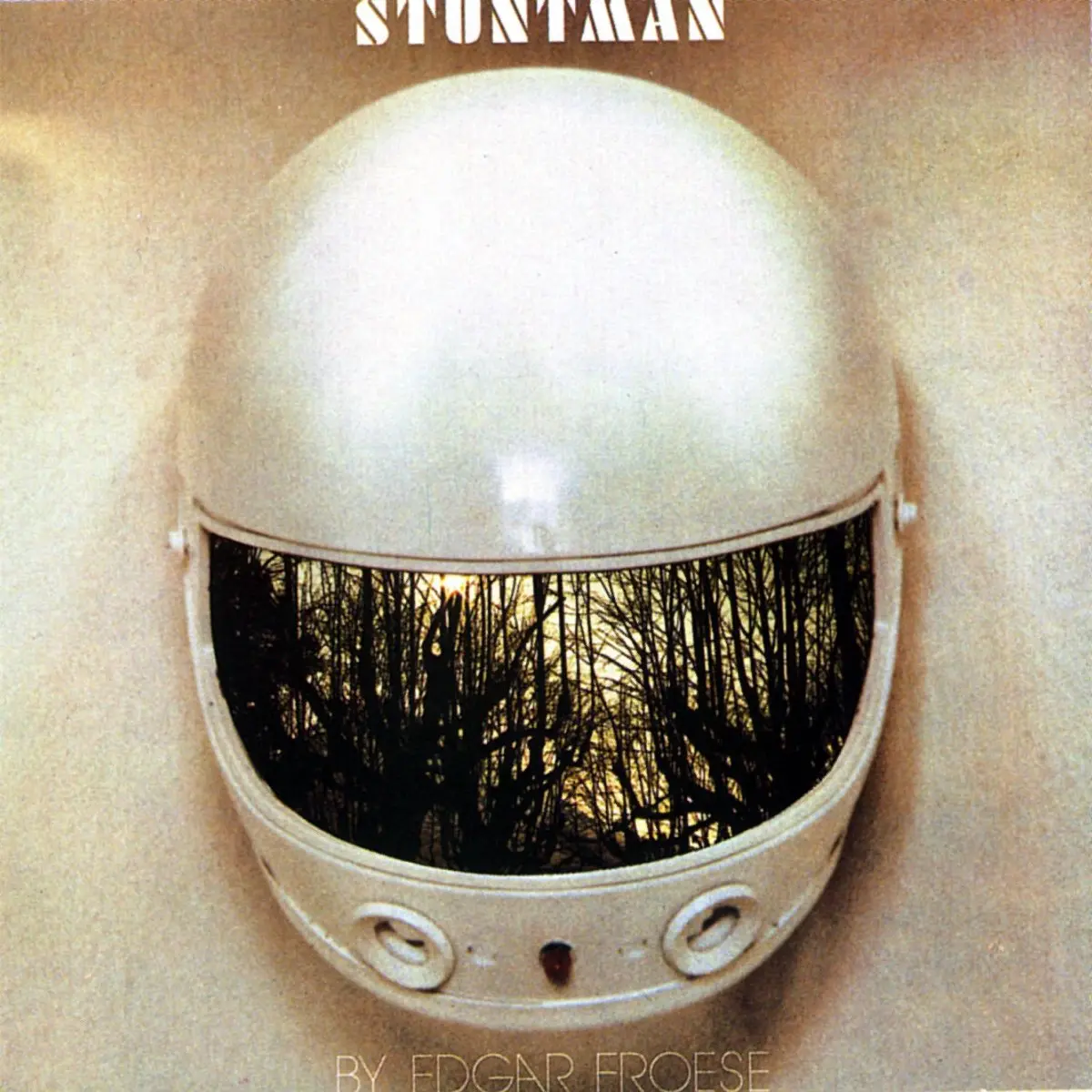 Edgar Froese released his fifth solo album, Stuntman, in October 1979 on Virgin.
The album signals a structural and stylistic shift from the side-long abstractions of his earlier solo work to a more compact and episodic format. Across six discrete tracks, Froese refines the rhythmic and melodic vocabulary he helped define with Tangerine Dream, folding modular sequences, sustained pads, and tonal ornamentation into shorter, self-contained compositions.
He emphasizes contour and development over drift, treating each piece as a modular vignette with internal logic and resolution. The result is an album that retains the exploratory spirit of his earlier output while adopting a tighter narrative flow.
Froese performs all material using a mixture of analog and digital synthesizers, Mellotron, sequencer, and electric guitar. He programs melodic figures on Moog and PPG 340/360 systems, filters ambient textures through phasing and stereo-panning effects, and applies tape delay to select elements for depth and scale. He uses the guitar sparingly but effectively—primarily as a lead voice within synthetic environments. Percussion is nearly absent, replaced by interlocking arpeggios and rhythmic modulation across layered synth timbres. Froese constructs harmonic plateaus with subtle key shifts and builds tension through stacked, detuned oscillations and evolving envelopes.
A1. “Stuntman” (4:13)
A2. “It Would Be Like Samoa” (10:40)
A3. “Detroit Snackbar Dreamer” (6:26)
B1. “Drunken Mozart in the Desert” (9:55)
B2. “A Dali-Esque Sleep Fuse” (8:26)
B3. “Scarlet Score for Mescalero” (4:12)
Froese recorded Stuntman during the summer of 1979 at Amber Studio in Berlin. He produced the album alone, relying on the same studio infrastructure and custom electronics used in concurrent Tangerine Dream projects. Though no external musicians appear, Froese’s expanded synth arsenal allows for layered dynamics and tonal complexity.
He later remixed and reissued the album on his Eastgate label with revised cover art. Stuntman marked the end of his 1970s solo phase and previewed the more structured direction his future work—both solo and collaborative—would adopt in the decade ahead.
Kamikaze 1989 (OST)
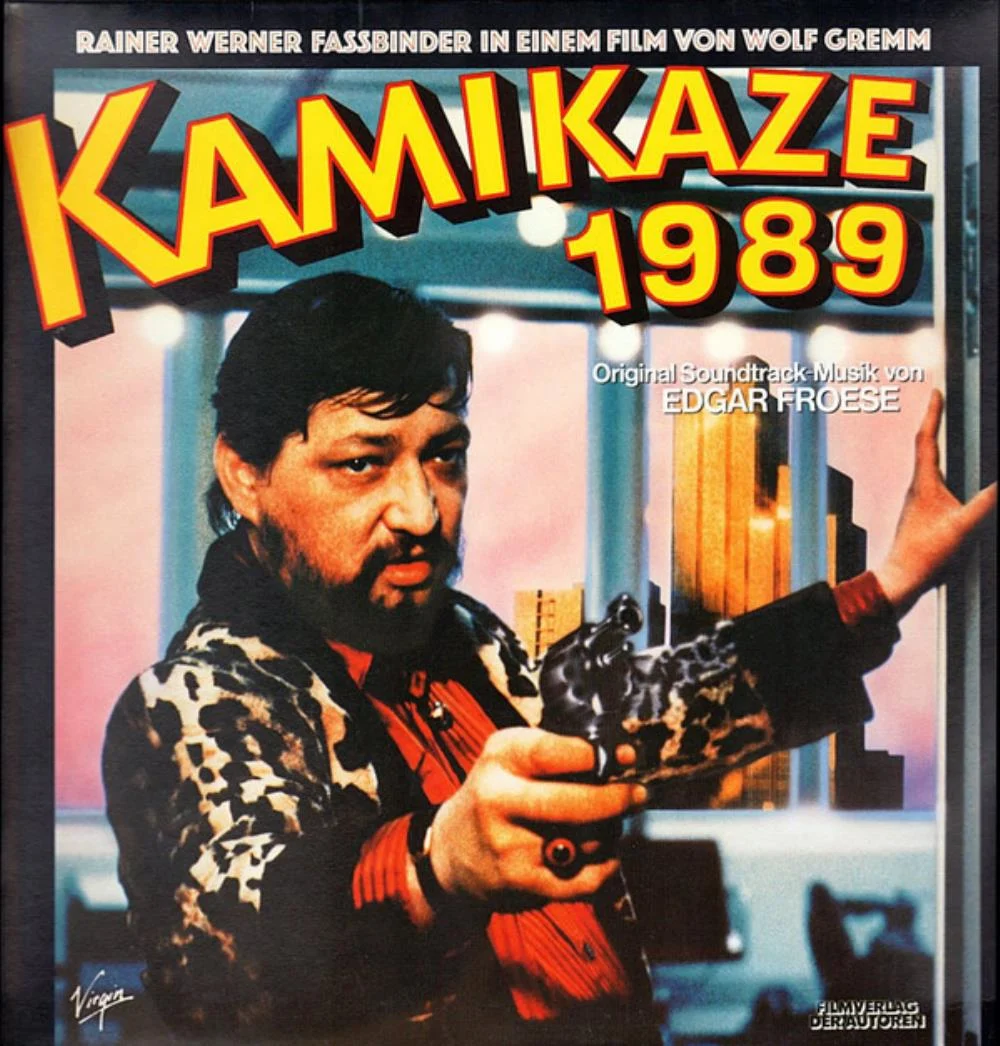 In 1982, Edgar Froese released Kamikaze 1989, the Virgin Records soundtrack to the West German cyberpunk thriller by director Wolf Gremm.
Adapted from Per Wahlöö’s 1964 dystopian novel Murder on the Thirty-First Floor, the film envisions a future Germany where economic prosperity masks a totalitarian regime enforced through media control, behavioral policing, and systemic censorship. Froese’s score provides atmospheric cues to the film’s eccentric tone and neon-noir aesthetic, but the soundtrack functions more as ambient interjection than thematic underscore. Each piece works as a short electronic sketch aligned with specific scenes or characters, capturing the detachment, absurdity, and low-simmering menace that runs through the film’s satire of technocratic governance.
The story takes place in 1989, where society appears utopian on the surface—there is no unemployment, pollution, or visible dissent. But personal freedoms have been eliminated, suicide is reclassified as “unexpected death,” and independent food growth is banned. All information flows through a single media corporation, which exerts total control over news, culture, and public emotion. Lieutenant Jansen, played by Rainer Werner Fassbinder in his final screen role, is a leopard-suit-clad alcoholic detective assigned to investigate a bomb threat directed at the media tower. As he digs deeper, he uncovers the existence of a mysterious 31st floor where critical thinkers are effectively silenced through indefinite editorial limbo. The comic strip “Blue Panther” becomes a subversive touchpoint, offering the only public critique of the regime under the guise of satire. Jansen encounters corporate insiders, disillusioned employees, and a trail of suspects, but the real perpetrator turns out to be Weiss, a former intellectual now reduced to manipulating events in a last bid for subversion. No bombs exist—the corporation fakes the threats to justify its own repressive measures.
Froese scores the film using sequencers, analog synths, and keyboard layers that fluctuate between pulse-driven miniatures and textural vignettes. Each track emphasizes a different aspect of the narrative—surveillance, paranoia, distortion, or internal breakdown—using electronics to mirror the film’s themes of control, repetition, and synthetic order. There are no orchestral or acoustic instruments; the entire soundtrack operates within a closed synthetic ecosystem.
A1. “Videophonic” (4:17)
A2. “Vitamin C” (2:17)
A3. “Krismopompas” (3:19)
A4. “Police Disco” (4:55)
A5. “Intuition” (2:05)
A6. “Police Therapy Center” (2:35)
B1. “Blue Panther” (3:08)
B2. “Snake Bath” (4:50)
B3. “Unexpected Death” (2:56)
B4. “Flying Kamikaze” (4:00)
B5. “Tower Block” (3:30)
B6. “The 31st Floor” (2:15)
Froese recorded the soundtrack at Amber Studio in Berlin during the film’s post-production period in 1982. He composed, performed, and produced all tracks himself using the same hardware and modular systems that defined his solo albums and Tangerine Dream’s early soundtracks. The Kamikaze 1989 score remains a compact entry in his discography, functioning more as a series of tone capsules than a full-length compositional work. Virgin issued the soundtrack on LP alongside the film’s release, presenting Froese’s pieces in the same sequence as their appearance in the film.
Pinnacles
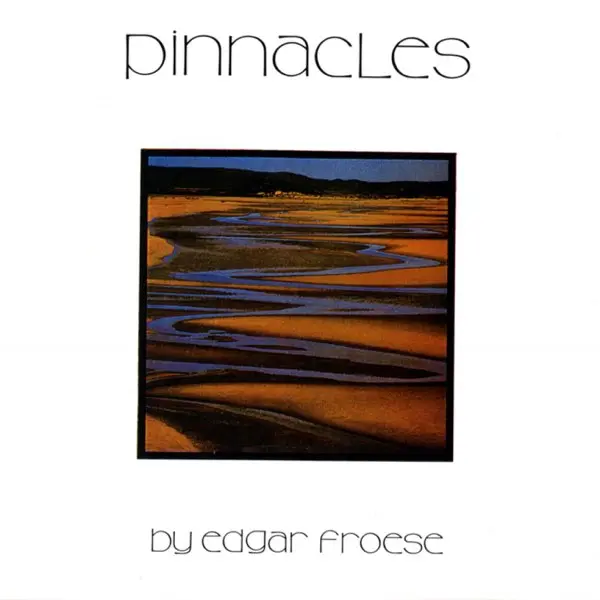 Edgar Froese released his seventh solo album, Pinnacles, in September 1983 on Virgin.
As his final solo effort for more than two decades, the album serves as a reflective coda to his initial phase of activity outside Tangerine Dream. Froese composed and recorded the four-part suite as an ode to the arid formations of The Pinnacles in Western Australia, translating their monumental stillness into a slowly evolving soundscape of sequenced pulses and layered textures.
Operating squarely within the Berlin School framework that he helped define, he favors gradual modulation and tonal drift over melodic directness. Shorter pieces on the first side explore shifting cycles and timbral contrasts, while the second side unfolds in an uninterrupted, twenty-two minute arc of immersive repetition.
Froese performs all instrumental parts using an array of analog and early digital synthesizers, sequencers, and signal processors. He programs intricate arpeggiations and overlays static-laced pads that swell and recede in prolonged waves. Manual pitch shifts and stereo panning add motion within narrow harmonic zones, sustaining atmosphere without thematic variation. Percussive elements remain largely synthesized and sparse, used for accent rather than propulsion.
A1. “Specific Gravity of Smile” (9:35)
A2. “The Light Cone” (4:22)
A3. “Walkabout” (7:10)
B1. “Pinnacles” (22:00)
Froese recorded Pinnacles in May 1983 at Amber Studio in Berlin. He produced and engineered the album independently, continuing his long-running practice of autonomous studio control. Virgin issued the LP with catalog number V 2281 in the UK and Europe.
Discography:
- Aqua (1974)
- Epsilon in Malaysian Pale (1975)
- Macula Transfer (1976)
- Ages (1978)
- Stuntman (1979)
- Kamikaze 1989 (OST, 1982)
- Pinnacles (1983)
Sources:
- Discogs: Edgar Froese
- 45worlds: Edgar Froese
- RYM: Edgar Froese
- MusicBrainz: Edgar Froese
- ProgArchives: Edgar Froese
Artist/Album Pages:
Northwind were an American band from Detroit, Mich., that recorded three albums between 1972 and ...
Lily (りりィ) — 鎌田小恵子 (Feb. 1952 — Nov. 11, 2016) — was a Japanese singer/songwriter who released ten...
Frank Lowe (June 24, 1943 — Sept. 19, 2003) was an American free-jazz saxophonist and composer fro...
Enzo Capuano is an Italian singer/songwriter who released the 1975 album Storia Mai Scritta on Div...
Freeport was a German jazz-rock band behind the 1980–83 albums Duanelessness and Alternating Curre...
Bergendy was a Hungarian rock and jazz band from Budapest. During the 1960s, the band released num...
Nuevo México was a Mexican symphonic/hard-rock band behind the 1975 Orfeon album Hecho en Casa, fo...
Sunhouse was a Belgian jazz-rock band behind a 1977 self-titled album on JW's Records. Bassist Ala...
Jimmy Ponder (May 10, 1946 — Sept. 16, 2013) was an American jazz guitarist from Pittsburgh who em...
Second Movement were a German symphonic-rock band that released the album Blind Man's Mirror and a...
Hatfield and the North were an English jazz-rock band that released the 1974/75 Virgin albums Hatf...
Fox was an English dream-pop band that released three albums on GTO between 1975 and 1977. After t...