
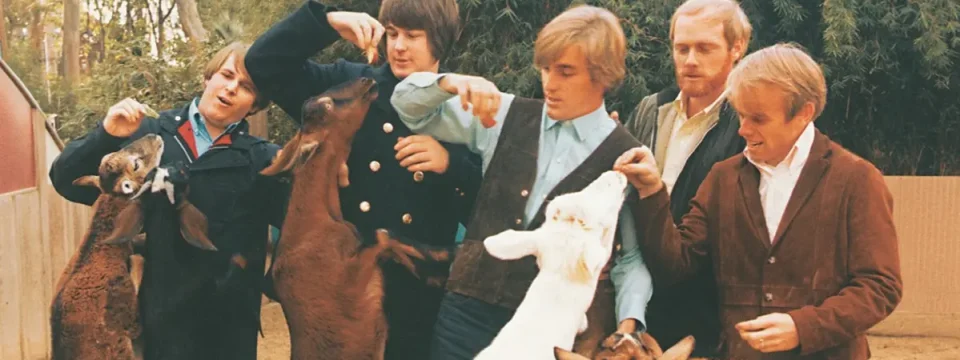
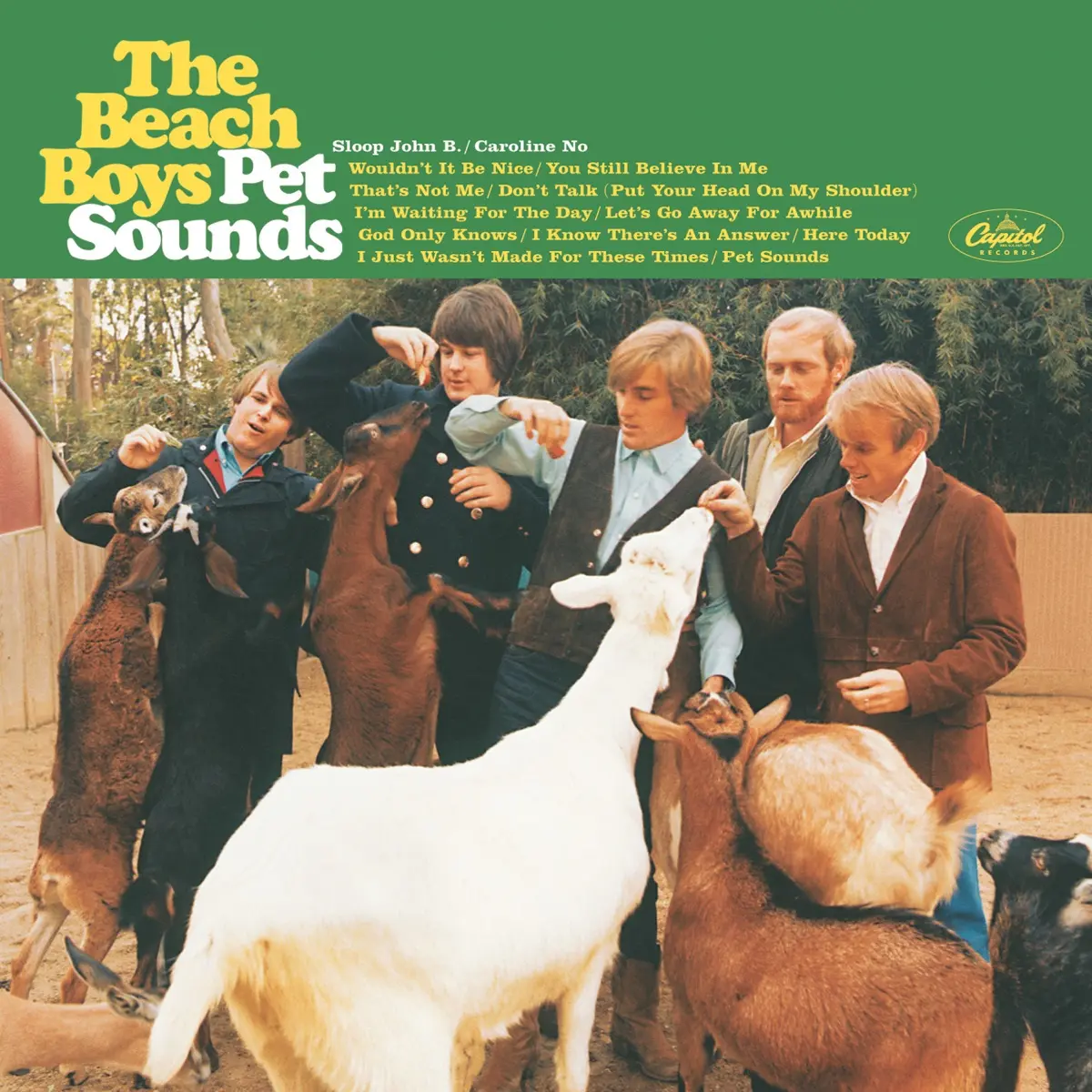
 Pet Sounds is the eleventh studio album by the Beach Boys, released on May 16, 1966, on Capitol Records.
The album redefined the possibilities of popular music through its advanced vocal layering, unorthodox orchestration, and modular studio architecture. It challenged mid-1960s production standards with intricate arrangements, wide emotional depth, and a harmonic vocabulary far beyond contemporary rock forms.
Though initially divisive in the U.S., Pet Sounds soon became a critical cornerstone of album-based music, influencing a broad spectrum of artists and producers from the late 1960s through the advent of chamber pop, progressive pop, and baroque-inflected rock.
Conception and Inspiration
Brian Wilson conceived Pet Sounds after stepping back from live duties in early 1965 to focus exclusively on studio composition. Motivated by marijuana use, spiritual introspection, and creative one-upmanship, he sought to surpass the perceived album cohesion of the U.S. version of Rubber Soul. Working in private while the other Beach Boys toured Japan and Hawaii, Wilson collaborated with lyricist Tony Asher—an ad copywriter new to pop songwriting—to shape a suite of songs that framed adolescence as emotionally fragile and adulthood as spiritually uncertain.
Writing took place at Wilson’s Laurel Way home across a two-to-three week period in early 1966. Each session began with musical fragments—melodic contours, “feels,” or chord cells—often refined on piano, then translated into lyric form through conversation. Asher served as interpreter and editor, lending psychological texture to Wilson’s thematic sketches. Together, they produced eleven vocal songs; Wilson composed two additional instrumentals and reworked “Sloop John B” to complete the album sequence.
Musical Structure and Lyrical Themes
Pet Sounds departs from surf-pop formulas with meditative pacing, modal ambiguity, and a widescreen palette that fuses pop, jazz, classical, and exotica. Its structures incorporate uncommon modulations, ternary forms, arch-shaped melodic figures, chromatic descents, and polytonal cadences. Wilson frequently doubles instruments in contrasting registers, blends bass harmonica and tack piano with English horn or vibraphone, and embeds ambient sounds such as train whistles and dog barks. Tonal centers remain fluid: most tracks move between keys or avoid clear root placement, building tension and release through contrast rather than repetition.
The lyrics pivot away from teenage exuberance toward interior dialogue, romantic doubt, and the burden of expectation. Characters face lost innocence, spiritual confusion, emotional dislocation, and the need for personal connection. Asher’s contributions reframe Wilson’s harmonic complexity in themes of longing, fragility, and self-awareness. Tracks like “You Still Believe in Me” and “Caroline, No” express relational vulnerability through sparse, intimate language, while “I Know There’s an Answer” critiques contemporary drug culture beneath a brightly colored arrangement.
Recording, Sessions, and Arrangements
Wilson recorded Pet Sounds between January and April 1966 at four Los Angeles studios, primarily Western Recorders. He worked with engineer Chuck Britz and a core group of L.A. session players later dubbed the Wrecking Crew, including Hal Blaine, Carol Kaye, Larry Knechtel, and Tommy Morgan. Instrumental tracks were built through live ensemble takes across four-track machines, then bounced to eight-track for layered vocal overdubs. Studio time was consumed by precision rehearsals and tone sculpting, often with multiple pianos, double basses, and percussion instruments recorded simultaneously to create phasing textures and layered depth.
Vocal sessions featured unrelenting retakes guided by Wilson’s acute pitch sensitivity. He distributed leads across group members but dominated the record with his falsetto and middle-range parts. Harmonies shifted from block “oo” parts to contrapuntal strands and abstract syllables. “Wouldn’t It Be Nice” and “God Only Knows” involved up to eight vocal overdub layers per section, each assigned a dedicated track for post-mix control. Mixing was completed rapidly over one day, resulting in an eccentric mono master with bleed-throughs, tape edits, and background noise preserved by Wilson’s aesthetic preference for emotional resonance over perfection.
Release, Impact, and Legacy
Capitol issued the album on May 16, 1966, preceded by Wilson’s solo single “Caroline, No” and the group single “Sloop John B.” Reaction in the U.S. was lukewarm: the album peaked at No. 10 and failed to reach gold certification on initial release. Capitol quickly followed with a greatest hits package that outperformed Pet Sounds, further obscuring its significance. In contrast, the album achieved immediate success in the UK, where a promotional campaign by Beatles publicist Derek Taylor positioned it as the most progressive pop album to date. British critics and musicians—including members of The Beatles, The Who, and Cream—heralded its emotional and sonic ambition. It spent six months in the UK Top 10 and was ultimately named joint Album of the Year by Melody Maker alongside Revolver.
Pet Sounds gained renewed status in the 1990s through archival reissues and critical reevaluation. It is now widely regarded as a landmark in studio composition, influencing artists from The Zombies and Genesis to Prefab Sprout and XTC. Its structural innovations, orchestrational reach, and emotional directness helped elevate the LP to an art form and prefigured the use of studio as compositional instrument in modern pop and rock production. In 2004, it was added to the U.S. Library of Congress National Recording Registry for its cultural and artistic importance.
A1. “Wouldn’t It Be Nice”
2:12 | Brian Wilson, Tony Asher, Mike Love | orchestral pop
“Wouldn’t It Be Nice” opens Pet Sounds with a dramatic burst of sound and sentiment, merging baroque pop architecture with forward-facing production and adolescent yearning. Written by Brian Wilson and Tony Asher (with Mike Love later added by legal action), the track reorients the Beach Boys’ lyrical focus from carefree romance to a dream of committed love delayed by youth and circumstance. Its structural shifts, layered orchestration, and tempo manipulation render it one of Wilson’s most ambitious miniature symphonies.
Background and Construction
Wilson conceived the melody alone and presented it to Asher with the structure largely intact, requesting lyrics around the idea of young lovers wishing for the freedoms of adult partnership. Asher developed the words while navigating Wilson’s intense micromanagement of phrasing and vocabulary. The line “good night my baby / sleep tight, my baby” originated during vocal rehearsals and was later cited by Love as evidence of his lyrical contribution. Thematically, the song reflects Wilson and Asher’s mutual experience of frustrated teenage romance, recasting earlier Beach Boys motifs of innocence into a wistful meditation on maturity and permanence. Inspiration may have stemmed from Wilson’s fixation on sister-in-law Diane Rovell, whose perceived purity informed several Pet Sounds tracks.
Arrangement and Recording
Instrumental tracking commenced on January 22, 1966, at Gold Star Studios with the Wrecking Crew under Wilson’s direction and engineer Larry Levine. The introduction features Barney Kessel’s 12-string mando-guitar run directly into the console, yielding a harp-like timbre that anchors the song’s dreamlike tone. Chord modulations shift the piece from A to F and then D major, incorporating ritardando and decrescendo—devices uncommon in pop but drawn from classical practice. Wilson layered accordions for textural breadth and applied isolated reverb to timpani for spatial effect. Multiple mixes and overdubs followed at Columbia and Western Studios, with final vocals compiled across several months. Dennis Wilson cupped his hands while singing to achieve a desired resonance in the blend, as devised by Brian. Vocal sessions extended over ten rounds as the band struggled to meet the precision Wilson demanded.
Sound and Structure
The song opens with an eight-beat flourish before settling into a verse in F major, where the melody floats atop a walking bassline modeled on Phil Spector’s productions. A later section modulates downward to D and reprises a melodic figure from the intro, after which the bridge slows and quiets before regaining tempo and fading out. Vocal harmonies build in complexity throughout, layering Brian’s falsetto with responses and textures from Carl, Dennis, and Jardine, while Love enters mid-song with his bridge vocal.
Harmonic Interaction
Brian Wilson’s lead lines glide above a harmonic bed structured by Al De Lory’s grand piano and Carl Fortina’s dual accordion voicings, which shift from percussive bounce to string-like sustain. Jerry Cole supplies 12-string guitar inflections, shadowed by Jay Migliori and Plas Johnson on saxophones that enrich the lower spectrum. Trumpeter Roy Caton adds upper-register definition while Frank Capp’s glockenspiel and timpani accent dynamic peaks. Carol Kaye and Lyle Ritz lock low-end figures on electric and upright bass, framed by Hal Blaine’s rhythmic anchors. The Beach Boys’ harmonies remain the tonal focal point, sculpted by Wilson through endless vocal takes and balance adjustments.
“Wouldn’t It Be Nice” Lyrics
Brian expresses a youthful yearning for the future, wishing he and his partner were old enough to escape the restrictions of their current lives and find a place of their own.
- Wouldn’t it be nice if we were older
- Then we wouldn’t have to wait so long
- And wouldn’t it be nice to live together
- In the kind of world where we belong
He anticipates the joy of no longer having to part ways at the end of the evening, finding comfort in the idea of permanent companionship.
- You know its gonna make it that much better
- When we can say goodnight and stay together
The singer imagines a domestic ideal where he can share every moment of the day and night with his loved one, emphasizing a deep desire for intimacy.
- Wouldn’t it be nice if we could wake up
- In the morning when the day is new
- And after having spent the day together
- Hold each other close the whole night through
Brian reflects on the happiness they currently share but admits he wants to prolong those moments indefinitely through a more permanent commitment.
- Happy times together we’ve been spending
- I wish that every kiss was neverending
He suggests that through sheer willpower and faith, they might achieve their dream of marriage, which he views as the ultimate source of happiness.
- Maybe if we think and wish and hope and pray it might come true
- Baby then there wouldn’t be a single thing we couldn’t do
- We could be married And then we’d be happy
He acknowledges that discussing their future creates a painful contrast with their current reality, yet he finds himself unable to stop dreaming.
- You know it seems the more we talk about it
- It only makes it worse to live without it
- But lets talk about it
Brian concludes the song with a tender farewell, returning to the reality of their current separation at the end of the day.
- Good night my baby
- Sleep tight my baby
This song functions as a quintessential teenage anthem of romantic idealism and the impatient desire for adulthood.
Innovation and Legacy
“Wouldn’t It Be Nice” introduced harmonic modulation and structural experimentation into mainstream pop, helping establish progressive pop as a distinct creative idiom. Its fusion of Spectorian layering, classical voicing, and romantic introspection influenced The Beatles on Sgt. Pepper’s Lonely Hearts Club Band and laid a conceptual foundation for late-60s chamber-pop and 70s art-pop.
Paul McCartney praised the composition’s form and emotion, while acts like Queen, Supertramp, and 10cc adopted its baroque density and emotional transparency. The track’s wistful tone and production subtlety presaged post-psychedelic blends of melodic uplift and melancholic subtext, informing later work by the Alan Parsons Project and Electric Light Orchestra. Commercially, the song peaked at No. 8 on the U.S. Hot 100 and remains one of the most enduring pieces in the band’s catalogue, routinely cited in retrospectives and anthologies.
Parallels
“Wouldn’t It Be Nice” captures the essence of mid-century American teenage longing, balancing innocent hope with a desperate need for independence. Historically, the lyrics reflect the 1960s societal emphasis on early marriage as the primary gateway to “real” adulthood (or, in the narrator’s core paradox, idealizing adulthood from a place of emotional adolescence). Thematically, it mirrors the 1961 film West Side Story, specifically the song “Somewhere,” which yearns for a place and time where a young couple can finally “belong.” It also aligns with the suburban idealism found in the 1950s and early ’60s “Teen Idol” films, but Brian adds a layer of psychological depth and musical complexity—tempo shifts, contrapuntal layering, tension-resolution—that transcends the genre.
Beach Boys
- Brian Wilson – lead vocals, backing vocals
- Mike Love – bridge and outro lead vocals, backing vocals
- Carl Wilson – backing vocals
- Dennis Wilson – backing and bass vocals
- Al Jardine – backing vocals
- Bruce Johnston – backing vocals
Session Musicians
- Jerry Cole – 12-string lead guitar
- Barney Kessel – 12-string mando-guitar
- Bill Pitman – acoustic rhythm guitar
- Carol Kaye – electric bass
- Ray Pohlman – Danelectro 6-string bass
- Lyle Ritz – string bass
- Hal Blaine – drums
- Frank Capp – timpani, jingle stick, glockenspiel
- Roy Caton – trumpet
- Steve Douglas – tenor saxophone
- Plas Johnson – tenor saxophone
- Jay Migliori – baritone saxophone
- Carl Fortina – accordion
- Frank Marocco – accordion
- Larry Knechtel – tack piano
- Al De Lory – grand piano
A2. “You Still Believe in Me”
2:31 | Wilson, Asher | chamber pop
“You Still Believe in Me” serves as the emotional hinge of Pet Sounds, the first ballad in the cycle and the first track to openly address insecurity and self-reproach. Brian Wilson adapted a pre-existing backing track titled “In My Childhood” into a new lyrical framework with Tony Asher, initiating a collaborative process that would shape much of the album’s introspective tone. Set in B major with static harmonic anchoring, the track merges chamber instrumentation with sparse textures and a vulnerable vocal approach that foregrounds Wilson’s falsetto against translucent orchestration.
Background and Construction
Initially conceived as “In My Childhood,” the song marked the first lyrical collaboration between Wilson and jingle writer Tony Asher. Wilson supplied a cassette of the instrumental track and directed Asher to write new lyrics based on a broader emotional theme. Asher replaced the childhood concept with an inner monologue of romantic remorse, reflecting the guilt and dependency of a partner who acknowledges his immaturity but takes solace in the continued faith of his lover. The finished lyric emerged from the pair’s early sessions and persuaded Wilson to continue the partnership, setting the tone for the album’s exploration of fragile emotional states. According to Wilson’s then-wife Marilyn, the narrative mirrored their own marital dynamic, and biographers have similarly interpreted the track as a semi-autobiographical confessional masked by abstraction.
Arrangement and Recording
Wilson tracked the original instrumental in October 1965 at Western Studio with the Wrecking Crew, then returned in January 1966 to cut the introduction—a passage constructed by Asher plucking piano strings with a bobby pin while Wilson held keys to create an ethereal, harp-like resonance. Clarinet and contra-clarinet lines extend beneath the melody, voiced in slow-moving suspensions that echo the song’s emotional stasis. Electric 12-string guitar by Glen Campbell and Barney Kessel doubles a melodic figure with two timbral colors, while timpani rolls and bicycle bell/whistle accents reference the song’s former childhood framing. Wilson’s double-tracked lead, completed live during mixdown, overlays a sparse vocal arrangement that expands only in the chorus, where a tightly voiced stack reinforces the phrase “you still believe in me.”
Sound and Structure
The song unfolds in B major and maintains tonal consistency, using six consecutive repeats of the I–ii♯7–V♯7 figure to anchor the verses in cyclical motion. The vocal line ascends gently in stepwise motion before resolving on a suspended G♯ chord, after which a harmonic shift introduces the chorus and its jazz-inflected descending cadences. Tempo drops subtly in the bridge and final section, where finger cymbals, bicycle sound effects, and sustained piano chords signal a closing lull.
Harmonic Interaction
Carol Kaye and Lyle Ritz alternate between electric and upright bass, moving in unison beneath Asher’s muted piano string plucks and Steve Douglas’s grand piano lines. Bill Green and Jay Migliori phrase bass clarinet and contra-clarinet parts that support and shadow Wilson’s falsetto, while Plas Johnson and Jim Horn add upper-register clarinet doubling. Kessel and Campbell interlace 12-string lines across both channels, creating stereo movement in otherwise minimal instrumentation. Hal Blaine and Julius Wechter supply subdued percussion textures, augmenting the atmosphere without rhythmic drive.
“You Still Believe in Me” Lyrics
In this confession, Brian admits his personal shortcomings and expresses gratitude for the unwavering patience his partner has shown him.
- I know perfectly well
- I’m not where I should be
- I’ve been very aware
- You’ve been patient with me
He marvels at her ability to forgive him and restart their relationship despite the pain or mistakes he may have caused.
- Every time we break up
- You bring back your love to me
- And after all I’ve done to you
- How can it be
Brian explains his struggle to maintain his better self, noting that he often falters or acts out when he is deprived of her grounding presence.
- I try hard to be more
- What you want me to be
- But I can’t help how I act
- When you’re not here with me
He admits to an internal battle with his own weaknesses, feeling a sense of guilt for failing to live up to the promises he made to her.
- I try hard to be strong
- But sometimes I fail myself
- And after all I’ve promised you
- So faithfully
This final exclamation conveys the overwhelming emotion he feels regarding his own flaws and her incredible capacity for love.
- I wanna cry…
The song presents an objective look at the dynamics of a relationship where one partner provides stability for another’s emotional fragility.
Innovation and Legacy
“You Still Believe in Me” helped redefine the expressive scope of pop music by pairing chamber textures with raw emotional content. Wilson’s use of prepared piano, non-traditional percussion, and restrained vocal performance introduced a new palette for balladry, influencing late-60s singer–songwriters and 70s soft-psych auteurs.
Paul McCartney praised the track as his Pet Sounds favorite, citing its melodic elegance and vocal resolution. The piece anticipates the intimate production styles of Harry Nilsson, Emitt Rhodes, and Todd Rundgren, and laid groundwork for pop-rock’s melancholy side, as explored by artists like Stories and The Raspberries. Though not issued as a single, its emotional resonance and inventive construction secured its place as a keystone in the album’s legacy.
Beach Boys
- Brian Wilson – lead vocal; plucked piano strings
- Carl Wilson – backing vocals
- Dennis Wilson – backing vocals
- Mike Love – bass vocals, backing vocals
- Al Jardine – backing vocals
- Bruce Johnston – backing vocals
Guest
- Tony Asher – plucked piano strings
- Marilyn Wilson – possible vocals in intro (uncertain)
Session Musicians
- Glen Campbell – 12-string electric lead guitar
- Barney Kessel – 12-string electric mando-guitar
- Carol Kaye – electric bass
- Lyle Ritz – upright bass
- Hal Blaine – bicycle horn, finger cymbals
- Julius Wechter – bicycle bell, timpani
- Steve Douglas – acoustic grand piano
- Al De Lory – harpsichord
- Jim Horn – clarinet
- Plas Johnson – clarinet
- Jay Migliori – bass clarinet
- Bill Green – contra-clarinet
A3. “That’s Not Me”
2:31 | Brian Wilson, Tony Asher | chamber pop
“That’s Not Me” strips Pet Sounds to a skeletal frame, foregrounding tonal contrast and lyrical self-examination over orchestration. Wilson and Asher recast the Beach Boys’ coming-of-age themes as an inner monologue between independence and emotional surrender, voiced in alternating lines by Mike Love and Brian Wilson. Repeated sectional shifts, abrupt dropouts, and unstable key centers reflect the narrator’s tension between detachment and return.
Background and Construction
Brian Wilson developed the musical structure and principal changes before assigning the lyrical concept to Tony Asher, who struggled to match words to its irregular phrasing and unresolved tonal turns. They shaped the song around a character torn between self-reliance and domestic reassurance, echoing Wilson’s own dislocation from touring life and the growing emotional distance between himself and the public image of the Beach Boys. Asher recalled dissatisfaction with the final lyric, calling it labored, though he acknowledged its fidelity to Wilson’s introspective mood. Wilson later cited the track as personally revealing, describing it as a confrontation with one’s own identity from both inside and out.
Arrangement and Recording
Wilson produced the session on February 15, 1966, at Western Recorders with the Beach Boys handling most instruments. He played Hammond B-3 organ while Carl Wilson and Dennis Wilson handled lead guitar and drums, respectively, with Terry Melcher and Steve Korthof adding tambourine. The group overdubbed multiple bass and twelve-string guitar layers in later passes, with Brian and Carl alternating instrumental roles across reduction mixes. Backing vocals and percussion were added in a subsequent session, and the final mix included isolated reverberation effects and textural cuts designed to reflect lyrical uncertainty.
Sound and Structure
The song opens without introduction, beginning abruptly in F♯ major before ascending to A and cycling back with no formal refrain. Each AB pair repeats with variation, using textural shift and key modulation as emotional punctuation. Sparse instrumentation leaves space between lines, and the bridge softens the tension with held chords and dropped percussion before the final verse regains momentum and closes unresolved.
Harmonic Interaction
Wilson’s Hammond organ articulates the harmonic skeleton, alternately pulsing and hovering beneath the vocal lines. Carl Wilson’s lead and overdubbed twelve-string guitar phrases appear between sections, introducing tonal movement and spatial contrast. Mike Love leads most verses in a narrowed melodic range, with Brian entering in the chorus as both counterpoint and inner voice. The backing vocals stay minimal, entering only to support the final chordal descent, preserving the sense of exposed reflection.
“That’s Not Me” Lyrics
Mike realizes that his attempt to assert his independence and live solo was a facade that didn’t reflect his true, social nature.
- I had to prove that I could make it alone
- But that’s not me
- I wanted to show how independent I’d grown now
- But that’s not me
He rejects the pursuit of fame or public stature, concluding that his true purpose is found in a singular, intimate relationship.
- I could try to be big in the eyes of the world
- What matters to me is what I could be to just one girl
The singer expresses anxiety about returning home after a poorly timed departure, acknowledging that even his parents saw his attempt at solitude as out of character.
- I’m a little bit scared
- Cause I haven’t been home in a long time
- You needed my love
- And I know that I left at the wrong time
- My folks when I wrote them
- Told ’em what I was up to said that’s not me
After a period of self-reflection and personal struggle, Brian admits he misses his familiar life and struggles with the loneliness of being away.
- I went through all kinds of changes
- Took a look at myself and said that’s not me
- I miss my pad and the places I’ve known
- And every night as I lay there alone I will dream
He explains that his move to the city was a necessary experiment that ultimately proved he is better off and more “ready” for a committed relationship.
- I once had a dream
- So I packed up and split for the city
- I soon found out that my lonely life wasn’t so pretty
- I’m glad I went now I’m that much more sure that we’re ready
The song objectively explores the conflict between the desire for independence and the inherent need for connection and home.
Cultural Context
“That’s Not Me” reflects a mid-1960s cultural tension between the pull of independence and the stability of companionship, filtered through the lens of young adult male identity. Its narrative follows a self-imposed departure from domestic life — “I once had a dream, so I packed up and split for the city” — only to arrive at a crisis of purpose and belonging. This internal dialogue aligns with a broader wave of postwar American literature and film that questioned the value of mobility and self-assertion as paths to meaning.
Thematically, the song parallels the existential dislocation explored in the 1958 Jack Kerouac novella The Subterraneans, in which the protagonist seeks personal truth through withdrawal, only to find himself emotionally stranded. It also echoes the post-Beat cinematic shift toward introspective male leads, as seen in The Swimmer (1966) and The Graduate (1967), both of which challenge the myth of autonomous selfhood and depict the quiet collapse of modern masculine ideals.
Innovation and Legacy
“That’s Not Me” departs from the orchestral sweep of Pet Sounds by demonstrating how psychological contrast and formal development could be built from minimal resources. Its disjunct structure and abrupt modulations introduced internal dialogue as a songwriting device, anticipating the confessional voice adopted by Cat Stevens, Roy Harper, and Dan Fogelberg. Its narrative framing and compositional economy positioned it as a quiet precursor to the self-questioning mode of early 1970s singer-songwriter albums.
The Beach Boys
- Mike Love – lead vocals
- Brian Wilson – lead and backing vocals, Hammond B-3 organ, overdubbed bass guitar, Danelectro bass
- Carl Wilson – backing vocals, lead guitar, overdubbed twelve-string guitar
- Dennis Wilson – drums
- Al Jardine – backing vocals
- Bruce Johnston – backing vocals
Session Musicians
- Terry Melcher – tambourine (slapping)
- Steve Korthof – tambourine (shaking)
- Hal Blaine – temple blocks or wood percussion
- Chuck Britz – engineer
A4. “Don’t Talk (Put Your Head on My Shoulder)”
2:58 | Brian Wilson, Tony Asher | orchestral pop
“Don’t Talk (Put Your Head on My Shoulder)” isolates the moment between touch and silence, recasting romantic intimacy as a sonic atmosphere rather than a lyrical narrative. Wilson delivers the track alone, using tonal ambiguity, low-register strings, and suspended harmonic movement to dissolve the boundaries between melody and emotion. Its hushed arrangement, irregular cadences, and string voicings draw from classical texture while rejecting conventional pop structure.
Background and Construction
Wilson composed the music to express unspoken communication between lovers, directing Asher to write lyrics around the theme of shared silence. Asher responded with an internalized narrative of emotional surrender, where physical closeness replaces verbal clarity. The line “Listen to my heartbeat” prompted Wilson to match words to rhythm, building the song around tactile resonance rather than vocal interplay. Asher later recalled being “speechless” on hearing the completed version, recognizing it as an early example of Wilson’s advanced compositional language.
Arrangement and Recording
Wilson recorded the basic track on February 11, 1966, at Western Studios, performing lead vocal and overseeing a small ensemble. Hal Blaine supplied brushed ride cymbal while Glen Campbell and Billy Strange doubled twelve-string electric guitar lines. Wilson assigned harmonic detail to Al De Lory on organ and Steve Douglas on acoustic piano, with Carol Kaye and Lyle Ritz anchoring the low register on electric and upright bass. On April 3, he overdubbed a six-piece string section, arranging the voicings to emphasize passing tones and midrange blend. No other Beach Boys appear on the recording.
Sound and Structure
The song follows an AABA form in 12/8, but the time signature appears only in melodic shape, as percussion remains minimal. It opens in ambiguous tonality, gravitating around G♭ major without resolving to its root, and incorporates chromatic chords that stretch beyond conventional pop voice leading. Each line concludes with arching figures that echo into the next phrase, culminating in a sustained string meditation that closes the track in unresolved suspension.
Harmonic Interaction
Wilson’s vocal traces a narrow range in high tenor, reinforced by internal stepwise motion in the organ and doubled piano. Kaye’s bass lines mimic a heart pulse beneath the surface, while De Lory’s sustained voicings hold tension across held tones. The string sextet emphasizes inner voice movement, assigning melodic function to the viola and cello while violins sustain above. Vibraphone and timpani enter in brief gestures, shaping vertical accents beneath the descending phrases.
“Don’t Talk (Put Your Head on My Shoulder)” Lyrics
Brian suggests that their non-verbal connection is so powerful that spoken words are unnecessary and might even disrupt the moment. His plea is tactile and immediate, rooted in trust, where spoken reassurance would diminish the intimacy.
- I can hear so much in your sighs
- And I can see so much in your eyes
- There are words we both could say
- But don’t talk put your head on my shoulder
He invites his partner into a state of total stillness and physical proximity, wanting to focus entirely on their physical and emotional bond.
- Come close close your eyes and be still
- Don’t talk take my hand and let me hear your heart beat
- Being here with you feels so right
- We could live forever tonight
- Lets not think about tomorrow
The closing chant serves as a plea for the partner to remain in this peaceful, silent embrace, far away from the noise of the world.
- Listen listen listen
This song illustrates the romantic concept that communication transcends language through physical and emotional proximity.
Innovation and Legacy
“Don’t Talk” introduced string-section integration and key instability into American pop balladry, framing romantic presence in abstracted harmonic terms. Its inward focus and tonal sophistication foreshadowed the chamber-pop minimalism of albums by Love (Forever Changes), Van Morrison (Astral Weeks), and Joni Mitchell (The Hissing of Summer Lawns), and prefigured art-song settings in the work of Scott Walker and Elvis Costello. As one of Wilson’s most harmonically dense works, the song repositioned emotional narrative within voice-led instrumental writing, influencing later uses of silence, breath, and harmonic suspension in singer-songwriter and orchestral pop contexts.
In the context of Pet Sounds, the track acts as an ambient pause — emotionally loaded but weightless in delivery — and it anticipates the growing cultural interest in unspoken communication and spiritual interiority that would permeate Western consciousness later in the decade. Its sparseness becomes its power, and its silence carries more meaning than any declaration.
The Beach Boys
- Brian Wilson – lead vocal, arrangement
Session Musicians
- Hal Blaine – ride cymbal
- Glen Campbell – 12-string electric guitar
- Billy Strange – 12-string electric guitar
- Frank Capp – vibraphone, timpani
- Al De Lory – Hammond B-3 organ
- Steve Douglas – acoustic grand piano
- Carol Kaye – electric bass
- Lyle Ritz – upright bass
The Sid Sharp Strings
- Sid Sharp – violin
- Arnold Belnick – violin
- Ralph Schaeffer – violin
- Tibor Zelig – violin
- Norman Botnick – viola
- Joseph Saxon – cello
A5. “I’m Waiting for the Day”
3:07 | Brian Wilson, Mike Love | chamber pop
“I’m Waiting for the Day” presents love as patient assurance, offsetting lyrical optimism with orchestral tension and abrupt tonal shifts. Wilson sings over alternating sections of chamber understatement and explosive percussive breaks, using timpani, English horn, and sudden harmonic detours to dramatize emotional volatility. The song’s pacing, structure, and textural contrast place it among the album’s most dynamically arranged pieces.
Background and Construction
Wilson copyrighted the song in 1964 with music and lyrics, later revising the words in collaboration with Mike Love for inclusion on Pet Sounds. The narrative centers on a man offering comfort to a woman recovering from heartbreak, pledging to wait until she’s ready to love again. Though framed as hopeful, the lyric expresses suspended tension between presence and hesitation, mirroring the album’s broader themes of vulnerability masked by reassurance. Wilson later disclaimed any specific inspiration, calling it a general love song rather than a personal statement.
Arrangement and Recording
Wilson tracked the rhythm section and string parts on March 6, 1966, at Western Recorders, then completed vocals and overdubs later that week at Columbia Studio A. Jim Gordon handled the core drum pattern while Gary Coleman played timpani and bongos, anchoring the song’s stark dynamics. Wilson layered English horn above the vocal in the verses and assigned parallel flute and backing vocal lines to unify the instrumental and harmonic registers. Mike Love contributed bass and backing vocals; no other Beach Boys perform on the recording.
Sound and Structure
The track follows a verse–refrain pattern in E major, with alternating fast and slow sections and a non-repeating seven-second string interlude before the final chorus. Verse chords trace a doo-wop cycle, with choruses pivoting on suspended figures and sudden breaks. Timpani strikes open and close the song, bookending abrupt tempo shifts and emphasizing rhythmic contrast between narrative sections.
Harmonic Interaction
Wilson’s lead vocal interlocks with English horn voicings in the verses, while flute and vocal lines double each other in arching counterpoint. Carol Kaye plays twelve-string electric guitar alongside Ray Pohlman’s electric bass and Lyle Ritz’s arco upright passages, framing the harmonic bed with low-end movement. Al De Lory provides chordal support on upright tack piano modified with taped strings, and a chromatic 10-chord string sequence introduces harmonic dislocation in the instrumental break. Flutes reinforce the vocal melody and expand textural clarity in transitions.
“I’m Waiting for the Day” Lyrics
Brian describes entering his partner’s life during a period of vulnerability, acting as a source of comfort after a previous breakup.
- I came along when he broke your heart
- That’s when you needed someone
- To help forget about him
He explains how he offered her a fresh beginning, aiming to heal her emotional wounds and help her move past her previous relationship.
- I gave you love with a brand new start
- That’s what you needed the most
- To set your broken heart free
The singer acknowledges her past pain but notes that he is patiently waiting for the moment her heart is fully healed and ready to love him completely.
- I know you cried and you felt blue
- But when I could I gave strength to you
- I’m waiting for the day when you can love again
He admits to moments of insecurity, where her lingering sadness makes him fear that she is still emotionally tied to her ex-partner.
- I kissed your lips
- And when your face looked sad
- It made me think about him
- And that you still loved him so
Brian recounts how he successfully brought joy back into her life, seeing signs that she was finally starting to reciprocate his feelings.
- But you know that pretty soon
- I made you feel glad
- That you belonged to me
- And love began to show
He tries to reassure her that the past is over, declaring his devotion and reiterating his patient wait for her full emotional recovery.
- He hurt you then but that’s all gone
- I guess I’m saying you’re the only one
In this frantic section, Brian suggests he was more proactive than she expected, refusing to simply watch her be lost to someone else.
- You didn’t think that I could sit around and let him work
- You didn’t think that I could sit around and let him take you
- You didn’t think that I could sit around and let him go
- You didn’t think that I could sit back and let you go
- You didn’t think…
The lyrics portray the complex role of a rebound partner waiting for true emotional reciprocity.
Innovation and Legacy
“I’m Waiting for the Day” integrates classical voicing, R&B rhythmic phrasing, and dynamic extremes into a single narrative arc, extending Wilson’s use of word painting through structural volatility. Its formal clarity and melodic assertiveness mark a contrast with the album’s more ambiguous ballads, while the interjection of chromatic string voicings in a non-modulating key foreshadowed later pop uses of orchestral rupture. The track’s balance of strength and restraint influenced subsequent baroque-pop arrangements by The Left Banke and shaped the episodic form adopted by Love, The Zombies, and Emitt Rhodes in the late 1960s.
The Beach Boys
- Brian Wilson – lead and bass vocals
- Mike Love – bass and backing vocals
Session Musicians
- Jim Gordon – drums
- Gary Coleman – timpani, bongos
- Bill Green – flute
- Leonard Hartman – English horn
- Jim Horn – flute
- Jay Migliori – flute
- Carol Kaye – 12-string electric guitar
- Larry Knechtel – Hammond B-3 organ
- Al De Lory – upright tack piano (taped strings)
- Ray Pohlman – electric bass
- Lyle Ritz – upright bass, arco overdub
The Sid Sharp Strings
- Sid Sharp – violin
- William Kurasch – violin
- Leonard Malarsky – violin
- Ralph Schaeffer – violin
- Harry Hyams – viola
- Justin DiTullio – cello
A6. “Let’s Go Away for Awhile”
2:25 | Brian Wilson | orchestral pop
“Let’s Go Away for Awhile” appears midway through Pet Sounds as a pause in the album’s narrative, offering a wordless reflection built from layered instrumental textures and suspended harmonic movement. Wilson arranges the piece as an abstract sequence of tonal fragments, voiced through strings, winds, vibraphone, and altered guitar effects. Its quiet propulsion and unresolved cadences evoke retreat without resolution, functioning as a transitional movement within the album’s emotional arc.
Background and Construction
Wilson composed the piece under the working title “The Old Man and the Baby,” then retitled it in reference to a phrase from How to Speak Hip, a spoken-word comedy album that he and lyricist Tony Asher shared during the Pet Sounds sessions. He considered setting a vocal to the track but ultimately left it instrumental, later calling it his finest composition up to that point. Wilson cited Burt Bacharach as a subconscious influence, particularly “Are You There (With Another Girl),” whose harmonic vocabulary informed his chordal approach. The track’s melodic absence, according to Asher, reflected the album’s underlying tension between lyrical sentiment and emotional inarticulateness.
Arrangement and Recording
Wilson recorded the track on January 18–19, 1966, at United Western Recorders, using two separate sessions to layer basic rhythm and woodwinds followed by strings and overdubs. He used 17 players across multiple sections: twelve violins, flute, oboe, trumpet, multiple saxophones, timpani, two basses, and an altered 12-string guitar processed with a glass bottleneck to imitate a steel guitar texture. Al De Lory played piano, and Julius Wechter added vibraphone and timpani to expand the vertical dynamic range. The final mix, assembled under Wilson’s direction, used spatial positioning and layered voicing in lieu of melody to construct tonal movement.
Sound and Structure
The track cycles through connected phrases without a central theme or motif, built instead from harmonic motion and timbral contrast. Arranged in episodic segments, it avoids full cadences and moves chromatically through modulated chord clusters. Percussive accents from timpani and vibraphone shape the sectional transitions, while strings carry sustained, unresolved inner voice movement.
Harmonic Interaction
De Lory’s piano establishes the harmonic center while Kaye and Ritz alternate electric and upright bass figures beneath arcing melodic shapes. Steve Douglas and Jules Jacob carry the high woodwind voicings, offset by low-register saxophones from Jim Horn and Jay Migliori. Al Casey plays 12-string slide guitar with a bottleneck effect to suggest pedal steel resonance, while Wechter adds shimmer and contour through vibraphone lines and timpani punctuation. The string section moves in close voicings, emphasizing inner harmonic motion over linear melody.
Innovation and Legacy
“Let’s Go Away for Awhile” rejected conventional instrumental form, favoring suspended harmony and orchestrated timbre as narrative devices. Its absence of lead melody and vocal counterpoint positioned it closer to third-stream chamber writing than contemporary pop, anticipating the baroque textures of Scott Walker and the modular arrangements of Van Dyke Parks. Issued as the B-side to “Good Vibrations” in October 1966, it functioned as both a stand-alone composition and an interlude that expanded the emotional and tonal scope of Pet Sounds.
The Beach Boys
No band members appear on this track.
Session Musicians
- Hal Blaine – drums
- Al Casey – 12-string slide guitar
- Roy Caton – trumpet
- Steve Douglas – flute, tenor saxophone
- Jules Jacob – flute
- Jim Horn – baritone saxophone
- Plas Johnson – tenor saxophone
- Jay Migliori – baritone saxophone
- Carol Kaye – electric bass
- Lyle Ritz – upright bass
- Barney Kessel – acoustic rhythm guitar
- Al De Lory – piano
- Julius Wechter – vibraphone, timpani
- Chuck Britz – engineer
The Sid Sharp Strings
- Sid Sharp – violin
- Arnold Belnick – violin
- William Kurasch – violin
- Leonard Malarsky – violin
- Ralph Schaeffer – violin
- Tibor Zelig – violin
- Jerome Reisler – violin
- James Getzoff – violin
- Joseph Di Fiore – viola
- Harry Hyams – viola
- Justin Di Tullio – cello
- Joseph Saxon – cello
A7. “Sloop John B”
2:59 | trad., arr. Brian Wilson | folk rock
“Sloop John B” reworks a Bahamian sea shanty into an orchestral folk rock lament, restructured with new chord sequences, harmonic modulations, and an elaborate vocal arrangement. Wilson builds the track around alternating vocal leads, stacked harmonies, and abrupt instrumental breaks, offsetting its upbeat tempo with lyrics of disorientation and domestic collapse. The song’s brass and percussion textures reflect Wilson’s fascination with marching-band dynamics in a pop setting.
Background and Construction
Al Jardine brought the song to Wilson’s attention after recalling its version by the Kingston Trio, suggesting it could be adapted into the Beach Boys’ style. Wilson dismissed the folk source but reconsidered after Jardine reharmonized the chords, adding a subdominant-minor progression to expand its harmonic palette. Within 24 hours, Wilson arranged and recorded the backing track, altering several lyrics for cadence and tone. Though credited as traditional, the version credited to Wilson and Love introduced rhythmic phrasing and melodic tension absent from prior recordings.
Arrangement and Recording
Wilson produced the basic track on July 12, 1965, at United Western Recorders with Chuck Britz engineering. He arranged the piece for drums, glockenspiel, flute, bass saxophone, electric bass, acoustic rhythm guitar, and marching-band percussion. Vocal sessions took place in December, with Wilson and Love splitting the verses and Strange later overdubbing a twelve-string guitar solo using a newly delivered Fender Electric XII. The master track blends folk-derived melody with chamber-pop instrumentation and multipart harmony, using breakpoints and tempo shifts to underscore lyrical instability.
Sound and Structure
The song alternates between bright major-key refrains and unstable verse passages, pivoting on modulating bridges and abrupt dropouts. Its verse–chorus format emphasizes shifting lead vocal roles, with sectional transitions marked by instrumental stabs and tempo resets. Wilson layers the chorus harmonies with rising counterlines and sustained upper-register phrases to expand the track’s vocal dimension.
Harmonic Interaction
Wilson and Love trade lead vocals across three verses, supported by full-group backing in the refrains. Billy Strange enters on twelve-string guitar during the instrumental break, inserting short chromatic runs between the vocal cadences. Flute lines mirror the melody in select passages, and the glockenspiel punctuates the chorus with bright upper-register accents. The arrangement relies on textural blend more than melodic solos, using orchestration to extend emotional range beyond the folk source.
“Sloop John B” Lyrics
Brian narrates a trip gone wrong, where a night of wandering and brawling leads to an intense feeling of being overwhelmed and homesick.
- We come on the sloop John B
- My grandfather and me
- Around Nassau town we did roam
- Drinking all night
- Got into a fight
- Well I feel so broke up
- I want to go home
This chorus acts as a desperate plea for escape, as Brian expresses a deep emotional and physical exhaustion from the chaotic voyage.
- So hoist up the John B’s sail
- See how the mainsail sets
- Call for the Captain ashore
- Let me go home let me go home I wanna go home
He describes the further breakdown of order on the ship involving theft and legal trouble, adding to his desire to flee the situation.
- The first mate he got drunk
- And broke in the Cap’n’s trunk
- The constable had to come and take him away
- Sheriff John Stone
- Why don’t you leave me alone
Brian lists final indignities regarding the loss of his food, declaring the entire experience a disaster and begging for its conclusion.
- The poor cook he caught the fits
- And threw away all my grits
- And then he took and he ate up all of my corn
- This is the worst trip I’ve ever been on
Based on a traditional West Indies folk song, these lyrics use a maritime setting to explore universal feelings of displacement and exhaustion.
Innovation and Legacy
“Sloop John B” introduced complex vocal layering, baroque instrumentation, and mid-song modulation into the commercial folk-rock idiom, redefining how traditional material could be reinterpreted in a studio environment. Its arrangement fused marching-band textures with rock rhythm and choral voicing, anticipating Wilson’s modular methods on Smile.
Released as a single on March 21, 1966, it reached No. 3 on the U.S. Billboard Hot 100 and No. 2 in the UK, topping charts in nine countries and becoming the group’s fastest-selling release to date. Its success affirmed Wilson’s position as a producer capable of reshaping folk material through harmonic recontextualization and orchestral design, influencing later adaptations by artists like Simon & Garfunkel and the Left Banke.
The Beach Boys
- Brian Wilson – lead vocals (verses 1 & 3), backing vocals
- Mike Love – lead vocal (verse 2), backing vocals
- Al Jardine – backing vocals
- Carl Wilson – backing vocals
- Dennis Wilson – backing vocals
- Bruce Johnston – backing vocals
Session Musicians
- Hal Blaine – drums
- Billy Strange – twelve-string electric guitar
- Steve Douglas – flute
- Plas Johnson – bass saxophone
- Roy Caton – trumpet
- Carol Kaye – electric bass
- Lyle Ritz – upright bass
- Barney Kessel – acoustic guitar
- Julius Wechter – glockenspiel
- Chuck Britz – engineer
B1. “God Only Knows”
2:55 | Brian Wilson, Tony Asher | baroque pop
“God Only Knows” opens side two of Pet Sounds with a transparent statement of devotion framed by chromatic shifts, key ambiguity, and layered counterpoint. Wilson and Asher craft a lyrical paradox—romantic uncertainty embedded in spiritual certainty—while the arrangement explores classical gesture and timbral fragility. Anchored by Carl Wilson’s understated lead, the track suspends harmonic resolution through modal drift, roundlike coda repetition, and French horn–mirrored motifs.
Background and Construction
Brian Wilson developed the melody after absorbing Rubber Soul and under the influence of marijuana. He composed the chordal framework at piano and handed the piece to Tony Asher, who shaped the lyrics around Wilson’s vision of faith and fidelity. The song draws conceptual influence from standards such as “Stella by Starlight” and melodic ideas from the recent Lovin’ Spoonful hit “You Didn’t Have to Be So Nice.” The initial line—“I may not always love you”—triggered hesitation for its implication, though Asher insisted on keeping it.
Wilson and Asher debated the use of “God” in the title, eventually agreeing to its inclusion despite 1960s radio taboos. At the time, Wilson described the writing process as devotional, holding prayer sessions with Carl. Though interpreted by some as suggestive of suicide or co-dependency, the lyric was conceived as a spiritual affirmation of eternal love amid imagined loss. Wilson initially recorded a vocal but reassigned the lead to Carl, whose restrained delivery fulfilled the producer’s intention to convey sincerity without embellishment.
Arrangement and Recording
Wilson tracked the rhythm section at Western Studio 3 on March 10, 1966, with over 20 musicians crowding the room. Carl played 12-string electric guitar while Wilson directed engineer Chuck Britz from the booth. The arrangement opens in A major, layered with French horn, sleigh bells, and harpsichord, but avoids tonic resolution in favor of inverted chords and modal ambiguity. Masking tape on a tack piano, orange juice cup percussion, and echo-treated bells reinforce the song’s fragility. Don Randi proposed staccato phrasing in the instrumental bridge, resolving tracking delays across 22 takes.
On April 11, final vocals were recorded at Columbia with Carl on lead, Brian and Bruce Johnston layering a two-voice coda. Earlier mixes included a discarded saxophone solo and expanded fadeout featuring Marilyn and Diane Rovell and Terry Melcher. The final arrangement reduces this to three interwoven lines, one of which doubles the French horn motif. Wilson retained balance by trimming voices to preserve the orchestral blend.
Sound and Structure
“God Only Knows” moves between E and A tonalities without asserting a home key. The verse emerges over D6/4 and B minor, pivoting toward E before falling into an ambiguous refrain that opens on A. An instrumental passage modulates up a fourth, followed by a variation of verse and chorus, and a wordless round that accumulates tension without cadence. The final coda cycles repetitions of the title phrase against triplet drum fills, resolving without tonal closure.
Harmonic Interaction
Carl Wilson’s lead threads across a harmonic base defined by Carl Fortina’s accordion, Alan Robinson’s French horn, and the sustained voicings of the string ensemble. Bruce Johnston and Brian Wilson double key vocal lines in the fade. Flutist Jim Horn shadows low-register phrases while Steve Douglas supports with baritone saxophone. Trumpeter Roy Caton adds upper-register tension. Don Randi’s tack piano, reinforced by harpsichord and sleigh bells, articulates the harmonic contour. Carol Kaye and Lyle Ritz anchor the low end on electric and upright bass, reinforced by Bill Pitman on Danelectro. The overall harmonic fabric remains pliant, never grounding in root-position tonics.
“God Only Knows” Lyrics
Carl opens with a provocative line that transitions into a promise of eternal devotion, suggesting his love is as constant as the stars.
- I may not always love you
- But long as there are stars above you
- You never need to doubt it
- I’ll make you so sure about it
He expresses a profound sense of dependence, stating that only a higher power could truly comprehend the void his partner’s absence would leave.
- God only knows what I’d be without you
The singer admits that while he would physically survive her departure, his life would lose all meaning and beauty without her.
- If you should ever leave me
- Though life would still go on believe me
- The world could show nothing to me
- So what good would living do me
The song is objectively noted for its sophisticated use of the word God in a secular pop context, which was unconventional for mid-1960s radio.
Innovation and Legacy
“God Only Knows” redefined the emotional vocabulary of American pop through harmonic abstraction, religious allusion, and through-composed form. It introduced spiritual introspection and formal complexity to the genre, pushing lyrical and structural boundaries. The song’s wordless round, tonal ambiguity, and counterpoint influenced Paul McCartney, who cited it as his favorite song and echoed its technique on “Here, There and Everywhere.”
It reached No. 39 on the U.S. Billboard Hot 100 as the B-side to “Wouldn’t It Be Nice” but charted higher abroad as an A-side—No. 2 in the UK, No. 4 in Canada, No. 6 in Norway. It became a staple of Carl Wilson’s live performances and remains a critical benchmark, referenced by artists from the Bee Gees to Pete Townshend. Its coda structure resurfaced in the Wings hit “Silly Love Songs” and multiple ELO finales. The song’s legacy endured through cover versions, film use, and performance tributes, and it is frequently cited among the greatest pop recordings of the 20th century.
Cultural Context
The title entered the cultural conversation shortly after the Time magazine cover story “Is God Dead?” (April 8, 1966), which sparked national debate over the role of divinity in a modern, increasingly secular society. While not a direct response, the song counterbalances that moment by affirming spiritual presence through human connection. Its opening line — “I may not always love you” — subverts traditional romantic tropes by introducing doubt and vulnerability, only to resolve into one of the strongest lyrical affirmations in the Beach Boys’ canon.
Thematically, the song mirrors the closing revelation of It’s a Wonderful Life (1946), where the protagonist’s absence is imagined and its emotional cost revealed. “God Only Knows” unfolds a similar premise from a first-person angle, contemplating the existential void left by a partner’s disappearance.
Beach Boys
- Carl Wilson – lead vocals, 12-string electric guitar
- Brian Wilson – backing vocals, coda vocals
- Bruce Johnston – backing vocals, coda vocals
- Al Jardine – backing vocals
- Dennis Wilson – backing vocals
Session Musicians
- Alan Robinson – French horn
- Carl Fortina – accordion
- Frank Marocco – accordion
- Don Randi – tack piano, harpsichord
- Carol Kaye – electric bass
- Lyle Ritz – upright bass
- Bill Pitman – Danelectro 6-string bass
- Jim Horn – flute
- Roy Caton – trumpet
- Steve Douglas – baritone saxophone
- Hal Blaine – drums
- Frank Capp – sleigh bells, percussion
B2. “I Know There’s an Answer”
3:08 | Brian Wilson, Terry Sachen, Mike Love | psychedelic pop
“I Know There’s an Answer” stages a confrontation between personal insight and collective denial, merging a colorful instrumental framework with a conflicted lyrical stance. Brian Wilson developed the music during his early LSD experimentation and initially wrote the lyrics with road manager Terry Sachen under the title “Hang On to Your Ego,” only to revise them at Mike Love’s insistence. What remains is a tense meditation on autonomy and restraint, layered over one of the album’s most percussive and harmonically vibrant arrangements.
Background and Construction
Wilson composed the piece prior to his Pet Sounds collaboration with Tony Asher, building the core track with Terry Sachen in early 1966. The original lyric, “Hang On to Your Ego,” reflected Wilson’s drug-induced introspection and disillusionment with ego death ideology, but Love objected to its psychedelic associations and proposed a more neutral rewrite. The compromise shifted the theme from a cautionary parable about acid culture to a broader message of inner search and reluctant detachment from self-centered others. Al Jardine was assigned the lead vocal, though the session proved difficult, with both he and Love struggling to meet Wilson’s demands. The final lyric retains residual tension from its original conception, positioning the singer as both witness and outsider.
Arrangement and Recording
The basic track was cut live on February 9, 1966, at Western Studio with a fifteen-piece ensemble under Wilson’s direction. Tommy Morgan’s improvised bass harmonica solo defines the instrumental break, while Glen Campbell added banjo as an overdub. Hal Blaine lays a steady tambourine pulse against Julius Wechter’s timpani accents, reinforcing the track’s forward momentum. Woodwind colors from clarinetists Bobby Klein and Steve Douglas and flutists Paul and Jim Horn brighten the harmonic field, with layered keyboard tones from Larry Knechtel and Al De Lory balancing percussive tack piano with Hammond organ texture. Final vocals were overdubbed over several weeks, with a March 3 session yielding the revised “Answer” chorus.
Sound and Structure
The song cycles through a 14-bar verse divided into distinct A and B sections, bridged by a slowed chorus and a chromatic bass-harmonica break. It modulates up a minor third (B♭ to D♭) on the lyric “now what can you tell them,” reversing the album’s usual downward key changes. Jardine’s verses alternate with Love’s low-register asides and Brian’s layered chorus lines, while backing harmonies accentuate the doo-wop-inspired “ba doo-be-doo-be-dooooo” interjections.
Harmonic Interaction
Tommy Morgan’s bass harmonica dominates the lower spectrum with resonant, stuttering phrases underpinned by Ray Pohlman’s electric bass and Lyle Ritz’s upright counterlines. Glen Campbell’s mando-guitar and banjo double with Barney Kessel’s 12-string textures to produce a chattering, brittle high end. Harpsichord-like attacks from De Lory’s tack piano and Knechtel’s Hammond merge with Wilson’s own keyboard overdubs for a dense, shifting harmonic base. Clarinet and flute lines punctuate the vocal phrasing with ornamental shading, while Julius Wechter’s timpani creates sudden surges of dynamic tension between sections.
“I Know There’s an Answer” Lyrics
Mike observes people who isolate themselves emotionally, noting their reluctance to step outside their comfort zones or engage with others.
- I know so many people who think they can do it alone
- They isolate their heads and stay in their saftey zones
He struggles with how to approach these individuals without causing them to become defensive or shut down further.
- Now what can you tell them
- And what can you say that won’t make them defensive
The singer asserts that a solution to this isolation exists, though he realizes he must find it through his own personal journey.
- I know there’s an answer
- I know now but I have to find it by myself
He criticizes those who project a peaceful exterior while remaining internally tense and unfulfilled in their daily lives.
- They come on like they’re peaceful
- But inside they’re so uptight
- They trip through their day
- And waste all their thoughts at night
Brian expresses a desire to help others improve their lives but remains unsure of the best way to communicate this effectively.
- Now how can I come on
- And tell them the way that they live could be better
The lyrics objectively reflect the mid-1960s cultural shift toward introspective self-help and the search for expanded consciousness.
Innovation and Legacy
“I Know There’s an Answer” marked one of the first mainstream pop tracks to wrestle explicitly with the philosophical and personal fallout of psychedelic use, despite its subsequent lyrical softening. The bass harmonica as a featured voice, the irregular verse structure, and the timbral collisions between banjo, organ, woodwinds, and tack piano set a new standard for sonic experimentation in 1966.
Though never released as a single, the song foreshadowed the lyrical ambivalence and sonic density of later albums by The Beatles (Magical Mystery Tour), The Zombies (Odessey and Oracle), and Kevin Ayers. Frank Black of Pixies revived the original lyric in his solo version, while Sonic Youth performed it as a tribute to its uneasy beauty and boundary-pushing intent.
Beach Boys
- Brian Wilson – lead (chorus) and backing vocals, overdubbed organ or harmonium
- Mike Love – verse opening line and bass backing vocals
- Al Jardine – lead (verse) and harmony vocals
- Carl Wilson – backing vocals
Session Musicians
- Glen Campbell – 12-string electric guitar, overdubbed banjo
- Barney Kessel – 12-string electric mando-guitar
- Tommy Morgan – bass harmonica
- Larry Knechtel – Hammond B3 organ
- Al De Lory – tack piano
- Ray Pohlman – electric bass
- Lyle Ritz – upright bass
- Hal Blaine – tambourine
- Julius Wechter – timpani
- Steve Douglas – clarinet
- Bobby Klein – clarinet
- Paul Horn – alto flute
- Jim Horn – alto flute
B3. “Here Today”
3:07 | Brian Wilson, Tony Asher | chamber pop
“Here Today” presents a hard-won warning against romantic optimism, structured around sharp bar divisions, modal shifts, and an unusually prominent electric bass. Brian Wilson and Tony Asher wrote the track late in the Pet Sounds sessions, building its cynical narrative around the voice of a jilted lover who advises a new suitor of his inevitable fate. Mike Love delivers the lead vocal against a dense, restless arrangement that foregrounds contrary motion and overlapping instrumental roles.
Background and Construction
Wilson and Asher co-wrote “Here Today” during the final phase of Pet Sounds development. Though Wilson later downplayed its personal meaning, Asher recalled the lyrics and melody emerging through a slow and difficult process, with multiple abandoned drafts. The lyric casts the narrator as a romantic predecessor, speaking to his ex-partner’s current boyfriend and warning that her affections are fleeting. The theme—love as transient and destabilizing—mirrors the musical form, which avoids symmetry and moves through compact, asymmetrical sections. Asher considered this one of his more substantial contributions, both lyrically and melodically.
Arrangement and Recording
Wilson recorded the backing track on March 10 or 11, 1966, at Sunset Sound—his only Pet Sounds session at that studio—using a twelve-piece ensemble. Larry Knechtel’s Hammond organ and Don Randi’s tack piano alternate roles as harmonic anchors, while Jay Migliori and Jack Nimitz provide baritone sax shading beneath Ernie Tack and Gail Martin’s low trombone voicings. The vocal track was completed two weeks later at Columbia, with Wilson stacking the harmonies around Love’s central lead. During the instrumental break, Frank Capp’s polka-styled snare figure shifts the rhythmic feel without disrupting tempo, aided by Ray Pohlman’s syncopated electric bass line and Lyle Ritz’s upright counterpoint.
Sound and Structure
The track opens in A major and leans into F♯ minor passages, using unresolved harmonic cycles to underline the lyric’s emotional instability. Each verse spans 20 bars (split into 8–7–5), and the choruses contract into 7-bar phrases, undercutting expected symmetry to reflect the song’s central idea—impermanence. The instrumental break divides into three dissimilar segments that contrast melody and texture, with short brass punctuations giving way to a rapidly repeating high-register bass motif beneath a carousel-like organ figure.
Harmonic Interaction
Pohlman’s electric bass defines the arrangement with rising octave patterns and tightly voiced sevenths that clash subtly with the surrounding chords. Ritz’s upright bass supports this tension by reinforcing roots while diverging rhythmically. Randi’s tack piano outlines the pulse during choruses, while Knechtel’s Hammond B3 moves in between the vocal lines, supplying sustained contrast against the staccato brass. Migliori and Nimitz double baritone sax roles with slight tonal shifts, offset by descending trombone harmonies that oppose the vocal ascent on the line “Ah-ah.” These contrary lines add harmonic friction, anchoring the song’s psychological unease.
“Here Today” Lyrics
Mike warns that the initial excitement of a new romance often leads to impulsive behavior despite knowing better.
- It starts with just a little glance now
- Right away you’re thinkin’ ’bout romance now
- You know you ought to take it slower
- But you just can’t wait to get to know her
He cautions that while love is beautiful, it also carries the potential for significant emotional distress if one is not careful.
- A brand new love affair is such a beautiful thing
- But if you’re not careful think about the pain it can bring
The singer describes the physical and mental toll of a failed relationship, emphasizing how it permeates every part of one’s day.
- It makes you feel so bad
- It makes your heart feel sad
- It makes your days go wrong
- It makes your nights so long
He delivers the central lesson: love is transient and can disappear as quickly as it arrived.
- You’ve got to keep in mind love is here today
- And it’s gone tomorrow It’s here and gone so fast
Brian acknowledges that new lovers often believe their situation is unique or perfect, but he reveals himself as the disillusioned predecessor.
- Right now you think that she’s perfection
- This time is really an exception
- Well you know I hate to be a downer
- But I’m the guy she left before you found her
He admits that he cannot view the situation objectively because he is still haunted by his own past experiences with the same person.
- Well I’m not saying you won’t have a good love with her
- But I keep on remembering things like they were
This song provides an objective warning about the fleeting nature of romance and the cyclical patterns of heartbreak.
Innovation and Legacy
“Here Today” introduced nonstandard formal divisions and narrative lyric voice into the mainstream pop album context, blending emotional detachment with architectural ambition. Wilson’s use of the electric bass as a solo instrument predated similar spotlighting by McCartney on Sgt. Pepper, and the song’s shifting sections and unstable cycles anticipate the modular construction of “Good Vibrations.” Though not issued as an A-side, “Here Today” found admirers among musicians, including Al Kooper and Lemmy, and informed the orchestral counterpoint of late-60s baroque-pop and early-70s soft-psych.
Beach Boys
- Mike Love – lead and backing vocals
- Brian Wilson – backing vocals (falsetto)
- Carl Wilson – backing vocals
- Al Jardine – backing vocals
- Bruce Johnston – backing vocals
Session Musicians
- Ray Pohlman – electric bass guitar
- Lyle Ritz – upright bass
- Larry Knechtel – Hammond B3 organ
- Don Randi – tack piano
- Jay Migliori – baritone saxophone
- Jack Nimitz – baritone saxophone
- Gail Martin – bass trombone
- Ernie Tack – bass trombone
- Frank Capp – tambourine on snare drum
- Nick Martinis – drums
- Al Casey – 12-string electric guitar
- Mike Deasy – 12-string acoustic guitar
B4. “I Just Wasn’t Made for These Times”
3:21 | Brian Wilson, Tony Asher | orchestral pop
“I Just Wasn’t Made for These Times” distills the emotional core of Pet Sounds into a deeply internalized reflection on alienation and creative disconnect. Brian Wilson and Tony Asher wrote the song as a character study rooted in Wilson’s own sense of misfit vision, using ambiguous phrasing and intricate vocal layering to express the tension between inspiration and isolation. Its arrangement introduces the Electro-Theremin to popular music, framing Wilson’s multitracked chorus with theremin-like phrasing, contrapuntal harmonies, and a foregrounded melodic bass line.
Background and Construction
Wilson conceived the song after a conversation with Asher about their mutual experience of social detachment during adolescence. Unlike other tracks on the album, Asher did not personally relate to the lyric but shaped it around Wilson’s description of his emotional state. The song’s narrator searches for purpose and connection, only to watch each potential path collapse, leading him to a reluctant self-awareness that he may not belong in the time or context he inhabits. Asher called it the rawest emotional statement Wilson committed to tape, expressing surprise that he chose to include it on the album. Wilson later confirmed the lyric’s autobiographical basis, equating the character’s sense of displacement with his own feelings during the making of Pet Sounds.
Arrangement and Recording
Wilson recorded the backing track on February 14, 1966, initially at Western and then Gold Star Studios, after running out of session time. He enlisted Paul Tanner to perform on Electro-Theremin, providing a gliding upper line that doubles clarinet and bass clarinet during the outro. Ray Pohlman’s electric bass functions as a melodic counter-voice in the verses, distinct from Chuck Berghofer’s foundational upright line. Don Randi plays honky-tonk piano during the chorus, masked in the original mono mix but exposed in the later stereo version. Wilson recorded his vocal lead the same day, and finalized the Beach Boys’ harmonies across two sessions in March and April, constructing overlapping vocal lines that build to a dense, internal monologue of discontent.
Sound and Structure
The song opens in B♭ major with a suspended chord that resolves downward, immediately undermining harmonic stability. Verse sections cycle through unresolved progressions where the electric bass outlines a lead melody using non-root tones, while each chorus adds a new vocal strand to Wilson’s solo. The closing bars layer clarinet and bass clarinet over the Electro-Theremin in parallel fourths, creating a spectral doubling effect that mirrors the song’s inward fade.
Harmonic Interaction
Pohlman’s bass line outlines stacked thirds and sixths in a high register, shifting the harmonic gravity above the vocal line and displacing traditional root motion. Don Randi adds soft honky-tonk coloration with tack piano voicings that blur into the harmonic field. Clarinetist Steve Douglas and bass clarinetist Jay Migliori reinforce the modal mood during the outro, pairing with Tanner’s Electro-Theremin line that floats an octave above, producing an otherworldly resonance. Mike Melvoin adds harpsichord arpeggios that briefly surface behind the choruses, rounding the track’s harmonic palette with brittle texture.
“I Just Wasn’t Made for These Times” Lyrics
Brian describes his struggle to find a community or environment where he feels understood and can speak openly.
- I keep looking for a place to fit
- Where I can speak my mind
- I’ve been trying hard to find the people
- That I won’t leave behind
He feels that his intelligence is more of a burden than an asset, as it doesn’t help him navigate his emotional or social difficulties.
- They say I got brains
- But they ain’t doing me no good
- I wish they could
The singer reflects on a pattern of initial hope followed by inevitable failure, wondering what consistently causes things to go wrong.
- Each time things start to happen again
- I think I got something good goin’ for myself
- But what goes wrong
He expresses a profound sense of sadness stemming from his inability to find a meaningful purpose or passion to dedicate himself to.
- Sometimes I feel very sad
- Can’t find nothin’ I can put my heart and soul into
Brian concludes that his fundamental personality and outlook are simply out of sync with the modern era he lives in.
- I guess I just wasn’t made for these times
He voices frustration that his attempts at innovation or change are met with resistance or a lack of support from others.
- Every time I get the inspiration
- To go change things around
- No one wants to help me look for places
- Where new things might be found
The singer feels abandoned by those he thought were his friends when he needs them most, questioning the nature of his social connections.
- Where can I turn when my fair weather friends cop out
- What’s it all about
The lyrics reflect the growing mid-60s sentiment of alienation and the difficulty of maintaining artistic integrity in a commercial world.
Innovation and Legacy
“I Just Wasn’t Made for These Times” introduced theremin-style sound design into rock music, foreshadowing the sonic experimentation of Good Vibrations and expanding the emotional reach of the pop ballad through structural dissolution and introspective text. Its vocal layering technique and expressive bass writing influenced the choral textures of Sgt. Pepper’s Lonely Hearts Club Band, while its lyrical self-analysis shaped later singer-songwriter confessionalism. The track became a signature piece for Wilson, whose later biographical projects adopted its title, and it has since been embraced by artists across genres as an anthem of creative misalignment and misunderstood vision.
The song is a pioneering example of the “outsider” anthem in pop music, articulating the specific loneliness of the avant-garde artist. Culturally, it reflects the growing disillusionment with the “Space Age” optimism of the early 1960s, moving toward a more introspective and fragile psychology.
Beach Boys
- Brian Wilson – lead and backing vocals
- Carl Wilson – backing vocals
- Dennis Wilson – backing vocals
- Mike Love – backing vocals
- Al Jardine – backing vocals
- Bruce Johnston – backing vocals
Session Musicians
- Ray Pohlman – electric bass guitar
- Chuck Berghofer – upright bass
- Don Randi – tack piano
- Mike Melvoin – harpsichord
- Paul Tanner – Electro-Theremin
- Tommy Morgan – bass harmonica
- Barney Kessel – mando-guitar
- Glen Campbell – rhythm guitar
- Hal Blaine – drums, timpani
- Frank Capp – temple blocks, cup with sticks
- Steve Douglas – clarinet
- Bobby Klein – clarinet
- Jay Migliori – bass clarinet
- Plas Johnson – piccolo
B5. “Pet Sounds”
2:38 | Brian Wilson | instrumental exotica
“Pet Sounds” applies jet-age textures and Latin percussion to a mid-tempo instrumental framed by horn swells and reverberant rhythm accents. Composed by Brian Wilson under the working title “Run James Run,” the piece filters his fascination with cinematic scoring through a soundscape that nods to Les Baxter, Henry Mancini, and Phil Spector. Its production layers—particularly the Leslie-treated guitars, processed percussion, and low-end horns—place it between space-age lounge and avant-pop studio experimentation.
Background and Construction
Wilson conceived “Pet Sounds” as a theme for a potential James Bond film after viewing Thunderball and immersing himself in scores by Henry Mancini and Les Baxter. He presented the track to Capitol under its original title, “Run James Run,” and recorded it without the other Beach Boys. While Wilson later distanced himself from claims of being a direct Les Baxter or Martin Denny fan, the track’s harmonic phrasing and Latin-inflected rhythm suggest secondhand exposure to exotica idioms. Capitol ultimately renamed the piece “Pet Sounds” and designated it the title track shortly before album release.
Arrangement and Recording
Wilson recorded the basic track on November 17, 1965, at United Western Recorders with Chuck Britz engineering and the Wrecking Crew executing the arrangement. Ritchie Frost supplied a distinct clanging texture by striking Coca-Cola cans with sticks—an effect Wilson deliberately inserted for tonal contrast. Bongos, tambourine, and güiro enhance the rhythmic bed, while muted trumpet, saxophone trios, and dual guitar parts filtered through a Leslie speaker produce layered harmonic interplay. Wilson played grand piano and supervised overdubs in multiple sessions, adding depth through spaced horn stabs and processed low-end swells.
Sound and Structure
The track unfolds as a looping melodic line over a loping bossa rhythm, anchored by interlocking horn figures and tuned percussion. Leslie-rotated guitars and guiro form a textured counterpoint that alternates between rhythmic attack and ambient drift. The melodic cycle repeats over minor modulations, avoiding traditional verse–chorus structure in favor of cinematic pacing and tonal layering.
Harmonic Interaction
Wilson’s grand piano outlines the harmonic base, offset by Lyle Ritz’s upright bass and Carol Kaye’s electric bass, which move in alternating pulses. Billy Strange and Tommy Tedesco alternate guitar voicings—one routed through a Leslie speaker for a swirling stereo effect—while Jerry Cole threads lead motifs between horn accents. Roy Caton’s trumpet and Plas Johnson’s tenor sax carry lead tonal weight, while Bill Green’s alto sax and Jim Horn’s bass sax enrich the harmonic floor. Jay Migliori adds baritone counterlines, and percussionist Ritchie Frost interlaces bongos with the metallic timbre of the Coca-Cola cans.
Innovation and Legacy
“Pet Sounds” bridges instrumental pop, studio experimentalism, and mid-century film scoring aesthetics in a form seldom attempted in 1966 rock LPs. Its reverb-treated timbres, Latin rhythmic base, and cinematic framing echoed through later works by Scott Walker and Van Dyke Parks. Though not issued as a single, the track’s title placement affirmed Wilson’s pivot toward conceptually unified albums. The piece influenced orchestral pop, easy listening crossovers, and post-psychedelic chamber experiments by groups such as Kayak, Klaatu, and Todd Rundgren’s Utopia.
Beach Boys
- Brian Wilson – grand piano
Session Musicians
- Jerry Cole – electric lead guitar
- Billy Strange – guitar with Leslie effect
- Tommy Tedesco – archtop acoustic rhythm guitar
- Carol Kaye – electric bass
- Lyle Ritz – upright bass
- Ritchie Frost – drums, bongos, Coca-Cola cans
- Roy Caton – trumpet
- Plas Johnson – tenor saxophone, tambourine
- Jay Migliori – baritone saxophone
- Bill Green – alto saxophone, guiro
- Jim Horn – bass saxophone
“Caroline, No”
2:51 | Brian, Asher | ballad
“Caroline, No” closes Pet Sounds with a mournful, introspective ballad centered on romantic loss and disillusionment. Brian Wilson sings lead in a high falsetto over harpsichord, bass flute, and layered percussion in a sparse, elegiac setting. A postlude of passing train and barking dogs ends the album on a distant, unresolved note.
Background
“Caroline, No” originated as “Carol, I Know,” a ballad Wilson wrote in 1963 about a girl who changed after moving away. Tony Asher reworked the lyric into a meditation on lost innocence, changing the name to “Caroline” and shifting the focus to the emotional aftermath of a broken connection. Wilson recorded the song as a solo track and issued it as a single under his own name on March 7, 1966 — the only such release during the Beach Boys’ prime era.
Composition and Arrangement
Wilson tracks his vocal over a harpsichord-based rhythm figure, doubled on tack piano and supported by Jim Gordon’s brushed snare and an expressive bass flute part. The song uses a descending chord cycle and subdued dynamics to evoke a sense of emotional stasis and faded beauty. A Moog-processed fade-in reveals a field recording from outside Wilson’s home, with passing freight cars and his dogs Banana and Louie barking.
Harmonic Interaction
Bass flutist Jim Horn carries the countermelody in staggered phrases that weave behind the vocal line, shadowed by string bass from Carol Kaye and upright double bass from Jimmy Bond. Harpsichordist Larry Knechtel interacts with Wilson’s falsetto phrasing through soft repetitions and sustained tones, while tack piano figures thicken the harmonic body in tandem with brushed percussion.
“Caroline No” Lyrics
Brian laments the loss of his partner’s youthful innocence and the physical changes that signify the end of the girl he once knew.
- Where did your long hair go
- Where is the girl I used to know
- How could you lose that happy glow
- Oh Caroline no
He questions who is responsible for her change in personality, recalling her past promise that she would remain the same.
- Who took that look away
- I remember how you used to say
- You’d never change but that’s not true
- Oh Caroline you
The singer expresses deep sorrow at witnessing the decline of something once pure and beautiful.
- Break my heart
- I want to go and cry
- It’s so sad to watch a sweet thing die
- Oh Caroline why
Brian wonders if it is possible to rediscover the qualities that originally made him love her, or if those things are gone forever.
- Could I ever find in you again
- Things that made me love you so much then
- Could we ever bring ’em back once they have gone
This song objectively explores the theme of disillusionment and the painful realization that people inevitably change over time.
Innovation and Legacy
“Caroline, No” departs from the group vocal harmonies and surf-rooted textures of prior Beach Boys material in favor of sparse orchestration and solo confessional delivery. The decision to release it as a Brian Wilson single underscored his increasing artistic separation from the band. Its elegiac tone and adult perspective made it a touchstone for later singer–songwriters and art-pop balladeers. The song’s stark mood and baroque instrumentation influenced Scott Walker’s early solo work and foreshadowed the melancholic aesthetic adopted by late-70s chamber pop and soft psych revivalists.
Summary
As the closing track, “Caroline, No” functions like a coda to Pet Sounds’ arc of yearning, disillusionment, and reflection. The song’s mournful tone, underscored by baritone sax and harpsichord, dissolves into the sound of a train and Brian’s dog barking — an auditory fade-out that further reinforces the album’s central motif: the passage of time and the impossibility of return.
Thematically, the song captures the “end of the summer” feeling that permeated the mid-1960s as the innocence of the early decade faded. Culturally, the song captures the “death of the girl next door” archetype, moving toward the more complex and cynical identities of the late 60s. Thematically, it mirrors the 1952 novella The Old Man and the Sea by Ernest Hemingway—a favorite of the song’s co-writer Tony Asher—which deals with the dignity of loss and the inevitability of change. It also echoes the sentiment of the 1961 film Splendor in the Grass, which famously deals with the ache of looking back at a first love that has been altered by time and adulthood.
The Beach Boys
- Brian Wilson – lead vocals
Session Musicians
- Larry Knechtel – harpsichord
- Don Randi – tack piano
- Jim Horn – bass flute
- Jimmy Bond – upright bass
- Carol Kaye – 6-string electric bass
- Jim Gordon – brushed snare
- Unknown – percussion
- Banana and Louie – barking
- Brian Wilson – tape editing, production
Sources: