

Ashra was the solo vehicle of German electronic musician and Ash Ra Tempel mastermind Manuel Göttsching. Under the Ashra name, he made the 1976/77 albums New Age of Earth and Blackouts. He formed a trio with keyboardist Lutz Ulbrich and drummer/synthesist Harald Grosskopf for the 1979/80 Ashra albums Correlations and Belle Alliance, all on Virgin Records.
Members: Manuel Göttsching (guitar, synthesizer, sequencer, bass, drum machine, gong, vibraphone, vocals), Lutz Ulbrich (guitar, synthesizer, piano, Mellotron, 1979-present), Harald Grosskopf (drums, percussion, synthesizer, vocals, 1979-present)
Background
Ashra was the follow-through to Ash Ra Tempel, the electro-Krautrock band that released four proper albums between 1971 and 1974 on Ohr. In 1975, Manuel Göttsching went solo with the Kosmische/Ohr release Inventions for Electric Guitar.
New Age of Earth
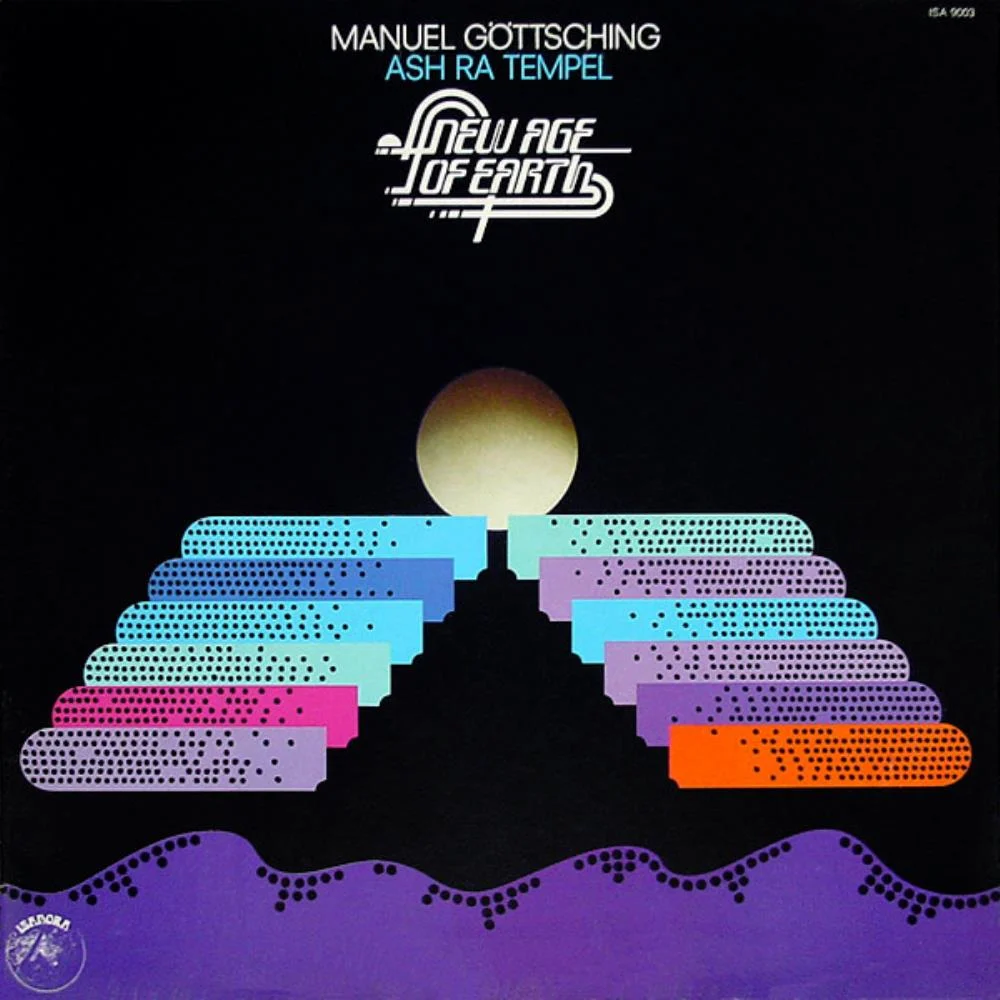 Manuel Göttsching released his first Ashra album, New Age of Earth, in 1976 on the French Isadora label. In June 1977, the album appeared in Germany on Virgin Records.
The album revolves around interwoven textures produced by synthesizer, sequencer, and treated guitar, all arranged and performed by Göttsching alone. His guitar overlays float above shifting harmonic beds, with synthetic arpeggios forming a pulse-like fulcrum that anchors the longer pieces.
New Age of Earth moves in slow, continuous arcs, with each piece built from repeating synth patterns that shift by small harmonic turns and incremental texture changes. “Sunrain” opens with bright, staccato sequencer figures and airy overlays that stay light on impact while the tonal center gradually thickens; motion comes from subtle layering, not dramatic breaks. “Ocean of Tenderness” stretches time further, letting long synth swells drift in wide, patient phrases while a subdued guitar line surfaces as occasional contour—more like distant signal than lead voice—and the arrangement expands in soft gradients.
“Deep Distance” tightens the form into a shorter, denser cloud, stacking sustained tones into a dusk-like hush with a stronger sense of harmonic weight. Side B’s “Nightdust” treats duration as structure: it begins in nocturnal stillness, then slowly accumulates momentum through brighter pulses and more insistent rhythmic drive, letting guitar accents flash through the upper register as the sequenced foundation turns faster and more urgent without ever breaking the album’s calm, suspended atmosphere.
A1. “Sunrain” (7:26)
A2. “Ocean of Tenderness” (12:36)
A3. “Deep Distance” (5:46)
B. “Nightdust” (21:52)
Göttsching recorded the album between March and June 1976 at Studio Roma in Berlin. He completed the mixdown at Aura Studio with technical assistance from Michael Hönig. Peter Butschkow handled the cover design and shared photography duties with Christian Remer. Isadora issued the album through RCA France, with pressing by A.R.E.A.C.E.M. and printing by Offset France.
Blackouts
 Manuel Göttsching released his second Ashra album, Blackouts, in December 1977 on Polydor (France) and Virgin (Germany).
He arranged each track as a layered interaction between sequencer cycles and reactive guitar lines, with phrasing that trades between clipped motifs and extended sustain. His guitar and keyboard parts alternate and entwine in modular blocks, shifting against an electronic pulse that serves as both backbone and propulsion across multi-part structures.
Blackouts keeps the sequencer at the center, then treats guitar as the expressive counterweight—sometimes soft and vaporous, sometimes brighter and more forward in the mix. “77 Slightly Delayed” moves at an up-tempo clip, packing multiple theme-shifts into a tight frame while an echoed lead line traces contoured turns over a minimal pulse. “Midnight on Mars” drops into a slower, suspended pace, with restrained synth shading and a more improvisatory guitar thread that twinkles and stretches across long bars.
“Don’t Trust the Kids” pushes the sequence up front with a heavier, more robotic insistence, then flows directly into “Blackouts,” where the same rhythmic chassis runs faster and the lead tone turns stronger and more sustained, ending with flickers of sci‑fi noise. “Shuttle Cock” extends the same template into a longer sprint, riding a bouncy, almost funk-coded beat while the guitar rambles in long arcs and synth waves drift in and out of focus. Side B’s “Lotus (Parts I–IV)” opens with keyboards leading the narrative—guitar held back as texture—then builds in pressure until the structure destabilizes into a chaotic passage of dissonant sequence and surging synth mass, before the final section resets into calmer, drifting motion with the main pulse re-established.
A1. “77 Slightly Delayed” (6:42)
A2. “Midnight on Mars” (6:50)
A3. “Don’t Trust the Kids” (3:30)
A4. “Blackouts” (4:18)
B1. “Shuttle Cock” (8:25)
B2. “Lotus Parts I-IV” (16:58)
Göttsching recorded the album at Studio Roma, Berlin, in September 1977 and completed remixing the following month at ERD Studio. He produced, arranged, and performed all material, sequencing and layering guitar and keyboard parts with no additional personnel. He credits Udo Arndt for the “lonely guitar sound,” Micky’s Stratocaster, Rosi’s patience, and Herr Schmidt’s support. Mike Noome designed the cover art under direction from Splash Studio, with layout coordinated by Andrew Archer Associates.
Correlations
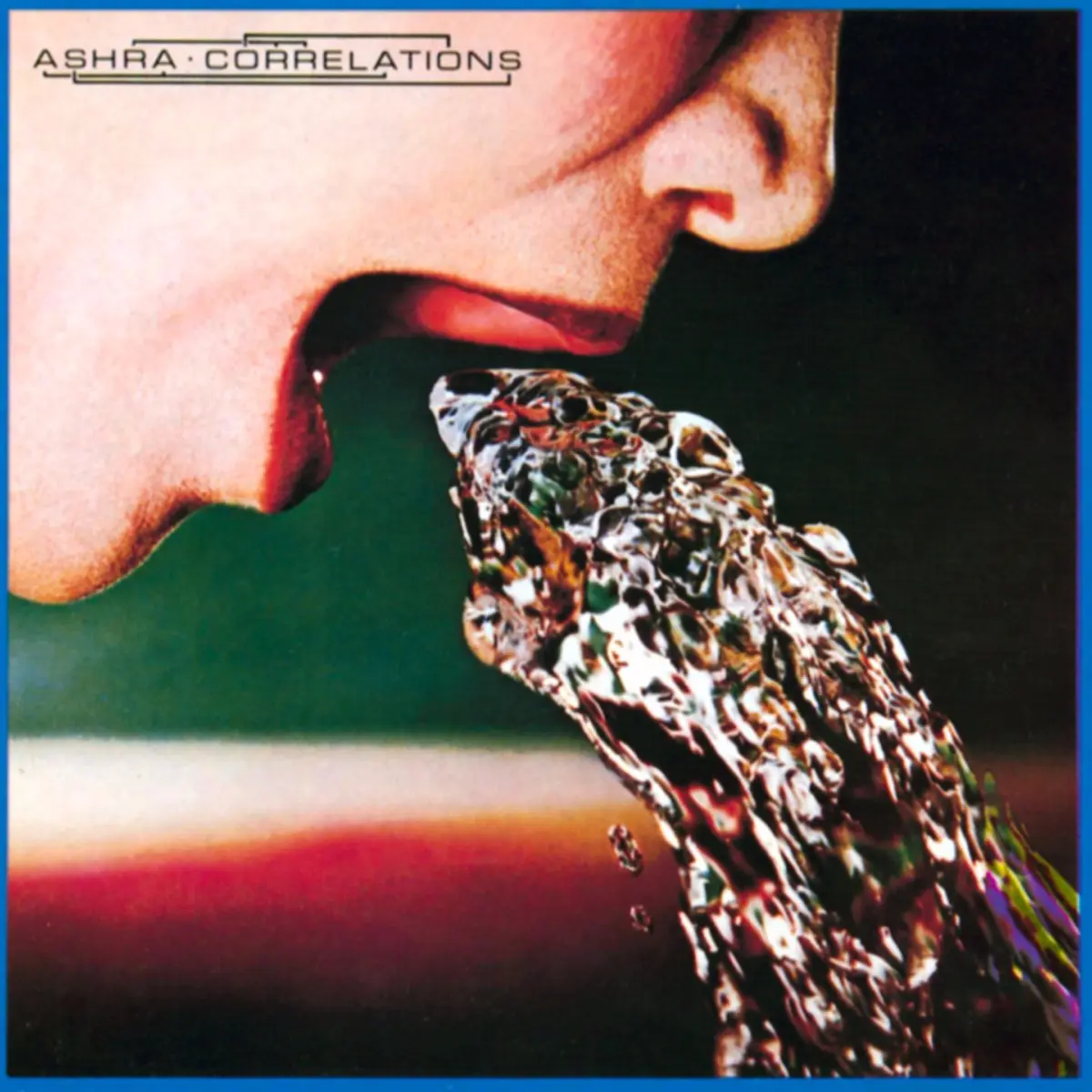 Ashra released their first trio album, Correlations, in March 1979 on Virgin.
Manuel Göttsching and Lutz Ulbrich trade linear phrasing and layered synth textures across extended instrumental builds, often responding in alternation or stacking contrapuntal motifs. Drummer Harald Grosskopf underpins the arrangements with a flexible, forward-leaning backbeat that shifts between metronomic propulsion and looser rhythmic contour depending on each track’s structure.
Correlations widens Ashra’s dynamic range, centering electric guitar over live drums and layering synth textures as connective tissue across tightly defined rhythmic sections. “Ice Train” opens with rapid pulse and percussive thrust, driven by dual guitar leads that alternate between sharp accents and cycling phrases. “Club Cannibal” slows the pace slightly, looping syncopated figures under echo-drenched keyboard bursts and filtered rhythm guitar that cuts in and out like clipped dialogue. “Oasis” returns to sparse phrasing and subdued tonal clusters, with clean guitar lines pulling across soft delay and hovering pads.
“Bamboo Sands” shifts toward clipped repetition with surface-level luster—bright themes flash briefly before receding into sequenced undercurrents. “Morgana Da Capo” draws the atmosphere inward, overlaying brooding textures and phased guitar motion atop a low-end shimmer. “Pas de Trois” unfolds gradually over nine minutes with interlocking lead and rhythm figures that build pressure in plateaus rather than waves, folding steel guitar textures into a fixed, circling pulse. “Phantasus” closes in twilight mode, sustained chords and slow rhythmic push supporting brief melodic arcs that dissolve before settling.
A1. “Ice Train” (7:42) – Grosskopf, Ulbrich, Göttsching
A2. “Club Cannibal” (5:25) – Grosskopf, Ulbrich, Göttsching
A3. “Oasis” (3:46) – Göttsching
A4. “Bamboo Sands” (5:41) – Göttsching
B1. “Morgana da Capo” (5:30) – Grosskopf, Ulbrich, Göttsching
B2. “Pas de Trois” (8:57) – Grosskopf, Ulbrich, Göttsching
B3. “Phantasus” (5:11) – Göttsching
Ashra recorded the album at multiple locations in Berlin and Rome during 1978. They tracked “Oasis” at Studio Roma, “Ice Train” at Panne-Paulsen Studios, and the remainder at ERD Studio. Udo Arndt handled the premix at Audio Studio, Berlin, while Eberhard Panne and Mick Glossop remixed the final album at Panne-Paulsen Studios in Frankfurt. Glossop co-produced the album alongside the band.
Manuel Göttsching – electric guitar, synthesizer, sequencer
Lutz Ulbrich – guitar, synthesizer, piano, Mellotron
Harald Grosskopf – drums, percussion, synthesizer
Hipgnosis provided the cover photography and layout design, with band portraits by Detlev Maugsch. Virgin Records Ltd. issued the LP, pressed at the CBS plant in Aston Clinton, with rights administered through Copyright Control. Gabriel Ibos managed the group.
Belle Alliance
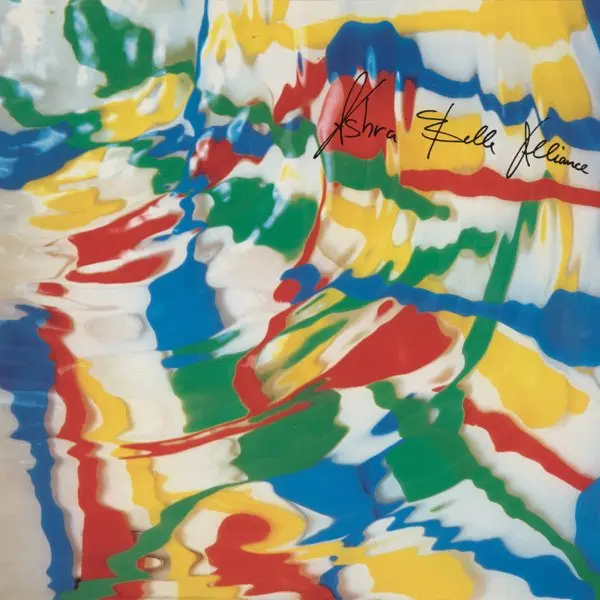 Ashra released their second trio album, Belle Alliance, in May 1980 on Virgin.
Guitarist Manuel Göttsching and Lutz Ulbrich trade between layered motifs and atmospheric accents, with each shaping the harmonic space through alternate textures—Ulbrich doubling across keyboards and bottleneck guitar, Göttsching reinforcing low-end phrasing with sequencer and bass overlays. Drummer Harald Grosskopf anchors the set with steady, clipped percussion patterns that pivot around tonal shifts, his synthesized additions blending with the instrumental framework rather than sitting above it.
Belle Alliance pivots between clipped rhythm studies and slow atmospheric drifts, dividing the album into compact motion-led pieces on side A and stretched tonal exploration on side B. “Wudu” opens with a brief pulse driven by tight sequencing and rhythmic accents, while “Screamer” tightens the tempo with jagged riffs and sharper guitar phrasing that rises over a steady undercurrent. “Boomerang” shifts to a light syncopation with staggered accents, allowing clean guitar figures to bounce through a sparse, major-key frame. “Aerogen” accelerates into the most energized passage, layering sequenced underbeats beneath climbing guitar lines that peak then dissolve.
“Sausalito” pulls back into a relaxed sway, using muted textures and minimal motion, its phrasing spread over subdued harmonic shifts. “Kazoo” lowers the lights further, drawing from modal patterns and elongated synth tones punctuated by sparse hand percussion and ambient overlays. “Code Blue” unfolds gradually across fifteen minutes, beginning with organ swells and settling into a slow-motion orbit of minimal patterns, suspended cymbals, and transparent layering that stretches the form without rupture. “Mistral” closes the album in a short cascade of fluid phrasing and semi-lyrical lead guitar, circling a central motif with brief harmonic embellishments before fading out.
A1. “Wudu” (2:29) – Grosskopf, Ulbrich, Göttsching
A2. “Screamer” (4:26) – Grosskopf, Ulbrich, Göttsching
A3. “Boomerang” (3:29) – Göttsching
A4. “Aerogen” (3:54) – Grosskopf, Ulbrich, Göttsching
A5. “Sausalito” (4:24) – Göttsching
B1. “Kazoo” (5:42) – Grosskopf, Ulbrich, Göttsching
B2. “Code Blue” (15:03) – Grosskopf, Ulbrich, Göttsching
B3. “Mistral” (3:41) – Göttsching
Ashra recorded and mixed the album in July 1979 at Panne-Paulsen Studio, Frankfurt, with engineering by Eberhard Panne. They produced the album themselves for release on Virgin Records Ltd., with distribution handled by Ariola and pressing by Sonopress.
Manuel Göttsching – guitar, sequencer, synthesizer, synth guitar, bass
Harald Grosskopf – drums, percussion, synthesizer, voice
Lutz Ulbrich – guitar, 12-string guitar, bottleneck guitar, keyboards, voice, bass
Detlef Maugsch photographed and designed the cover, printed by Mohndruck Graphische Betriebe GmbH. Phonographic copyright held by Virgin.
Discography:
- New Age of Earth (1976)
- Blackouts (1977)
- Correlations (1979)
- Belle Alliance (1980)
Sources:
Artist/Album Pages:
The Outlaws were an American hard-rock band from Tampa that formed during the late 1960s and reach...
Quarterflash was an American modern-rock band from Portland that scored a rare NW breakout with "H...
Tee & Company were a Japanese avant-jazz supergroup assembled by saxophonist Kenji Mori for a ...
Punishment of Luxury is an English post-punk band from Newcastle that made the 1979 UA album Laugh...
Ibis was an Italian symphonic-rock band that released the 1973 Fonit Cetra album Canti d'innocenza...
Le Roux was an American southern/hard-rock band from Lafayette, formed in 1978 as Louisiana's LeRo...
Foghat is an English hard-rock/blues band that formed in London in 1971 and built its main recordi...
Linda Tillery (born September 2, 1948) is an American singer, percussionist, producer, arranger, a...
707 was an American melodic/hard-rock band that released three albums on the PolyGram subsidiaries...
John Lee & Gerry Brown were an American jazz-funk duo that cut the 1974 album Infinite Jones f...
Marlena Shaw (1939–2024) was an American soul singer who recorded two albums and assorted singles fo...
Gabriel Bondage was an American post-psych band from Chicago that released the 1975 album Angel Dust...