

Marlena Shaw (1939–2024) was an American soul singer who recorded two albums and assorted singles for Cadet during the late 1960s, culminating with the popular 1969 release The Spice of Life. Between 1972 and 1976, she released five albums on Blue Note, followed by three 1977–79 titles on Columbia. In the 1980s and ’90s, she recorded sporadically for South Bay, Verve, and Concord Jazz.
Background
Marlena Shaw was born in New Rochelle, NY, on September 22, 1939. Her uncle, Jimmy Burgess, was a jazz trumpeter who introduced her to the music of Dizzy Gillespie, Miles Davis, and singer Al Hibbler, who impressed her with his vocal phrasing. At age 10, she sang with her uncle’s band on stage at Harlem’s Apollo Theater. She later studied music at the New York State Teachers College in Potsdam but didn’t finish the program.
Shaw made her initial impressions as a jazz vocalist in 1963, doing a brief stint with Howard McGhee. After several years on the club circuit, she got a residency at Chicago’s Playboy Club, where she was spotted by representatives of Chess Records, which signed her to their Cadet division.
Out of Different Bags
 Marlena Shaw released her debut album, Out of Different Bags, in January 1968 on Cadet.
The album frames Shaw’s voice in Richard Evans’ orchestrations, alternating between swinging jazz backdrops and soul-infused arrangements. Its mixture of standards, film themes, and contemporary pop covers gave her a platform to navigate multiple styles with polish and command.
Shaw moves between the Broadway opener “Matchmaker, Matchmaker” and the film theme “The Eyes of Love,” contrasting both with her driving take on “Nothing but Tears,” first cut by Hour Glass. She applies torch phrasing to “Will I Find My Love Today” and switches to a brisk tempo on “It Sure Is Groovy.” Side two pairs Ahmad Jamal’s “Ahmad’s Blues” with urbane readings of “Alone Together” and “I Stayed Too Long at the Fair,” closing with a soulful treatment of the Naked City theme “Somewhere in the Night.”
A1. “Matchmaker, Matchmaker” (2:58)
A2. “The Eyes of Love (Carol’s Theme)” (2:30) is a song by Bob Russell and Quincy Jones from the 1967 film Banning.
A3. “Nothing but Tears” (2:50) originated as a deep cut by Hour Glass, the pre-fame vehicle of Duane and Gregg Allman.
A4. “Will I Find My Love Today” (3:20)
A5. “It Sure Is Groovy” (2:35)
A6. “I’ve Gotten Over You” (3:10)
B1. “Ahmad’s Blues” (3:05)
B2. “A Couple of Losers” (2:35)
B3. “I Stayed Too Long at the Fair” (3:05)
B4. “Alone Together” (3:07)
B5. “Somewhere in the Night (Naked City Theme)” (2:20)
Richard Evans produced, arranged, and conducted the set, having just overseen 1968 Cadet releases by Ahmad Jamal, Dorothy Ashby, Harold Land, Jack McDuff, and Ramsey Lewis. Quincy Jones co-wrote “The Eyes of Love” with Bob Russell, while Alan and Marilyn Bergman contributed lyrics to Jones’ “It Sure Is Groovy.” Doug Brand engineered the sessions at Ter Mar Studios in Chicago during October 1967.
Out of Different Bags features cover art by Jerry Griffith with photography by Don S. Bronstein.
The Spice of Life
 Marlena Shaw released her debut album, The Spice of Life, in November 1969 on Cadet.
The album shows Shaw in full command of a broad repertoire, spanning socially conscious funk, traditional blues, torch ballads, and orchestral soul. Charles Stepney and Richard Evans arranged the material with a layered palette that blends brass, strings, kalimba, and psychedelic guitar accents into the Cadet house sound.
Shaw co-wrote “Woman of the Ghetto” and “Liberation Conversation” with producer Bobby Miller and arranger Richard Evans. Ashford & Simpson supplied “California Soul,” while Gerry Goffin and Carole King contributed “Go Away Little Boy.” Barry Mann and Cynthia Weil wrote “Looking Thru the Eyes of Love,” and Billy Taylor and Dick Dallas composed “I Wish I Knew (How It Would Feel to Be Free).” Other outside selections include T-Bone Walker’s “Call It Stormy Monday,” Ben Oakland and Milton Raskin’s “Where Can I Go,” and Ed Marks’ “Anyone Can Move a Mountain.”
The six-minute “Woman of the Ghetto” opens with a dark bass line under Shaw’s pointed lyrics on poverty and race, building to a searing statement piece. She switches to a stripped-down blues feel on “Call It Stormy Monday,” then leans into balladry with “Where Can I Go” and “I Wish I Knew (How It Would Feel to Be Free).” “Liberation Conversation” contrasts with handclaps and playful scat, while “California Soul” uses driving rhythm and layered orchestration. “Go Away Little Boy” and “Looking Thru the Eyes of Love” highlight her jazz phrasing, and the set closes with the anthem-like “Anyone Can Move a Mountain.”
A1. “Woman of the Ghetto” (6:02)
A2. “Call It Stormy Monday” (3:01)
A3. “Where Can I Go” (2:21)
A4. “I’m Satisfied” (2:48)
A5. “I Wish I Knew (How It Would Feel to Be Free)” (3:12)
B1. “Liberation Conversation” (2:03)
B2. “California Soul” (2:59)
B3. “Go Away Little Boy” (2:45)
B4. “Looking Thru the Eyes of Love” (3:00) not to be confused with the Russell/Jones song from her first album.
B5. “Anyone Can Move a Mountain” (3:03)
Sessions took place in February and July 1969 at Ter Mar Studios in Chicago with producers Charles Stepney and Richard Evans. Dave Purple and Stu Black engineered the recordings under the supervision of Bobby Miller.
The Spice of Life features cover photography by Bob Crawford with album design by Jerry Griffith.
Marlena
 Marlena Shaw released her third album, Marlena, in 1972 on Blue Note.
The album moves through jazz standards, pop ballads, and contemporary soul, highlighting Shaw’s control over phrasing and dynamic range. Wade Marcus arranged the material with layered orchestration, incorporating strings, brass, and a mix of acoustic and electric instrumentation to support her vocals without overwhelming them.
Primary songwriters include Marilyn and Alan Bergman with Michel Le Grand on “What Are You Doing the Rest of Your Life” and “You Must Believe in Spring.” Marlena also covers songs by Horace Silver (“Wipe Away the Evil”), Marvin Gaye (“So Far Away”), and Carole King (“Save the Children”).
The album juxtaposes theatrical and intimate numbers: the Bergman-Le Grand pieces frame Shaw’s vocal agility against lush strings, while “So Far Away” and “Runnin’ Out of Fools” emphasize subtle rhythm variations and piano interplay. “Save the Children” channels soul-infused phrasing with restrained orchestration, and Silver’s “Wipe Away the Evil” adds a jazz-inflected piano and percussion dialogue.
A1. “What Are You Doing the Rest of Your Life” (5:07)
A2. “Somewhere” (3:25) is a song from the 1957 Broadway musical West Side Story, written by Leonard Bernstein and Stephen Sondheim.
A3. “Runnin’ Out of Fools” (4:47) is a song by Kay Rogers and Richard Ahlert, first released as an August 1964 single by Aretha Franklin and covered since by Kiki Dee, Diahann Carroll, Isaac Hayes, and Labelle.
A4. “So Far Away” (3:58) originated on Gaye’s 1971 album What’s Going On.
A5. “I’m Gonna Find Out” (3:51)
B1. “Save the Children” (4:07) originated on Carole King’s 1971 album Tapestry.
B2. “You Must Believe in Spring” (4:33)
B3. “Wipe Away the Evil” (5:00) originated on Silver’s 1970 album That Healin’ Feelin’.
B4. “Things Don’t Never Go My Way” (5:55) is a song by jazz pianist Loonis McGlohon with lyrics by Tony Faile.
Sessions took place on August 10–11, 1972 at A & R Recording Studio in New York City with producer George Butler and engineer Don Hahn.
Marlena features art direction by Norman Seeff with cover photography by Malcolm Hart.
From the Depths of My Soul
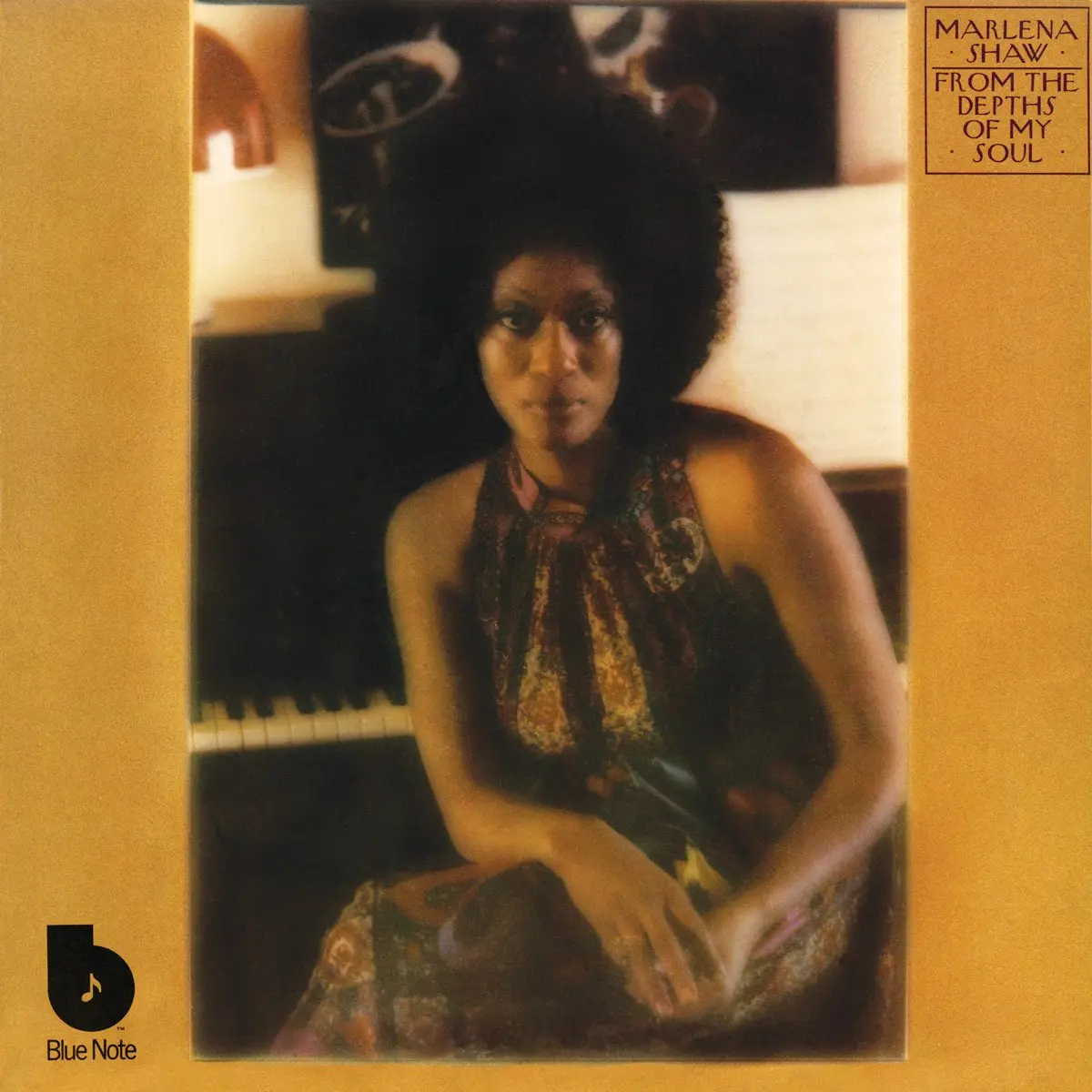 Marlena Shaw released her fourth album, From the Depths of My Soul, in September 1973 on Blue Note.
The album blends contemporary soul, jazz, and pop balladry, framing Shaw’s vocals with sophisticated orchestration. Arranger and conductor Wade Marcus shapes each track with layered strings, brass, and a mix of acoustic and electric instruments, allowing Shaw to navigate both intimate and expansive passages with precision.
Primary songwriters include Shaw herself on “Say a Good Word,” with Wade Marcus contributing “Prelude.” Charles Fox and Norman Gimbel wrote “The Feeling’s Good” and “Time for Me to Go,” Randy Edelman composed “The Laughter and the Tears” and “Waterfall,” and David Richardson with David Edwards penned “Wildflower.” Other outside writers include Bill Chandler (“I Know I Love Him”), E. Robinson and R. Green (“Hum This Song”), Blossom Dearie (“But for Now”), Anita O’Day (“Easy Evil”), and B. Eli, J. Freeman, and V. Barrett (“Just Don’t Want to Be Lonely”).
The album alternates reflective ballads and rhythmic soul cuts. The opening “Prelude / I Know I Love Him” sets a contemplative tone with orchestral layering, while “Hum This Song” and “But for Now” feature subtle rhythmic shifts and piano interplay. “Wildflower” and “Just Don’t Want to Be Lonely” emphasize variations in pace and percussive texture. “Say a Good Word” showcases Shaw’s phrasing against restrained accompaniment, balancing the album’s dynamics.
A1a. “Prelude” (1:00)
A1b. “I Know I Love Him” (2:11)
A2. “Hum This Song” (3:08)
A3. “But for Now” (3:48)
A4. “Easy Evil” (3:39)
A5. “The Laughter and the Tears” (3:05) originated on the 1972 album The Laughter and the Tears by songwriter Randy Elderman; covered months beforehand by Nancy Wilson.
A6. “The Feeling’s Good” (3:55) originated on the 1972 debut album by Lori Lieberman.
B1. “Wildflower” (4:04)
B2. “Just Don’t Want to Be Lonely” (3:41)
B3. “Waterfall” (3:45)
B4. “Say a Good Word” (3:04)
B5. “Time for Me to Go” (3:16)
Sessions occurred on May 30–31, 1973 at A&R Recording Studio in New York City with producer George Butler and engineers Don Hahn and Brad Davis.
From the Depths of My Soul features art direction by Mike Salisbury, cover design by Lloyd Ziff, and cover photography by Fred Valintine.
Marlena Shaw Live at Montreux
 In 1974, Blue Note issued Marlena Shaw Live at Montreux, a document of her performance at the 1973 Montreux Jazz Festival.
The album captures Shaw in a live setting with a piano-led trio, emphasizing her R&B-inflected phrasing within a jazz framework. Her vocals navigate both standards and originals with expressive intensity, framed by Ed Boyer on bass, Harold Jones on drums, and George Gaffney on piano.
Primary songwriters include Shaw herself on “Woman of the Ghetto,” with B. Miller and R. Evans collaborating, while other selections feature Harold Silver (“The Show Has Begun”), J. Kern and O. Hammerstein II (“The Song Is You”), Stevie Wonder (“You Are the Sunshine of My Life”), Jon Hendricks (“Twisted”), B. Dorough (“But for Now”), and A. Cleveland, M. Gaye, and R. Benson (“Save the Children”).
The set alternates between concise standards and extended numbers. The opening “The Show Has Begun” sets a brisk pace with piano motifs and rhythmic drive, while “You Are the Sunshine of My Life” and “Twisted” feature angular turns in phrasing. Shaw expands the performance in “Woman of the Ghetto,” layering dynamic intensity over shifting tempos.
A1. “The Show Has Begun” (3:50)
A2. “The Song Is You” (2:20)
A3. “You Are the Sunshine of My Life” (4:20)
A4. “Twisted” (3:45)
B1. “But for Now” (4:32)
B2. “Save the Children” (4:20)
B3. “Woman of the Ghetto” (9:20)
Sessions occurred live at the Montreux Jazz Festival in Switzerland on July 5, 1973 with producer George Butler.
Other credits include Marlena Shaw on vocals, George Gaffney on piano, Ed Boyer on bass, and Harold Jones on drums. The release was manufactured and pressed by United Artists Records.
Who Is This Bitch, Anyway?
 Marlena Shaw released her fifth studio album, Who Is This Bitch, Anyway?, in March 1975 on Blue Note.
The album expands Shaw’s soul-jazz approach into funk-tinged R&B while retaining her sharp vocal phrasing and expressive intensity. She alternates between humorous dialogue, socially aware commentary, and intimate balladry, supported by arrangements from Bernard Ighner, Byron Olson, and Dale Oehler.
Primary songwriting comes from Shaw and Bernard Ighner, with secondary contributions from Byron Olson, L. McGlohon, A. Munson, M.A. Lelkin, B. Callender, and Eugene McDaniels, the latter providing the cover of “Feel Like Makin’ Love.” Shaw co-wrote “You” and “The Lord Giveth and the Lord Taketh Away,” while Olson contributed arrangements and the “Prelude for Rose Marie.”
The record opens with “You, Me and Ethel,” a dialogue-sketch introduction leading into the funk-driven “Street Walkin’ Woman.” Ballads such as “You Taught Me How to Speak in Love” and “Davy” feature layered backing vocals and contoured phrasing, while mid-album tracks like “Feel Like Makin’ Love” and “The Lord Giveth and the Lord Taketh Away” balance lush harmonies with rhythmic variation. The final sequence, including “Rose Marie (Mon Cherie),” accelerates tempo with bright instrumentation, providing a climactic, spirited close.
A1.a “Dialogue: You, Me and Ethel” (3:17)
A1.b “Street Walkin’ Woman” (3:03)
A2. “You Taught Me How to Speak in Love” (3:52)
A3. “Davy” (5:26)
A4. “Feel Like Makin’ Love” (5:00) originated as a 1974 single by Roberta Flack; also covered in the same two-year period by Lou Rawls, Gladys Knight, Mieko Hirota, and Mari Nakamoto.
A5. “The Lord Giveth and the Lord Taketh Away” (1:05)
B1. “You Been Away Too Long” (3:07)
B2. “You” (3:45)
B3. “Loving You Was Like a Party” (4:17)
B4. “A Prelude for Rose Marie” (1:56)
B5. “Rose Marie (Mon Cherie)” (4:19)
Sessions occurred at The Record Plant in Los Angeles, California on June 12 and December 3–6, 1974 with producer Bernard Ighner and engineer Phil Shier, assisted by Michael Bronstein.
Other credits include Marlena Shaw on vocals, Bernard Ighner on piano, flugelhorn, and vocal arrangements, George T. Walker, Dennis Budimer, and Larry Carlton on guitar, Chuck Rainey and Chuck Domanico on bass, Harvey Mason and Jim Gordon on drums and percussion, Larry Nash and Mike Lang on keyboards, and backing vocals from Julia Tillman, Marti McCall, Maxine Willard, and Patti Brooks. Photography was by Albert McKensie Watson and artwork by Lloyd Ziff.
The album reached No. 8 on the Billboard Jazz Albums chart.
Just a Matter of Time
 Marlena Shaw released her sixth studio album, Just a Matter of Time, in May 1976 on Blue Note.
The album moves toward a polished soul-jazz style, blending gospel inflections, R&B rhythms, and disco-tinged arrangements. Shaw’s vocals retain their expressive precision, supported by Bert DeCoteaux and Tony Silvester’s production, which emphasizes smooth instrumentation and layered textures.
Primary songwriting comes from a mix of external contributors, including Lee Garrett (“It’s Better Than Walkin’ Out”), Gwen Guthrie (“This Time I’ll Be Sweeter,” “Think About Me”), Betty Crutcher (“Take My Body”), and Frederick Knight (“Be For Real”). Shaw arranged and adapted the closing track, “No Hiding Place,” which features her on piano.
The album opens with the disco-tinged push of “It’s Better Than Walkin’ Out” and the playful, punctuated rhythms of “Brass Band.” Shaw shifts to sweeping balladry on “This Time I’ll Be Sweeter,” “You and Me,” and “Love Has Gone Away,” shaping each line with contoured phrasing and sustained intensity. Gospel elements surface on “Be for Real” and “No Hiding Place,” while mid-album tracks “Sing to Me” and “Take My Body” layer backing vocals over precise instrumental interplay, balancing rhythmic drive with lyrical nuance.
A1. “It’s Better Than Walkin’ Out” (4:20)
A2. “Brass Band” (3:40)
A3. “This Time I’ll Be Sweeter” (4:57) was first recorded by Martha Reeves for her 1975 debut solo album and covered since by Linda Lewis.
A4. “Think About Me” (4:30)
A5. “You and Me” (3:57)
B1. “Love Has Gone Away” (4:53)
B2. “Sing to Me” (4:00)
B3. “Take My Body” (4:53)
B4. “Be for Real” (4:59)
B5. “No Hiding Place” (2:13)
Sessions occurred at Mediasound Studios in New York, New York, in February 1976 with producers Bert DeCoteaux and Tony “Champagne” Silvester, engineered and mixed by Bob Clearmountain, and mastered by Jose Rodrigues.
Shaw recorded Just a Matter of Time with bassist Bob Babbitt, drummer Jimmy Young, conguero Carlos Martin, percussionists Dave Carey and Ted Sommers, and multiple guitarists (Hugh McCrakin, Jeff Mironov, Jerry Friedman, Lance Quinn) and keyboardists (Bert DeCoteaux, George Butcher, Ricky Williams). Art director Ria Lewerke designed the cover, which features a crimson-framed portrait shot of Marlena by photographer Doug Metzler.
Blue Note lifted “It’s Better Than Walkin’ Out” as a single. It gained airplay in the Northeast and Midwest and reached the Billboard R&B Singles chart.
Sweet Beginnings
 Marlena Shaw released her seventh studio album, Sweet Beginnings, in February 1977 on Columbia.
The album blends soul, disco, and funk with polished jazz inflections, highlighting Shaw’s expressive control and nimble phrasing. Producer Bert DeCoteaux balances tight instrumental arrangements with layered backing vocals, supporting Shaw’s assured and charismatic delivery.
Songwriting comes from a mix of contributors, including Marlena Shaw herself (“Yu-Ma,” “No Deposit, No Return”), Gerry Goffin and Carole King (“Go Away Little Boy”), Van McCoy (“Walk Softly”), Domenic Troiano (“The Writing’s on the Wall”), Leon Ware (“Sweet Beginnings”), Billy Tragesser (“Look at Me, Look at You (We’re Flying),” “Johnny”), and Linda Creed and Thom Bell (“I Think I’ll Tell Him”).
The album opens with the upbeat energy of “Pictures and Memories” and the brief, emotive “Yu-Ma,” moving into Shaw’s assured take on “Go Away Little Boy.” Mid-album tracks, including “The Writing’s on the Wall” and “Walk Softly,” layer tight instrumentation and R&B rhythms, while the title track demonstrates her poised, sensual phrasing over disco-tinged textures. “Look at Me, Look at You” and “Johnny” showcase lighter, expressive vocal touches, and the closing “I Think I’ll Tell Him” contrasts brassy big-band accompaniment with her playful assertiveness.
A1. “Pictures and Memories” (4:33)
A2. “Yu-Ma” (2:47)
A3. “Go Away Little Boy” (4:06)
A4. “The Writing’s On the Wall” (3:31)
A5. “Walk Softly” (4:29)
B1. “Sweet Beginnings” (4:28)
B2. “Look At Me, Look At You (We’re Flying)” (4:01)
B3. “No Deposit, No Return” (3:23)
B4. “Johnny” (3:45)
B5. “I Think I’ll Tell Him” (3:45) originated as “I Think I’ll Tell Her” on the 1973 debut album by Ronnie Dyson; covered since by O.C. Smith and Etta Jones, who cut the first gender-reversed version.
Sessions occurred at Total Experience Recording Studios in Hollywood, California, with producer Bert DeCoteaux and engineers Bob Hughes, F. Byron Clark, Ty Blair, and Steve Pouliot. Bob Higgins assisted, and Bert DeCoteaux conducted and arranged the sessions.
Shaw recorded Sweet Beginnings with bassist David Shields and James Jamison, drummer James Gadson, percussionist Bob Zimmitti, conguero Eddie “Conga” Brown, guitarists Greg Poree and Jay Graydon, and keyboardists Bert DeCoteaux and Jerry Peters. Backing vocals were performed by Alex Brown, Dee Ervin, Julia Tillman Waters, and Maxine Willard Waters.
The single “Yu-Ma/Go Away Little Boy” reached No. 21 on the Billboard R&B Singles chart and No. 19 on Cashbox, while the album peaked at No. 12 on the Billboard Jazz Albums chart and No. 14 on the R&B chart.
Acting Up
 Marlena Shaw released her eighth studio album, Acting Up, in 1978 on Columbia.
The album emphasizes upbeat disco and funk rhythms while retaining Shaw’s controlled phrasing and expressive vocal nuance. Bert DeCoteaux arranges and conducts the sessions, blending layered backing vocals with tight instrumentation to support Shaw’s dynamic presence.
Songwriting comes from a mix of contributors, including Marlena Shaw herself (“More,” “Mama Tried”), B. Tragesser (“Moonrise,” “I Wonder”), K. Wakefield and K. Hirsch (“Rhythm of Love”), A. Posey and J. Powell (“Places”), G. Withem and J. Conrad (“You Bring Out the Best in Me”), B. Ighner (“Dreamin’”), K. Stover (“I’m Back for More”), and C. Connors and A. Kane (“Theme From ‘Looking for Mr. Goodbar’ (Don’t Ask to Stay Until Tomorrow)”).
The set opens with Shaw’s assertive delivery on “More” and flows into the layered textures of “Moonrise.” By contrast, “Rhythm of Love” and “Places, balance disco-inflected pace with intricate backing vocals and instrumental interplay. “I Wonder” and “You Bring Out the Best in Me” showcase smooth phrasing over funk-oriented arrangements, while “I’m Back for More” highlights a playful, exuberant disco sensibility. The closing tracks, including “Mama Tried” and the cinematic “Theme From ‘Looking for Mr. Goodbar’,” feature piano and spoken-word improvisation layered over rich orchestration.
A1. “More” (3:45)
A2. “Moonrise” (4:20)
A3. “Rhythm of Love” (3:46)
A4. “Places” (3:59)
A5. “I Wonder” (4:23)
B1. “You Bring Out the Best in Me” (4:40)
B2. “Dreamin'” (4:30)
B3. “I’m Back for More” (4:06)
B4. “Mama Tried” (3:23)
B5. “Theme From ‘Looking for Mr. Goodbar’ (Don’t Ask to Stay Until Tomorrow)” (3:29)
Sessions occurred at Village Recorders in Los Angeles with Bert DeCoteaux producing, arranging, and conducting, and engineers Godfrey Diamond and Wayne Neuendorf assisted by Earl Williams and Phil Shrago.
Shaw recorded Acting Up with bassists Abraham Laboriel and Greg Middleton, drummer Quinton Dennard, percussionists Robert Zimmitti, Paulinho DaCosta, and Tommy Vig, guitarists Craig McMullen and Greg Poree, keyboardists Jerry Peters and Larry Nash, harpist Jene Bianco, and saxophonist/flutist Seldon Powell. Backing vocals feature Dee Ervin, Julia Tillman Waters, Luther Waters, Marlena Shaw, and Maxine and Orin Waters. Shaw plays piano on “Mama Tried.” Nancy Donald handled design, and Suzanne Nyerges photographed the cover.
Take a Bite
 Marlena Shaw released her ninth studio album, Take a Bite, in 1979 on Columbia.
The album emphasizes disco and R&B rhythms while retaining Shaw’s dynamic vocal control. It features continuous sequencing on Side A, blending extended medleys with layered backing vocals, brass, and strings to create a dance-oriented yet harmonically rich sound.
Songwriting credits include Marlena Shaw herself (“Shaw Biz,” “No One Yet,” “I’ll Be Your Friend”), B. Tragesser and K. Nelson (“Haven’t We Been in Love Before”), A. Willis and F. Golde (“Suddenly It’s How I Like to Feel”), E. Drake (“It Was a Very Good Year / I’m a Foster Child”), D. Porter and I. Hayes (“I Thank You”), and M. Masser and R. Miller (“Touch Me in the Morning”).
The album opens with the continuous disco medley Suite Seventeen, spanning “It Was a Very Good Year / I’m a Foster Child,” “Love Dancin’,” “I Thank You,” and “Touch Me in the Morning,” balancing uptempo rhythm with reworked pop and soul standards. Side B mixes dance-oriented tracks like “Shaw Biz / Suddenly It’s How I Like to Feel / Shaw Biz (Reprise)” and “No One Yet” with gospel-infused balladry on “I’ll Be Your Friend” and smoother R&B phrasing on “Haven’t We Been in Love Before.” Shaw layers expressive improvisation and piano contributions throughout, particularly on the closing tracks.
A1. “It Was a Very Good Year / I’m a Foster Child” (3:07)
A2. “Love Dancin'” (4:31)
A3. “It Was a Very Good Year / I’m a Foster Child” (0:40)
A4. “I Thank You” (3:14) originated as a 1968 Sam & Dave single
A5. “It Was a Very Good Year / I’m a Foster Child” (0:40)
A6. “Touch Me in the Morning” (5:52)
B1a. “Shaw Biz” (Part of continuous medley)
B1b. “Suddenly It’s How I Like to Feel”
B1c. “Shaw Biz (Reprise)”
B2. “No One Yet” (5:15)
B3. “Haven’t We Been in Love Before” (4:08)
B4. “I’ll Be Your Friend” (3:57)
Sessions occurred at the Power Station and Soundworks in New York, with producers Harold Wheeler, Marlena Shaw, Meco Monardo, and Tony Bongiovi. John Luongo handled post-production and mixing with engineers Bill Scheniman, Bob Clearmountain, Jerry Garszva, Neil Dorfsman, and Scott Litt, assisted by Phil Shargo.
Shaw recorded Take a Bite with bassists Neil Lee and Will Jason, drummers Allan Schwartzberg and Richard Crooks, guitarists Hiram Bullock, Jeff Mironov, Ken Hatfield, Lance Quinn, and Paul Schafer, keyboardists Frank Owens and Harold Wheeler, percussionists Jimmy Maelen, Nyto Bongo, and Yogi, harpist Jene Bianco, and brass and reeds including Bobby Bryant, Jon Faddis, Lew Soloff, Wayne Andre, Eddie Bert, Paul Falise, George Marge, Phil Bodner, Ronnie Cuber, and Seldon Powell. Backing vocals feature Diva Grey, Ellen Bernfield, Gordon Grody, Jimmy Maelen, John Luongo, and Lani Groves.
Francesco Scavullo photographed the cover, and Edward Broderick and Sheldon Seidler handled design. Side A tracks run gapless as a continuous medley, with a custom inner picture sleeve included.
Let Me in Your Life
 Marlena Shaw released her tenth studio album, Let Me in Your Life, in 1982 on South Bay.
The album emphasizes urban-contemporary R&B with touches of funk and smooth balladry. Shaw’s vocals remain precise and expressive, supported by layered instrumentation and polished arrangements from producers Johnny Bristol and Webster Lewis.
Primary songwriting comes from a combination of external and in-house contributors. Secondary writers appear on “Next Time I Fall in Love” and “Without You in My Life,” while Shaw interprets material arranged by Benjamin F. Wright Jr., with vocal arrangements from Jakki Milligan and James Gadson.
The album opens with the assertive funk of “More Room at the Top” and the sleek pacing of “Never Give Up On You,” then moves through contoured R&B ballads such as “Love Is Alive and Well” and “I Just Want This Feeling to Last.” Side B mixes soulful textures and light jazz inflections on “Next Time I Fall in Love,” alto-saxophone highlights on “Without You in My Life,” and gospel-tinged phrasing on the closing track, “At Last.” Shaw navigates the varying rhythms with controlled phrasing and emotive dynamics throughout.
A1. “More Room at the Top” (4:42)
A2. “Never Give Up On You” (3:51)
A3. “Love Is Alive and Well” (4:40)
A4. “I Just Want This Feeling to Last” (4:43)
B1. “Spend Some Love” (3:57)
B2. “Next Time I Fall In Love” (3:55)
B3. “Without You In My Life” (4:53)
B4. “At Last” (6:34)
Sessions occurred at studios in Los Angeles with producers Johnny Bristol (tracks A1–A4) and Webster Lewis (tracks B1–B4). Engineers included Fred Mitchell and Gene Shiveley, with assistant Jim Ashwill and chief engineer/mixer Lewis Peters Jr. James Mares handled photography for the album.
Shaw recorded with bassists James Jamerson Jr. and Nathan Watts, drummers Dennis Davis and Quentin Dennard, guitarists Arthur K. Adams, Marlo Henderson, David T. Walker, and Miles Joseph, keyboardists Clydene Jackson, Hense Powell, and Jerry Peters, percussionists Paulinho Da Costa and Melvin Webb, pianists Hiroshi Upshur, and saxophonist Don Myrick, among others. Backing vocals feature Billie Barnum, Jessica Smith, Maxi Anderson, Myrna S. Schilling, and Phyllis St. James.
Studio Discography:
- Out of Different Bags (1967)
- The Spice of Life (1969)
- Marlena (1972)
- From the Depths of My Soul (1973)
- Who Is This Bitch, Anyway? (1975)
- Just a Matter of Time (1976)
- Sweet Beginnings (1977)
- Acting Up (1978)
- Take a Bite (1979)
- Let Me in Your Life (1982)
- Love Is in Flight (1988)
Live albums:
- Marlena Shaw Live at Montreux (1974)
- It Is Love (1986)
Sources:
Artist/Album Pages:
The Nazz was an American psych-rock band from Philadelphia that released the 1968–69 albums Nazz ...
Wild Turkey was an English progressive hard-rock band that released the album Battle Hymn on Chrys...
Heaven & Earth were an American soul group from Chicago that released the album I Can't Seem ...
Mandala was a Brazilian Latin/jazz-rock band from São Paulo that released a 1976 self-titled albu...
Jean-Pierre Ferland (June 24, 1934 – April 27, 2024) was a Québécois chanson singer-songwriter, larg...
Anacrusa was an Argentine progressive folk-rock band behind two self-titled albums in 1973/74 on ...
Illustration was a Québécois brass-rock band that released a 1969 self-titled album on Janus. Me...
Demian was an American hard-rock/psych band from San Antonio that released a self-titled album on...
Washington Jamb Band was an American soul-funk band that issued two 1976 singles and the 1977 albu...
The Ebonys were an American soul group that released eight singles and a 1973 album on Philadelph...
Arena were an Australian jazz-rock band that released a self-titled album on Crystal Clear in 1976...
Broken Glass were an English hard-rock band that released a self-titled album on Capitol in 1975. ...